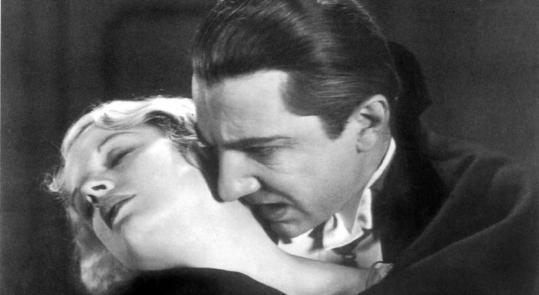
Chelsea Quinn Yarbro's immortal vampire, the Comte de Saint-Germain, is one of the most popular characters of his kind ever created. Publishers Weekly has called him a "veritable Prince Charming of the darker arts."
In Darker Jewels the Count is sent by the King Of Poland to the court of Russia's Ivan IV, to use his alchemical skills to craft unearthly gems for the mad emperor. there he finds not only dark intrigue and heart-stopping danger, but a breathtakingly beautiful woman to whom he loses his heart.
A professional writer for more than forty years, Yarbro has sold over eighty books, more than seventy works of short fiction, and more than three dozen essays, introductions, and reviews. She also composes serious music. Her first professional writing - in 1961-1962 - was as a playwright for a now long-defunct children's theater company. By the mid-60s she had switched to writing stories and hasn't stopped yet.
After leaving college in 1963 and until she became a full-time writer in 1970, she worked as a demographic cartographer, and still often drafts maps for her books, and occasionally for the books of other writers.
She has a large reference library with books on a wide range of subjects, everything from food and fashion to weapons and trade routes to religion and law. She is constantly adding to it as part of her on-going fascination with history and culture; she reads incessantly, searching for interesting people and places that might provide fodder for stories.
In 1997 the Transylvanian Society of Dracula bestowed a literary knighthood on Yarbro, and in 2003 the World Horror Association presented her with a Grand Master award. In 2006 the International Horror Guild enrolled her among their Living Legends, the first woman to be so honored; the Horror Writers Association gave her a Life Achievement Award in 2009. In 2014 she won a Life Achievement Award from the World Fantasy Convention.
A skeptical occultist for forty years, she has studied everything from alchemy to zoomancy, and in the late 1970s worked occasionally as a professional tarot card reader and palmist at the Magic Cellar in San Francisco.
She has two domestic accomplishments: she is a good cook and an experienced seamstress. The rest is catch-as-catch-can.
Divorced, she lives in the San Francisco Bay Area - with two cats: the irrepressible Butterscotch and Crumpet, the Gang of Two. When not busy writing, she enjoys the symphony or opera.
Her Saint-Germain series is now the longest vampire series ever. The books range widely over time and place, and were not published in historical order. They are numbered in published order.
Known pseudonyms include Vanessa Pryor, Quinn Fawcett, T.C.F. Hopkins, Trystam Kith, Camille Gabor.
Saint-Germain makes jewels (don't ask) for Ivan the Terrible in 16th century Russia.
Not one of my favorites of the series. I enjoy these, but I need to remember to space them out because they all have pretty much the same plot transposed into a different setting. It's as if Saint-Germain is doomed to live out the same drama over and over again as he moves through the ages, with new players and new scenery but without being able to alter the outcome. No wonder he's so melancholy.
(I should start tallying the various injuries Saint-Germain has endured. The man has been disemboweled, crucified, flogged, poisoned, shot, and stabbed with every sort of sharp implement known to man. And I've only read about half of the series.)
Saint-Germain marries in this book. I think it's the only time in 4,000 years that he does so. But his relationship with his wife is pretty par for the course, nothing special; she's no Olivia or Madelaine.
I like Olivia's haranguing letters (written from the court of Elizabeth I of England in this book) but otherwise I'm mostly bored by the letters that the author uses to begin each chapter.
So this book follows Saint-Germain to Russia during the time of Ivan IV as part of a Polish embassy for...some reason...it's really not clear...look, that's part of the problem, ok? Let's break this down.
The flaws: 1) I cannot tell you how disappointed I was when I realized this was going to be Ivan IV post-his-son's-death. I see this happen with Henry VIII too. So many authors fall into the trap of thinking that because the "angry, old, raving tyrant" version of a historical figure is the most well known, it is therefore the most interesting. Anyone who has ever studied history knows that it's actually the YOUNGER versions of these figures that are the most fascinating, because they still have hopes and are conflicted and bla bla bla.
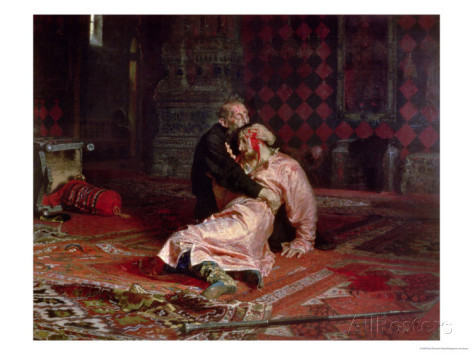
(fascinating, complex, conflicted Ivan IV)
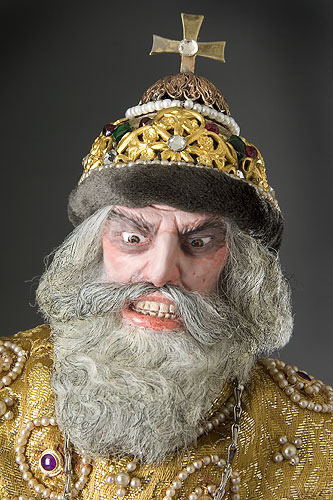
(This book's Ivan IV)
2) This is one more book where Christians are the main bad guys because Christians are eeeeeeeevil. Look, we get it, Chelsea Quinn Yarbro, you don't like Christians. You think they did nothing but ill for humanity. That's fine, that's great, I have no problem with that. But when you keep doing it over and over again in your books, it stops being about making a point, and it starts being unimaginative writing. Evil Christians are evil because they are and there's no other motivation. Here's the thing: some religious people are evil because of their religion. Some religious people are evil in spite of their religion. Some religious people use their religion as an excuse to hide some darker motivation. And some religious people are evil and it has nothing to do with their religious affiliation, they're just greedy or prideful or envious or whatever. But in Yarbro's world, there's only 1 motivation for religious people being evil (religious fervor/superstition, which if you'll notice is not really a reason - there needs to be a reason behind that reason in order to really be a reason arg), and it gets old really really quickly. The bad guys are all the same, and they all have the exact same motivation. In fact it's gotten to the point where I have decided to skip several books in the series because, despite the fact that they are set in really interesting time periods and places, I just can't do it again. I can't. I'm tired. They've just become 80s cartoon villains.
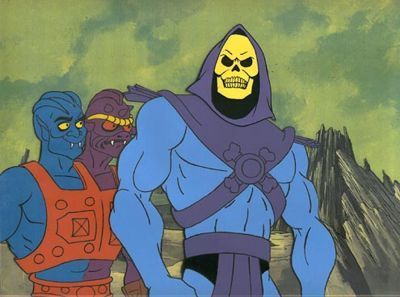
(Skeletor has more complex motivations that these bad guys)
3) But the above brings up another problem: it's not just that the bad guys have little true motivation, the good guys (and neutral guys) don't either. Ivan IV favors Saint-Germain because he has to in order to further the plot. Benedict Lovell and Boris Gudonov like Saint-Germain because it furthers the plot. The only characters that feel like fleshed out people are Saint-Germain himself and the character Xenya. Everyone else just does what they need to do to get the plot going where it needs to go, and that's the only explanation you're going to get, sorry.
4) Which leads to the next problem -- since Saint-Germain and Xenya and the only characters with depth, that means that any time one of them isn't on the page, the book is boring boring boring. I am actually a huge fan of Russian history and I love all the boyar politicking, but this book's description of it put me to SLEEP.
Because the book wasn't totally a waste, I'll mention the good points: 1) The scenes between Saint-Germain and Xenya were actually quite lovely and really pretty sexy, and that's saying a lot coming from someone who really really hates overdone sex scenes. If Yarbro wrote her political maneuvering scenes with the same skill that she did with her more personal, relationship scenes, I would be eating these books up with a spoon.
(Oh yeah, get some!)
2) Usually the percentage of the stupid letters between the chapters that are useful and move the plot along is 0%; in this book, it's a whopping 25% or so. So that's an improvement.
*Sigh* Honestly, at this point I don't know if it's even worth it to try to read some of the others -- maybe the ones set in the 20th century? People who have read these books: are there ANY that don't focus on the evulz of religion?
Logika polskiego wydawnictwa: O, kultowa seria o wampirach. Wydamy z niej tomy 1-3, a potem 7 i 10! Nie będę się z tym kłócić, zwłaszcza, że seria i tak nie zachowuje porządku chronologicznego i może w Rebisie myślano, że tom, w którym pojawia się Stefan Batory będzie cieszył się większą popularnością?
Problem z seria o Saint-Germain jest taki, że bardzo mało tu wampiryzmu. Ostracyzm, jaki spada na głównego bohatera równie dobrze może wynikać z faktu, że jest mądrzejszy niż ogół, nie osądza ludzi i stara się uczynić świat lepszym miejscem, ulżyć innym w cierpieniach. Nic tak nie wkurwia ludzi jak tego typu postawa. W rzeczywistości to świetne powieści historyczne, które przedstawiają kulturę i mentalność różnych miejsc i epok. Dlatego je lubię. W polskich podręcznikach do historii Borys Gudanow nie jest pozytywną postacią, dlatego byłam zaskoczona sposobem, w jaki został tu odmalowany. Nawet Iwan Groźny nie jest takim potworem - chociaż poznajemy go w ostatnich miesiącach życia, kiedy choroba psychiczna i fizyczna całkowicie go zmieniła. Wciąż jest nieobliczalnym maniakiem, ale Yarbro ma dla niego więcej sympatii niż historycy. Albo to Germain ma więcej sympatii, bo napatrzył się przez tysiąclecia na wszystkie odmiany ludzkiego cierpienia.
I fabuła każdej powieści jest taka sama: Saint Germain przybywa w jakieś miejsce, próbuje sobie poradzić i zbudować życie (albo jego pozory), zostaje wplątany w intrygi najpotężniejszych ludzi epoki, cierpi, koniec. Ciekawe jest to, co dzieje się pomiędzy przybyciem a tragicznym końcem - historia.
Tutaj zostaje wysłany przez Batorego w polskim poselstwie do Moskwy, żeby zagwarantować sojusz z Rusią przeciwko ekspansji Imperium Osmańskiego, która zagraża chrześcijańskiej Europie. Wszystko byłoby super, gdyby nie to, że na tronie Rusi zasada Iwan Groźny, obecnie szalony, jego syn jest nie nadaje się na cara, a bojarskie rody gotowe są na wszystko w walce o władze i wpływy. Kościół moskiewski bije się z cerkwią jerozolimską. W polskim poselstwie oprócz Rakoczego są jezuici, więc ma przerąbane, bo z nimi nie da się rozmawiać. Misja polska jest skazana na porażkę. Rakoczy chciałby przeżyć. Bez większych obrażeń. Jest gęsto od polityki, Sujszscy i Romanowowie knują, Rakoczy zostaje wplątany w ich intrygi wbrew własnej woli. Dużo opisów architektury, koni, miejscowej kuchni, obyczajów itd. Dużo przemocy. Prawie jak przewodnik turystyczny po Rusi na przełomie XV i XVI wieku. To nie jest kraj dla cywilizowanych alchemików-wampirów. Dużo wspomnień o genezie Rakoczego, jak zwykle brak konkretów. Nie mogę doczekać się aż trafię na tom, który osadzony jest w starożytnym Egipcie i dowiem się wreszcie, jak to wszystko się skończyło.
Although I loved my history, this brought forth some things I had not really known, or known well. I like that. Again, the cover art? Who knows what's going on there? Maybe later editions get it better. This is improving, however, from the anthology work with the old dude. Russia went through a lot, and Americans don't seem to know much about Russia,[or Canada, for that matter]. We like repeating the errors of the past, as if we are the first ones to invent everything. But, by gum, we are not. Anyway, plenty of suspense, sensuality, good vocabulary, and so on here. The author took pains to explain some of her spelling choices, and even the patronymic in the preface to this edition. That's good. There might have been a strange horsemanship misstep, but I didn't actually laugh aloud this time. [You just have to get on and off of horses, a lot. With packs behind the saddle, and without, in many situations, and it gets easier. As long as you have 2 legs, it's the same for everyone, dead or undead.] I'm not sure how many more of these I will read. At least one more. Why not? I find I like the more contemporary ones better, but I don't know why that is. Is it the spelling? I honestly don't know. I'm a bit of a weirdo about that sort of thing, and the average reader is not going to be bothered. I'm reading early editions, and the verb/subject agreements are off, often, and that also really irritates me. However, I just hope someone changed that in later editions and did not let the author down. Being creative is not easy, and proofreading and editing are actual occupations; that's why people get paid for them.
This novel had two great things going for it: its suave, benevolent vampire hero (the vampire your mother always hoped you'd marry :-) and its 16-th century Russian setting. But Yarbro takes very little advantage of either one. We almost never see the vampire doing anything specifically vampiric --perhaps Yarbro counts on the reader having read the previous books and not needing to know more about his peculiar nature. More importantly, there is little sense of time and place. Yarbro should have done more to transport us to medieval Russia: a few onion domes and an endless blessing-of-icons won't do it!
For a change St. Germaine does not start out at the center of a historical crisis. He has left his homeland of Transylvania due to the Ottoman invasion and is called on by King Stephen of Poland, who is also Transylvanian by birth. The King wants St. Germaine to undertake a diplomatic mission for him, so he gets sent into the center of a historical crisis. He is sent to Moscow and the court of Ivan the Terrible. Ivan is currently less rational than usual after murdering his son, so diplomatic relations with him are difficult. St. Germaine is not helped at all be the addition of a group of Jesuits sent with him who want to save the Orthodox Catholic Russians from their heresy. He gets caught up with all the palace intrigue and backstabbing, and of course finds time to fall in love.
Not the most action packed of stories, but there is a lot of history going on. One thing of note I find interesting is the appearance of the English traders, who are the beginnings of the British Moscow Company, many of whom later form the British East India Company on December 31, 1599. Lots of famous Russians and some references to other famous people of the time, though the main character here does practically nothing.
Even though I like to think I love vampires, the truth is that I had not read any of Yarbro's works until a friend gave me this book. #7 was NOT the book to start off with. I didn't know anything about Saint-Germain's character in this series and I was quickly frustrated when he wasn't the solo viewpoint character nor did he start off the book. When I could focus on his experiences, his chapters, and his sections within chapters I found him to be an engaging and empathic character that makes me want to read more. The only other characters I cared about and wanted to see a viewpoint from were Rothgaer and Xenya.
However, I have to ask and hope some can answer -- is this back and forth viewpoint between minor characters common in Yarbro's Saint-Germain series? Are there always "letters" inserted? Had I started from the beginning of the series perhaps I might care about some of the letter writers such as Olivia, but in this book I felt pulled out of the world and away from the characters I did care about.
This book was more of a challenge than l was expecting. More historical novel than the vampire tale l was expecting, it took me a little while to decide how l felt about it. Ultimately l was swept up in the story and loved the subtle way the author handled the main character's vampiric nature. I'll be searching for the rest of the books in this series.
1582 - The last years of Russian's Czar Ivan VI's (Ivan the Terrible)reign - He ruled for 50 years - and was a dynamic, effective ruler - warring and winning land for Russia - by a man thought to be insane.... In this fiction he is crazed by the guilt of killing his son (striking him in the side of the head in anger) - spending an inordinate amount of time in chapels, not washing, obsessing over getting a message of forgiveness, consulting witches, going into convulsions at times.
And Rakoczy, exile, friend to Transylvanian King Istavn Bathory of Poland is sent to use his alchemy to produce stones for the crazed Ivan, and work with the priests/emissaries to forge trade agreements.
And Rakoczy becomes embroiled in the politics of the Russian court - He is rewarded (a manipulation of Shuisky) for a gorgeous amethyst he gives to Ivan by being wedded to Xenya Evgeneiva, a 'damaged' cousin of Shuisky - Xenya's father abandoned 11 year old Xenya to 8 Mongols who overran their estate, who all raped her. She is now 23, past the age of marrying, living in one of the court Shuisky's homes as poor relation, doing charity works... she only wants to be invisible. Shuisky wants to use her a spy in Rakoczy's house.
We learn of the Orthodox church... the noblilities infighting to become Czar... of crazy Ivan's last days of guilt for killing his son... of his other son, perhaps of Down's syndrome, who succeeds him with 2 advisors appointed him... of the Shuisky's treachery... of Boris Godunov (future successor to Ivan's son) - an honorable man who loves Russian, loves his family, forward thinking, friend to Rackozy.
Rothgar, his faithful servant, accompanies him to Russian
And Saint-Germain - keeps his humanity by finding one to love - and in this decade it is Xenya - he treats her with a respect that is unknown to most Russian women, allowing her to decide for herself the role she will play. He is her friend, giving her the comfort she would allow after a nightmare... and then later, loving her in his way - helping her find her joy (sexual climax) so that he can find his... He loves her in stages, waiting her out, giving her control... and when he is arrested and beaten, though he has arranged for her lifetime income & a safe place to live, she finds her strength, and goes with his damaged body as he tries to exit Russia - to the point of giving her life defending him from guards sent to rearrest him.
And Boris puts down the Shuisky's plan, exonerates Racokzy... and Rakozy heals, and goes to Ghent...
This entire review has been hidden because of spoilers.
Yarbro writes vampire novels that are really excursions into historical fiction, emphasis on historical. She apparently does considerable research on the period that provides the setting for Count Saint Germain, the vampire who has more Christian and human qualities than do most of the other characters. I suppose the author would argue that he got that way by experiencing so much human tragedy over the centuries. Whatever. Yarbro always delivers a satisfying read. This one is set in sixteenth-century Moscow, where Saint Germain has been sent on a diplomatic mission by King Ivstan of Poland. The czar, Ivan the Terrible, close to death and virtually mad, is very difficult to deal with, and the priests accompanying Saint Germain begin to suspect Germain of satanic powers when he “miraculously” cures one of them of what appears to be pneumonia by means other than prayer (he has learned, perhaps a little conveniently of numerous drugs over the centuries). The Czar, loving the jewels that Germain alchemically creates, rewards him with a wife - - women are badly treated in sixteenth century Russia -- much to the count’s consternation. His ways must appear somewhat peculiar and he is forced to constantly explain why he doesn’t eat or drink in public, and the thick-soled shoes that allow him to walk on his “native earth” -- I know it does seem a little silly, but no worse than science fiction -- must also look odd. The result of this match is one of the better love stories. These books remain a lot better than television and seek to provide the flavor of what it must have been like to live during the time of their setting. Assuming they do so accurately, they can be informative. The Russia of this time was pervaded by xenophobia, superstition, and viciousness. Yarbro has also written a series with Germain’s centuries-long love, Olivia, another vampire.
Had been away from reading the Saint-Germain series for too long. Didn't realize how much I had missed him, like an old friend and beautiful lover. LOVED this book!
Soooo appreciated the author's tutorial in the Introduction to a piece of Russian history and to assist the reader in understanding and pronouncing Russian names.
A good solid 4 stars from me,Xenya as a character was well done she was more thought out than the other women characters she had more personality.I think alot of the women or girl characters are not as well developed as they could be.I think her death could have been handled better ended a bit sudden for me.
Ivan the Terrible was crazy, and he inflicted his insanity on everyone around him, friend and foe alike. Also, old Russian cites tended to be built of wood - really not a good thing when you heat the buildings with wood fires.
Bought this for .99 cents, and thank goodness for that because if I paid anymore, I'd have felt ripped off. This book, I guess isn't terrible? I'm really into vampires and vampire literature but this book did nothing for me. It was so boring I couldn't even read it as bathroom reading.