Jump to ratings and reviews
Rate this book

After Such Knowledge #3

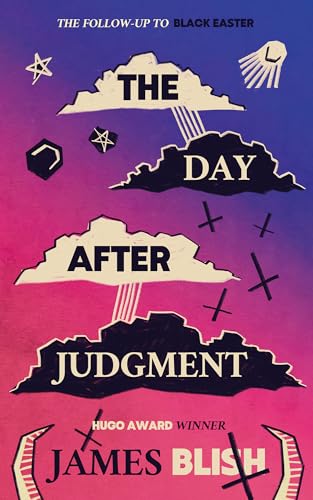
The Day After Judgment

Rate this book
The powerful black magician Theron Ware has opened the gates of Hell and unleashed an army of demons. Chaos and destruction prevail, and most of the world lies smouldering in ruins. But in a bunker beneath the ashes of Denver a small group of survivors are determined not to submit to the forces of evil. They summon the nuclear powers of the country's military arsenal to destroy Hell, but what can men do against the almighty evil that is Satan himself?

A direct sequel to Hugo Award winner James Blish's occult classic Black Easter (1968), The Day After Judgment (1971) can also be read as a standalone book. Like its predecessor, it features a blend of horror, science fiction, fantasy, philosophy, and black humor that makes it quite unlike anything else you have ever read.

120 pages, Kindle Edition

First published January 1, 1971

11 people are currently reading
762 people want to read

About the author

James Blish

454 books326 followers
James Benjamin Blish was an American author of fantasy and science fiction. Blish also wrote literary criticism of science fiction using the pen-name William Atheling Jr.

In the late 1930's to the early 1940's, Blish was a member of the Futurians.

Blish trained as a biologist at Rutgers and Columbia University, and spent 1942–1944 as a medical technician in the U.S. Army. After the war he became the science editor for the Pfizer pharmaceutical company. His first published story appeared in 1940, and his writing career progressed until he gave up his job to become a professional writer.

He is credited with coining the term gas giant, in the story "Solar Plexus" as it appeared in the anthology Beyond Human Ken, edited by Judith Merril. (The story was originally published in 1941, but that version did not contain the term; Blish apparently added it in a rewrite done for the anthology, which was first published in 1952.)

Blish was married to the literary agent Virginia Kidd from 1947 to 1963.

From 1962 to 1968, he worked for the Tobacco Institute.

Between 1967 and his death from lung cancer in 1975, Blish became the first author to write short story collections based upon the classic TV series Star Trek. In total, Blish wrote 11 volumes of short stories adapted from episodes of the 1960s TV series, as well as an original novel, Spock Must Die! in 1970 — the first original novel for adult readers based upon the series (since then hundreds more have been published). He died midway through writing Star Trek 12; his wife, J.A. Lawrence, completed the book, and later completed the adaptations in the volume Mudd's Angels.

Blish lived in Milford, Pennsylvania at Arrowhead until the mid-1960s. In 1968, Blish emigrated to England, and lived in Oxford until his death in 1975. He is buried in Holywell Cemetery, Oxford, near the grave of Kenneth Grahame.

His name in Greek is Τζέημς Μπλις"

Ratings & Reviews

What do you think?
Rate this book

Friends & Following

Create a free account to discover what your friends think of this book!

Community Reviews

5 stars
104 (22%)
4 stars
177 (37%)
3 stars
141 (30%)
2 stars
38 (8%)
1 star
7 (1%)
Displaying 1 - 30 of 57 reviews
Profile Image for Martin.
327 reviews174 followers
July 4, 2019
Armageddon - the end of the world.
Or is it?
Theron Ware - Black Magician,
Doctor Baines - owner of Consolidated Warfare Service,
Jack Ginsburg - secretary to Dr Baines,
Father F. X. Domenico Bruno Garell - a monk and White Magician.
Having started the End these unlikely people are now forced to save the world.
The direct sequel to "Black Easter".


The Fall of God and what came after
“When the hell is he coming back?” Baines, the client, demanded suddenly, irritably. “This waiting is worse than getting it over with.”
Father Domenico turned from the refectory window, which was now unglazed, from the shock wave of the H-bombing of Rome. He had been looking down the cliff face, over the half-melted pensioni, shops and tenements of what had once been Positano, at the drained sea bed. When that tsunami did arrive, it was going to be a record one; it might even reach all the way up here.
“You don’t know what you’re saying, Mister Baines,” the white magician said. “From now on, nothing can be over with. We are on the brink of eternity.”

The demon induced world war
Rome was no more, nor was Milan. Neither were London, Paris, Berlin, Bonn, Tel Aviv, Cairo, Riyadh, Stockholm and a score of lesser cities. But these were of no immediate concern. As the satellites showed, their deaths had expectably laid out long, cigar-shaped, overlapping paths of fallout to the east—the direction in which, thanks to the rotation of the Earth, the weather inevitably moved—and though these unfortunately lay across once friendly terrain, they ended in enemy country. Similarly, the heavy toll in the U.S.S.R. had sown its seed across Siberia and China; that in China across Japan, Korea and Taiwan; and the death of Tokyo was poisoning only a swath of the Pacific (although, later, some worry would have to be devoted to the fish). Honolulu somehow had been spared, so that no burden of direct heavy nuclei fallout would reach the West Coast of the United States. This was fortunate, for Los Angeles, San Francisco, Portland, Seattle and Spokane had all been hit, as had Denver, St. Louis, Minneapolis, Chicago, New Orleans, Cleveland, Detroit and Dallas. Under the circumstances, it really hardly mattered that Pittsburgh, Philadelphia, New York, Syracuse, Boston, Toronto, Baltimore and Washington had all also gotten it, for even without the bombs, the Eastern third of the continental United States would have been uninhabitable in its entirety for at least fifteen years to come. At the moment, in any event, it consisted of a single vast forest fire through which, from the satellites, the slag pits of the bombed cities were invisible except as high spots in the radiation contours. The Northwest was in much the same shape, although the West Coast in general had taken far fewer missiles. Indeed, the sky all over the world was black with smoke, for the forests of Europe and northern Asia were burning, too. Out of the pall, more death fell, gently, invisibly, inexorably.

Invasion by demons
Translated from the FORTRAN, the document said that the United States had not only been hit by missiles, but also deeply invaded. This conclusion had been drawn from a satellite sighting of something in Death Valley, not there yesterday, which was not natural, and whose size, shape and energy output suggested an enormous fortress.

Arial photographs of Dis, the foram surrounding Nether Hell.
The picture showed what appeared to be a towering gate in the best medieval style. Hundreds of shadowy figures crowded the barbican, of which three, just above the gateway itself, had been looking up at the plane and were shockingly clear. They looked like gigantic naked women, with ropy hair all awry, and the wide-staring eyes of insane rage.
“I thought so,” Satvje said.
“You recognize them?” Buelg asked incredulously.
“No, but I know their names: Alecto, Megaera and Tisiphone,” Satvje said. “And it’s a good thing that there’s at least one person among us with a European education. I presume that our distrat friend the navigator is a Catholic, which does just as well in this context. In any event, he was quite right—this is Dis, the foram surrounding Nether Hell. I think we must now assume that all the rest of the Earth is contiguous with Upper Hell, not only in metaphor but in fact.”
“If you blow up that photograph, I think youll find that the hair on those women actually consists of live snakes. Isn’t that so, Colonel?”
“Well ... Doctor ... it ... it certainly looks like it.”
“Of course. Those are the Furies who guard the gates of Dis. They are the keepers of the Gorgon Medusa, which, thank God, isn’t in the picture. The moat is the River Styx; the first terrace inside contains the burning tombs of the Heresiarchs, and on the next you have the River Phlegethon, the Wood of the Suicides, and the Abominable Sand. A rain of fire is supposed to fall continually on the sand, but I suppose that’s invisible in Death Valley sunlight or maybe even superfluous. We can’t see who’s down below, but presumably that too will be exactly as Dante described it. The crowd along the barbican is made up of demons—not so, Colonel?”

After talking to the perfectly sane, military scientists about how to destroy demons Baines is thoughtful.
Baines said nothing more, advisedly. It had occurred to him, out of his experience with Theron Ware, that angels fallen and unfallen, and the immortal part of man, partook of and had sprung from the essentially indivisible nature of their Creator; that if these men could destroy that Part, they could equally well dissolve the Whole; that a successful storming of Dis would inevitably be followed by a successful war upon Heaven; and that if God were not dead yet, He soon might be.
However it turned out, it looked like it was going to be the most interesting civil war he had ever run guns to.

Men take the War to Hell
UNITED STATES ARMED FORCES
Strategic Air Command Office
Denver, Colorado
Date: May x
Memorandum: Number I
To: All Combat Arms
Subject: General Combat Orders
1. This Memorandum supersedes all previous directives on this subject.
2. The United States has been invaded and all combat units will stand in readiness to expel the invading forces.
3. The enemy has introduced a number of combat innovations of which all units must be made thoroughly aware. All officers will therefore read this Memorandum in full to their respective commands, and will thereafter post it in a conspicuous place. All commands should be sampled for familiarity with the contents of the Memorandum.
4. Enemy troops are equipped with individual body armor. In accordance with ancient Oriental custom, this armor has been designed and decorated in various grotesque shapes, in the hope of frightening the opposition. It is expected that the American soldier will simply laugh at this primitive device. All personnel are warned, however, that as armor these “demon suits” are extremely effective. A very high standard of marksmanship will be required against them.
5. An unknown number of the enemy body armor units, perhaps approaching 100%, are capable of free flight, like the jump suits supplied to U. S. Mobile Infantry. Ground forces will therefore be alert to possible attack from the air by individual enemy troops as wen as by conventional aircraft.
6. It is anticipated that in combat the enemy will employ various explosive, chemical and toxic agents which may produce widespread novel effects. All personnel are hereby reminded that these effects will be either natural in origin, or illusions.
7. Following the reading of this Memorandum, all officers will read to their commands those paragraphs of the Articles of War pertaining to the penalties for cowardice in battle.
By order of the Commander in Chief:
D. WILLIS MCKNIGHT
General of the Armies, USAF

Hell mouth is the city of Dis - now in Death Valley - USA.
Watch the devastating show-down between the demons while the four protagonists meet Satan


Enjoy!

Profile Image for Stephen.
1,516 reviews12.4k followers
February 9, 2010
6.0 stars. The sequel to the superb Black Easter, this book may be even better than its predecessor. This book is both incredibly fun and amazingly inciteful. I won't give away the ending but it is even better than the ending of Black Easter which I thought was incredible. Highly recommended.
Profile Image for Manny.
Author 48 books16.1k followers
September 4, 2011
The sequel to Black Easter , but not as good. As usual, though, a very memorable ending.

So, in Black Easter, an insane arms dealer pays a black magician to release all the demons of Hell for one night. This leads to Armageddon: at the end of the book, the Devil materializes in person and tells his horrified audience that the long war between Heaven and Hell is over. God is dead. You would think a sequel was impossible, and I'd love to know whether Blish had already planned it when he wrote the first book. Astonishingly, he finds an idea which doesn't come across as a hopeless anticlimax.

The main characters of the first book are still alive, in the midst of a world that's trying to cope with the aftermath of a nuclear war and the simultaneous appearance of Dis, the Infernal City, in Death Valley. (Where else?) Attempts by the US military to fight the demonic hosts are as ineffectual as one would expect. Finally, our heroes are brought to the foot of the Satanic Throne. They expect to be cast into the fiery gulf, but a surprise is waiting for them. Around the terrible horned head of the Worm, there is a halo. This, too was part of the Divine Plan: when God dies, Lucifer unwillingly has to take His place.

I think most Christian theologians would dismiss the idea as the most appalling blasphemy, but you have to admire its boldness. And, to me at least, it makes poetic sense. Everyone can be redeemed, even Satan himself. It's a shame that Blish was such a sloppy writer. He had a wonderful imagination.


This entire review has been hidden because of spoilers.
Profile Image for Caleb Fogler.
162 reviews16 followers
August 13, 2025
The Day After Judgement is the sequel to Black Easter, also by James Blish, and was the opposite reading experience for me from the first book. Our reoccurring characters from Black Easter; Father Domenico, Theron Ware, Doctor Baines and Jack Ginsburg investigate the fallout from Armageddon and explore different routes to survive or attempt to assist the forces of heaven or hell depending on the character. We also meet a new character in the racist General McKnight whose character slowly declines in likability as the story progresses.

The initial events in the beginning sections are interesting as we see what Blish’s vision for Armageddon might be with tsunamis and nuclear war destroy cities and wreck countries. We also experience the different routes that the characters take in more detail than the magic trials are described in Black Easter which I felt was a huge letdown in the first book.

While those aspects were enjoyable for me, the ending was a major letdown. Our characters converge their separate journeys on Hell’s stronghold of the city of Dis in Death Valley as they either attempt to confront or negotiate with the forces from Hell. What follows is a climax of the story that felt like a high speed train coming to an abrupt stop. It was very disappointing, hard to understand what was happening, and then just suddenly ends the book with myself questioning what went wrong. Overall The Day After Judgement is an interesting vision for what Armageddon might look like in a nuclear armed world but don’t expect a satisfying or conclusive story.
This entire review has been hidden because of spoilers.
Profile Image for Ira (SF Words of Wonder).
273 reviews71 followers
August 14, 2023
Check out my full, spoiler free, video review HERE. More dark, serious, and entertaining but with a bit more humor (Jack Ginsberg). Again, short but well researched with a fantastic ending. I liked Black Easter a bit more.
Profile Image for Sarinys.
466 reviews173 followers
December 4, 2022
Sequel diretto di Pasqua nera, l'azione riprende dove si interrompeva nel finale. Per me non ha lo stesso fascino del precedente perché ciò che mi colpiva di più era il racconto in chiave fantascientifica del fenomeno occulto.

Questa volta, una larga parte della storia è dedicata alle conversazioni nel bunker, che contengono probabilmente anche le speculazioni filosofiche che interessavano a Blish, ma ammazzano un po' la storia. Le parti migliori sono quelle con Theron Ware che viaggia sulla scopa, l'azione attorno alla città di Dite spuntata nella Death Valley, il confronto col succubo. Insomma, le parti in cui l'immaginario infernale viene messo in scena e fatto interagire.

Qui l'ispirazione è dantesca nel modo più letterale possibile. Mi ha un po' deluso il discorso finale presentato come un poema, più che altro perché questa edizione ha una traduzione abbastanza scadente e quelle ultime pagine sono terribili da leggere. Come finale, è un po' troppo anticlimax.

Il romanzo precedente era tutto in crescendo fino all'apoteosi, cosa che qui un po' si perde: non c'è una vera costruzione dell'azione fino a poco prima della fine, i personaggi sono bloccati o girano a vuoto, non sanno nemmeno cosa stia succedendo. C'è l'evocazione di un demone, ma è una breve parentesi.
Profile Image for prcardi.
538 reviews87 followers
November 26, 2017
Storyline: 2/5
Characters: 3/5
Writing Style: 3/5
World: 2/5

Unlike the first two books in the very loosely affiliated "After Such Knowledge" series, The Day After Judgement is a direct sequel (to the series' third, Black Easter). There is no need whatsoever to have read A Case of Conscience or Doctor Mirabilis, but these final two should be treated as a pair. And it is an odd pairing. Black Easter was a short, pungent and fantastically realistic demonology with understated portents for the Cold War. The brevity gave it weight, and the ending to that book sold the analogy more effectively than additional chapters (or a sequel) could have. The very existence of The Day After Judgment takes away some of the forcefulness of the predecessor volume. It picks up immediately after the events of Black Easter and considers what follows the apocalypse. This volume, however, is much more of a Cold War satire, focusing more on nationalism and ignorance and rigid militaristic impulses. There isn't much of a religious subtheme until one reaches the final chapter. I started reading that chapter with some apprehension. The scene was set for a dramatic and profound conclusion. But then Blish felt the need to deliver the climactic revelations through pages of early modern English verse
Yee whose coming fame had bodied forth
A hope archemic even to this Deep
That Wee should be amerced of golden Throne....
Since nothing else in the book had followed that style, it was an ostentatious choice that made the ending unnecessarily cumbersome. Once deciphered, one finds it contains an astonishing idea, an idea that was worth writing a book about. Unfortunately the book that preceded those final pages did not prepare for this ending, and it was instead another stylistic choice - the "ending with a flourish."
Profile Image for Tony.
88 reviews1 follower
July 23, 2008
This, and it's predecessor / companion FAUST ALEPH NULL, are a pair of hilariously-dark, end-of-the-world novellas that astonish and delight in equal measure.

Drawing extensively from actual magical rituals, the "always-delivers" Mr Blish imagines an international arms dealer employing a real wizard to unleash all the demons from Hell onto Earth for one night of Revelations-style armageddo-fun while a Vatican rep watches on, observer-style, because the Cosmic rules (the contract between God and Satan) prevent him from intervening.

Undeniably downbeat at the end, these two volumes skip through descriptions of magical ritual, demonic emergence and play and the arrival of the City of Dis with wit and aplomb.

And it's gripping.

And it's a little bit scary.

And it'd make a FAR better movie than Arnie's risable END OF DAYS

These books are also loosely grouped, by Mr Blish himself, in a trilogy of volumes called AFTER SUCH KNOWLEDGE (A Case of Consience and Doctor Mirabilis)

If you've not discovered Mr B before, seek all of these out on EBAY (dirt cheap!) and revel in the sheer variety and depth of his prose.

Always recommended!
3 reviews
April 13, 2018
Wonderful, intelligent writing.

I've just finished re-reading this book for what must be the tenth time since first encountering it (and the rest of the trilogy) 40 years ago.

I loved Blish's unique blend as soon as I first came across it in "Cities in Flight", and "Earthman, Come Home" in particular. So, I knew that Blish could create characters of huge intelligence and place them in thought provoking, yet gripping plot lines.

This trilogy (quadrilogy?) took Blish even beyond that. To be able to mix a hard science fiction novel, in "A Case of Conscience" with impeccably researched Black Magic, and tie them together with a theological theme, supported by fascinating characters was a huge achievement. But I didn't realise how magnificent until some years later when I laid hands on a copy of "Dr Mirabilis".

And yes, I know Blish had his flaws as a writer. He never once produced a female character who was more than a cipher, and he did churn out some true pulp. I can forgive him that, for the two outstanding series.

I genuinely believe Blush, "Cities in Flight" and "After Such Knowledge" are massively underestimated even by science fiction fans. A tragedy.
Profile Image for Pam Baddeley.
Author 2 books64 followers
January 24, 2016
A sequel to Black Easter, which follows on directly from the events of that book. The four men, priest, black magician, arms dealer and the latter's sidekick go their disparate ways to try to deal with the situation that now exists after nuclear weapons have destroyed many great cities and demons are loose on the earth. Eventually they will be drawn back to a common destination to confront their destiny. At times reminiscent of the film Doctor Strangelove, this comes across as darkly humourous in parts. The ending was a bit confusing, as I wasn't sure, when .

Read as part of the After Such Knowledge omnibus and posted as an individual review as all the other GR reviews are under the individual books.

Profile Image for Eric Zimmerman.
121 reviews
April 1, 2012
Part of the After Such Knowledge trilogy, which is actually 4 books, which you can read out of official sequence. This book starts off with, "Okay, a bunch of demons from Hell just came to earth. What the hell do we do now?" Great ending. The diction can be a bit difficult, and you need to not put it down for too long between reading sessions.
Profile Image for Sidney.
Author 69 books138 followers
May 14, 2012
As David Hartwell notes in the afterword, this is not constructed as a modern bestseller in spite of its concept. It's more of an intellectual exercise, but it's a fascinating one. Following Black Easter, which has literally brought about Hell on Earth, military and magical experts attempt to cope with a demon-haunted world.
708 reviews20 followers
August 18, 2010
A fitting conclusion to his trilogy about forbidden knowledge. Blish does a good job of imaginatively reconciling the operations of magic with science, and also includes some scathing commentary on the tactics used in Vietnam.
Profile Image for Mizuki.
3,364 reviews1,397 followers
May 23, 2013
I read this book so long ago, James Blish's concept is terrific, but I don't think I understand what's going on.^^;;;
Profile Image for Lisa (Harmonybites).
1,834 reviews410 followers
July 13, 2013
This is a sequel to the novella Black Easter, and to me was an anti-climax. What Stoker's Dracula and King's Salem's Lot is to vampires, Black Easter is to demons. Blish said in his Author's Note to that first novel that every one of the "novels, poems and plays about magic and witchcraft" he's read treat it as "romantic or playful." He sought to write a treatment that "neither romanticizes magic nor treats it as a game." That book is dedicated to C.S. Lewis and even included an extensive quotation from his Screwtape Letters heading one of the chapters.

So although I'm not sure I'd classify this as out and out Christian fiction, this does come out of that world view and takes the demonic seriously--that's what does make it unusual and at times fascinating. It's obvious not just from his note but the vividness of his details and even the quotes heading chapters Blish did extensive research--actually reading grimoires and manuscripts on ceremonial magic. At the same time Blish is best known as a science fiction writer, and approaches magic with almost scientific rigor. This sequel had even more of a science fiction feel than the first. This sequel though is not so much Christian allegory of scientific hubris as Cold War parody--and I found that more dated and less interesting, although it did have moments of (very black) comedy. And maybe a believing Christian would have found the ending powerful and moving, as the ending of the first book was intended to be shocking--I found it trite.
5 reviews9 followers
November 25, 2008
It was hard to decide whether I should give this 1 star or 5. It is so bad it becomes hilarious. eg:
"The Rocket paratroopers were dropping in, and the laser squadrons should be cutting through that wall like a rapier through cheese."
Or another one of my favourites:
"Most of Europe had been wiped out by the Nuclear fallout, and eventually some consideration would have to be given to the fish."
Definitely worth a read. If you can find it.
Profile Image for Norman Howe.
2,202 reviews5 followers
May 22, 2015
Sequel to Black Easter. God is Dead. The world should be ending"," right? We should only be so lucky! But eternity abhors a power vacuum"," and Satan wants to continue being the Great Adversary. An exciting trip!
Profile Image for Jared.
400 reviews9 followers
March 8, 2012
Tongue-in-cheek Satanism fantasy about the end of the world. A total blast to read, and the descriptions of black magic are fascinating.
Profile Image for Doug Bolden.
408 reviews35 followers
November 14, 2024
In my review of Black Easter I noted that the first book in this duology (which, zooming out, is the final but middle volume in a trilogy) was a brilliant literary exercise that needed more literature - plot, characters, conflict - to truly make it work. This "second half" does all of those but, in somewhat predictable fashion, accomplishes it by draining off most of what made the "first half" so unique. We have characters who struggle and grow. We have plotlines that actually pretend to matter - all reading is a willful suspension of acknowledging the writing process - and we have glorious conflict and consequences happening on page rather than through implication. We also get a whole lot more handwaving and narrative shortcuts.

After the events of the first novel/la, a demonic horde has been released upon the earth - I am not spoiler marking this because it tends to be discussed openly in the book's description - while destruction runs rampant (though not completely). Four of the characters carry on a trio of quests to carry out their own response to the situation.

There is a bit of meta-fiction here. The After Such Knowledge series has four books, two of which are a single book split somewhat in half. Here we have three narratives which has one split somewhat in half.

As for this story, it lashes together Black Easter, Inferno (the first part of The Divine Comedy), and a broad parody of the American Military Mindset that would be right at home with Dr. Strangelove. Its most effective scenes tend to be its smaller set-pieces - a sight of slaughter at a farm, the gathering in Venice, the military fight with the infernal hosts - while the broad philosophical bend of the ending makes for something interesting to chew though feels perhaps a bit pre-destined.

The main mystery still remains how this novel/la, which feels vitally attached to the first novel/la to such a degree as for both to be lesser with each other, got so removed that it took a few years before Blish worked it out. I have no answer for this.

Four-stars assuming you have read Black Easter, most likely three- if you have not.
Profile Image for Deb Omnivorous Reader.
1,985 reviews177 followers
March 6, 2025
This book, allegedly, was considered by the author to be the second part of a book rather than a standalone and Black Easter was the first part of it. This time I have read them as they were intended, one after the other and I have to say this is the best way to enjoy them. There is so much complexity and detail as well as SFF puns... Just so much!

I have read this book more often, as I have always owned it and it is the more complex of the two. Black Easter has a limited cast of characters, only one or two sets and the narrative is very consistent and linear. The complexity in Black Easter is all from the descriptions of black magics, demonology and ritual magic and well as the cataclysmic ending.

THIS book however is far more complex, with multiple characters, new characters and a range of locations and world building that are more in line with classic SFF writing in general.

I loved it. It will not be for everyone, the description of the US military initiatives against the city that has just sprung into being in Death Valley, those are for everyone who reads SFF, but the nuances of the different chracters and their journeys there will not thrill all modern readers.

The ending? Well, Blish does his own version of John Milton's Pardise Lost and I loved it and the the theological question of god and the devil was marvelous.

Not for everyone, also reviewed, in combination with Black Easter on https://www.youtube.com/watch?v=PKamQ...
Profile Image for KDS.
232 reviews15 followers
May 2, 2025
Read on its own, this isn't particuarly good or as coherent as it could be in exploring humanity's relationship with religion, morality and technology. However, this is really part two of Black Easter and taken as a whole, is quite the worthwhile read.

Dealing with the after effects of the actions taken in that story and the massive revelation at its climax, this is another bleak book which again draws from a deep well of classical sources of magic and mythology. Where Black Easter examines the "how", The Day After Judgment" tries to look more at the "why" and explores what happens next.

The story switches between the surviving US military and their cavalier approach of trying to blow everything up (at obscene costs) to retake control and the original characters who are looking for their own place in this twisted new reality. Most of these perspectives and morality questions are somewhat dated by modern, liberal standards, but there are some interesting philopsophical thoughts to pursue that give the book greater value. And the imagery - drawn direct from Dante - is quite spectacular. In fact quite a lot if packed into 100 pages.

The ending is presented in the form of an epic poem (fitting given the scene is drawn directly from The Inferno), but is no less impactful and mind blowing compared to the first book. I'm not a big poetry lover, but I appreciated the connection here and just about got what I needed from it and indeed it's one of the better examinations of Good vs Evil I have come across, presenting an interesting question about humanity's place in a grander scheme.

Ignore the terrible cover on this edition - it's well worth a read when combined with Black Easter. Together they companion with two other books Blish wrote and I look forward to exploring those next.
Profile Image for Jesse.
787 reviews10 followers
June 22, 2025
When you've already loosed an indeterminate quantity of devils on the world, had a semi-big bad claim God is dead (though of all beings, why trust him?), and more or less implied that Armageddon has happened, where do you go next? How about a Miltonian soliloquy about the evil that men do? And maybe some Strangelove-type government nuttiness, featuring a general who's a hybrid of Edwin Walker, MacArthur, and Westmoreland (and who sees the evil Dr. Fu Manchu everywhere he turns), a Herman Kahn winnable-nuclear-war madman, and a sort of Kissinger stand-in, all of whom work for "President Agnew"? Oh, and soldiers v demons, which does not turn out well? And theological speculation about what comes next, and what that proves? If things follow the now-standard Rapture narrative (surprised Blish knew it that well way back then, though clearly he'd done his reading, going all the way back to the beginnings), does that mean that actually God lives? I think this would make no sense if you haven't read Black Easter, and honestly, checking out a couple of overly detailed Blish fan sites did not particularly make me want to read the other parts of this trilogy (these two being counted as one), but maybe that's their fault rather than his. As it is, this is by turns drolly satirical (imagine Kubrick directing The Omen, I guess) and actually quite straightforward in its theological contemplation, which makes for an extremely unusual mix. Late-60s popular demonology, well before it got overheated in the 80s Satanic panic, is definitely its own thing, an odd, intellectually serious grappling with the tenor of the times. Who knows, maybe there's someone out there who took the time to ponder the theology of "Sympathy for the Devil"?
97 reviews4 followers
August 12, 2025
This follow up to Blish’s Faustian tale Black Easter is equally infernal.

World War III has taken place and it is, quite literally, hell on earth. It is this literal quality which is itself intriguing. If spiritual entities, like the demons of hell, were to set up abode on earth, how would it actually work? What commerce is possible between the corporeal and spiritual?

Theologians and philosophers have long puzzled over this: the relation between body and soul/mind, the mystery of the incarnation, the earthly yet spiritual nature of the sacraments. Such paradoxes, which tend to resist precise formulation, are housed more appropriately in symbol and metaphor. Which makes the sudden appearance of the City of Dis in Death Valley California not only the ultimate military, but also the ultimate metaphysical, challenge humanity has ever faced.

Confronted with the complete impenetrability of the iron walls of hell against every form of nuclear and conventional weapon, one of the US Army’s chief scientists reluctantly concedes: “they must be only symbolically iron…”. I found this highly amusing, and also kind of profound: the complete impotence of materialist certainty against the elusive impenetrability of the symbol!

Theologically erudite and deeply grounded in the Christian literary tradition, this is the kind of sci-fi I like.
Profile Image for Nathan Anderson.
186 reviews39 followers
October 15, 2021
3.5

The Day After Judgment is collected in the same volume as Black Easter, which I read last summer sometime. Seeing as though October is horror month, I decided to finally read the followup.

For some context, I really enjoyed Black Easter— the premise being that an arms dealer consults the help of a black magician to summon all the demons of Hell on Earth for a day… is really interesting, and Blish’s attention to occult detail made for a simple story with a very clear focus. The Day After Judgment more or less, takes place after the events of Black Easter, as the guilty parties must atone for what they’ve done to plunge the Earth into such ruin.

I enjoyed it, though not nearly as much as Black Easter— DAJ kind of muddies the relative simplicity by adding in some sci-fi/militaristic elements that I feel just kind of distract from the methodically-presented occult aspects, and they date the novel a bit as well.

Together they make for a neat oddity within horror/sci-fi, and honestly, I don’t find enough of those.

Profile Image for Gannon Kuehn.
16 reviews1 follower
February 9, 2025
If I had one complaint about The Day After Judgement and its predecessor Black Easter, it would be that they aren't one book. Blish stated in the afterword that he wants them considered as a unit, but also stated that he wants them to be able to be read and enjoyed separately -- why? For me, the weakest aspect of Black Easter is that it feels incomplete, and the weakest part of The Day After Judgement is also that it feels incomplete, so why not combine these two novella-length books to yield a complete novel? Pointless nitpicking aside, both books are excellent. Blish is a very talented prose stylist, and his attention to detail in terms of depicting an "accurate" version of black magic leads to a very immersive experience. Both endings excel at their intended effect—Black Easter concludes with a deep sense of nihilism and misery, while The Day After Judgment is more ambiguous and harder to pin down. The latter's ending, although initially baffling, has grown on me immensely as is, in my opinion, a truly excellent and thought-provoking ending.
Profile Image for Ayon Ibrahim.
Author 1 book1 follower
June 6, 2021
Was really looking forward to this after reading "Black Easter", its direct prequel. Unfortunately, this one definitely does not pack that same punch. The Cold War/military satire juxtaposed with the post-Armageddon world was definitely an interesting theme, but there were more issues than good qualities. The pacing was strange, the characters are very 1-dimensional (they were in the first book too, but it was shorter and so it didn't matter as much), and worst of all...is the ending. I'm very conflicted by it. On one hand, Blish has the conclusion delivered in Miltonian English, which I found very annoying - quite different from the rest of the story, with no warning of the switch, and in my opinion, completely unnecessary. On the other hand, once you decipher it...it is an incredible ending! An awesome idea, executed poorly.

I think this is still worth the read but be prepared to do some "translation" at the end.
Profile Image for O K.
29 reviews
November 26, 2022
I started reading this small book based on a youtuber (@bookpilled) recommendation. I later learned that the story is actually a continuation to another book titled Black Easter. My experience has been simply this; I don't get why this is supposed to be a good book. As the book is quite short, there is not enough character development. Even though I like books with religious motifs, this was more like a fantasy book with demons and magicians, there are more demonology and magic in it than references to known religious undertones to engage the reader. But without giving any spoilers let me say that the ending did it for me, I do not think this book is worth your time to read it. I should have tried "A case of conscience" from the same author, a work that has a more universal acclaim. Oh well, if we did not read some mediocre books how would we become aware of the great books when we read them.
181 reviews1 follower
August 2, 2025
This was a wonderful read, and a great sequel and conclusion to Black Easter. While some of the characters were a little one dimensional, I liked how the main cast developed from the first book. The descriptions of the hellscape that Earth has become after the events of the first novel are haunting. It is well paced and had me immersed in the narrative from beginning to end. The ending was very unexpected. I was moved by its philosophical implications, and i believe that they will stick with me for a long time. If you liked Black Easter, definitely give this a read. If you are a fan of dark fantasy and philosophical musings on the nature of evil, demons, and God, then I highly recommend this!
21 reviews
June 2, 2025
This was fine, but fell pretty flat for me compared to the first book. In black Easter, the action and themes felt very tightly woven together. Here, it felt largely felt like a pulpy plot tagged with a philosophical twist at the very end. The end was interesting, but in many ways felt orthogonal to the action in the rest of the book.

Overall, in hindsight I think I would have just ended with Black Easter. If you're just really curious about what happens next, this does technically answer that question, but I don't feel like it added much of anything meaningful to the themes Blish is exploring.


Displaying 1 - 30 of 57 reviews

Can't find what you're looking for?

Get help and learn more about the design.