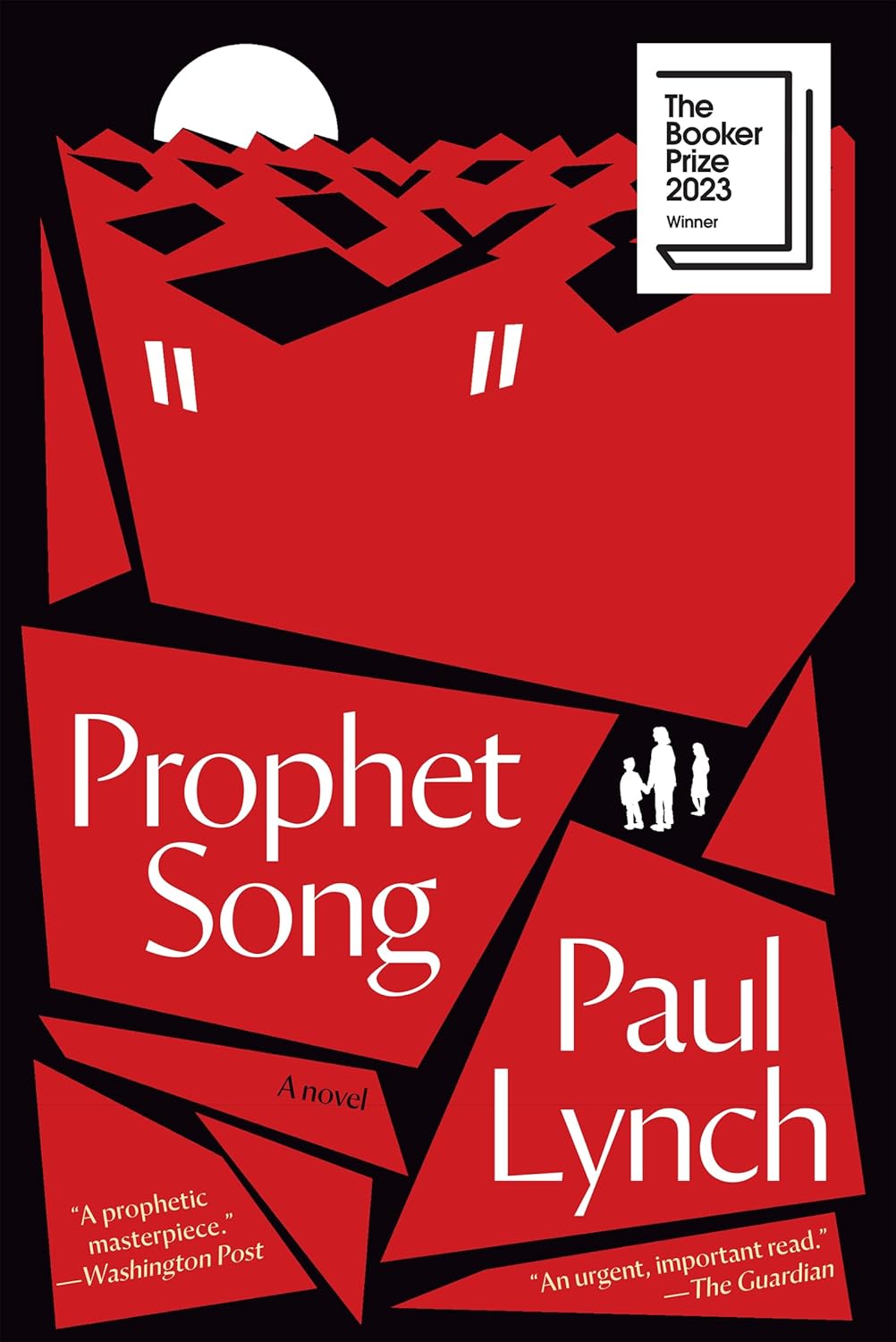
WINNER OF THE BOOKER PRIZE 2023 • INSTANT NATIONAL BESTSELLER
Winner of the 2024 Dayton Literary Peace Prize Finalist for the 2024 Kirkus Prize
On a dark, wet evening in Dublin, scientist and mother-of-four Eilish Stack answers her front door to find two officers from Ireland’s newly formed secret police on her step. They have arrived to interrogate her husband, a trade unionist.
Ireland is falling apart, caught in the grip of a government turning towards tyranny. As the life she knows and the ones she loves disappear before her eyes, Eilish must contend with the dystopian logic of her new, unraveling country. How far will she go to save her family? And what—or who—is she willing to leave behind?
The winner of the Booker Prize 2023 and a critically acclaimed national bestseller, Prophet Song presents a terrifying and shocking vision of a country sliding into authoritarianism and a deeply human portrait of a mother’s fight to hold her family together.
Paul Lynch is the internationally-acclaimed, prize-winning author of five novels: PROPHET SONG, BEYOND THE SEA, GRACE, THE BLACK SNOW and RED SKY IN MORNING, and the winner of the Kerry Group Irish Novel of the Year 2018, among other prizes.
His debut novel RED SKY IN MORNING was published to critical acclaim on both sides of the Atlantic in 2013. It was a finalist for France’s Prix du Meilleur Livre Étranger (Best Foreign Book Prize) and was nominated for the Prix du Premier Roman (First Novel Prize). In the US, it was an Amazon.com Book of the Month and was featured on NPR’s All Things Considered, where Lynch was hailed as “a lapidary young master”. It was a book of the year in The Irish Times, The Toronto Star, the Irish Independent and the Sunday Business Post.
THE BLACK SNOW (2014) was an Amazon.com Book of the Month. In France it won the French booksellers’ prize Prix Libr’à Nous for Best Foreign Novel and the inaugural Prix des Lecteurs Privat. It was nominated for the Prix Femina and the Prix du Roman Fnac (Fnac Novel Prize). It was hailed as “masterful” by The Sunday Times, “fierce and stunning” by The Toronto Star and featured on NPR’s All Things Considered where Alan Cheuse said that Lynch’s writing was found “somewhere between that of Nobel poet Seamus Heaney and Cormac McCarthy”.
GRACE was published in 2017 to massive international acclaim. The Washington Post called the book, “a moving work of lyrical and at times hallucinatory beauty… that reads like a hybrid of John Steinbeck’s ‘The Grapes of Wrath’ and Cormac McCarthy’s ‘The Road'”. It won the Kerry Group Irish Novel of the Year and was shortlisted for the Walter Scott Prize and the William Saroyan International Prize. In France it was shortlisted for the Prix Jean Monnet for European Literature, among other prizes. It was a book of the year in the Guardian, the Irish Independent, Kirkus and Esquire, a Staff Pick at The Paris Review and an Editors’ Choice in the New York Times Book Review.
BEYOND THE SEA was published in September 2019 to wide critical acclaim in the UK, Ireland, Australia and the US. The Wall Street Journal called the book "mesmerising"; The Guardian called the book “frightening but beautiful”, while The Sunday Times said it had “echoes of Melville, Dostoyevsky and William Golding”. It was chosen as a book of the year in the Irish Independent by Sebastian Barry who called the book "masterly". In 2021, it was published to wide acclaim in France where it won the 2022 Prix Gens de Mers.
PROHET SONG was published to ravishing praise in August 2023 and was shortlisted for the Booker Prize. John Boyne in The Sunday Independent called Prophet Song "entirely original". The Observer called the book "a crucial book for our current times... brilliant, haunting". The TLS called it "thunderously powerful". The Guardian called it "an urgent, important read". The Literary Review called the book "a masterly novel".
Paul Lynch was born in Limerick in 1977, grew up in Co Donegal, and lives in Dublin. He was previously the chief film critic of Ireland’s Sunday Tribune newspaper from 2007 to 2011, and wrote regularly for The Sunday Times on cinema. He is a full-time novelist.
At first, I thought it would be better to wait a while before I write anything about Prophet Song (2023) by Paul Lynch, just to calm down a little and catch my breath, but then I realized that my ability to build coherent sentences about this reading experience might diminish over time. I devoured this novel in two days. It trapped my attention from the first sentence and ensnared me at once.
Prepare to have your emotions wrapped around Paul Lynch’s finger and the strings will be pulled tighter and tighter with every page. The thing I found most impressive about this novel is its atmosphere. The tension keeps growing gradually and the feeling of menace is more and more suffocating.
The word exhilarating in the blurb baffled me as I found Prophet Song one of the darkest and most depressing books I have ever read. It depicts the rise of totalitarianism resulting in civil war, seen through the eyes of a family with four children. The novel is set in Ireland at an unspecified time but judging from the technology the characters are using it is contemporary. Bertolt Brecht's motto about the dark times was a perfect choice: the novel protagonist, Eilish, is akin to Mother Courage, dealing with unimaginable traumas. She does her best to keep her family together against all odds. By the way, Mother Courage's son is called Eilif which sounds so similar to Eilish. Both Brecht and Lynch's portrayals of motherhood in the time of moral apocalypse are heart-wrenching.
The relief coming from the fact that Prophet Song is a dystopian novel doesn't last long as there is nothing unrealistic about the plot: the nightmarish events could have happened anytime, anywhere. Some passages hit unsettlingly close to home: The government has taken control of the judiciary by putting their own people in, that’s the nub of the problem, once you get your own people in you can do whatever you like. Sounds exactly like Poland at the moment.
Maybe one year and a half ago I would have found Paul Lynch's vision of totalitarianism overdrawn but the war in Ukraine proves that it's not. I couldn't stop thinking of Ukrainian children while reading passages like this: She whispers to him though there are no words for a child this age, no explanation for what has been done and yet what the child will never recall from memory will always be known by him and he will carry it as poison in the blood.
Some reviewers complain about the oddity of Paul Lynch's style which is quite unusual indeed. For me, it was definitely this novel's forte. It blends detailed realistic descriptions with dreams and snippets of prose poetry.
Prophet Song crushed me almost physically. I owe it a sleepless night. Maybe the concentration of bleakness and darkness in this novel is exaggerated. Sometimes it felt overwhelming, almost insufferable. On the other hand, this book is a clear warning and warnings are seldom whispered or painted with watercolours.
It doesn’t take a prophet to foresee that Paul Lynch’s novel will make it to the Booker shortlist and may not stop there.
This was terrible. And you know what, I will not use paragraphs during this review just to demonstrate how fucking stupid it is not to be using paragraphs. Especially in a 300 page book about a fictional authoritarian regime. First of all, I knew from the moment I opened the book and saw Paul Lynch looking like someone cosplaying Kylo Ren that this would be special. I just hoped it would be the good kind of special, the fun kind of special, the self aware kind of special. It turned out to be please someone steal this book from me in the metro so that I have an excuse not to finish it kind of special. Speaking of Kylo Ren, I don’t know what 2000’s emo rock band was Paul Lynch listening to while writing this but there are sentences that go harder at making you cringe than any YA book about dragons that fuck could ever hope to even come close to (“Graduate…or die!” included). Characters randomly spit out these random quotes that could easily be lyrics from a Nickelback song from 2005 and we are somehow supposed to believe it to sound natural because LOOK HOW TERRIBLE THE SITUATION IS…ISN’T IT JUST TERRIBLE?? YOU WOULD ALSO TALK LIKE A HOT TOPIC EMPLOYEE IF THIS HAPPENED TO YOU!! I don’t know how someone decides to write about horrific fictional events that have actually happened (and are still happening) to real people in the real world and just change nothing, not alter the situation at all and just slap a big fat THIS IS FICTION Y’ALL sticker over it and place it in your own country. Like if I want to read a moving portrayal of authoritarian regime where people suffer, political prisoners are being executed and thousands flee the country I will go and read a book based in Czechoslovakia in the 50’s. If I want to read a fun take on tyranny I’ll go and read fucking Hunger Games. Why in the hell did I have to read a sob story about something that never happened but did actually happen and wait is actually still happening JUST NOT IN IRELAND. And I’m not even getting into how dull and uninspired the story itself is. The mother advertised as a “scientist” is just living her life of definitely not being a scientist (but I suppose researching microbiology would be too much of a task) and then shit happens and more shit happens and all of a sudden you question your sanity because you’re only half way through and somehow it feels like you lost years of your life reading about nothing and the privilege just glows from the pages as the book tries to get more and more emotion from you. I’d be actually surprised if you’ve made it this far into this review but apparently at least 300 people have made it through 300 pages of this stupid format so I guess you can make the reader suffer through anything as long as you label it an artistic choice. In conclusion, another white man trying to become George Orwell and the literary world eating it up.
This is the Way my Booker Ends: Not with a Bang but a Whimper
----------------------------
I'm honestly confused, flabbergasted even, by all the five star reviews. I promise I went into this with open eyes and open heart; I wanted to end on a high note after all poor reading this list has brought into my life. I feel like I read a completely different book. Or maybe this is the first dystopian some have read, or they don't know about any other book that deals with a totalitarian government, or is the news not being watched?
I've seen people call this highly emotional and that it really makes you think how it could happen to "us" (a liberal democracy). You're realizing this in 2023?
Maybe I was doomed as soon as I saw Eilish not believing that the government can listen to your phone calls, there are laws don't you know! I guess she never read or heard of Edward Snowden in this reality (when does this book take place? who knows. recent past, recent future, it doesn't really matter. It barely matters that it's Ireland) This might just be the American in me and in Ireland people still believe that the government would never go against their citizens. Let's just say I found her naïveté irksome.
Other reviewers mention the writing being lyrical and poetic. Maybe the giant blocks of text (Melchor this is not) kept me from noticing it, but they didn't hide the constant use of dark, darkness, and darkening (this becomes comical) or the odd word choices peppered throughout. It's almost as if the author noticed the writing was flat and a bit dead and decided to jazz things up. Someone whips our their member, someone is suddened, a character sleeves their coat on or they walk into colding loom.
I kept reading, hoping for the exhilarating plot I was promised only to be slapped in the face with a side character speech rehashing the central conceit of the novel. After 300 pages!! Paul, do you not trust I'll understand that it's hard to know when to leave, how to realize that it's too late? Even when you have mentioned this exact thing multiple times in the novel?
The blurb asks how far a mother will go to save her family. Not very far it seems. She sticks around hoping for things to turn and makes it to the corner store for milk and cigarettes. It also asks what or who she is willing to leave behind. No one, until they're super dead. This woman doesn't get moving until the end of the book.
If this novel of 'radical empathy' opens people's eyes and hearts to the migrant struggle then great. I'm honestly happy. But I'm also dejected that it's a generic novel about an Irish woman that had to do it.
I just know this will make it to the short list (it's topical?!) but I honestly hope it does not win.
Update 26.11: Now Winner of the Booker Prize 2023 I usually like Booker winners so I might have been wrong about this one. I guess I will have to try again at some point. As the author more or les stated, it is a book about Syrian refugees who are transformed in Irish people an placed in a dystopian alternative present. The idea still does not grab me. I’ll ask myself again in a about a year.
Abandoned at around 10%. Book 6/6 from the shortlist.
I have to start with a disclaimer. After browsing the blurb of this novel, I had no interest to read it. I’ve recently read a couple of books about real totalitarian regimes, including a non-fiction about life in North Korea. I did not want more, not even about an imaginary regime. However, since I've at least tried all of the other shortlistees, I though that it won't hurt to give this one a try. It is true I did not try too hard, but the novel managed to annoy me early on. Ok, starting with the main idea. The novel was sold as something original. Hmm, I've never seen a Western European country who turned extremist..oh wait, I have. Also, as an Eastern European, I constantly live with the fear that things might return to less liberal times so I do not need a reminder. So, this is why I was not keen on reading the novel in the first place.
Unfortunately, the writing, which was much praised, kind of annoyed me. Mind you, I already did not feel like reading the book so... confirmation bias? However, what made me give up, was the main character's surprised reaction when she discovered the phone was tapped. She could not believe a government could do that. Right...Maybe, the novel does not only present an alternative present but also an alternative past where Snowden never existed.
If Paul Lynch’s “Prophet Song” were a horror novel, it wouldn’t feel nearly as terrifying. But his story about the modern-day ascent of fascism is so contaminated with plausibility that it’s impossible not to feel poisoned by swelling panic. I woke up three mornings in a row from nightmares Lynch had sown in the soil of my jittery brain.
“Prophet Song,” which won Britain’s Booker Prize on Sunday, describes how the fibers of political decay get caught in the lungs: the wracking cough of tyranny precedes the illness, the horrible death. But rather than survey the whole body of governmental putrefaction, Lynch focuses on the travails of one woman struggling to protect her family in Dublin.
Eilish Stack is a respected microbiologist, a mother and the wife of a union leader. After a long day of work, she craves only a spot of peace and renewal. But if you remember the first line of “1984” — “It was a bright cold day in April, and the clocks were striking thirteen” — you’ll hear the opening of “Prophet Song” as a sepulchral echo: “The night has come and she has not heard the knocking.”
That knocking in the nighttime, the implacable salutation of the KGB and security agents the world over, is the first in an uninterrupted series of perversions of. . . .
Paul Lynch’s Prophet Song is a gripping novel that pulled me right into the abyss. It received widespread acclaim as soon as it was published and even won the 2023 Booker Prize.
The book tells the story of a mother trying to keep her family alive as society collapses around her. When the “end” times come knocking, the world is in chaos - land is ripped from the ground, the sun still shines, yet everything is in darkness.
What makes this novel so powerful is how Lynch uses poetic language to capture the clash between personal reality and looming disaster. It’s razor-sharp, almost like the teeth of some giant beast, making for a reading experience that’s both unsettling and deeply affecting. But rather than taking a straightforward, realist approach to depicting suffering, he crafts a chillingly original vision of Ireland slipping into totalitarian rule and eventual collapse. The book vividly captures the nightmare-like quality of living through such a catastrophe. where fear, disbelief, and resistance all exist at once. In a way, the apocalypse here isn’t some natural disaster; it’s man-made. And it feels eerily local, disturbingly close to home.
Potential Spoilers Ahead!
The novel is set in Ireland. After an unnamed epidemic, the ruling National Alliance Party (NAP) enacts an “Emergency Powers Act” under the guise of responding to an ongoing crisis. What follows is unrest, civil war, and a refugee crisis. The novel isn’t about politics; it’s about what happens inside a person’s heart at a given moment. Reading it, I sometimes felt trapped inside the protagonist Eilish’s mind, experiencing her fear and anxiety as the world crumbles around her. The claustrophobia is suffocating.
Eilish is a scientist. Her husband, Larry, is the deputy secretary of Ireland’s teachers’ union. They live a comfortable life with their 4 children in a house with a garden on the outskirts of Dublin, planning an Easter vacation to North America. Then, 1 night, there’s a knock at the door - 2 officers, their faces barely visible, asking for Larry. “A knock at the door” is a classic literary device, signaling suspense and an impending shift. The officers are polite, even reassuring, but after they leave, Eilish senses that something invisible has seeped into her home. With this eerie, understated moment, Lynch sets the stage for a national nightmare - where small, personal sensations foreshadow a massive, uncontrollable collapse.
A few days later, Larry disappears after attending a teachers’ protest. More and more people around Eilish - colleagues, neighbors - are taken, vanishing without a trace. Yet even then, Eilish’s focus isn’t on the turmoil outside - it’s on her family, on survival. She has to keep the fridge stocked with milk, get the kids to school, care for her teething baby and her aging father, even as curfews are imposed, mobs attack her car, and bombs fall on their home.
Her father, Simon, a fellow scientist, is one of the first to sense how bad things are getting. Despite his dementia, his warnings to Eilish are clear: You have to leave with the children. But leaving means abandoning everything, uprooting her entire life. She stays. She has no choice.
In times of crisis, people rarely grasp the full scope of the disaster unfolding around them. They cling to their routines, unable to see the bigger picture. Eilish convinces herself it’s all temporary, that if she just opens the back door, things will return to normal. She ignores her father’s advice, choosing instead to wait - for her husband, for her son, who later joins the resistance. Until, finally, when there’s nothing left to hold onto, she joins the flood of refugees. She closes her eyes and sees everything that has been swallowed, everything she has lost. She is just a body now - no heart left, just swollen feet carrying her children forward.
Prophets have always wandered the earth, singing their warnings, casting shadows over history. There’s nothing new under the sun - crises repeat, as if humanity shares a collective nightmare. Prophet Song is, in many ways, a prophetic novel. It doesn’t just show destruction; it makes you feel its urgency. It suggests that history is a cycle, that similar tragedies will keep happening, generation after generation. And yet, absurdly, people will keep ignoring them, burying suffering and bloodshed in the ground. What humanity learns from disaster is about as much as a lab rabbit learns from lab test.
But maybe - just maybe - this bleakness is also the starting point of awareness, of resistance. The title itself suggests that the prophets’ lament never truly ends. The disasters of 1 era are just the beginning of the next crisis. Real change hasn’t come yet. But even so, individuals still have to take responsibility for their fate - because that’s the only way redemption can ever happen.
Lynch’s writing always begins at the edge of despair. He shows us powerless individuals who refuse to surrender, who still hunger for justice and dare to fight for it. He forces us to see a world dominated by horror and destruction, to witness humanity struggling in its cracks. In his stories, human nature is pushed to its extremes. no longer just a concept, but something raw and exposed. His novels aren’t just about historical facts; they tap into something deeper, something timeless. Whether it’s 19th-century tenant farmers, famine survivors, wartime refugees, or intellectuals in a collapsing Dublin, their fate is the same - being uprooted, displaced, forced to search for meaning beyond the world they knew.
By the time I turned the final page, I felt like I had just come up for air after being underwater for too long. It’s not an easy book - it doesn’t offer comfort, closure, or even a clear path forward. But that’s exactly what makes it so powerful. It lingers. It unsettles. It demands to be reckoned with.
I think Lynch doesn’t just want us to witness the collapse of a society - he wants us to feel it, to live inside it, to understand, even in the smallest way, what it means to lose everything. And in doing so, he reminds us that the world we take for granted is far more fragile than we’d like to believe.
Maybe that’s the real prophecy of Prophet Song. It’s not just about a distant, fictional Ireland - it’s about us, right now, wherever we are. It’s a warning, yes, but also a challenge: What would you do? How far would you go? What would you be willing to lose before you finally decided to run?
And maybe the most unsettling question of all: Would you even realize it was time to go before it was too late?
This is a must read and would be a worthy Booker winner.
The central premise, that Ireland has elected a neo-Fascist nationalist government, union leaders and other enemies of the regime start disappearing, and the country rapidly descends into civil war and poverty, takes a little swallowing, but (as in The Handmaid's Tale) everything that Lynch describes has happened somewhere in the world in modern times, and given the upsurge in populist right wing politics in many western states in recent years it seems a timely and potent warning. The final section also seems a perfect antidote to the "stop the boats" rabble-rousing rhetoric so beloved of the current British government.
The heart of the story is a very human and brilliantly realised tale of an ordinary Dublin woman trying to protect her family in impossible circumstances. At the start of the book, her husband, a trade union leader, is arrested and soon disappears (echoes of Pinochet's Chile). Her own job soon becomes impossible, and her attempts to provide for and guide her four children and a father with dementia are constantly frustrated.
Listen, guys, it’s not like I didn’t believe the scenario presented here. And it’s not like I don’t like dystopian novels either.
What I didn’t like was the writing style. Wait, let me show you how it all starts:
The night has come and she has not heard the knocking, standing at the window looking out onto the garden. How the dark gathers without sound the cherry trees. It gathers the last of the leaves and the leaves do not resist the dark but accept the dark in whisper. Tired now, the day almost behind her and the children settled in the living room, this feeling of rest for a moment by the glass.
See what I mean? Does this not sound a bit like pretentious drivel? If she’s standing and looking, and the dark gathers the last of the leaves and the leaves do not resist the dark but accept the dark, does this mean that the author (narrator) was there writing everything down as the events unfolded, or was this the only way he could find to create a sense of closeness and urgency?
Either way, I found it jarring all the way through.
Also, for me, this “closeness” and “immediacy” allied to the poetic but slightly forced and overwritten way in which this was told, instead of creating vivid imagery only served to blur every single scene and character, and I ended up not being able to picture any of it or feel for any of the characters.
On a side note, I’d like to mention that I don’t think children in 2023 talk the way they do in this novel.
I also feel like some “bad” decisions were taken by the characters only to keep the wheels in motion and get to the point the author wanted to go. I also spotted a few plot holes and inconsistencies, but nothing I couldn’t close my eyes off to.
All in all this was an okay read to me - nothing too bad, but also, unfortunately, not amazing either.
Stuff like this, and I mean people trying to take over the world by all means, has been happening since the beginning of times, is still happening today and will keep on happening for as long as there’s people on this planet. Some might say it’s only human nature. Others might call it natural selection. I, for instance, call it selfishness.
" History is a silent record of people who didn't know when to leave."
Prophet Song kept me up reading late into the night. It is an emotionally draining novel with Orwellian themes and scenes that propel the reader forward with the intensity of a Hitchcock film.
In a dystopian future, Ireland's far-right National Alliance Party (NAP) comes to power. To maintain order, they create a secret police with supplemental powers that strip citizens of their fundamental rights. The story centers on the impact of the new order on a middle-class Dublin family, the Stacks; Eilish, a microbiologist; Larry, an official in the Teacher's Union of Ireland, their four children; and Eilish's aging father, who is struggling with dementia.
The nightmare begins when secret police attack a peaceful teacher's rally for higher wages. Larry and other union officials are arrested and disappear. Legal due process starts to erode, and the NAP replaces people in jobs nationwide with party hacks, causing Eilish to lose her job. Lynch chronicles Eilish's struggles to keep her children and aging father safe as the nation descends into a violent civil war, and they become refugees.
At first, I found Lynch's writing style difficult to follow. There are no paragraphs, and he doesn't use conventional indicators for dialogue. Scenes proceed without interruption until a gap appears, indicating a new section's start. However, once I grew accustomed to his style, I found his writing had almost a cinematic flow that drew me deeper and deeper into the nightmare.
Prophet Song is a powerful novel as it crystalizes the trauma that so many people worldwide are experiencing. In an interview, Lynch stated that two competing sentiments motivated him to write this novel. First, he is troubled by the lack of empathy for refugees, which he feels is prevalent in the West. Lynch also wanted to explore how much agency individuals possess in times of societal collapse. He succeeds on both fronts. Prophet Song is a mesmerizing, provocative read. I highly recommend it.
Now Shortlisted for the 2025 Dublin Literary Award Winner of the Booker Prize 2023 Take current public debates centering on the rise of right-wing authoritarianism through elections in Europe, project the worst case into the future and, voilà, this is the result. It's certainly a worthwhile political dystopia, but surprising, innovative or unusual it is not, it's more like a mixture of 1984 and It Can't Happen Here, but make it Irish.
Our protagonist is microbiologist Eilish Stack whose husband Larry, a trade unionist, is abducted by the secret police of the new authoritarian Ireland, leaving Eilish to care for the four children and her father who is suffering from dementia. The family, perceived as traitors as Larry was organizing workers and was thus opposing authority, comes under increasing duress, topics like the loss of objective reality and truth are discussed (after all, Eilish is a scientist), and the aging father works like an oracle, constantly speaking from the depths of his slipping mind but knowing that Eilish should never underestimate the ruthlessness of people and thus the system they have built. The children show different reactions to their loss of freedom, and have to face different consequences.
To me, the most interesting aspect was how Eilish struggles to be just in this impossible situation: She wants to stand up to the system and demand her husband back - but will that kill him, if he isn't already dead? Also, is she a bad mother if she fights political injustice, as she puts her children in danger? Should she flee and maybe save her children, but leave her severely ill father alone, a man who is already threatened by the state?
The language and style of this novel was much praised, alas, I cannot find the specific beauty in these run-on sentences, these deserts of text (as we say in German when the pages are crammed with letters). I see that there's a punchy rhythm going on, a bleakness that fits the narrative, but it didn't really reach me.
So while "Prophet Song" certainly has some things going on for it, it does seem a little conventional for me.
September 2024 sit in Book Club read, 🤦♀️ and my second attempt at this Booker prize winner.
I listened to this one on Audible. The narrator Gerry O Brien was excellent and made my second attempt at this one much more bearable than my first. While I finished the book this time, I still didn’t enjoy the novel. The writing style is lyrical and poetic (overdone in my opinion ) but the characters are bland and the plot seriously lacking any spark. I hope this will redeem itself with a good group discussion on bookclub night.
(First Review) Nov 2023 50% though this booker prize winner and I just can’t waste any more reading time on this one, as it’s becoming such a chore to pick up.
There is certainly an important element to the story for the times that are in it. The fact that the account is told without paragraph breaks made the book feel relentless to me and I just wasn’t enjoying the read. It’s a slow burn and I really didn’t connect with the characters and therefore had little interest in slogging to the end. Booker prize winner and this has numerous five star reviews on Goodreads. So it’s obviously made many reader’s favourite list and worth checking out if you are a fan of dystopian novels. I have a love hate relationship with Booker Prize nominees and winners, so am not surprised that this didn't work for me.
This book gets a lot of love. And that's fine. We can't all like the same things, but this really is an unoriginal, trite, forced, and nonsensical novel. It's basically 200+ pages of attempting to sell empathy to refugees by positing the thought, 'what if Ireland became Syria' and people had to flee. What if we - the Western folks - were forced to make our way across dangerous borders pushed by people smugglers?
Do you care now about these people? Because it might be you one day. A fact rammed home by the ending, which is taking a hammer to crack a nut.
The world building is lazy. Ireland couldn't become Syria because too many Irish people (or people with Irish roots) living outside Ireland. Especially in the USA. Too many votes up for grabs. Plus Ireland - currently - has a border with Britain on the island of Ireland. A border that I'm pretty sure has proved porous as hell forever. A border that forms the perfect place to launch an international peacekeeping force from. A no fly zone, which would be easy because I don't believe the Irish military has any offensive air capability.
And it is written in a way that flattens out all the emotion. It has that tedious modern tendency for no paragraph breaks and no separation of speech from the main text. We're told that this is a 'harrowing' story. And it would be if it was written in a way that didn't give it the emotional heft of a balloon.
Now if you love it. Great. But there are better, less patronising books on this subject from other authors. And honestly, if you need a book like this to teach you empathy or to illustrate the terror of being a refugee then you've not been paying much attention in the last...well...forever.
I'd also point out that there was an advert run by Save The Children in the UK in about 2005 that basically does this story from the point of view of a child in England -https://www.youtube.com/watch?v=RBQ-I... - It's more powerful, more effective and less patronising than anything in this book. Watch this instead.
I’ll be shocked if this isn’t on the Booker shortlist. I think it might just win the whole damn thing. By far, the bleakest and most intense read on the list. The most horrifying journey. And there’s a pivotal moment that caused me to break down and cry. Damn.
When I first picked up this book I assumed it was about the Troubles, but then I slowly realized it was a modern-day dystopian, which imagines Ireland becoming a Fascist state. And of course, things become terrifying at an accelerated speed. Bad things start happen, really bad things keep happening.
But as a reader, you should always be aware that the type of atrocities that occur in the book are already happening elsewhere in the world. So, as much as this content may seem unimaginable, “the end of the world is always ending over and over again in one place but not another and that the end of the world is always a local event.”
Written in claustrophobic prose that manages to place you in a “no-way out” situation. It all feels so oppressive as it should. What a read!!
Lynch writes about a fictional Ireland being overtaken by a totalitarian regime with people losing their rights and their freedom and their lives. The only thing original in the story is that it is set in Ireland, so a Northern European white culture, otherwise people all over the world are either living this story right now or else have lived it in the past. Furthermore, a Northern European people did live through this kind of story about 90 years ago, I'm speaking of Nazi Germany here.
So should I applaud this book on it's originality, well no.
Should I applaud it for showing that this can happen to a Northern European white person, well it happened to the Germans (I'm including German Jews, German Gypsies, German homosexuals here as well), so no.
Should I applaud it for showing that people will be effected by this story because it shows that it can happen to 'us' when it has been happening all over the world to lots of people who are of differently coloured skin, different language, different culture, different religion. Well, no, I will not applaud to that, because that would mean that I care more what happens to 'us' than what happens to 'others'.
Should I applaud the book for its use of language, for the writing. Lynch writes a fog of dark words, which creates a great sense of foreboding. At the same time, I really cannot say that I appreciated the writing because I had to make myself read. So, there is no applause here as well.
And I cannot leave without offering just a small correction to Eilish when she says the sea is life. This is not a 100% true fact, ask the hundreds who have died on the Mediterranean shores whilst seeking refuge, or the hundreds who have died crossing the English Channel, this is just to mention the deaths I know of. There are others, I'm sure.
An ARC kindly provided by author/publisher via Netgalley 2023 Booker winner
Absolutely terrible. With being shortlisted for the Booker Prize, 'Prophet Song' has received praise after praise and I have to profoundly disagree. I found it ignorant, selfish, patronising and self-entitled, to name a few of the sentiments I got when reading the text.
Conceptually, it lacks originality. The story follows a mother of 4 in Ireland, facing the fact that her husband has been captured and that her country is turning into a totalitarian state. This is by no means new in literature - '1984' and 'The Handmaid's Tale' are some successful examples of the same storyline. And what made them such hits is the creativity aspect. '1984' looked in depth at the usage of language, at how it molds ways of thinking and its importance in conveying information and accuracy. 'The Handmaid's Tale' approached the subject of intolerance towards minorities exceptionally, with a focus on women, exposing the levels of political power and how they pray on those who are different. The biblical themes are also evergreen as we can see in 2023.
Standing on the shoulders of these giants, 'Prophet Song' doesn't stand a chance. It doesn't bring anything new to this topic. For those who are well-informed about the state of China or North Korea at present, the rise of Nazism or of the Soviet Union, it reads patronising. We have a main character who is shocked that the government would listen to her phone conversations! How dare they?! Even in the US, known for its individualistic policies, these rights have been demonstrated to be blurry at best.
I had hoped that the note of originality would be brought by the location. But apart from the usage of the word 'mam' for 'mum', a few mentions of streets, one of sausages and one of lamb, this didn't read particularly Irish. Meaning that again it gets lost in the totalitarian dystopia realm.
And don't get me started on writing style... the whole book is in these very long paragraphs. And by long I mean ranging from 2 to 5 pages. There are no indications of dialogue, new ideas being introduced within these paragraphs, nothing. And I'm reading it and wondering why, except for the shock value. It makes the information difficult to parse, it adds a lot of heaviness to the dialogue because characters are constantly addressing each other by name to show who's talking (something you wouldn't do in real life, especially if it's a one-to-one chat), so it's both to the disadvantage of the reader and the immersion into the narrative. I am also concerned what this says about Paul Lynch's care for diversity, I understand that people with attention deficit are negatively impacted by this choice especially, because for them parsing paragraphs one by one is essential for following an idea and retaining the gist of it.
I am deeply disappointed to see this on the Booker shortlist.
Following a woman, Eilish, who is a scientist and mother of four in an Ireland that could be, Paul Lynch’s stunning novel shows just how quickly a country, and the many lives it contains, can change.
One night two men knock on Eilish’s door inquiring about her husband, a teacher’s Union leader accused of sedition. The men come from a recently instituted secret police in Ireland, part of the radical party taking over the government and the way of life as she knows it. From there the story unfurls and rushes headlong to a conclusion that is both inevitable and heart-wrenching.
Lynch’s prose is engrossing and yet claustrophobic. He writes in large blocks of text with very few full stops. The dialogue is without quotation marks and woven into the prose itself, though it’s rarely difficult to follow. This lends itself to a poetic and powerful writing style, conveying the utter dread present in Eilish’s observations and thinking as the world around her changes.
I was incredibly moved by this story. It feels timely and yet the story itself, the writing and characters, feel timeless. It reminds me of something like The Handmaid’s Tale that almost lives outside of time and space, and yet is incredibly visceral. Its dystopian fiction with a literary bend. I loved it.
RATING BREAKDOWN Characters: 3⭐️ Setting: 3⭐️ Plot: 2⭐️ Themes: 1⭐️ Emotional Impact: 1⭐️ Personal Enjoyment: 1⭐️ Total Rounded Average: 2⭐️
Well, it's got an original style, I'll give it that. No paragraphs. No quotation. And every sentence is inverted. If it were a direct translation, it might have felt transportive, but it's written in English, so it's either poor mastery of the language or breaking all the rules on purpose. My question is, to what effect? For what reason? I don't feel any closer to the characters, any more immersed in the setting. It feels like style for style's sake, which ultimately came across as pretentious and indulgent.
This is a deeply unsettling novel that plays out like a horror. Let's read about a loving functional family, as they slowly dissolve under oppression. The end. No exposition. No speculative questions outside of what if Dublin fell under a totalitarian regime, and all the children ended up in the morgue? Interesting. Pass the bean dip.
WTF.
It had emotional impact. I felt furious and disturbed, but was left with nothing to hope for or aspire to. It was just a tragedy. I little snapshot of the bleakest everyday thing someone could imagine, played out in monotonous daily grind detail.
I suppose the moral of the story is even if you've found the love of your life, and created four beautiful children together, and both love your work and home, and have wonderful neighbors and appreciate your life, a government could come in and take it all from you, slowly, without explanation, without warning, without closure, without end, and you won't even know it's happening until it's all gone. Bleak as fuck.
I'm convinced it won the Booker Prize for audacity. And that's not enough to make it good.
I grew up in the aftermath of a revolution that ended a dictatorship, so I've always been drawn to dystopian novels and stories about totalitarian regimes. It was therefore surprising for me to notice how little I connected with this novel. I'd liken it to sampling a dish that on paper sounds tailored for yet taste, yet with almost every bite you feel like something is missing. There were several reviews calling it truly original--to which I have to say that this novel came years after monumental dystopian novels like "1984", "This Can't Happen Here" and even memoirs and non-fiction books discussing real-life descents into totalitarian terror such as "Reading Lolita in Tehran," "Talking About Jane Austen in Baghdad," "Night," "The Escape Artist"--all of which I found more compelling. What "Prophet Song" does differently is that we see the descent into chaos through the eyes of a rather passive woman--and I think that was the wrong choice. Not because the people who don't escape, or don't fight, don't deserve to have their story told. But because, the way the story was written leaned hard on patriarchal notions of 'duty' and the scientist main character just didn't make sense to me, another scientist. Eilish spends the majority of the novel shopping, feeding, clothing and missing her relatives, emphasis on the male ones. It was difficult seeing this character in the 21st century; it was hard to believe that this character could be a scientist. If you make it as a woman in the academic world, you are NOT a pushover. I wish writers stopped writing these characters. Eilish lacks completely the three characteristics shared by every scientist I have ever met (including the female Irish scientists I worked with during my PhD and Postdoc): she takes no initiative, she is afraid of change, she is incapable of accepting a conclusion. Yes, I understand what the book was trying to say: that we sometimes refuse to believe bad things can truly happen to us, that we become complacent until it gets really bad. But when the reader is 10 steps ahead of the main character it's just not a fun story to read. Eilish was educated and had connections, she is privileged, so her refusal to leave Ireland because she wanted to wait for her male relatives to return, even after she is told they are almost certainly dead, her refusal to leave because she needed to care for her father, even though she was clearly told that he will be extracted together with her, stopped making sense. Something was missing: Eilish's internal monologue was too focused on poetry and things stuck in her mouth, instead of exposing us to the contradictory thoughts that would be running through a person's head in such conditions. The chronology of events wasn't particularly logical either: you're telling me shelves are emptying, and gas is becoming expensive, but your family still finds milk to buy and still has hot water??? Ladies and gentleman, I actually lived through a revolution, and the hot water was the first to go. Milk? Eggs? Formula? What are you talking about, those would be long gone. Her inability to plan ahead was also too much at times: she knows tap water is no longer good to drink, yet she doesn't store water, and realizes when the water is cut that she doesn't have enough. She waits until the neighborhood gets bombed to move the kids into a safer spot in the house (my grandma moved me to the one room in the apartment with two layers of windows and barricaded the window as soon as she heard the first cracks of gunfire at the start of the revolution; and my grandma grew up in the countryside, and didn't have university training). You've got believable scenes, mixed in with scenes of a mother who in the middle of a bombed city somehow found a bouquet of wild flowers and then, when someone opens fire, said mother keeps the flowers in one hand and drags a child who is unable to run using her other arm....instead of, you know, tossing the flowers, grabbing her child in her arms and RUNNING.
But let's put aside my not-suspended disbelief at Eilish's and other characters' actions. Who knows, a person like Eilish may actually exist, after all we don't all perceive and react to danger in the same way. Another problem I had was with the writing. The novel opens with: "The night has come and she has not heard the knocking, standing at the window looking out into the garden." I know what the sentence is saying, but my editor would not let me keep this sentence. The syntax is just off. Still, I understood the author chose this writing style, syntax teetering on the edge, on purpose, to create the feeling of the world breaking down around Eilish. Except the grammar and syntax remained unchanged for the rest of the novel; the more things broke down around Eilish, the writing style remained unchanged. So what was then the purpose of creating these barriers in reader comprehension (admitting, mild), if the style didn't deliver? Was the writing style chosen on purpose, so that I wouldn't be able to tell if the sentence: "seeing how she been carried forward" butchered the past perfect tense on purpose, or if it was the author's inability to write proper grammar? Apart from the grammar, the overly poetic introspection focused in my opinion on the wrong things. Metaphorical sentences like: "Darkest blue the sky over the surrounding darkness, the dark blackest around the fire which unmakes each face then paints it again" do paint a picture, but I felt nothing. Where I was absolutely devastated was the scene where Eilish finds the body of her dead, tortured son; less poetry, simpler words, yes to unorthodox syntax--now that eviscerated me. Not pebbles stuck in people's mouths, not films of panic coating their tongues, just simple descriptions. The focus was on beautiful, unique sentences, instead of the raw, short, cutting reality of dictatorship and war.
Ultimately, my final conclusion was that in a society obsessed with the individual and the nuclear family, where even in times of war everybody is on their phone and laptop, we are doomed. More doomed than the Jewish and Roma people during WW2, more doomed than the Syrian refugees escaping Isis, etc, etc. I don't believe this novel will be effective in raising awareness to the plight of the housewife during war, nor does it interrogate what makes people stay in areas of conflict. The synopsis itself is deceptive, asking us "What, or who, is she willing to leave behind?" Nothing. She leaves nothing behind (the house is destroyed, her car is gone, her career is gone) and no one (her husband is dead, her eldest son is missing likely dead, her father has already been rescued, and she waits until her second son is captured, tortured and killed before she finally ups and leaves). Why were the men in her family more important than her toddler and her daughter? It's a mystery that was in my opinion improperly explored.
This story begins, more or less, with an election, a neo-Fascist government is elected, and Ireland is in upheaval. People begin to disappear. One of those is a trade union leader, a husband who is arrested, and simply ‘disappears.’
This story is mostly revealed through Elish Stack’s thoughts, whose world - along with many others - is falling apart after her husband’s ‘disappearance’, and soon after that her teenage son will also disappear. Without her husband and son, she is stretched thin having to be the sole provider and caretaker for her other three children, along with a father with dementia who needs looking after, as well.
The country is soon falling apart, as well, and the families that surround her hide inside their homes. It becomes difficult to determine whose side others are on, and so people become wary, and their distance grows from one another.
This was a heartbreaking read, but also, unfortunately, believable. When one person can have a book automatically banned in a state, when the chorus of those who chanted ‘Hang Mike Pence’ is still remembered for not bending to the desires of others, how difficult can it be to believe?
Pub Date: 12 Dec 2023
Many thanks for the ARC provided by Grove Atlantic, Atlantic Monthly Press
I've thought long and hard about this book. I really wanted to like it because friends had all given it 5 stars and raved about it.
However I just couldn't engage with it at all. To begin with I never really understood what the original emergency was that led to the authorities turning tyrannical. Was there a war? A national crisis? Someone just got greedy?
The second problem for me was Eilis. She behaved like no mother I know. She put her husband's disappearance ahead of her children's wellbeing and continued to do so almost until the end. I found it totally unbelievable. Then there's the way she deals with the increasing military presence and curfew. She seems to consider that emergency supplies consist of chocolate and cigarettes.
Other things that bothered me was the substitution of "party types" into a very specific scientific role. Don't get me wrong I am fully aware that Ireland is crammed with extremely highly educated people but to find another scientist (or a lot of them) within such a short space of time felt unrealistic.
The only parts that felt realistic was Eilis' reaction to her father's increasing confusion and the way she deals with Bailey.
I recently read a book by a real refugee traveling from Africa and what he went through was much more harrowing. It felt like Paul Lynch wanted to go so far but no further - the scenes with Molly at the border come to mind.
The actual style I found a little irritating - was it a poem or prose?
I feel bad about not liking the book but it was simply unrelenting misery - even the weather was bad every day. Perhaps I'd built the book up too much in my mind? Perhaps I expected too much from a fictional account.
Thanks to Netgalley for the advance review copy ahead of the paperback release.
1) I thought it was just the right time to read this book. Here in the UK we have a strange situation – our Labour government has a huge majority in parliament but everyone and his uncle and his dog thinks they are going to lose the next election. It took them about 6 months to go from hero to zero, an interesting story, but this is a book review, or would like to think it is. The party that is expected to win the next election is Reform, led by Nigel Farage, who are (sharp intake of breath) unashamedly right wing, out and proud anti-immigration, and very terrifying for many people. So what might happen if some (totally inexperienced) headbangers become the government? Let’s read a fictional version of just such a thing.
2) But life is too short for books written by authors who seem to strongly and frankly dislike their readers and wish to induce migraines by throwing out the concept of paragraphs and instead present their novel in massive pages-long BLOCKS of type. Paul Lynch musta been reading Thomas Bernhard and he musta thought hey – I could do that too. It’s so mean and nasty!
3) Also life is too short for books written by authors who don’t use any speech marks at all, so inside the undifferentiated BLOCKS of type there are various sentences of speech but every time you have to work out who is saying it to who. This is like making a single point over and over and over again on every page. Plus, I’m not so sure what the point was.
4 ) Inside the vast blocks of type the prose will sometimes try its best to put you into a coma
This feeling the attic does not belong to the house but exists in its own right, an anteroom of shadow and disorder as though the place were the house of memory itself, seeing before her the remnants of their younger selves, the self folded, packed into boxes, bagged and discarded, lost in the disarray of vanished and forgotten other selves, the dust laying itself down upon the years of their lives, the years of their lives slowly turning to dust, what will remain and how little can be known about who we were., in the closing of an eye all will be gone.
4) And life is too short to read books that have already been written, which I should have realised before i started this one. Authors keep writing the same story of our beloved democracy being overturned by nasty faceless fascists, they are like a dog with a bone – Sinclair Lewis, It Can’t Happen Here (1935), George Orwell, 1984 (1948), Ray Bradbury, Fahrenheit 451 (1953), Margaret Atwood, The Handmaid’s Tale (1985), P D James, The Children of Men (1994), Philip Roth, The Plot Against America (2004), and a lot more.
5) At the end of last year I read a Booker Prize Winner, The Promise by Damon Galgut, and it was the best novel I read in 2024. I thought I’d try that trick again by reading another Booker Winner. But there are Good Bookers. And there are Bad Bookers.
Some books require patience to write about; however, 'Prophet Song' certainly does not fall into that category. The space and details created by Mr. Lynch are such that the reader is compelled to discuss the book immediately upon finishing it, or else risk losing the intricacies. Before saying anything else, I must caution eager readers awaiting to purchase and read this book to prepare themselves. Prepare yourself to confront the other side of this world, a dark and haunting realm that devours and destroys the souls of humans bit by bit, akin to a moray eel.
I immersed myself in 'Prophet Song' over the course of four days. The atmosphere of the book is very dark and oppressive, yet the reader cannot put it down. Once you begin reading the book, you become a member of Mr. Lynch's world, forced to live in this world. The tension of the story builds not instantly but gradually. In my opinion, this is one of the strengths of the author. If it were to reach its climax too quickly, the reader might discard the book due to the lack of mental stamina to continue. Mr. Lynch possesses a creative pen and skill. In this book, he writes in a manner reminiscent of Gabriel Garcia Marquez in 'The Autumn of the Patriarch.' Therefore, it is essential to note that there are no short sentences or paragraphs for pauses in the story; the narrative unfolds in very long sentences, sometimes spanning several pages. Although I admit that this narrative style may be bothersome for some readers.
I currently reside in England but hail from a country where the meaning of totalitarianism, war, self-destruction, populist behaviors, and poverty is well-known. Perhaps, for a significant portion of European readers, the story that Mr. Lynch narrates might seem ludicrous, but I have a suggestion for them: read Umberto Eco's 'Fascism' to understand his concerns, the concern of how he, the people of Europe, might go to sleep one night in Europe and wake up having lost everything they had the day before. In Mr. Lynch's story, the same concern as in Eco's work comes to life.
Close your eyes and imagine: you live in the heart of Europe. A place where democracy and human rights laws have given you the gift of peaceful living. One day, you wake up and see that the far-right extremists, whose beliefs have been suppressed for years, have risen, and a civil war has begun. With the onset of this war, worse than any other kind, poverty quickly grows, ruining people's lives. People die or disappear.
The story is set in Ireland, but the time period hasn't been clear yet. The main character, Eilish, is a microbiologist married to Larry, a teacher and union leader. They live with their four children and Eilish's elderly father with dementia. Everything begins on a seemingly calm night when two members of the 'GNSB' (a recently formed secret police by far-right extremists in Ireland) knock on the door and question her about Larry. I stop here without delving further into the plot to avoid spoilers. The protagonist of the story strives to preserve her family under extraordinary circumstances she never anticipated. She must make tough decisions and take significant actions, but do not forget, she is in a war, and in war, events do not unfold as people expect them to.
I, as a refugee, believe this book serves as a great wake-up call for those who indulge in sweet dreams. Those who have no understanding of the sorrows of war, bloodshed, totalitarianism, populism, asylum, and displacement. Wait, my intention is not to blame them. They are not at fault. As Albert Camus puts it, 'Nobody can understand the nights in prison until he has spent one night there.' That's why I consider this book to be a wake-up call. Hopefully, people around the world will awaken and comprehend what war truly means. So that when they hear the sound of war in some corner of the world, they won't sit silent and passive in their place. because, as Dr. Ferdinand Céline said, 'Nothing is worse than war.'
'Prophet Song' deserves the Booker Prize in 2023. I give this book a five-star recommendation and urge all my fellow book lovers to read it.
I've produced a thorough and comprehensive video to present this book, and it's been uploaded on YouTube. While the video is in Persian, subtitles have been added, enabling you to watch it with online translation in your chosen language👇🏻 https://youtu.be/cnYvR22uhXU نسخهی فارسی (فاقد محتوای افشا کننده): مادام که شبی را در زندان نگذرانید، نمیتوانید شبهایش را تصور کنید. -بیگانه-آلبر کامو
پیش از هر حرفی، عرض میکنم که ویدئویی برای معرفی این کتاب ساخته و در یوتوب منتشر کردهام که در صورت علاقه میتوانید از طریق لینک زیر به تماشای آن بنشینید: https://youtu.be/cnYvR22uhXU در روزهای گذشته، از اینکه نخستین فارسی زبانی هستم که برای برندهی جایزهی ادبی بوکر در سال ۲۰۲۳ نقد فارسی مینویسم خوشحال و مفتخر بودم. اکنون اعتراف میکنم نوشتن به فارسی برای من دشوارتر از انگلیسی است. روز گذشته برایش به انگلیسی ریویوی مفصلی نوشته بودم، پس منشأ این دشواری قطعا عدم اطلاع نیست، بلکه به کلمات فارسی بر میگردد. کلماتی که انتخاب و جادوی ترکیب آنها برای من دردآور است، هم برای من و هم برای آنان که درک میکنند.
در خیابانهایی قدم میزدم که چشم جهانیان به آن خیره بود. دهها هواپیما در هر ساعت به فرودگاه حمد مینشست. توریستها با رنگ پوستهای متفاوت از نژادهای گوناگون برای تماشای جام جهانی فوتبال از نقاط مختلف کرهی خاکی به دوحه آمده، و با خنده و فریاد شوق در خیابانها شلنگ میانداختند. ایرانیها نیز بخشی از این مسافرها بودند. زن و مرد نداشت، شناختن آنها برای من بسیار ساده بود. مگر میشود آدم هموطن! صبر کنید، من کلمهی «وطن» را به رسمیت نمیشناسم. پس اصلاح میکنم، «همزبانهای» خود را نشناسد؟ برای خود یک بازی ترتیب داده بودم، «بازی سگ شدن». بازی به این شکل بود که باید بو میکشیدم. چه را؟ ایرانیها را. بو میکشیدم که پیدایشان کنم تا از آنها فرار کنم. فرار کنم مبادا مامور باشند. زیاد بودند. ماموران حکومتی زیادی به همراه مسافران به دوحه سفر کرده بودند. با لباسهای عادی، حتی با لباسهایی که اگر وصف کنم، باورتان نمیشود اما آنها مامور بودند. برای چه آمده بودند؟ نمیدانم. کافیست سفرهای پهن شود تا مفتخورها پیدایشان شود! روزها از ترس آدمها و شبها از سایهی خود فراری بودم. بلاتکلیفی امانم را بریده بود. من یک دونده بودم و تلاش میکردم با دویدن ذهن خود را آرام کنم اما مگر میشود درد را فراموش کرد؟منتظر بودم. منتظر ویبرهی تلفن همراه، منتظر رسیدن یک ایمیل و یا یک نامه. از کجا؟ از سازمانی بینالمللی که وظیفهاش پیگیری وضعیت پناهجویان بود. مشکل من بزرگ بود. راه برگشتی وجود نداشت. جایی که در آن بلاتکلیف زندگی میکردم حیاط خلوت حکومت مستقر در سرزمین مادریام بود. انتظار راه پس را میکشیدم. روزها فکر، شبها فکر، به عبارتی همیشه فکر و خیال. کمتر از دو ساعت تا بازی ایران و امریکا باقی مانده بود که ایمیلی دریافت کردم. از من خواسته شده بود نام پنج کشور از میان هجده کشوری که لیست شده بود را به ترتیب الویت خودم ترجیحا با رعایت دانستن زبان کشور مقصد انتخاب و برای آنها ارسال کنم. زمانی برای فکر کردن نبود. پس در پاسخ ایمیل نوشتم : ۱-ایالات متحده امریکا ۲-کانادا ۳-انگلستان ۴-فرانسه ۵-نروژ روزها و شبها پشت هم میگذشتند و بلاتکلیفی ادامه داشت. دیگراز دیدن قیافهی نحسشان در خیابانهای دوحه خسته شده بودم، و تنها خوشحالیام این بود که ایران خیلی سریع از مسابقات حذف شد و آدم بدها به کشور خود بازگشتند. تا آنکه شبی در جزیره مروارید نشسته بودم، پاهایم را داخل آب خلیج فارس تکان میدادم و با ماه گپ میزدم که گوشی لرزید. ایمیلی بود که میگفت فورا با رعایت نکات امنیتی پیوست ظرف ۲۴ ساعت به کنسولگری بریتانیا مراجعه کنم. وقتی هواپیمای ایرباس قطرایرویز روی باند فرودگاه هیترو نشست، احساس عجیبی داشتم. من بودم و یک کوله پشتی و کشوری که نمیشناختمش. کشوری که الویت سوم من برای پناهندگی بود. نه آنکه دوستش نداشته باشم چون از کودکی عاشق تیم ملی فوتبال انگلستان و باشگاه منچستریونایتد بودم اما این کشور و مردمانش غریبه بودند. کشوری که حتی خلیج فارس را هم نداشت تا غروبها بروم و دست و پاهایم را در آن فرو کنم و از این سوی آب مادرم را در آن سوی آب صدا کنم. به همراه ماموری که برای استقبال از من آمده بود به هتلی رفتیم و پذیرش شدم. سازمان مربوطه برای ده شب اتاقی برایم رزرو کرده بود. در هتل سه وعده غذای رایگان به همراه اینترنت به من دادند. هر چند خودم مقداری پول که با کار در دوحه پس انداز کرده بودم را به همراه داشتم، اما اینجا دیگر ایران یا قطر نبود. اینجا یکی از گرانترین پایتختهای جهان بود و مخارج بالا. پس از دو روز استراحت، مراجعات به ادارات مختلف آغاز شد. بررسی توسط کمیسیونهای اعصاب و روان، عقاید دینی و ... تا آنکه پس از گذشت نزدیک به چهار ماه، پس از انگشت نگاری و سایر ترتیبات قانونی، پاسپورت پناهندگی خود را با نامی جدید دریافت کردم. دیگر باید با نام و پاسپورتی جدید در دنیایی جدید که برایم غریبه بود، زندگی میکردم، اما از همان اول حس پرندهای آزاد را داشتم.
آزاد که هرگونه میخواهم فکر کنم، هر چه میخواهم بنویسم، هر چه میخواهم بخوانم، هر چه میخواهم بخورم، هرچه میخواهم بنوشم، هر چه میخواهم بکنم و با هر کس که میخواهم بخوابم، بدون آنکه نگران باشم مشت آهنین حکومت به سمتم آید. آزادی زیباست و همان چیزیست که بشر از روز خلقت به دنبال آن بوده است. حکومتها در طول تاریخ به بهانههای مختلف و وضع قوانین مطبوع خود این حق اولیه را از همنوعان خود سلب کرده و روحشان را کشتهاند. از یک انسان بیروح چه چیزی باقی میماند؟ پرندهای رها بودم که آزادانه میان مردمان انگلستان پرواز میکردم. به آنها لبخند میزدم و آنها با لبخند پاسخم را میدادند اما آیا من به واسطهی داشتن یک پاسپورت که به روی جلدش نوشته بود «قلمرو پادشاهی بریتانیای بزرگ و ایرلند شمالی» و بر خلاف پاسپورت بیارزش کشوری که از آن میآمدم میتوانستم به بیش از یکصد و پنجاه کشور جهان بدون ویزا سفر کنم، از نظر بومیها هموطن حساب میشدم؟ پاسخی برایش نداشتم اما نژادپرست نبودند و من را میان خود پذیرفتند. با من دوست شدند و به من کار، پول و خانه دادند. «زندهگی» من تمام شده بود و جایش را به «زندگی» داده بود، و اکنون که مدتی بیش از یکسال از آمدنم میگذرد از انگلستان بابت تکتک چیزهایی که با مهر به من بخشید قدردان و سپاسگذارم. این قصهی پر غصهی زندگی من بود، اما آیا زندگی تمام پناهندهها به مانند من ختم به خیر میشود؟ یا مالشان به سرقت رفته و جانشان در دریاها خوراک ماهیها و در خشکی خوراک کرمهای خاکی میشود؟ اصلا زندگی من غصه دارد یا زندگی آنها؟ لبنانیها، سوریها، عراقیها، افغانستانیها(این مورد را لازم به توضیح میدانم که: منظورم پناهندگان قانونی افغانستان است، قویا معتقدم چند میلیون مهاجر غیرقانونی افغانستان که وارد ایران شدهاند، بدون پرداخت مالیات همانند زالو مشغول مکیدن اندک منابع کشور و سهم مردم فقیر ایران هستند و خود را به حکومت معرفی نمیکنند باید هر چه سریعتر از ایران اخراج شوند چون جان و مال مردم ایران را تهدید میکنند)، فلسطینیها و ... . من حرف و درد این پناهندهها را میفهمم، چون جنگ، خونریزی، دیکتاتوری، سانسور، خفقان، زندان، شکنجه و مرگ را میشناسم، اما آیا اروپاییها و امریکاییها حقیقتا میفهمند پناهنده کیست و چرا به بدترین اشکال ممکن جانش را به خطر مرگ میاندازد تا به کشوری دیگر پناه ببرد؟ صرف نظر از بررسیهای ادبی، فکر میکنم کتاب آقای لینچ بسیار با ارزش است. با ارزش از آن جهت که میتواند تلنگر بزرگی باشد برای عدهی زیادی از مردمان اروپا و امریکا که در سایهی دولتهای دموکراتیک در کمال امنیت و آرامش به دور از تجربههای سیاه مردمان خاورمیانه زندگی میکنند و درد و رنج این مردمان برایشان صرفا یک خبر مفرح و اکشن در شبکههای خبری است. تازه اگر اهل تماشای خبر باشند و گرنه میلیونها نفر هستند که اگر نام ایران و کشورهای نامبرده را به آنها بگویید حتی نمیتوانند محل کشور را روی کرهی زمین با دست نشان دهند. حدودا شش ماه قبل کتابی با عنوان «فاشیسم» از استاد فرهیخته و والامقام «اومبرتو اکو» خوانده بودم، که ایشان در این کتاب دغدغه داشت. دغدغهی خود و مردم اروپا را که نباید فکر کنند دیگر زمانه گذشته است و آنها از خطر فاشیسم در امان هستند. چرا؟ چون ممکن است شبی در آرامش بخوابند و روز بعد راست افراطی در کشورهایشان قدرت را قبضه کرده و در یک چشم بر هم زدن، تمام حقوق بشری که سالها زیر سایهاش با امنیت و آرامش زیستهاند را به سادگی پامال کنند. حقیر این کتاب را به تعبیری پرداختی قوی به دغدغهی آقای اکو میدانم. داستان کتاب از آنجایی آغاز میشود که در شبی آرام در کشور ایرلند، دو مامور از پلیس مخفی که به تازگی توسط راست افراطی تشکیل شده است، زنگ خانهای را میزنند. ایلیش(شخصیت اصلی-قهرمان داستان) که مایکروبایولوژیست و همسر یک معلم و یکی از رهبران اتحادیهی کارگری است، درب خانه را وا میکند و با بازجویی ماموران که در مورد همسرش سوالاتی میپرسند روبرو میشود. نیت به اسپویل داستان ندارم و از روی وقایع میپرم اما جنگ داخلی در کشوری دموکراتیک درگرفته است و آدمها در آن یا غیب یا کشته میشوند. ایلیش به عنوان یک زن میخواهد خانوادهاش که شامل چهار فرزند و یک پدر که مبتلا به بیماری زوال عقل است را حفظ کند، اما راهش چیست؟ آیا باید بماند و هر روز با خطر کشته یا دستگیر شدن فرزندانش کنار بیاید یا از کشور بگریزد؟ اگر بخواهد بماند چگونه در این فقری که به سرعت به موجب جنگ داخلی ریشه دوانده زندگی را بچرخاند و اگر بخواهد از کشور برود چگونه میتواند فرار کند؟
فرض میگیریم که بتواند فرار کند، مگر دل کندن آسان است؟ دل کندن از خانه، آدمهایی که یک عمر در کنارشان میزیست، خانواده و ... فرض میکنیم که با این موضوع نیز کنار آید، مگر رفتن به این سادگیهاست؟ خیر، بلکه عزم سفر به معنای آغاز دشواریهاست. در آخر میخواهم کمی از فرم روایت و سبک قلم آقای لینچ صحبت کنم. من کلاه خود را برای آقای لینچ از سر برداشته و ایستاده تشویقش میکنم. معتقدم ایشان در شکل روایت داستان با تبحر جا پای بزرگانی همچون عالیجنابان مارکز و فاکنر گذاشته است. اگر بخواهم صادق باشم، با شناختی که از روحیهی کتابخوانهای فارسی زبان و انگلیسیزبان دارم، به خاطر شکل و فرم روایت داستان، این کتاب مورد دلخواه شاید نیمی از آنها نباشد. جملاتی بسیار بلند که طولشان به صفحهها میرسد و ساختاری بدون پاراگراف و نقاط توقف، قطعا مورد پسند آنها نیست، اما معتقدم گاهی لازم است. لازم است چون اگر به آن شکل روایت نشود، قدرت تفهیم خود را از دست میدهد. میشود یک انشا به قلم یک بچهی مدرسهای که چیزی برای ارائه ندارد. سال گذشته چنین شکل از یک روایت را در «خزان خودکامه» از گابریل گارسیا مارکز، یکی از نویسندگان محبوبم خوانده بودم که خواندنش اگر نگویم دشوار باید اعتراف کنم خسته کننده بود. آقای لینچ در این کتاب سطح تنش را کم کم بالا میبرد و خواننده را با وجود دنیایی سیاه و رعبآور که برای اهل کتاب یادآور دنیای جورج ارول است، پای کتاب نگاه میدارد. نویسندهی جوان به خوبی میداند خواننده در چه زمانی و در کجا ممکن است از خواندن خسته شود، درست در همان نقطه دست از روایت اصل داستان میکشد و به جزئیات میپردازد تا ذهن و روح خواننده را کمی آرام کند، و این نمایانگر چیزی نیست جز قدرت قلم نویسنده و تسلط کامل او بر داستانش و صدالبته شناخت او از جامعهی کتابخوان.
به عنوان حرف آخر، از دید من آواز پیامبر لیاقت جایزهی بوکر، ستایشها و تحسین بزرگان ادبیات را داشت. بنابراین ضمن آنکه پنج ستاره برایش درج و آنرا در لیست کتابهای محبوبم طبقه بندی کردم، خواندن این کتاب با ارزش را با ذکر یک نکته به تمام دوستهای کتابخوانم پیشنهاد میکنم: آقای لینچ همانند آقای جویس یک ایرلندی است، اما در کتابش از پیچیدگیهای ادبی قلم آقای جویس و همچنین کلمات و اصطلاحاتی که دود از سر خواننده بلند میکند خبری نیست. سن و جوانی آقای لینچ را فراموش نکنید، او فقط چهل و شش سال دارد و زبان که به مانند یک رود روان است، در گذر زمان آسانتر شده است. بنابراین فکر نکنید خواندن آواز پیامبر به مانند خواندن «یولیسیز» سخت و جانکاه خواهد بود، اگر مهارت مطالعهی رمانهای امروزی به زبان انگلیسی را دارید، برای مطالعهی این کتاب مشکلی نخواهید داشت.
دوازدهم آذرماه یکهزار و چهارصد و دو بروزرسانی(افزودن ریویوی فارسی) در تاریخ سیزدهم آذرماه یکهزار و چهارصد و دو بروزرسانی دوم (افزودن لینک یوتوب) در تاریخ بیست و یکم دی ماه یک هزار و چهارصد و دو
A harrowing, claustrophobic tale of slippery slopes. This books requires you paying close attention, as we should when a power grab is commencing. You call yourself a scientist and yet you belief in rights that do not exist. The rights you speak of cannot be verified, they are a fiction decreed by the state, it is up to the state to decide what it believes or does not believe according to its needs. Surely you understand this?
More relevant than ever given recent and ongoing events, Paul Lynch doesn't make life for Eilish Stack, the main character of Prophet Song easy, and the same applies to the reader. In winding, exquisitely written sentences we follow a fictional Ireland descending into repression, violence, dictatorship, civil war, and what those words we read everyday in the news about far off places actually mean in day to day lives. A worthy, timely and claustrophobic Booker Prize winner in my view!
Lynch doesn't explain too much what drove events and we don't really get to understand what powers the state. Who is bad and who is good from an ideological point of view is not overly obvious in a sense. Eilish Stack, molecular biologist, PhD and mother of 4, is unsettled by a nightly visit. We learn it is a difficult time for the state, there is an emergency powers act, talk of enemies of the state and union busting, with teachers union members being cast as subversive. Some even talk of fleeing your country to Canada. National Alliance Party members show up and lapels and badges showing allegiance feature in the workplace. There is a speech on changing reality in chapter 1 which is utterly chilling, but just a taste of what is to come in the novel: We are both scientists, Eilish, we belong to a tradition but tradition is nothing more than what everyone can agree on – the scientists, the teachers, the institutions, if you change ownership of the institutions then you can change ownership of the facts, you can alter the structure of belief, what is agreed upon, that is what they are doing, Eilish, it is really quite simple, the NAP is trying to change what you and I call reality, they want to muddy it like water, if you say one thing is another thing and you say it enough times, then it must be so, and if you keep saying it over and over people accept it as true – this is an old idea, of course, it really is nothing new, but you’re watching it happen in your own time and not in a book.
This books requires you paying attention, as we should when a power grab is commencing. For a long time in the book I was struggling to understand who her father was, was it Simon? Or Larry? No that is her husband. This whole just dropping in of names is so confusing, are her kids: Marc, Bailey, Molly, Ben (baby)? I think this was an element of the book that kept me a bit at distance, while the events described are already dark, disorientating and disturbing enough. A march is repressed, internment camps being set-up for “security risks”, repression ramping up two weeks before Christmas. Eilish struggles on and tries to care for her father who battles dementia, while the world is shifting unrecognisably: The old world of laws that lies broken at his feet Children of detained people bed wetting themselves is another small, heart breaking detail. There is a creeping sense of parallel time, and seemingly small changes that for instance cut-off the opportunity to travel abroad: I’m sorry, the procedure has changed & Your husband is in detention Mrs Stack, you are deemed a security risk
Taking over the judiciary is the first step of the power grab, which should give everyone in the world right now pause to think. Rights are violated and lead to more rights being trodden on in a spiral downwards: You call yourself a scientist and yet you belief in rights that do not exist. The rights you speak of cannot be verified, they are a fiction decreed by the state, it is up to the state to decide what it believes or does not believe according to its needs. Surely you understand this?
There are some glimmers of hope, which we often cling to, but don't seem to materialise in this book (and in real life, one is led to wonder): Sooner or later, of course, reality reveals itself, he says, you can borrow for a time against reality but reality is always waiting, patiently, silently, to exact a price and level the scales
17 year olds are forced into compulsive national service. There is mandatory signing of the national anthem before marriage ceremonies. Protestors at Temple Bar dying in detention. Curfews, burner phones, hanging the national flag to show allegiance. Sentences in absentia for people who cross the border and publication of addresses of those who abstain from military service. City divided in zones, internet blackouts and listening to foreign media being banned. No water, queues for hours to get supplies, rampant inflation. And then the end of chapter 8 🫣😡😱 You get angry with Eilish, for waiting out, having hope, while the world around her turns into something like The Road. But in the end, is this not what we would do when our world would be upturned? Won't we cling to our homes, our jobs and think that things will just pass over us? Deeply sobering and as Lynch says: History is a silent record of people who could not leave, it is a record of those who did not have a choice, you cannot leave when you have nowhere to go and have not the means to go there, you cannot leave when your children cannot get a passport, cannot go when your feet are rooted in the earth and to leave means tearing off your feet.
Quotes: This is not a time to speak, it is a time to be silent
Tell me, you believe in reality?
If you open this door you don’t know what is on the other side
What she sees before her is an idea of order coming undone, the world slewing into a dark and foreign sea. She holds him in her arms, seeking in her whispers to rebuild for her son the old world of laws that lies broken at his feet, for what is the world to a child when a father without word can be made to disappear? The world gives to chaos, the ground you walk on flies into the air and the sun shines dark on your head.
This is not a time to speak, she says, but a time to be silent
Why are we made to feel guilty while it is an evil that is being done upon us?
the end of the world is always a local event, it comes to your country and visits your town and knocks on the door of your house and becomes to others but some distant warning, a brief report on the news, an echo of events that has passed into folklore
Sooner or later pain becomes to great for fear and when the people’s fear has gone the regime will have to go.
She does not look like a bad person; so few of them are.
History is a silent record of people who did not know when to leave.
If you want to die you need to pay for it
Fear attracts the very thing you are afraid of
We are made to behave as criminals, don’t you think?
And regarding your job, there will be no economy in three months time, so I wouldn’t worry if I were you
You cannot put a stop to the wind and the wind will blow right through the country
The best defence is an armed citizen
Something solid has begun to come loose
There is nothing to do now than keep on hoping.
They are calling it an insurgency on the international news, Molly says. But if you want to give war its proper name call it entertainment. We are now TV for the rest of the world.
History is the law of force
Right now there is no truth
How many people across how many lifetimes have watched upon war bearing down on their home, watching and waiting for fate to come, entering into silent negotiation, whispering and then pleading, the mind anticipating all outcomes but for the spectre that cannot be directly looked at?
the world is always ending over and over again in one place but not another and that the end of the world is always a local event, it comes to your country and visits your town and knocks on the door of your house and becomes to others but some distant warning, a brief report on the news, an echo of events that has passed into folklore
A passenger to her own life
We’re so bloody lucky, you know
Too young to understand, too young to know the world beyond black and white and regimental commands
How she was told but did not listen
How her life was consumed by some law of force that governs all and she is nothing more than a speck of dust
People are entitled to their lives, people are entitled to some small peace
How can a thirteen year old disappear?
There will be a cost for crossing the border, an exit tax if you like
Off course there will be a price, there is always a price
She is no longer a person but a thing
We were offered visas, you know, to Australia, and we turned them down, my husband said no, plain and simple, he said it was impossible to go at the time and I suppose he was right, and how could he have known anyhow, how could any of us have known what was going to happen, I suppose other people seemed to know, but I never understood how they were so certain, what I mean is, you could never have imagined it, not in a million years, all that was to happen, and I could never understand those that left, how they could just leave like that, leave everything behind, all that life, all that living, it was absolutely impossible for us to do so at the time and the more I look at it the more it seems there was nothing we could do anyhow, what I mean is, there was never any real room for action, that time with the visas, how were we supposed to go when we had so many commitments, so many responsibilities, and when things got worse there was just no room for manoeuvre, I think what I’m trying to say is that I used to believe in free will, if you had asked me before all this I would have told you I was free as a bird, but now I’m not so sure, now, I don’t see how free will is possible when you are caught up within such a monstrosity, one thing leads to another thing until the damn thing has its own momentum and there is nothing you can do, I can see now that what I thought of as freedom was really just struggle and that there was no freedom all along, but look, she says, taking Ben by the hand and dancing him, we are here now aren’t we and so many other people are gone, we’re the lucky ones seeking a better life, there is only looking forward now, isn’t that
2023 winner of the Booker Prize for Fiction 4★ “Let me understand you correctly, he says, you’re asking me to prove that my behaviour is not seditious? Yes, that is correct, Mr Stack. But how can I prove what I am doing is not seditious when I’m merely just doing my job as a trade unionist, exercising my right under the constitution? That is up to you, Mr Stack, unless we decide this warrants further investigation, in which case it will no longer be up to you and we will decide.”
Dystopian Dublin, which is not Belfast and The Troubles, this is worse, it’s insidious, it’s relentless, it’s all too believable, and Lynch just keeps pouring out event after event, thought after thought, sometimes in beautiful, inspired language that I didn’t want to interrupt, but sometimes with far-too-clever phrases that I thought perhaps he had collected and saved for use in a novel.
“She drives to the supermarket and coins free a trolley . . . a boy standing in the driveway of a house across the street watches the evacuation while rounding an orange in his hand.”
The long convoluted sentences, some pages long with no quotation marks or paragraph breaks demand constant, close attention. Turning other parts of speech into verbs, while descriptive, tends to interrupt the flow and pace of what is an intense, exhausting story.
The nature of his writing leaves the reader gasping for breath. The section I quoted is a small part of the scene where Larry Stack, the father of the family and a supporter of those protesting against the government, is answering to two visiting Garda, from the Garda National Services Bureau. He’s being told, basically, that he can’t win, and it’s not long before he is arrested.
"How quickly posters have appeared on the advertising boards along the bus routes, pages handwritten or typed up on a computer with the photos of men and women who have disappeared, the people arrested, detained by the regime, one moment you are asleep in your bed and wake to see the GNSB standing in your room, they ask you to put on some clothes, help you find your shoes."
After Larry is picked up, Eilish is left with four children. Their eldest is Mark, who is only a couple of weeks shy of his seventeenth birthday and has already been notified that he must register, but he is determined to leave home and join the rebels.
Fifteen-year-old Molly hangs a white ribbon from the tree in their yard every week that her father is gone. Twelve-year-old Bailey is a lively boy, who begins acting up as Eilish is becoming more stressed and highly strung and protective. Bossy, pushy, becoming frantic.
On top of that, baby Ben is teething. One day, Molly announces:
“I’m going out, she says. Out where? I’m going into town. Eilish regards her for a moment, the white denim jacket, the white scarf coiled around her neck. If you’re going into town, she says, you can take them off right now. Molly looks down at her body with mock surprise. Take what off right now? You know what I’m talking about. How do I know what you’re talking about, how do I know what anybody is talking about or even thinking of for that matter if nobody says anything, if nothing is ever said in this house?”
Eilish’s sister and family live safely in Canada, while her father lives in another part of the city alone with his dog and his increasingly failing memory. Checkpoints sprout on street corners, men with firearms patrol, curfews are put in place, shortages make shopping difficult, and Eilish’s sister keeps pressuring her to leave. But the government won’t issue baby Ben a passport.
As I was reading this in December 2023, the news has been filled with the obliteration of Gaza, which made the strikes and attacks in this even more frightening. But it isn’t about me or how I felt.
“… it is vanity to think the world will end during your lifetime in some sudden event, that what ends is your life and only your life, that what is sung by the prophets is but the same song sung across time,… . . . and the prophet sings not of the end of the world but of what has been done and what will be done and what is being done to some but not others, that the world is always ending over and over again in one place but not another and that the end of the world is always a local event, it comes to your country and visits your town and knocks on the door of your house and becomes to others but some distant warning, a brief report on the news, an echo of events that has passed into folklore. . . ”
Lynch began writing this four years ago, and he thought it might end his career. I can see why he feared that and also why it didn’t, and I can also see why the Booker committee selected it. On the other hand, I can also understand why many readers have left it unfinished or given it a very low rating. To say it's divisive is an understatement.
None of the characters got under my skin or stirred me, but the way they represent everything that is so outrageously wrong with justice in the world today, certainly affected me - the fracturing of the family unit, the division between friends.
This may be dystopian fiction about Dublin, but it’s just the way the world has been working for a long time for so many people in African and South American countries, Eastern Europe, and throughout Asia.
As Lynch says, their news “comes to your country and visits your town and knocks on the door of your house and becomes to others but some distant warning, a brief report on the news...” Don't ignore the news.
Thanks to #NetGalley and Grove Atlantic for a copy of #ProphetSong for review.
Descent Paul Lynch’s 2023 Booker Prize-winning novel, Prophet Song, is a literary masterpiece and an absolute powerhouse of a book. It is a profoundly unsettling and deeply resonant work that captures the terrifyingly swift descent of a modern, democratic society into totalitarianism. Lynch crafts a narrative that is not set in a distant, speculative future or an unrelated place, but in a chillingly familiar present, making its warnings even more potent and immediate.
This is more than a novel; it is a foreboding 'Prophet's Song' that we experience through its characters. In my case, one that felt all too familiar with my past growing up in Northern Ireland during the 'Troubles'. As someone who was burned from their home for being in a minority group, I vividly connected with how the characters felt when they came under attack in their own home. The fear, the destruction, the hatred and loss, and the unfathomable question – WHY DO HUMAN BEINGS BEHAVE LIKE THIS TO EACH OTHER?
The novel centres on Eilish Stack, a scientist and mother of four living in Dublin, whose life is irrevocably fractured when two officers from the newly formed secret police arrive at her door to interrogate her husband, a trade unionist. From this single, ominous event, Lynch charts the insidious unravelling of a nation and a family. The true genius of the novel lies in its masterful prose. Written in long, breathless paragraphs without quotation marks, the text creates a claustrophobic, relentless momentum that mirrors Eilish’s own mounting panic and the suffocating logic of a world collapsing in on itself. While this writing style may not be to everyone’s taste, I felt it effectively reinforced the book's power, immersing the reader in the chaos and anxiety of a reality where the familiar rules of society no longer apply.
Prophet Song is a difficult read, but it is an essential one. It serves as a devastating and vital cautionary tale for our contemporary world, reminding us of the fragility of democracy and the human cost of political extremism. Lynch forces the reader to confront the terrifying question of what they would do when faced with an unthinkable reality. By grounding this dystopian vision in the fierce, desperate love of a mother trying to save her family, he creates a story that is both heartbreakingly human and politically terrifying. For its sheer narrative force, stylistic brilliance, and profound relevance, Prophet Song is an unforgettable accomplishment, and a resounding five-star read.
I had never forgotten that spring when the world began to fall apart. People kept saying there would be no war, ignoring the dead bodies in the streets flashing across the news, the villages in flames, and the unrelenting howls of the dogs of war. My mother left for work in the morning only to be turned back by armed men at the barricades. My father disappeared on his way home from a police shift. No one knew where he was while he was digging trenches because some local thugs decided he wasn’t patriot enough. I remember the knocking on the door and the two men in uniform. My father was on the front line, and their arrival could only mean one thing. My mother pulled me by the hand; the hospital smelled putrid, and I felt sick, but the man in the bed wasn’t my father—it was his brother. Wounded, thankfully. My father returned one night, a stranger in a filthy uniform reeking of tobacco and gunpowder, his hair unkempt, his beard long. Dark eyes, void of light. Was this man my father? Paul Lynch said that "Prophet Song" is an attempt at radical empathy inspired by the civil war in Syria and the images of refugees. Perhaps this book affected me so deeply because I have lived through so much of it—scenes that seem as though they were lifted straight from my life. My mother, like Eilish, chose to stay to keep her family whole. My father returned, but many did not. I was Bailey, the defiant one, the one who, through the dust of a grenade explosion that had taken the top floor of the house we were in, saw his mother breathlessly running to get him, calling his name through the ringing in his ears. I survived. Many did not. In Lynch’s Ireland, set in the near future, a far-right party declares a state of emergency. Anyone who speaks out against the regime disappears. It’s a story we have heard and seen many times before, even today, across the world. It seems that many European nations—and even those across the Atlantic—may soon face the same fate. Eilish waits for her missing husband. Her father is demented, with only fleeting moments of lucidity. Her eldest son escaped and joined the rebels. Her middle son resents her. Her daughter stands by her while the youngest child remains blissfully unaware of the horrors unfolding around them. Eilish clings to hope, refusing to believe that the world is changing—and not for the better. She is one of those who say, “There will be no war,” ignoring the signs. She moves through it all like a mute observer, speaking little, but crying as only a mother can cry. Who could blame her? Why believe that your government would want to harm you? Why? Because of religion? Skin color? Nationality? That’s not the case here. They are all Irish. Their political beliefs differ, but is that enough reason to drag people into the dark? To torture children and throw them onto piles of corpses, identified only by numbers? Lynch’s style is poetic, filled with powerful imagery. Despite his choice of long, often unconventionally structured sentences, with no paragraph breaks or clear separation of dialogue, his writing has rhythm. He writes a prophet song, but for whom? For Ireland? For the rest of the world? Lynch has not predicted anything new nor revealed anything we do not already know, but his expression is potent. His imagery strikes like a punch to the gut, stealing the breath away. His words choke in the throat, suffocating in tears before they can be spoken. There are too many harrowing moments to choose just one, but there is a scene in this novel that will leave no reader untouched—where we feel every one of Eilish’s tears, every scream, every sob. A scene as emotionally powerful as the one with the mortuary in Ondaatje’s Anil's Ghost. Every word of praise for this novel is deserved. Read "Prophet Song".
I am going to agree with the other reviewers (in the minority) who really did not like this book. I think this book is a failure, even though it has moments that are compellingly written. It begins, really, with the assumption that this level of catastrophe (a dystopian world, where a fascist government suddenly appears in Ireland) is yours to write about--that you are capable. It's like the book lacks a basic level of humility in front of a century of horrors and exchanges that humility for clichés: "ruined eyes," pain, darkness, etc, etc, bla and bla. But what if these kinds of things aren't like this. What if you meet someone (a refugee, a Holocaust survivor) and you look in their eyes, and you cannot, in fact, read the entirety of their experiences in one glance? What if this kind of thing is basically untranslatable and inexplicable? Not to mention that Ireland does have a history of horrors, recent ones even, and instead of addressing those, this book just thought-experiments its way through a generic account of totalitarianism. Sometimes I get the feeling the author just watched Youtube videos of hospitals during wars or "What's it like during a bombing raid." Or even just binged "A Handmaid's Tale" and thought it would make for a good literary homage. I also agree with the other critiques of the ending. It would not be my choice for the Booker, not even the shortlist.
Update: I am immensely annoyed and disappointed in the panel of judges that rewarded this book with the Booker. Even just listening to his speech--that he read a book when he was 15 that made him cry and he's been chasing that "hit" every since--proves my point.
Finally read last years Booker Prize winner …… I have thoughts …most of them circled around how good George Orwells 1984 is.
I just didn't get on with this style of writing at all but I accept for other readers it was a worthy read. I found it to be a kind of authoritarianism misery-fest with a frustratingly pretentious word usage, and lack of paragraph breaks. I shall sleeve-on my coat of grumpiness and end my review here.
3.5 stars. The great strength of this book is that it makes clear to a Western audience what an enormous impact both an authoritarian state and a civil war can have on ordinary life. Paul Lynch (° 1977) does this skillfully, by applying these phenomena to an ordinary Western country, in this case Ireland. Throughout the book he follows the Irish mother of four Eilish Stack, who loses one family member after another, first through the coming to power of a party that uses emergency laws to sideline democracy and systematically locks up and persecutes people, then through the bloody resistance of rebels who in many ways are almost as bad as the government party.
But the focus is not on these political an military events, but on the personal story of Eilish Stack. Lynch cleverly describes the roller coaster of emotions that Eilish goes through, and the mental process of learning to accept that the situation is not only worrying, but life-threatening. This focus on the 'inner world' of the woman is at times both moving and intense, with dramatic scenes that almost play out in slow motion. Until the end, Eilish continues to live in denial, refusing to seek shelter elsewhere,n only to come to a very relevant conclusion: “you could never have imagined it, not in a million years, all that was to happen, and I could never understand those that left, how they could just leave like that, leave everything behind, all that life, all that living, it was absolutely impossible for us to do so at the time and the more I look at it the more it seems there was nothing we could do anyway, what I mean is, there was never any real room for action… how were we supposed to go when we had so many commitments, so many responsibilities, and when things got worse there was just no room for maneuver ... if you had asked me before all this I would have told you I was free as a bird, but now I'm not so sure, now... I can see now that what I thought of as freedom was really just struggle..." Indirectly, Lynch also cleverly describes how a 'civilized' state can slowly but surely slide into pure barbarism. A key factor in this is how people around Eilish consciously adapt to the new situation, accommodate themselves and sometimes even opportunistically take advantage of it. In that sense, this is a real dystopia, but with the emphasis on the psychological side of people in a chaotic situation.
From a literary point of view this book is a bit uneven, with a very strong beginning, and then an alternation of weaker and more haunting passages. But this is definitely a real punch in the stomach, and a clear warning, especially now that scum and psychopaths are in power in Washington, Jerusalem, Moscow and Beijing. Outright terrifying.