Jump to ratings and reviews
Rate this book

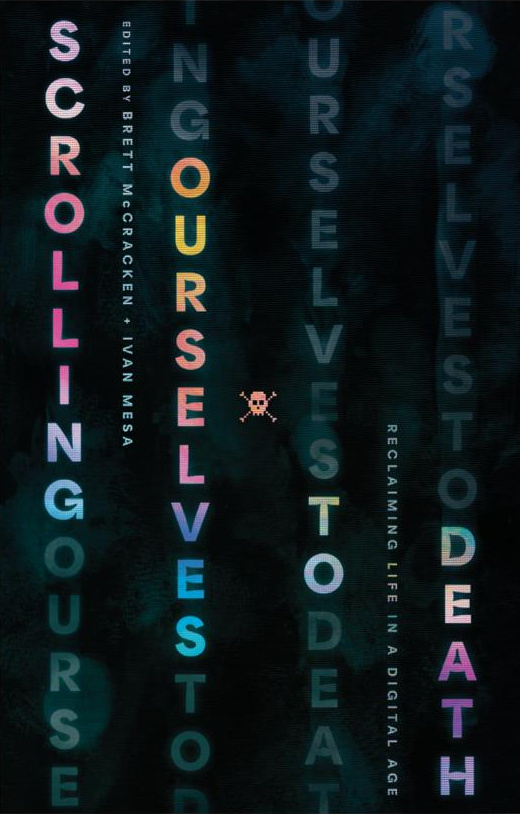
Scrolling Ourselves to Death: Reclaiming Life in a Digital Age

Rate this book
Christian Wisdom for Our Tech-Saturated Age

The rapid advance of digital technology is reshaping our world and warping our minds. The onslaught of social media and smartphones has brought an appetite for distraction, an epidemic of loneliness, and increased rates of mental unhealth. For Christians, the digital revolution has profound implications for spiritual formation and mission. How should believers respond to the theological and discipleship challenges of scrolling life?

On the 40th anniversary of Neil Postman's prophetic book Amusing Ourselves to Death (1985), Scrolling Ourselves to Death gathers today's most incisive writers to think critically about the shaping power of contemporary technology. This book explores Postman's insights, connects them to the challenges facing Christians today, and turns difficult challenges into life-giving opportunities for the church. Stepping back from their screens, listeners will be equipped to live faithfully, and grow spiritually, in a "scrolling ourselves to death" world.

Includes action steps listeners can use to reclaim a healthy life in a tech-saturated world Helps listeners become more discerning in the way they think about and utilize technology Useful for Church Leaders or Ministry Perfect for those who want to help those they lead think more carefully about technology Expert Features insights from a wide variety of leading Christian thinkers on technology, faith, and culture

256 pages, Paperback

Published April 15, 2025

188 people are currently reading
1748 people want to read

About the author

Brett McCracken

12 books219 followers

Ratings & Reviews

What do you think?
Rate this book

Friends & Following

Create a free account to discover what your friends think of this book!

Community Reviews

5 stars
311 (49%)
4 stars
233 (37%)
3 stars
71 (11%)
2 stars
11 (1%)
1 star
2 (<1%)
Displaying 1 - 30 of 159 reviews
Profile Image for Amanda E. (aebooksandwords).
151 reviews62 followers
May 1, 2025
Summary: This book is intended to get you thinking about phone and social media usage, in part by showing you how it is changing the way we think and how to wisely navigate this as believers.

Are our lives passing us by as we stare at a screen, spending time we’ll never regain? Is this our reality? Sadly—for most of us—it is. What can we do to terminate this sick cycle? How can we take back our focus—our souls—from deadening distractions?

Enter “Scrolling Ourselves to Death: Reclaiming Life in a Digital Age.” This book features chapters from authors such as Brett McCracken, Jen Pollock Michel, Jay Y. Kim, and others, drawing from Neil Postman’s “Amusing Ourselves to Death.”

“Dopamine media is the most powerful, pervasive, and engineered form of communication technology in human history, and it's not shaping us to love Jesus most. It's not shaping us to love our neighbor. It's shaping us into pleasure-seeking addicts.” - Patrick Miller

Fave chapters:

• From Amusement to Addiction: Introducing Dopamine Media
• From the Age of Exposition to the Age of Expression
• Striving for Seasonableness in a “Now . . . This” World
• Use New Media Creatively But Cautiously
• Cling to Embodiment in a Virtual World

“Ultimately, the call isn't to abandon technology but to bring it under Christ's lordship.”

This challenging book has already changed my life! Because of it I’ve drastically altered how I use my phone and social media. Of all the things I can’t stop thinking about this book, it’s that this book is a must read for all!

Highlights:

“...the way gambling works on the brain is exactly how dopamine media works.”

“Dopamine, plain and simple, dictates much of our behavior, especially online.”

“We must think carefully about why we find certain distractions, addictive, and cultivate in their place solid loves for the gifts with which God has filled his world.”

“Our flight into digital distraction is often Jonah-like; we want to forget these circumstances and delegate those roles.”

“The time we spend scrolling and wandering down algorithmic rabbit trails is often time taken directly away from the nobler, if harder, tasks God has given us to do.”

“…algorithmically driven social media tends to affirm and reinforce what we already believe.”

“...the onset of AI technology, which can put any words in anyone’s mouth in remarkably real-looking video or audio clips, gives us new reason to doubt online content’s trustworthiness.”

“We must step in and speak truth that gives life . . . lifting hunched-down faces to behold the one who is infinitely more satisfying than whatever fleeting amusements flash across our screens.”

Total: 4.75 Stars

Readability: 4
Impact: 5
Content: 5
Enjoyment: 5

Thank you to Crossway for gifting me a copy of this book. I am leaving this review voluntarily and was not required to leave a positive review. All opinions are my own.
Profile Image for Jared.
Author 22 books93 followers
January 7, 2025
The book begins with an incisive analysis of our cultural technopoly. Joe Carter and Samuel James's chapters excel here as well as Jen Pollock Michel's chapter, which is the first in the book to cast a clear vision for what new affections we might cultivate to, as the subtitle says, reclaim life in our digital age. In part 2, Nathan Finn's chapter on reading history is also excellent. In part 3, the contributions from Shane Morris (evaluating the Christian use of video/film), Jay Kim (on the necessity of embodied Christian community), and Andrew Spencer (which should've been titled "Consider the Amish") are stand-outs.
Profile Image for Jason Williamson.
41 reviews1 follower
May 10, 2025
An excellent modern Christian companion to Neil Postman’s classic “Amusing Ourselves to Death”. I love TGC books featuring many contributors, in this case, one per chapter. This book builds on the successes of Postman’s book while also avoiding some of the pitfalls, namely, the lack of actionable steps to avoid his dystopian vision of the future. In this book, each author leaves the reader with action steps to be taken both individually and corporately in Christian community to devote our lives to Christ, His people, and His good gifts, rather than “scrolling ourselves to death”.
Profile Image for Joshua Crask.
15 reviews7 followers
July 8, 2025
"meeting people where they are" does not necessarily mean "meeting people in the media format they most prefer". great read for the church to refocus ourselves in the digital age and includes practical points to not be too taken with our technology.
Profile Image for Alyssa Borwick.
60 reviews
August 12, 2025
Wow! I really enjoyed this. Gave me a lot to think about. Would recommend!

4.5/5
Profile Image for Dr. David Steele.
Author 8 books262 followers
May 2, 2025
The internet has changed life as we know it for the foreseeable future. Despite the benefits of recent technological tools, we are experiencing a phenomenon that should be of grave concern to pastors, parents, and Christian leaders. Some notable authors have highlighted how technological advances is hindering learning and even re-wiring the brain.

Brett McCracken and Ivan Mesa continue the discussion in their recent book, Scrolling Ourselves to Death: Reclaiming Life in a Digital Age. The editors of this fine book lock arms with a formidable team of pastors and Christian thinkers who are committed to offering biblical solutions in a world that is being manipulated by technological pirates, through artificial intelligence and algorithms.

The book draws some of its most potent material from Neil Postman’s book, Amusing Ourselves to Death, first published in 1985. Postman’s warning was apropos at the end of the twentieth century. It is even more serious now. Scrolling Ourselves to Death begins by focusing on Postman’s insights. Patrick Miller writes insightfully, “Your phone is a digital syringe. It’s a gateway to lifelong, brain-altering, relationship-destroying addiction.” Such a warning should readers to pause and reflect, leading them to the next section.

The book continues by noting some practical challenges that face Christian communicators. Matters of apologetics, epistemology, and theology are explored, all subjects that make good use of Postman’s timely observations. Thaddeus Williams makes the keen observation that “Christianity scratches humanity’s deepest existential itches for relationship, freedom, mystery, beauty, awe, hope, and more.” This powerful reality is seen throughout the book and serves as a testament to the authority of God’s word.

The book concludes with a section that provides insight on how the church can minister to a “scrolling death” world. Technological advances are not cast aside here; rather their use is encouraged with the caveat of caution. In an especially illuminating chapter, Read Mercer Schuchardt never repudiates the use of technology or media. But he does admonish readers to embrace their mission. He writes:

Go touch grass. Put down the phone, give up the screen, and initiate: no matter your age, stop scrolling and start your life. You need only ten thousand hours of deliberate practice to get good at something worth doing, and you’ve got that in spades if you give up the 10.85 hours per day currently devoted to media. That’s just 749 days to get really good at your skill, art, trade, or craft; that’s just two years, which is half the time it takes to acquire a college education.


Scrolling Ourselves to Death is a much-needed work. The authors pick up where Postman left off and offer readers a smorgasbord of practice tools for moving into the future with an eye on the gospel and a heart for the kingdom of God.

I received this book free from the publisher. I was not required to write a positive review.
Profile Image for Kevin Halloran.
Author 5 books101 followers
May 15, 2025
I had been meaning to re-read Postman's seminal work Amusing Ourselves to Death for some time, but I'm glad I came across Scrolling Ourselves to Death instead. The TGC team thoughtfully draws on Postman's core themes and applies them to today's digital landscape through a clear biblical lens. The result is a book rich in theological insight and practical wisdom, offering a timely challenge to engage with technology more intentionally and faithfully.
Profile Image for Jed Walker.
224 reviews17 followers
March 17, 2025
Early candidate for book of the year. Outstanding research and analysis that leads to practical discussions of how to navigate this critical topic. Honors Postman’s legacy in all the right ways.
Profile Image for Alex McEwen.
310 reviews2 followers
June 25, 2025
I finished Murray’s “Christian Baptism” a few days ago, and so Brett McCracken’s “Scrolling Ourselves to Death” came with me to the pool yesterday. It was an easy single sitting read at under 200 pages. Unfortunately, I don’t think I liked it.

McCracken sets out to build on Neil Postman’s classic “Amusing Ourselves to Death.” A book I recommend without hesitation to anyone trying to make sense of our media saturated age. In fact, McCracken goes as far to say this is meant to be a spiritual and cultural sequel, or at least a companion volume. The premise is solid. Postman’s warnings have only grown more urgent in the age of TikTok and algorithms fighting for our souls. And McCracken rightly identifies our scrolling habits as both a symptom and a driver of modern discontent.

But while it’s clear in its aims, the execution feels thin. The essays are only loosely connected reflections orbiting Postman’s insights. That’s fine as a format, but the downside is that the material quickly begins to recycle. After a while, I felt like I was reading the same five or six ideas again and again, just dressed up in slightly different language. Even the discussion questions, an otherwise welcome addition, begging to feel exactly the same after each essay. They all seemed to ask, how are you distracted? Where do you seek meaning? What is the impact of media on your formation? All important questions, but they blur together after a few iterations of the same question asked every few pages.

McCracken is pastoral and thoughtful, and occasionally he lands a line that sticks. But I found myself wondering if this book would have been stronger had it remained a short series of online essays. Or better yet, if it had encouraged readers to revisit Postman directly, perhaps with a companion guide. As it stands, I suspect the best approach would be to read the introduction and then skim a chapter or two that most piques your interest.

That said, I probably will return to the discussion questions as prompts for small groups or conversations. They aren’t bad, just repetitive. And without their inclusion, I don’t know if I would have allowed this boon to take up the shelf space when I finished.

As always, Crossway gives us a lovely page, typeface is excellent, and the paper weight is premium. But there’s absolutely no margin space to reflect on the questions they just asked you! You’re prompting me to journal. Give me the space to do it! Also, a book this saturated with facts just needs the margin space for you to take notes.

In the end, “Scrolling Ourselves to Death” left me a bit underwhelmed. It’s a beautiful book, physically. The topic is timely. The heart behind it is good. But the content doesn’t quite warrant the time investment especially when you can just read Postman himself, or even Jonathan Haidt’s “The Anxious Generation.”
Profile Image for Ivan.
754 reviews116 followers
September 28, 2024
Not because I’m one of the editors, but this volume has contributions from some of the most thoughtful people that I enjoy reading and learning from. We’re publishing this to coincide with the 40th anniversary (2025) of Neil Postman’s ‘Amusing Ourselves to Death’ (1985), as we think Christianly about technology, social media, and the task of Christian discipleship. Our aim is to gather clear, countercultural thinkers and brave prophets who, like Postman, sound necessary alarms and provide timely guidance. We need frequent reminders of how the ancient gospel can speak truth and shape life in our brave new world. We pray this offers a bracing and hope-filled word to the church.
Profile Image for Anthony Joseph.
104 reviews3 followers
May 15, 2025
The more books I read about technology and it's effects on us, the more I learn about how so deeply formed we are by it. Scary.

Of those books, this one might be my favorite. Really well researched. Convicting. It's less practical but I'm still feeling very called-to-action.
Profile Image for Melanie.
2,215 reviews598 followers
August 1, 2025
Scrolling Ourselves to Death is a collection of writings by different authors. The book quoted Neil Postman's "Amusing Ourselves To Death" a lot and had some good points. I definitely think "scrolling" and/or entertainment can be an addiction and we need wisdom with how we use our time. It is definitely a struggle!

The book did feel a bit repetitive at times, but it was a pretty easy read. All in all, a powerful read at times and a good reminder to use wisdom with how to live in our tech-saturated world.

*Disclosure of Material Connection: I received one or more of the products or services mentioned above for free in the hope that I would mention/review it. I was not required to give a positive review, only my honest opinion - which I've done. All thoughts and opinions expressed are my own and I only recommend products or services I use personally and believe will be good for my readers. I am disclosing this in accordance with the Federal Trade Commission's 16 CFR, Part 255: "Guides Concerning the Use of Endorsements and Testimonials in Advertising.*
Profile Image for Noah Senthil.
82 reviews2 followers
December 17, 2025
This is my 2nd full read. But I’ve read the chapter by Read Mercer Schuchardt—one of Neil Postman’s former students—at least 4 times in the past year. It is piercing and prophetic. One of the best essays (though more like a rebuke/exhortation) on technology and human flourishing I’ve ever read. When I was in undergrad at Wheaton, everyone knew who Dr. Schuchardt was because you either loved him and imitated his way of life or thought he was the most annoying professor on campus, even if you never met him. I was in the latter category of students. I was totally wrong about him. Almost all of his opinions that I thought were absurd—which I heard via other students—I now agree with. Such is life!

Brett McCracken’s chapter on the separation of information and action is also profoundly true and particularly helpful in matters I’ve been navigating recently. Overall, Brett and Ivan did a great job compiling and editing this volume. An impressive achievement.
Profile Image for Rachel Ekberg.
115 reviews2 followers
August 16, 2025
A very helpful update to Neil Postman’s book “Amusing Ourselves to Death” that moves past postman’s focus on TV to consider the impact of social media. It also includes more useful application but does suffer from a little unevenness in the writing as each chapter has a different author.
Profile Image for Faith.
145 reviews25 followers
October 1, 2025
Out of all the tech-debunking content I’ve read this was by far the most clear, helpful, and convicting. I’d highly recommend this book and considering what are the costs of consuming the media that you do!
Profile Image for Bobby Bonser.
276 reviews
July 14, 2025
Every so often we must pause from our media reverie and ask reflective and hard questions about our use of technology:
What are my technology habits doing to my brain?
How is my use impacting my relationships?
What is my reason for using it?
Where do I find myself addicted or drawn in to use it too much or for the wrong reasons?
What can I replace these habits with that are more productive for eternity and the sake of Christ?

This book fundamentally is an update/addendum to Neal Postman's oddly prophetic (in a non-mystical sense of the word) classic written in the 80s "Amusing Ourselves to Death", written before the advent of the Internet.
(McCracken references Postman often, so I would highly recommend reading Postman's book before diving into this one. It's a "must read" book in my opinion).

That being said, this was a refreshing addendum to Postman in two ways:
1. It is updated by about 50 years, for the age in which we live (internet, smart phone, AI). Now that we have lived with the Internet for about 4 decades, we have much more science and study about what the Internet is doing to our brains and society at large. Some of the effects are positive, most are negative. But everyone is swept up into the age whether we like it or not, as the new technology renders functionality in society very difficult if you choose to completely abstain.

McCracken wades through this research, highlighting the science and providing caution, whilst also having a realistic view of how to live in this tech culture as Christians. Which leads to my next point.

2. The analysis is helpful because it is from a Biblical perspective. Postman, being Jewish, hints at the impacts of technology individually, as a society, and then hints at how this may affect the way we think about or worship God. McCracken, writing from a Biblical Worldview, tackles these questions and issues head-on. How do we, as Christians, think through and resist the media frenzy while also not becoming luddites? What should churches do to guard against some of the pitfalls of this technology frenzy? How should church leaders think through these issues to help others and shepherd people in their families and relationships (parents, children, students, etc.). The implications drawn from these questions will necessarily inform how we function in these relationships, and day-to-day how we use our time to honor Christ.

He does a good job in the book of not "prescribing" a certain exact rule or set of rules, but merely raises questions and poses thoughts through research and bringing the Bible to bear on thinking through these ideas.

One critique I have is that would loved to have heard more of the gospel in the book itself. While that wasn't his primary purpose, I think there were natural moments in the book that a discussion about how the good news of Christ's death and resurrection intensely impacts and changes our desires even in the way we use and choose technology daily. He could highlight a little more clearly the security we have in Christ; that even as we fail and continue to battle these daily inundations, we must run to the cross where we see our precious Savior who died for our sins.

Overall, this is a very helpful book, written this year (2025) that I think everyone should put on their "to read" list.
Profile Image for Josh Kannard.
86 reviews1 follower
July 30, 2025
Read for a summer book group at my church.

I found this book to be pretty uninspiring. I think that it suffers from the very thing it's against. With 14 chapters (+ the intro) over 216 pages of text, all isolated and writen by different authors, the book doesn't really have the ability to make a profound cohesive argument. It's just an collection of brief snapshot chapters that remain shallow. I would rather have spent my time directly reading Postman.
Profile Image for Michael Philliber.
Author 5 books69 followers
May 31, 2025
I read Neil Postman’s “Amusing Ourselves to Death” years ago. His point, back in the 1980s and 1990s, was about the way we have become an entertainment culture, where television and televised news media, have sucked the life out of our ability to have healthy discussions, process news, and reason. I was delighted that Crossway has just recently pulled together a team of thinkers who are not anti-technology, but want to help fellow Christians think through technology – especially in the areas of multiple media venues, AI, cyber-space, etc. “Scrolling Ourselves to Death: Reclaiming Life in a Digital Age,” is a 256-page softback edited by Brett McCracken, an author and senior editor for the Gospel Coalition, along with Ivan Mesa, editorial director for the Gospel Coalition. This highly readable book is “intended to get you thinking about technology…showing how technology is changing the way we think” (pg. 11). This material is clearly for the digital natives (Millennials and GenZers – those who grew up with the internet and smartphones). But also, those of us who are digital immigrants (Boomers and older GenXers – who came from a land and time before there was even a dial-up internet connection), have much to gain here as well.

The chapter contributors cover a wide spectrum of academics, editors, pastors, and more: Collin Hansen, Read Mercer Schuchardt, Joe Carter, Jen Pollock Michel, Hans Madueme, Samuel D. James, Nathan A. Finn, Jay Y. Kim, Patrick Miller, Keith Plummer, Thaddeus Williams, G. Shane Morris, Andrew Spencer. Each writer brings a unique perspective into the discussion from different angles. The variety ensured that there was never a dull moment as I worked through each chapter.

The book could have become a “Technology-is-utopia” panegyric, or it could have swung to the other extreme and been a dark and dismal dystopian diatribe. Instead, each author, interacting with Neil Postman’s works from the 20th Century, brings Postman’s analysis into the 21st Century, and works through his warnings and evaluations with fresh eyes. There is analysis of what is being done to us, the behind-the-scenes intentions (gathering audiences by dopamine addiction who can be sold to advertisers), and the way it changes our views and understandings of God, self and what it means to be human.

But all the way through are remedies and ways of resistance – not a “rage against the machine” kind of defiance. Rather, Christian maturity and soberminded types of resistance. One of the main ways to stand our ground, as shown by multiple contributors in these pages, is personal presence in people’s lives and flesh-and-blood congregations worshiping and serving together. In the snazzy way that Read Mercer Schuchardt puts it (drawing from Jacques Ellul), L’existence, c’est resistance! – Existence is resistance (pg. 185)! Or Andrew Spencer’s deliberative declaration, “Widespread resistance to technological dominion can happen only when robust communities with strong social fabrics enable that resistance…Christian communities have the resources to resist the negative influences of technology and break the self-reinforcing feedback loops a tech-saturated society creates. We have the gospel’s hope to guide us beyond the utopic technological visions of our day” (pg. 206).

My copy of this book is underlined, dog-eared, and ruffled all the way through. Many of the conclusions are conclusions I have been aiming at and pointing to for years (See my books, “Gnostic Trends in the Local Church,” “Our Heads on Straight: Sober-mindedness – a Forgotten Christian Virtue,” and “Beyond Outrage: Vetting Media to Increase Sensibility and Stability”). I could fill this book review with a bushel of quotations from “Scrolling Ourselves to Death” that would ring your bells and possibly bring you to tears. But I will leave things here.

If you’ve begun to despair over how “the algorithm serves us what we crave, not necessarily what we need for spiritual nourishment” (Hansen, pg. 102); or if you have finally seen how the disembodied cyber-world has brought us to conclude that our “bodies don’t define us; our desires do” (Michel, pg. 53), then here is some help! This is a must-read-must-discuss book for church leaders of all stripes, Christians, parents, and all who are beginning to sense this thing is about to race beyond our restraining reach and turn back around on us and consume us. I strongly recommend you grab hold of a copy of “Scrolling Ourselves to Death” yesterday! Okay, that was a bit melodramatic, but you get the urgent point.
Profile Image for Christine.
211 reviews
June 30, 2025
I almost skipped this one because I'm a little tired of the topic... but I loved this! loved his approach.
Profile Image for Jacob Marker.
28 reviews
December 14, 2025
Pretty fascinating content! This book does a good job of not only continuing the conversation for Postman for modern day readers but also viewing it through an explicitly Christian lens. Additionally I appreciated that it was a selection of essays from various writers. It diversified my thinking to see the problem from different angles but also helped me to see where consensus was made.
Profile Image for Aneurin Britton.
72 reviews1 follower
October 4, 2025
Really insightful! I do not agree with all said the points made. But I thought this really highlighted the need for real relationships, authenticity, and careful consideration of the way we reach people for Christ!
47 reviews
May 5, 2025
Excellent. Should be read by many. There were many valuable insights I took away from the book, but here are the main ones, with some quotes:

How seductively powerful is the addictive, dopamine-releasing effect of social media, and how careful Christians must be if we are to live “as wise, making the best use of the time” (Ephesians 5:15-16Open in Logos Bible Software (if available)).

“Dopamine media is designed to distract us to death. Or, if we’re more honest, to distract us into an addiction that leads to death…. The best of us are responsible users who can consume media in moderation. But none of us is fully sober…. If the first victims of our addiction are our time and attention span, the second (and far more important) victims are our families and relationships.” (Patrick Miller 27-28)

“Dopamine media is the most powerful, pervasive, and engineered form of communication technology in human history, and it’s not shaping us to love Jesus most. It’s not shaping us to love our neighbor. It’s shaping us into pleasure-seeking addicts. Christians must recognize that, at its heart, this technological revolution has resulted in an institutional, relational, and formational crisis for the church.” (Patrick Miller, 28)
How social media tempts us to replace in-person, embodied relationships with online, disembodied relationships:

“And with each click, swipe, and scroll, we encounter yet another series of faces ‘whose smiling countenance is unalterable,’ offering us polite pleasantries and robbing us of the messy, painful, beautiful, and transformative gift of meaningful community as the embodied church.” (Jay Y. Kim, 195)

“The time we spend scrolling and wandering down algorithmic rabbit trails is often time taken directly away from the nobler, if harder, tasks God has given us to do.” (Samuel D. James, 86)

“It is one of the evils of rapid diffusion of news that the sorrows of all the world come to us every morning. I think each village was meant to feel pity for its own sick and poor whom it can help and I doubt if it is the duty of any private person to fix his mind on ills which he cannot help. (This may even become an escape from the works of charity we really can do to those we know.) A great many people do now seem to think that the mere state of being worried is in itself meritorious. I don’t think it is.” (C.S. Lewis, quoted by Brett McCracken, 169)

“When pastors and church leaders give inordinate energy toward online engagement, unintentionally conceding our ecclesiology to the comfort and convenience of digital platforms, we reshape congregations into audiences. Teaching gives way to entertainment. Communion gives way to commercialization.” (Jay Y. Kim, 200)
How the internet and social media disrupt our view of and attitude authority and institutions:

“We need only notice how many Christians decide their lives today not by external forms of authority (the Bible, church leaders, generational and communal wisdom) but because of their ‘deeply felt personal insight.’ According to (Charles) Taylor, this translates as radical religious individualism. ‘The religious life or practice that I become part of must not only be my choice, but it must speak to me, it must make sense in terms of my spiritual development as I understand it.’ In this spiritually expressivist house of cards, our emotions and intuitions confirm truth. If we participate in community at all (and many do not), our loyalties are often self-selecting along demographic, partisan, and ethical lines. We seek less to be transformed and more to be ratified.” (Jen Pollock Michel, 54)

“Compared to twenty years ago, the internet—not the local church—has become the primary place wehre Christians are formed today. Before their leaders ever speak, many church members already know what they believe. After all, they’ve been reading, listening, and watching their favorite teachers all week. And they expect their leaders to conform—or else. Preaching, then, is expected to confirm the convictions already developed through the internet.” (Collin Hansen, 94)

“The world can’t do without the local church. And the world can’t do without preachers who exposit God’s word for people they know and love by name. I urge preachers to think small…. What if Christians knew this message was for them—right here, right now? What if they knew they couldn’t get that message unless they showed up in person? What if they knew it wasn’t interchangeable with a digital devotional or sermon podcast or YouTube clip?” (Collin Hansen, 101)
How social media discourages deep, careful thinking, and patient, loving conversations, both of which play vital roles in Christian formation:

“While social media is ill-suited for nuanced reporting and fostering meaningful discourse about substantive issues, it excels at fanning the flames of partisanship and exacerbating the ‘us vs. them’ narratives that now dominate politics. Social media rewards incendiary statements and discourages careful rhetoric, transforming politics into a schoolyard where bullies who make the loudest noise attract large followings. No wonder ‘trolling’ has become common practice for leaders and politicians at the highest levels.” (Hans Madueme, 68-69)

“Christians struggling to answer deep questions should consider how face-to-face conversations, thoughtful books, and other resources are more naturally conducive to slow, meaningful thinking.” (Samuel D. James, 84)

“The most successful TikTok videos last between twenty-one and thirty-four seconds…. Experts tell us the average person takes 10 to fifteen seconds simply to process a new piece of information. It takes far longer to consider it and formulate a response. By that time, a new video is queued up and tailored teasers beckon us: ‘Watch this next!’ Such insectile intervals mean human cognition is literally incapable of doing anything with information presented in this format. We experience it more with our reflexes than with our minds.” (G. Shane Morris, 149)
How the “information glut” of nonstop news and social media can deaden our powers of wisdom and discernment, and distract us from what’s most important:

“Our feeds alternate seamlessly between the useful, the tragic, the absurd, the outrageous, and the pointless. Constructing order out of this chaos requires the wisdom tradition of seasonableness, which both limits and orders our consumption. It’s a way Christians can actively push back against the consuming, mind-numbing effects of ‘everything, all of the time.’ (Samuel D. James, 87)

“The information glut has many side effects…. These include information trivialization…(‘How serious can a flood in Mexico be, or an earthquake in Japan, if it is preceded by a Calvin Klein jeans commercial, and followed by a yogurt commercial’); a tendency toward impatience, forgetfulness, and poor logic in how we process information; and a massive shift in the formula for political success.” (Brett McCracken, quoting Neil Postman, 7)
Profile Image for Alicia Rushton.
16 reviews
September 14, 2025
This book is a collection of 14 chapters authored by different Christian contributors discussing the impact of advancements in technology on our culture and ourselves centered around insights and predictions raised by Neil Postman in his 1985 book Amusing Ourselves to Death. It’s written specifically to Christians to explore proper responses and strategies for faithfully navigating the world we find ourselves in. Postman had been concerned about serious negative impacts television would have on culture. I have never read Postman’s book, but according to this book, Postman’s concerns seem overwhelmingly on-point. It might have been tempting at the time to dismiss him as a pedantic curmudgeon who simply didn’t like new technology. However, hindsight seems to confirm his concerns regarding television (or other screens now) having negative impacts on attention, complex discussion, abstract reasoning, politics, preference for emotive responses, and more. One author writes, “Postman thought TV-cultivated a highly subjective, highly expressive, highly therapeutic, and highly individualized way of perceiving the world and self, and of evaluating truth.” One shudders to think what he might have said about smartphones, social media, and other modern apps that many of us allow to keep us glued to our screens.
Speaking for myself, as one who has struggled with the addictive effects of smartphones and social media, the warnings seem timely. Around the beginning of this year I deleted Twitter from my phone because I had been spending so much time on it that I literally had a hand injury which terrified me because as a nurse I need dexterity to do what I do. When I would take SM breaks I would find myself scrolling my email because apparently my phone needed to be in my hand. And I hate email! 🤦‍♀️ My excuse that had kept me on twitter was the scattered theological or philosophical conversations I had from time to time with people more learned than myself on things like divine simplicity, Trinitarianism the Filioque, etc. but so much of my time on there was less productively spent. I’m glad that I had begun to take more steps to decrease my addictive relationship to my phone use prior to reading this book, but still ashamed that it took a physical injury to motivate me to successfully change and I still have regrets about my current usage. I think this book is helpful in confronting us with potential ways that technology is shaping us and the world intentionally or not, challenging us to think through the risks and trade-offs proactively instead of passively letting technology steer us inexorably down a path of least resistance.
In one of the last chapters, the author reordered two thoughtful questions from Postman to ask when considering new technology, “What is the problem that this new technology solves?” and “What new problems do we create by solving this problem?” It reminds me of the Thomas Sowell quote, “There are no solutions, only trade-offs.” Do we gain more than it costs us? Twitter and my smartphone use generally had begun to cost me a great deal more than it gave me. I think it’s a cost-benefit analysis that I will need to constantly revisit.
Another timely issue brought up in the book was something Postman called the “information-action ratio.” The author of that chapter writes, “For most of human history, there was a high correlation between the information that filled human brains and the tangible actions they could take in response…But all this changed Postman argued, with the invention of the telegraph.” Postman said, “For the first time in human history, people were faced with the problem of information glut, which means that simultaneously they were faced with the problem of a diminished social and political potency.” Connected to this issue is the phenomenon that on social media, being informed tends to be seen in and of itself as a social virtue. But why? If you can’t do anything about the endless tragedies we read of except feel angst, what’s the point? To that point, the book relates a quote from C.S Lewis, “A great many people do now seem to think that the mere state of being worried is in itself meritorious. I don’t think it is.” The book encourages us to strive for a more balanced information-action ratio. Don’t let problems far away that you can’t hope to fix, distract you from needs in your local community that you can help fix.
And perhaps most importantly, the book encouraged readers to lean into the local church community, to a pastor and people who know you and whom you can know as counter-cultural as that may be.
My favorite chapter was Thaddeus Williams’ Chapter titled Telling the Truth about Jesus in an Age of Incoherence. A major idea of his chapter was how incoherent the constant stream of information that flashes before us can be. We see a video of a murder, scroll past an ad for dish soap, see images of a far-away disaster, and then a pic of a friend’s baby all in a few seconds. In addition, we are hit with misinformation, disinformation, and the relativising of truth. He wrote, “In a culture devoid of a grand meaningful story and turning to inadequate, ultimately dehumanizing stories, it is the Christian’s task to tell the better story. Tell the best story. Tell the Bible’s story of creation, fall, redemption, and consummation. Tell in the pulpits the good news of Jesus’ perfect life, substitutionary death, and bodily resurrection. Rehearse the story in the sacraments. Catechize your children into that story. Heavily stock a church library with the great theological minds who expose that sorry. Embody that story by living a life marked by grace and love in the context of real-flesh-and-blood, first-name-basis communities.”
Profile Image for JD.
45 reviews
June 20, 2025
Very informative book that challenges Christians to carefully evaluate technology and its uses. More than ever there seems to be a need not to go forward in technology (especially any that brings entertainment, news, or the like) but to resist it. We live in an age of excess; we were made for simpler things. The damage that the internet and smartphones have done to us, especially young people whose brains are still developing, is incalculable. The future of Huxley’s “Brave New World” is here, where pleasure rules at the cost of our minds, our time, our families.

This book is a call not to throw all our technology out the window and return to the Stone Age, but rather to examine technology and ask, “How will this improve my life?” or more pressing, “How will it harm my life?”

As we practice resisting these things, we must also practice connecting with our world and those in it. Go outside, enjoy God’s creation. Spend time with real people, not their curated avatars. Read lots of books, not just the reviews. Make things, not watch other people make them. Have a life beyond your screens.

Ironically I’m posting this with my phone, but Goodreads is one very few apps I use regularly. My average screen time a day is slightly under two hours, compared to the seven hours that’s typical of most smartphone users. I don’t say this brag, but to point out that living minimally with your phone is possible— and you’ll physically, mentally, and emotionally feel way better for it.

The path to freedom is to limit your phone. When you cut away your addictive social media, games, and streaming services (among other things), you aren’t missing out— you’re prying the bars off your cage. Delete apps and whole accounts, if you can. Unsubscribe. Set restrictions on websites. Be in control; whatever you do not master will master you.

Is this easy? Not at all. This requires sacrifice. But you will feel better, in the same way a living human would feel better than an undead zombie. Zombies don’t reason, they only consume. God did not create us to only consume, but to contribute, to serve, to love. And the best way to do that is in person, by being the hands and feet of Jesus, who walked among us in the flesh, touched the untouchables, spoke life to the spiritually and physically dead, and gives us a tangible hope and a real mission. Our friends and families are addicted to technology; they need us to put down our phones and pick up our crosses. They need us to point them back to Christ, who satisfies our every longing, whose joy lasts longer than the dopamine hits in our scrolling. They need someone who walks in freedom to help them walk free themselves.

Will we be those people?
Profile Image for Kev Willoughby.
578 reviews14 followers
September 17, 2025
"Our addictive drug of choice isn't ingested or injected; it's consumed ocularly. The tradeoff we all make in the digital era is not merely between substantive and trivial discourse. It's between sobriety and addiction." - Patrick Miller

This book is scarier than any horror story, because it isn't fiction. Even before reading this, like most people in the 21st century, I understand that I spend "too much time" on my phone.

However, that is surface-level thinking. I already knew that before I picked up this book, but that knowledge hasn't really changed my digital behavior until now.

The implications of making a daily decision to spend quality time with a digital device is much more far-reaching than I realized. This book unveils the reality of how sinister our electronic devices actually are.

I can't say it any better than Patrick Miller does in Chapter 1 (From Amusement to Addiction: Introducing Dopamine Media): "It's easy to think smartphones are just an extension of TV technology, but even though the phone in your pocket looks like a tiny TV, it's actually something far more nefarious. Your phone is a digital syringe. It's a gateway to lifelong, brain-altering, relationship-destroying addiction."

I had to read that again... digital syringe... lifelong... brain-altering... relationship-destroying...

Destroying!

Addiction.

And I play games on it.

I actually think of it as a fun diversion at the same time that it is actively changing who I am each time I pick it up and invite it to continue amusing me.

And I keep scrolling.

Digital syringe.

This book should be mandatory reading for all digital citizens, and then I should be required to read it again each time I purchase a new cell phone. I especially was convicted by Read Mercer Schuchardt's challenge when he said, "See if you can be a participant in life, more than a virtual spectator of other people's lives."

I had never thought of it quite that way before, but that is an accurate depiction of many of the things I do while holding my phone. I'm watching other people live their lives. And what's more is that there's no satisfaction in doing so. Schuchardt describes the research available to us that reveals, "Digital media has played its hand and by almost all quantifiable measures, its primary effect has been to perpetuate despair in the human soul."

Have you ever watched a scary movie and been dumbfounded at how naive the characters are as they seem to foolishly, if not eagerly, put themselves squarely in harm's way? Like me, you might have even found yourself shaking your head at their stupidity as you watched them making fatal decisions.

I could always walk away at the end of the movie though, knowing it wasn't real.

However, this book made me realize that I'm the naive character. Only I'm not on the screen; instead, it's right in front of my face. And I'm foolishly, if not eagerly, putting myself in harm's way each time I voluntarily bring it out and begin to scroll, with a nonchalant awareness of impending doom.

Only it's not a movie.
Profile Image for Joshua Bremerman.
131 reviews3 followers
June 6, 2025
As with any compilation of essays, some really interesting, some not so interesting. I have grown disaffected by some of the authors, but overall I found the book well done. They traverse common questions through the lens of Neil Postman, and I was overall pretty interested throughout.

Chapter 12 by Read Mercer Schuchardt is perhaps the best treatment of tangible participation in the world that I have ever read. The statistics and science on what is happening to our brain in the digital age, while not new, is always sobering.

My biggest critique, and probably my biggest critique of the TGC world in general, is that many authors seem like they want to sound smart. It’s hard to describe, but the engagement with Postman, then stats, then obscure philosopher X, comes off pseudo-intellectual at points—like they are trying to prove themselves to somebody, but definitely not the normal person.

A second critique is that if the problem is as dire as described, and I believe them, then act accordingly. The solutions are so often “We can find the right balance.” How about we actually believe all the good analysis and really make some changes instead? This is probably why I found chapters 12 and 13 (to a lesser extent) so good. These authors, actual students of Postman, I believe, seem to actually practice what they preach (at least as far as I can tell from the chapters).
Displaying 1 - 30 of 159 reviews

Can't find what you're looking for?

Get help and learn more about the design.