Jump to ratings and reviews
Rate this book

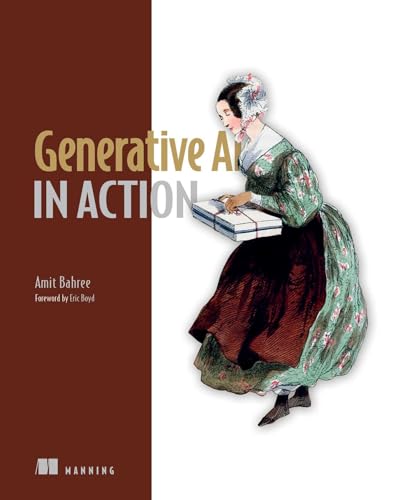
Generative AI in Action

Rate this book
Generative AI can transform your business by streamlining the process of creating text, images, and code. This book will show you how to get in on the action!

Generative AI in Action is an engaging, practitioner-focused companion that reveals how large language models drive transformative software solutions. Building on Amit Bahree’s extensive background in AI and machine learning, it illustrates core concepts by demonstrating text, image, and even music generation—spotlighting the versatility of these models. Beyond the technical fundamentals, it delves into deployment best practices, performance considerations, and ethical responsibilities, ensuring you’re well-prepared to bring generative AI into enterprise contexts with confidence.

Inside Generative AI in Action you will

• A practical overview of of generative AI applications
• Architectural patterns, integration guidance, and best practices for generative AI
• The latest techniques like RAG, prompt engineering, and multi-modality
• The challenges and risks of generative AI like hallucinations and jailbreaks
• How to integrate generative AI into your business and IT strategy

Generative AI in Action is full of real-world use cases for generative AI, showing you where and how to start integrating this powerful technology into your products and workflows. You’ll benefit from tried-and-tested implementation advice, as well as application architectures to deploy GenAI in production at enterprise scale.

About the technology

In controlled environments, deep learning systems routinely surpass humans in reading comprehension, image recognition, and language understanding. Large Language Models (LLMs) can deliver similar results in text and image generation and predictive reasoning. Outside the lab, though, generative AI can both impress and fail spectacularly. So how do you get the results you want? Keep reading!

About the book

Generative AI in Action presents concrete examples, insights, and techniques for using LLMs and other modern AI technologies successfully and safely. In it, you’ll find practical approaches for incorporating AI into marketing, software development, business report generation, data storytelling, and other typically-human tasks. You’ll explore the emerging patterns for GenAI apps, master best practices for prompt engineering, and learn how to address hallucination, high operating costs, the rapid pace of change and other common problems.

What's inside

• Best practices for deploying Generative AI apps
• Production-quality RAG
• Adapting GenAI models to your specific domain

About the reader

For enterprise architects, developers, and data scientists interested in upgrading their architectures with generative AI.

About the author

Amit Bahree is Principal Group Product Manager for the Azure AI engineering team at Microsoft.

The technical editor on this book was Wee Hyong Tok.

Table of Contents

Part 1
1 Introduction to generative AI
2 Introduction to large language models
3 Working through an Generating text
4 From pixels to Generating images
5 What else can AI generate?
Part 2
6 Guide to prompt engineering
7 Retrieval-augmente

839 pages, Kindle Edition

Published November 26, 2024

Loading...
Loading...

About the author

Amit Bahree

7 books2 followers

Ratings & Reviews

What do you think?
Rate this book

Friends & Following

Create a free account to discover what your friends think of this book!

Community Reviews

5 stars
10 (38%)
4 stars
7 (26%)
3 stars
5 (19%)
2 stars
3 (11%)
1 star
1 (3%)
Displaying 1 - 5 of 5 reviews
Profile Image for Matt Busche.
185 reviews8 followers
December 24, 2024
Going with a higher rating based on "how much I recommend" vs "how much did this book help me"

If you're just getting started with Generative AI this book is an excellent read.

If you're not a beginner, it's still worth your time, but I give it a 3 if you have experience with Generative AI.
Profile Image for Zumrud Huseynova.
242 reviews3 followers
June 14, 2025
left at the part 3, as further than that is not relevant for me right now.
640 reviews13 followers
August 17, 2026
The time pressure to deliver something about generative AI must have been immense, judging by the quality of this book. Part One (“Foundations”) reads like AI slop straight from the prompt to the page. It is full of endless repetition, explaining the same concepts over and over again. Some of the examples are questionable (such as the one involving the math problem), the visualizations often seem only loosely connected to the text, and the author cannot seem to decide whether this is supposed to be a high-level overview or a detailed guide explaining every parameter of an API.

The editing does not help. Putting an image between the text introducing a list and the list itself should simply not happen. One code example uses syntax highlighting; the next does not. Taken together, it all feels rushed and lacking in basic editorial attention.

Part Two (“Advanced Techniques”) improves somewhat. The chapter on prompt engineering is decent and, thanks to concrete examples, genuinely useful - although parts of it may already be outdated when applied to the newest frontier models. The chapter on RAG also starts well, particularly as an introduction to building the necessary infrastructure. It is too superficial to be directly usable, but at least it offers some actionable advice.

Unfortunately, the following chapter on chatting with your data does not build on the RAG example. Instead, it takes a detour through Microsoft Azure tools to discuss enterprise requirements, illustrated with Redis running the author’s blog in Docker. This is followed by yet another explanation of how vector databases work before eventually continuing with Azure OpenAI. The final chapter in this part covers fine-tuning, but unfortunately does so entirely through Azure, which made it of little use to me.

Part Three begins with a wild mix of frameworks for application architecture, followed by yet another Azure OpenAI sales pitch. By this point, it feels as though the author is running out of chapters and throwing everything together in the hope of finishing the book. Important aspects get lost in the sheer number of topics.

The chapter on evaluation and benchmarking illustrates one of the book’s fundamental problems: without a clear, consistent example that we have followed throughout the book, there is very little to meaningfully benchmark or evaluate. Instead, we get a long list of names and concepts that seems designed mainly to cover all the bases.

Only in the final chapter do we finally get a more substantial discussion of risks, limitations, and hallucinations rather than simply seeing these terms mentioned. Ignore the opening statement, “We covered hallucinations earlier and won’t go into much detail again.” This is where we actually get some detail. If the section on ethical generative AI sparks your interest, however, you are out of luck. There is plenty of discussion about why GenAI should be ethical, but very little concrete guidance on how to achieve that in practice. A handful references to external sources is not enough.
Overall, the book is far too focused on Microsoft Azure products and feels rushed, repetitive, and poorly structured. It has its moments, like the compact table describing API roles was genuinely useful. But they are nowhere near enough to justify a 450+ page book.

I cannot recommend it.
Profile Image for Raoul.
54 reviews1 follower
May 1, 2025
The book covers a good range of topics and seems largely accurate, but it's full of slop like the below (chosen by opening the book on a random page, so it's not even particularly cherry-picked). The writing may well be entirely human, but many passages read as if they were written by GPT-4. Given that better models now exist, you'll probably get more up-to-date information with less bloat if you just feed the table of contents into a frontier model and ask it to walk you through each of the areas.

While RAG is still in its early stages of development, it holds the potential to transform
the landscape of text generation models. RAG can be harnessed to produce more
comprehensive, varied, and factual text generation models for many applications.
This section delves into the myriad of benefits that enterprises can gain.

RAG’s ability to draw data from external resources in real-time is a game changer
for sectors that require up-to-the-minute data, such as finance, healthcare, or news.
Whether tracking market dynamics, updating healthcare records, or breaking news,
RAG guarantees the inclusion of the latest information. This ensures that the output
is consistently relevant and current.
Profile Image for Abhishek.
12 reviews1 follower
June 14, 2025
Lots of things to learn. Good book for beginner to start working on GenAI tech.
Some things were repetitive. Book could be a bit shorter.
Displaying 1 - 5 of 5 reviews