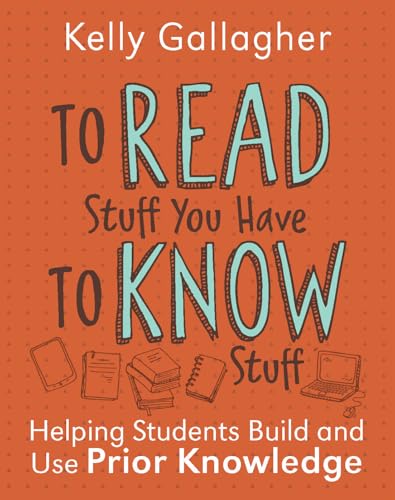
In the age of click-and-go reading, why do students need to know information when they can just look things up?
Bestselling author Kelly Gallagher argues that to think critically, it’s imperative that we teach kids stuff. Lots of it. Why? Because students who know more are able to read more, and read better.
In To Read Stuff You Have to Know Stuff, Kelly draws from his own teaching practice to share the importance of building students’ prior knowledge at four
How building knowledge helps students to overcome word poverty
Sentences and How building knowledge helps students to comprehend “small” reading
How building knowledge helps students to critically read articles―an important skill in our digital age
How building knowledge moves students away from fake reading and back into reading full-length books
To Read Stuff You Have to Know Stuff also shows how students can monitor their own comprehension. They can see that many reading difficulties aren't the result of not being a "good reader"― they simply lack knowledge.
Our students are fortunate to live in an age where so much information is a click away. But to read well―and think well―they need to own that knowledge.
I always find myself nodding my head when reading this author’s books, as I did when I saw him in person at a PD session. This book connected with everything I believe to be true about teaching literacy, and gave me some great ideas for doing so. This is a solid teaching resource.
I love a Kelly Gallagher book on teaching. I (always) find myself inspired and mind-blown. If you're a teacher of adolescents, and you're not reading KG's books, you're missing out.
Want your boost your students' reading skills? Or grow their critical thinking ability? Or increase their vocabulary? You can do all three at once by intentionally adding to your students' background knowledge. This book offers incredibly practical tips for teachers to do exactly that, and unlike most nonfiction about teaching strategies, it's a delight to read. My copy is chock full of book darts and highlighter tape, and I find myself referring back to it often. Thanks to this book, I'm feeling inspired and empowered to not only build my students' background knowledge but my own as well.
Kelly argues that to think critically, it’s imperative to teach kids stuff. Lots of it. Why? Because students who know more are able to read more, and read better. He identifies the assumptions that many make, primarily that teachers can just tell kids to read and they will do it, and that students can just look things up when they don’t know something. He then gives a very "hands-on" approach to the teaching of reading, starting with word work and moving through passages and finally to whole novels. This step-by-step approach helps kids build the knowledge they need to be successful readers. As usual, Kelly goes to some of his favorite sources, other leaders in the field of education (past and present): Penny Kittle, Kylene Beers, Bob Probst, Tom Newkirk. Be he also draws from his own teaching practice to share the importance of building students’ prior knowledge. Building knowledge helps students to overcome word poverty, to comprehend “small” reading, to critically read articles—an important skill in our digital age, and moves students away from fake reading and back into reading full-length books. Kids are fortunate to live in an age where so much information is a click away. But to read well—and think well—they need to learn to monitor their own comprehension and see that many reading difficulties aren't the result of not being a "good reader"— they simply lack knowledge. This is a great book for all types of educators and takes a lot of Gallagher's specific focus on literacy in the English classroom and applies it in a way that is accessible to other subjects. For those who are familiar with Kelly’s work, you will not be surprised when he makes connections to baseball or crime dramas, but be prepared for him to express his opinion vociferously about censorship, diverse literature, and educational policy. His work inspires me, but I do not agree with all of his ideas. 4
Gallagher does it again. This is an excellent book that ironically and frustratingly does not have an e-book format despite having an audiobook format. Get with the times Gallagher!
This is a great book for all types of educators and takes a lot of Gallagher's specific focus on literacy in the English classroom and applies it in a way that is accessible to other subjects, which is definitely a large gap in educational literature currently.
Attached are my notes:
"Reading in front of kids must be a performance"
David Doctorman - what is the next best thing to learn?
Blough "What does it say what does it mean why does it matter?"
Knowledge is the primary driver of comprehension
Ch 1 key points Students who know more are able to read easier. Read more. Think about at a deeper level because can make connections
Ch 2 Owning words makes it easier to connect sith new learning
B: Word nerds Scholastic's kids and family reading report 2010-2019 " a rise in... infrequent readers"
B: Rosenblats: literature is exploration
10-15 times to learn a word with various exposure. Timothy Shanahan
Knowledge of a word is a memory residue of several meaningful encounters with it in diverse contexts
Bid idea 3: we learn words im waves
If you are learning one word you are really learning many words
Developing 'reading allegiance'
Book clubs centered around a theme or idea Ex: y8 who am i? Effron divided The prince and the dress maker The crossover
Y9 how does identity change? Miles morales Speak a graphic novel
Ch 3: Sentence construction activities
Ch 5: When do kids stop defining themselves as readers? Will and skill
Kelly Gallagher is one of the foremost names in English teacher circles. He champions common-sense, practical moves in the Language Arts classroom that are accessible and backed by plenty of research. Beyond that, he seems very mindful of the world, the direction its going in, and the need to stick to quality teaching moves even when the latest fads (and there are always fads, friends) pull otherwise.
This book is focused on an oft-overlooked topic in professional development circles: background knowledge and what it can do to give flight to a reader's progress and love of the topics they encounter. The title says it all, and Gallagher repeats it often throughout the entire book--to read stuff you have to know stuff.
It's not all heady, though. Sure, there are concepts and philosophy and theory, but he gives solid advice on actual moves teachers can implement tomorrow that help our students become deeper, more involved readers. Some of which that stood out to me are:
- Weekly texts of the weeks (Article of the Week, which he has made famous in English classrooms across the U.S.) implemented, but not during class time.
- Framing lessons by providing context and buy-in among topics students may need more prior-knowledge to grasp fully
- Unfamiliar vocabulary charts that students can use metacognitively
- Building a robust classroom library that students can self-select from and READING TIME IN CLASS
- Sentence stems for syntax study
- Annotating by genre and purpose at the paragraph level for structure
- "Stump the teacher" prior knowledge practice
And so on. If you're in my world of teaching English, give this a try!
This is an important text to read for all educators and gives solid theory and advice and guidance in "helping students build and use prior knowledge". First, the organization and illustrative and font choices make it the least boring professional text. Second, it doesn't overwrite any of the concepts Gallagher is sharing. He gives information, solid examples, help, citations and then moves on to the next topic.
The delivery is solid. And it's a necessary conversation because it's so true. Kids do not have the kind of prior knowledge to be able to read stuff. Period. Building that can include things like an article of the week. It's challenging them to engage with the information they do know to be able to say that they are the ones with the deficit and it's not the "writer's fault" that they didn't understand what they were reading, then HOW to move forward from that.
I pulled so much from this text to be able to talk about and apply!
I first want to say that I am a huge Kelly Gallagher fan. I've read everything he's written. I've seen him speak. And if I'm being completely honest, I wish I could write WITH him to make his work more transferable for those of us who work in the world of high school special education. For me, and perhaps it is because I'm so familiar with his work, this book wasn't something I chose to keep. Is it filled with wonderful ideas? Yes. Does it reference a large amount of other works to look into? Also, yes. I was hoping to see more strategies and applications rather than references to previous works, etc. I don't know why... I was just hoping for more.
One of the best Professional Development books I've read in a long time. Kelly gives a very "hands-on" approach to the teaching of reading and the assumptions that many teachers make that we can just tell kids to read and they will do it. Starting with word work and moving through passages and finally to whole novels, this step-by-step approach helps kids build the knowledge they need to be successful readers.
I will always adore Kelly Gallagher, but this latest book didn’t pack the same punch as 180 Days. It makes its case well, and it is well organized— know words, know sentences, know background info, know whole texts)— but it’s not as packed with plans and specific texts as I longed for. I also think some of the research cited feels old.
I am a fan of Gallagher. I appreciate his writing style and practical application to my teaching practice. I participated in a voluntary book study in my district. After finishing this book, I am pumped to add some of these strategies to my high school ESL class to build my students' background knowledge and enhance their English acquisition.
As usual with Gallagher's work, it is relevant, creative, compelling, and quite honestly, "doable" within classrooms. His ideas are simple, yet have complex outcomes if implemented and used well. Makes me want to get back into the classroom a little bit...
Read this and attended Gallagher’s webinar on the book. So thankful for clear guidance that cuts through all the distractions and noise in teaching. It is validating and enlightening at the same time. The work of literacy is a steady drumbeat—onward march!
Not only does Kelly do a wonderful job teaching me strategies that I should implement in my classroom, but he is one of the only PD authors that can keep me engaged! His comments are entertaining as well as educational!
Good book for teachers about incorporating and increasing prior knowledge into our curriculum. Quick read and does not read like a textbook, which is great! Gallagher's books are always useful to me.
Excellent and easy read about the importance of prior knowledge in reading. An argument for all subjects to be taught in a balanced curriculum. So informative and offers some practical ideas. Must read for all primary and secondary school teachers.
I am always amazed at how much I can learn from one of Kelly Gallagher's books. I highly recommend this for any parent or teacher. This gives practical and yet deeply rich information on how information is gathered and needed to be not only a successful member in society, but an empathetic one.
Fantastic, accessible book for teachers of all content areas. It’s a simple concept, but one we don’t think about enough: one students can fluently decode, much of the reading issues come from a lack of prior knowledge. This book talks about what teachers can do to help.
This was incredibly insightful and I am excited to implement some of the different things Kelly Gallagher discussed in my classroom this upcoming year!
A great resource on thinking through the levels of background knowledge necessary for interpreting texts and high quality student writing across multiple domains.