The year is 2045. 18-year-old Charlie Nobunaga creates the world’s first sentient AI and becomes an overnight sensation. But amid the red carpet galas and TV interviews, Charlie is diagnosed with cancer, and her promising future grinds to a halt.
To save her life, an ambitious tech company uploads Charlie’s mind into the body of a cutting-edge robot. The procedure is a success, but with a horrifying catch. They create additional clones for their own ends.
Charlie wakes up four times as four distinct entities: a robot named PRIME, a holographic assistant named SHADOW, a mysterious four-armed killer named ECHO, and the original dying human renamed ZERO. Separated and imprisoned, each version of Charlie begins an arduous journey alone. But their paths soon intersect in surprising ways as they retaliate against the people determined to destroy them.
ZERO ECHO SHADOW PRIME is the story of one young woman who splits into four…and fights to become whole again.
An unabashed geek, Peter is always searching for intelligence, whether it be artificial, extraterrestrial, or his own. He earned his storytelling chops at USC Film School, learned from the best at Pixar Animation Studios, and edited numerous indie films.
First, let me get this off my chest: how in the hell is this not insanely popular and being raved over on every book blog ever!?
Now, on with our regularly scheduled programing.
Set in a future full of AI and tech, Zero Echo Shadow Prime is the story of 18 year old Charlie Nobunaga, who just built a wildly revolutionary piece of technology. Unfortunately Charlie is dying from the same cancer that claimed her sister years before. When tech mogul Jude Adler offers her a way out, Charlie is forced into a deal with the devil.
I don't want to say too much more about the plot. The back of the book summary is more detailed and spoilery. On one hand, said summary sounded so fucking cool I knew I had to read this. And knowing some of what was to come didn't ruin things. On the other hand, I would have loved to have gone into this blind.
If you haven't figured it out by now, I loved this. I mean, it's really fucking fantastic. Well written, imaginative, exciting, nuanced, and basically everything that good sci-fi should be. There's such a detailed world full of such fantastic characters. A world full of useful developed interesting female characters who all interact with each other? Excuse me while I swoon. And CHARLIE! My heart almost cannot take how much I love Charlie.
Now that I'm done spewing my book love everywhere, I'll just go back to grumbling about how in the world this isn't topping bestseller lists. Grrrr.
I love hunting for indie gems and Zero Echo Shadow Prime (ZESP) definitely qualifies as one. It expertly blends action and serious themes (like transhumanism) into a compelling narrative. If you’ve ever wondered how would it feel to have a digital brain or have your mind uploaded in a robot body, you’ll love ZESP and the answers it provides.
Set in 2045, the story revolves around a young scientific prodigy, Charlotte “Charlie” Nobunaga. She created the world’s first sentient artificial intelligence, her friend and companion Alan (virtual assistant with holographic avatar). When she gets critically ill, her father makes a risky deal with Jude Adler, a villainous CEO of the Rivir corporation. They plan to keep Charlie “alive” by transferring her consciousness into a robot called PRIME and, if the procedure succeeds, euthanize the original Charlie (termed ZERO) who is beyond rescue.
As any self-respecting CEO, Jude Adler has a hidden (and nefarious) agenda. She uses Charlie’s brain scans in her secret projects named ECHO (android and constantly evolving killers trapped in a virtual simulation) and SHADOW (improved version of virtual assistants). People don’t trust corporations and in Samet’s world, we have a Sapien movement, led by charismatic Bob Sapiro, that fights with technology that could replace humans. They play an important role in the story.
So, without getting into details you should discover on your own, ZESP focuses on a woman split into four clones/iterations: a terminally ill human (ZERO), a robot (PRIME), a virtual assistant (SHADOW) and a killer (ECHO). The narrative shifts between them, and, surprisingly, it works. All subplots converge near the end in a satisfying conclusion that gives a chance for the sequel but ties most loose ends.
Beyond the specifics of ZESP‘s plot, I loved the strong and nuanced cast of female leads, excellent worldbuilding, and fascinating concepts. Take, for example, SHADOWS - a piece of programming living in smart cells injected into a person’s body. Not only do they have fancy avatars (like Khnum - an Egyptian Deity or Alan Turing), but they can also control a person’s hormones or neural activity. Fancy an adrenaline shot? No problem. More dopamine? Consider it done.
With Alan, the first sentient AI, we need to consider the ethics of his relationship with Charlie - is it slavery? Is it consensual? Does true consciousness make it/him a living being? If yes, isn’t using him a power abuse? Mind-boggling and thought-provoking stuff. Especially when you focus on other Shadows, including one of Charlie's iterations and their interactions with people.
I related to Charlie’s idealistic personality and her interest in what makes humans human. Instead of feeling repulsed by synthetic copies of herself, she considers them her sisters. She accepts their inhumanity and treats them as her kin. Her intelligence and empathy made her more interesting. I admire strong-willed females with real agency, and Charlie is one of the most memorable ones I read about recently. The story’s villain is also a powerful female with an agenda.
That said, my main complaint concerns Jude Adler’s motivation. It feels shallow. A cliche corporate greed brings nothing new to the table. Sure, Adler is interested in the species' progression, but this thread remained underdeveloped. The Echo storyline felt a little superfluous and slightly confusing, especially at the beginning. I think the author decided to edit a lot of things out of the story to keep it tight. I get it and even appreciate it because it makes the book hard to put down (while leaving you with some lingering questions and an appetite for more).
I found the set-up compelling, and the focus on strong female leads refreshing (nowadays we have more of them in fantasy but I’m not so sure about sci-fi). The story finds a perfect balance between breakneck pacing and serious themes. Above all, though, it entertains.
After finishing ZESP, I checked the author's bibliography but, unfortunately, it’s his only published book. A pity, because I would like more:)
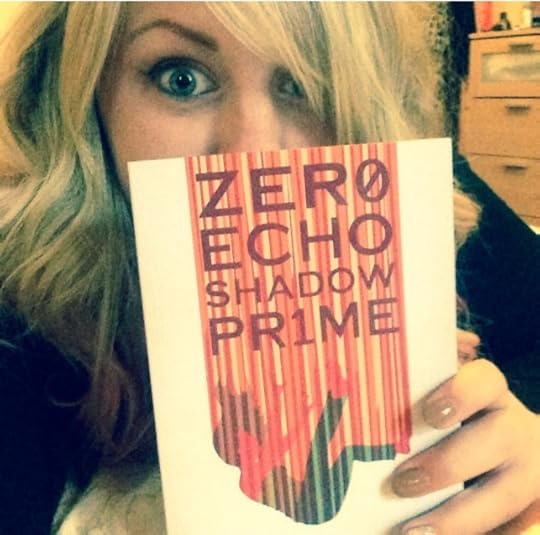
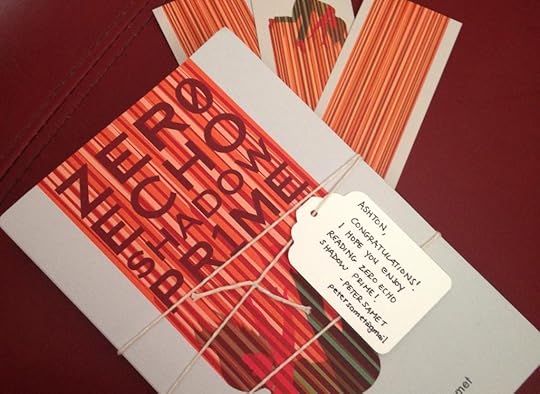
I received this as part of a GoodReads First Read giveaway (very quick may I add, and all the way from America)! It even came with a cute personal note and some bookmarks, AND it was signed. A huge thank you goes to Peter Samet!
Zero Echo Shadow Prime tells the story of a young girl called Charlie Nobunga who has become an overnight sensation but unfortunately suffers with cancer, hindering her chances of a promising future. That is, until she is presented with an opportunity: a second chance at her life inside a robotic body. If it seems too good to be true, it probably is... Charlie is used for purposes unbeknownst to her and her brain is scanned and so emerge four copies of Charlie: Zero, a discarded dying human, Echo, programmed to kill and forced to play a murderous game with billions of other clones, Shadow, a virtual assistant who is stripped of her memories, and Prime, an advanced robot with the mind of Charlie who is subject to various tests.
I've never read a book with a heavy sci-fi theme before as it's never really been something that appeals to me, but I was, of course, happy to make this my first sci-fi book attempt... AND I LOVED IT!!
Literally, the first chapter just had me completely hooked. The first chapter explores later events and then leaves you wanting more as the second chapter takes a step back into the past where the story begins. It was a brilliant way to begin the story and it left me so excited to read the full thing!
The world created is incredible, and the concept it just brilliant. The science and technology is believable, impressive yet super easy to understand (though maybe the fact I come from a scientific and mathematical background helped this). Things are clearly explained and nothing is left open, which is perfect. As the story begins to split into separate chapters for Zero, Echo, Shadow and Prime, Peter Samet does and amazing job of giving each character uniqueness and keeping them as distinct, individual characters, even as their stories begin to intertwine. I never found myself particularly connected to the original Charlie, but as she split into four separate beings, she became so much more relatable in four different forms. Besides, even if I never did end up connecting with her characters, I wouldn't have cared, the story itself is just so awesome. And I loved Alan completely. I need my very own Alan.
The writing itself was wonderfully fast paced and Peter Samet involved small sections where we simply read a conversation between two minds like a script, and I loved it. And I loved how the story was written by various viewpoints, even minor characters. Oh, and I loved that there was some violence and gore... I mean who doesn't love violence and gore?!
I'd seriously recommend this book to everyone, sci-fi fan or not. It was freakin' awesome and I am soooo glad I got picked as a giveaway winner otherwise I would have never picked this book up and read it, and that would have been a huge huge shame.
Okay, the cover art. Love it. It seems to me like that was what drew me in initially way back when I first stumbled upon this book. I'm a sucker for things with kind of a minimalist look, but somehow I feel like the cover image perfectly encompasses the story.
The story itself was like Neuromancer meets Snow Crash meets Do Androids Dream of Electric Sheep? meets something-else-I-can't-even-describe. Even though it had elements that reminded me of all these other books, I can honestly say that it's one of the most unique stories I've ever read. I've recently become a fan of the whole what-is-it-that-makes-us-human debate, so any story that deals with artificial intelligence and humanoid robots is pretty much guaranteed to draw me in. The way Peter Samet took those elements, split them up into four separate sections, and then wove them back together again was pure genius. Keeping track of who was a real person and who was in who's head was super trippy, and I did get confused a couple of times, but in the end I didn't feel like it really hurt the story.
I'd like a Shadow now. And side note: for some reason I just really love the command, "[Shadow name], spin, my/all eyes."
Unique and Compelling Take on the Singularity’s Biggest Question
One of the best aspects of singularity sci-fi is that, when done well, the questions it poses are not only difficult but also make you deeply uncomfortable, challenging your beliefs about the world and where it’s headed.
ZESP accomplishes this in spades through a brilliant and original plot device: presenting the story through the eyes of 4 characters who are actually 4 embodiments of the same woman. In this way the question, “What does it mean to be human?” takes on a whole new meaning and becomes all the more challenging to answer. The book also explores a side of the impending singularity which is often neglected in the genre—the impact of the rapid technological changes and social upheaval on the people involved. The technology is an important part of this story, but the point of the story is the characters and the effect the technology has on their lives, in a deeply personal way.
ZESP doesn’t pretend to give you all the answers; it doesn’t wrap the future up and put a tidy bow on it. Instead, the questions it asks linger with you long after the last page is turned—which is the definition of not merely a good book, but a meaningful one.
Full disclosure: I received this book for free as part of a Goodreads giveaway, but I'll do my best to give it a fair and honest review.
Zero Echo Shadow Prime tells the story of Charlie Nobunga, a young genius who just programmed a new sort of AI assistant that actually feels like a real person. In the midst of her fame, she's diagnosed with cancer, the same kind that killed her twin sister, but the head of a cutting edge technology company proposes a solution... to scan her brain and copy her personality into a stronger, artificial body. Charlie's unsure about the whole thing, but the procedure goes ahead... and many different Charlies awaken, each unaware of the others, sometimes unaware of a lot more. First, there's Prime, the planned superior body, a form that could be a cyborg supersolider. There's also Echo, a four-armed warrior with no memories, in a digital world full of other, slightly different Echos. There's Shadow, who's been converted into an AI assistant in somebody's head. And finally, there's Charlie's original body, which wasn't destroyed during the scan but never intended to be reawoken unless there was a problem... except it's been kidnapped by Luddites, who want her help to take down the company that scanned her.
This book's not only a first novel, but a self-published one. This normally makes me very leery of potential poor quality works (I've been burned before), although I'm certainly willing to give a first novel a little more leeway, and the book's concept was impressive and ambitious. So does it live up to it, and is it a successful novel that you could expect to get published on its own?
The answer to both questions is, yes, mostly. Some flaws (and I will get a little nitpicky about them, but only in the hopes of helping the author improve), but clearly this is an author with a lot of potential. The story is well-paced and the changes in perspective keep you interested, and what could turn out to be a complicated mess, with many copies of the same people running around, never falls outside his control. The stories are separate at first, but tie together in believable ways and with excellent timing, neither too slowly or too quick (although maybe I'd have liked a little more solo time on a couple of them). For the most part the science and technology is believable without being overwhelming. In fact, I think this is quite a good novel to introduce people to various singularity-type themes without requiring them to be versed in a lot of prior SF.
As for the flaws? Well, a lot of it depends on whether this is intended to be a full-on SF novel, or a (higher-age) Young Adult SF book. It's not absolutely clear from the descriptions and promotion, but there are a few markers for option B. The character being 18, for example, suggests it may be marketed towards teens, and the romance angle felt a little on the YA side, opposite sides, immediate attraction and suddenly falling for each others. However a few things point in the other direction, like the ending which seems to set up for a sequel that is decidedly less YA and more complex.
The prose is pretty good, overall, but I did notice some examples of what's called "Said Bookism", where the author notably avoids using the word "said", and instead characters insist, implore, chime in, drone, and so on, some of which is certainly okay for variety, but when it's done too often, it can be distracting. In this case, it's on the edge of being a problem, so this is one of the nitpicky points, something the author should be careful of in the future. Some parts are worse than others, but it's not a huge problem overall.
Charlie's big development that led to her Shadow winning the Turing test seems a little facile, described as a stunning breakthrough, when really it seems like a fairly obvious thing that would be tried many times in many different ways. Similarly, the "replicator" she invents is a little sci-cute rather than consistant and thought out (if it's possible under the technology of the world, there ought to be a lot of them produced by a lot of people, a big problem that society has ways to deal with). Both of these are things I'd completely overlook if I were to consider it a YA novel... the main characters being sort of exceptional-in-a-way-that's-easy-for-the-audience-to-relate-to is a common trope, and it's easier to give her a simple insight that for some reason nobody else has thought of than bog the younger reader down with a lot of technical gobbledegook. But I'd like a little more rigor in a full-fledged, no-qualifier SF novel.
Another thing in that category (things that are more forgiveable if you consider the book to be a YA) is one of my minor disappointments in the book. There seems like a lot of characters, but... in many ways, there's really one character, seen in many different ways and contexts, sometimes interacting with herself. But, in the end, I wound up finding her a little bland as a character: a generally good person who's smart and has a real stubborn streak. The almost archetypical hero, with only a few details above and beyond that. In a YA, this isn't a problem (and may even be ideal) because a somewhat bland character is easier to project yourself into and inhabit, and it can become less about who the character is as it is about what you might do in that situation. But in a more adult, deeper work, I'd expect a lot more exploration into what certain characteristics lead to which parts of our personality, how removing memory or putting us in complex scenarios might alter our natures, how an invulnerable Charlie is different from one dying of cancer, at the very least, know that feature character inside out. But after reading about all these different versions, I never really got the sense that I knew the character any better, any more deeply, than I would in a TV show. There's a bit of a difference between the Echos and the others, but most of that is caused by stuff that happens off page and left for a potential sequel.
There is one final bit that rankled me particularly, and that's involving Charlie's cancer. First, the idea that cancer is still a worry in a world where nanotechnology can build new bodies for people from scratch is one of those few inconsistent moments (surely it would be easier to have some nano searching her body for tumors and eliminating them... even if it couldn't be a full cure, something to make her functional instead of sickly), but that's not even my biggest problem. My biggest problem is there's a point in the story where Charlie is told "Cancer's an electrolyte imbalance, chemo is the worst thing you can do," and told to drink something. Now, this is a Luddite character who may not know what they're talking about, but... it's never really refuted in the story, either, and she's portrayed as educated in this field particularly. A lot of their other ideas are shown to be wrong, but at other points it's clear they might have some valid points, and in the case of this cancer cure... it's an awfully specific claim about cancer that borders on woo and could wind up hurting real people if they took it on faith as they might many of the other technological advancements. That bothered me. I wouldn't even mind if they still claimed they have a cure for cancer (true or not), as long as they weren't specific about how it worked and claim that current medical advice is the WORST thing you could do... but if you're going to declare something about a real medical condition that goes directly against current medical thinking, I think it's your responsibility to either prove it, declare it explicitly an alternate universe that has no basis in fact, or refute it directly in the text.
Otherwise, it's a very solid first novel. So yes, there are flaws, but even a professional first novel from one of the big publishing companies might have issues like these, and they don't seriously harm the book. On the whole, I was engaged, never bored, and always looking forward to what happened next. The ultimate test of a first novel is, would I read a sequel (or another novel by the author), and the answer in this case is an unequivocal yes (particularly a sequel). A final rating is still somewhat complicated, because as a normal SF book, it's good and shows a lot of potential, but takes a few too many shortcuts and so it's not quite up there with my favorites. I'd put it as a high three, maybe getting close to four. If I were to consider this a Young Adult book (again, edging towards the higher end of the teen years), it comes off much better. In fact, I'd wager to say it's probably one of the most enjoyable YA pure-SF books I've read (although admittedly, there aren't many). I'd put it firmly in four territory, and if Goodreads allowed half-stars, a 4.5 might be what I'd score it. I guess the best thing to do is split the difference and call it a four, because I did really enjoy it, just with some reservations.
For many people Science Fiction is about spaceships and the exploration of far flung planets, but to me science fiction is all about the exploration of ideas, and Zero Echo Shadow Prime is packed full of them.
Set in the very near future, a young coder creates the very first sentient AI and everybody wants a piece of her. The problem is, she's dying of cancer. When rich industrialist father calls in a few favours and with the help of Jude Adler, CEO of the technology firm Rivir, decides to save Charlie's life against her wishes, Charlie's problems are only just beginning.
I really enjoyed this book. It's packed full of ideas, exploring some of the questions around human consciousness - what makes a person who they are, what is sentience, along with some of the thornier philosophical issues around the rights of synthetic beings and who owns a copied consciousness - all wrapped up in a fast-paced thriller. The world building is very well done, providing the small elements of detail required to show what areas of society and culture have changed without resorting to pages of backstory and setup.
In Charlie Nobunaga, Samet has created an intelligent, strong-willed female lead that had real agency despite her physical limitations, who is also a fearsome four-armed killer; a holographic personal assistant and a supercharged android warrior. The fact Samet manages to flick between each point of view without causing confusion is great testament to his skill as a writer.
There were a couple of areas where I thought the book could bi improved, the Echo storyline, while interesting, felt a little superfluous and the love interest never quite came off for me, but in a book this fast moving and complex, these are just minor issues. Overall this is a great read, and if this review doesn't persuade you to buy the book then the cover surely will.
If you are looking for a fun-filled thriller with substance and ideas, this is the book for you. Recommended.
Fascinating concepts and fast paced storytelling make this book a great read, but what disappoints me is that the ideas are poorly explored, the secondary and tertiary characters poorly motivated and the ending is awfully forced and resolves nothing. I just wish this book was much more meaty in both the ideas and the story.
Zero Echo Shadow Prime is an ambitious and fearless debut. The narrative structure takes a risk by following four distinct points of view that are simultaneously from the same character; this style works to highlight the book's themes: What happens when technology falls out of our control? And what is reality?
The most chilling aspect of Peter Samet's novel is it's plausibility. What will happen when, in the near future, the human mind (which includes the host's memories and personality) can be mapped, digitized, copied and transferred? Who will own the copyright to this neural map? What becomes of the humanity of these copies? Though the book explores existential themes, such as our perspective on what compromises reality, it also plays on our present fears of technological advancements.
Surrounding these questions is a fast-paced storyline. Charlie, our protagonist, is a brilliant young woman with a bright future ahead of her, but she is dying. Her father makes a desperate decision in a bid to save her life: He allows her mind to be copied and transferred into an advanced robot that is essentially her clone. From these events, Charlie is thrown into a technological revolution. On one side is the Sapien Movement: A group of rebels in opposition of the singularity event [human and machine becoming one] brought on by Jude Adler. On the other side is the Rivir Corporation: The company responsible for mapping and duplicating Charlie's mind and of which Jude Adler is CEO. We follow all four Charlies as they navigate their way through the complicated web of their own identity and as they seek freedom and autonomy from their creator, Jude Adler.
The science and technology described in the novel is not only believable but foreseeable. Though Zero Echo Shadow Prime is a fantasy demonstrating a worse-case scenario event, it also serves as a cautionary tale against combining technological breakthroughs with corporate greed and megalomaniac ambition.
ZESP is a perfect read for those who are both familiar and unfamiliar with science fiction. As someone who doesn't read sci-fi, I found myself thinking about the book when I wasn't reading it, and eagerly anticipating how all four personalities would come together. Though the subject matter can seem heavy, Samet never pushes any ideologies or themes onto the reader. Rather, he allows you to come to your own conclusions while entertaining you from start to finish. Though the first chapter was a little jarring for me, the book settles into a more traditional storytelling narrative that slowly fragments as Charlie's mind is copied and different versions emerge.
Zero Echo Shadow Prime is the type of book that will have future generations saying: We we warned.
Holy cow. I hesitate to call this the best book I’ve read this year, but Zero Echo Shadow Prime will definitely fall into my best of the year list. I’d been recommended the book a few months ago and it piqued my interest, but I forgot about it until a friend told me it was out. I quickly snatched it up and spent every free moment reading this book from yesterday afternoon, evening, and then this morning when I finished. I was relentless as I worked to finish this amazing book. Mr. Samet has outdone himself with his debut novel. While the plot isn’t the same, I had some of the same feelings and emotions I had when I read Ernest Cline’s Ready Player One. (To tell you how much I love RPO, I currently re-read it AT LEAST once a year.) I loved it, no if’s, and’s, or but’s. So you might be asking – what is this book about? Zero Echo Shadow Prime is a novel about one character…or is it four…or a billion? My head is frankly still spinning a little from all the different aspects of this story, but to boil it down, ZESP is Charlie’s story. Charlie (short for Charlotte) is an 18-year-old woman who has created the world’s first Shadow (personal assistant in a way) to pass the Turing Test. Alan (obviously named after Turing) is a technological marvel, but Charlie has a problem. Cancer is stripping her of life until her father and a business associate named Jude offer a solution. Next thing you know, Charlie’s story is now four separate tales. There is Charlie O.G. (Original Recipe), called ZERO; Charlie the so-called zombie surrogate, a robotic body called PRIME; Charlie as her own version of a SHADOW, stripped of memories; and Charlie in a world with a billion other versions of herself, an ECHO. It could have been dizzying to keep up with these four stories, but Samet does an excellent job keeping the stories separate, but at the same time drawing them all together. There is so much great story here, starting off the book with a bang with the story of Four Arms, an ECHO version of Charlie as she is forced to fight and kill (almost Hunger Games-style) in order to survive. Around each corner, however, there are twists and turns that leave you breathless, wondering how Samet came up with all this. But even apart from all the action, this book really offers some intriguing questions. What exactly is a human? Is it just flesh and bone or is there something more? If a person was able to move their consciousness to a computer, is there a spark of humanity there? With the new movie Transcendence coming out soon, these are all fascinating questions and ones that don’t have easy answers with the new world that we are embarking upon. My recommendation – GO BUY THIS BOOK. NOW. You won’t regret it.
I received this book for free through a giveaway. Before I read it, it sounded really interesting and the plot seemed unlike anything I'd heard of previously. Turns out, it's a unique gem of a book.
Zero Echo Shadow Prime was a fantastic read. It started off with a bang, which I really enjoyed. I don't like it when a book is slow and uninteresting up until halfway through. Luckily, that was not the case here. I was hooked from the first page.
The story was amazing, albeit having a few confusing details here and there. I love how Peter Samet was able to write the stories of more than one main character and manage to make them flow so easily.
This novel was definitely focused on the science fiction genre. Even though it was set in the future, the world was still recognizable and the main characters relatable. I love how the girls evolved from being one person to being distinct, separate individuals. It just shows that life and our experiences shape us, and we could be entirely different people had the world treated us differently.
I was hooked on this book until the very end, and let me just say: That ending! I want to know what happens next!
I'm not going to spoil anything for anybody, but I really hope there's a sequel. I would totally read it. Zero Echo Shadow Prime was a great read. I applaud Mr. Samet for this terrific novel. I recommend this book to any and all people that like science fiction or action or awesomeness. You won't regret it.
*****4.5**** I loved the story!! I loved the title as well,actually that's what drew me in then the blurb and the cover; it's perfect! The story hooked me from the beginning. And when Charlie saw how she could be save when she goes to place where the projects are working on, it reminded me of the scene from Resident Evil which got me more excited! (Cloning storage in the movie) And I loved getting to know about different versions of Charlie. I love how a story comes together ;) (I love that quote, and I thought about it when I reached the near end of the book and tweaked it accordingly) Yes how all the things at first which felt wrong came together. I highly recommend this book to sci-fi lovers. I'm looking forward to read next books in the series! I don't know about the next book but how things are, I'm excited with just thinking about it. And don't worry no cliffhanger but there always will be problems to solve. Hope it doesn't take three years ( I read acknowledgements) *shrug* and author Peter Samet is working on the book. Got the book in exchange of an honest review.
Fist of all, let me say I received a copy of this book as a giveaway through First-Reads on this site. That being said, this is the best work of fiction I have read in a while. It has been some time since a book drew me in and I finished it in a day. I thought I saw inspiration gleamed from William Gibson and Rudy Rucker in this novel. Since I think so highly of both those authors, it is intended as pretty high praise. The book tells an interesting story set in a well developed cyberpunk setting. The writing is strong and the characters are engaging. I would recommend this book to all fans of things dark and cyberpunk.
Zero Echo Shadow Prime is really quite perfect. This world is insane and the author does an excellent job at making the book come alive.
The premise of this book is... kind of terrifying. I could certainly see this on a shelf of horrors, and that is awesome. The technological details are amazing and the abilities of characters deserve a nerd award.
The best part is definitely the voices of the characters. Each one is different and holds the reader's attention. I love the uniqueness of each Charlie.
I had to read this novel for my college English class and at first, I wasn't that excited about it because I thought it was going to be a weird book. However, now that I have completed the novel, I've found that I was wrong. While this novel was a tad strange and somewhat hard to follow since it had so much going on, it was overall a pretty good read. I liked how the author separated the book into four different perspectives. Although, I must admit using four different perspectives made the story a little confusing, especially since they were not explained all that well before reading the story. It automatically starts out with one of the four perspectives -- ECHO -- and I, as a reader, was very confused because I only had a very brief description of what ECHO was on the back of the book. I also wasn't a fan of how long this book took to read. I typically enjoy reading, but it just felt like this book dragged on and on forever. It kept throwing information at me and I got really confused. I had to reread a lot of the paragraphs/pages because I didn't understand it. This book is definitely not an easy read, but it is interesting. 8/10 recommend.
This was a really good book! Reading this was an assignment for my Reading and Writing 2 course. Typically, I don't enjoy books that are assigned in class, but this one kept me entertained. To read this book, you need to be able to understand books that jump around a lot. Every chapter is a different version of Charlie so it can get kind of confusing in some spots. The one thing that I didn't really like about this book is how drawn out some of the plots are. The book starts off with the story of Echo and it takes a couple of chapters to get the next part of the story. The same can be said with Shadow's character. In the first half of the book, we get a small chapter introducing her, and then we hear nothing about her until a little bit later.
All in all, this was a really good book and I recommend it to anyone who enjoys science fiction.
Zero Echo Shadow Prime, is quite an exciting read. Charlie Nobunga was a really interesting main character. headstrong, and quite the genius throughout the entire book. overall the book was really good. except for the fact that the ending doesn't really answer all the questions i have about the book. they leave it on a really confusing cliffhanger, which could possibly have been done to make us come up with our own ending. I feel like it is a very good book to read especially in english classes because it really makes people think about what the story is really trying to say. and it helps us analyze books better because you will be searching intensely through the book to find a topic to talk about.
I was impressed with the futuristic ideas incorporated between an Artificial Intelligence and human DNA. The book captured the idea of the possibilities for humanoids to continue to live by duplicating their DNA and living over and over again while perfecting their future selves. The character, Charlie, creates an AI that has the ability to recreate himself. Throughout the book, Charlie's Shadow begins to learn how to feel emotions the same as a human. Interesting book. A good read if you like books that skip from one scene to another. This is a book that must be read in its entirety to understand the beginning.
When I got this book for an English Composition 2 class I was first drawn to the cover and couldn't wait to open it up and start reading. Once I did that I couldn't help but continue on reading. I've never read anything like this and all the ideas included made it so interesting. However, once getting into the meat of the book those ideas, once used in the beginning, started to decrease. Additionally, the final few chapters lacked explanations that were needed to complete the ideas introduced before. Overall, a good read though!
Peter Samet's novel is certainly one to take notice of. The way in which the author address the question of the singularity through his work, what it means to be human in a world that is rapidly becoming more and more reliant on technology. The conclusion is eyeopening and offers a distinct stance on the meaning of the simulation. The only issue that I had with this novel was the manner in which the author changed perspectives as well as the explanation for how technology worked in this world were not very clear. Overall an interesting read that I would recommend to others.
Zero Echo Shadow Prime was a really good book because it talks about how technology is used and how people use and treat technology. Reading Zero Echo Shadow Prime taught me how to some parts of technology is not that important how people think it is. A lot of people look up to technology because it's the only think that the believe in. Technology is not that important to people, you really don't need technology because it is not teaching you anything that's good for your brain.
The layout of the story line of Zero Echo Shadow Prime made me lose interest in the book. The story first started out great, but I felt the further I read the more I got confused. I typically don’t read novels in this genre, but this book made me clarify why I do t read this genre. For majority of the time I was confused on how the different stories connected themselves and what was actually going on. It seemed like there was so much back story before the author even got to the main point.
I think this book was pretty good and it was very detailed. But the storyline was very hard to follow since Peter was jumping back and forth from each character and adding new information. Towards the end, it was really hard to follow. I would suggest having each character have a part in the book then after you get done talking about each character then start to incorporate each one as the book goes deeper into the storyline. Besides that, I thought the book was good.
This book is an interesting book for those who have an open mind to reading new things. It is also a good reading for those with a creative mind to visualize the different images that takes place in the book. Overall, I would recommend anyone to read this book with a mature enough mind to understand.
Personally, this book is not a book that I’d really go for. The plot and characters are extremely confusing making it a difficult read. You need to be able to dedicate a lot of time to sit down and read to understand what’s happening. Other than that, I’d recommend this book to anyone interested in Sci-fi.
In my opinion this book had a good story behind it. But it was very hard to follow. Trying to keep track of different characters is a challenge depending how interested you are in the book. If you like Si-Fi books or books that are a challenge I definitely recommend but if not I wouldn't bother reading it.
This book was electric to read! There was always something that would make you keep turning the pages. If you don't pay too much attention to the novel you could find your self easily lost due to the four characters ZESP. I strongly recommend for science-fiction readers!
This was a good novel to read. I liked how the book moved around from place to place, it made the book that much more interesting. It was my first sci-fi book that I have read and I want to read more of this genre now. I was very intrigued and couldn’t get myself to put the book down.
This book contains everything somebody can want or expect in a sci-fi book. Very compelling story line with a lot of futuristic elements involved. Overall it was a good read but at times it can hard to follow and must go back and reread to fully enjoy the plot.