

What do you think?

Tailspin
World War II tail gunner Gene Moran fell four miles through the sky without a parachute and lived. Captured by the Germans, he survived a harrowing eighteen months as a prisoner of war, including a six-hundred-mile death march in 1945 across Central Europe.
When Gene returned home, he kept those memories locked up for nearly seventy years. His nine children knew little of their dad's war story. But when John, a young history teacher, learns of Gene's amazing fall, he's desperate to learn more. Finally, Gene agrees.
So begins a series of "Thursdays with Gene" interviews. Gene, nearing his ninetieth birthday, recounts incredible tales. But John has no idea what wounds he's reopening. Gene's nightmares and grief return. But both men persevere, bonded by their close and growing friendship.
As the interviews go on, John faces an ordeal of his own. His wife is fighting brain cancer. What will happen to his wife and his two young children? John must continue uncovering Gene's story of survival as he himself confronts the greatest trial of his life.
Tailspin is more than a war story. It's a story of two men's separate journeys confronting trauma and loss. It's a story of resilience and hope.
When Gene returned home, he kept those memories locked up for nearly seventy years. His nine children knew little of their dad's war story. But when John, a young history teacher, learns of Gene's amazing fall, he's desperate to learn more. Finally, Gene agrees.
So begins a series of "Thursdays with Gene" interviews. Gene, nearing his ninetieth birthday, recounts incredible tales. But John has no idea what wounds he's reopening. Gene's nightmares and grief return. But both men persevere, bonded by their close and growing friendship.
As the interviews go on, John faces an ordeal of his own. His wife is fighting brain cancer. What will happen to his wife and his two young children? John must continue uncovering Gene's story of survival as he himself confronts the greatest trial of his life.
Tailspin is more than a war story. It's a story of two men's separate journeys confronting trauma and loss. It's a story of resilience and hope.
424 pages, Kindle Edition
First published April 30, 2022
Ratings & Reviews
Friends & Following
Create a free account to discover what your friends think of this book!
Community Reviews
Displaying 1 - 30 of 208 reviews

September 19, 2022
Tailspin will be our book club's December selection. We are always on the lookout for local authors! To find a copy of the book, please check out our catalog, Hoopla, or Libby. Happy reading!
To join in the discussion: https://www.goodreads.com/topic/show/...
4.5/5 stars
Tailspin is one of those nonfiction books that grip you like a thriller novel. Let me explain.
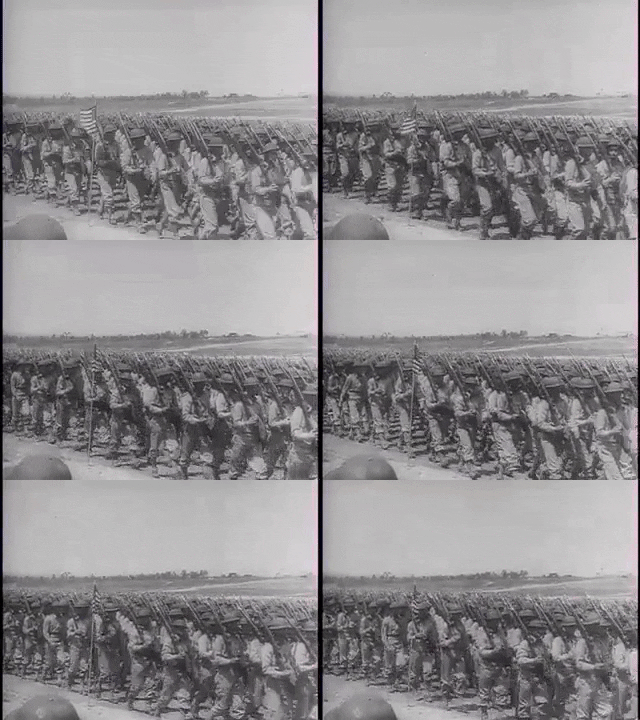
This is a WWII story centering around Wisconsin-born tail gunner Gene Moran. The story told in newspapers was that he survived falling four miles to the ground when his plane, the Rikki Tiki Tavi, was shot down over Germany.
Mind you, he fell without a parachute in the tail section of the plane, which had separated from the rest of the aircraft, and survived! Tailspin catches us up on the events leading to the plane being shot down and Gene’s travails afterwards.
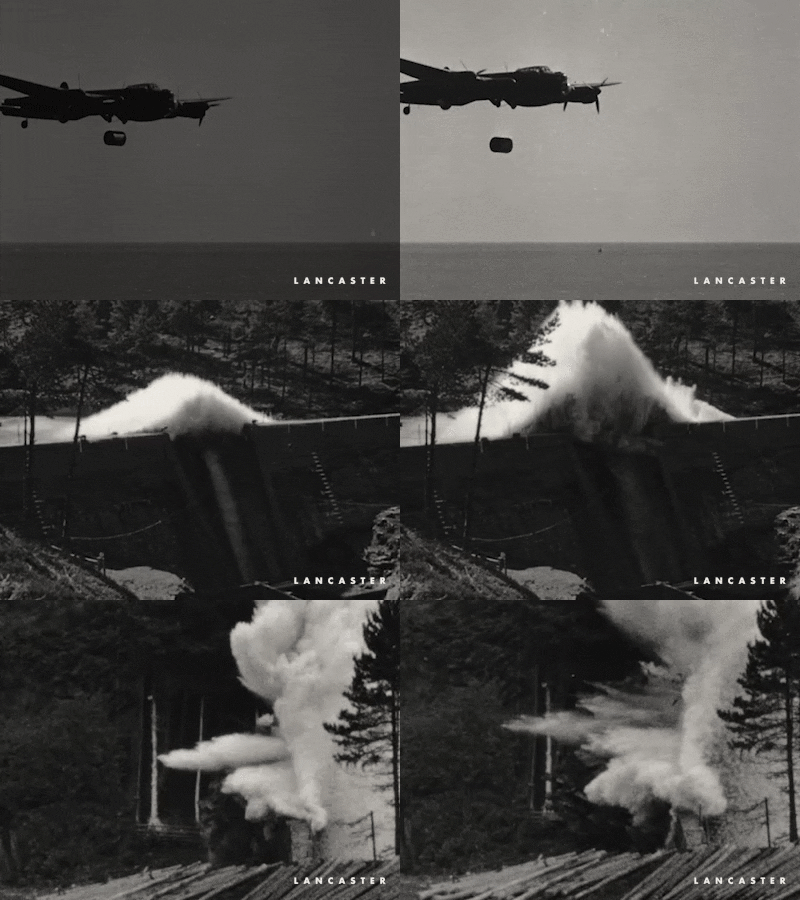
What the newspapers didn’t cover was the immense trauma Gene experienced throughout his time in military service. (The fall alone is incredibly traumatic.)
He survives when he is patched back together at a German prisoner-of-war (POW) camp, one of three the Germans shuffle him and his fellow prisoners around to as the Allies gradually advance from the west.

Even though Germany ostensibly signed up to the Geneva Convention and had to treat Allied POWs with care, conditions in these prison camps were awful.
Diseases spread rapidly among prisoners that already were not at their best, having been caught during combat missions in or over German territory. (The Soviet Union had not signed on to the Geneva Convention. The brief descriptions of the Soviet prisoners in these camps, however, were even more chilling, as Germany treated them as subhuman.)
Often, the prisoners were evacuated as bombings were in progress, cruelly snatching away what they thought was their freedom, only to have to march at a merciless pace in awful weather to whatever place was next. For people in already bad shape, this led to further deaths from disease, exposure, and starvation.
There was a considerable amount of gallows humor, but that is understandable.
Camaraderie develops almost immediately between prisoners caught in the same horrible circumstances, leading to Gene developing some friendships that lasted long after the war.

Gene is much braver than I will ever be. May he rest in peace.
But Gene’s story is only part of Tailspin, believe it or not.
At the time Wisconsin-based historian and author John Armbruster is interviewing Gene for the book, his wife, Carmen, is suffering through metastatic breast cancer that has spread to her brain.
Despite relentless chemotherapy, the brain tumor keeps recurring. Armbruster gracefully interweaves these two narratives, his wife’s declining health and Gene’s WWII survival story.
Throughout Tailspin, both men work out their trauma with each other during their “Thursdays with Gene” interviews.
This process is incredibly moving, watching both become the best of friends during and after the interview process.
Tailspin is a great read. However, make sure to have a box of tissues next to you! If your reading experience is anything like mine, Tailspin will stick with you long after you finish the story.
Happy reading!
Find this book and other titles within our catalog.
To join in the discussion: https://www.goodreads.com/topic/show/...
4.5/5 stars
Tailspin is one of those nonfiction books that grip you like a thriller novel. Let me explain.
This is a WWII story centering around Wisconsin-born tail gunner Gene Moran. The story told in newspapers was that he survived falling four miles to the ground when his plane, the Rikki Tiki Tavi, was shot down over Germany.
Mind you, he fell without a parachute in the tail section of the plane, which had separated from the rest of the aircraft, and survived! Tailspin catches us up on the events leading to the plane being shot down and Gene’s travails afterwards.
What the newspapers didn’t cover was the immense trauma Gene experienced throughout his time in military service. (The fall alone is incredibly traumatic.)
He survives when he is patched back together at a German prisoner-of-war (POW) camp, one of three the Germans shuffle him and his fellow prisoners around to as the Allies gradually advance from the west.
Even though Germany ostensibly signed up to the Geneva Convention and had to treat Allied POWs with care, conditions in these prison camps were awful.
Diseases spread rapidly among prisoners that already were not at their best, having been caught during combat missions in or over German territory. (The Soviet Union had not signed on to the Geneva Convention. The brief descriptions of the Soviet prisoners in these camps, however, were even more chilling, as Germany treated them as subhuman.)
Often, the prisoners were evacuated as bombings were in progress, cruelly snatching away what they thought was their freedom, only to have to march at a merciless pace in awful weather to whatever place was next. For people in already bad shape, this led to further deaths from disease, exposure, and starvation.
There was a considerable amount of gallows humor, but that is understandable.
Camaraderie develops almost immediately between prisoners caught in the same horrible circumstances, leading to Gene developing some friendships that lasted long after the war.
Gene is much braver than I will ever be. May he rest in peace.
But Gene’s story is only part of Tailspin, believe it or not.
At the time Wisconsin-based historian and author John Armbruster is interviewing Gene for the book, his wife, Carmen, is suffering through metastatic breast cancer that has spread to her brain.
Despite relentless chemotherapy, the brain tumor keeps recurring. Armbruster gracefully interweaves these two narratives, his wife’s declining health and Gene’s WWII survival story.
Throughout Tailspin, both men work out their trauma with each other during their “Thursdays with Gene” interviews.
This process is incredibly moving, watching both become the best of friends during and after the interview process.
Tailspin is a great read. However, make sure to have a box of tissues next to you! If your reading experience is anything like mine, Tailspin will stick with you long after you finish the story.
Happy reading!
Find this book and other titles within our catalog.

November 5, 2023
What an amazing story of survival. This nonfiction reads like fiction and the audiobook was done perfectly.

July 29, 2022
Before starting this review, I would just like to say this: what an underrated book. It clearly has the potential to be found in more libraries, yet I only discovered this book thanks to my Grandma who actually was able to meet the man that cheated death in WWII.
Gene Moran grew up in Soldiers Grove, Wisconsin. Like most young men at the time, when news came that Japan attacked Pearl Harbor, they put aside any future plans and joined the armed forces en masse. Gene joined up with the Air Corps and took to the skies in the iconic B-17 Flying Fortress. Gene, along with his nine other crewmates, flew some of the most death defying missions imaginable. Scenes of German flak exploding and planes colliding with each other mid-air, all the while trying to stem off German fighter planes, were gripping scenes that had me on edge. I've read about the dangers that airmen had to endure during bombing runs in WWII, and this book helped solidify in my mind just how many close calls and near misses can come about when flying thousands of feet above the heavily armed enemy.
Unfortunately, luck can run out and those near misses are transformed into a direct hit. On a bombing run to Bremen, Germany, Gene's plane fell back from the rest of the bombing group and found itself surround by German fighters. The plane sustained heavy damage, so much so that the plane split in half. Gene found himself isolated in the tail section of the plane and, not having a functioning parachute on hand, braced himself for the inevitable. The tail of the plane fell four miles until it hit the ground. Gene was found by German troops still miraculously clinging on to life.
This part of the book is where I discovered some of the its problems, but chief among them is the lack of thoroughness when describing certain scenes. How exactly was Gene able to survive such a fall? Why did the plane separate from the bombing group in the first place? Although there may not be any clear cut answer, speculation into the various possibilities would have been greatly appreciated. Historians speculate all of the time when it comes to studying ancient Greece or the Medieval Ages due to the lack of historical documents and evidence. I wish the author could have dug deeper into why such events in the book might have happened, even though a conclusive answer might not be within reach.
I won't fault the author too much, however, since I'm sure he was dealing with his own demons that life brought his way. This brings me to the huge positive that is this book's narrative. It's completely unique. I've not read a book that does what this book sets out to do. Yes, this book describes a war story, but it also entwines it with the author's story of pain and loss as well. The writer, John Armbruster, was dealing with supporting his wife through cancer while conducting the interviews with Gene. When his wife eventually succumbs to the heinous disease, he describes his devastating loss and ties it in with the loss of Gene's crewmates during the war. John and Gene are thus entwined in the pursuit of healing throughout the story. It's done in a respectful manner, with John never trying to steal the spotlight away from Gene or trying to equate his loss with the suffering Gene endured while being a prisoner of war after the crash. All of this really helped add to the uniqueness and readability of the book.
The story turns to Gene trying to survive the numerous POW camps that he was shipped off to. An excruciating moment was when he was put on the Hell Ship, a rusted Soviet supply ship that was used to haul POWs across the Baltic sea in order to evade approaching Soviet forces. Gene, along with hundreds of other prisoners, were crammed into the hull of the ship with little to no water or food. For days, he had to suffer the unbearable feelings of claustrophobia, starvation, and dehydration. There was absolutely no room to lay down, forcing him to stand upright and stave off the urge to pass out for the fear of never waking back up again. It was a haunting moment of the book and one that will stick with me for years to come.
Finally, the addition to include Gene's war with PTSD after coming back home was a welcomed addition. Too many times has this happened where a war story will end after the enemy is defeated. The mental damage done after suffering through the savagery of fighting is often overlooked. This book took the extra step to describe the pain that was returning from war and trying to start a "normal" life. The strains that were put on Gene's marriage, the relationships with his kids, and himself were all explored, helping me get a better insight into what the return home can feel like for many veterans. I commend the author for including this part in the story.
All in all, this is a book I would recommend whole heartedly to others. The positives completely outweigh any of the negatives that I found with the writing, with the biggest positive being the uniqueness of the twin narratives that were John's loss and Gene's war. My Grandma has always had a knack for finding a book that I might enjoy. It seems like she still has no problem doing so.
Gene Moran grew up in Soldiers Grove, Wisconsin. Like most young men at the time, when news came that Japan attacked Pearl Harbor, they put aside any future plans and joined the armed forces en masse. Gene joined up with the Air Corps and took to the skies in the iconic B-17 Flying Fortress. Gene, along with his nine other crewmates, flew some of the most death defying missions imaginable. Scenes of German flak exploding and planes colliding with each other mid-air, all the while trying to stem off German fighter planes, were gripping scenes that had me on edge. I've read about the dangers that airmen had to endure during bombing runs in WWII, and this book helped solidify in my mind just how many close calls and near misses can come about when flying thousands of feet above the heavily armed enemy.
Unfortunately, luck can run out and those near misses are transformed into a direct hit. On a bombing run to Bremen, Germany, Gene's plane fell back from the rest of the bombing group and found itself surround by German fighters. The plane sustained heavy damage, so much so that the plane split in half. Gene found himself isolated in the tail section of the plane and, not having a functioning parachute on hand, braced himself for the inevitable. The tail of the plane fell four miles until it hit the ground. Gene was found by German troops still miraculously clinging on to life.
This part of the book is where I discovered some of the its problems, but chief among them is the lack of thoroughness when describing certain scenes. How exactly was Gene able to survive such a fall? Why did the plane separate from the bombing group in the first place? Although there may not be any clear cut answer, speculation into the various possibilities would have been greatly appreciated. Historians speculate all of the time when it comes to studying ancient Greece or the Medieval Ages due to the lack of historical documents and evidence. I wish the author could have dug deeper into why such events in the book might have happened, even though a conclusive answer might not be within reach.
I won't fault the author too much, however, since I'm sure he was dealing with his own demons that life brought his way. This brings me to the huge positive that is this book's narrative. It's completely unique. I've not read a book that does what this book sets out to do. Yes, this book describes a war story, but it also entwines it with the author's story of pain and loss as well. The writer, John Armbruster, was dealing with supporting his wife through cancer while conducting the interviews with Gene. When his wife eventually succumbs to the heinous disease, he describes his devastating loss and ties it in with the loss of Gene's crewmates during the war. John and Gene are thus entwined in the pursuit of healing throughout the story. It's done in a respectful manner, with John never trying to steal the spotlight away from Gene or trying to equate his loss with the suffering Gene endured while being a prisoner of war after the crash. All of this really helped add to the uniqueness and readability of the book.
The story turns to Gene trying to survive the numerous POW camps that he was shipped off to. An excruciating moment was when he was put on the Hell Ship, a rusted Soviet supply ship that was used to haul POWs across the Baltic sea in order to evade approaching Soviet forces. Gene, along with hundreds of other prisoners, were crammed into the hull of the ship with little to no water or food. For days, he had to suffer the unbearable feelings of claustrophobia, starvation, and dehydration. There was absolutely no room to lay down, forcing him to stand upright and stave off the urge to pass out for the fear of never waking back up again. It was a haunting moment of the book and one that will stick with me for years to come.
Finally, the addition to include Gene's war with PTSD after coming back home was a welcomed addition. Too many times has this happened where a war story will end after the enemy is defeated. The mental damage done after suffering through the savagery of fighting is often overlooked. This book took the extra step to describe the pain that was returning from war and trying to start a "normal" life. The strains that were put on Gene's marriage, the relationships with his kids, and himself were all explored, helping me get a better insight into what the return home can feel like for many veterans. I commend the author for including this part in the story.
All in all, this is a book I would recommend whole heartedly to others. The positives completely outweigh any of the negatives that I found with the writing, with the biggest positive being the uniqueness of the twin narratives that were John's loss and Gene's war. My Grandma has always had a knack for finding a book that I might enjoy. It seems like she still has no problem doing so.

December 6, 2022
I met John Armbruster in 2015 at UW-Madison's Write by the Lake retreat. We were in the same nonfiction class. Flash forward to 2022, I was working as a library director and one of our volunteers asked if we could order this book called 'Tailspin.' He started telling me the story of Gene Moran, WWII veteran. Something about the story made me realize "I know this!" I googled the book's author and sure enough, it was John. I remembered him working on this book in our class.
I'm thrilled to see it now in print and boast what an exceptional job John did chronicling the survival of one war hero, as well as his own family battles with the loss of a loved one. How John managed to combine these threads of self awareness, survival, grief, loss, regret, and hope is no small feat. It's an incredible war story, but it's also the story of two men finding common ground as they both help one another into and back out of the traumas of their lives. It's a war story told with reverence for what WWII vets underwent and offers better understanding of their lives after.
Gene said he would tell his story only if John would write it. I'm so glad he did.
I'm thrilled to see it now in print and boast what an exceptional job John did chronicling the survival of one war hero, as well as his own family battles with the loss of a loved one. How John managed to combine these threads of self awareness, survival, grief, loss, regret, and hope is no small feat. It's an incredible war story, but it's also the story of two men finding common ground as they both help one another into and back out of the traumas of their lives. It's a war story told with reverence for what WWII vets underwent and offers better understanding of their lives after.
Gene said he would tell his story only if John would write it. I'm so glad he did.
April 6, 2023
The main story in this book is very intriguing and I did enjoy it for the most part. But there is more to this book which includes a story line following the author himself. I am not a fan of that in general, I don’t like when the author inserts themselves into a biography, I feel that the story should concentrate on the main subject. This was good but I feel that it could have been a lot shorter and concise. I do understand the author is a first time author and the book was definitely a compelling read.
March 20, 2022
I got to read this early and was floored by how beautiful, wise, and evocative it was.
The world of Germany in the depths of WWII is brought fully to life, as is the delicate relationship between the author and Gene Moran, the subject of the book. Prepare to feel some big, big things. And the ending...couldn't have been better. Highly recommended.
The world of Germany in the depths of WWII is brought fully to life, as is the delicate relationship between the author and Gene Moran, the subject of the book. Prepare to feel some big, big things. And the ending...couldn't have been better. Highly recommended.
June 27, 2022
It often seems like the topic of World War II has been exhausted. With so many books and movies covering it, from the large events to the small ones, what stories can possibly be left to be told, and what can they offer to those living in the 21st century? John Armbruster's book completely shattered my expectations and my tiredness of the topic. By tying the incredible story of Gene Moran in the war to its effects on Gene and his family in its aftermath, Armbruster would have easily illustrated the nature of conflict in a way few others have faced head-on. However, Armbruster didn't leave the story there. Instead, he wove in his own personal tragedy as he attempted to gather Gene's story, which made the book absolutely devastating. This masterpiece of a novel, delivered in a way that seems like it should be a movie screen, emphasizes the fragility of life and demonstrates that, although the scars of the past still linger, they can become something that propels us into the future and makes us kinder and better people.

March 6, 2022
It’s so important that such personal histories as this be recorded and this is an unusual way of presenting such an account, weaving in a secondary story at the same time. The second layer takes this book beyond a social history to be a genuinely moving account of challenge and grief and how we come to terms with both.
May 15, 2024
Great story about a local hero from Wisconsin, written by a local teacher.

November 21, 2025
A well written true story that kept me interested the entire book. I Highly recommend this book if you enjoy WW2 stories, bonus the story partly takes place in Wisconsin.

April 1, 2025
This was a good book. Two men's stories in one, with Gene's story be central. A story of friendship, struggle, love, overcoming. A story that needed to be told and remembered. 4 stars
July 14, 2022
Wow! What a remarkable story of a man who survived…. Again and again! What a legacy he has left for his family. It’s hard to believe such events happened, in real life, but they did. And what a brave man, the author, who not only embarked on the harrowing journey to uncover the dark, buried past of a wounded WWII Tailgunner, but who did so while teaching school, raising a family and supporting his wife through her own hellish battle with cancer.
This book had me in tears several times. A powerful, un-put-downable book!
This book had me in tears several times. A powerful, un-put-downable book!

May 11, 2022
This is a fantastic book! It’s a great story filled with a range of emotions and I could barely put it down! If you have any interest in World War II stories or are just looking for a new book to read, I 100% recommend “Tailspin”
May 23, 2024
Awesome book! If you ever have self doubt you need to read this book to understand what your body & mind can endure. The saying “What doesn’t kill you makes you stronger” must have heard the story of Gene Moran. One of the toughest SOB’s to ever walk this earth. AMAZING!!!

June 15, 2026
John Armbruster’s “Tailspin” is one of those rare works of narrative nonfiction that starts as an almost unbelievable combat anecdote and deepens, page by page, into a meditation on memory, trauma, and the long half‑life of war. It is ostensibly the story of Gene Moran, a B‑17 tail gunner who falls four miles without a parachute over Nazi Germany and lives, but the book’s real power lies in how Armbruster braids that astonishing survival tale with his own private ordeal on the home front. Armbruster structures the book around years of “Thursdays with Gene” interviews, in which an elderly, close‑mouthed former POW finally begins to talk about burning bombers, shattered crews, and the brutal, six‑hundred‑mile death march across Central Europe in 1945. The effect is almost novelistic: scenes unfold with cinematic clarity, yet Armbruster never loses the historian’s discipline about chronology, place, and corroboration. For a reader steeped in military history, the operational details of the air war and the POW system are accurate, sobering, and mercifully free of the gauzy nostalgia that often infects “greatest generation” narratives. Where “Tailspin” becomes quietly extraordinary is in the counterpoint between Moran’s long‑suppressed trauma and the author’s own crisis as his wife battles brain cancer. The book never devolves into a dual memoir gimmick; instead, Armbruster lets the two arcs echo each other, showing how one man’s wartime endurance becomes another man’s template for navigating anticipatory grief and single fatherhood. That parallel narrative could have felt manipulative in lesser hands, but here it reads as something closer to an intergenerational handoff of resilience. Stylistically, Armbruster writes with a teacher’s clarity and a journalist’s restraint, trusting Moran’s experiences—hell ship transport, POW camps, solitary confinement, the march—to carry their own moral weight. The result is a book that will satisfy the technically minded reader looking for an accurate account of one NCO’s war, yet it lingers because it is, fundamentally, about what happens when those wars finally come home. “Tailspin” earns the overused adjectives—gripping, poignant, “cinematically grand”—and then some; it is a story of survival that refuses to end at liberation, insisting instead on following its subjects all the way through the long, difficult business of living. If you tend to favor works where human character is tested as severely as any weapon system, this is a book worth clearing space for on your shelf.
April 30, 2024
Tailspin is an incredibly moving book. Gene’s story of survival as a tail gunner and POW is an incredible enough story on its own, and Armsbruster does a truly masterful job interweaving Gene’s story with his own.
I loved the stories about Gene’s childhood in Wisconsin, and also appreciate Armsbruster goes in depth on what happened when Gene returned from the war. The struggles of POWs and soldiers did not end when they returned from WW2, and especially given Armsbruster’s personal relationship with Gene so many years later, make the true story that much more meaningful.
I’m also glad that Armsbruster chose to intertwine his story with Gene’s. This is not just a world war 2 war story- it’s also a story of the author’s relationship with that veteran, and the author’s his own family struggles, from his wife dying of cancer to his challenges raising his sons as a widower. This added to Gene’s story by showing a very different, but no less real, type of suffering and resilience. It was also just nice to hear about their friendship, and how crucial that friendship and mutual respect was to the book that I was reading. Gene chose Armsbruster specifically to write his story, so I’m happy that Armsbruster’s own story was included in the book.
I would highly recommend- it’s a very well-written war story, and it’s also a hell of a lot more than that.
I loved the stories about Gene’s childhood in Wisconsin, and also appreciate Armsbruster goes in depth on what happened when Gene returned from the war. The struggles of POWs and soldiers did not end when they returned from WW2, and especially given Armsbruster’s personal relationship with Gene so many years later, make the true story that much more meaningful.
I’m also glad that Armsbruster chose to intertwine his story with Gene’s. This is not just a world war 2 war story- it’s also a story of the author’s relationship with that veteran, and the author’s his own family struggles, from his wife dying of cancer to his challenges raising his sons as a widower. This added to Gene’s story by showing a very different, but no less real, type of suffering and resilience. It was also just nice to hear about their friendship, and how crucial that friendship and mutual respect was to the book that I was reading. Gene chose Armsbruster specifically to write his story, so I’m happy that Armsbruster’s own story was included in the book.
I would highly recommend- it’s a very well-written war story, and it’s also a hell of a lot more than that.

April 1, 2026
A Wisconsin WWII veteran's story of his fall 4 miles from the flying fortress and other gruesome details of his time as a POW. Written by a Wisconsin author. This book is non-fiction but reads like a fiction, it was a quick read. And on some level you had some relatable moments to his fondness of Wisconsin, eating fish fry's and his time spent on a farm. I know some other reviews mentioned they didn't like having the author's perspective, but I enjoyed it. It really helped paint a picture of Gene as well. I had been highly recommended this book and found it at goodwill. Once I got home, I realized it was a signed copy. A really special book, I encourage everyone to read! The pictures at the end really tied the story together as well.

March 1, 2025
This is the story of two men. A teacher interviewing a WWII Vet who fell in the tail of a plane 4 miles to the earth not a parachute in sight, captured by Germans, starved and forced to walk HUNDREDS of miles until finally liberated by the allies. The teacher also has to face his own struggles while balancing interviewing Gene with his life. Oh. And THEYRE BOTH WISCONSINITES!!!! I’m frustrated I didn’t know about this book sooner. My only complaint…. Good fricking lord get an audiobook narrator that’s from here (Wisconsin). 10/10 book. Read this **slaps book cover enthusiastically** I will annoyingly talk about this book for weeks now.

November 13, 2022
This is a remarkable story. It's not hard to understand why it was so sensational at the time and should be today. Both the author and the veteran suffered through grief and loss to bring us this book. I'm so grateful to Gene for fighting his demons to speak out and tell about his experiences in WWII. Details of POW camps bring home the brutality of war. It's a testament to humanity and resilience of spirit.
September 3, 2026
Very underrated and unknown for its quality; or maybe it’s personally a “can’t put down” book for me because of my dad’s time in Vietnam. Emotional read for me as our families and my dad himself had similar responses to what the war did to us all and still does.
A MUST READ, if you want to relate to the much underground effects of war.
A MUST READ, if you want to relate to the much underground effects of war.

January 22, 2023
A friend recommended this one to me after she heard the author speak at a local event. I am so glad she did! This story will stick with me for a very long time. What a gripping true story of another American hero more people should know about and respect. Wow...just wow!!

March 17, 2023
Wow! Awesome book writtenby and about someone from Wisconsin! Such a great 1st hand account of what happened in World War 2!

May 10, 2024
Wow, incredible. This is an unimaginable story of the life of this veteran and his experience during WWII. Definitely had some tears, but how incredible this book was! Highly recommend!!
March 1, 2025
Another almost unbelievable story from WWII, reaffirming the seemingly endless count of true American heroes that served our country.

June 1, 2026
A heart wrenching account of one man's experiences before, during and after WWII. It reminds me of how strong that generation was and how much we owe to them.

June 13, 2023
Unforgettable. As the grandson of a top turret gunner on a B17, this book is a real gift. I always wanted to know what my grandfather went through, but I could never ask him about it.

September 14, 2026
A really remarkable story…and what a gift to Genes family. Well done- I really loved looking at the pictures at the end too.

June 14, 2024
It is humbling, yet jubilant to know what I know now of my friend E.P. Moran, formerly of Soldiers Grove, WI.
I was introduced to E.P. by his son Mike, a.k.a. Bugzy. Bugzy and my husband, David Mischel served together on Viroqua's volunteer fire department. I think that was 1997-2004
I heard family lore stories from Bugzy, his son, Tim Moran, Marty, E.P.'s younger brother, and family friends. We were invited to many family gatherings, especially to the Northwoods cabin in the spring & fall to four-wheel.
My husband went to high school where Joni was an art teacher. He was his own kind of rebel rouser and had "discussions" with Joni during detention.
I introduced our eldest to E.P. at his kitchen table just like John Armbruster. Steven Mischel was 11 or 12 then and was writing a paper about WWII and the bombing runs against Germans. He was nervous and overwhelmed to actually meet a soldier from that war. I wasn't privy to that conversation but I do know it left an impression because Steven went on to volunteer with the Civil Air Defense in Lacrosse and then with the US Air Force, and is now training as Air Crash crew with the Reserves out of Madison, WI.
Gene was a character and always had that certain twinkle in his eye like he knew things but didn't say. (His grandson, Tim, has that same charm). He was friendly, yet "cranky" and I always thought the world of him because he had really Lived Life. He was a confidant for my husband to talk about the nightmares of war. He was just opening up and acknowledging the trauma of raising his family while dealing with PTSD. He told me I was a good wife for sticking by Dave and that I reminded him of Peg, whom I never met.
These stories, lives, are important to remember. Just like John said, [we] "may be the last living witnesses who knew [the Greatest Generation] Gene." There have been other wars, other survivors who deserve the same respect, the same dignity to tell their stories. Read. Learn.
I was introduced to E.P. by his son Mike, a.k.a. Bugzy. Bugzy and my husband, David Mischel served together on Viroqua's volunteer fire department. I think that was 1997-2004
I heard family lore stories from Bugzy, his son, Tim Moran, Marty, E.P.'s younger brother, and family friends. We were invited to many family gatherings, especially to the Northwoods cabin in the spring & fall to four-wheel.
My husband went to high school where Joni was an art teacher. He was his own kind of rebel rouser and had "discussions" with Joni during detention.
I introduced our eldest to E.P. at his kitchen table just like John Armbruster. Steven Mischel was 11 or 12 then and was writing a paper about WWII and the bombing runs against Germans. He was nervous and overwhelmed to actually meet a soldier from that war. I wasn't privy to that conversation but I do know it left an impression because Steven went on to volunteer with the Civil Air Defense in Lacrosse and then with the US Air Force, and is now training as Air Crash crew with the Reserves out of Madison, WI.
Gene was a character and always had that certain twinkle in his eye like he knew things but didn't say. (His grandson, Tim, has that same charm). He was friendly, yet "cranky" and I always thought the world of him because he had really Lived Life. He was a confidant for my husband to talk about the nightmares of war. He was just opening up and acknowledging the trauma of raising his family while dealing with PTSD. He told me I was a good wife for sticking by Dave and that I reminded him of Peg, whom I never met.
These stories, lives, are important to remember. Just like John said, [we] "may be the last living witnesses who knew [the Greatest Generation] Gene." There have been other wars, other survivors who deserve the same respect, the same dignity to tell their stories. Read. Learn.

October 24, 2022
I can’t put into words how good this book is. I am from the same area of SW Wisconsin as the author & Mr. Eugene Moran and had never heard about this incredible man. A gripping story about a true hero from America’s greatest generation, and the war he endured for a lifetime. Intertwined is the personal story the of author as he navigates tragic circumstances in his family life while wrestling with the impact Gene’s retelling of his own story over the course of a few years is having on Gene himself.
This was the best book I’ve ever read. I’m not being hyperbolic. It is the best damn book I’ve read, because it’s not just a story, it’s real life. It runs the gamut of emotions - and it’s heart-pounding, heart-wrenching, horrific, tragic, sad, nostalgic, poignant, inspiring, and even at times, humorous - and (unlike the mass produced paperbacks on which those hollow recycled blurbs are splashed) truly is impossible to put down. I finished the last third of the book while on an airplane from Milwaukee to Charleston via New York City. The first time author (and full time Dad, husband, and teacher) felt unworthy of retelling Mr. Moran’s story, worried that he wasn’t qualified to write it with the reverence it deserves - but he did. Boy did he ever.
Buy it. Read it. Recommend it to everyone you know.
This was the best book I’ve ever read. I’m not being hyperbolic. It is the best damn book I’ve read, because it’s not just a story, it’s real life. It runs the gamut of emotions - and it’s heart-pounding, heart-wrenching, horrific, tragic, sad, nostalgic, poignant, inspiring, and even at times, humorous - and (unlike the mass produced paperbacks on which those hollow recycled blurbs are splashed) truly is impossible to put down. I finished the last third of the book while on an airplane from Milwaukee to Charleston via New York City. The first time author (and full time Dad, husband, and teacher) felt unworthy of retelling Mr. Moran’s story, worried that he wasn’t qualified to write it with the reverence it deserves - but he did. Boy did he ever.
Buy it. Read it. Recommend it to everyone you know.

July 25, 2022
Wow. This is a remarkable book. Incredibly well written and like no other I have read. Believe me I have read many,many.
Gene Moran led a life like many growing up in this era.
Young men were flocking to join the military in world War II. My Dad was one as well.
The chapters led you through his entire journey away and back at home.
Some very hard to read,as if you were the child of an injured on the battle field soldier or POW you could identify.
The story of Gene and also the story of John, the book is so very well done, that I have recommended it to many friends.
Thank you. WW II is, for me better understood. I only wish I could have thanked Gene myself.
Thank you John for your journey and your selflessness. I wish my copy was signed but it none the less will never leave my library. Please write again, you are very talented.
Thanks Dad.
Gene Moran led a life like many growing up in this era.
Young men were flocking to join the military in world War II. My Dad was one as well.
The chapters led you through his entire journey away and back at home.
Some very hard to read,as if you were the child of an injured on the battle field soldier or POW you could identify.
The story of Gene and also the story of John, the book is so very well done, that I have recommended it to many friends.
Thank you. WW II is, for me better understood. I only wish I could have thanked Gene myself.
Thank you John for your journey and your selflessness. I wish my copy was signed but it none the less will never leave my library. Please write again, you are very talented.
Thanks Dad.
Displaying 1 - 30 of 208 reviews