

What do you think?

Goodnight Punpun Omnibus #1
Boa noite, Punpun 01
A vida de Punpun não é fácil.
Em casa os pais discutem, os adultos que conhece são neuróticos e a rapariga de quem ele gosta acaba de se mudar.
Felizmente, uma nova aluna chega à escola. O Seu nome é Aiko Tanaka, e Punpun apaixona-se perdidamente por ela. Mas, com a sua timidez, não será fácil chamar a sua atenção e ao mesmo tempo a situação em casa complica-se…
Em casa os pais discutem, os adultos que conhece são neuróticos e a rapariga de quem ele gosta acaba de se mudar.
Felizmente, uma nova aluna chega à escola. O Seu nome é Aiko Tanaka, e Punpun apaixona-se perdidamente por ela. Mas, com a sua timidez, não será fácil chamar a sua atenção e ao mesmo tempo a situação em casa complica-se…
428 pages, Paperback
First published January 1, 2006
About the author
Inio Asano
120 books2,854 followersInio Asano (浅野いにお, Asano Inio) is a Japanese cartoonist. He is known for his character-driven stories and his detailed art-style, making him one of the most influential manga author of his generation.
Asano was born in 1980 and produced his first amateur comics as a teenager. His professional debut happened in 2000 in the pages of the magazine Big Comic Spirits. Since then, he has collaborated with most of the major Japanese magazines of seinen manga (comics for a mature audience). Among Asano's internationally acclaimed works are: the psychological horror Nijigahara Holograph (2003-2005); the drama Solanin (2005-2006); the existentialistic slice-of-life Goodnight Punpun (2007-2013); the erotic A Girl on the Shore (2009-2013); the sci-fi Dead Dead Demon's Dededede Destruction (2014-2022).
Asano was born in 1980 and produced his first amateur comics as a teenager. His professional debut happened in 2000 in the pages of the magazine Big Comic Spirits. Since then, he has collaborated with most of the major Japanese magazines of seinen manga (comics for a mature audience). Among Asano's internationally acclaimed works are: the psychological horror Nijigahara Holograph (2003-2005); the drama Solanin (2005-2006); the existentialistic slice-of-life Goodnight Punpun (2007-2013); the erotic A Girl on the Shore (2009-2013); the sci-fi Dead Dead Demon's Dededede Destruction (2014-2022).
Ratings & Reviews
Friends & Following
Create a free account to discover what your friends think of this book!
Community Reviews
Displaying 1 - 30 of 2,587 reviews

January 4, 2016

I actually know little to nothing about manga, other than having read Ito's Uzumaki and a few issues of Akira back in the day. But just over a year ago I came across an online article proclaiming Inio Asano's Nijigahara Holograph one of the ten best graphic novels of 2014, comparing the sinister, dreamlike atmosphere to a David Lynch film. So of course I immediately bought and read it, and was totally enveloped the entire time. It wasn't just one of the best graphic novels I'd ever read, it was one of the best and most powerful pieces of storytelling I'd ever experienced, in any medium. I immediately snatched up everything else by Asano that was available in English (which wasn't much), and while I enjoyed them, mostly they were normal "slice of life," love and heartbreak-type stuff. Which is fine, but I really missed the weirdness of Nijigahara. Punpun seemed right up my alley, a mixture of "slice of life" and the bizarre, but it was still only available in Japanese. After searching for any online, fan-made translations to no avail, then (briefly) considering learning Japanese, I decided to wait til it was made available in English.
Now that it's here, I can say it was definitely worth the wait. The artwork is absolutely stunning, and while the story didn't grab me quite as much as Nijigahara, it was still pretty damn absorbing, and this is only the very beginning of an epic story spanning several years, tracing Punpun's life from an adolescent to an adult. This first volume follows Punpun's years in grade school (or the Japanese equivalent of it), dealing with his parents' divorce, succumbing to things like peer pressure and love, and dreaming of one day colonizing distant planets (as he thinks this will impress the new girl in town, whom he loves). He sees himself as an outsider, not really belonging anywhere, which I suppose is why he's drawn like a cartoonish bird while everyone and everything else is more lifelike.
But it's not just a coming of age story, as there are Haruki Murakami-esque moments where unreality and reality collide, such as when Punpun repeats a simple chant that his hip, slacker uncle taught him for when he needs God to show up and help. I won't tell you what God is like, but it's pretty hilarious and tripped-out. We also see that one of his buddies has an entirely different God that appears for him. And Punpun's thoughts and daydreams are pretty hallucinogenic as well.
Most importantly, Asano is a master at depicting the joys and triumphs, as well as the anxieties and tragedies, of growing up. He is able to make the simplest, most everyday accomplishments seem like a massive feat, which is of course true when you're 9 or 10, and it was true for me while reading. The weirdness that creeps in occasionally doesn't feel out of place at all in this otherwise pretty realistic (sometimes gut-wrenchingly realistic) story. It's a near-perfect marriage of "boy meets world"-type stories and otherworldly strangeness, and I'm already counting down the days until volume 2 becomes available.
Recommended to pretty much everybody who's looking for a moving, first-class coming of age story. As long as you don't mind a side of straight-up weird to go along with it.
4.5 Stars,
or


September 22, 2022
Am I wrong or was this terrible?
I don’t understand the hype.
I want to be *that* otaku but apparently I’m weeb status only with this one.
I don’t understand the hype.
I want to be *that* otaku but apparently I’m weeb status only with this one.

March 21, 2024
Cute, weird, sad, funny, but just wayyyyyyy too slow for me. I might check out the next volume at some point.

May 17, 2018
Aww, it is tough being a dumb little confused kid in a complicated world!
Inio Asano made me not only read about but actually appreciate the internal lives of average grade school kids. That is real talent there.
Inio Asano made me not only read about but actually appreciate the internal lives of average grade school kids. That is real talent there.

November 28, 2016
This is the first big omnibus collection of Asano's tale of a little chicken-like creature, Punpun, his dysfunctional family, friends, and his crush on a girl. This is basically a coming of age story and the tone of it is much like his also accomplished Solanin, somewhat subdued, but with fantasy/magical realism thrown in. It's funny and sweet, for the most part. I might have liked it more had I not had Asano's amazing and much darker Nijigahara Holograph to compare it to, but this guy can draw! The art in this one is better than the story, though this one is more accessible and more deliberately coherent (considering its younger audience, YA) than Nijigahara Holograph.

October 9, 2021
Everyone seems to love this manga but I just felt oddly uncomfortable reading it for some reason. Idk it just wasn't for me.

January 28, 2022
Strangely uninteresting
Even so, if I don't find anything else, I'll keep reading.
Even so, if I don't find anything else, I'll keep reading.
July 7, 2026
5/5
اگر یک روزی خواستین سراغ مانگا برید، من این رو حتما پیشنهاد میکنم.
داستان پون پون رو دنبال میکنه که توی یک خانواده ی مشکل دار بزرگ شده و یک از آرزوهاش برنده شدن جایزه نوبله.
این کامیک یک تجربهی دارک کمدی و چندش آوره، گاهی طنز و گاهی به شدت افسرده کننده و همزمان شکل گرفتن یک عشق کودکانه رو به تصویر میکشه.
پیوند دادن ایدهی یک پسر پرندهای کاریکاتوری در یک دنیای کاملا رئال و پر از جزئیات ، تجربه خوندن جملات و پنل ها رو خیلی خیلی منحصر به فرد کرده.
یک قسمت جالب که inio asano، مانگاکای اثر انجام داده، اینه که عناصری از رئالیسم جادویی را وارد داستان کرده، و خیلی ها این رو الهام گرفته از کارهای موراکامی میدونند.
شخصیت پردازی و پرداخت به داستان بسیار ماهرانه است.
نویسنده توی والیوم اول انقدر سوال ایجاد کرده که به نظر من این جلد یه مقدمهی خیلی حساب شده برای شیفته کردن خواننده و کشوندنش به ادامه داستان توی کتاب های بعدی داستانه!
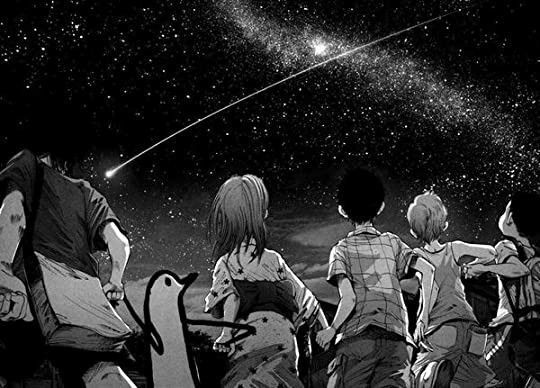
"The sky is so full of stars it's about to overflow. I hope I get to see it again someday."
اگر یک روزی خواستین سراغ مانگا برید، من این رو حتما پیشنهاد میکنم.
داستان پون پون رو دنبال میکنه که توی یک خانواده ی مشکل دار بزرگ شده و یک از آرزوهاش برنده شدن جایزه نوبله.
این کامیک یک تجربهی دارک کمدی و چندش آوره، گاهی طنز و گاهی به شدت افسرده کننده و همزمان شکل گرفتن یک عشق کودکانه رو به تصویر میکشه.
پیوند دادن ایدهی یک پسر پرندهای کاریکاتوری در یک دنیای کاملا رئال و پر از جزئیات ، تجربه خوندن جملات و پنل ها رو خیلی خیلی منحصر به فرد کرده.
یک قسمت جالب که inio asano، مانگاکای اثر انجام داده، اینه که عناصری از رئالیسم جادویی را وارد داستان کرده، و خیلی ها این رو الهام گرفته از کارهای موراکامی میدونند.
شخصیت پردازی و پرداخت به داستان بسیار ماهرانه است.
نویسنده توی والیوم اول انقدر سوال ایجاد کرده که به نظر من این جلد یه مقدمهی خیلی حساب شده برای شیفته کردن خواننده و کشوندنش به ادامه داستان توی کتاب های بعدی داستانه!
"The sky is so full of stars it's about to overflow. I hope I get to see it again someday."

April 30, 2021
Dark comedy at its peak, read it at your discretion.

June 16, 2023
A lot of heart in this coming of age story. I'm intrigued and can already tell that I will blast through them. Thankfully I took out all 7 volumes from the library, so I have a good few days ahead of me. I will try and write a full review for the final volume.

January 21, 2022
Minus one star for the time it took for me to fall into the story but once I was in, I was hooked.
This can happen from time to time in the graphic medium where the author just throws you in, I think it's a choice by the author and that the reader either sinks or swims. I prefer it when the story is easy to follow but some stories are worth the effort put in to understand and Goodnight Pun Pun is 100% worth that effort in my opinion.
Punpun is just a little kid who has been dealt a crappy hand in life. His parents are fighting, badly. His mom gets hurt, his dad has to go to jail, his uncle (who isn't much better) moves in to help raise Punpun. Punpun has the weight of the world on his shoulders and he doesn't know how to handle it, what 5th grader would?
If I'm going to read and enjoy a contemporary it usually has to be something more heavy that really makes me feel some things, Asano accomplished that.
Because the story is so dark Asano throws us these really weird, usually stranger interactions as a comedic relief. It took me a minute to understand what was going on but once I got it those moments cracked me up every time. It is just so Punpun's life that anything and everything completely messed up and weird would happen.
Punpun tends to make the dumb dumb head decision in most situations but I still feel for the poor little guy. I've seen some people comment on the depressive vibe of the book/series in general but I just felt for him, my heart goes out to Punpun. It's obvious that life is probably going to be rough for him for a while but I’m here for whatever comes to pass.
This can happen from time to time in the graphic medium where the author just throws you in, I think it's a choice by the author and that the reader either sinks or swims. I prefer it when the story is easy to follow but some stories are worth the effort put in to understand and Goodnight Pun Pun is 100% worth that effort in my opinion.
Punpun is just a little kid who has been dealt a crappy hand in life. His parents are fighting, badly. His mom gets hurt, his dad has to go to jail, his uncle (who isn't much better) moves in to help raise Punpun. Punpun has the weight of the world on his shoulders and he doesn't know how to handle it, what 5th grader would?
If I'm going to read and enjoy a contemporary it usually has to be something more heavy that really makes me feel some things, Asano accomplished that.
Because the story is so dark Asano throws us these really weird, usually stranger interactions as a comedic relief. It took me a minute to understand what was going on but once I got it those moments cracked me up every time. It is just so Punpun's life that anything and everything completely messed up and weird would happen.
Punpun tends to make the dumb dumb head decision in most situations but I still feel for the poor little guy. I've seen some people comment on the depressive vibe of the book/series in general but I just felt for him, my heart goes out to Punpun. It's obvious that life is probably going to be rough for him for a while but I’m here for whatever comes to pass.
May 1, 2022
Năm ngoái mình rất thích Solanin của Inio Asano. Vô tình mình phát hiện ra Goodnight Punpun Omnibus, Vol. 1 và cực kỳ tò mò về nó.
Câu chuyện xoay quanh Punpun - một cậu bé được khắc họa dưới hình dáng một con chim, diễn biến của cuốn sách xoay quanh những Punpun và những người thân của cậu bé.
Ngay từ nhân vật dã rất kỳ lạ và nhất là Punpun - hoàn cảnh gia đình của Punpun đã khiến mình chạnh lòng ngay từ đầu. Các nhân vật khác bổ sung cho nhau rất ổn, họ cũng có những câu chuyện của riêng họ - nơi những nỗi buồn cứ tồn tại mà chẳng thể nói ra.
Diễn biến đôi khi rất hài hước nhất là biểu cảm của nhân vật được vẽ rất hài. Nhưng có lẽ thứ đặc biệt hơn thế là "sự cô đơn", càng đến cuối cảm giác buồn bã cứ thế chiếm lấy mình, mình thực sự thấy đồng cảm.
Không biết vì sao, hình ảnh những người đàn ông như: cha của Punpun, người chú Yuichi, hay cả nhóm bạn của Punpun và cậu bé; mang cho mình những hình ảnh đặc biệt. Những áp lực về hôn nhân, trách nhiệm với gia đình thật khó khăn; và mình yêu những khoảnh khắc của những cậu bé - những tò mò về "dậy thì" xem tạp chí và phim khiêu dâm và cả thủ dâm - những khoảnh khắc hay được khắc họa rất hài hước và không quá thô thiển.

Nhìn chung Goodnight Punpun Omnibus, Vol. 1 hoàn toàn đáng mong đợi, mình đang sắp hoàn thành xong vol.2, nghe nói càng về sau câu chuyện sẽ càng "dark" và nặng nề nhưng mình càng muốn đọc.

August 29, 2023
PT Que obra-prima. Se existe algo como o manga perfeito, este está muito perto disso.
Nem estou a falar propriamente da história, mas de quão bem está construída — escrita, arte, ritmo, sequenciação, fluidez narrativa — tudo é executado com uma precisão notável.
Agora, quanto ao conteúdo…
Muitos leitores vão identificar-se com o Punpun. Ele é retratado quase como um alien, mas, na minha perspetiva, não é verdadeiramente um excluído. Tem amigos, não é alvo de bullying nem de opressão, e a sua vida não é particularmente má — com exceção da sua família profundamente disfuncional.
No fundo, trata-se de uma jornada de autodescoberta e de procura do seu lugar no mundo.
É também uma exploração do amor em todas as suas dimensões. O Punpun acaba por perceber que o amor pode ser uma espada de dois gumes, e quem já amou verdadeiramente reconhecerá como uma relação problemática se pode tornar quase numa dor física.
É uma viagem extremamente envolvente, com muito para analisar.
Sem dúvida, uma das melhores leituras do ano.
--
EN What a masterpiece. If there is such a thing as a perfect manga, this comes very close.
I’m not even referring to the story itself, but to how impeccably it’s crafted—writing, artwork, pacing, paneling, narrative flow—everything is executed with remarkable precision.
Now, regarding the content…
A lot of readers will relate to Punpun. He’s portrayed almost like an alien, yet he isn’t truly an outcast, in my view. He has friends, he isn’t bullied or oppressed, and his life isn’t especially bleak—aside from his deeply dysfunctional family.
At its core, this is a journey of self-discovery and of trying to find one’s place in the world.
It’s also an exploration of love in all its forms. Punpun comes to understand that love can be a double-edged sword, and anyone who has truly loved will recognize how a troubled relationship can manifest as something almost physically painful.
It’s an incredibly compelling journey, with a great deal to unpack.
Without a doubt, one of my best reads of the year.
Nem estou a falar propriamente da história, mas de quão bem está construída — escrita, arte, ritmo, sequenciação, fluidez narrativa — tudo é executado com uma precisão notável.
Agora, quanto ao conteúdo…
Muitos leitores vão identificar-se com o Punpun. Ele é retratado quase como um alien, mas, na minha perspetiva, não é verdadeiramente um excluído. Tem amigos, não é alvo de bullying nem de opressão, e a sua vida não é particularmente má — com exceção da sua família profundamente disfuncional.
No fundo, trata-se de uma jornada de autodescoberta e de procura do seu lugar no mundo.
É também uma exploração do amor em todas as suas dimensões. O Punpun acaba por perceber que o amor pode ser uma espada de dois gumes, e quem já amou verdadeiramente reconhecerá como uma relação problemática se pode tornar quase numa dor física.
É uma viagem extremamente envolvente, com muito para analisar.
Sem dúvida, uma das melhores leituras do ano.
--
EN What a masterpiece. If there is such a thing as a perfect manga, this comes very close.
I’m not even referring to the story itself, but to how impeccably it’s crafted—writing, artwork, pacing, paneling, narrative flow—everything is executed with remarkable precision.
Now, regarding the content…
A lot of readers will relate to Punpun. He’s portrayed almost like an alien, yet he isn’t truly an outcast, in my view. He has friends, he isn’t bullied or oppressed, and his life isn’t especially bleak—aside from his deeply dysfunctional family.
At its core, this is a journey of self-discovery and of trying to find one’s place in the world.
It’s also an exploration of love in all its forms. Punpun comes to understand that love can be a double-edged sword, and anyone who has truly loved will recognize how a troubled relationship can manifest as something almost physically painful.
It’s an incredibly compelling journey, with a great deal to unpack.
Without a doubt, one of my best reads of the year.
March 12, 2025
Lo empecé porque me regalaron una camiseta del personaje y yo quería saber qué llevaba puesto, pensé que sería ligera y cómica y, aunque sí es cómica en cierto sentido, también es bastante densa. Mentiría si dijera que ya entendí qué rumbo y filosofía quiere presentar, pero por eso continuaré.
July 15, 2018
2024 Review: Pretty much feel the same way. This time though I'll be going to volume 2!
2018 Review: This was...well it was weird as shit yet I read all 300+ pages in one sitting.
So Punpun is this ghost looking creature. His whole family actually looks like these things. However, everyone in the world is normal looking humans. It's not said if everyone else sees Punpun and his family different but I doubt it since they all act normal around them. So this is mostly in Punpun's head, and let me tell you...This is not a kids story despite 90% of it being about kids. Kids go through some crazy shit. After the first chapter ends with someone ending up in the hospital we get to see Punpun's life change by meeting a girl, exploring sex stuff with his buddies, and learning about life problems getting older.
Good: This is a coming in age story wrapped up in some comedy and drama and weirdness and it works for the most part. The characters all feel real and different, the pacing is well done and never boring, and the subject matter is important. I also thought the designs and art are top notch.
Bad: I think some of the weirdness is TOO much and TOO over the top at times to ruin the atmosphere sadly. I also think some of the dialog bubbles sometimes hard to read.
Overall a interesting look into the life of a young boy and his buddies. I can't say this is a classic yet but I'm having a feeling if this series keeps up this will be. A 4 out of 5.
2018 Review: This was...well it was weird as shit yet I read all 300+ pages in one sitting.
So Punpun is this ghost looking creature. His whole family actually looks like these things. However, everyone in the world is normal looking humans. It's not said if everyone else sees Punpun and his family different but I doubt it since they all act normal around them. So this is mostly in Punpun's head, and let me tell you...This is not a kids story despite 90% of it being about kids. Kids go through some crazy shit. After the first chapter ends with someone ending up in the hospital we get to see Punpun's life change by meeting a girl, exploring sex stuff with his buddies, and learning about life problems getting older.
Good: This is a coming in age story wrapped up in some comedy and drama and weirdness and it works for the most part. The characters all feel real and different, the pacing is well done and never boring, and the subject matter is important. I also thought the designs and art are top notch.
Bad: I think some of the weirdness is TOO much and TOO over the top at times to ruin the atmosphere sadly. I also think some of the dialog bubbles sometimes hard to read.
Overall a interesting look into the life of a young boy and his buddies. I can't say this is a classic yet but I'm having a feeling if this series keeps up this will be. A 4 out of 5.

May 5, 2026
Something for certain, it's definitely not for kids

April 28, 2016
I'm not a fan of the painfully awkward and this book revels in it. The discordance begins with illustrating Punpun, the protagonist, and his family in a primitive style that makes them look like a family of bird ghosts while everything else around is illustrated in a very nice typical manga style. Every situation in which Punpun is placed and the way he responds shoots right past invoking sympathy in me, taking me to a place where I can only see Punpun as just plain pathetic. There are a few nice moments here and there, but the book just leaves me feeling bad about life. And that's not what I'm looking for in my entertainment right now.

February 28, 2020
Someone commented on my video saying this was 'accomplished but bizarre' and yeah, that's perfect. https://youtu.be/Tfn0wAZsEGI
October 23, 2022
This was so creative! Asano’s unique artistic liberties were really captivating to me, almost more so than the story itself (which was also wonderful). Having the main character Punpun drawn like he was scribbled together by a child, while all of the side characters were gorgeously detailed is such a cool choice in my opinion!
Punpun’s journey felt almost nostalgic, given how it’s so reminiscent of an actual middle schooler’s life. Witnessing him tackle the confusion of first loves and pure joy alongside the occasional unexplainable sadness was really comforting. I loved the simplicity of this story as it tackled the complexities of humanity!! A great start to this series :)
Punpun’s journey felt almost nostalgic, given how it’s so reminiscent of an actual middle schooler’s life. Witnessing him tackle the confusion of first loves and pure joy alongside the occasional unexplainable sadness was really comforting. I loved the simplicity of this story as it tackled the complexities of humanity!! A great start to this series :)
April 10, 2018

Well, this was dark...and I loved it. Shocking~
I really didn't know what I was getting myself into with this one other than the fact that two of my best friends have read the entire series and highly recommended it. I knew it was going to be dark and quirky and it really lived up to that expectation. I'm definitely interested in continuing with this series! Time for volume 2!

May 16, 2026
to było tak dziwne, kreatywne, smutne, niezręczne i zabawne zarazem… loved it

April 29, 2025
Ініо Асано — автор, із яким я вже мав нагоду познайомитися через його відому манґу «Соланін». Тоді мене вразила його здатність передавати душевну вразливість персонажів, їхню боротьбу з собою та зі світом навколо. Тож беручись за «Добраніч, Пунпуне», я вже приблизно уявляв, що на мене чекає: історія, яка не боїться важких тем, поєднання реальності з ірраціональним і зворушлива чесність у зображенні дорослішання. Проте навіть із цим очікуванням манґа змогла мене захопити й здивувати.
«Добраніч, Пунпуне» розповідає про життя маленького японського школяра на ім'я Пунпун Пун’яма. На перший погляд, це типовий школяр із дитячими мріями: врятувати світ, отримати Нобелівську премію, завоювати серце однокласниці. Але за цією звичайністю криється набагато складніша реальність: проблемна родина, насилля, самотність і відчайдушні спроби знайти своє місце в безжальному світі. Паралельно з дитячими веселощами й відкриттями, манґа поступово занурює читача в темніші, тривожніші аспекти життя Пунпуна та його оточення.
Одне з головних досягнень «Добраніч, Пунпуне» — постійна інтрига, яка тримає від першої до останньої сторінки. Ініо Асано майстерно балансує між дитячою наївністю і дорослою жорстокістю світу. У найневинніших сценах криється тривога, а веселі моменти часто набувають гіркуватого відтінку. Читати цю манґу — все одно що йти по тонкій кризі: ти не знаєш, коли й під чим вона трісне, але не можеш зупинитися.
Пунпун зображений як простенький пташкоподібний силует серед реалістично намальованих людей, і цей художній прийом працює блискуче. Він одночасно і окремий від світу, і беззахисний у ньому. Його внутрішній світ багатий на фантазії, страхи й мрії, а зовнішні події лише поступово змінюють його, витісняючи наївність жорсткою реальністю. Через Пунпуна Асано показує, як уразливість дитячого серця стикається з байдужістю дорослого світу, і як ця боротьба непомітно, але нещадно змінює людину.
Особливе місце в манзі займає саме дитяче сприйняття навколишнього. Світ Пунпуна наповнений ірраціональним: Бог, який являється йому у формі усміхненого фотореалістичного чоловіка (автор, який став образом у манзі), дивакуваті одкровення друзів, спотворені страхи й надії. Все це здається диким і абсурдним тільки на перший погляд. Насправді ж, це неймовірно точна передача того, як дитина намагається пояснити те, що не піддається розумінню, і як уява стає єдиним захистом від реальності.
Візуальна сторона манґи також є сильною стороною історії. Фонова деталізація іноді сягає фотореалістичного рівня. Контраст між виглядом Пунпуна і реалістичними фігурами навколо ще більше підкреслює його відчуженість. При цьому Асано вміло використовує малюнок для передачі емоцій: гротескні обличчя дорослих у моменти напруги, плавні переходи між реальністю та мареннями роблять настрій історії майже відчутним фізично.
«Добраніч, Пунпун» — це манґа, яка точно не залишить байдужим. Вона зачіпає важкі теми — самотність, насилля, пошуки себе — й робить це з надзвичайною чутливістю та майстерністю. Якщо ви шукаєте історію про дорослішання, яка не прикрашає реальність, якщо готові до емоційного виклику і бажаєте побачити світ очима дитини, яка поступово втрачає свою невинність, — ця серія обов'язкова до прочитання. Історія, яка зачепила мене. Не знаю, що очікувати далі.
«Добраніч, Пунпуне» розповідає про життя маленького японського школяра на ім'я Пунпун Пун’яма. На перший погляд, це типовий школяр із дитячими мріями: врятувати світ, отримати Нобелівську премію, завоювати серце однокласниці. Але за цією звичайністю криється набагато складніша реальність: проблемна родина, насилля, самотність і відчайдушні спроби знайти своє місце в безжальному світі. Паралельно з дитячими веселощами й відкриттями, манґа поступово занурює читача в темніші, тривожніші аспекти життя Пунпуна та його оточення.
Одне з головних досягнень «Добраніч, Пунпуне» — постійна інтрига, яка тримає від першої до останньої сторінки. Ініо Асано майстерно балансує між дитячою наївністю і дорослою жорстокістю світу. У найневинніших сценах криється тривога, а веселі моменти часто набувають гіркуватого відтінку. Читати цю манґу — все одно що йти по тонкій кризі: ти не знаєш, коли й під чим вона трісне, але не можеш зупинитися.
Пунпун зображений як простенький пташкоподібний силует серед реалістично намальованих людей, і цей художній прийом працює блискуче. Він одночасно і окремий від світу, і беззахисний у ньому. Його внутрішній світ багатий на фантазії, страхи й мрії, а зовнішні події лише поступово змінюють його, витісняючи наївність жорсткою реальністю. Через Пунпуна Асано показує, як уразливість дитячого серця стикається з байдужістю дорослого світу, і як ця боротьба непомітно, але нещадно змінює людину.
Особливе місце в манзі займає саме дитяче сприйняття навколишнього. Світ Пунпуна наповнений ірраціональним: Бог, який являється йому у формі усміхненого фотореалістичного чоловіка (автор, який став образом у манзі), дивакуваті одкровення друзів, спотворені страхи й надії. Все це здається диким і абсурдним тільки на перший погляд. Насправді ж, це неймовірно точна передача того, як дитина намагається пояснити те, що не піддається розумінню, і як уява стає єдиним захистом від реальності.
Візуальна сторона манґи також є сильною стороною історії. Фонова деталізація іноді сягає фотореалістичного рівня. Контраст між виглядом Пунпуна і реалістичними фігурами навколо ще більше підкреслює його відчуженість. При цьому Асано вміло використовує малюнок для передачі емоцій: гротескні обличчя дорослих у моменти напруги, плавні переходи між реальністю та мареннями роблять настрій історії майже відчутним фізично.
«Добраніч, Пунпун» — це манґа, яка точно не залишить байдужим. Вона зачіпає важкі теми — самотність, насилля, пошуки себе — й робить це з надзвичайною чутливістю та майстерністю. Якщо ви шукаєте історію про дорослішання, яка не прикрашає реальність, якщо готові до емоційного виклику і бажаєте побачити світ очима дитини, яка поступово втрачає свою невинність, — ця серія обов'язкова до прочитання. Історія, яка зачепила мене. Не знаю, що очікувати далі.

April 12, 2016
It's been a couple of days, but I'm still unsure about this book. I was a fan of Inio Asano's Solanin, a story about twenty-somethings looking for identity, but did not like Nijigahara Holograph, a work of surreal psychological horror that I never connected to.
This volume has the trick/gimmick/mechanic of using a stick figure bird as our protagonist Punpun, while most of the other characters and all of the settings are fairly realistic and at times quite detailed. It looks like an application of the masking effect Scott McCloud describes in Understanding Comics --- you increase identification with your character because it is so easy to project yourself onto a relatively blank slate. And, to an extent, Punpun represents a typical child going to middle school, having a crush on a classmate, and dealing with lousy family dynamics.
And yet, that "everyman" experience is mitigated, first off, because Punpun and his friends represent an exclusively heterosexual male prespective, exemplified by their search for discarded porn. Secondly, all of Punpun's relatives (his father, mother, and uncle on his mother's side) are also depicted as stick figure birds. (At times, Asano carries out the disturbing spectacle of representing the uncle as a stick figure but with realistic eyes.) And thirdly, but perhaps most importantly, the other characters and narrative regularly verge into the strange. It's tough to see an everyman story when things regularly get psychedelic.
Some of Asano's surrealism is focused on Punpun's internal life. Punpun regularly invokes God through a nonsense prayer and sees a young man with an afro who gives questionable advice. There is a dream sequence (around the time Punpun starts masturbating) with dancing vaginas. And many times, it is clear Punpun is retreating into a visually rich mental world in order to avoid the anxiety of his life.
But a lot of the surrealism is just out in the open. Practically every adult outside of Punpun's family is depicted as insane, from the principal and teacher at his school who play hide and seek to the family lawyer who just goes "Yup yup" all the time like a large friendly dog. And the narrative moves strangely as well, sometimes focusing on regular school life, but detouring for quite some time to a dangerous mission to an abandoned warehouse where dead bodies may have been stored.
When the focus is on characterization, I really like the book. Asano clearly gets across Punpun's uncertainty as his family breaks apart, and I thought his friends were fascinating to read about. But I'm not sure what the sweep of the story is besides Punpun's crush, and the surrealistic bits, while expertly carried out, left me groundless.
This volume has the trick/gimmick/mechanic of using a stick figure bird as our protagonist Punpun, while most of the other characters and all of the settings are fairly realistic and at times quite detailed. It looks like an application of the masking effect Scott McCloud describes in Understanding Comics --- you increase identification with your character because it is so easy to project yourself onto a relatively blank slate. And, to an extent, Punpun represents a typical child going to middle school, having a crush on a classmate, and dealing with lousy family dynamics.
And yet, that "everyman" experience is mitigated, first off, because Punpun and his friends represent an exclusively heterosexual male prespective, exemplified by their search for discarded porn. Secondly, all of Punpun's relatives (his father, mother, and uncle on his mother's side) are also depicted as stick figure birds. (At times, Asano carries out the disturbing spectacle of representing the uncle as a stick figure but with realistic eyes.) And thirdly, but perhaps most importantly, the other characters and narrative regularly verge into the strange. It's tough to see an everyman story when things regularly get psychedelic.
Some of Asano's surrealism is focused on Punpun's internal life. Punpun regularly invokes God through a nonsense prayer and sees a young man with an afro who gives questionable advice. There is a dream sequence (around the time Punpun starts masturbating) with dancing vaginas. And many times, it is clear Punpun is retreating into a visually rich mental world in order to avoid the anxiety of his life.
But a lot of the surrealism is just out in the open. Practically every adult outside of Punpun's family is depicted as insane, from the principal and teacher at his school who play hide and seek to the family lawyer who just goes "Yup yup" all the time like a large friendly dog. And the narrative moves strangely as well, sometimes focusing on regular school life, but detouring for quite some time to a dangerous mission to an abandoned warehouse where dead bodies may have been stored.
When the focus is on characterization, I really like the book. Asano clearly gets across Punpun's uncertainty as his family breaks apart, and I thought his friends were fascinating to read about. But I'm not sure what the sweep of the story is besides Punpun's crush, and the surrealistic bits, while expertly carried out, left me groundless.

October 22, 2016
WHAT?! I think that word sums up this manga.
Punpun is about an innocent pigeon boy (in a class of human students) learning about the bees and the birds, life, and whatever else there is to know. How he remained so innocent in this world is anybody's guess.
This is a really creepy book compared to some of Asano's other works that I've read, and certainly geared towards an older audience (repeat, this is not for anyone under the age of 18 despite the cute looking anthropomorphic main character). While Nijigahara had bouts of insanity, it was still packaged in a generally normal plot. Solanin was basically entirely realistic, with dreams being the only opportunity for Asano to go crazy. This on the other hand has something as wacky as Asano's caricature size head coming down to talk to the main character and observe him as a god. Sexual themes abound. Punpun's mother gets beaten by his father in the opening chapter, so he goes to jail, she goes into silence at the hospital from PTSD, and Punpun has to live with his Uncle, Yuichi. A lot of the adult human characters also look insane, like smaller versions of the Attack on Titan collosi. It's just extremely chaotic.
You can't help but think of something like Southpark while reading this since you have that same mix of adult attitudes and humor in a school setting for contrast. This is best seen in Aiko, Punpun's love interest, a gap toothed girl who talks about the end of the world due to an oil shortage, and how we have to get off the planet; until then she plans to blow all her money as a teen because the end is nigh if we don't find an interplanetary solution before she becomes an adult.
You'll laugh, you'll cringe, and you'll cry at the content in this book. It's a very sensory experience. Much like Solanin, Punpun lets its dialogue do the talking, many panels broken up by three panels with just words over a black background. These are usually poignant messages that seem to go beyond the plot itself, to reach out to the reader and others on the subjects of tough and confusing times in life. Punpun also has moments where his expression does the talking as well.
I've kind of been looking for something off kilter, non traditional, and... I guess I found it. It's almost too bizarre, but I won't knock points for that. The art is amazing by the way, whether you ignore or inclufe the weird imagery. I'd say it's better than Solanin and Nijigahara, which is weird to say considering this features a nondescript looking stick figure bird as the protagonist.
Punpun is about an innocent pigeon boy (in a class of human students) learning about the bees and the birds, life, and whatever else there is to know. How he remained so innocent in this world is anybody's guess.
This is a really creepy book compared to some of Asano's other works that I've read, and certainly geared towards an older audience (repeat, this is not for anyone under the age of 18 despite the cute looking anthropomorphic main character). While Nijigahara had bouts of insanity, it was still packaged in a generally normal plot. Solanin was basically entirely realistic, with dreams being the only opportunity for Asano to go crazy. This on the other hand has something as wacky as Asano's caricature size head coming down to talk to the main character and observe him as a god. Sexual themes abound. Punpun's mother gets beaten by his father in the opening chapter, so he goes to jail, she goes into silence at the hospital from PTSD, and Punpun has to live with his Uncle, Yuichi. A lot of the adult human characters also look insane, like smaller versions of the Attack on Titan collosi. It's just extremely chaotic.
You can't help but think of something like Southpark while reading this since you have that same mix of adult attitudes and humor in a school setting for contrast. This is best seen in Aiko, Punpun's love interest, a gap toothed girl who talks about the end of the world due to an oil shortage, and how we have to get off the planet; until then she plans to blow all her money as a teen because the end is nigh if we don't find an interplanetary solution before she becomes an adult.
You'll laugh, you'll cringe, and you'll cry at the content in this book. It's a very sensory experience. Much like Solanin, Punpun lets its dialogue do the talking, many panels broken up by three panels with just words over a black background. These are usually poignant messages that seem to go beyond the plot itself, to reach out to the reader and others on the subjects of tough and confusing times in life. Punpun also has moments where his expression does the talking as well.
I've kind of been looking for something off kilter, non traditional, and... I guess I found it. It's almost too bizarre, but I won't knock points for that. The art is amazing by the way, whether you ignore or inclufe the weird imagery. I'd say it's better than Solanin and Nijigahara, which is weird to say considering this features a nondescript looking stick figure bird as the protagonist.

March 7, 2020
• i wasnt expecting to like the story but i did. there were weird things happening, some of which i do not understand. either that part is not related to the actual story but was included to the story itself. those left me confused but once everything goes back to normal, all was good again.
• this the perfect example of adults not thinking about how their actions will affect their kids. i hated punpun's mom. such a selfish human being. things certainly aren't always at it seems with the characters too.
• punpun experienced his first love at a very young age. i dont think it's true love per se, but he felt it was something. the writer was able to convey how that feels like for someone as young as punpun and how confusion will start to settle in as well as he gets older.
• the thing that i could actually relate to while reading this was how punpun felt lonely and alone as he was going through all the things happening to his life. that hit home for me. we may not share the same age but i do feel the same most of the time. i thought it wae great the author was able to capture that emotion.
• i dont know why his family as drawn the way it was drawn. is there any significance to why they look like that aside from it looking unique?
• this the perfect example of adults not thinking about how their actions will affect their kids. i hated punpun's mom. such a selfish human being. things certainly aren't always at it seems with the characters too.
• punpun experienced his first love at a very young age. i dont think it's true love per se, but he felt it was something. the writer was able to convey how that feels like for someone as young as punpun and how confusion will start to settle in as well as he gets older.
• the thing that i could actually relate to while reading this was how punpun felt lonely and alone as he was going through all the things happening to his life. that hit home for me. we may not share the same age but i do feel the same most of the time. i thought it wae great the author was able to capture that emotion.
• i dont know why his family as drawn the way it was drawn. is there any significance to why they look like that aside from it looking unique?

April 29, 2023
Just really not for me. Didn’t like the sexual content and the absurd stuff. I also thought the subtle emotional stuff it wanted to communicate wasn’t executed in a way that actually got you as the reader emotional and invested.
I don’t think it’s awful, but I didn’t like anything about it so I see no reason to give it a higher rating. I just didn’t get anything from it. Clearly I’m not the target demographic, with the constant sexualisation of female characters in the story it seems to be more for a young male audience.
I don’t think it’s awful, but I didn’t like anything about it so I see no reason to give it a higher rating. I just didn’t get anything from it. Clearly I’m not the target demographic, with the constant sexualisation of female characters in the story it seems to be more for a young male audience.

April 2, 2021
rtc bc your girl needs TIME.

January 5, 2017
Innovative and bracing and quite well done and not what I look for in a manga. (Could Pun Pun maybe play some volleyball or try to assassinate some aliens?)
May 9, 2021
ok this was definitely both sweet and dark. extremely weird at times; i wonder if Asano took some inspo from Murakami with the weirdness that was featured in the manga!

March 12, 2026
I've been spoiled on most of the manga, but still, I don't know how this sweet baby could hurt anyone :((((
Displaying 1 - 30 of 2,587 reviews