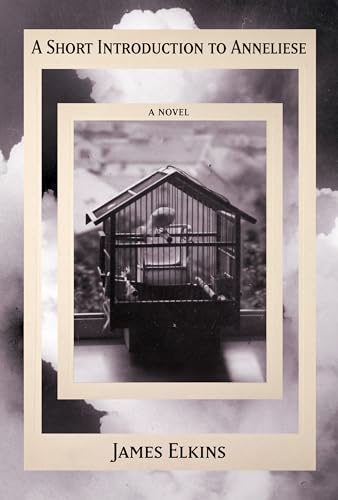
A Short Introduction to Anneliese is the second volume in author James Elkins’ multi-volume mega-novel Five Strange Languages being published by Unnamed Press, all of which trace the final year of Samuel Emmer’s life before he disappears.
When Samuel Emmer meets unemployed biologist Anneliese Glur for dinner during his stopover in Frankfurt, he has no notion of what to expect. Anneliese is an old friend and former colleague of his boss, and he agrees to dinner for no other reason than he has nothing better to do. As it turns out, Anneliese is a torrent of observations, digressions, theories, hypotheses, and resentments. She complains about her niece, who lives with her and her brother Paul, and about their uncle Hans, whose dementia haunts Anneliese’s concerns about the state of her own mind. She deconstructs the “awfulness” of language, calling it an ill-fitting suit, and challenges the validity of memory.
Most surprising is what Samuel comes to realize by the end of this strange that the insufferable but deeply compelling Anneliese is conducting a kind of interview with him – the purposes of which are not entirely clear. A month later, back home in Guelph, Samuel finds himself on the phone with Anneliese, listening to her once again.
Her monologues are wild, seemingly endless, often laugh-out loud funny, and occasionally repellent; but nothing is random, for Anneliese Glur is systematically introducing Samuel not just to her work, but to a breakdown in her mind, which she describes as thirteen distinct problems in her thinking. She is fascinated by long books, and she tells Samuel what she thinks of dozens of books including epic poems, encyclopedias, Joyce, Proust, Aquinas, Velikovsky, Roussel, Wallace, Murnane, Sade, Gibbon, Schopenhauer, and Ossian. She is no longer sure that she is sane, and she needs Samuel to read her book – a comprehensive theory of the essence of life, that transcends category or definition – to see if it makes sense. But first, through a series of long conversations, she introduces him to the world of her mind.
A Short Introduction to Anneliese has notes, which comprise a separate narrative at the end of the novel, written by Samuel in extreme old age (whom readers will recognize from Weak in Comparison to Dreams). This Samuel scarcely remembers Anneliese. Instead, her way of talking sounds to him like music. Her startling ideas have evaporated, leaving only melodies.
James Elkins (1955 – present) is an art historian and art critic. He is E.C. Chadbourne Chair of art history, theory, and criticism at the School of the Art Institute of Chicago. He also coordinates the Stone Summer Theory Institute, a short term school on contemporary art history based at the School of the Art Institute of Chicago.
Long complex books are slow-acting poisons, everything in them is coated with a thin lacquer of poison, every stone in those opalescent worlds has been licked by the author’s poisoned tongue.
A Short Introduction to Anneliese is volume 2 of a five volume experimental novel by James Elkins. Book 3, Weak in Comparison to Dreams, was published before this and the first book, Stories, like Illnesses, is due in Autumn 2026.
And based on the first of these that I have read I can confidently say this is one of the great literary projects of the century - indeed Elkins has been working on the project for 20 years.
The series as a whole concerns Samuel Emmer, whose job is to monitor the water supply in a town in Ontario. The main “present day” narrative focus on a year of his life from October 2019, before he disappeared. His own accounts of what happened are written from 2-3 years later, but the books as a whole include his own notes, having rediscovered the manuscripts some 40 years later, in his 80s. He has no real memories of what he describes, indeed he sees the person of those times as a separate being, but they do provoke musical resonances. In a sense Elkins/Samuel’s project is anti-Proustian as where in Proust’s work the madeleine dipped in the tisane provokes a flood of memories, here it is more for Samuel that the re-discovery of events of his past explain, in a sense, his present day obsessions some four decades later, particularly for music.
Each of the five novels has a very distinct style - here Anneliese, who dominates much of the novel with a monologue Samuel struggles to interrupt, is explicitly Bernhardian - simultaneously hilariously un-self-aware, manically obsessed verging on mad and yet intellectually brilliant. And the novel’s, and Anneliese’s, focus is on long books, long novels in particular, and the failure and insanity inherent within them.
Elkins own description of this book:
“This is the story of Anneliese Glur, an unemployed Swiss biologist who has been working in nearly perfect solitude (no social media, no colleagues, no readers), for twenty years.
When she meets Samuel Emmer, she tells him about her niece, her cat, her toothpaste, her illnesses, and everything else that comes into her head, especially her theories. Samuel tries to sympathize, but she shows no curiosity about his life. Her monologue is wild, endless, funny, repellent, and weird, but it is not random, and as it goes on Samuel realizes she is systematically introducing him to her work. She is no longer sure if she is sane, and she needs Samuel to read her notebooks to see if they make sense. She speaks more intensely and hypnotically each time they meet, drawing him further into her imagination. As soon as she’s finished writing, she says, he will have to quit his job and devote a year to reading her work, which is over a million words written in a hundred notebooks.
Her brother sends the notebooks to Samuel. He is overwhelmed: she may have written a kind of masterpiece. He leaves his office, intending never to return.
This is a novel about very long, complex writing projects, and what it means to spend years writing without readers. It’s for anyone who has battled through War and Peace, Proust, or any novel over a thousand pages long. Anneliese has read long books in hopes of finding guides to her own work, and she decides every book over a certain length is insane, including hers—and by implication, this one as well.
A Short Introduction to Anneliese has notes, which comprise a separate narrative at the end of the book. They are written by Samuel in extreme old age. He has found his memoir about Anneliese—the one we’re reading, which he had written as a middle-aged man—and he’s reading it again for the first time in forty years. He scarcely remembers Anneliese. Instead her way of talking sounds to him like music. Her startling ideas have evaporated, leaving only melodies.”
Elkins project is an immensely complex and meticulously constructed one, built on his own manifesto on how novels can or should be written, and comes with detailed explanatory notes available on his website, which add to the appreciation of the series: https://jameselkins.com/writing-sched...
I don't have the capacity for anything like what Anneliese or Stockhausen accomplished. Her notebooks defeated me after just a couple of hours. Still, I think this book I wrote, and these notes, are a little like her notebooks. She would laugh at that, because this book is short in comparison to what she did. Yet I think I have described what really matters about her. She would hate that, because I have drained the sense out of her life's work by turning it into music-but I no longer care about her science or what she wrote. I have been faithful to the peculiar way she thought. When I look at Stockhausen's unusual notations, when I count his thirty-second notes, or try to memorize his rules, I feel like I'm listening to the obscure words and unusual languages Anneliese used. His piano pieces have the same relentless grinding machinery of theories and rules. Perhaps these notes are a way of making her strange language into another one, even stranger. Maybe there is no way to translate an intricate language, invented by just one person, back into an ordinary one.
James Elkins does it again. A Short Introduction To Anneliese is another masterpiece, following in the path of the equally-excellent Weak in Comparison to Dreams .
Both of these novels are part of Elkins’ Five Strange Languages - a collection of writings about Samuel Emmer, a middle-aged biologist living in Canada, on the cusp of a very life-changing year. Weak in Comparison to Dreams , the third book (and first to be published) felt like a fever-dream about fear and observation. Anneliese , on the other hand, is about madness and legacy.
For apt readers, A Brief History of Anneliese contains plenty of rich humor and nods to the reader. The first instance lies in the title of the book, as the novel is far from short, clocking in at almost 600 dense pages. Unlike Weak , which has our hero traveling the globe and meeting a cast of characters - this time we are stuck with the manic, brilliant (!?), garrulous Anneliese, who monologues through the majority of the book’s first four-hundred pages. Her rants are overwhelming, tangential, all-encompassing - but never once boring. Elkins finds ways to keep these diatribes full of life, humor, horror, and heart. When reading them, we empathize with Samuel. Anneliese may drive us crazy, but we can’t look away. There’s something utterly compelling about her and her compendium of ideas.
At some point, if you’re like me, you’ll ask: “where’s this all going? Can Elkins stick the landing?” The answer is a categorical yes. Without spoiling a thing, the last two hundred pages of the book surprised and moved me in a myriad of ways I wasn’t quite expecting. It’s a bit of a magic trick, what Elkins does - and I, for one, was completely astonished.
I can’t recommend this book enough. It’s fiercely funny, deeply philosophical and unshakably sad. Thank you to Unnamed Press for publishing these tremendous, unclassifiable books. I can’t wait for the book three.
oh, another novel in this ambitious five volume project by Elkins that is just so much a work of art… I would recommend reading them in the order that they’ve been published, starting with Weak in Comparison to Dreams, before diving into this world… but definitely recommend each.
I started this one in hardcover, but had to leave it (& all other books!) behind for a long residency in Detroit, so finished as an ebook. this works well in both formats, but make sure to look thru the Notes section at the end in depth (as clicking for the notes only seemed to show me parts of them…)!
oh, & the tie with piano compositions… brilliant. swoon.
We’re each of us enigmas to ourselves, that’s despite what Socrates thought about living the examined life. He said, The unexamined life is not worth living, but he should have said, Examine your life if you’d like, if it’ll make you feel better. If it’ll convince you you’re clever and profound, by all means go ahead, try to figure out your life, puzzle out your mother, plumb your doubts and desires. But look at me, Socrates should have said, I claim to know who I am, but all I really know is I’m about to drink poison. (X)
*
Oh, language, that’s what we say, Oh, language, you’re so flexible, so beautiful. Ah, the great poets, ooh, Vergil, eee, Milton, aah, Goethe, but if you just stop for a moment, Shakespeare, I forgot him, wow Shakespeare, he is amazing, but if you just stop and consider how shabby language is, Rilke too, I forgot Rilke. Oh my oh my Rilke, so swoony, so deep and dreamy… so we praise language all the time, but if you stop for just one minute, you see how embarrassing language is. You’re just ashamed to be seen in public using language, but you have no choice, you have to go on saying things like, She pushed on our buttons. It’s horrible, but you struggle on, twisting and turning in your tight, badly tailored Language Suit with its 1970s style super-wide lapels and big shiny plastic buttons, language buttons, buttons you have to push on. Language is not the beautiful miracle that makes us human, blah blah. Language is ill-suited, there, see? I am forced to make a joke out of my own idea, I have to wear the ill-fitted suit. Language has forced me to make fun of myself, my idea is wrapped around me like this suit. (7)
*
There was a pause, like one of those uncanny moments in a storm when the winds cancel themselves and everything holds its breath. Outside, four more swans were swimming against the current. They drifted toward the bank, then away out into the river toward the far side, then back, like anchored ferryboats, always crossing, but never landing. Then the monologue began again. (13)
*
[…] and that would only be the beginning of the horror that would then ensue, because horror always “ensues,” that’s what horror does, it “ensues,” and okay, but all this is really just a fantasy. We wish there were people out there who cared about us, who read our research, who want to write to us and speak with us and maybe, in the end, even follow us around, we almost wish there were stalkers out there, not that we want real stalkers, and not even zany people with preposterous ignorant theories, but that in our fantasies we certainly want to be read and praised and deferentially questioned and even followed around a little, because that would mean we matter. (31)
*
No one recovers, omnes una manet nox, I thought I made that clear. (100)
*
Of course there are no universities in Texas. (118)
*
Theories are like dark-eyed boys at the beach, or girls in red bikinis, or mysterious men in cafés who smoke cigarettes and read thick books and glower at everyone, or impossibly well-dressed women who walk elegantly but quickly, as if they are just passing through the ordinary world, theories are like powerful people who don’t care what anyone thinks, their eyes shine with emotion, you look at them and think, I should have a life like that, but I don’t, well I do, I mean I might, because my life’s work is nearly completed. Soon, Samuel, I will be an object of desire. (140)
*
“Language has made it impossible for people to ever get to know each other,” Fritz Mauthner said that, and it’s true. That is the Surd Theory. My eleventh theory is the Despair Theory— (186)
*
And let’s say that this person can also reason about all this, he can explain it exactly like I’m explaining it to you, then he might say, Only despair can explain all this, only despair can account for these levels of unreason, only despair can encompass them all, like this. (231)
*
And that’s good? Yes! A cave chamber completely filled with poison crystal powder is beautiful and perfect. That’s what your notebooks are like? (302)
*
You know, if you’re tired you really don’t need to tell me about the worms. (327)
*
When you read those notebooks, Samuel, the levels will be your guide. I lived several years in that state. I was sleepwalking. I wasn’t fully alive. I was dormant, hibernating. I think people accommodate themselves to what their life gives them, they learn to live with a spoiled relationship, a bad job, a small apartment, but it isn’t really living. I was like that, registering my life but half dreaming. I knew things weren’t right, but I didn’t stop, I kept going, maybe I didn’t want to wake up. I convinced myself I was doing real work, that it was still science. (336)
*
I got lost in languages, I studied words for life and soul in many different languages, I didn’t know where I was going, I felt more and more that I was on my own. I had lost sight of the place I started, like I did in Greece when I swam out into the sea. Sometime around 2010 the notebooks no longer made sense at all. I sounded drugged. (336)
*
My voice in those notebooks sounded muffled, cocooned. I repeated myself, many times, over hundreds of pages. I wrote in a fog. (336)
*
No one should have to experience again their own suffering, no one should have to witness themselves being tormented, that is why pain is so hard to remember, because it’s anguish to relive your suffering. Both bad and good memories evaporate in order to protect us. (337)
*
As I came closer and closer to the present, of course I remembered everything in those pages, but the person who wrote them was no longer me. She sat motionless. She was looking through my neck, as if she was examining my spine. (340)
*
I just don’t want to hear about the index. (342)
*
Then comes aberrans, it means aberrant, a person who wanders off the path. I think you know all about that. What? Then aboethetos, it means hopeless or incurable, you can guess why I am interested in that, and it is a Greek word for despair. Aboethetos is also the name of a kind of bacterium that can only live where there is a lot of uric acid, like in urine or in toilets. My dictionary is full of names of animals and plants, and many are also names I call myself. There is something appropriate about a word for despair that also involves urine. Certainly it is depressing to think too much about urine, if I did nothing except think about urine I would definitely be sad. Next is abscission, I will get to it later. (343)
*
There is an expression, cave feminam unius libri, beware the woman with one book, maybe I should have told you that one earlier, but it is too late now. (352)
*
I don’t think about things like that, they are too black. No writer, no one, can bear to think no one will see her work, no one will hear her voice, or read her words, or ever think about her again. (357)
*
It is dry here now. Dry, perhaps you know what I mean by this. As if I am waiting, but I do not know what for. [Footnote: 34] (367)
*
Psūkhḗ, (369)
*
Ways of wasting your life, 6: love a Loving other people, and failing b Loving only yourself, and failing c Loving only ideas, and failing (390)
*
Psūkhḗ , my companion over these many pages! Where are you, exactly? You are neither in the brain nor the heart. You are a reddish bulb. You are bound in the fascicles inside my nerves, in the fiber bundles in my muscles, in the fibrils of my tendons. I know you are in the bacteria and water droplets in my breath. I can almost see you braided into the lilac strands of my irises. But I will not cut into my eyes to find you. I cannot dissect a single droplet of water. You will not let yourself be found. (459)
*
Maybe that was her accomplishment, to show we are all like roses, optimistically blooming, pencil yellow, iceberg white, aorta red, flourishing and flowering for no one. That is a story I told myself, the first of several, to assuage my guilt over abandoning her work. (483)
Really fantastic stuff, I thought the narrator of the first novel was a joyously hilarious insane lunatic but he's a pillar of sense compared to the wonderfully imagined Anneliese. It's just so entertainingly written! I read it at 500 words a minute with a 35% comprehension rate, maybe I'm a hedgehog reader, lol.
One of the best novels in years. This manages to be so many things at once, it is so satisfying as it progresses through comedy and horror and comedic horror, it really hits the tragi-comic sweet-spot.
I laughed many times and the whole thing is wonderfully entertaining and interesting while hitting the beats of pathos and humor throughout.
Absolutely brilliant. Absolutely insane. A Short Introduction to Anneliese is Book 2 in a five volume experimental novel by James Elkins. It follows the life of Samuel Emmers, and each novel explores a particular theme. This book explores long, complex novels, and how writing them affects their authors (oftentimes driving them toward insanity). We actually don't learn much about Samuel through this book, but he is a side character in the torrential flood that is Anneliese. Anneliese picks Samuel out to read her work, a lifelong project contained in 66 volumes of notebooks (with other volumes cross referencing them). She is afraid she has lost her mind in the process and she wants Samuel to enter her world, to have someone else see what she has crafted for 40 years, to hope that her life's work is not in vain.
The novel is primarily Anneliese monologuing to Samuel through the majority of the book, with notes from old Samuel at the end, translating his experiences into music. It's really brilliant in how you relate to her character. At first you hate her and want her to shut up, but something keeps you going. As you keep reading, as she opens up to you about the 13 Disorders of her mind and the sheer volume of effort she has taken to work on these notebooks, you begin to sympathize. You're still annoyed and a little bored, but you are held like a fly trapped in a spider's web, too fascinated to stop. You begin to care for her and hope everything works out, and the end leaves you feeling a little gutted. And the only way you've known this character is through her own monologue. I believe it's meant to be written part comedy/part tragedy.
The way this book explores mental illness and depression is incredible. I especially appreciated the Despair Theory toward the middle of the book, one of Anneliese's 13 Theories, and her use of the comet and her examples from Robert Burton's book, The Anatomy of Melancholy (one I have not read). Another interesting element was her monologue on how she read all the longest books in the world to find a parallel to her own work and came up dissatisfied. It reminded me of the Preacher in Ecclesiastes, when he searches over and over for meaning in the different contexts of his life.
James Elkin's work is so interesting. His writing is almost a parallel to Anneliese's--if you read about this novel on his website, he has countless amounts of pictures, data, graphs, and summaries to represent his work. This is a novel he has been working on for 20 years, and I think he might be a little insane too if he's able to write this. As I read this book, I realized he must also be a genius, to be able to take all these concepts and remember them and blend them together.
I love Anneliese. She annoys me but I love her anyway. I love her fascination with worms (she classifies everyone in her life as a different type of worm), and her brilliant insanity, and her honest search for meaning through her writing. Her nine and a half hour breakfast is legendary. I actually read that passage to several people because I was so entertained. "I need to concentrate on my work. I feel confident that you can manage to cook at least one dish correctly, so please just bring me every single thing on the breakfast menu, one after another, except the four items I have already tried, do not bring me scrambled eggs, fried eggs, omelets of any kind, or boiled eggs, just bring me everything else, in order, from the top of the menu to the bottom, and do not speak to me again."
Elkin's work is a fascinating rabbit hole to fall down, but it's hard to know how to recommend it to people. (Read this weird book that begins with a 200 page rant!) But I think if you do read it, you'll at least be entertained, if nothing else. However, I'd start with Weak in Comparison to Dreams, as I think I appreciated this more after reading that book first.
From Thomas Aquinas to Finnegan’s Wake to WORMBASE to nipples to the definition of breathing and life itself, including multiple languages, music, and more than a dozen types of nematode; from ancient religious texts from every single continent, to Burton’s The Anatomy of Melancholy to astrological theory of gender and sex, Plato to Prozac to Huxley to Stein, of whose work “The Making of Americans” Anneliese describes as “pale and faceless as a row of ten thousand blind cave salamanders”
All of this, too, after a nearly 300 page RANT of sorts on all topics by the chattiest, nonstoppingest, most annoying but beloved character I’ve encountered in a long long time, I realize now while this nearly 600 page novel is still called “A Short Introduction…” it’s not kidding. This massive, EXPANSIVE novel is but a glimpse into this character, summoned from where in Elkins’ universe I do not know and can’t even begin to comprehend. There are serious fathoms to be dealt with here.
So much of these works, (Weak in Comparison to Dreams and A Short Introduction to Anneliese) is so far beyond my comprehension bandwidth, and yet I feel so seen and so understood by these novels. They ask the questions I care about and discuss the ideas about literature and biology and quantum physics and the kingdom fungi and mathematics and logic and medicine that I actually care about, with a wonderfully twisted sense of humor, too.
Still, after that, against all odds, the last section of this novel before the notes in which we glimpse the side of Anneliese hidden from us in the beginning—especially the very, very end—I felt immensely moved. I felt the tingling hot prickles on the back of my neck, that frisson the best crescendoing literature is able to conjure, the thing we’re always looking for in books.
I got that here. This novel is something else. I’ll never understand it, but I know that I feel BIG about it, just like I did the first. These novels are a big deal. I love them, a LOT, and am just happy to get to read them. Best feeling out there, probably.
James Elkins asks a lot of his readers. In return, we are rewarded with the most ambitious work I have ever laid eyes on. Many writers of a philosophical bent spend time attacking language as an imperfect vehicle for conveying thought. They are as children romping on the playground compared to Elkins, whose ideas of language extend far beyond words or even the human animal. It’s thrilling stuff, the engine churning away in the background to drive his five-part novel.
The first book, Weak in Comparison to Dreams, introduces us to Samuel Emmer, an amoeba expert working as a water-quality inspector in Guelph, Ontario. Samuel is back in Anneliese in a much-diminished role, serving mostly as a pair of ears for our main character, Anneliese, to pour a tsunami of words into. If I’m honest, many readers will wish our Short Introduction to Anneliese were shorter yet. We’re supplied plenty of evidence that Annaliese is completely off her rocker, and yet much of what she says makes sense, if not exactly in the way she explains it.
It’s a formidable challenge Elkins has set for himself: How do you keep readers engaged through 350 pages of a repellant, socially maladjusted woman pouring forth torrents of thoughts? To his credit, he makes it work. I recently laid Fernanda Melchor’s Hurricane Season aside because the run-on sentences in it seemed more for the enjoyment of Fernanda Melchor than for the reader. Elkins’/Annaliese’s sentences are equally long, but effortless to follow. She can be eloquent, disgusting, funny or just batshit crazy (or any combination of these.)
I admit I skimmed quite a bit of this, but Elkins is sneaky in the way parallels are set up here. The heart of the book are three sets of notebooks Anneliese has written. The cheap lab notebooks contain her initial work, the black notebooks extend her ideas and document her insanity, while the gray notebooks clean everything up and, for the right kind of mind, make some degree of sense. Her verbiage throughout the book mirrors this. And then there’s the ‘Notes’ section at the end, which is literally musical notation, for the most part, and generates another set of parallels.
It took me over a month to finish his. It’s not a project for a free weekend. But if you love to think while you read, you could hardly do better.
Woah. Quite an intense shift in tone and writing which I'm not entirely convinced serves the motifs of the series in the best ways. The obsession with genius inevitably runs itself into the same old cliches of verbosity, autism, arrogance, brazenness that become the pitfalls of most works like this. I'm reminded of the final Cormac McCarthy novel much more than any real genius-- the two novelists here in question undoubtedly possess immense technical skill and experience and artistic knowledge but as far as shifting that into something that is not a didactic regurgitation of pet interests but more synthetically progressive requires a level of sight about ones project which I think James Elkins could have learned like any master had he gone a more traditional route of publishing and edited this work into a simpler brusque satire as it runs the course on its themes relatively quickly and becomes a sort of text coffee book eulogy to the death of interesting people. Perhaps part of the stiltedness of the writing in the character of Annaliese is meant to project that?