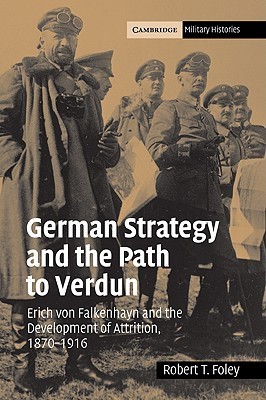
Really fascinating revisionist history that challenges the standard interpretations of Falkenhayn and Verdun - that, essentially, Falkenhayn was a weak, vascillating leader and never intended Verdun to be a limited attritional offensive. Foley traces the evolution of attritional approaches in German strategic thought from 1870, sparked largely by the continued French "people's war" resistance at the end of the Franco-Prussian War, when the great battles of annihilation at Sedan and Metz failed to secure the surrender of the French people (as opposed to the government of Louis Napoleon, who was captured at Sedan). This school of strategic thought, at odds with the Prussian/German mainstream, continued to develop in parallel to annihilation-focused strategies through the periods of Moltke the Elder, von Schlieffen, and finally the younger Moltke, meaning that when Falkenhayn took command, there was a tradition of thought about attritional strategies for him to draw on.
Foley traces the development of the Verdun strategy very effectively, and concludes that Falkenhayn truly meant the limited offensive and attritional strategy - that a limited attack threatening such a viscerally important landmark as Verdun would draw massive French efforts to defend it - as well as a counteroffensive somewhere else to draw off the pressure. Falkenhayn believed from the results of 1915's battles at Artois, Loos, and Champagne that the German Army could resist that offensive and bleed its enemies white. It's interesting to consider that if the German defensive tactics of 1917-18 (defense-in-depth) had existed in 1916, it is likely that the Somme bloodletting could have ended up being exactly that battle that Falkenhayn envisioned. (Instead, the German focus on holding the front line maximized British casualties, but also ended up causing horrific German losses to artillery fire).
Instead, however, the devil was in the details - no defense-in-depth doctrine existed in 1916; Falkenhayn communicated his limited-offensive intention at Verdun poorly, so Crown Prince Wilhelm and his army did not utilize limited offensive tactics; the weather forced a postponement that ruined surprise; the initial attack was not big enough to secure both banks of the Meuse, leaving German troops vulnerable to enfilading artillery fire from Cote 304 and Mort-Homme on the left bank; and rather than keeping forces in the Verdun meat-grinder indefinitely to allow a French counterattack elsewhere, Petain convinced Joffre to institute the noria rotation system, and left the counteroffensives to the British at the Somme and the Russians (Brusilov offensive). Eventually, Verdun (like Stalingrad in World War II) assumed a logic all its own, driven by emotional and political considerations that subverted the strategic logic. All of this raises the question of how one can pursue limited war strategies in an "unlimited" war - see also Japanese strategy in the Pacific in World War II. . .