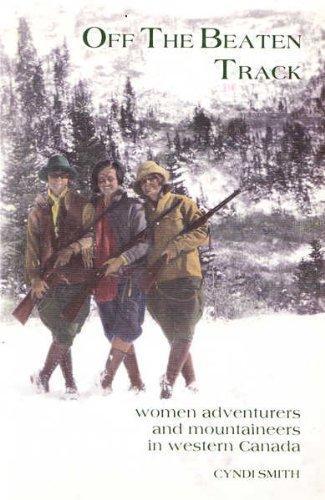
This was a second read for me of this inspirational book. I purchased this book while cycling the Canadian Rockies between Banff and Jasper. Historically, little has been written of the women who explored the wild places of North America. Their lives and contributions taking a back seat to male explorers. Women often accompanied the male explorers and made significant contributions in their own right. While she was a scientist and artist, Mary Vaud Walcott also carried the mantle of her husband’s work for the Smithsonian after his passing. This during the early 1920’s. Women also forged ahead and created their own businesses. After several summers in the 1910’s of independent mountaineering and exploring, Caroline Hinman lead exploring trips for young women in the Rockies and throughout the world. Exposing these women to the joys and wonders of the mountains and being self sufficient and strong at a time when this was not the norm.
I have to believe that the Rockies attracted, helped develop and ultimately supported these women in becoming more free spirited and strong than a standard city upbringing would have encouraged. The freedom of being a pioneer in the wilderness leveled the gender playing field a bit and brought a freedom they would not have experienced elsewhere.
My great grandmother gave birth to my grandfather in the Yukon Territory on a gold mine stake in the dead of winter. My grandmother spent her early 20’s exploring Alaska. This book helped me feel close to them. It was a hard life but I have seen pictures of my grandmother in Alaska and the open freedom in her eyes is striking. After reading this book, I feel like I have better insight into what brought that twinkle into her eyes.
But, I digress. I really am glad I came back for a re-read of this book 25 years later. It’s inspirational and refreshing. The sources and bibliography at the end is also worth a read. I hope to find some of these books and articles and delve into this topic more.
I love the paraphrased quote from Mark Twain in the forward: “She is not quite what you would call an undignified woman; she is not quite what you would call a dignified woman. She is the sort of woman who keeps a parrot.” Read the book and happy trails!
Oh man, for someone who has an explored the Rockies this book was an absolute treat! Picturing these women summiting the same peaks as I have - but over 100 years ago - blew me away. They conquered societal pressures to explore, they wore nailed boots, and wool pantaloons and just absolutely crushed these hikes before mountaineering was even popular. So inspiring! I would say this book would be quite dull for someone who had not explored these areas; but for me it was magical.
Part of the book is a wonderful record of strong mountaineering women who pushed past societal norms to do what they really wanted to in life. Part of the book really highlights how the rich and bored vacationed to the Canadian Rockies and is much less interesting.
Another serendipitous estate sale or library book sale find - I very much enjoyed this one. I learned a lot about mountain climbing - and the sheer amount of effort it takes to do a first ascent... clearing a trail, laying in supplies ahead of time, managing a string of 10+ pack horses, carrying supplies - including 50 pounds of potatoes - and the like. This book gave great insights to a wonderful corner of women's lives during the turn of the 20th century not often discussed. Women who traveled independently, single women hanging out with men (male guides), women wearing pants to the horror of their relatives and society, shooting guns / hunting, and, in some cases, doing a man's job (guide).
My only quibbles with the book are small: I would have loved the mountain heights to be given in imperial (feet) as well as meters and I would have liked in-line maps / illustrations of each section of each woman's story so I could have a better sense of where they were and the route they took without having to pause reading to go look it up. This is especially true in the sections of many stories that became solely long litanies of mountain peaks traversed. I found myself skimming those sections as I didn't have enough context to know (or care) about the names of all the peaks climbed. I would have preferred the author spent more time describing the landscape of the peaks climbed and less letting men's stories creep into the narrative - there were substantial sections on the lives of several of the male guides and on the various husbands, which distracted from the focus on the women (which is what the book is supposed to be about). Despite these slight quibbles, the book was highly enjoyable and the author did a great job of creating an interesting narrative from what I suspect were very thin source materials. She was able to flesh out the story of each woman and bring her fully to life.
This book provides short biographies of a dozen women who were active in the Canadian Rockies, half of which were climbers.
Most came specifically for the beauty of the Rockies, often engaging in painting and photography. Many of the women studied the flowers.
The urge to explore is evident. Many organized trips to areas that have rarely been visited since. While today, many run in to the wilderness for a day or two, these early explorers made extended trips comprised of equal parts travel, exploration and rest days.
Georgia Englehard Cromwell's characterisation of the Swiss guides:
"They were short, strong, stocky men and rather monosyllabic, though both Chris and Edward had palky senses of humour. They were not great guides in that they were not artists on rock and ice and snow but very competent workmen. They had no knowledge or use for the modern techniques the use of piton and karabiner, the art of rappelling were beyond their ken. They did use crampons on occasion, but preferred to cut steps. After World War Two when the use of Vibram soles on boots became popular, they were among the last to give up their nailed boots. But despite their conservatism they were great guides in that nothing delighted them more than making a first ascent or a new route. They had a terrific flair for route-finding, not only on rock and ice but also through the often dense forests that clothe the lower stretches of an ascent. They seldom went wrong."
I started this book while “glamping” @ at the Purcell mountain Lodge in Interior B.C. What a way to visit the high alpine: not just running water, but HOT water, and electricity!!! All thanks to foresight and clever engineering by the original creators of this lodge located at tree line, with a fabulous view of Mt. Sir Donald and the Purcell range. And sustainable: the local creek provided a ready source of fresh water, and the turbine located further down the slope generated the power. What a different world than the one I was reading about: adventurous women who loved the Canadian Rockies, interior ranges, and the West Coast range. Most were well-to-do Americans who could afford to stay in the mountains for months at a time, and hire guides and outfitters to take them into the mountains for prolonged exploring. And explore they did! And climb formidable mountains! And name a few peaks along the way. All loved the wild places and most tried to inform their fellow citizens when they returned home about the beauty and value of preserving these spaces. The book reads like an encyclopedia, but the author used as much original material written by the subjects to create their voice and experience. After visiting Purcell Lodge, I came away with the same feeling of awe for the importance of preserving wild places, even though civilization has certainly had an impact .
The lives of pioneering women has always fascinated me. These women explored and climbed in Western Canada, and it's hard not to admire their resilience, determination, and sheer love of the mountains.
Cyndi Smith shines a light on women who it seems were too often overlooked in the history of mountaineering and exploration. Several stories made me want to learn more about the women featured, which is always a good sign.
The book reads more like a collection of biographical sketches. Some profiles felt quite brief, and I often wished for more context about the women themselves, the challenges they faced, or the broader history of mountaineering in Western Canada.
The writing is clear and accessible, although straightforward. I'm glad I read it because it highlighted an important and often neglected part of Canadian history, but I don't think it fully capitalised on the incredible lives it documents.
I was excited for this book,I love Rocky mountain history, but this book sadly wasn't what I imagined. It reads more like an encyclopedia article or textbook, there's no imagery or emotion, you don't get the feel of anything. I forced myself to get halfway,then I abandoned it. Also,there seemed to be more about the husbands,fathers, brothers than the women,who it's supposed to be celebrating.
Learning about the different ways women worked, hiked, and mountaineered through Western Canada may seem like a dry subject. Yet it is a history that needs more people, discussion, and recognition in order to keep this history alive and going. Cyndi Smith did a good job in being able not to throw a bunch of facts together. Also, a fan of hockey I liked hearing about other things going on in some of the places that were familiar.