

What do you think?
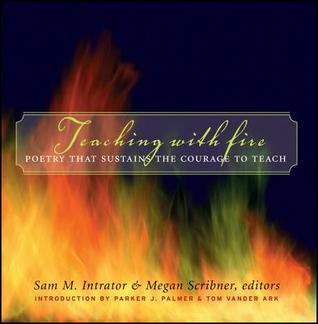
Teaching with Fire: Poetry That Sustains the Courage to Teach
Reclaim Your Fire " Teaching with Fire is a glorious collection of the poetry that has restored the faith of teachers in the highest, most transcendent values of their work with children....Those who want us to believe that teaching is a technocratic and robotic skill devoid of art or joy or beauty need to read this powerful collection. So, for that matter, do we all."
?Jonathan Kozol, author of Amazing Grace and Savage Inequalities
"When reasoned argument fails, poetry helps us make sense of life. A few well-chosen images, the spinning together of words creates a way of seeing where we came from and lights up possibilities for where we might be going....Dip in, read, and ponder; share with others. It's inspiration in the very best sense."
?Deborah Meier, co-principal of The Mission Hill School, Boston and founder of a network of schools in East Harlem, New York
"In the Confucian tradition it is said that the mark of a golden era is that children are the most important members of the society and teaching is the most revered profession. Our jour ney to that ideal may be a long one, but it is books like this that will sustain us - for who are we all at our best save teachers, and who matters more to us than the children?"
?Peter M. Senge, founding chair, SoL (Society for Organizational Learning) and author of The Fifth Discipline
Those of us who care about the young and their education must find ways to remember what teaching and learning are really about. We must find ways to keep our hearts alive as we serve our students. Poetry has the power to keep us vital and focused on what really matters in life and in schooling. Teaching with Fire is a wonderful collection of eighty-eight poems from such well-loved poets as Walt Whitman, Langston Hughes, Billy Collins, Emily Dickinson, and Pablo Neruda. Each of these evocative poems is accompanied by a brief story from a teacher explaining the significance of the poem in his or her life's work. This beautiful book also includes an essay that describes how poetry can be used to grow both personally and professionally.
Teaching With Fire was written in partnership with the Center for Courage & Renewal and the Bill & Melinda Gates Foundation. Royalties from this book will be used to fund scholarship opportunities for teachers to grow and learn.
CALL FOR SUBMISSIONS for our next Teaching from the Heart. Due date for submissions is Feb. 1, 2013 For details, visit CourageRenewal (dot) com/poetrybook.
?Jonathan Kozol, author of Amazing Grace and Savage Inequalities
"When reasoned argument fails, poetry helps us make sense of life. A few well-chosen images, the spinning together of words creates a way of seeing where we came from and lights up possibilities for where we might be going....Dip in, read, and ponder; share with others. It's inspiration in the very best sense."
?Deborah Meier, co-principal of The Mission Hill School, Boston and founder of a network of schools in East Harlem, New York
"In the Confucian tradition it is said that the mark of a golden era is that children are the most important members of the society and teaching is the most revered profession. Our jour ney to that ideal may be a long one, but it is books like this that will sustain us - for who are we all at our best save teachers, and who matters more to us than the children?"
?Peter M. Senge, founding chair, SoL (Society for Organizational Learning) and author of The Fifth Discipline
Those of us who care about the young and their education must find ways to remember what teaching and learning are really about. We must find ways to keep our hearts alive as we serve our students. Poetry has the power to keep us vital and focused on what really matters in life and in schooling. Teaching with Fire is a wonderful collection of eighty-eight poems from such well-loved poets as Walt Whitman, Langston Hughes, Billy Collins, Emily Dickinson, and Pablo Neruda. Each of these evocative poems is accompanied by a brief story from a teacher explaining the significance of the poem in his or her life's work. This beautiful book also includes an essay that describes how poetry can be used to grow both personally and professionally.
Teaching With Fire was written in partnership with the Center for Courage & Renewal and the Bill & Melinda Gates Foundation. Royalties from this book will be used to fund scholarship opportunities for teachers to grow and learn.
CALL FOR SUBMISSIONS for our next Teaching from the Heart. Due date for submissions is Feb. 1, 2013 For details, visit CourageRenewal (dot) com/poetrybook.
256 pages, Hardcover
First published October 10, 2003
Ratings & Reviews
Friends & Following
Create a free account to discover what your friends think of this book!
Community Reviews
Displaying 1 - 30 of 35 reviews

January 2, 2009
What an excellent collection of poetry. Includes greats from Billy Collins, ee cummings, Mary Oliver and Wislawa Szymborska. Not only did it remind me of some of my favorite poems I had forgotten about, but it also exposed me to some great new works, including "I Care and I'm Willing to Serve" by Marian Wright Edelman.
One of the teachers quotes poet Lucille Clifton: "Every pair of eyes facing you has probably experienced something you could not endure."
One of the teachers quotes poet Lucille Clifton: "Every pair of eyes facing you has probably experienced something you could not endure."

October 3, 2017
Found this on a friend's desk at work. It's nice little selection of poetry intended to inspire educators. Each poem is book ended by essays or letters that usually touch on the poem. I found myself more interested in the poems, so I would catch myself skipping some of essays.
I might update this review tomorrow by listing some of my favorite poems selected. The book is back on his desk and I don't have it with me. However, the poem that has stuck with me the most was "I care and I am willing to serve" by Marian Wright Edelman.
I might update this review tomorrow by listing some of my favorite poems selected. The book is back on his desk and I don't have it with me. However, the poem that has stuck with me the most was "I care and I am willing to serve" by Marian Wright Edelman.

August 31, 2007
The premise was cool...poems about teaching and reflections (kind of Americans' Favorite Poems-style), but I'm picky about my poems and for me, the selection just didn't deliver. There were a couple of winners though.
September 11, 2021
I’ll probably never be done with this book. It’s one I will pick up again and again for inspiration. I loved the poems and also the reasons the teachers gave for selecting them.

July 1, 2024
Sentimental flattery. Even the occasional good poem selections are ruined by the shallow commentary. Avoid this book, teachers. The profession needs no additional misery.

November 6, 2025
I was surprised by the amount of poems I connected with in this book. I read this book thinking that even if I found a small handful of poems I liked, reading it would be worthwhile; to my great surprise, one poem after another after one thrilled me and inspired me and encouraged me to keep teaching!
Of the 65 unique authors represneted in this collection, I only recognized a small handful. So, I was glad to be introduced to so many wonderful poets! I wish the authors would have included a brief bio of each of the poets, but I was able to look this information up on my own.
Of the authors who have more than one poem represented in this book, my favorites were these:
Billy Collins, "On Turning Ten," at first, it seems like a spoof of the existential crises people have turning 30, 40, or 50, but it's not a spoof. It's a serious reflection, on the part of a boy whose bicycle "never leaned against the garage as it does today, all the dark blue speed drained out of it," about the sadness of leaving childhood.
Billy Collins, "First Reader," is another sad poem about the cost of young children learning the rigid, "clicking permutations" of the alphabet, "alphabetical ourselves in the rows of classroom desks, we were forgetting how to look, learning how to read." However, I disagree with Collins that learning how to read and write hinders pure imagination and creativity. I think reading and writing open up doors to imagination and creativity that were previously closed.
Billy Collins, "Introduction to Poetry." This would be a fun poem to introduce to students when we start our American Romanticism poetry unit. In the poem, Collins lists several fun ways of studying a poem, such as "press[ing] an ear against its hive" and "drop[ping] a mouse into a poem / and watch him prove his way out." It ends with this stark image: "But all they want to do / is tie the poem to a chair with a rope / and torture a confession out of it. / They begin beating it with a hose / to find out what it really means."
William Stafford, "Silver Star," this poem to me sounds like a Christian poem, an assertion I base on the allusion to Matthew 25:23, "Well done, my good and faithful servant," at the end: "[Imagine you are] a mountain... if a forest grows, you care... [you must endure trials]... If you are lucky, people will give you a dignified name and bring crowds to admire how sturdy you are... and some time, they say, if you last long enough you will hear God; a voice will roll down from the sky and all your patience will be rewarded. The whole world will hear it: 'Well done.'" I did some research, and Stafford called himself a seeker, though he grew up in the church; that said, in 1973 he told the Paris Review, in answer to the question was he a Christian poet, "I think I would be whatever religion there was in the society around me."
William Stafford, "The Way It Is." This poem is about following your calling through the dark twists and turns of life by fiercly holding on to its thread. It reminds me of Psalm 119:105: "Thy word is a lamp unto my feet and a light unto my path."
Langston Hughes, now I think of it, is one of my favorite poets. His poems are represented in this book, "Harlem" (Dream Deferred), "My People," and "Mother to Son" are some of his best. I also love his short story, "Thank you, Ma'am."
David Whtye, I found out, wrote "Working Together" for Boeing to mark the introduction of the 777 jetliner. Poetry and corporations seem like oil and water, but here they produce a congenial mix:
-- thirty-five, which is a lot / righteous / and understanding / -- three".
I've never liked Walt Whitman, though I enjoyed both of his poems in this collection: "Preface to Leaves of Grass" [Excerpt] and "Crossing Brooklyn Ferry" [Excerpt].
I didn't love Rainer Maria Rilke's "I Believe in All That Has Never Yet Been Spoken," but I loved her poem "The Archaic Torso of Apollo," which is basically an ephratic poem until the last line: "You must change your life." I like what contributor Rob Reich, a college professor from California, says about this: "Transformative teachers... secretly hope that the effect of their presence in the classroom will be that of Rilke's poem: the instruction to change your life, to see the world with fresh eyes, to become something new" (146).
Mary Oliver's poem, "The Summer Day," is a good one--deserving of its reputation, I'd say! Here it is in full:
Now, I've only talked about the poets who had more than one poem in this collection. And writing all this, I realized that I have barely scratched the surface of even these specific poems I've named. Poems really are a rich well of meaning and inspiration, and I will need to come back to this book again in the future to drink more. But for now, I want to end this review with my favorite poem from the entire collection, "Names of Horses" by Donald Hall, submitted to this collection by Laurel Leahy, a kindergarten teacher. I love what Leahy says about this poem: "But how could this poem speak to me? This poem is about horses!. This poem, which Leahy says is about "holiness even in the mundane," speaks to me, too. The poem is actually quite depressing at first: it's about the mundane work of horses, that all their lives repeat monotonous tasks, for which there is little thanks except perhaps a pat on the neck and provision of water and food, with the occasional apple as a treat now and then. Then, near the end of the poem, the horses die and are buried in a nondescript grave. It's depressing. It makes me think of my work as a teacher--thankless and mundane, repetitive year to year, and at the end I'll be buried in the grave. But this depressing setup is actually why the last line shines so full of hope! Here the poem is in full:
Of the 65 unique authors represneted in this collection, I only recognized a small handful. So, I was glad to be introduced to so many wonderful poets! I wish the authors would have included a brief bio of each of the poets, but I was able to look this information up on my own.
Of the authors who have more than one poem represented in this book, my favorites were these:
Billy Collins, "On Turning Ten," at first, it seems like a spoof of the existential crises people have turning 30, 40, or 50, but it's not a spoof. It's a serious reflection, on the part of a boy whose bicycle "never leaned against the garage as it does today, all the dark blue speed drained out of it," about the sadness of leaving childhood.
Billy Collins, "First Reader," is another sad poem about the cost of young children learning the rigid, "clicking permutations" of the alphabet, "alphabetical ourselves in the rows of classroom desks, we were forgetting how to look, learning how to read." However, I disagree with Collins that learning how to read and write hinders pure imagination and creativity. I think reading and writing open up doors to imagination and creativity that were previously closed.
Billy Collins, "Introduction to Poetry." This would be a fun poem to introduce to students when we start our American Romanticism poetry unit. In the poem, Collins lists several fun ways of studying a poem, such as "press[ing] an ear against its hive" and "drop[ping] a mouse into a poem / and watch him prove his way out." It ends with this stark image: "But all they want to do / is tie the poem to a chair with a rope / and torture a confession out of it. / They begin beating it with a hose / to find out what it really means."
William Stafford, "Silver Star," this poem to me sounds like a Christian poem, an assertion I base on the allusion to Matthew 25:23, "Well done, my good and faithful servant," at the end: "[Imagine you are] a mountain... if a forest grows, you care... [you must endure trials]... If you are lucky, people will give you a dignified name and bring crowds to admire how sturdy you are... and some time, they say, if you last long enough you will hear God; a voice will roll down from the sky and all your patience will be rewarded. The whole world will hear it: 'Well done.'" I did some research, and Stafford called himself a seeker, though he grew up in the church; that said, in 1973 he told the Paris Review, in answer to the question was he a Christian poet, "I think I would be whatever religion there was in the society around me."
William Stafford, "The Way It Is." This poem is about following your calling through the dark twists and turns of life by fiercly holding on to its thread. It reminds me of Psalm 119:105: "Thy word is a lamp unto my feet and a light unto my path."
Langston Hughes, now I think of it, is one of my favorite poets. His poems are represented in this book, "Harlem" (Dream Deferred), "My People," and "Mother to Son" are some of his best. I also love his short story, "Thank you, Ma'am."
David Whtye, I found out, wrote "Working Together" for Boeing to mark the introduction of the 777 jetliner. Poetry and corporations seem like oil and water, but here they produce a congenial mix:
The visibleWislawa Szymborska, "There But for the Grace," this is a poem about a millimeter, a second, a "sheer coincidence," saving someone from the Nazi ovens during WWII. The contributor who submitted this poem applied this poem to 9/11. I enjoyed this poem; it reminds me to trust in God for the millimeters and seconds to line up for me according to His will. Her poem "A Contribution to Statistics" is good, too, especially this part: "Out of a hundred people.... righteous /
and the invisible
working together
in common cause,
to produce
the miraculous.
I am thinking of the way
the intangible air
passed at speed
round a shaped wing
easily
holds our weight.
So may we, in this life
trust
to those elements
we have yet to see
or imagine,
and look for the true
shape of our own self,
by forming it well
to the great
intangibles about us.
-- thirty-five, which is a lot / righteous / and understanding / -- three".
I've never liked Walt Whitman, though I enjoyed both of his poems in this collection: "Preface to Leaves of Grass" [Excerpt] and "Crossing Brooklyn Ferry" [Excerpt].
I didn't love Rainer Maria Rilke's "I Believe in All That Has Never Yet Been Spoken," but I loved her poem "The Archaic Torso of Apollo," which is basically an ephratic poem until the last line: "You must change your life." I like what contributor Rob Reich, a college professor from California, says about this: "Transformative teachers... secretly hope that the effect of their presence in the classroom will be that of Rilke's poem: the instruction to change your life, to see the world with fresh eyes, to become something new" (146).
Mary Oliver's poem, "The Summer Day," is a good one--deserving of its reputation, I'd say! Here it is in full:
Who made the world?Marge Piercy's, "The Seven Of Pentacles," even though I don't think she means to allude to the Bible as the title of her poem is a Tarot card, seems to me to allude perfectly to 1 Corinthians 3:6, "I planted the seed in your hearts, and Apollos watered it, but it was God who made it grow." But the poem in this collection that I really liked was "To be of use":
Who made the swan, and the black bear?
Who made the grasshopper?
This grasshopper, I mean—
the one who has flung herself out of the grass,
the one who is eating sugar out of my hand,
who is moving her jaws back and forth instead of up and down—
who is gazing around with her enormous and complicated eyes.
Now she lifts her pale forearms and thoroughly washes her face.
Now she snaps her wings open, and floats away.
I don't know exactly what a prayer is.
I do know how to pay attention, how to fall down
into the grass, how to kneel down in the grass,
how to be idle and blessed, how to stroll through the fields,
which is what I have been doing all day.
Tell me, what else should I have done?
Doesn't everything die at last, and too soon?
Tell me, what is it you plan to do
with your one wild and precious life?
The people I love the best.Jellaludin Rumi, "Two Kings of Intelligence," was written in the 1200s AD by Rumi, a Persian poet! I wish the introduction to the poem in this collection would have told me this, because I think it's age gives this poem even deeper signficance, for the feeling of being not start enough is a feeling that humanity has experienced for a long time.
jump into work head first
without dallying in the shallows
and swim off with sure strokes almost out of sight.
They seem to become natives of that element,
the black sleek heads of seals
bouncing like half-submerged balls.
I love people who harness themselves, an ox to a heavy cart,
who pull like water buffalo, with massive patience,
who strain in the mud and the muck to move things forward,
who do what has to be done, again and again.
I want to be with people who submerge
in the task, who go into the fields to harvest
and work in a row and pass the bags along,
who are not parlor generals and field deserters
but move in a common rhythm
when the food must come in or the fire be put out.
The work of the world is common as mud.
Botched, it smears the hands, crumbles to dust.
But the thing worth doing well done
has a shape that satisfies, clean and evident.
Greek amphoras for wine or oil,
Hopi vases that held corn, are put in museums
but you know they were made to be used.
The pitcher cries for water to carry
and a person for work that is real.
There are two kinds of intelligence: one acquired,Gary Snyder's "Axe Handles" is a cool poem about how we pass on information in society, from master to apprentice, down and down and down the generations.
as a child in school memorizes facts and concepts
from books and from what the teacher says,
collecting information from the traditional sciences
as well as from the new sciences.
With such intelligence you rise in the world.
You get ranked ahead or behind others
in regard to your competence in retaining
information. You stroll with this intelligence
in and out of fields of knowledge, getting always more
marks on your preserving tablets.
There is another kind of tablet, one
already completed and preserved inside you.
A spring overflowing its springbox. A freshness
in the center of the chest. This other intelligence
does not turn yellow or stagnate. It's fluid,
and it doesn't move from outside to inside
through conduits of plumbing-learning.
This second knowing is a fountainhead
from within you, moving out."
Now, I've only talked about the poets who had more than one poem in this collection. And writing all this, I realized that I have barely scratched the surface of even these specific poems I've named. Poems really are a rich well of meaning and inspiration, and I will need to come back to this book again in the future to drink more. But for now, I want to end this review with my favorite poem from the entire collection, "Names of Horses" by Donald Hall, submitted to this collection by Laurel Leahy, a kindergarten teacher. I love what Leahy says about this poem: "But how could this poem speak to me? This poem is about horses!. This poem, which Leahy says is about "holiness even in the mundane," speaks to me, too. The poem is actually quite depressing at first: it's about the mundane work of horses, that all their lives repeat monotonous tasks, for which there is little thanks except perhaps a pat on the neck and provision of water and food, with the occasional apple as a treat now and then. Then, near the end of the poem, the horses die and are buried in a nondescript grave. It's depressing. It makes me think of my work as a teacher--thankless and mundane, repetitive year to year, and at the end I'll be buried in the grave. But this depressing setup is actually why the last line shines so full of hope! Here the poem is in full:
"All winter your brute shoulders strained against collars, padding
and steerhide over the ash hames, to haul
sledges of cordwood for drying through spring and summer,
for the Glenwood stove next winter, and for the simmering range.
In April you pulled cartloads of manure to spread on the fields,
dark manure of Holsteins, and knobs of your own clustered with oats.
All summer you mowed the grass in meadow and hayfield, the mowing machine
clacketing beside you, while the sun walked high in the morning;
and after noon's heat, you pulled a clawed rake through the same acres,
gathering stacks, and dragged the wagon from stack to stack,
and the built hayrack back, uphill to the chaffy barn,
three loads of hay a day from standing grass in the morning.
Sundays you trotted the two miles to church with the light load
a leather quartertop buggy, and grazed in the sound of hymns.
Generation on generation, your neck rubbed the windowsill
of the stall, smoothing the wood as the sea smooths glass.
When you were old and lame, when your shoulders hurt bending to graze,
one October the man, who fed you and kept you, and harnessed you every morning,
led you through corn stubble to sandy ground above Eagle Pond,
and dug a hole beside you where you stood shuddering in your skin,
and lay the shotgun's muzzle in the boneless hollow behind your ear,
and fired the slug into your brain, and felled you into your grave,
shoveling sand to cover you, setting goldenrod upright above you,
where by next summer a dent in the ground made your monument.
For a hundred and fifty years, in the Pasture of dead horses,
roots of pine trees pushed through the pale curves of your ribs,
yellow blossoms flourished above you in autumn, and in winter
frost heaved your bones in the ground - old toilers, soil makers:
O Roger, Mackerel, Riley, Ned, Nellie, Chester, Lady Ghost."

June 24, 2025
A wonderful anthology with a selection of poems that are not found in every anthology. And even the more well known poems have a unique explanation as to why they are in the collection. Highly recommend.
August 28, 2019
How I wish I’d discovered Parker Palmer and the Centers for Teacher Formation and their retreats for teachers when I was teaching in high school and college. The definition of good teaching has been my philosophy: good teaching flows out of the identity and integrity of the teacher. Without question, the teacher is the most important part of any classroom, so who she is in the core of her being matters! What keeps good teachers in the classroom for the long haul when things fall apart and nothing seems to work, along with exhaustion and frustration which accompany mandates, standards, and testing? Oh, how we long for the exhilaration of discussing big ideas and the freedom to allow students to soar! Poetry can provoke us as teachers and stir our students. If I didn’t believe that before, I certainly would after reading this anthology.
Where did I find this book? It is a marvelous collection of eighty-eight poems from poets both internationally known and those unknown. Each poem is introduced by a short story from a teacher who explains the significance of the poem in his or her life’s work. In addition, Sam Intrator (editor) has written an outstanding essay on using poetry in the classroom, boardroom, social gathering, etc. I enjoyed the introductions to the poems as much as the poems. And I love the thread that ties the book together: Teaching with Fire.
I read and reread the poems—not understanding all of them, but delighting in the words and pulled in by the images. I also made personal connections with my own teaching experiences. And I’ve copied some poems which I want to share with friends!
If you’re a teacher or thinker or philosopher or the neighbor next door, you might be delighted by the unexpected surprises you’ll find in these poems!
Where did I find this book? It is a marvelous collection of eighty-eight poems from poets both internationally known and those unknown. Each poem is introduced by a short story from a teacher who explains the significance of the poem in his or her life’s work. In addition, Sam Intrator (editor) has written an outstanding essay on using poetry in the classroom, boardroom, social gathering, etc. I enjoyed the introductions to the poems as much as the poems. And I love the thread that ties the book together: Teaching with Fire.
I read and reread the poems—not understanding all of them, but delighting in the words and pulled in by the images. I also made personal connections with my own teaching experiences. And I’ve copied some poems which I want to share with friends!
If you’re a teacher or thinker or philosopher or the neighbor next door, you might be delighted by the unexpected surprises you’ll find in these poems!

March 5, 2016
This was a first for me: sitting down and reading a poetry book cover to cover. I was tremendously moved by many of the poems that were included and will probably spend the next few days photocopying pages to share with other teachers.
Third time through... now that I'm retired ...this gem of a book speaks to me on a new and different level. This time I am determined to write a review. I'll be back and link it.
Third time through... now that I'm retired ...this gem of a book speaks to me on a new and different level. This time I am determined to write a review. I'll be back and link it.

March 7, 2008
Some of the poems in here are a bit hokey, but, for the most part, many are familiar and, in a strange way, inspiring (especially those that are taken a bit out of context). The personal stories that accompany each poem really do make the difference in this collection, though. I just wish that some of the more blatant editing oversights had been corrected.

October 17, 2023
Collection of poems that can accompany the vision of Courage to Teach (Parker Palmer). Each poem comes with a brief narrative from the person who suggested it for this collection. Some good poems in there; helpful resource.

May 2, 2024
One of those books that I didn't want to be finished. The poems along with their corresponding vignettes were uplifting and impressive. As an educator, I'm sure I'll be reading some of them time and again in the future...

August 8, 2024
This book and its message is inspiring. It brought up some great ideas for curriculum and running meetings. Not all the poetry or messages within hit home or made sense.

September 4, 2025
What I loved most about this book were the teacher reflections paired with each poem. As an educator and parent, it felt like a gift to glimpse students’ “lightbulb” moments. One favorite was a teacher who helped her class connect with William Carlos Williams’ The Red Wheelbarrow by incorporating play—students raced down the hallway as wheelbarrows, laughing and breathless, before sitting down to write. Their joy showed how even a 16-word poem can open the door to storytelling, new perspectives, and accessible learning for everyone.

July 13, 2011
This hs been a great pick-me-up over the years for me. The book contains various poems that teachers have contributed. And their thoughts and reasons why each poem resonates for them really hit home for me. Not an overwhelming book, but a gritty and realistic look at how teachers really feel as they impact and interact with children on a daily basis. The poems are really carefully chosen. You won't go wrong with this book.

February 8, 2013
Well, the poems were good. But they aren't original to this book so I'm judging it based on its cover original content which, to me, after reading the first several entries, seemed to be only slight variations on the same theme of "we're teachers, students need pity, we need encouragement." If that's your thing this book is for you but it's not for me. Thanks anyway.

April 2, 2008
I was given this book by my principal and, unfortunately, blew it off because she never impressed me as a person who had her finger on the pulse of ... well ... anything. Realizing now who helped bring this book about may just incite me to pick it up again. For now, the 2 stars remain.

August 4, 2008
Why did I stop reading poetry regularly, when I love it so much? I forget, sometimes, but then I read something like this, with so many good poems, and it makes me want to cry, thinking that I'll never be able to write like that.
February 21, 2008
Received this as a gift from an 80 year old teaching mentor. It's a great bedside read!

February 21, 2008
get it, RUN!
May 28, 2008
inspiring for teachers to read a bit at a time

August 29, 2008
I love this collection of poetry and insight into the classroom. Inspirational even for those out of acadamia. I try to keep this one at arm's length.
September 5, 2009
Great book!

July 18, 2010
Nikki Giovanni, Langston Hugh's, Wallace Stevens, Billy Collins, thank God for poets, poems, & poetry. Thank teachers for helping us to read poets. Thank God for teachers.
October 28, 2010
My advisor in college wrote this. It is a wonderful collection of poems. Every poem was chosen by a teacher and comes with an short story about how the poem "sustains their courage to teach."

May 30, 2011
Really interesting anthology of poems selected because of what they say to classroom teachers. Cool concept.

September 23, 2011
My favorite poetry collection ever!

July 6, 2012
My once touchstone book!

August 27, 2012
LOVED IT

January 9, 2013
A good pick-me-up. Makes me think about what poem I would choose, were I asked.
Displaying 1 - 30 of 35 reviews