David Lloyd George is at Chequers for the weekend with his mistress Frances Stevenson, fretting about the fact that his involvement in selling public honours is about to be revealed by one Victor Grayson. Victor is a bisexual hedonist and former firebrand socialist MP turned secret-service informant. Intent on rebuilding his profile as the leader of the revolutionary Left, he doesn't know exactly how much of a hornet's nest he's stirred up. Doesn't know that this is, in fact, his last day.
No one really knows what happened to Victor Grayson – he vanished one night in late September 1920, having threatened to reveal all he knew about the prime minister's involvement in selling honours. Was he murdered by the British government? By enemies in the socialist movement (who he had betrayed in the war)? Did he fall in the Thames drunk? Did he vanish to save his own life, and become an antiques dealer in Kent?
Whatever the truth, Green Ink imagines what might have been with brio, humour and humanity; and is a reminder that the past was once as alive as we are today.
A novelistic imagining of the last day of Victor Grayson's life. Grayson was a Labour MP and great hope of British left wing politics before he crashed out, an alcoholic, a war hero, bisexual, a firebrand campaigning journalist exposing the Lloyd George cash for honours scandal, a mole for British Intelligence among Socialists. As Walt Whitman almost said, "Do I contradict myself? Fucking right I do."
The mess that was Grayson is mercilessly laid out on the page along with all the forces converging on him: the father-in-law determined to get legal custody of the child Grayson abandoned, the intelligence services seeing him as a weapon or possibly a loose cannon, the radicals who wanted to use him to get at Lloyd George, Lloyd George very much not wanting to be got at.
If you're into the minutiae of the 1920s this is a fantastic read. We get Basil Thomson (skewered as brutally as he deserves), Frances Stevenson, Philip Noel-Baker, Maundy Gregory, along with AFAIK some invented characters: an upper class Socialist woman reeling from the aftermath of war, an Indian guy with an interest in Aleister Crowley and a murky past. It's a terrific picture of the era: the miserable London setting is well drawn, and the chaotic politics and social upheaval of the time are well to the forefront along with a great mood of utter moral bankruptcy. There's a lot of sex. Everyone is out for themself; everything is dirty.
It doesn't have a massive amount of plot, per se, but you want to know what happens. (Grayson disappeared completely that night and nobody ever found a body. It might have been Maundy Gregory's doing to shut him up about cash for honours but there are other theories.) This is a novelised version not a serious attempt to solve the insoluble, and the answer it gives is perfect for the mood and feel of the book.
Strong writing, fabulous atmosphere; I enjoyed it a great deal. I'm not sure if it would be quite so accessible if you're coming at the era from scratch, but I had been very much wanting a book on Victor Grayson, tragic waste of potential that he was.
As in the author’s very enjoyable book, Sell Us The Rope, which concerned the young Stalin’s visit to London in May 1907, Green Ink is based on a real historical event, namely the disappearance of Victor Grayson on 28th September 1920. The circumstances of his disappearance remain unknown to this day and have been the subject of much speculation over the years. This is the author’s imagined answer to the mystery.
Told over the course of the day of Victor’s disappearance, the book gives the reader a vivid insight into a man who lived life on the edge – a drink, drug and sex-fuelled edge. The author assembles a cast of people who might have had reason to welcome Victor’s disappearance. These include Prime Minister David Lloyd George, fearful Victor may reveal his involvement in corruption, a spurned former lover and someone who has very personal reasons to resent Victor’s volte-face from passionate opponent of Britain’s entry into the First World War to enthusiastic advocate. And perhaps the memoir Victor is writing might disclose information the British government would rather remained secret. (Behind the scenes they’re doing quite a lot of information gathering themselves.)
This is London in the aftermath of the First World War and its consequences are graphically depicted. As Victor follows his fellow drinkers – ‘sad-eyed men and their long-suffering friends’ – out of a pub into the streets of London he sees ‘men muttering to themselves or hopping through the damp fog on crutches’. The streets are populated by ‘the blind, the crippled, the halt and the traumatised. Men chanting softly to themselves like so many confused monks.’ There is one particularly memorable scene in a cinema which brings home the devastation war can wreak on the human body.
I loved some of the character descriptions such as this one of actor and theatre producer Maundy Gregory. ‘He’d be an impressive figure if it didn’t look like subsidence was affecting his face, cheeks and jowls slithering to wards a flabby neck like a slow-moving mudslide.’
The book contains some explicit sex scenes which I found a little too anatomical to be erotic. There is also quite a bit of swearing which didn’t bother me but might some readers. On the other hand, there’s an infectious wit and verve about the writing which makes the book highly entertaining.
The circumstances of Victor’s disappearance, as imagined by the author, are dramatic but have an element of poetic justice. Of course, it doesn’t claim to be the truth and in a clever sleight of hand we learn exactly why that might not be the case. Oh, and the book’s title? ‘Everyone knows only the security services use green ink for their memoranda.’
3.5* - There is some truly lovely writing in this novel, and it also has a very well grounded historical sensibility. I’m in no doubt that Stephen May did his homework. It’s fun too; or at least, it has a wry Yorkshire humour to it: cynical and heartwarming at the same time. It’s swift and sharp, with some big feelings, and I ate it up quick as you like. It does feel slight though - a character piece that doesn’t have much new to say about the early 1920s. Not to sound too much like a lecturer telling her students how to get a 1st, but I want my historical fiction to make an intervention in my understanding of a period, a place, a set of circumstances. Give me a new light to see by. Green Ink doesn’t quite get there; still, a deeply enjoyable read.
Extremely well written and an interesting imagining based on real political events. Manipulation, double crossing, stealth, cunning and deceit throughout. Very enjoyable.
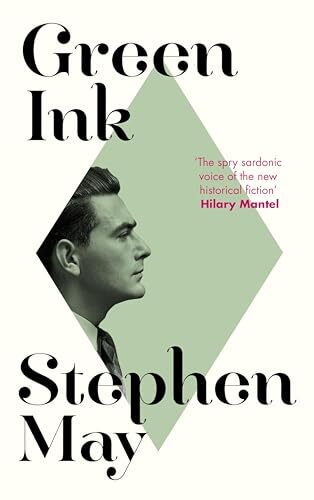
I thought this was a book about David Lloyd George - but it isn’t really - he is the excuse for the main plot line, and as a vehicle for other fascinating characters and the early evolution of the intelligence services. It is set over 2 days in September 1920, the foreign section of the secret service, an offshoot from the CID that became the SIS (Secret Intelligence Service) and then MI6. The original head of department was Mansfield Cumming, hence references in this book to ‘C’ branch. The current incumbent is Sir Basil Thomson, formerly of the prison service and far-flung south seas governorships. I'd like to think that it's true that he learnt and passed on Tongan and Fijian as secret languages within the service … but the fact and fiction are brilliantly blended here, so it is not clear without research. May has built on Sell Us the Rope to become, according to the blurb, ‘The spry, sardonic voice of the new historical fiction’.
Lloyd George is worried about the blow-back from a cash-for-honours scandal, and particularly how his enemies on the left might use ex-firebrand MP and journalist Victor Grayson to undermine him. This becomes an unofficial mission for his mistress and private secretary-cum-fixer, the indomitable Frances Stevenson. Lloyd George and Frances don’t know that Grayson is both the target of observation by the intelligence services as well as still being in their pay from his earlier war work. It is this role as a proxy army recruiter that leads to his death, a muddled and messy affair in an East End street, which conveniently clears up the problem for Lloyd George. This is not a classic spy story, but May’s creation to explain Grayson’s real-life unexplained disappearance. We also meet a 'proper' spy, the poet warrior Sikh Bohemian Hardit Joshi, a new recruit Babs, and her brother Maurice, disfigured during the war, our entry into the gay (in both senses) post-war London.
The ‘green ink’ of the title features in several key ways; the notes taken by the spooks as they listen in to Lloyd George and Stevenson’s affair, ‘… everyone knows only the security services use green ink’; Grayson’s communication from his handler; the poetry written by Joshi, and; finally, in the 'insurance' copy of Basil Thompson’s inflammatory manuscript. The epilogue imagines this whole sordid story as an [unpublishable] memoir written by the retired chief.
And a few other snippets from this brilliant book.
As well as the above plots we see glimpses and back-stairs gossip from the geo-political landscape of the time, noticeably a conference at Chequers between the British and French carving up the former Ottoman Empire in the Middle East. Also the Irish question, the new League of Nations, social changes in a post-war, post-flu, world.
Frances explains to Sir Basil that the Chequer trees, from which the PMs country residence is named, are also called ‘wild service’ trees. This is an interesting metaphor for the early intelligence service.
Grayson has a Martinez cocktail with a friend, Dr. Ethel Vaughan-Sawyer (another real person, a follower or Freud with Virginia Woolf as a patient), referred to as the ‘ur-cocktail’ that led to the, ‘much inferior American dry Martini’ … a nod to James Bond, I like to think?!
5 years later Sir Basil’s manuscript is rejected by American publishers Nelson Doubleday and Curtis Brown. They are in an up-market restaurant with the great and the smug of the book business, including Conan Doyle, H.G. ’Herbert’ Wells, Bertrand Russell, and Virginia Woolf (again), ‘Her face is readable even if her books aren’t …’ Drop the mic Mr. May!
And, a final, final comment, Sir Basil’s memoir is referred to as the birth of a new form, a ‘non-fiction novel’, both meta-fictional and self-referential, styles of writing that I particularly like, and that May is becoming a master of.
This entire review has been hidden because of spoilers.
Green Ink (2025) centres on one of the 20th century's most enduring British political mysteries: the 1920 disappearance of Victor Grayson, a firebrand socialist MP turned hedonistic secret service informant.
Set over two days in September 1920, Green Ink is a fictionalised account of Prime Minister David Lloyd George’s involvement in a "cash-for-honours" scandal.
It evokes the era credibly and the narrative takes the reader from Chequers to the streets of post-WW1 London and captures the cynicism, trauma and weariness of 1920s Britain.
Despite the interesting depictions of Victor Grayson and David Lloyd George alongside a diverse cast of supporting characters ultimately this felt less than the sum of its parts. Worth a read for those interested in the era but far from essential.
3/5
David Lloyd George is at Chequers for the weekend with his mistress Frances Stevenson, fretting about the fact that his involvement in selling public honours is about to be revealed by one Victor Grayson. Victor is a bisexual hedonist and former firebrand socialist MP turned secret-service informant. Intent on rebuilding his profile as the leader of the revolutionary Left, he doesn't know exactly how much of a hornet's nest he's stirred up. Doesn't know that this is, in fact, his last day.
No one really knows what happened to Victor Grayson – he vanished one night in late September 1920, having threatened to reveal all he knew about the prime minister's involvement in selling honours. Was he murdered by the British government? By enemies in the socialist movement (who he had betrayed in the war)? Did he fall in the Thames drunk? Did he vanish to save his own life, and become an antiques dealer in Kent?
Whatever the truth, Green Ink imagines what might have been with brio, humour and humanity; and is a reminder that the past was once as alive as we are today.
This novel revolves around the real-life disappearance of Victor Grayson in September 1920. He was once a famous socialist firebrand, who one day walked out his apartment and was never seen again. It is a fascinating mystery and Stephen May wraps it up in a mystery involving politics and power.
Part of this story is set at Chequers, where David Lloyd George is staying with his mistress, Frances Stevenson. There is a story about to be released that the PM has been involved in a scandal, selling public honours. Meanwhile, Grayson, a former MP, bisexual, former secret-service informer, is down on his luck. Widowed, his only daughter is living with his former father-in-law, and he is attempting to write for money.
During this novel, the author switches between different points of view, including a young woman whose brother has been terribly disfigured during WWI, Hardit Joshi, who also arrived in the UK via the trenches, Sir Basil Thomson, a political player who is all too aware of the PM's failings and has an interest in using Grayson and others.
WWI overrides everything, with the shadow of loss and of people trying to rebuild their lives tangible whenever the characters visit a pub or cinema or walk down a London street. There are those who regret the jingoism that led them to death and destruction, and others who have to live with those decisions. Meanwhile, the PM is distracted by the disapproval of his daughter, a visit by his wife and unaware of how all his behaviour is taken down in ministerial green ink...
I know other reviewers have mentioned this and I have to agree that this novel would have worked just as well without some rather cringeworthy sex scenes. Those aside, I enjoyed this enough to want to read this author again.
I found this book a bit disappointing after it got some rave reviews in the Press.
Is it a new trend to pile on the graphic sex? It shares that with the last book I read,"Flesh".It is tiresome and seems very 60's and Harold Robbins.Do we need to have details of women washing their genitals after sex? of Lloyd George's cock etc.
It's a shame as the period is very interesting:the political corruption, the terrible effect of the war on boys and men,the rise in power of women due to the shortage of men destroyed in World War 1.
Much of the internal thoughts of the characters seems false and unreal for the time,as does thoughts of sexual transition.Surely that is a bizarre modern obsession?
As is often the case today, some of the editing was poor.A character began reading several Wooster/Jeeves "stories in the early days of the war" when the first one was published in 1915 and the second one only in 1919.
Obviously a writer and a period and subject of great interest (although the central character was so unappealing that one really did not care what happened to him),but this was somewhat of an opportunity squandered.
Set over two days in September 1920, this book is part fact, part fictionalised account of Prime Minister David Lloyd George’s involvement in a cash-for-honours scandal. Victor Grayson is a ex-MP, renowned socialist and bisexual man who is also an informant to the secret services. Grayson has evidence of this corrupt practice but he disappears mysteriously. The author Stephen May imagines what happened to him in this inventive and sometimes humorous novel. Although this book includes interesting depictions of the impact of the First World War on English society, the way that powerful men act and David Lloyd George’s personal predilections, I found it slight and inconclusive. 3*
This book is based around real life events concerning the unexplained disappearance of politician Victor Grayson in London in 1920. However I think in this work of historical fiction there is a lot of fiction. There is also a lot of sex. Everyone seems to be at it. But it's always good to be introduced to historical events otherwise unknown. An enjoyable read.
This was an easy read and cleverly written to be evocative of its time (1920). While the intrigue revolves around David Lloyd George and his sale of honours, the secondary characters, his private secretary (and mistress), an Indian member of the secret service and a socialist MP and alcoholic. So far, so Wes Anderson. It’s an enjoyable read nonetheless.
A political scandal and a mystery, written as fiction... or is it? Churchill and Thatcher seem to hoover up all the PM interest, so it was interesting to get an insight into the forgotten 'great leader' of the twentieth century.
Good characterization, and the setting is written so you get a good sense of the time period and its vibe. However, the story lacked pace and tension and got quite muddled as more POV characters were introduced. I liked it but I wish it hooked me a bit more.
You know I love a book about political bisexuals but this was a bit of a disappointment. The writing is serviceably good, characters almost too interesting and varied, but on trying to cast a broad portrayal of events, it loses the intimacy a sharper look would have.
A good read, especially for those interested in Colne Valley politics! Nicely interwoven truth and fiction - fun to decide where the line is... Enjoyable twist in the epilogue too.