Jump to ratings and reviews
Rate this book

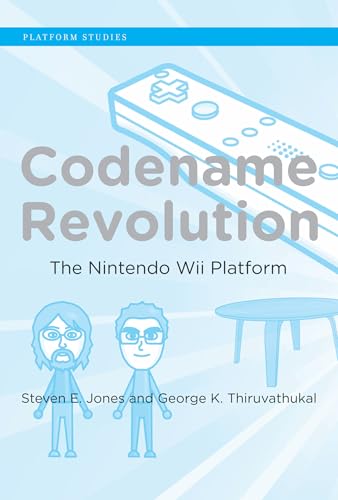
Codename Revolution: The Nintendo Wii Platform

Rate this book

The Nintendo Wii, introduced in 2006, helped usher in a moment of retro-reinvention in video game play. This hugely popular console system, codenamed Revolution during development, signaled a turn away from fully immersive, time-consuming MMORPGs or forty-hour FPS games and back toward family fun in the living room. Players using the wireless motion-sensitive controller (the Wii Remote, or "Wiimote") play with their whole bodies, waving, swinging, swaying. The mimetic interface shifts attention from what's on the screen to what's happening in physical space. This book describes the Wii's impact in technological, social, and cultural terms, examining the Wii as a system of interrelated hardware and software that was consciously designed to promote social play in physical space. Each chapter of Codename Revolution focuses on a major component of the Wii as a platform: the console itself, designed to be low-powered and nimble; the iconic Wii Remote; Wii Fit Plus, and its controller, the Wii Balance Board; the Wii Channels interface and Nintendo's distribution system; and the Wii as a social platform that not only affords multiplayer options but also encourages social interaction in shared physical space. Finally, the authors connect the Wii's revolution in mimetic interface gaming--which eventually led to the release of Sony's Move and Microsoft's Kinect--to some of the economic and technological conditions that influence the possibility of making something new in this arena of computing and culture.

214 pages, Paperback

First published February 24, 2012

13 people are currently reading
141 people want to read

About the author

Steven E. Jones

11 books4 followers

Ratings & Reviews

What do you think?
Rate this book

Friends & Following

Create a free account to discover what your friends think of this book!

Community Reviews

5 stars
7 (15%)
4 stars
10 (22%)
3 stars
17 (37%)
2 stars
8 (17%)
1 star
3 (6%)
Displaying 1 - 3 of 3 reviews
Profile Image for Koen Crolla.
818 reviews236 followers
July 27, 2014
I'm still not sold on ``platform studies'' as a field of study within the humanities. I enjoy reading about the technical details of a platform and the way those details affect the software written for it; I don't care at all about masturbation about ``haptic affordances'' and ``casual revolution''.

As time goes on and general-purpose hardware components become more cost-effective than the bespoke peculiarities that characterised older platforms like the Atari VCS, gaming consoles become less and less distinguishable from each other as they asymptotically approach the Von Neumann platonic ideal (the only real difference between the PS4 and the Xbone is the color of the lights on the front panel), so I suppose it's inevitable that entries in the platform studies series covering newer platforms will spend more time wanking and less time being interesting. The Wii still has just enough idiosyncrasies to be worth looking at, but Codename Revolution still veers into boringness as soon as it feels it can get away with it, with the smugness and prolixity only a humanities textbook can muster.
I'm not saying a book like this needs to have complete circuit diagrams—actually, I am. I would have enjoyed a good circuit diagram. The fact that the Wii has a dedicated ARM processor for the OS in addition to the PowerPC processor it uses for the actual games should not be a bit of trivia tossed in as an afterthought between discussions of rounded rectangles in the menu and boring descriptions of commercials.

It's true that the Wii is just too powerful to be interesting entirely by virtue of its limitations in the same way the VCS was (the most significant constraints on the platform aren't hardware limitations, but Nintendo's arbitrary DRM and ludicrous barriers of entry for developers), but it isn't nearly as boring as this book makes it look.

(There's one more book in this series at this point. Let's find out if the Commodore Amiga was any better.)
Profile Image for Marcin Wichary.
24 reviews12 followers
May 21, 2012
Not as gripping as the previous two books in the Platform Studies series (Racing The Beam and The Future Was Here), but still an interesting and insightful look at Nintendo Wii and the way it redefined gaming in general, and social gaming in particular.
Displaying 1 - 3 of 3 reviews

Can't find what you're looking for?

Get help and learn more about the design.