'We systematically overestimate the role of success factors; but at the same time, we systematically disregard the role of failure factors. Why? Because successful companies, projects and people make it into the media. Flops, on the other hand - no one wants to hear about them. Deadbeats don't usually write autobiographies. And in the rare event that they do, they fail to find a publisher or at the very least an audience.
So, we study these shining examples and delude ourselves that success is the result of a series of carefully orchestrated success factors, when it's really about avoiding the things that kill success. Why not visit the graveyards of failed companies, projects, people, marriages and families instead? That's where you'll learn the most - namely, what to avoid.'
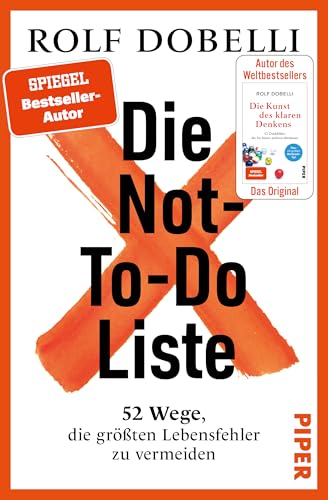
Just as some people collect vinyl, video game consoles or vintage clothes, for years Rolf Dobelli has been accumulating stories of failure - botched attempts at work, family life, marriage and life in general. Using information gleaned from some of the world's most innovative and curious minds, as well as from his own experience as a writer, businessman, entrepreneur and philosopher, Dobelli skilfully distils the 52 most important habits to avoid if you want to live a successful, and ultimately happy, life.
Rolf Dobelli is a Swiss author and businessman. He began his writing career as a novelist in 2002, but he is best known internationally for his bestselling non-fiction The Art of Thinking Clearly (2011, English 2013), for which The Times has called him "the self-help guru the Germans love".
Sie lesen das Inhaltsverzeichnis und haben das Buch damit eigentlich schon durch. Es ist als würde meine Mutter mir sagen etwas nicht zu tun, ohne zu erklären warum. Die Ausführungen des Autors zu jeder Wege wirken, als hätte man ChatGPT einen ‚Nicht-zu-tun‘-Satz gegeben und den Rest einfach generieren lassen. Trotzdem sind die darin erwähnten wirklich Gewohnheiten, die wir nicht haben sollten.
Um Ihnen Zeit zu sparen, hier sind die 52 Wege, die Sie besser lassen sollten: English readers, to save you time, below are 52 habits you shouldn't do:
1 Let everything wither away 2 Feed your inner procrastinator 3 Be unreliable 4 Be a jerk 5 Harbor high expectations 6 Live for the moment 7 Keep having conflicts in your marriage 8 Give up as quickly as possible 9 Preach water, but drink wine 10 Hold on to your bad habits 11 Set ridiculous goals 12 Drink yourself into misery 13 Meddle in other people's affairs 14 Learn exclusively from your own experience 15 Spend your free time on social media 16 Lose your temper in traffic 17 Surround yourself with grumpy people 18 Pick fights with your neighbors 19 Get high on drugs 20 Maneuver yourself into a dead end 21 Please, no ease 22 Wallow in guilt 23 Be ungrateful 24 Trust your banker 25 Be paranoid 26 Don’t take others seriously 27 Live in the past 28 Listen to your inner voice 29 Believe in the rational human 30 Become a nihilist 31 See catastrophe in everything 32 Consider money unimportant 33 Cultivate self-pity 34 Become submissive 35 Get rich quick, get smart quick 36 The endless loop of thoughts 37 Trade your reputation for money 38 Avoid every difficulty 39 Let your emotions run wild 40 Try to kill yourself 41 Marry the wrong person and stay together forever 42 Hold grudges 43 Devote yourself to an ideology 44 Try to change people 45 Always say what you think 46 Do everything possible at once 47 Stay superficial 48 Surround yourself with psychos 49 Throw yourself into competition 50 Say yes to everything 51 Clutter your life 52 Fall into the content trap
Ich weiß nicht was ich erwartet habe, denn ich habe bereits “Die Kunst des klaren Denkens” von Rolf Dobelli gelesen und mochte es damals auch nicht.
Aber ich dachte ich geb dem ganzen nochmal ne Chance.
Doch dann gab es 300 Seiten der offensichtlichsten Lebensratschläge die ich je gesehen habe.
Gut, das wär jetzt kein Problem, wenn das Buch dafür auch vernünftige Ratschläge geben würde wie man diese obvious Sachen aber auch tatsächlich ins Leben einbaut.
But it doesn’t.
Und dann wertet sich das Buch immer mal wieder selber ab, mit Whacko Aussagen wie:
„Wenn sie fünf jahre lang zum Psychotherapeuten gehen um ihre Vergangenheit aufzuarbeiten, machen sie etwas falsch“. Ahhh, ich muss die Vergangenheit einfach loslassen. Wär ich da mal früher drauf gekommen.
Ich hab mir zwei einigermaßen nützliche Stellen im ganzen Buch markiert, aber die waren nicht so herausragend um den ganzen Rest auszugleichen. Für mich das zweite Buch und das erste Sachbuch des Jahres, dem ich einen Stern gebe.
52 mehrheitlich Binsenwahrheiten zum Vermeiden von Lebensfehlern. Das Buch ist aber liebevoll aufgemacht, schön illustriert und eignet sich daher bestens als "coffee table book".
این کتاب با عنوان فهرست کارهای انجام ندادنی از نشر مون منتشر شده.. کتاب سطحی و پیش پا افتاده با مطالب تکراری.. مثلا همه میدونن که نباید با ادم های منفی باف تو زندگیشون بگردن یا همه میدونن باید مدیریت مالی داشته باشن و ولخرجی نکنن یا هممون میدونیم باید تمرین کنیم که هر چیزی رو قبول نکنیم و بلد باشیم نه بگیم و حالا ۵۲ قانون اینجوری در ۳۰۰ صفحه نوشته شده که نه تنها نکات جدیدی رو نمیگه بلکه فقط تکرار نکات قدیمی و سطحیه..
I wish this book didn't have the sarcastic or ironic sections at the beginning of each chapter, each of which is consumable enough. The author applies the law of inversion to state various points on how to lead a good life. All of which are earnest enough but as a reader I really could have done without the sections at the beginning of each chapter. Would have made for a thinner and more consumable book. I picked up this book because I have read the author's earlier work which was great. This is a basic but good enough read you can consume quickly.
کتاب در مورد شیوه های مرسوم شکست خوردن است، پس منطقی است که با انجام ندادن آنها، احتمال شکست خوردن کم شود یا حداقل اینکه شکست ها کم عمق تر شوند. در واقع احتمالا همه خوانندگان قسمت عمده ای از مطالب کتاب را از قبل می دانند و شاید دقیقا به همین دلیل است که کتاب امتیاز بالایی کسب نکرده است ولی از سمت مقابل، اگر به دید یک یادآوری به کتاب نگاه بشود، کتاب قابل اعتناتر می شود. البته که ممکن است با مباحثی از کتاب موافق نباشید ولی بهرصورت به عنوان یک داربست فکری، مفید است. به نظرم می رسد که شخصیت نویسنده ذاتا کمی بدبین و محتاط است، به همین دلیل هم است که کلیت کتاب کمی ناامید کننده است. اما یک نکته قوت کتاب، پیوست نسبتا پر و پیمان انتهای کتاب است پینوشت: کتاب من از نشر مهرگان خرد با ترجمه فاطمه یزدانپناه بود
Some good parts, some less good parts. I feel like the author tries to gloss over a lot of complex topics, providing oversimplified solutions (and for some chapters I just flat out disagree with him).
I read the English version of this book, but I'd imagine it's a shit book in German too.
Dobelli had a good book in The Art of Thinking Clearly and it found worldwide success, and rightfully so. It was actually good. But he made the mistake of continuing to write things down. In truth, the stuff he had to say in that book was all he had to say. All further books are attempts to repeat this same success, and to do so, he writes about the same stuff.
Some of the things he advises are so blatanly obvious - be nice to people, or whatever. Then he says things that are downright SILLY, if you'll pardon my French. He talks about not committing suicide and basically says just not to do it. Gee, Rolf. I never thought of it that way. If only suicidal people just simply didn't commit suicide. What a world it would be, and how much additional space we would have in local graveyards! That's Swiss efficiency.
I respect that he tells the book from his own perspective and he is loyal to his own beliefs to a fault, despite how cringeworthy some of them are. He parades his Reddit-esque atheism without seeing the irony of it, maybe because his fedora is pulled down over his eyes. Facts and logic are all that exist. Including the fact that this book is shit.
His chapters are ridiculously short, which can be done well in some books, like Catch-22 for example, but Dobelli makes it feel rushed, and you get the impression he didn't put in very much effort. Half of each chapter is some reverse psychology thing where he tries to convince you to do the opposite of what he's actually recommending, which I undertstand is the book's central idea but is also a massive waste of paper. He also just copied the premise for the book from Charlie Munger, who he quotes constantly throughout.
Want a fun drinking game? Take a shot every time you see the words "Nobel Prize". This guy is obsessed with the Nobel Prize. Why? What's so special about it? Alfred Nobel invented this prize to improve the public's opinion of him after he invented dynamite. It's sanitary and meaningless, just like this book with it's pretty white cover.
This book is a cash-grab. He has his contract with the publisher, he does his public speaking, he writes his mediocre books, and life goes on. All the more power to him.
Rolf Dobelli’s The Not-To-Do List is a sharp, contrarian guide that flips the usual self-help formula on its head. Instead of prescribing what to do, Dobelli catalogs the habits and mindsets to avoid—like multitasking, shallow work, and overthinking—that quietly erode productivity and clarity.
What makes the book stand out is its brevity and wit. Each chapter is concise, almost aphoristic, yet grounded in behavioral insights and real-world observation. Dobelli doesn’t overwhelm with theory; he delivers quick, memorable lessons that are easy to apply, though sometimes they feel more like reminders than deep revelations.
That said, the simplicity is both a strength and a limitation. Readers looking for detailed frameworks or step-by-step systems may find it lacking depth. But if you want a compact, thought-provoking reset on how to think and work more effectively, this book does the job well.
The Not-To-Do List is based entirely on inversion - here's the mistake, and now, quietly, here's why you shouldn't make it. It's a clever structural trick, but clever isn't always useful. The world already has no shortage of people telling you what not to do in the comment section. What I actually pick up a self-help book for is the actionable flip side: so then what do I do?
This book is a masterclass in cutting through the noise of modern self-help literature, and honestly, it's one of the most useful reads I've encountered in recent years. What makes The Not To Do List genuinely exceptional isn't the complexity of its ideas—it's the clarity with which Dobelli presents what we already know deep down but have somehow lost in the chaos.
The genius of this book lies in its premise: instead of yet another motivational tome telling you what to do, Dobelli does something radical by telling you what not to do. The 52 items he outlines feel painfully obvious once you read them, yet they're precisely the things most of us are actively doing wrong—caught up in the exhausting, chaotic lifestyle that characterizes our modern age. Whether it's saying yes to everything, listening to your unreliable inner voice, having impossibly high expectations, or endlessly multitasking, nearly every reader will find themselves uncomfortably reflected in these pages.
What strikes me most is how the author validates what we suspect: if you're feeling stuck, unfulfilled, or perpetually exhausted, the problem likely isn't that you're missing some secret ingredient or success hack. The problem is almost guaranteed to be one (or several) of these 52 items. And Dobelli articulates each point with surgical precision—not with motivational fluff, but with the steady, unsentimental reasoning of someone who understands both business and human psychology.
Despite appearing deceptively simple or like "just another self-help book," this is genuinely one of the best investments of time I've made reading in the last couple of years. The usefulness-to-page ratio is extraordinary. There's no filler, no lengthy anecdotes stretched to chapter length, no vague philosophizing. Each chapter is focused, actionable, and respects your intelligence. Dobelli treats the reader like someone capable of understanding complex ideas without needing them spoon-fed through repetitive motivational language.
The book is most valuable for people ready to genuinely question themselves—for those willing to admit that their life isn't working the way they want and are honest enough to explore what role they might be playing in that failure. If you're someone who reads self-help books because you're serious about reconsidering your life direction and eliminating what isn't serving you, this is essential reading. It won't make you feel good; it will make you think acutely and, more importantly, act differently.
Das Buch nutzt mal den Ansatz der umgekehrten Psychologie. Man erhält 52 Tipps wie man sein Leben so richtig in den Sand setzen kann. Ich habe immer nur ein paar Kapitel gelesen, weil ich mich damit bewusst beschäftigen wollte. So konnte ich danach noch ein wenig sinnieren. Die Kapitel sind dafür recht kurz. Der Autor hat vieles gesammelt das schief geht, zeigt auf schwarzer Humor Basis wie man es richtig „verkacken“ kann aber dann kommt „die Stimme der Vernunft“ und zeigt auf wie man es lieber richtig macht. Für alle Lebenslagen ist etwas dabei! So als kleines Nachschlagewerk finde ich es gut, wenn etwas einen bedrückt oder nervt.
Das Buch umfasst 52 kurze Abrisse, um Fehler in verschiedenen Bereichen der Lebensgestaltung aufzuzeigen. Dabei wird zuerst das Fehlverhalten umrissen und anschliessend aufgeklärt. Die Auflistung wirkt teilweise etwas beliebig und mitunter etwas gesucht. Manchmal sind gewisse Kapitel auch etwas trivial, einige aber durchaus originell. Nur schon die Struktur des Buches sorgt dafür, dass der Leser wohl wenig mitnehmen kann daraus. Es liest sich aber durchaus flüssig und auch unterhaltsam.
From the author of The Art of Thinking Clearly comes a new non-fiction title, The Not To-Do List: The Surprisingly Simple Art of Success!
Instead of a To-Do List for success, Dobelli has come up with the inverse, a Not To-Do List. Each chapter consists of sarcastically written entries on a Life of Misery, followed by advice from the Quiet Voice of Reason. Formulaic, but an inspiring self-improvement book to get oneself back on track, if you're feeling unmotivated, sluggish. This book outlines the keys to a life of failure, and counters such negativity with logic.
The Not To-Do List is a powerful and wise guiding force for living your best life each day.
One thing I didn't quite like was how the author kept referring to Warren Buffett, Charlie Munger, Berkshire Hathaway so frequently, it felt like a shameless plug/advertorial at times which was a bit cringey for me. And there was a lot of 'reflected glory' kind of remarks like 'oh my friend who happens to be a billionaire' which I found off-putting.
But here are some lines I enjoyed:
'Maintenance is by no means a heroic deed. It is boring and unsexy, and most of it goes unseen. But that's not to say it's any less important than heroism - in fact, quite the opposite. While we systemically overestimate the value of a grand design or a brave rescue mission, we systematically underestimate the value of quiet ongoing maintenance.'
'[Benjamin Franklin] was on a constant quest for self-improvement. At the age of 20, he came up with a plan to 'perfect' his character. He compiled a list of 13 virtues he wanted to cultivate in his life - things like industry, frugality, resoluteness and avoiding unnecessary small talk. He devoted a week to each of these virtues, consciously practising and focusing on them. Then he started the cycle all over again from the beginning.'
'Never give others a reason to meddle in your personal life. Set clear boundaries and deal with your own problems behind closed doors. A small cast, three-act play is over faster than an epic opera.'
'Your environment offers plenty of lessons on the foolish things that are best avoided. I'm not suggesting you delight in them, but you should definitely learn from them. Where exactly did this person go wrong? Probe like a scientist.'
'In a hundred years' time, people will wonder: what on earth was going through these people's minds when they posted and consumed all that inane nonsense? Didn't they have anything better to do with their lives?'
In Kapitel 48 führt Dobelli Menschen mit Schizophrenie, bipolarer Störung oder Borderline zusammen mit Lügnern, Betrügern und Kriminellen als Personen auf, die man meiden solle. Diese Empfehlung steht im ernst gemeinten Ratgeberteil. Er setzt diese Gruppen nicht ausdrücklich gleich, ordnet sie jedoch derselben Kategorie zu meidender Personen zu. Die psychiatrische Diagnose wird damit selbst zum Ausschlusskriterium, ohne das konkrete Verhalten der Person zu berücksichtigen.
Diese Einordnung ist stigmatisierend: Eine Diagnose sagt nicht automatisch etwas über die Vertrauenswürdigkeit, Moral oder Gefährlichkeit eines Menschen aus. Kriminelles oder manipulatives Verhalten kann nicht pauschal aus einer Diagnose abgeleitet werden. Die gemeinsame Aufzählung legt jedoch nahe, psychisch erkrankte Menschen seien grundsätzlich eine Belastung für ihr Umfeld. Das kann Vorurteile verstärken und soziale Ausgrenzung begünstigen. Grenzen gegenüber tatsächlich schädigendem Verhalten sind nachvollziehbar; sie sollten sich auf konkrete Handlungen und den Umgang mit Grenzen stützen.
Die abschliessende Einteilung in Menschen, die einen «hochziehen» oder «runterziehen», beurteilt Beziehungen zudem vor allem nach ihrem persönlichen Nutzen. Gegenseitigkeit, unterschiedliche Stärken und Lebensphasen, in denen Menschen mehr Unterstützung benötigen, bleiben dabei unberücksichtigt.
Not your ordinary self-help book filled with tips on how to be successful, this book uses the inversion method and makes you focus on the nasty habits (so that you can avoid them, of course! 😂)
The idea is to avoid doing things that are going to sabotage your peace of mind and your life. The author starts each chapter of how-to-ruin-your-life tips with sarcasm and words of encouragement for you to sabotage your life. Next comes the quiet voice of reason, rationalising what you actually need to do.
For people from other cultures, it might sound negative or demeaning, but I grew up with that. Asian mothers will respond to you tripping on the floor while running crazily with your cousins by asking you to RUN MORE MY DEAR CHILD. You’ll get things like “Ha, larilah lagi. Lari lagi. Kenapa berhenti?” 🤣We are so used to detecting things that are going to spell doom for us from a young age. So reading the sarcasm part is quite entertaining for me 😂
Nevertheless, it’s a 3⭐️ from me because the sarcasm part grows shorter as the book progresses. Thank you Definitelybooks and Izah for this Do-Not-Help-Yourself book! 🤭
An interesting take on productivity and decision-making, focusing on what we should stop doing rather than what we should start doing. Some useful insights, although several ideas felt familiar and repetitive.
My Top 3 Learnings:
1. Success is often about subtraction, not addition — Eliminating bad habits, unnecessary commitments and distractions can be more effective than continuously adding new productivity techniques.
2. Avoiding mistakes is as important as making good decisions — Instead of always asking, "What should I do to succeed?", ask, "What behaviours and decisions are likely to make me fail?" Then consciously avoid them.
3. Protect your attention and energy — Say no to low-value activities, unnecessary information and commitments that don't contribute to your priorities. Doing fewer things well is better than doing everything.
My biggest takeaway: A good not-to-do list can be just as powerful as a to-do list. Sometimes the fastest way to improve life is to stop doing what doesn't matter.
⭐⭐⭐ 3/5 — A useful reminder of the power of elimination, but not particularly groundbreaking.
If you've ever found yourself making the same life mistakes over and over, Dobelli's "The Not To Do List", instead of telling you what to do (like most self-help books), this one flips the script and focuses on 52 things you should avoid.
The book's central philosophy borrows from Charlie Munger's wisdom: "All I want to know is where I'm going to die, so that I'll never go there." Each short chapter identifies a common pitfall, explains why it's problematic, and then offers "the quiet voice of reason" - practical advice for steering clear.
For newcomers to self-help literature, this is an accessible, quick read with straightforward language and a unique negative-to-positive approach that makes lessons stick. Experienced readers will find majority of chapters familiar territory, despite that they will find it as a good read.
Overall, it's a good addition to your reading list if you're looking for practical life advice presented in a novel way - just don't expect mind-blowing revelations if you're already well-versed in self-improvement literature.
Subtraction, not self-improvement. This is not a book that tells you to work harder. It's the gentle friend who leans in and whispers, "You don't have to do that." And somehow, your shoulders relax. . Rolf Dobelli does not give out mantras. He gives you a scalpel. Every idea in The Not-To-Do List challenges you to cut—habits, distractions, mental rubbish posing as ambition. There is a relief in the way he writes: exact, limited, and pleasantly unsentimental. It is not intended to make you feel better. It is intended to make you think more acutely, live more simply.
Some of it stung—because it was true. The cult of remaining perpetually in high expectations, the urge to multitask, the fantasy that saying yes always counts—Dobelli takes these down with a measured, matter-of-fact voice that admits no performance. You get the message or continue to overpack.
For me it was a gentle course correction. The best part being this isn't a guide to do more. It's permission to do less—and do it well..
Ein einfaches Buch mit vielen Kapiteln (Wege) über verschiedene Lebensratschläge mit jeweils satirischen Grafiken von einem bestimmten Künstler. Es ist auch mal etwas anderes, wenn man zuerst das Negativbeispiel liest und danach - in Anführungszeichen - "das Richtige" Beispiel zu haben, wie man handeln sollte. Es sind viele selbstverständliche Inhalte dabei und dementsprechend sehr gut geeignet für junge unerfahrene Menschen. (Am Anfang stand auch, dass das auch an seine Kinder gerichtet ist, so habe ich angenommen, dass es dementsprechend einfach und verständlich geschrieben worden musste). Es ist auf jeden Fall kein Buch, den man sich die ganze Zeit durchlesen wollen würde, sondern eher etwas für zwischendurch für ein paar Kapitel bei einem Päuschen.
While I appreciate that the author tried to do something different, the book’s format didn’t quite work for me. Each chapter starts with a sarcastic section where the author encourages you to do something you shouldn’t, followed by an explanation of why you should not act that way.
I could have easily done without this sarcastic part, and I ended up skipping it in most of the chapters.
That said, some chapters were better than others. Some of the advice felt overly simplified or even extreme at times.
No for rating for this book - as I don’t know how to rate it.
This book motivated me to go see a dermatologist (weird I know) and motivated me to rethink the way I save. However, there some points I disagree with (Cult chapter, I’m looking at you!). At the same time, the author says in the end of the book that he is entitled to change his opinions and might change them, I hope he does. (No, I’m not trying to change people.)
Das Buch hat mich insgesamt sehr dazu inspiriert, mich mehr mit Sachbüchern weiterzubilden und ein sinnvolleres Leben zu führen, was das allerdings heißt, muss ich individuell für mich herausfinden. Die Tipps waren gut und nüchtern, sehr klar formuliert, allerdings gab es einige Tipps, die irgendwie „von oben herab“ formuliert wurden. Das wirkte etwas unsympathisch, weil es so klang, als ob der Autr alles richtig gemacht hätte in seinem Leben. Da bin ich etwas skeptisch.
This entire review has been hidden because of spoilers.
Good book if you’re busy and on the go. This book has a lot of mini chapters (3 pages) and I personally love how he Star each chapter sarcastically. This book is easy to read. I’d you already into self help books and have read half of the books on the market, then this book is more of a reminder and you won’t learn much more.