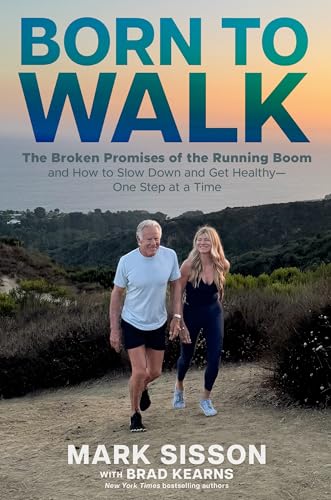
The romanticized notion that humans are "born to run" has buoyed the so-called running boom of the past 50 well-intentioned fitness enthusiasts lacing up their cushioned shoes and plodding down roads and trails in pursuit of the runner's high, a trim physique, and the fountain of youth. Unfortunately, born to run is a big, fat ruse—a marketing gimmick and a gross misappropriation of evolutionary biology insights about our Homo sapiens genetic attributes for endurance. While any movement away from a sedentary-dominant lifestyle is laudable, the truth is that humans are actually born to walk, not run.
Mark Sisson, New York Times bestselling author, forefather of the ancestral health movement, entrepreneur founder of Primal Kitchen and Peluva footwear, and former 2:18 marathon runner, is officially proclaiming an end to the running boom. For the vast majority of enthusiasts, running—even slow-paced jogging—is far too physically, metabolically, and hormonally stressful to promote health, weight loss, or longevity. Alas, the elevated, heavily cushioned modern running shoe enables ill-adapted people to run with poor technique, increased impact trauma, and a truly embarrassing rate of chronic overuse injuries.
Born To Walk will help reshape fitness culture to reject flawed and dated "no pain, no gain" ideals, and replace them with a simple, accessible, sustainable program to increase general everyday movement, improve aerobic conditioning the right way, avoid the risks of injury and burnout associated with running, and promote a healthy, happy, energetic, long life–one step at a time. In Born To Walk you'll
How the "endurance runner hypothesis" of evolutionary biology is irrelevant to most modern citizens, whose genetic endurance gifts are buried under excess body fat, insufficient daily activity, weak musculature, and dysfunctional feet caused by a lifetime in shoes How the running boom was made possible by the invention of the heavily cushioned shoe. Without this, most people would be unable to run more than a short distance (especially on pavement) before succumbing to discomfort or injury How elevated, cushioned shoes actually increase impact trauma, enable poor technique, and are the driving cause of overuse injuries How to avoid the shocking 50 percent annual injury rate among regular runners by slowing down, improving foot functionality and implementing a correct midfoot landing technique How running does not help you lose excess body fat, and in fact can prompt genetic signaling for increased appetite, carb dependency, fat storage, and poor metabolic and hormonal health How running can promote a "skinny fat" deficient strength and muscle mass, poor posture, and an accumulation of health-destructive abdominal fat–even if you run lots of weekly miles How an extreme devotion to endurance training can increase cardiovascular disease risk, compromise gut health, and suppress immune and hormonal function How the misplaced competitive intensity and struggle & suffer ethos of modern running culture can promote and unhealthy obsession and a high risk of burnout How marketing hype, distorted cultural values, and unsavory peer influences lure you into events like marathons and ultras that are inherently antithetical to health How aerobic conditioning at comfortable heart rates is the foundation of all fitness endeavors, and improves performance at all higher levels of intensity How to identify your ideal training pace using "fat max" heart rate–likely a bri
I took 13 pages of notes from this one!! The premise is that our bodies are made to walk rather than run. There is extensive science about this premise and also information about our feet/shoes/etc. I found it interesting and motivating!
Walk a lot more and do a lot more low intensity aerobic activity at a heart rate about 180 minus your age, sometimes sprint and occasionally do brief, heavy weight training workouts. That’s the whole book. It keeps saying the same thing over and over in different ways to fill out a whole book. It’s something I see commonly done and is my pet peeve.
Born to Walk gave me a lot to chew on. The target audience is endurance runners or those aspiring to be—whether determined to complete their first marathon or running their umpteenth half or full at a moderate pace. The book’s central argument is that the rise of endurance running owes more to marketing than to actual health benefits.
Sisson and Kearns highlight some uncomfortable truths: running has an astonishingly high injury rate compared to other sports, it’s not an effective weight-loss tool, and chronic high-heart-rate cardio can potentially harm the heart rather than protect it. They also critique the carb-loading culture that comes with endurance sports, pointing out its long-term health implications.
Like McDougall’s Born to Run, this book takes issue with modern running shoes, arguing that they exacerbate injury risks. Sisson and Kearns place even greater emphasis on the need to build a solid aerobic base first, advocating for the MAF method—using the 180-minus-age formula to determine one’s ideal heart rate for training. Their broader message is compelling: prioritize walking, diversify fitness routines with strength, sprints, and play, and rethink the assumption that endurance running is the gold standard for health.
That said, a few aspects left me skeptical. The book makes no distinction between male and female physiology—a notable omission given the ongoing Zone 2 training debates (see Stacy Sims work). It also leans on lessons from the "Blue Zones" longevity studies without acknowledging recent challenges to that research (e.g., unreliable record-keeping related to death certificates has inflated life expectancy data). Additionally, the recommendations on daily step count seems inconsistent throughout the book—are 4,000, 8,000, or 12,000 steps enough?
Despite these reservations, the book offered a fresh perspective and has me reconsidering my own long-term fitness goals.
I have very mixed feelings about this book. I think everyone (especially runners) should read the first part about the myths of running. I think that would go a long way with people! I also did find some items in here interesting that I was able to implement which I feel have helped my health! Other parts of this book however I found extremely boring. It offers a brief insight into a healthy lifestyle but nothing substantial. I also was hoping for more guides on how to become better at walking specifically since he mentions using minimalist shoes. All it really boils down to is run less and walk more. I did feel that I got a few takeaways from this and for me that was worth it enough to read. If you idolize running I highly encourage you to read at least part of this book! If you already hate running you probably can skip this one.
Sisson and Kearns bring up a lot of new studies that I would like to follow up on. The ideas are contrary to what most of us grew up on (including them). The conclusions seem common sense and reasonable, especially basing endurance training on heart rate!!
The fact that Sisson admits that he massively overtrained during his competitive years adds extra credibility! I also appreciate when an ‘expert’ can admit that they got it wrong.
Easy reading book that encourages me to research further - I highly recommend!!
Good book. Lots of good information. Well worth reading. Some say that it contradictory to "Born to Run". While he does have some negative things to say about B2R, as well as the shoe industry in general, I felt like both books were definitely worth reading. I found some common threads in both books that could help the recreational runner.
audiobook. Best concept in whole book is in appendix: monthly personalized benchmark workout. I feel like the authors and the target audience of this book are living in a completely different world than me. I used to be an aspiring endurance athlete. Unfortunately I did too much research and I could also do math. I was not going to have enough time or money to accomplish any of my goals without cutting everything else in my life. Wasn't worth it. Felt like walking was talked about less than 1%. Still feels like this book is targeted towards elite endurance athletes. Does anyone still believe endurance sports are healthy? Anyway …. Endurance sports are for 2 classes of humans: elite humans getting paid to perform said endurance feat and monetary elite that have 40+ hours free time every week to train. What's a better use of time and resources and improves quality of life way better than endurance sports? Strength training. I drank the Starting Strength kool aid. I highly recommend skipping this book and going straight to Starting Strength by Mark Rippetoe.
He raises a lot of good points about over training and the importance of walking and resistance training to maintain overall health. He comes across pompously, putting down fat people who are running or anyone who doesn’t abide by his ideas.
Born to Walk was a timely and eye-opening read as I turned 50. Mark Sisson’s message that movement is essential, but slowing down is just as important really resonated.
It reminded me that walking isn’t just exercise, it’s a lifelong practice for health and clarity. It’s a great motivator for embracing a gentler, more sustainable fitness mindset.
Interesting premise for chronic endurance runners or joggers who are prone to shuffling along with poor form, but poorly written and repetitive. Plus he quotes very technical medical stats but doesn’t seem to understand them enough to explain them. The main takeaways are probably true and worthwhile however — do most of your workouts below peak fat burning mode, focus on good form, and consider switching shoes.
Initially, I thought to myself, how much can you write about walking. Turns out a great deal. I wouldn’t have picked this book up if it wouldn’t have been written by Mark Sisson, who I know to have lots of amazing insights in the primal and fitness world backed by science. Same with this book, it does not disappoint. I also gained a new appreciation for co-author of Brad Kearns. thanks, I learned a lot, probably for life.
I bought this book as a challenge as it seemed to include some messages I might not want to hear. The overarching idea that high-intensity #nopainnogain training and especially running is not healthy at all seems plausible and can be an important message for many people (including myself). However the execution of that message is not very well, bordering terrible to be honest.
It starts out with minor things that would still warrant 3 or even 4 stars. Sure you can reference other authors from time to time - why not. But it feels like 80-90% of the "scientific" reference comes down to generic things like "many other experts think that" or "Mr. xyz author of this other famous self-help book said...".
Then we have a few very cringe sentences. Mr. Sisson either thought this was funny or really doesn't get Newton: "Make a concerted effort to move every day, and it becomes easier to move naturally. This is validated by Newton’s first law: An object in motion stays in motion, and an object at rest stays at rest"... like what? oO
But what really got me down to a 2 for this one where the misleading claims. Just to highlight one of the more extreme ones: "You can still get an A-plus in cardio by walking extensively [...], logging 80 percent of your weekly mileage in zone 1 (à la Eliud Kipchoge)".
Well... it's not wrong technically. But according to this source first of all Eliud is still going on a "casual" 40km zone 2/3 long run every week (at a speed of 3:00min/km) and most importantly when we talk about zone 1 for Eliud there doesn't seem much walking to be involved as his average pace is a crushing 4:00min/km on these runs. You can't just say that the same applies to your average recreational runner just alone for the fact, that Eliud spends hours working on his running form while we would just walk along in zone 1.
Last but not least I kinda feel sorry for Mark. He really seems to have been that guy who overdid it. And now he kinda swung the pendulum to the other extreme. In his last category "Play" he highlights the importance to "concentrate on play, ideally in nature, that is spontaneous and unstructured, eschews tangible measurements of accomplishment, and gets you out of the focused, rational mindset that you exist in for most of the day".
Unfortunately he forgot to list one of the best activities to do just that: Running.
I liked this one a lot! Mark and Brad nailed it with their analysis on the “running boom” in America. I myself have fallen into this trap, buying bigger and better shoes in an effort to stave off injury. And the call to return to running can be strong even though the act itself can be destructive for so many… at times they can come off as bitter old men, and I think sometimes it’s easy for them since they’ve accomplished so much in their sports. It’s easy to reflect on your career and the mistakes you’ve made, but in the moment the actions make complete sense.
I would have liked a chapter on his nutrition philosophy, however I know he’s written on this in other books.
Overall a really good read for those floundering in running and needing the insensitive to try something else or for the aging runner who is looking to tone it down a bit.
I read about half of the book, then kind of skim-read the rest. He definitely makes a very compelling case for avoiding running as an activity. And he is eminently qualified seeing as he is quite an accomplished runner. The toll on runners’ bodies is severe and he backs this up with many studies. The latter half of the book explains how you should walk for exercise. My main complaint about this book is that it is really very dense in the presentation of information. I agree with the premise that walking is superior to running, but I didn’t really get a clear concept of how to walk. (Perhaps bc I was skimming the half that discussed it?).
I have enjoyed reading all of Mark Sisson’s books and when I saw this new book on walking, I knew I had to read it! It was extremely well written with lots of literature citations. There was an overemphasis on the problems with endurance running. I’m not a runner, but it was still interesting to learn more about the problems with runners. I especially enjoyed the last few chapters as he discussed the need to walk more, move more, lift heavy things and an occasional sprint! Enjoyed the book overall and highlighted a lot. Glad I read it! 😎🚶♂️
Although I did feel like this book was overwhelming in the sheer amount of data presented, it was somewhat of a paradigm shift for me as someone who has felt like humans are “born to run”! I loved this varied perspective and totally see the validity in slowing down and the benefits of steady state cardio, rather than all-out training day after day. Great read for me!
This book contains a lot of what seems to be good and reputable information, but there were so many typos throughout (mostly missing words) that it became annoying - it's hard to believe this book was ever actually proofread prior to publishing. I hope this lack of attention to detail doesn't carry over to the author's Peluva line of shoes.
Wow this book really made you question the information you have regarding "endurance" training. There is a wealth of compelling evidence to support the points highlighted in this book. Very interesting read would recommend this to anyone wanting to improve their "lifespan" and train in a way that supports longevity
A lot of it didn't apply to me since I am not a marathon runner.... or runner at all lol... but overall some great information on why our body needs certain movement, and why doing all that cardio is not making you lose the weight that you want!
Such an interesting book!! Very detailed - almost too detailed unless you are a dedicated runner. However, the recommended protocols for life long fitness, and the reasons why, were excellent and eye opening.
Good book though a little repetitive at times and occasionally maybe too harsh on full fledged endurance junkies (which is ironic coming from me as a lifelong meathead that hates running longer than a minute or so)
Some really good information, and a solid argument: chronic, high-volume cardio is actually an unhealthy practice, and a less-hyped, more sustainable lifestyle based on strength training, walking, and occasional sprinting is a better path.
A bold but educational take on chronic endurance exercise from a former ultra marathon runner. Fascinating and freeing as a former runner who has felt that pressure to “get back to it”. I learned lots about heart rate zones and building an aerobic base that I will take into my fitness habits.
Many assumptions and one-sided arguments. I was frustrated because I hoped for something to explore the nuance of running, biomechanics, and our current wellness culture but this book read like the manifesto of a cult.
Outstanding well researched and written on how walking is much better for you than running. A lot of research by the author that sold me on the unconventional view on fitness.
While I appreciate the authors being thorough, it became very repetitive and almost overwhelming... You can have too much information 😆 BUT, It was still worth reading.
Really changes your mindset on what is considered exercise. Walking is better for you on every metric over jogging. Essential read to understand what exercise is in our modern lives.