The galaxy of Yokkun’s Depth has been settled since time immemorial. There is only one frontier left, and it’s a one-way journey: to pierce the skin of existence and delve the countless younger universes beneath.
Running through these universes is the fabled Well, a fissure formed in the distant past into which horrors have been flung for millions of years. Amongst their number was an impossibly ancient sorcerer, cast down to the wastelands of a thousand apocalyptic worlds, never to return.
Until now.
Whirazomar is crossing the stars in the belly of a sentient spore, hoping she can make it to the Well before her masters’ rivals realise what she’s hunting: somewhere far below them, a hapless explorer has drafted a map of reality. A map that the exile is sure to seek out. A map so valuable that a kaleidoscope of beings will run the gauntlet of every universe to get it, even at the cost of their lives.
Caspar Geon has lived many lives in many different dimensions, and published books in all of them. The Immeasurable Heaven is his first book set in the infinite realities of the Phaslairs.
A dazzling collision of weird fiction and boundary pushing scifi, The Immeasurable Heaven is a riot of creativity and cosmic imagination. Geon crafts a universe of staggering ambition - a completely alien cast, wildly inventive species, living technologies and communication styles that feel genuinely otherworldly. As if every page opens a door into a biology or civilisation we've never dreamed of.
At its core are the phaslairs, a brilliant twist on the multiverse. Instead of slight variations, each level is a completely different ecosystem - strange, vivid, fantastical - and when you drop in, you become a natural lifeform of that level. It’s bold, surreal and endlessly surprising, delivering a constant jolt of wonder as new environments and forms spill onto the page.
The plot has a classic hook - a quest, a coveted map, a mysterious threat - alongside plenty of hijinks and setbacks. The first half leans plot light, revelling in discovery before the second act draws everything together. It demands attention, especially early on, as a kaleidoscope of concepts, species and names flood in. The joy is in the immersion: letting the strangeness wash over you, trusting the story to unfold with every idea vivid, strange and brimming with possibility.
The characters shine too: Draebol, the hedonistic adventurer; Whirazomar, duty driven and unshakeable; and a menagerie of exotic companions dragged along for the ride. The contrasting POVs thread charm and personality through the cosmic spectacle.
Fearless, playful and ferociously imaginative, The Immeasurable Heaven is a feast of ideas and a masterclass in alien wonder. If this is the breadth of invention Geon brings to one book, I can’t wait to see what he dreams up next. If you're craving something truly different - something past the familiar into the exhilarating unknown - it's an absolute must read.
The Immeasurable Heaven is a wildly ambitious work of science fiction that keeps unfolding into worlds within worlds within worlds—until the genre itself starts to blur into something closer to cosmic fantasy. Geon floods the page with dazzling, bizarre, and genuinely innovative ideas: strange civilizations, outlandish technology, a profusion of organic and non-organic species, and a cascade of backstories that feel almost inexhaustible. The imagination on display is mind-blowingly rich, but it comes at a cost. The narrative is dense and discursive, heavy on exposition and light on dialogue, with characterizations that often feel thin. The plot can be bewildering and loses momentum as it wanders, making the book more fascinating than truly compelling. Still, for readers who prize sheer inventiveness and conceptual audacity over narrative drive, this is an unforgettable experience.
This book is a shotgun blast of ideas, a kinetic assault of imagination directed straight at the reader's face.
For starters, there are no human characters. None. No hairless Earth apes at all. Every viewpoint, every culture, every technology is from, by and for completely alien entities.
That in itself was enough to get my readerly juices flowing, and as soon as I read the blurb I was in.
The Immeasurable heaven is a reality hopping extravaganza filled with more world-building and cool ideas than I could possibly touch upon in a review.
Suffice to say, in a future galaxy populated with thousands of sentient species, where evolved AIs prevent all violence and murder (by liquifying the brain of any who attempt either) there is a great well in space that reaches down into the infinite realities that have branched off from this one.
Those realities can be visited, either through the well, or via the use of a metal called illiquin, but once you leave the 'surface' reality you can never come back. This one way journey, along with the prohibition on killing, means that dimensional weapons are popular - get shot with one and you will find yourself dumped into the next reality down, never able to return.
Or at least, that's what everyone thinks. It seems that some horrific, vengeful monster is climbing back up the realities, breaking all the known laws and making the rulers of the surface galaxy very, very worried.
One of these rulers sends an agent - Whira - to find this returning monster and destroy it. Meanwhile, Draebol, an inter reality explorer who has fallen through 17,000 realities, is exploring yet another, the map he has made of his travels a tempting prize both for Whira and the mysterious monster.
Whew. That's a precis of the setup, but there's a wealth of fun, engaging detail here, deftly written and beautifully built. Geon knows how to tell a story, and his worldbuilding is first class.
While the end rushes up a bit - I could happily have had another fifty pages of fun before the book finished - this is an engaging and satisfying read. Some of the colourful aliens, places and ideas that Geon plays with will stick with me for years I suspect, and I flew through the book, loving every page. I found myself up late at night with this one, reluctant to the put The Immeasurable Heaven down until my bleary eyes made the decision for me.
Four and a half nearby (but increasingly odd) human-free realities out of five.
Disclaimer: I received a copy of this book in exchange for a fair review.
Received an early copy from the author for an honest review. Many thanks, Caspar.
What an interesting and odd sci-fi story. Caspar Geon claims that this is the first speculative fiction book since Brian Jacques' Redwall series to have an entire non-human cast. Everyone is an alien of some sort here.
According to the author's note and afterword, The Immeasurable Heaven is, much like Star Wars a story from a long, long time ago in another universe, transcribed to us the best way the writer can. It is about a universe called with Yokkun's Depth filled with different levels of dimensions, called Phaslairs, that one may traverse by only going down, but never up. Yet someone is ascending through the Phaslairs, and he is hellbent on getting to the highest Phaslair, no matter the cost. Whirazomar, or Whira, traverses the galaxy in the belly of giant sentient spore named Gnumph under the orders of her alm (ruler) to reach the Well at the center of the universe to acquire a map of all the realities. Draebol, the maker of that map, is jumping through Phaslairs on the run from multiple people trying to catch him. However, the ascender soon learns of the map and his plight becomes more emboldened.
Whew! This was definitely a wild ride and my brain is still a little cooked in some of its lobes because of everything that happened and the amount of information the book threw at you. Seriously, for the first 30%-ish part of the book there is a lot going on in terms of worldbuilding and explanations of the characters' backgrounds. I will admit that portion of the book was a bit of a slog to get through, the pacing was slower there, but after that things got quicker and the plot progression streamlined itself. As I said above, this is a world totally without humans and all of the aliens races that appear are described vividly from head to toe. Although this is clearly technologically advanced universe, not all of the "technology" is of machines and electronics. Some of it is biological, like the spire Gnumph. It was very cool and interesting to see this meshing of machine and biology into a cohesive technology (for lack of a better world). The main issue in the early part of the book with this technology, and other things, was that Geon sometimes interrupted the natural flow of the story or a character's thoughts to take sizeable paragraphs to describe them. So, yes, there is some significant info-dumping in the beginning and I'm able to forgive its length because it was interesting stuff that really gave you the impression that Yokkun's Depth is a really, really old universe inhabited, constructed, and governed by alien species far older than our own an incomprehensible in some ways to us; not in a Lovecraftian incomprehensibility, but a kind of Gene Wolfean one. However, I just wish Geon had done this information after a character's complete thought or progression at certain points. Like I said, though, this info-dumping eventually stops and any other information relevant is delivered more naturally.
There are several perspectives throughout the book, but the primary three are Whira, Draebol, and the ascender the latter of three which is the only first person one. There are few others from minor characters such as Whira's alm and Tiliph, an alien Whira befriends through a virtual online game while journeying through space (yes, they even have virtual reality), but of these more minor characters my personal favorite was Gnumph whom I'm glad Geon gave perspective to. Gnumph is mostly a gentle giant, but it can be a crafty and calculating beast and I'm glad it got a happy ending. But let's talk about the main three. Whira, I would argue, carries most of the story. She is dedicated to her duty, but is clearly hesitant about some things and hiding other things. Her character arc is a small one, growing from a hesitant and nerve-wracked being to just finally doing what she needs to do, no matter that is, and throwing caution to the wind. I enjoyed the friendship she formed with Tiliph and the back and forth between her and Draebol. Now, would I say that Whira is two faced? Not necessarily, but she clearly as her own motives at play. I will admit--and no spoilers here--I was a bit confused as to why she did what she did at the book's climax. Did the pressures of her alm and the journey just finally get to her? Also the aftermath of the book's climax is passed over giving us a somewhat rushed ending, though I was still very happy for Whira ended up.
Draebol's perspective was a bit confusing at first because I wasn't entirely sure what he was doing at first, but it eventually became clear. He starts off as a by-the-seat-of-his-pants guy, er...alien, who despite the danger he's in, seems to be making the best of it. However, he eventually gets warn down both physically and mentally; getting chased across all realities and maimed while do it will do that to you. I think he provided and interesting contrast to Whira who's arguably the main character. Whira did everything because it was her duty, Draebol does everything because it's what seems right. I felt bad for the guy, especially at the novel's end. However, his final scene in the book felt a bit sudden to me.
As for our sole first person narrator, like Draebol's perspective, I was confused at first, but with this guy I think Geon intends this. We don't know who the ascender is for the longest time or why he's so determined to ascend through the Phaslairs, but he definitely becomes an interesting character. He truly does not care what happens to those around him as he strives for his goal; he is not sadistic or anything like that, but by Hell is he going to get what he wants and if you're in the way then God help you. His perspective became more clearer midway through the book and before and after the climax I kind of had a moment where I was like, "Man...That was a wild ride!" Essentially, the ascender does reach the end and gets something in return, it answered some questions, but raised so many more. I wouldn't mind an addition to this world from the ascender's perspective, because despite the resolution it's clear that he hungers for more.
The world of The Immeasurable Heaven is immense and has a lot going on with it, some of which ties into the main plot, most because this world is overseen by a race of some sort of AI-like star, gaseous alien things. To the ascender, his actions and goal are not of anyone else's business or importance except his own, yet everyone else, even Whira and Draebol fear the consequences of his actions. It is almost ironic that cause the of climax is really much of the fault of the ascender himself. He certainly did not go about things "the right way," but it was never his intention the frighten the entire galaxy. Nonetheless I am satisfied with the endings of most of the characters. Most of them got a just ending.
What really aides the book is Geon's prose. Even in the aforementioned slower opening chapters, it has a certain cerebralness to it. There's a few words here and there that aren't alien or sci-fi that you will not have heard of before, but I wouldn't say it's purple. Regardless, it still gives off a certain sense of wonder, especially in the ascender's perspective, throughout the book, as if the transcriber of these events is in awe himself of the story he's telling.
Overall, this was a very decent book. Not perfect, but still pretty darn good and cinematic in some ways. A very good first read from Geon for me.
The Immeasurable Heaven releases on July 15. 2025.
The Immeasurable Heaven is an imaginative and wild space opera novel written by Caspar Geon, published by Solaris Books. A proposal that promised a different way to approach the genre, blending together science fiction and fantasy in a story devoid of human characters, with an expansive worldbuilding that ends up blowing your mind; be ready to feel confused, but trust the author, because the journey is one to remember.
Our story is set in Yokkun's Depth, a universe filled with different levels of dimensions; a place that is still to be explored, as the journey through the layers (called Phaslairs) is one in only one way: you can always go down to a younger layer, but never up. However, despite being something impossible, somebody is ascending through the Phaslairs, decided to reach the higher Phaslair, no matter the cost. Whirazomar (Whira for short) is traversing the galaxy in the belly of a sentient giant spore called Gnumph, in order to reach the center and manage to acquire a map of all the realities. At the same time, Draebol, the maker of the map, is quickly jumping towards lower Phaslairs, trying to escape from the multiple people that are trying to capture him; when the ascender learns about the map, they will also act accordingly.
Characterization pales a bit in comparison with how extensive and trippy is at sometimes the worldbuilding, but mostly because the latter captures most of your brain power; said that, Geon still takes the opportunity to develop the characters. Not only we have a Whira who is tied by duty, but still keeping some secrets, carrying most of the narrative weight, but I found myself fascinated by Draebol and his travel through the Phaslairs; trying to escape and constantly changing the form as he traverses from one layer to other. He's tired as his mission has been on the run for an indeterminate amount of time; still, he continues because he feels this is what is right, even if the tax is too high. The encounter between these two characters is also one of the defining moments of the book, an inflexion point in the plot.
I find difficult to convey how unique the whole Yokkun's Depth and its creatures feel; while there's a high level of technology achieved, there's also a biological component that allows for the most imaginative creatures, many of whom manifest incredible characteristics that are used by some of our characters. It is true that this ambition also makes the first half of the book a bit slower than I usually like, with Geon introducing us to the universe and some of its bits through the perspective of an indeterminate narrator from a long time after the story; however, my advice is to just trust the author, let him take you onto Yokkun's Depth and marvel yourself with how many cool creatures there are.
The Immeasurable Heaven is such an unique and imaginative novel, perfect for those that come from a fantasy background but want to deep dive into sci-fi; a space opera that keeps you guessing and trying to understand what's happening, rewarding the patient reader with an excellent climax. I really hope that Geon eventually returns to Yokkun's Depth in next novels; and honestly, here's a candidate to be my novel of the year.
This lost the plot. I mean, literally. The plot vanished somewhere in all that world-building.
First, let me maybe mention that I was not aware of the focus on the cast being entirely non-human, when it comes to this book's marketing. Technically, it is true, but also very misguided, as any reader picking it up for that reason is bound to be entirely disappointed. While it is technically true there's no human in there, there's also no vastly alien species - most could be played by a human in costume, Star Wars cantina scene or old Star Trek style, with their behaviour, emotions, thought processes also being 100% human.
But again, I didn't go into this for the "no human" angle so I didn't care much: I am happy to suspend disbelief if given cool concepts, a good story or interesting characters.
Unfortunately we got none of that. This is a book that is entirely dedicated to world-building, everything else takes a backseat. If you enjoy gratuitous world-building as a reader, you will LOVE this.
I am discovering that I am not one of those readers. To me, this amounted to a lot of decor being thrown my way, but surprisingly very little of substance: entire galaxies, infinite parallel universes and even simulated worlds... all of it an exercise in garnishing.
First, a lot of it is redundant, if not in form, in what it brings to the table. For this amount of compulsive world-building to feel satisfying in itself (if at all possible), I would need it to explore truly ground-breaking ideas, but this is not the case. Well, to be fair, there were genuinely great ideas in there: a bunch of the concepts glimpsed were quite novel and I am not questioning the author's ingenuity or imagination, here. But those great concepts were not given the space to develop past their "glimpse" status, and the rest of the world-building was less mind-bending, firmly set in the "exotic but deeply human" flavor range (logic, relationships, even scale in time and space, despite the setting, felt mostly human. I rarely felt lost, except maybe with the villain, which is why I loved his perspective - more on that later).
Second, there are large parts of side-worldbuilding that simply got in the way and derailed the plot. It all comes down to the same problem: I did not need yet another glimpse into one more cool life form or alien world idea the author came up with, what I needed was a narrative direction through all of this, something that would allow them to have a meaningful impact both on the plot and, through it, on me as a reader. Instead I was perpetually flashed new worlds like I was the one falling through phaslairs (the parallel realities) with absolutely nothing meaningful to do with all that shiny input.
Outside of the world-building, there was very little to hang on to when it came to the characters and who they are / what they want / how they feel about anything... It was all a haze. And what we get is given in a series of static vignettes as if they, too, were part of the world-building setting rather than a driving presence: we barely get to see them do things or make decisions, often the action cuts before they do something and comes back to them while they are already almost done with it. There's a very passive quality to it, as a result: it seems that nobody really does anything by their own volition or out of their own competency.
As for the plot, there were quite a few holes or, at minima, recurrent demands that the reader do not ask too many questions. And the presence of those flaws gets increasingly hard to discount when, in the midst of one more effort to suspend disbelief in hopes to be rewarded by what happens next, you are instead promptly halted in your tracks yet again, and asked to behold that new species with a funny configuration of fingers and nostrils (somehow those were very consistently described, with their numbers and placement diligently charted across the whole galaxy and its parallel iterations). A few examples:
Not only is it frustrating, but more problematically, it makes it hard, if not impossible, to care about anything or anyone. I started this review's draft before I finished the book, and reviewing the notes I jotted down, I see that I mentioned characters I cared about then, but that have all but disappeared from my radar now that I am done, barely 150 pages later - utterly drowned out by the white noise. In contrast, there's this random dude who gets a 2-pager happy ending at the end while I found myself struggling to even remember who that was... Not that it matters, because it turns out that he's just a means to show one last cool setting concept (which again, was indeed cool - as cool as a glimpse unanchored from anything that would let me care could be).
Before I just wrap it up, I want to make a mention of the villain, whose 2-3 first appearances are a thing of beauty: he's violently nihilistic, single-mindedly focused, insatiable. Some of his early scenes are amazing: ... that was such a great, chilling character, I wanted way more of that unhinged guy! He totally loses his luster after that, though - his backstory and aspirations end up to be grounded in fear, making him rather pitiful, and he loses a lot of his agency after that point too. What a loss! That first version of him will remain with me for a long time, that's for sure.
All in all, the book is incredibly imaginative, but to a fault. Its main themes could have been leveraged with a lot less and the never-ending onslaught of world-building did not serve the plot, did not explore the couple mind-bending concepts it came up with, and did not allow for very developed characters either. It's world building for its own sake.
As a side note, the movie Valerian kept coming to mind: they did a great job hinting at a universe of wondrous life forms and structures but somehow everything else was neglected and the story ended up feeling rather hollow.
Received an arc from the publisher, doesn't affect my opinion, etc.
Extremely cool aesthetics and creature-design, massively undercut by the fact that all of these aliens are, psychologically/culturally, just humans playing dress-up. None of them felt alien; the strangeness, the Otherness, is entirely superficial. Surface-deep, if you will (a truly appalling pun, given the main setting is called Surface and the plot revolves around the existence of limitless layers of alternate realities). I am really, really tired of aliens like this. It doesn’t matter how weird you make them look if they’re functionally human! And I would argue that it’s bad writing, when your whole Thing for your book is ‘there are no humans here anywhere’.
I read a third of this book and simply didn’t care; I was way more interested in the worldbuilding than the plot, but Geon refused to give me worldbuilding, only fascinating little crumbs he refused to expand on. (Scents as currency! Pain as language! Fashion wherein you hire other aliens to follow you around and cover bits of your body! Epic ideas that we never get to explore.) Geon did an excellent job at creating an impression of a very full, very visually diverse universe, but it rang so hollow. The worldbuilding is decorative, not fundamental. It was so disappointing!
Plot-wise: everyone knows you can only pass down through the layers of reality; if you go down even one layer, you can’t come up again. But le gasp, something is coming up!!! What could it BE?! I mean, we know what it is, because the prologue/first chapter makes it pretty clear, and because of that there’s just no tension whatsoever. There’s no mystery. There’s no time to absorb The Way Things Are before the tables are flipped; one moment we’re told nothing can come up, then we’re told something is coming up. Which just makes me shrug: okay. Fine. It’s not shocking because I never had a chance to believe nothing can come up before you revealed that wasn’t the case.
Pretty much all the information we get is like that: just info-dumped at us, never shown. For all that Immeasurable Heaven feels very Hard SciFi, like we’ve been dropped into the middle of an incredibly complex setting – it’s not, and we haven’t. It’s pretty simple and straightforward, actually. Once you realise the weirdness is only an aesthetic, everything is very dull. Characters moving from point A to point B with nothing terribly unexpected happening on the way.
(To be fair, maybe there’s huge twists and whatnot after the 30% mark! Maybe it gets much better after the first third! But I’m not betting on it.)
Also, this is an issue of taste and not an objective flaw of the book, but Geon revels in the ick too much for me. One character has been stuck in his not-very-advanced spacesuit for too long, and we are not allowed to forget for even a moment that it’s full of urine and faeces up to the character’s eyes. Ew. You could just mention it once and then we know it, but nope, it’s drummed into us. Ick ick ick.
Three billion years from now in a galaxy not our own, an ancient being begins its journey upwards through realities to discover the true reality. The surface reality receives information through the inter-reality network that an unknown being is ascending through the realities, which was thought to be impossible. An agent is sent to discover how the being does so. Another agent is already deep down in the realities and has the maps needed to better intercept the being. These are the three primary perspectives.
This is a novel length exercise in weird worldbuilding, but not in a way that I'm able to appreciate because that's all there is. All the characters are alien and much is outside the frame of human reference, at least on a superficial level. What I mean is that if you're trying to have mental image at all of what's going on, you're going to have keep a lot in mind because it's unlikely that you have any related experience to help you imagine it. If you don't imagine what you read, then I don't know this will go for you.
The viewpoint characters are bipedal symmetrics, but almost none of the other characters are. The locales are similarly unfamiliar. This is surely among the most cosmetically exotic of any book I've read. I say that because their psychology, their behavior, and everything else aside from their appearance is very much human. That bothers some, but I don't really care.
The problem I do have is that if theoretically an author had 10 points to spread across a book's attributes, then this has 9 in worldbuilding. This would've been better as an art book. I've described the plot in the opening paragraph and there's nothing more than that. The pacing is awful and gets worse the further along it goes. Why anything happens becomes increasingly incoherent towards the end. The characters have almost no development, though that's to be expected since this is like three novellas that eventually intersect, and the book isn't long, so each character doesn't have all that many pages. Usually I don't have any problem with multiple POV books, but this one definitely should've been a singular POV focused on the intercepting agent.
This is a standalone novel and at the end of it I wondered at the point of it all. The journey was fine, there wasn't anything notable except for being weird. The destination though was awful. I really disliked it. I don't know if it was meant to be an emotionally profound statement and/or an error-correcting warning.
If you can be satisfied by a book that relies entirely on the coolness of its worldbuilding by having tons of sentient species who have strange physiologies and go to odd places, then this may work for you. Whenever they go to a different or virtual reality, their bodies change. This isn't the author's debut novel, he has a SF trilogy as Tom Toner. Based on an interview, he knows what's he done here and it was intentional.
Admittedly, this was a rather poor effort from me but after reading just the first chapter I was dreading reading the rest.
I think this is just far too ambitious for me. It was sold to me on the fact that the cast of characters is entirely alien - ie no humans at all. I liked the idea but in reality it just means there's not really anything familiar to grasp on to.
This, in fact, doubles down on the notion by immediately introducing a wildly different universe inhabited by a bunch of different alien species whose forms of communication are anything but similar to our own, which to me felt a little too heavy-handed. Introducing the way each species communicated felt more like checking off the different senses - this one communicates by touch, this one by sight, this one by smell ... etc. Some clever ideas, but nothing particularly intriguing to hold the interest.
There was also far too much jargon to try and explain the set up and not nearly enough story happening. Again, I'll admit that I gave up pretty early on, but by 11% the book was still mostly setting the scene which boded ill for my love of fast-paced stories.
I wanted to like this but it immediately became a chore to me, and with so much to read and so little time, I decided not to punish myself with it further.
Those looking for completely out-of-the-box sci-fi stories may be interested to pick this one up, but it was a little too strange for my tastes.
This story is nuts, but in a good sense most of the times. It features a universe brimming with endless realities, each populated by a variety of unique sentient beings. There are AI deities residing in stars, massive creatures/spores serving as transport vessels and so many other strange elements. However, the major drawback for me was its density and the occasionally disjointed narrative, which often makes it challenging to follow what exactly is going on. This is a whole new level of strange SF, definitely not for everyone. It's a way way out of the box SF story.
Thank you to the author and publisher for the gifted copy of this extremely unique science fiction novel.
The world that Geon creates here is detailed and intriguing. However, he spends so much time describing it that the plot suffers immensely in such a short book. The first 70 pages of this 300 page book really contain no forward momentum. Geon builds this universe in great detail, which he does well, although in a very long winded style. (If reading allowed you would easily run out of breath before his sentences come to an end).
Once the plot starts to move forward he ventures onto side quests with multiple povs in different levels of realities that never resolve. They seem to only exist to further describe the universe in detail. Obviously these realities are interesting with whole worlds existing in the mouth, stomach or on the back of a large creature. Existing with no knowledge, in some cases, of the entire realm within their own being. Despite this they never move the plot forward in any meaningful way.
The main plot line is so sparse that it feels extremely rushed once the climax occurs (with only about twenty pages left in the book). The ending leaves you with more questions than answers, but not in a good way. The motives of the characters and rules of the universe are left very muddy and character arcs are left unresolved despite this being a stand alone novel.
2.5 ⭐️ but I would be interested to read another book in this universe if he were to write one.
Firstly, NO HUMAN CHARACTERS - I can only the imagine the amount of time and effort (and the amount of mindmaps) that went into creating this cast. Each character is so well thought out and well described, this alone added to the complexity of the world building but was so well explained it wasn’t confusing.
The plot was interesting, with this amount of sapient species the way the author explained how violence is capped within each area was crazy like an AI that brain scrambles you if you think about extreme violence? Mad.
I don't read a lot of contemporary science fiction since I don't think most of it is very good; it's usually either too much like a Marvel movie or just flat and unoriginal. But every once in a while a release catches my eye and I hear good things about it from opinions who I trust, and both of these stars alligned for *The Immeasurable Heaven* by Casper Geon. And when I heard this was science fiction without the human element that would be more of a bombastically inventive space adventure than a thinly veiled analogy of anything us stupid humans are up to, I knew I was sold. I even chose it to kick off my 2026 reading year to "set things off on the right foot." Well, that was a valiant effort on my part, but I don't think it succeeded - while it sets up a wonderful kaliedescope to begin with, the plot definitely got out of my interest in caring; at least the last couple pages were wonderful. Skip the next couple paragraphs if you haven't read this before (although I spoiler tag all the real juicy bits) and hop on down to the critique for a bit more detail into that. But first, you know how it goes...
But first, a quick note: *The Immeasurable Heaven* is built on the concept of Phaslairs, which can be thought of as different layers of reality or "just" alternate dimensions. The action starts on the "Surface Phaslair," but people can use a substance called Iliquin to drop down into the varying divergent realities "beneath" the Surface. It's physically impossible to go *up* the Phaslairs, or return to the surface. At least, that's what we're led to believe....
The book starts with an unidentified first-person narrator being "sent to Hell" - really down the Well, something he himself banished many an enemy down during his unspecified reign - and waking up in the body of an unknown species, left to dig through mounds of clay to find a buried city underneath. We then see a giant underwater creature called the Translator use the pressure sensors in its tongue to register a signal from the Well, and finds it more intense and painful than anything it's ever received before. It doesn't take a genius to figure out that signal's from our first narrator, and it turns out that our primary main character, Whirazomar (Whira for short), an agent of two Alms (the sixty-seven people who rule distinct chunks of the galaxy under the supervision of the sun-dwelling AI god-machines called Throlken) is on the hunt of this signal too. She boards a sentient spore that flies through space with sentient passengers named Gnumph, and while Whira doesn't tell the diverse cast of life that inhabits Gnumph about her mission to the Well right away, she eventually lets them in on the secret: it seems like this signal is travelling *up* through the different Phaslairs, which should be impossible. Meanwhile, as long as we're speaking of different Phaslairs, we're introduced to Draebol, a scout who drops to different Phaslairs to investigate them and sends notice of his findings up to the Surface. And every time you drop into a different Phaslair, you end up in the body of the sentient species close to where you Drop too - you don't keep your original form. Draebol finds himself in a weird form in a world with incongruent physics and he thinks he's hit the motherlode of Phaslair prospecting, a Throlken-less reality; but locals try to rough him out before anything happens, so he's forced to drop down to another reality. Back on the Surface, ...
Meanwhile, back to that unidentified narrator: ...
I don't really get joy out of writing a summary that long-winded, but I feel like it's important to get all these bases covered while I can because I don't know how well this book will stick in my brain. It was a pretty interesting dichotomy of a reading experience, though - the first half was a wildly colorful and enjoyable look into a unique universe taking place on a stack of interdimensional galaxies far, far, away, and the back half was a wild and kind of incoherent space opera adventure. But let's start with the good: Geon's worldbuilding. While some people say it's kind of thin or unoriginal, I think that's unfair to the density of the world he creates here. As one reviewer put, this galaxy is "infested with life"; this isn't like Reynold's Revelation Space universe where alien machines prune life before it has a chance to begin. Sure, there are machine intelligences of unimaginable power, but they seem to support the spread of life, and even instantly strike down people if they so much as strike another sentient being with an arrow. This life can be seen in the more normal spread of humanoid races but also in weird life forms like the sentient spore space-ship, the big underwater Translators, the Torturethings (one of my favorite inventions, a species which communicates through pain, which is the only brand of lifeform to understand the initial signal sent from the Well), and more. The use of technology is also rather different; FTL is a commonplace thing barely worth mentioning (although the spread of ships can range from coral-made things to rickety "Homemades") and computers exist via the Myriad, microscopic processors which inhabit sentient-occupied space at a density of hundreds of millions every square meter. These things take away the need for computers; if you need information pulled up, just ask the Myriad (as long as you're on good terms with them). These microscopic computers are probably the most original part of this world; other aspects like the infraspheres, immersive AI worlds, are a little generic, but when woven into the tapestry of everything else it feels unique and noteworthy. Large chunks of the writing in the first third of the book were random dalliances into how all of these things (and more) work, and I found these to be my favorite parts of the book by far. Geon has broken the mold of what your space opera worldbuilding can encompass, and while not shattering the earth, it's definitely more so than most worlds; I was a fan of this, and I hope that Geon writes more in this world in the future.
I just hope that when he does write it he keeps a bit better track of the logic of it all. Past all the introductions, things start to buckle under the weight of all that he introduces, specifically in terms of the Phaslairs. For example, apparently the infraspheres contain players from different realities (and different galaxies, although they're very laggy - not that intrigued my sense of wonder). That's fine on the surface, but when you look at the scale of all this, and the fact that this world has played out for hundreds of millions of years with all these people dropping down to different dimensions, you start to wonder; how can a scout who's only in Phaslair #17,018 (that would be Draebol) be discovering anything new in that Phaslair? Hasn't someone, in the history of hundreds of millions of years, been that far down before? And even if his information about a Throlken-less Phaslair is new development by some miracle, later in the book the existence of a Throlken-less Phaslair is very flippantly thrown around, and what first seemed like it would've been a great playground for the Alms to test actual weapons gets weirdly shrugged off and brushed under the rug. But at the end of the day, the problem is that this sense of discovery and movement shouldn't exist in a galaxy that's been ruled by the same Throlken for 320,000,000 years, especially if some random self-employed scout is only through seventeen thousand of those realities. I mean, rookie numbers - and this isn't all. 320,000,00 years and ? A huge galaxy full of life and hundreds of millions of years and nothing? Maybe one could say that the Throlken shut them down, but then why didn't the Throlken shut Yib'Wor down? It makes no logical sense. There were other things I wrote down, and some basic questions like... why does Draebol care about money from the Surface? What does it get him when he's endlessly dropping through realities? Do they pay using the living currency Flicker that the Throlken engineered? Etc. But the scale was a bit counterintuitive on this one.
So even though it made for an awesome world, the scale couldn't handle a plot that meant anything within the world. Geon had trouble holding the plot together in general, and not because of the worldbuilding like people blame - in fact, after page 100, the worldbuilding thinned out and the plot thickened up, and got a little muddled in my opinion. What was happening after the two plot lines converged felt unfinished, like there was connective tissue that was supposed to make things more meaningful or the transition to the Auction less jarring, but it seemed like character moments and room to breath were cut out and things got a bit spastic and hard to engage with because of that. I listened to half of a YouTube interview with Casper Geon and he bragged about how he'd spent a bunch of time editing this book so it wasn't hundreds upon hundred of pages like the books written under his name of Tom Toner, but honestly, I feel like he did too much self-pruning, and the story feels clipped and incomplete because of it. Maybe answers to some of my questions or the logical fallacies presented by the book are answered; I don't know if I'll ever know. Maybe realistic motivations could've been given to characters; why was Whira ? Why'd the Alms need to go through the trouble of chartering a sentient spore to travel under the galaxy when there are so many other forms of transportation, even inter-Phaslair Dropping and teleportation seemingly? Why all the fuss about ? I don't know. I presume Casper knows, but... he didn't make the lines of communication very clear.
The first third of the book is an 8/10 for me; the world is wonderfully colorful. But the back half, while it tries and has something worthwhile under its scatterbrained surface, gets markedly less. But it wouldn't go *below* a 5/10... a think a light 6.5/10 is the way to go with this book. It put colorful pictures in my head and made me think, but the plotting towards the end and the overall lack of some elements make me question Geon's effectiveness as a cohesive storyteller. I would pick another entry in this series up to support Solaris' attempt to do unique and interesting things in the field, but I'm more interested in Tom's earlier, "clunkier" books, which might be more up my alley. Anyways, thanks for reading this review; I'll be doing more like it throughout the year as I catch up on the 2025 titles that I missed and all that good stuff. Till we meet again, think of Casper Geon the next time you hear of a "galaxy far, far away," and you might just be surprised - and vaguely disgusted - at the weird and wonderful things you'll find...
This is a book which really throws everything at the wall to see what sticks. It's a very large scale space opera, with a vast alien cast (and no humans), unknowable machine gods living in the stars, and a multiverse story on top of that, with a multiverse where you can go down to younger universes, but not back up. Until now. Something is coming up, someone is sent to meet them, something something something... profit??
I'm well aware that I've been reading a lot of very light fluff for the last few years, and, as a result, my science fiction muscle has somewhat atrophied, but I think that even accounting for this, this would have been a tough book. Like Geon's previous book (written under the name Tom Toner), The Promise of the Child, there's a huge amount of worldbuilding thrown at you very quickly. And the decision to have no humans, leaves you floundering without a safe harbour point of view, and then there's the whole thing that dropping down a layer of reality changes your body to that of the dominant local sapient species, so you're constantly bombarded with new descriptions of alien races.
I probably didn't help myself by trying to read this in small doses in my lunch break either. It's definitely the sort of book that you need to concentrate on, and give yourself a good chunk of time to take it in. There was just a lot that I failed to get, and I'm not sure if it was because I was reading it in small chunks and I just forgot stuff, or if I failed to register it. Like the person coming back up the universes (who is the only character who gets first person PoV) seemed to think that someone was following him (or preceding him, I'm a bit fuzzy), and then who opens a portal and hands him a sword at the end? What? And I didn't really understand the point of Draebol's survey map of the universes he'd travelled in and why people were chasing him, nor what happened with Gnumph's passengers.
But what I did enjoy was the sheer number of ideas thrown at you as part of the worldbuilding, which I could enjoy without worrying about the plot. I loved the idea of sentient spores of an immense tree, that had a subdimension in its stomach and which it used to carry passengers around the galaxy, and there's definitely a sense of the weight of history, in this vast, and long-settled galaxy.
The book is self-contained and tells a single story, but the author does note that there's vast scope to tell more stories in the same setting. I'm afraid that having sampled two books by Geon now, I think that his style isn't for me so I won't be coming back for further adventures in the galaxy's of Yokkun's Depth.
The galaxy of Yokkun's Depth is only the surface layer of reality's torn fabric, lying above countless stacked Phaslairs – other universes accessible only as a one-way trip, until now. Word has reached the surface that an ancient evil has discovered a way to travel upwards, intent on ripping the multiverse apart.
I loved that deep time has filled every galactic niche to overflowing, life existing atop accreted layers of older civilisations, technology, and knowledge: "nearly every rock formation, lake, forest and lonely mountain road had already been named, forgotten and renamed a hundred times already". There is no frontier in Yokkun's Depth – the galaxy is packed to bursting, swimming in civilisational detritus.
Geon's imagination cannot be faulted – each chapter introduces fresh aliens and bizarre societies, feeling at times like it was conjured from a late-night pub brainstorming session. The downside of this fecundity is that we don't spend long enough with any reality to deeply connect; instead, a superficial carnival atmosphere pervades the novel as we gawk at the parade of grotesque and macabre. More Douglas Adams than Iain M. Banks, the alien overload is nonetheless great fun.
Like Delany's Nova, it's messy and chaotic: the laissez-faire citizens are free to behave almost primally, protected by the backstop of godlike technology. In places, this leads to a few Deus ex Machina moments – a language 'Pattern' that makes all speech intelligible, nanobots that can make anything out of thin air, and body swapping to match the new reality as you drop between Phaslairs. It's verging on too much Marvel-magic to merit the hard SF label its high concepts demand.
The biggest weakness of the story is the perceived threat. Whilst the antagonist is undeniably villainous, we're never shown why he's a galaxy-level existential threat worthy of such extreme measures. That being said, I can forgive the plot holes, and the magic, and simply enjoy the spectacle. This is an enjoyable, fast-paced read with well-crafted characters and big-screen action - it's what space opera was born to be.
They had sent me to hell, down and down through the incorruptible membranes of ten thousand realities, thinking there was no way I could return.
It was a rare fine day, a break in the sweeping, ashen storms, and I remembered the mountains back on the Surface, their slopes carved into labyrinthine chalk cities.
What in all the worlds had they found, in the dark? Terror. Agony. A cry of such panic that his body still resounded from it, like a bell struck hard. And it seemed it had been made this way, for a reason.
In the days of my youth you could sail the void and never starve, catching vacuum swimmers by the bucketload as you swept through shoals of life, siphoning water from frost-catchers in your hull. Now I was reduced—once the boiled pit-mummy cartilage was finally gone—to peeling and eating the rubber from the soles of my boots (inserted into a heated feeding canister and connected to the bodged airlock in my faceplate). It was only then, whittled by starvation, that I encountered my first spinning hulk, hidden in the shattered orbit of a half-obliterated world.
Here, two marvels unfold: a vast and boundless tapestry of imagination, spun throughout a multitude of universes with the grandeur that only the finest science fiction or fantasy can achieve — and a literary elegance at its service that sings on every page.
To wit.
The Irraith: The Helium Folk, natural gaseous inhabitants of most stars who have lived and watched the galaxy’s development over the aeons.
The Throlken: The collective term for the billions of postbiological Intelligences spread across the galaxy of Yokkun’s Depth, each claiming a star for itself and living (recomposed as helium) within it, amongst the Irraith. They are considered by the Alms and their subjects as living gods, the progenitors of the synthetic bloodline and the inventors of the Pattern language spoken by all in Yokkun’s Depth.
The Myriad: A vast swarm of microscopic creatures, machines and tamed, ancient virus and microbe strains who inhabit nearly all the breathable air in Yokkun’s Depth. They act like a living substrate, turning the galaxy into one huge computer, and instantly fix, update or correct every piece of data or machinery they find to be broken, wrong or inaccurate—even if it is handwritten, hand-made or hand-drawn—swarming together to form pen styluses, tools and machinery. Some Alms have attempted to clear their kingdoms of the tiny beasts, without success. They are found everywhere except the Forbidden Almoll.
The Zilble: A hypothetical entity smaller than a single atom, believed to have existed in 57 separate universes.
Spores: Sentient megaspores of the Ingaal tree, found throughout the galaxy on migrations that can last thousands of years. Some make a little money on the side transporting cargo or passengers, even occasionally operating as spies.
Jewelcraft: A type of crystal vessel set into a ring or necklace, capable of growing into an entire ship at a single command.
Infrasphere: Large virtual realities, housed in subdimensions, that host billions of players from across the galaxy.
And also:
Over the near countless worlds of Yokkun’s Depth ruled the sixty-seven Alms, emperors each commanding volumes thousands of light-years deep, billions of stars strong. Though they squabbled and spied and schemed, actual war—even violence itself—was unknown, outlawed by the Throlken, the machine gods who dwelt inside each star.
The Translator, hundreds of meters from snout to tail, had never seen the galaxy with its own eyes, for it possessed none. It was likewise completely deaf, as most other species understood the term, relying instead on the single most sensitive organ for light-years around: a tongue equipped with twenty million pressure receptors per cubic centimetre, a tongue it had never seen.
Lirrelang’s body consisted of a wide fungoid parasol equipped with two articulated tails; her species liked to hang from the branches of the pheromone forests, communicating with nothing but the spectacularly elaborate language of smell.
There is much more, and then some. Everything here is estranged from our reality, the world-building is boundless, the canvas without edge. And yet, for all its otherworldliness, the core of the narrative or rather, narratives, since there are several quests, three of them major and ultimately converging—remains humanly relatable. Were it otherwise, the book might have slipped into the kind of arcane intellectual exercise typical of some last-century science-fiction writers from behind the Iron Curtain. But it's not the case. The storytelling is a wonder-feast for the imagination — richly strange, and accessible.
My only reservation lies in the central story (or stories): in the midst of these marvelously overwhelming, sense-of-wonder universes, what unfolds is simply solidly good. And to me, it feels lacking, it needs to be more than that. Still, it is, without question, endlessly fascinating.
It was obvious, at least to her: the universe was on its way to developing sentience. It started small, of course, with the blossoming of life across a good scattering of worlds in every galaxy, some of which evolved intelligence over time and built their societies, spreading like a crust of mildew. Civilisations, by now accreted and clumped together and linked across their respective worlds, then reached out to join with others, until over millions of years—as life had witnessed in Yokkun’s Depth—a galaxy became inextricably connected by a dense, bundled sprawl of life. The Throlken, the cause of all her misery, were an example of the next step in this process, of an intelligence that had fused with the stars and now turned every sun in the galaxy into a mind, joined and conversant. In the future, no matter how distant that may be, Whira believed the galaxies themselves, each populated with an overarching intelligence so that they could be considered sentient in their own right, would spread their tendrils and link, creating webs that fired together like strands of neurons. The universe would awaken, cluster by cluster, zone by zone, until one day many billions of years hence it would know itself at last.
(N.B.: It’s worth noting that this book is, at heart, both science fiction and fantasy—a fascinating and in the case fully achieved combination in itself.)
Thank you to the author for the free copy of the book in exchange for an honest review.
3.75 stars.
Set in a far-off galaxy, with new terms and places, and proliferated by all-alien characters, this sci-fi book took me a while to get into, as it was a little brain-boggling at first. I appreciated the ambition and scope that the author realised, I just thought it could have done with some more pages.
There is a trope in science fiction of setting your novel in a future so far advanced from us that everything is incomprehensible. On the one hand this allows the author to run riot with his imagination since anything goes, but on the other hand unless it's done elegantly it quickly gets tedious because ... well ... anything goes.
I felt that Geon just about gets away with it in this book. I have a high tolerance for the weirder end of science fiction but even I was getting a bit fed up by halfway through the book. My rating is really a 3.5 but I rounded it up because I admire Geon's ambition. Readers less tolerant than me would probably give the book a considerably lower rating.
I am reluctant to recommend this book because it is certainly not for everyone. However if you too enjoy weird SF then you should give it a try. Everyone else should quietly put it down and walk away.
I received a free copy from Solaris Books in exchange for a fair review. Publish date July 17th, 2025.
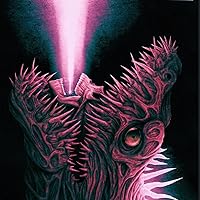
I was intrigued by the striking rainbow cover and world-hopping plot of this novel. In Immeasurable Heaven, an alien agent is sent down into the multiverse on a living spaceship in a secret mission to intercept a mysterious signal. To succeed, she must locate a dissolute traveller with an invaluable atlas and evade the universe's overlords, the AI Throlken.
Caspar Geon has a fascinatingly vivid imagination, and The Immeasurable Heaven was bursting with alien life of all kind: antennaed, horned, elongated, with fabulous combinations of eyes and spikes and nostrils. This book would make a fantastic illustrated fantasy art book. However, Geon hasn't quite got the touch for inventing conlangs, and his endless stream of SF make-believe names are absurd: Glorish Peeper, Gnumph, Yokkunphirelleng, Throlken. When you add in the fact that most of his alien species are apparently a foot or two high, it gives an inescapable impression of Whoville.
The three main point of view characters have a relatively static character arc and don't change over the course of the novel. Agent Whira is fussy and always accompanied by her nanobot swarm, the Myriad. Prospector Draebol is careless and dissolute. We don't get much of a sense of either character's past or motivations. And the mysterious being travelling upwards through the dimension is violently nihilistic, characterized only through his excessively gory murders. Not much in the way of emotional stakes, aside from the threat of death.
Like the characters, the riotously colorful surface of the worldbuilding conceals a thinly imagined interior. You can only travel downwards through dimensions--once you've descended, you're trapped in a new body and you can never return. But characters casually speak of being paid by people in higher dimensions, and travel downwards cavalierly. Likewise, the ineffable god-species the Throlken, who dictate the currency and language in the galaxy and beyond, are only shallowly explored.
Fascinating concept, but shallow execution. Not recommended.
The worldbuilding in this book might have completely rewired my brain. It was definitely the biggest strength, with all of the ancient alien civilizations and stacked layers of reality. This genuinely felt like such a real, old, and lived in world to the point where it was nearly overwhelming. and a universe that feels so old and lived. It definitely took a minute to get into and I was confused at first, but everything clicks into place as you spend more time with the world and characters. There’s a lot to take in at first, and then the pacing picks up a ton. I loved how fully alien everything felt, no humans, no familiar anchors, just strange, organic, biomechanical wonders (traveling inside a sentient spore? wow). I thought it was so cool how the technology felt grown rather than built. I did want a little more from some of the characters, but Whira absolutely carried this for me, especially seeing her loyalty tangled up with her own private motives. I didn’t always agree with her, but I did root for her. Also… the ascender??? Unhinged in the most fascinating way. The slow reveal of who he is and what he wants had me glued to the page, and the fallout of his obsession was so much bigger than he ever seemed willing to admit. By the time everything collided I just sat there staring at the wall because what do you mean we just did all that across multiple planes of existence. The prose has this thoughtful, almost reverent quality that makes the whole thing feel like a myth being carefully retold, which only adds to the scale and wonder of it all.
When I was offered an ARC for this, I was frankly hooked by "non-human PoVs" and that was about all it took. But when I actually read it, what I found was something I've been frankly STARVING for: far-future, rich, high-tech alienish peoples and cultures living actual lives amid mind-boggling, awe-inspiring vistas.
I'll be honest, this is what *I* always imagined SF to be as a kid. The reality is often a bit disappointing, or just plain mild, with the good stuff always leaning more toward characters or fantastic plot over that overarching feel of awe.
But there ARE SFs out there that give proper respect to the AWE. And for years, I feel like I've been truly starving for it. There are a few, of course, like Ninefox Gambit or some Reynolds or Adrian Tchaikovsky, but 'tis just a handful.
This soon-to-be published work is a must-read for all you starving SF fans who understand what I'm talking about. Wild, visual, deeply thematic, and it has a flood of SF ideas that we can float around in like a wild-river ride. Give it some love.
My synesthesia went into an overload, as if I had just fallen into Willy Wonka's factory.
Personal note: If anyone reading my reviews might be interested in reading my own SF, I'm going to be open to requests. Just direct message me in goodreads or email me on my site. I'd love to get some eyes on my novels.
No character has a recogniseable name, or physiology, no place or time is recogniseable. Trying to picture any scene or person is impossible. But most of all everything is grotty and grimy, it reminds me of China Mievilles criticism of his own early work… needlessly grimy. Layer upon layer until it obfuscates the story. The chapters shift between 3 characters, throwing you from one reality to the other, it takes ages to reorient where you are.then the chapter ends and youre thrown somewhere else entirely.
I had to persist well beyond my usual efforts. I dont know whyi did. Though in the end the idea of the phaslairs and travellers was interesing. But to find a glossary of characters and time line af the BACK of an eBook is like kicking the reader… “hah you struggled through when you could have used this”. It wouldnt help much, but it would have made the first 300 pages more sensical….
So im not a fan. Rave reviews for this title on the cover, but honestly, i didnt get much out of it, i didnt kearn anything or percieve anything that i could apply in my life. I prefer scifi that helps me reflect on the world i live in. So this was not for me. Not entirely a waste of time, but a lot of wasted effort on my part…
My first encounters with Golden Age science fiction shaped my being-in-the-world. The hackneyed phrase 'sense of wonder' is barely adequate. Those encounters were part of a steadily growing religious awe over the idea of existence itself. That reality was vaster than I'd previously conceived. This insight was best conveyed with a lovely chill that reality was not just strange but stranger than I had ever imagined. Leaving me with the conclusion that the Real might even be stranger than anyone had imagined. These books should not be dismissed as escapism. My sense is they are the opposite, they allow one to robustly embrace existence. They are philosophical exercises. They are warnings against falling asleep to the wonder of being alive. The works by golden age science fiction writers of my youth were events. Each story smashed the ice of my everyday hum-drum complacency. The Immeasurable Heaven is a grand return to novels and short stories of that kind. If you miss the great ones: Asimov, Clarke, and Heinlein, this novel could be for you. If you enjoy speculative fiction that delves into the nature of ultimate reality, then this is the book for you.
An astonishing menagerie of aliens across parallel galaxies. Every two pages, Geon introduces a new alien species; each one is more unique, strange, and wonderful than the last. The effort to keep all this straight, and have a plot to back it up, is a feat. I really liked Whirazomar as a character, pompous and determined, yet nuanced. Reading through all 300+ pages though was a chore. I could not have finished this had I had given up on another book; this is a story and universe that requires your full attention. The tone is hard to reckon with as well. At times, it is full of humor, at others, you are cringing at the bloodsoaked path of one POV, at yet other times, you're eyes are spinning as that menagerie unfolds. This is NOT a book for those trying to get into sci-fi. As magical as it is, it's also insanely difficult.
Clarke’s first law was wrong: advanced technology looks like magic. *Sufficiently* advanced technology looks like surrealism.
The worldbuilding here is strange and hard to grasp. Characters drop between realities, sometimes at will. Species vary dramatically in size and shape. Because of this, there’s a lot of atmospheric scenes (a zero gravity passenger ship, the air increasingly occupied by particles of sprayed food), the most understandable scenes are often set in surprisingly mundane settings: an auction, for example, or several scenes set in an MMO.
The cover compares this to Banks, but I think a better analogy is Gladstone’s Empress of Forever. Both are space operas set in a world where scale seems maliable.
I don’t regret reading this, but I don’t think I’ll read more.
I'm gonna be honest, I really wanted to like this book but there is just way to much going on, it felt like we were bouncing all over the place, every page there's a new creature, place or technology that's being explained and it all gets to be just a bit much.
Don't get me wrong the world building here was fantastic, like 10/10 but the plot was very simplistic and was drowned out by the constant bombardment of descriptions being thrown at you.
I found myself racing through the last few chapters, just to get to the end, it was a bit overwhelming and hard to follow, especially since there were no human characters at all, which is fine but when nothing is familiar it does make it hard to grasp on to anything.
Ironically, for a story about parallel realities, this felt really one-dimensional. The author seems entirely preoccupied with strangeness. From the outset, relentlessly, the writing felt very self-conscious, as though the multitude of weird creatures and zany ideas were invented purely for the sake of being random and surprising to the reader, rather than being relatable, thematically interesting or relevant to the plot. I think there's probably a great story under all the superficial clutter, but as other reviewers mention, the worldbuilding got completely in the way of telling the story.
I was a little confused the whole time I won’t lie. I had a hard time picturing the different species so the art is helpful, but it’s a very well written and really unique story!!! Heavy on the scifi but the characters still feel relatable. I’ve enjoyed the mystery in the plot and piecing things together. We get a few different POV’s and one from the antagonist. If you want a book that’ll make you think and use your imagination, this may be the one for you. I would recommend this to an experienced scifi reader looking for an interesting standalone.
Went in with few expectations as to what the book would be. Ended it having enjoyed it alot, its fast paced and changes up often enough to keep you wanting to zip along and finish it.
Gives you little pieces of very imaginative alien cultures and technology, enough to make you interested in how such things would work or change life. But not overbearing you with information superfluos to the speed of the plot.
One the most inventive science fiction books I've read in a long time. Reminded me a bit of Iain M. Banks books like The Algebraist or Inversions, but with the weirdness turned up to eleven.
I need this book to be made into a movie by Jim Henson studio. All these weird aliens as muppets would work so fucking well.