Jump to ratings and reviews
Rate this book

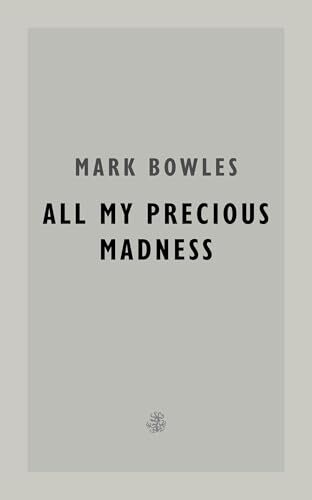
All My Precious Madness

Rate this book
Henry Nash has hauled his way from a working class childhood in Bradford, through an undergraduate degree at Oxford, and into adulthood and an academic elite. But still, he can't escape his anger. As the world - and men in particular - continue to disappoint him, so does his rage grow in momentum until it becomes almost rapturous. And lethal. A savagely funny novel that disdains literary and moral conventions, All My Precious Madness is also a work of deep empathy even when that also means understanding the darkest parts of humanity. It is, as critic Stephen Mitchelmore says, the book for everyone who longs for 'an English Bernhard' - and to read one of the most electric debuts of the last decade.

276 pages, Paperback

Published September 26, 2024

40 people are currently reading
696 people want to read

About the author

Mark Bowles

19 books11 followers

Ratings & Reviews

What do you think?
Rate this book

Friends & Following

Create a free account to discover what your friends think of this book!

Community Reviews

5 stars
98 (32%)
4 stars
100 (32%)
3 stars
72 (23%)
2 stars
28 (9%)
1 star
6 (1%)
Displaying 1 - 30 of 67 reviews
Profile Image for Harris Walker.
97 reviews14 followers
September 19, 2025
It was a pleasure to be cudgeled over the head by Mark Bowles’s philosophical cynicism, sarcasm, and irony. His protagonist, Henry Nash, grumpily battles the World without yet reaching the age where one normally does so. 'In All My Precious Madness’, he rants, raves, and ridicules the vicissitudes and vices of modern society, driven by his working-class background. It’s anti-capitalism served with biting ridicule and light-hearted irony. 

Just my cup of tea.

Always a precocious intellect from an impoverished industrial backwater, Nash wins a scholarship to Oxford University. Unfortunately, his anxiety to succeed prevents him from completing a university degree in English Literature, thus stymying his ability to shine above his more illustrious peers. Bowles writes that Nash wore his education “like a trench coat on a summer’s day”, and eventually, he succumbs to its psychological and physical malaise, though he finally falls on his feet with a state-assisted rental in the very heart of the West End of London. So begins a venting of sardonicism and mockery from one of the ubiquitous coffee-houses of the capital city, which became an extension of his working space, where Nash has his head over a milky coffee (definitely not a frappe, latte, or cappuccino) and his laptop. 

Though the West End of London is an area I know well—having worked there for many years in its seedy, bejeweled, and lustrous quarters—my mind was transported only a few Underground stops away to the Barbican, where I’d lived and experienced frustrations similar to Nash. It’s an area of postwar reconstruction, the brutalist architecture of the highest calibre. Sitting against London’s medieval wall, it’s a privileged enclave within the the municipal bounds of the City of London, cheek by jowl with the institutions that carry out the financial machinations of the nation, and the focal point of incredible wealth. There, across the road from my apartment, was a Starbucks where, like Henry Nash, I’d sit and exist with my laptop in a condition between work and play.

I say Starbucks, but it may have been Costa Coffee. Whatever, it was one of the coffee-house chains, which ubiquitously sprinkled their outlets around the city. Naturally, there were unwelcome interruptions and intrusions, and I felt entirely attuned to Nash’s diatribe against the braggadocio city workers, who assert, preen, complete business deals with jargon and inane management-speak, and manage the office environment as though they were the epitome of Ricky Gervais in ‘The Office’. He names one of these posturing prats, Cahun, and says:

“This Cahun weasel, for example, I hear him on the phone. He’s arranging a get-together for someone’s birthday. ‘I’ll reach out to Scott,’ he intones, ‘see if he’s got a window.’ ’I’ll push you out the fucking window,’ I whisper, clenching my fist.”

Apart from railing at those around him, Nash explores the odious machismo of the male ego and the delight of intellectual interrelations with women. Bowles says:

“I have never assumed for myself the name Man, or wanted anything to do with this name in so far as it means anything over and above bare biology.” And with my wholehearted agreement, he criticizes the habit we have of labelling ourselves; “All of us, of course—those made with a penis and those made with a vulva—come in various such combinations of the things we call ‘Male’ and ‘Female’. But there is a cultural system, we might call it, which insists we nail ourselves to ‘Male’ and ‘Female’ and see these not as characteristics we contain but as containers for everything else. All of us are naturally androgynous in this sense, only most suppress and veto the Female or Male characteristics under the duress of culture.”

Additionally, Bowles explores the complicated relationship with his father, the domestic violence of his past, his working-class background, and the fickleness of fate that served a glittering education that eventually evaded him. The story comes to a denouement with Nash’s pent-up fury returning him to a childhood he was desperate to leave, by reenacting his father’s aggression, a legacy of his past. Done with lashings of humor, this dark, brooding sounding-off paradoxically sparkles and glitters with wit and charm. I hope there will be much more delicious causticity to come from his pen. I very much enjoyed this. That said, this is a debut novel, and one senses it’s a memoir that covers most of Bowles’s life, so a sophomore effort is likely to be much different. A follow-up could fulminate more, or conversely, as some people in their dotage become more mellow it could be an idyllic sequel of tranquillity and pastoral seclusion.

I’ll be intrigued to read more of Mark Bowles who with this book just missed out on the Goldsmiths Prize.
Profile Image for Jonathan Pool.
721 reviews133 followers
October 2, 2024
It’s quickly apparent, to those readers of the 2019 Booker Prize shortlisted Ducks, Newburyport that this is a Galley Beggar (the publishers) pick.
An extended monologue, the reader who taps into first person narrator, Henry Nash’s, world view, will find much to like.
The difficulty with such a close focus on a single individual is that for this reader I am split about evenly on my reaction to the life observations and aphorisms that populate each page.
There are points of view that I recognise and identify with, and there are some that strike me as oddball, unrealistic and manufactured.

I’m with Mark Bowles on the ghastliness of social media/ sales speak. Dreadful cliches, butchering the English language.
But I like my latte in a takeaway mug, in the coffee shop- for heat retention, not to give off a sense of being a man in a hurry.

Bowles’s disdain and dislike for office work is visceral, and while I appreciate that it’s fair game, among some practitioners of the arts, to look askance at the drones making their way to and from the metropolis, the inner torment of the worker is much better presented in Michael Bracewell’s Perfect Tense and Unfinished Business.

The portrayal of certain types of men (this couched via office parties, and office banter) is frankly inaccurate and out of date. This is a book set in the twenty first century and not in the 1970s. Maybe Bowles/Nash was just unlucky to find himself marooned in an anachronistic throw back telesales call centre.

I liked the numerous literary references throughout the book. Walter Benjamin, Adorno, Wittgenstein, Beckett. The Oxford University passages worked less well for me.

Bowles is excellent on family, and childhood. His capture of children’s voices is lovely and uplifting. On witnessing the effect of strong winds: The trees are panicking
The acknowledgments at the end of the book reveal that “William’s” voice is drawn directly from Bowles’s own young children.
With his writer's ear for conversation, the field of children’s wisdom and natural creativity is where I would focus next if I were Bowles and planning to line up a follow up novel.

The mixture of personalities contained in Henry’s father is another highlight, culminating in a concluding fifty page epilogue (seemingly dedicated to Bowles’s own father?)
This is prose of great beauty, and a fitting finale that makes this a book of hope rather than of regret.

I hope this book is successful commercially (money, I’m afraid is a pernicious necessity for Arts to flourish!) and that Galley Beggar continue their tradition of support to one of their own.
Profile Image for Paul Fulcher.
Author 2 books1,979 followers
May 9, 2025
Shortlisted for the 2024 Goldsmiths Prize
Shortlisted for the 2025 James Tait Black Prize for fiction
Shortlisted for the Author’s Club Best First Novel Award

Anyway, I could not write, nor cross that arm's length of silence, with Cahun encamped here with his phone and laptop and sloppy latte. It was impossible to think when Cahun was present. He diverted, Cahun, my thoughts into other things. He had nothing to do with any of these things, necessarily, Cahun.

No, he was a kind of wall against which my thoughts re-bounded, or were redirected along various overgrown lanes and through sleeping rusty gates, away from everything he represented.


Shortlisted for the 2024 Goldsmiths Prize, judge Lola Seaton's citation reading:
"Mark Bowles’s All My Precious Madness is an exhilaratingly intelligent, hilariously foul-mouthed monologue: partly a crankish rant, railing violently – and digressively – against the crushing idiocies of contemporary life, partly an affecting Bildungsroman, centred on the narrator’s relationship with their father. At once crackling with spontaneity and beautifully controlled, alternating between a curmudgeon’s uproarious disgust and a child’s poignant wonder, Bowles’s novel is a wonderful piece of writing which you will be sorry to finish."


The Author’s Club Best First Novel Award judges said:
A poignant meditation on a son’s love for his father, masculinity, the desire for human connection, and the consolations of poetry. Bowles’s controlled, satirical novel is unforgettable.

All My Precious Madness is a well crafted portrait of a truly monstrous character, one who seems in his self-account determined to purge any sympathy the reader, or at least this reader, might have.

The book comes with a blurb from Stephen Mitchelmore “Anyone who has wished for an English Bernhard need look no look no further” and the narrator Henry (his surname is never given although oddly various reviews and even the book’s description have it as ‘Nash’) sets out his Bernhardian stance on his own country, versus his beloved Europe, early on:

The English prefer to look at the world through the filter of irony and resignation. In the end it will be necessary to live in exile from the English, which would not be exile but homecoming. Berger, who is certainly an emeritus at the Academy of the Underrated, was compelled to move elsewhere, rather than have his mind stop… and the same is true of all writers. The English hate anything which doesn’t return them to the prosaic and the everyday. Grand passions and intellectuals are automatically suspect. They live under the sign of necessity: “What can you do?” they burble, “It’s a funny old world”. They permit themselves the sole freedom of mockery. To a script written and edited by others, they make ironic additions in the margins. The English may have a ‘good sense of humour’ and a historic litany of many comedians, satirists, ironists of the best mettle. Fine. But the forfeit they pay is intellectual castration.

When Thomas Bernhard wrote in the 1960s and 70s in a similarly derogatory way about his own Austria he was termed a “Nestbeschmutzer”, a wonderful, German term meaning one who fouls his own nest.

And, this novel set after the 2016 referendum, English now has an equivalent term: a Remoaner.

The ostensible central thread of the novel has Henry reflecting on how his enjoyment of his morning coffee in his favourite Italian cafe in Soho was ruined by the presence of another regular, a man he labels Cahun, after the surrealist Claude Cahun, for his androgynous appearance. Henry later finds Cahun is called Seb Johnson, which he initially mishears as Seth Johnson, the somewhat ill-fated signing by Leeds from Derby, one of a number of football references by which Henry tries to lay claim to working class origins (but see below), some of which (also see below) are rather more disturbing.

Cahun is a digital consultant who holds business calls in the cafe, and who even in Henry’s garbled and comic take on his uttering has some interesting insights into marketing in the modern age, but to the academic Henry his use of business jargon, as well as the heinous crime of drinking his coffee in the cafe but in a takeaway cup (the reader baffled as to exactly what the issue is), ignites Henry’s rage.

Afterwards I looked up some of these rebarbative terms, such as ‘actionable' and so forth, but found only more vacuous jargon. Each jargon term is glossed only by other jargon terms until we return to the first, a kind of lexical 'circle jerk', as they say. In the popular imagination, jargon is associated with academics such as myself, who are thought of as deliberate obscurantists.

Well, each tribe, each profession has its terms of art, but as far as jargon goes, the world of business, or so-called business, is the worst offender. Jargon is always an attempt to remove the history and connotation attached to a word. In removing from words their penumbra of connotation, their history, jargon also removes from words their capacity to express, to serve as vehicles for our affects. Jargon always purges affect from the world.


Henry’s musings, which aren’t simultaneous with his time in the cafe, but later reflections on why Cahun triggered him, fill us in on his own history.

From northern England, his father worked as a housing officer, actually placing Henry firmly in the intermediate, or even professional, rather than working class to which he likes to lay claim; attended a poorly run and uninspirational (at least in his memory) state school; and from there he managed to win a place at Oxford, matriculating in 1990, but where he immediately felt out of place with his private school educated companions:

Someone who wears their knowledge in too cumbersome a fashion, someone who betrays the fact that their knowledge was only won through hours at the workbench, and armed with a pile of dictionaries and encyclopaedias, will be viewed as a pitiful and comical figure. As, no doubt, was I. Everything in fact which shows signs of labour, of the sweaty origins of what is now taken for granted, the vials or barrels of sweat from which insouciant privilege grew and prospered: that must be hushed up, and it is hushed up by scorn and social embarrassment. An autodidact at an aristocrat's table might as well be exposing his belly or hairy arse. I wore my learning, such as it was, like a trench coat on a summer's day. While they peppered their conversation with casual Latin and French, or Shakespeare, I used words like 'adventitious’, rescued from the obscurer pages of the thesaurus.

And the words rescued from that thesaurus are still a constant companion 25 years later, Henry never afraid to use an obscure term if it can be used in place of the mundane (bloviate, appetency, aetiology, pulchritude, telluric and perineural some I jotted down in just a few pages).

Shortly after graduating and while working on a thesis, Henry suffered an illness (part physical, largely psychological), the aftermath of which curtailed his academic career, and led to him working in a telesales office in Plaistow (a traditional working class of London area for which he doesn’t hesitate to display his contempt) for 10 years, and for which his bitterness about the business world stems.

More recently he was able to complete his thesis, on a concept from Wittgenstein, at Birbeck before obtaining an academic position at a London outpost of an American university, where he subjects his students to his rants about most aspects of modern life (unless they are aspects from the rest of the EU).

For Henry is, as his late father was before him, someone with a deep seated rage triggered by almost anything, and which he is happy to express in violent terms. Justifying his thoughts about physically harming Cahun he reaches for a football analogy he uses more than once - indeed kicking in someone’s head seems to he something of a leitmotif:

If you say to another person You're making me feel angry' or 'You're making me feel sad' these are descriptions of a state of mind not expressions. Anger or irritation needs an exit, some form of words, or action of course, which allows it to be released. Or completed. It is therefore better to say ‘you're going to get your fucking head kicked in', as the football fans used to chant, or some such thing. A vent.

And inevitably the novel is building up to an act of cathartic but entirely unjustified act of violence, although one which does trigger some of Henry’s more poignant and poetic thoughts, this a reference to the end of Molloy from his beloved Beckett:

... but I remember reading Beckett, when doing the Oxford entrance exam, It was not midnight. It was not raining... such a beautiful two sentences and also the beauty of literature, to subtract the ostensible so-called truth and make words sing and ring out all the more, all the more fully and sadly and mortal against that pure leftover silence.

And the novel’s epilogue has Henry now better able to reflect on the relationship with and affinity to his father, someone who also had a strong streak of violence until his own illness, around the same time as Henry’s, one which led him to lead a very different life for his final decade.

Mixed feelings. I am not sure I read this the way the author intended, who from interviews was perhaps expecting the reader to have at least some sympathy with Henry, and hence be more complicit in his act of violence. That was not my reaction at all - I was Team Cahun all along - but it still worked as a well-written and unusual character study.
Profile Image for Rubicon.
45 reviews5 followers
October 14, 2024
I’ve only just started this, but I’m giving it 5 stars in advance for the virtuosic skewering of a tech wanker in a cafe (what is the difference between a “grande” latte and a bottle of baby milk, seriously?) and bang-on, withering, hilarious observations of the English.

Hopefully the era of simpering bell-ends imploring writers to #bekind is over and we’re back to #justbeagoodwriterwithsomethingtoactuallysay (minus the sodding hashtag).

Let’s see what happens, I guess, but I am a fan so far!

Bravo to the author - and to Galley Beggar Press, too, for continuing to have the biggest set of balls and best sense of humour BY A COUNTRY MILE in contemporary UK publishing! 💪😘

***Having finished it now...***

Fucking brilliant. Beautiful, funny, insightful, heart-wrenching.

The second half is quite a departure from the first half. It does exactly what Henry himself (the narrator) talks about regarding teaching: reels you in with the Trojan Horse of being absolutely fucking hilarious and slagging off all the latte tech wankers that everyone (surely?!) hates; then, once you’re hooked, smuggles in all these big beautiful ideas - in gorgeous prose. I gave up underlining bits because I was just underlining everything. Loved it!
Profile Image for Paul Dembina.
710 reviews168 followers
January 1, 2025
Bloody marvellous! The sort of novel/essay crossover I've learnt to love. Reminiscent of Sebald, Kate Briggs and of course Lars Iyer. Like the latter he leavens his erudition with humour. A new favourite author for yours truly.
Profile Image for Zadie Loft.
36 reviews2 followers
February 24, 2025
My fave read of 2025 so far (it’s only Feb but still) !

Very cynical and existential and funny — actual laugh out loud moments of funny. A book that acts as a balm for the increasing emptiness of modernity (technology, corporations, words). I particularly enjoyed the complex compassion the narrator could hold for his father, and the idea the narrator has of that ‘what is expressed does not precede its expression’ (that is, it is only in the expression of an idea or action that you find the idea, as opposed to expression as a vehicle for pre-existing ideas). Not sure what I think about it myself, but an interesting idea and explored well in the plot and narrative!
Profile Image for Nigeyb.
1,489 reviews410 followers
March 22, 2025
I heard about All My Precious Madness (2024) via the Backlisted Podcast and was sufficiently intrigued to give it a go.

All My Precious Madness is Mark Bowles's debut novel, published in September 2024. It's about Henry Nash, a London based, Bradford born academic who narrates a monologue in which he critiques society and his associated feelings of alienation and discontent.

It's sporadically brilliant but also too meandering and discursive. I stuck with it because the good sections were so sharp and witty, and worth wading through the other stuff.

I'm interested to discover what will follow this promising debut.

3/5


Henry Nash has hauled his way from a working class childhood in Bradford, through an undergraduate degree at Oxford, and into adulthood and an academic elite. But still, he can't escape his anger. As the world - and men in particular - continue to disappoint him, so does his rage grow in momentum until it becomes almost rapturous. And lethal. A savagely funny novel that disdains literary and moral conventions, All My Precious Madness is also a work of deep empathy even when that also means understanding the darkest parts of humanity. It is, as critic Stephen Mitchelmore says, the book for everyone who longs for 'an English Bernhard' - and to read one of the most electric debuts of the last decade.


4 reviews
November 12, 2024
Aside from some well-crafted paragraphs and interesting perspectives on life, particularly surrounding father-son relationships, I found this book to be overly dense and the author to be incredibly pretentious.

I have read some reviews of the book (all of which seem to be positive) describing how the author, despite his flaws, is able to “keep you on side” and I completely disagree with this. The character of Mark Bowles (who is actually Henry Nash) to me, is an angry, self-righteous man who has little to no empathy for others and sees the worst in almost everything. Throughout the book, he uses these phrases “we all have this” or “all of us do this” and the final sentence in the book “Say it with me, be on my side, as I know you are: Fuck off.” All of these phrases impose the idea that everyone is like Mark Bowles when in fact many people would find him intolerable. Despite the book starting well with some very funny anecdotes and comparisons, it eventually loses its way and becomes a dull rant. Also his incessant use of the word “Fuck” throughout the book grated on me and felt inauthentic.

I feel like this book is for other angry men who will enjoy reading 200-odd pages of rambling and ranting interspersed with some intellectual philosophy. 4/10
Profile Image for Mark Thompson.
Author 1 book11 followers
October 23, 2024
Fabulous!

A joy to read… distilling the essence of thought, and being, is a tricky venture for a novelist - Mark Bowles has created a truly worthy gem of a novel.
1,186 reviews13 followers
May 2, 2025
What to say about this? It is very much in the tradition of angry young man novels that I am not really used to reading in a UK setting (although this angry young man is in his forties). To begin with the protagonist is very difficult to like - although he can be funny and writes well he’s also pompous and hugely pretentious. I also vehemently disagreed with many of opinions and even when I agreed with them he generally went that little bit too far… BUT at the same time there are some magnificent insights into the effects on a working class child of moving in to a different milieu that for once concentrated more on the psychological effects rather than the obviously transparent (yes of course it’s stressful not knowing which knife and fork to pick up first but anyone with a modicum of intelligence can learn that - the bigger problem is encountering a completely different mentality about the world and your place in it). And this then leads to how judging that pretentiousness is problematic as he admits to using obscure words in order to fit in with his more classically educated associates at Oxford (generally unsuccessfully) and opines on how the accumulation of knowledge and learning looks different when you’ve needed it as route out of a lower socio-economic background - you just don’t wear it as lightly as those with more privilege. So, in short, I’m conflicted - what I disliked I really disliked but there are also some perspectives that really resonated and opened my eyes and my rating should be seen (as a slightly positive one) in that context.
Profile Image for Benedict Ness 📚.
109 reviews5 followers
February 1, 2025
3.5, took a while this one. Very philosophical and funny, quite hard work but ultimately rewarding. Enjoyed frequent references to Keighley, Bingley and Baildon. The prose is pure molasses and knee-high, so bring your wellies.
Profile Image for Simon Harper.
55 reviews2 followers
March 9, 2025
By turns visceral and violent, but with moments of tender counterpoint, All My Precious Madness is a wonderful - and wonderfully written - book, with stylistic echoes of Beckett and especially Bernhard. Relentless, thrilling, darkly comic and, in places, deeply moving.
Profile Image for Liam McMahon.
190 reviews
November 19, 2025
“There are certain strangers who will illuminate our soul from such and such an angle unexpectedly and certain friends and family of course who, when we are with them, allow parts of ourselves to shine forth, parts which might otherwise have remained in darkness and unknown, or even unborn”

yep feel that felt that thank ya
Profile Image for Robert.
2,320 reviews263 followers
November 10, 2024
Henry Nash is the ultimate grumpy person. If you’re a more savvy critic I guess one could call him a chronicler of society’s malaises.

All My Precious Madness is a rant which goes off in many directions. Among the many topics we have internet usage, social class, Nash’s childhood, Parental relationships, Gen Z behaviour, ex lovers the list goes on. As Nash continues, the reader gets a clear picture about his own life and the roots behind his constant anger. Look at the bigger picture and Mark Bowles is giving us a portrait of the problems which are prevalent in humanity.

At the same time it is a funny book. Nothing escapes Henry Nash and his vitriolic jabs involve both major and minor details. There’s also the creative swearing which punctuates Nash’s spiel. Think of early B3ta.com.

As this is a novel from Galley Beggars Press there’s inventive prose which complements the strong story. I’m pleased that they’ve been going on for 12 years and they still haven’t abandoned this philosophy. if you’re fan of GBP books, then All My Precious Madness is another notch in their impeccable roster.

Profile Image for Jeff.
121 reviews14 followers
December 2, 2024
What can I say about this book that hasn't been said already and better? It's an extended semi-hilarious rant, though less Bernhardian and more Beckettian. No, not Beckettian either, despite the Beckett namedropping. Though, yes, I felt some kinship to Molloy and the futility of his sucking-stones.

It's an ode to the complex relationship we have with those we love despite our lingering and limitless anger, those we love despite how impossible it is to rectify their impact on us compared to the rest of the world. For the narrator, it's his father, and it feels wildly specific yet universal.

It's also an ode to language, to our attempts to define and describe things, to our attempts to hide in analogies, to the act of using synecdoche to both expand and shrink ourselves, to exist in "a constellation of tics and traits and [...] infer a person supporting these."

It's about simmering rage, violence begetting violence. But... each review saying "ha ha so funny don't we all hate annoying tech bros" misses the sickly impotence, the radical misapplication. Rage drags the narrator down, its target is undeserving and a poor substitute. A *failure* of synecdoche.

This novel is about years lost wandering in the desert of a misapplied life, about artists who spend decades away from art, about struggling to exist in the world, about carrying the burden of our past, the demands of capitalism, our fears-turned-blame, about dragging around our weighty bodies.

It's the kind of book where every well-tuned metaphor, every adjective, feels like a tetromino dropping into place in the broader theme, where the brilliant usage of assonant bon mots like "clammy facticity" justify the entire endeavor.

You can read it like an archeologist dusting off each word for closer examination, or you can let the language rush over you like you are buried neck deep in the sand and the tide is coming in.

Such a great great book.

I love gushing reviews on Goodreads with tweeful cries of "all the stars for [book]," usually aimed at superfun exciting reads, reviews with animated gifs as visual squeals of joy.

To be clear, I love that kind of bookthusiasm, so allow me to say:
All the stars for All My Precious Madness.

I called my father after reading this book to tell him I loved him.
Profile Image for Bjorn.
997 reviews188 followers
February 1, 2025
There's a long, proud tradition in literature of the Misanthropic Male Rant; the lonely guy who's seen through all of society's faults and is now going on a rant for howevermany hundred pages we'll let him get away with it. From Burton to Dostoevsky to Kennedy Toole to Ellis. Books that, at worst, are just reactionary Facebook posts without a character limit, and at best give us a crack to see beyond the narrator's bullshit and see an of both the world and the narrator, turns that mirror back and forth.

Bowles' entry point is language. He can barely get through the first few dozen pages of vitriol about lattes (when espressos are clearly superior!) and lad culture and Instagram tourism (unlike other Brits, his fascination with foreign cities is intellectual, don't you know) before he has to admit that of course he doesn't entirely mean it; but the act of writing it down forces him into exaggeration, forces him to point it outside of himself. Then he takes us on a ride through meaning, through expression, through... well, the actionable.

(One section is about Wittgenstein's assertation that art is an uncommitted crime; violence that is channelled into something else. Which the Philistines, to the narrator's eternal contempt, turn into an untranslatable pun about commitment issues. Damnit, English!)

I had to put this book down for a full week at one point. It's just the sort of book that requires a certain mood. To ride in the narrator's carriage without getting swept up. To stop folding back every other page to go back to the pages that deliver funny, clever, angry, double-sided vomitries. It's not a book to read when you're angry at the world and susceptible to easy targets.
Profile Image for Alan.
Author 15 books194 followers
January 9, 2025
Loved the ranting and its self centred philosophy, the disdain for corporate speak, and the Northerner’s eventual reconciliation with his near silent dad etc., but, boy, does he get it wrong about the Brummie accent. He completely misses its musicality (sing song) - it’s the accent of Shakespeare, you twat (WS born and brought up 20 miles from here (Birmingham, UK)). Besides, my Brummie daughter is living with her Italian boyfriend and any future child (admittedly seems unlikely at present) will not be a monster as you suggest. So there!
Profile Image for Colin.
1,330 reviews31 followers
June 27, 2025
Now, this is not the sort of book that would usually appeal to me, so I’m grateful to my daughter for buying it for me as a present and providing me with a reading experience that is outside my normal comfort zone. It is both a very European book (both in terms of content and cover design) but also a distinctly English one. European in its discursive first person narrative and its grounding in twentieth century continental philosophy (Sartre, Althusser, Deleuze, Wittgenstein, along with Samuel Beckett, all feature in the tale our narrator has to tell), and English in the familiarity of the everyday annoyances and frustrations that power his disillusion and propensity to violence. It’s a sort of existentialist fantasy-cum-nightmare but riveting and refreshingly different from my usual literary diet.
Profile Image for Samantha Garrad.
29 reviews
January 22, 2025
Hated the first part, was not on his side, he’s a bloody misery guts
Liked the epilogue, felt really tender and sweet.
Profile Image for I'.
551 reviews291 followers
abandonados
March 1, 2025
Abandoned at page 100.

This is described as a "work of deep empathy" but from my point of view it was very repetitive, full of obnoxious big words for the sake of it around a very disjointed inner thought thread on how difficult is to be a man be because my father hit me as a kid despite all the great education I received at Oxford.

Sadly, not for me.
Profile Image for Luke Mitchell.
22 reviews
May 7, 2025
At the snooker we'd see one cued against the odds and, just before it goes in, shout 'shot!'

I read this and shout 'book!'
Profile Image for Jai.
51 reviews
December 3, 2025
I love the voice of the narrator - pretentious, deeply cynical, and full of rage - but balanced with moments of humour and real emotional depth.
Profile Image for Jo.
290 reviews23 followers
February 26, 2025
Confirming the theory that Oxbridge grads will inform you of this fact within five minutes of meeting, this guy goes as far as regaling the reader with his entire entrance interview spiel...excruciating. Pretentious as all hell - a total sellout & a carbon copy of the toffs he purports to loathe at Oxford. Describes his "microhumiliation" of being told to use a tissue after sniffing on the train & the injustice of this, but feels entirely entitled to chuck a cup of boiling coffee at the man using a mobile phone in public. Marking himself as a rare & special creature for being attracted to "fat" women only to name check the lucky women who earn his admiration as fucking Christina Hendricks, Monica Belucci & Anita Ekberg. These women are hardly fat. Just say you like big tits and move on. An intellectual snob.

Despite his insistence on using words like Aetiology, exsiccation, appetency, rebarbative, jejune, desuetude, perineural, condign... he rages at the existence of corporate jargon. Astonishing that it takes him until page 89 to reference his therapist.

Talks of the middle classes as of he is not a card-carrying member. Calls Jane Austen overrated.

"I escaped the office party [held at Claridge's NATCH] to read a slim book of poetry by Rilkes" GIVE ME STRENGTH

His critique of football: utterly joyless

On his time working in a call centre: "I will never outlive the ignominy of having worked there...the intellectually demeaning work" MERCY

Weirdly, I started off enjoying it, wanted to bin it by 100 pages but cried reading the epilogue.

Thank fuck that's over.
This entire review has been hidden because of spoilers.
524 reviews1 follower
December 28, 2025
I absolutely loved this. No matter that the narrator is a mix of snob and plain talking Yorkshire man, no matter that he uses pretentious vocabulary (I've never had to look up so many words in an English book), no matter that he goes off on full scale rants of rage over the smallest things. I hope that this is a fictional narrator and not just a disguised autobiography of Bowles, because he isn't a likeable character, but I understood him completely in all his intolerance for other people and modern life . The language is gorgeously purple. The ending is perfectly simple, and simply perfect. I am so sad to have finished.
Profile Image for Joshua Line.
198 reviews23 followers
Read
July 23, 2025
Enjoyable for the most part, however the Bernhard comparisons, flimsy and performative at best, collapse with the conclusion - an Afterword with the narrator offering a love letter to his late violent (albeit apparently reformed) father. The cloying, sentimental ending - like watching a late episode of The Bear - ruined the entire novel for me.
Profile Image for Gumble's Yard - Golden Reviewer.
2,227 reviews1,807 followers
May 9, 2025
Shortlisted for the 2024 Goldsmiths Prize.
Shortlisted for the 2025 Author’s Club Best First Novel Award
Shortlisted for the 2025 James Tait Black Memorial Prize

The book is published by the Norfolk based small press – Galley Beggar Press who remarkably have won the Goldsmiths Prize twice in its eleven year history – with perhaps the two most distinctive and (in my view) strongest winners of the prize: Eimear McBride’s “A Girl Is A Half Formed Thing” (which also won the Women’s Prize, the Desmond Elliott Prize and the Folio Prize) and Lucy Ellman’s “Ducks, Newburyport” (which was Booker shortlisted and also won the James Tait Black Memorial Prize).

Written in a first person monologue – although in a much more conventional voice than those two novels – it is the internal thoughts of Henry, which while roaming very deliberately over his life, is ostensibly anchored immediately after the Brexit referendum (a result that Henry angrily mourns) as Henry sits in a café trying to write a memoir about his (often angry and violent) father while silently despising a digital entrepreneur – who he names Cahun – who noisily conducts his business (Henry is as enamoured of capitalism and even just business as he is of Vote Leave) nearby.

Henry is a Francophile and Italophile and the front cover reference to “an English Bernhard” extending not just to angry monologue but also to hating his own country. He does seem rather oblivious to his beloved Paris and Rome’s political trajectory compared to that of his despised England.

(Ful disclosure: I was a Remain voter and am far from patriotic but find myself more and more distanced from those proud of their inability to accept a democratic vote or the near collapse of the EU and also challenged by Orwell’s famous quote “It is a strange fact, but it is unquestionably true that almost any English intellectual would be more ashamed of being caught standing to attention during God Save The King than of stealing from a poor box”)

Henry, we learn grew up in Yorkshire (one perhaps if one wants to play class games as this book sometimes does slightly less working class than either the book’s cover or Henry’s positioning of his past imply), before studying at Oxford where he simultaneously idealised the intellectual environment while being only too aware of those whose passage to Oxford was along a well mapped path of privilege.

(Full disclosure my own upbringing was working class but in Galley Beggar’s Norfolk and with a very loving father. I studied at Cambridge only a few years before Henry’s own undergraduate years, but saw less of the privilege as I went to a college which prioritised state school applications – so was oddly unable to relate to sections which should have worked for me).

An illness shortly after graduating cut off his academic career and after two and a half years of drawing benefits in London he was forced by “penury” into a telesales job – one in what I think is part autobiographical detail seems to have had a workforce stuck in the attitudes and laddishness of previous decades and which largely inspired his hatred of commerce. It also seems to have inspired a hatred of Plaistow where he was based.

(Full disclosure – before University I spent a year living in Plaistow while working in Tilbury – the area, its inhabitants were so far removed from their ungenerous if not downright unpleasant portrayal by Henry and I have to say so much nicer human beings than him in every sense that I found it hard to overlook the writing at this point).

Much of the book – and often the parts mentioned in favourable reviews – is grounded in Henry’s anger at much of modern society (with targets much wider than England and people who actually earn money – but going as far as the heinous crime of for example drinking latte in cafes in takeaway cups.

(Full disclosure – I was until we became one of the many casualties of lockdown – director of a high street coffee shop well known for the quality of its coffee – but I am entirely a tea drinker myself so not really au fait with coffee drinking protocols, although I would say that our café’s very ethos was to be welcoming to all from the coffee afficionado to someone who could only afford to nurse a filter coffee but wanted company/community – so I struggle a little with the idea of judging others on their drink choice).

The effect is I have to say rather like the TV programme Room 101 – where guests (predominantly male, white and left of centre – check out the guest list for the early series if you don’t believe me) rail humourously against various pet hates. For Henry that includes some far from original observations on the Birmingham accent, tourism (just not the sort of tourism in which he partakes), culture consumption (unless done by him or those of whom he approves) and even anger itself (if the anger is directed at him – he is positively apoplectic when someone is offended by his nose blowing).

(Full disclosure – despite being male, white and left of centre myself, I always felt uncomfortable with Room 101 really due to its judgemental and often superior nature – with many of the judgments mean spirited (See Plaistow), rather cliched (see Birmingham accent) and often hypocritical – see anger)

Where though the book really soars – and I perhaps wish it had concentrated – is in parent/child relationships.

One of Henry’s greatest and for me most understandable sources of anger about anger is against those who rail against children.

They cannot admit to themselves their hatred of children, for that would amount to confessing a hatred of life. But this is exactly what they do hate, the exuberance and uncompromised delight of the wobbling baby, the toddler circling in gleeful triumph around the listless, ironic adults, who sit decomposing on the sofa.

When we enter this state of becoming a child, of course, how can we not meet again our own childhood coming towards us, how can we not have it again, the gift of our own childhood too, from the child we play with, the child who speaks to us.


Because when both Henry and the text are at their most playful is when Henry reflects on the world attitudes and verbal invention of his young children - words and ideas heavily quoted in the text and which rather delightfully the author in the Acknowledgements reveals were directly inspired by the words of his own children.

(Full disclosure – I am a father of three now teenage daughters, and I can still remember their infant world-verbalisations while finding they continue to show me new and unjaded perspectives to view the world).

I think I would have preferred the book – perhaps even loved it – if somehow this wonder, this playfulness was a mirror held up to Henry’s life, revealing his own hatred of life and decomposition as he sits not on a sofa (again here we have Henry’s snobbishness and judgementalism even in this choice of word) but on a trendy chair in his favourite (if Cahun marred) Italian coffee shop – and that lead to a transformation in his world view.

Instead that transformation comes in a cathartic physical act - one I sense where I sense I was not as a reader meant to have hoped for the roles of deserving victim and perpetrator to have been reversed).

But once the transformation occurs it is mirrored in the text – firstly in a stunning stream of consciousness, or perhaps more accurately river of consciousness as it takes place in a Thameside walk, and then in an Epilogue – a short monograph written by Henry about his father (presumably the fruits of his memoir attempts finally unlocked) and involving an act Henry calls a “strange necromancy” again taking place by a river, as Henry tries to emphasise with his late father’s memory and reach a place of closure with him by donning his very speech, mannerisms and attire.

(Full disclosure: while not as strong as book as its two Galley Beggar/Goldsmith predecessors – although I will say that is an incredibly high bar – and not my favourite to win the prize; these last two sections did reconcile me to much that had gone before and convince me of the merits of its shortlist place).
Displaying 1 - 30 of 67 reviews

Can't find what you're looking for?

Get help and learn more about the design.