When the Verity Aquinas crash lands on the way to a concert, the Shredded Orphans seismic rock band finds themselves stranded in the middle of the desert. Lix and the rest of the band must find their way back to civilization.
The Shredded Orphans are slaves to their job - literally. The galaxy is run by the corporate class and at its head is the Galactic Media Corporation. By night the band plays concerts, by day Lix and the group are on a secret mission to save the universe, one slave at a time.
Travel with the Shredded Orphans as they encounter ex-advertising slaves, unknown fauna and over-exposure to the sun on this “road” trip of galactic proportions.
Sonya Rhen lives in the Pacific Northwest with her husband and two children. They also share their home with two dogs, two cats and a lonely catfish. Sonya looks for the humor and humanity in daily life. When she’s not writing or hanging out with the family, you might find her dancing.
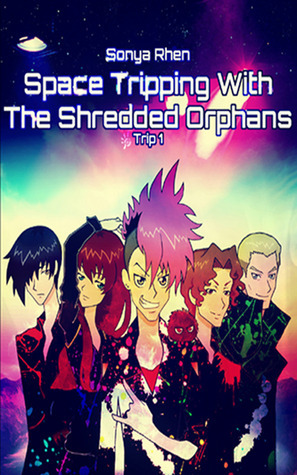
From the cover, Space-Tripping might appear to be a graphic novel, and a humorous one at that. There’s nothing wrong with graphic novels, but this isn’t one. It is humorous, in a way that reminds me simultaneously of “This is Spinal Tap” and “Red Dwarf”, but it is indeed a regular text-only novel. Or at least, it’s as regular as a light-hearted dystopian book can be. (Is that a genre yet? If not, let’s make one.)
Space-Tripping’s setting is a nod to the classic sci-fi idea of a universe controlled by galactic corporations, and a wink at Kafka's bureaucracy. The tone of the book is as perky as a seventies-era soft drink commercial, and the writing style is dialogue-driven and upbeat. The contrast between the setting and the style is what makes this book work, I think. There are no hard-hitting expositions to show us how dehumanizing life is there. We get enough to draw our own conclusions, but being depressed or moody about it is not part of the experience.
The protagonists in the story are members of a musical group, which was designed and packaged for maximum profit. Its members are commodities that can be traded or sold at any point by the executives of the corporation that owns them. The group itself, “The Shredded Orphans”, can be disbanded at corporate whim, and its music style and genre, Seismic Rock, switched to something else by similar fiat if the return on investment isn’t high enough.
We are introduced to the band members all at once as the book opens. Their spaceship crash lands some distance away from the city where their concert is scheduled and though they are unharmed, it is a major crisis. A missed show means that their popularity and image points will drop precipitously. The story follows their attempts to be able to perform so that they can stay together, be true to themselves in a setting that makes that difficult, and somehow help others when their futures are uncertain.
The book is never heavy-handed, either in setting or substance. In fact, the protagonists came across almost as stereotypes or cartoon characters in the early chapters. At first, I wondered whether debut writer, Sonya Rhen, had just not yet hit her stride, but as I read along, I began to think that this was deliberate on her part. We may have been seeing the Shredded Orphans members as their world saw them: this one is the charming but sarcastic lead singer and that one is the beautiful but aloof female eye-candy whose job is to entertain with her body kinetics. Another is the token alien in the band to give the group a sense of the exotic and still another is the long-suffering pragmatic that keeps everything working. And of course, there is an undercurrent romantic attraction between two of the members.
The band was as invented as the The Monkees were in the 1960s and Spinal Tap was decades later, but its members have made themselves real, if only to each other. As the book goes on, the character sketches fill in a little, but never too much. We smile or wince at their joking, we follow along as they try to solve their problems, and we get glimpses of brief bursts of kindness and empathy from the occasional faces that come out of a bland monolithic bureaucracy to help them.
My favorite parts of the book were references to the names of stores, malls, and corporations, which were either tongue-in-cheek or out and out acknowledgements of their ultimate motive of profits over people. The “Why Be You?” dress-up bar and clothing store is a nice example. It obviously invites some thought about how closely the Space-Tripping’s economic culture follows our own, but doesn’t spend much time in trying to do our thinking for us. We get only glimpses of how the individuals respond to their cookie-cutter consumer world, where recreational pharmaceuticals and body makeovers are aggressively promoted to pacify everyone at their own expense. Those struggling to make ends meet learn the hard way that more fortunate friends aren’t allowed to share meal card credits with them, but it’s easy enough to do so with their “Drink-Me-To-Your-Liter” credit account or their “Dazed-And-Crazed” pharmaceutical card.
The band members are true to their environment in many ways. They understand and are at home with the notion that everyone should fit in formulas and preference genres. The Shredded Orphans love their seismic rock shtick, complete with earthquake at the end of each performance. The lyrics to their songs are parodies themselves, leaving open whether we’re laughing with them or at them. I suspect it’s with them, but I couldn’t really be sure if there was conscious irony in some of their Spinal Tap-like songs or if they were just as clueless about it. (Sorry for the reference to The Tap again, but those familiar with the movie will understand what I mean).
Even so, the hearts of the band members are in the right places, and despite their occasional sibling-like loyal-but-grumbling interactions with each other, their primary concern is each other as individuals, and with those who have it even rougher than they do. In their universe, that is very seismic and counter-cultural in itself.
The Shredded Orphans band is set to perform in another galaxy. No problem. Their ship, the Verity Aquinas, and their navigator Justice will take them straight to the city and performance venue, but After mechanical issues and the disappearance of some very important navigation charts, they land on the planet in the middle of nowhere. Certain that they can find the city if they walk in the right direction, the Shredded Orphans head out in search of civilization.
The little world details are the treasures that kept me reading, such as names of items, trademarked things, and chapter titles. The sci-fi world building details were stupendous and very imaginative.
This book reminded me a lot of Feed by M.T. Anderson. The Shredded Orphans and Feed both have that young person abandon with a carefree attitude. Both main characters in Shredded Orphans and in Feed feel invincible even in the face of problems – like dehydration and death in the middle of a deserted planet. The humorous dialogue and character interaction in Shredded Orphans are also similar to Feed, including some world building dialogue and slang/language, though it was not as far out as Feed.
The book did meander, just like the shredded orphans do in the beginning of the book. This adds to the plot wandering and randomness to the story. The book gets funnier and funnier as you get to know the characters.
I was at first disturbed by the sexism and female stereotyping Lix displays toward Ophelia (the signature female in the first half of the book). She says no and he continues to flirt. He touches her inappropriately without permission. When Ophelia wants to help build using a hammer she is asked to instead help make food (this doesn’t mean she listens, of course). The first questions that people ask of her upon meeting her include whether she has a boyfriend. Lix tries again to get with Ophelia after they’ve been drinking. Chitto was able to sway my opinion. Chitto is “sexless” and from a special and different planet. At first, Chitto said something that I didn’t like about not wanting to be a woman (by having long hair), but later Chitto showed that he could be both man and woman (as a gender), but simply preferred being a man and not because women were inferior or anything. Chitto, actually, is fairly humorous and great for the addition of an LGBTQ aspect to the book. “…if you are going to give my name a gender identity, but in my race we never use them.” (pp. 212-213).
If they don’t make it to their next concert, the five members of the band Shredded Orphans could be split up and sold. That’s because everyone in this dystopian future is a slave to their job, and the manager they work for is hard to please. The ragtag group perseveres through a series of mishaps and calamities in this fast paced adventure.
This book is a fast read, I almost did it in one sitting. It kept me up way past bedtime turning pages. The characters are funny and consistent. The plot is never predictable and the resolution is surprising. This book is perfect for young adult readers.
The Shredded Orphans is a fun science fiction novel about a rock band stranded in the middle of nowhere and late for their concert. It’s humor in the vein of Douglas Adams and Terry Pratchett and the humor feels British to me, although the writer’s American.
The book is a quick fun fluffy read, and I mean that as a compliment. There are two more books in the series and I’ll be checking them out. The characters are unusual and memorable and the world building has interesting quirks.
I'm not a Sci fi fan, but this book was a delight. The characters are rich, and complex, and their private mission is something that we all can relate to. From the beginning they are on an adventure as they crash on a planet that appears to have only one city. What a shock to learn that there is so much more.