

What do you think?
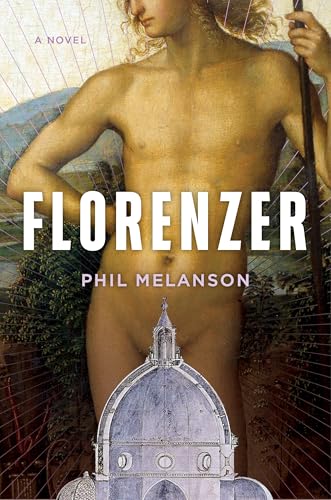
Florenzer: A Novel
Set in Renaissance-era Florence, this ravishing debut reimagines the intersecting lives of three ambitious young men—a banker, a priest, and a gay painter named Leonardo.
“A dazzlingly prescient parable of ambition, greed, and wealth rattling even the firmest foundations. Like the fractured Italy leaping from its pages full of life and sound and smell, Florenzer churns at the quicksilver pace of creation itself.” —Isa Arsén, author of Shoot the Moon
Allstora’s July selection for “The (Very Gay) Book Club”
Longlisted for the Center for Fiction First Novel Prize
Leonardo da Vinci, twelve years old and a bastard, leaves the Tuscan countryside to join his father in Florence with dreams of becoming a painter. Francesco Salviati, also a bastard and scorned for his too-dark skin, dedicates himself to the Catholic Church with grand hopes of salvation. Towering above them both is Lorenzo de’ Medici, barely a man, yet soon to be the patriarch of the world’s wealthiest and most influential bank. Each of these young men harbors profound ambition, anxious to prove their potential to their superiors—and to themselves. Each is, in his own way, a son of Florence. Each will, when their paths cross, shed blood on Florence’s streets.
Fifteenth-century Florence flourishes as a haven of breathtaking artistic, cultural, and technological innovation, but discord churns below the the Medici’s bank exacerbates the city’s staggering wealth inequality, and rumors swirl of a rift between Lorenzo and the new pope. Meanwhile, the city has become Europe’s preeminent destination for gay men—or “florenzers,” as they come to be crudely called. For Leonardo, an astonishingly gifted painter’s apprentice, being a florenzer might feel like personal liberation—but risk lingers around every corner.
Brash and breathtaking, this lush historical drama unfolds the machinations of a city on the brink of a new age as it contends with the tensions between public and private lives, the entanglement of erotic and creative impulse, the sacrifices of the determinedly pious, and the risks of fantastic power. With his “unforgettable characters and an ever-twisting plot, all told with style, skill, and wry black humor” (Tim Leach), Phil Melanson emerges as an enthralling new voice in contemporary fiction.
“A dazzlingly prescient parable of ambition, greed, and wealth rattling even the firmest foundations. Like the fractured Italy leaping from its pages full of life and sound and smell, Florenzer churns at the quicksilver pace of creation itself.” —Isa Arsén, author of Shoot the Moon
Allstora’s July selection for “The (Very Gay) Book Club”
Longlisted for the Center for Fiction First Novel Prize
Leonardo da Vinci, twelve years old and a bastard, leaves the Tuscan countryside to join his father in Florence with dreams of becoming a painter. Francesco Salviati, also a bastard and scorned for his too-dark skin, dedicates himself to the Catholic Church with grand hopes of salvation. Towering above them both is Lorenzo de’ Medici, barely a man, yet soon to be the patriarch of the world’s wealthiest and most influential bank. Each of these young men harbors profound ambition, anxious to prove their potential to their superiors—and to themselves. Each is, in his own way, a son of Florence. Each will, when their paths cross, shed blood on Florence’s streets.
Fifteenth-century Florence flourishes as a haven of breathtaking artistic, cultural, and technological innovation, but discord churns below the the Medici’s bank exacerbates the city’s staggering wealth inequality, and rumors swirl of a rift between Lorenzo and the new pope. Meanwhile, the city has become Europe’s preeminent destination for gay men—or “florenzers,” as they come to be crudely called. For Leonardo, an astonishingly gifted painter’s apprentice, being a florenzer might feel like personal liberation—but risk lingers around every corner.
Brash and breathtaking, this lush historical drama unfolds the machinations of a city on the brink of a new age as it contends with the tensions between public and private lives, the entanglement of erotic and creative impulse, the sacrifices of the determinedly pious, and the risks of fantastic power. With his “unforgettable characters and an ever-twisting plot, all told with style, skill, and wry black humor” (Tim Leach), Phil Melanson emerges as an enthralling new voice in contemporary fiction.
363 pages, Kindle Edition
First published June 10, 2025
About the author
Phil Melanson
1 book51 followersPhil Melanson is the author of the queer historical novel Florenzer.
He is a graduate of NYU’s Tisch School of the Arts and the University of Warwick. Prior to writing Florenzer, he was a digital marketer for Hollywood film studios, working on campaigns for movies such as Little Women, Mamma Mia! Here We Go Again and Once Upon on a Time… in Hollywood. He teaches with Boston University in London, where he lives with his husband.
He is a graduate of NYU’s Tisch School of the Arts and the University of Warwick. Prior to writing Florenzer, he was a digital marketer for Hollywood film studios, working on campaigns for movies such as Little Women, Mamma Mia! Here We Go Again and Once Upon on a Time… in Hollywood. He teaches with Boston University in London, where he lives with his husband.
Ratings & Reviews
Friends & Following
Create a free account to discover what your friends think of this book!
Community Reviews
Displaying 1 - 30 of 229 reviews
February 23, 2025
This book is beautifully descriptive. You can almost smell and taste on each page how Italy was at that time! However, it was too dense for me with so many characters to keep track of! It is not a “light weekend” read! You will need to spend a lot of time with this story! 3 Stars ⭐️⭐️⭐️!

February 21, 2025
Florenzer by Phil Melanson was a departure from my usual reading choices, but I was intrigued by the premise—a novel set in Renaissance-era Florence, weaving together the lives of a banker, a priest, and a young Leonardo da Vinci. When I first picked it up, I thought, Oh, gay 1400s Italy? Sounds fun! However, I quickly realized that the combination of intricate historical detail and dense storytelling required more focus than I had anticipated.
I initially struggled to get into the book, as Melanson’s writing style felt more like a movie script—highly visual and descriptive, but not always immersive for me. That being said, his ability to paint vivid scenes is undeniable. His passion for the subject matter is evident on every page, and I appreciated the meticulous care he put into crafting this world.
The novel picked up for me in the second half as the action intensified. While I wasn’t particularly invested in Francesco Salviati or Lorenzo de’ Medici’s chapters—likely due to my limited prior knowledge of their historical significance—I was completely captivated by every chapter featuring Leonardo. If the book had focused more on him, with Salviati and Medici serving as secondary characters, I think I would have been more engaged from the start. But, of course, that wasn’t Melanson’s vision, and I respect the creative choices he made.
One aspect I truly appreciated was how the novel encouraged me to research historical events and figures. I found myself pausing my reading to look up biographical details, which ultimately deepened my understanding of the time period. My only critique is that the chapter headings, marked only with Roman numerals, made it difficult at times to discern whose perspective I was following. Including character names at the beginning of chapters would have helped with clarity, especially for readers unfamiliar with all three historical figures.
Overall, while Florenzer wasn’t entirely within my comfort zone, I found it to be a beautifully written novel. Melanson is an incredibly talented writer, and it’s clear that this book was a labor of love. I look forward to seeing what he writes next.
Thank you to NetGalley and W. W. Norton & Company | Liveright for the advanced copy.
I initially struggled to get into the book, as Melanson’s writing style felt more like a movie script—highly visual and descriptive, but not always immersive for me. That being said, his ability to paint vivid scenes is undeniable. His passion for the subject matter is evident on every page, and I appreciated the meticulous care he put into crafting this world.
The novel picked up for me in the second half as the action intensified. While I wasn’t particularly invested in Francesco Salviati or Lorenzo de’ Medici’s chapters—likely due to my limited prior knowledge of their historical significance—I was completely captivated by every chapter featuring Leonardo. If the book had focused more on him, with Salviati and Medici serving as secondary characters, I think I would have been more engaged from the start. But, of course, that wasn’t Melanson’s vision, and I respect the creative choices he made.
One aspect I truly appreciated was how the novel encouraged me to research historical events and figures. I found myself pausing my reading to look up biographical details, which ultimately deepened my understanding of the time period. My only critique is that the chapter headings, marked only with Roman numerals, made it difficult at times to discern whose perspective I was following. Including character names at the beginning of chapters would have helped with clarity, especially for readers unfamiliar with all three historical figures.
Overall, while Florenzer wasn’t entirely within my comfort zone, I found it to be a beautifully written novel. Melanson is an incredibly talented writer, and it’s clear that this book was a labor of love. I look forward to seeing what he writes next.
Thank you to NetGalley and W. W. Norton & Company | Liveright for the advanced copy.

Read
August 1, 2025I might have enjoyed this more if it had focused solely on Leonardo da Vinci, with Medici and Salviati playing supporting roles. The setting was rendered with lovely details, but overall, the story never grabbed me as I’d hoped (though Salviati's conclusion was chef's kiss 🤌). (more thoughts below 👇)
Florenzer is my second read from the 2025 Center for Fiction First Novel Prize longlist. The story unfolds in 15th century Florence and opens with a twelve-year-old Leonardo da Vinci, who dreams of becoming a painter. Also in the mix is the Catholic Francesco Salviati, who hopes for salvation, as well as Lorenzo de' Medici, who's poised to become a figure of great power and influence. Three young men harboring ambitions, each fated to shed blood on the streets of Florence.
Let's see how they fare, shall we?
THE SETUP
Leonardo (age 12) is a highly observant young man, with an eye drawn to color, and a proclivity for jotting down his observations.
Lorenzo (age 14) aspires to be more and achieve far more than his recently deceased grandfather.
Salviati (age 21) has a cousin pressing him to work at a bank, but Salviati aspires to join the church.
THE MIDPOINT
😮💨 Whew! I wish I could say I'm enamored with this book. But the truth is I'm finding it difficult to stay invested. Medici's chapters are slow, largely concerned with banking matters. Salviati's chapter are even slower. They're full of scheming, so you'd think they'd be more interesting, but alas...
It's Leonardo da Vinci's chapters that have me invested. I enjoy reading the descriptions of various paint colors or watching one of his works unfold in his mind then take shape on the canvas. His relationship with Iac is sweet, but it also puts him at risk, and Phil Melanson's captivating midpoint hinges on that reality.
THE CONCLUSION
The end of Salviati's story is, without question, the zenith of this book. Talk about stellar writing!
Medici's story felt so inconsequential that it could probably be removed from the story entirely without harming the novel in any way.
Da Vinci's story was the most captivating, though as other reviewers have pointed out, this is not a Leonardo who aligns with the one other biographers (most notably Walter Isaacson) have introduced us to. Nonetheless, it was Melanson's descriptions of da Vinci's view of the world, his tenderness toward other men, his fascination with machinery, and his eye for color that made this book worth reading.
Florenzer is my second read from the 2025 Center for Fiction First Novel Prize longlist. The story unfolds in 15th century Florence and opens with a twelve-year-old Leonardo da Vinci, who dreams of becoming a painter. Also in the mix is the Catholic Francesco Salviati, who hopes for salvation, as well as Lorenzo de' Medici, who's poised to become a figure of great power and influence. Three young men harboring ambitions, each fated to shed blood on the streets of Florence.
Let's see how they fare, shall we?
THE SETUP
Leonardo (age 12) is a highly observant young man, with an eye drawn to color, and a proclivity for jotting down his observations.
He commits his curiosities, his stirrings, his whims to paper, loose sheets he tucks beneath his mattress.
Lorenzo (age 14) aspires to be more and achieve far more than his recently deceased grandfather.
Whatever it takes, he thinks, he'll do it. Anything, to be magnificent.
Salviati (age 21) has a cousin pressing him to work at a bank, but Salviati aspires to join the church.
He turns toward the piazza. It is bright and crowded, as it is every day. This city has nothing for him. No amount of his cousin's gold will change that.
He has to leave. Florence is sick, he thinks. He sees it now: God has made His judgement on this marble Sodom.
Save the monuments, and let the plague take the rest.
THE MIDPOINT
😮💨 Whew! I wish I could say I'm enamored with this book. But the truth is I'm finding it difficult to stay invested. Medici's chapters are slow, largely concerned with banking matters. Salviati's chapter are even slower. They're full of scheming, so you'd think they'd be more interesting, but alas...
It's Leonardo da Vinci's chapters that have me invested. I enjoy reading the descriptions of various paint colors or watching one of his works unfold in his mind then take shape on the canvas. His relationship with Iac is sweet, but it also puts him at risk, and Phil Melanson's captivating midpoint hinges on that reality.
THE CONCLUSION
The end of Salviati's story is, without question, the zenith of this book. Talk about stellar writing!
Medici's story felt so inconsequential that it could probably be removed from the story entirely without harming the novel in any way.
Da Vinci's story was the most captivating, though as other reviewers have pointed out, this is not a Leonardo who aligns with the one other biographers (most notably Walter Isaacson) have introduced us to. Nonetheless, it was Melanson's descriptions of da Vinci's view of the world, his tenderness toward other men, his fascination with machinery, and his eye for color that made this book worth reading.

May 22, 2025
Made it to 49% and just couldn't go on.
I’m sure author Phil Melanson did his research, but the Leonardo of “Florenzer” bears little resemblance to the Leonardo of myriad biographies, contemporary reports, and even Leonardo’s notebooks.
For starters, this Leonardo is depicted as a diffident loner who’s mocked by his fellow apprentices for appearing to be a homosexual and as a naif regarding sexuality. In reality, Leonardo was well liked and popular among his peers even before becoming acclaimed. While he was self-conscious about his lack of formal education, particularly his ignorance of Latin, he was not in doubt about his artistic skills.
Then, too, while sodomy was illegal in Florence at that time, it was also accepted, especially between men and youths, in keeping with the ancient Greek philosophy. Given that Leonardo was exceptionally good-looking (“It was the most beautiful face in the world,” enthused 16th-century historian Paolo Giovio) even as a young man, the likelihood that he had not been propositioned during his adolescence are slim.
There are other disturbing lapses. Botticelli most likely never apprenticed with Verrocchio as Leonardo had, and given the age difference they wouldn’t have done so at the same time anyway; also, Botticelli and Leonardo were friends, so the former would not have taunted the latter. Leonardo at one point says the reason babies in paintings were ugly was because they weren’t depicted from life; it’s actually because the vogue was to depict them to resemble the adults they would become, particularly in religious works, as per the homunculus concept.
Maybe I’d be able to overlook this if the prose weren’t so ponderous and pretentious. The myriad descriptions overwhelm the characters and the plot, and the sentence structure is so repetitious. Reading this became a chore. Sad, since I was so looking forward to it.
Thank you, W.W. Norton & Co. and NetGalley, for providing me with an advanced copy in exchange for a (very) honest review.
I’m sure author Phil Melanson did his research, but the Leonardo of “Florenzer” bears little resemblance to the Leonardo of myriad biographies, contemporary reports, and even Leonardo’s notebooks.
For starters, this Leonardo is depicted as a diffident loner who’s mocked by his fellow apprentices for appearing to be a homosexual and as a naif regarding sexuality. In reality, Leonardo was well liked and popular among his peers even before becoming acclaimed. While he was self-conscious about his lack of formal education, particularly his ignorance of Latin, he was not in doubt about his artistic skills.
Then, too, while sodomy was illegal in Florence at that time, it was also accepted, especially between men and youths, in keeping with the ancient Greek philosophy. Given that Leonardo was exceptionally good-looking (“It was the most beautiful face in the world,” enthused 16th-century historian Paolo Giovio) even as a young man, the likelihood that he had not been propositioned during his adolescence are slim.
There are other disturbing lapses. Botticelli most likely never apprenticed with Verrocchio as Leonardo had, and given the age difference they wouldn’t have done so at the same time anyway; also, Botticelli and Leonardo were friends, so the former would not have taunted the latter. Leonardo at one point says the reason babies in paintings were ugly was because they weren’t depicted from life; it’s actually because the vogue was to depict them to resemble the adults they would become, particularly in religious works, as per the homunculus concept.
Maybe I’d be able to overlook this if the prose weren’t so ponderous and pretentious. The myriad descriptions overwhelm the characters and the plot, and the sentence structure is so repetitious. Reading this became a chore. Sad, since I was so looking forward to it.
Thank you, W.W. Norton & Co. and NetGalley, for providing me with an advanced copy in exchange for a (very) honest review.

April 16, 2025
Set in Renaissance Florence, Florenzer explores the lives of three men who made mark on Florence’s history: an artist, a priest, and a banker.
Leonardo da Vinci, a child of twelve, dreams of becoming an artist while his father wants him to become notary like him. Francesco Salviati, also a bastard as Leonardo, dedicates himself to the Catholic Church. And Lorenzo de’ Medici, a young son of one of the most influential families of its time, soon to be ruling over Florence.
This richly depicted historical drama explores the pursuits of three men who become distinguished in their endeavors. Also, bringing to surface the time when gay men such as Leonardo were often persecuted.
This character-driven story takes time in vivid depiction, giving the reader the front seat to the events. The characters are complex and fascinating revealing their vulnerable side. Thus, as result, touching upon human emotions.
The passion for the subject and the eloquence of the language are evident in this storytelling.
Source: ARC was provided by the publisher via NetGalley in exchange for an honest review.
Leonardo da Vinci, a child of twelve, dreams of becoming an artist while his father wants him to become notary like him. Francesco Salviati, also a bastard as Leonardo, dedicates himself to the Catholic Church. And Lorenzo de’ Medici, a young son of one of the most influential families of its time, soon to be ruling over Florence.
This richly depicted historical drama explores the pursuits of three men who become distinguished in their endeavors. Also, bringing to surface the time when gay men such as Leonardo were often persecuted.
This character-driven story takes time in vivid depiction, giving the reader the front seat to the events. The characters are complex and fascinating revealing their vulnerable side. Thus, as result, touching upon human emotions.
The passion for the subject and the eloquence of the language are evident in this storytelling.
Source: ARC was provided by the publisher via NetGalley in exchange for an honest review.

August 6, 2025
I'm somewhat at a loss: by rights, I should've been enthralled by a book mostly set in a city I fell hard and fast and permanently for when I lived there very briefly a couple of decades ago. I should, furthermore, have been enthralled by the historical setting: Lorenzo de Medici rules Florence; Leonardo is making art, messing around with a sex-working goldsmith's apprentice named Iac, and also learning the perfectionist's art of agonized procrastination; Francesco Salviati is busy scheming for advancement in Rome, under the della Rovere pope Sixtus IV.
The narrative suffers from its shifts in point of view among these three men, because neither Salviati nor, especially, Lorenzo is any kind of pleasure to spend time with. It's not that I require all the characters in a book to be likeable, but the inside of Lorenzo's head, in particular, is a repellent place and I didn't want to be there. Salviati's scheming is high-stakes for him, less than a draw for someone who doesn't come to the story well versed in curial politicking: it's a writerly trap, I guess, because if a reader's to care about the ins and outs of the papal court she needs to, okay, be rooting for the schemer, and I didn't care enough about Salviati for the stakes to matter. As for Leonardo, he's by far the most sympathetic of the three, but his inner life is tortuous and torturous.
All that having been said, once the Pazzi conspiracy gets going, so does the story. After Salviati's death (that whole sequence is terrific in all senses of the word) the perspective is Leonardo's, and since he's finding his right vocation -- no matter how awful the circumstances -- there's a sense of movement and opening that I found lacking in the book's first half.
I also found myself thinking, often, of K. J. Charles, whose historical settings are impeccably researched and fully realized, but who wears her learning lightly. Phil Melanson's historical setting is impeccably researched and fully realized, but -- I won't say the result stinks of the lamp, but I definitely knew the lamp was there.
But "Florenzer"'s flaws are all owing to its ambition, and how can I object to a writer trying to do something complicated and interesting and not quite succeeding? Three and a half stars rounded up, with thanks to Norton/Liveright and NetGalley for the ARC.
The narrative suffers from its shifts in point of view among these three men, because neither Salviati nor, especially, Lorenzo is any kind of pleasure to spend time with. It's not that I require all the characters in a book to be likeable, but the inside of Lorenzo's head, in particular, is a repellent place and I didn't want to be there. Salviati's scheming is high-stakes for him, less than a draw for someone who doesn't come to the story well versed in curial politicking: it's a writerly trap, I guess, because if a reader's to care about the ins and outs of the papal court she needs to, okay, be rooting for the schemer, and I didn't care enough about Salviati for the stakes to matter. As for Leonardo, he's by far the most sympathetic of the three, but his inner life is tortuous and torturous.
All that having been said, once the Pazzi conspiracy gets going, so does the story. After Salviati's death (that whole sequence is terrific in all senses of the word) the perspective is Leonardo's, and since he's finding his right vocation -- no matter how awful the circumstances -- there's a sense of movement and opening that I found lacking in the book's first half.
I also found myself thinking, often, of K. J. Charles, whose historical settings are impeccably researched and fully realized, but who wears her learning lightly. Phil Melanson's historical setting is impeccably researched and fully realized, but -- I won't say the result stinks of the lamp, but I definitely knew the lamp was there.
But "Florenzer"'s flaws are all owing to its ambition, and how can I object to a writer trying to do something complicated and interesting and not quite succeeding? Three and a half stars rounded up, with thanks to Norton/Liveright and NetGalley for the ARC.
February 28, 2025
This was one of the most beautifully descriptive books i have read in a long time. It was full of intricate details that made it feel like you had been transported to another world. I found the story incredibly captivating one of those books you just cant put down. My one gripe was with how hard i found it to keep up with the timing i wish there had been more dates throughout the book so i could better keep up with when events were happening. Overall one of the best books I’ve read so far this year
5⭐️
5⭐️

March 24, 2025
Thank you to the author and publisher for giving me a free arc in exchange for a review.
“Sodomy exists anywhere there are men with cocks and men with holes. Which is everywhere, really, except for the convents—and there the nuns have their own methods.”
This was so good I’m actually losing it. I have always been a fan of historical reimagines like this, and I loved the way the author wove the 3 men’s lives together. My favorite was definitely Leonardo, but all 3 narratives were compelling and I never wanted to skip any of them. The descriptions were extremely lush too. I loved the way the art was described, and that expanded to the setting. 100% a must read for fans of Medici (2016) or o’farrells the marriage portrait. Despite being 400 pages it didn’t drag and i couldn’t put it down.
5 stars!!
“Sodomy exists anywhere there are men with cocks and men with holes. Which is everywhere, really, except for the convents—and there the nuns have their own methods.”
This was so good I’m actually losing it. I have always been a fan of historical reimagines like this, and I loved the way the author wove the 3 men’s lives together. My favorite was definitely Leonardo, but all 3 narratives were compelling and I never wanted to skip any of them. The descriptions were extremely lush too. I loved the way the art was described, and that expanded to the setting. 100% a must read for fans of Medici (2016) or o’farrells the marriage portrait. Despite being 400 pages it didn’t drag and i couldn’t put it down.
5 stars!!

December 8, 2025
I attempted to listen to “Florenzer” by Phil Melanson, narrated by Krysten Peck, but the narration made it difficult to stay engaged. The voice and pacing were so monotonous that I often found myself drifting off, and I eventually stopped halfway through.
The story itself, centered on Leonardo da Vinci’s childhood has potential, but the delivery drained much of the energy from it. Unless a different audiobook edition is available, I may need to read the print version or have someone read it aloud to fully appreciate the book.

February 27, 2026
I’m not a historical fiction kinda guy. But, it was promised to me there were gay elements to the story of Leonardo Da Vinci in this book. I stuck through and god was it difficult sometimes. I just dgaf about the color of the paint strokes, “while the sweated beaded down my skin” type $hit. So give it a try at your own risk.
And whatever you do, don’t say the F slur— Florenzer.
And whatever you do, don’t say the F slur— Florenzer.
February 26, 2025
got this arc from netgalley, i love honesty, consider this a disclaimer!
ok so. i think this is my pro-gay bias talking (lol), but i found the leonardo chapters much more captivating than salviati's or lorenzo's. actually, i also really enjoyed salviati because the man is just so, so tortured, and i love to see it. lorenzo was a much more boring character, but i think that's because watching a rich boy destroy the financial empire handed to him when he was too young and egomaniacal to be reasonable about it is kind of boring? it's obvious. maybe that's part of the point, actually. i don't know.
but leonardo? extremely complex compelling. also extremely tortured. my favourite type of character.
i devoured this book. it is beautifully written to my tastes. it seems very historically grounded to me, although i will have to admit i don't know enough about the actual history to know if i am lying about that. it feels very human, and i admire that. i hope phil melanson keeps writing, because i would love to see what else he can do. i don't have a long, analytical review because i don't have anything to nitpick and i don't know how to compliment books beyond recommending them to people. i already told my dad to read this when it comes out. that's how good my opinion is. so, absolutely do recommend, would read again, etc.
ok so. i think this is my pro-gay bias talking (lol), but i found the leonardo chapters much more captivating than salviati's or lorenzo's. actually, i also really enjoyed salviati because the man is just so, so tortured, and i love to see it. lorenzo was a much more boring character, but i think that's because watching a rich boy destroy the financial empire handed to him when he was too young and egomaniacal to be reasonable about it is kind of boring? it's obvious. maybe that's part of the point, actually. i don't know.
but leonardo? extremely complex compelling. also extremely tortured. my favourite type of character.
i devoured this book. it is beautifully written to my tastes. it seems very historically grounded to me, although i will have to admit i don't know enough about the actual history to know if i am lying about that. it feels very human, and i admire that. i hope phil melanson keeps writing, because i would love to see what else he can do. i don't have a long, analytical review because i don't have anything to nitpick and i don't know how to compliment books beyond recommending them to people. i already told my dad to read this when it comes out. that's how good my opinion is. so, absolutely do recommend, would read again, etc.

January 25, 2026
Can one put a price on peace? No, he thinks. Everyone would balk at the cost. No one would want it.A part of my heart has been fixated on this book since I first caught a glimpse of the cover, and I don't even go for men that much anymore. Once I got ahold of a physical copy, it accompanied me to musical waiting lines and restaurant bars, and when my oral chemo went awry and forced me to bed, I without hesitation snatched the eBook as well so as to not break up the momentum simply because I couldn't sit up. As one can see, I didn't come out of this read with a five star. However, I still finished sustained, and it's good fortune I am of long habit of puzzling out the post coital literacies, else I'd have no means of convincing others that yet another newfangled white guy stuff with a scandalously demure cover is worth it. Trust me.
"And the pope lives too. Do you aim to hang him as well?"Through years of disappointments and reconfigurations of paradigms, I remain inordinately susceptible to a good piece of historical fiction. In that regard, Renaissance Italy has graced my palate from childhood to adulthood , and with da Vinci's journals and promise, however subtle, of queer glory waiting for my eventual commitment at a local library, a work such as this would've had a hard time going unremarked. da Vinci is but one of three significant historical figures, but it is the queer Künstlerroman that ties it all together, from the lofty nudity of a supersubtle Sebastian to the dregs of a sodomite prison house, from the game of principalities of women and their bastards to the nationwide dice rolls of sin and salvation, from the parts we play to cannibalistic perfection and the human, all too human. And, of course, the art, and to hear da Vinci and his compatriots bemoan the passing of the golden age was a balm for my ego and a wonder to my sense of time. Not everyone escapes unscathed, but my previous hint at a certain such of such and such was not without purpose, as this work in the midst of the gay and the rapture ended up scratching a deepseated itch for violence and all its solipsizing munificence. For all that bloodthirstiness, I was pleased at the happy ending, something I didn't realize I needed until it was over and complete.
"Don't tempt me."
There's only one person he knows who can comprehend what has been done, who will want to wound.
"Send a coach to Morba," he says. "Bring my mother back here."
He's now grateful for every missed commission, for those workless years. He needed that time to gather strangers' faces in his notebooks, to witness the madness of a crowd, to see chisels taken to palace escutcheons, to see stonework crumble and fall.The current administration of my country has murdered yet another everyman, and all those who sat and stared at the Black Lives Matter, the pro-Palestine, the NoDAPL and the Occupy are suddenly inspired. In the wake of a plague, after the deluge of thousands seized from hospitals and courtrooms, on the back of a settler state uneasily stirring over its bed of enslavement and rapine, there's something to be said for how much of this life can be found in 15th c. Florence. We've traded private security for panopticon justice, but there is still art, and community, and the things the old do so that the young never have to through it all. I will say that the narrative erred on the side of vacuous repetitiveness at times, and more could have been done to differentiate than a last minute Mephistopheles burst of sacrilegious profundity. Still, for as long as this haunted me, it did not disappoint, and I wish both the work and its author all the best for future endeavors. For those who do not learn history are doomed to repeat it, and if da Vinci can survive his interesting times long enough to shake the world forever after, so can I.
Don't let it bring you down
It's only castles burning
Find someone who's turning
And you will come around
-Neil Young, "Don't Let it Bring You Down"

August 4, 2026
STUNNING AMAZING PERFECT.

June 16, 2025
A miss for me in so many ways.

August 19, 2025
hate to say it; this book was rlly disappointing!!! esp because it contains some of my favorites things (italy, riches, homosexuals). commit the cardinal sin of switching between the perspective of 3 disparate characters whose narratives never come together in a satisfying way (or really, any way)
i could complain a LOT. more about this book but i will restrain myself 💕 it was decently well written tho
i could complain a LOT. more about this book but i will restrain myself 💕 it was decently well written tho

July 14, 2025
IF YOU LOVE HISTORICAL FICTION, THIS IS A GREAT NOVEL!
During the Italian Renaissance of the latter half of the 15th century, there were three young men living in Florence who would eventually make history. The most prominent was Leonardo da Vinci who, at age 12, has come to live with his father. He wants to paint. He will do so much more. Although ignored by historians and biographers until just recently, it's now assumed through strong circumstantial evidence that da Vinci was also sexually attracted to men and Melanson in this story will imagine what his love life might have been. At one time, Melanson relates in his afternotes, sodomy was such an open secret in this city of artists, "Florenzer" had become a pseudonym for "sodomite."
There is also Lorenzo di' Medici, still in his 20s, but with the premature death of his ill father, becomes the patriarch of historically famous and richest banking family in Europe at that time. Finally, there is Francesco Salviati who has dedicated himself to the Roman Catholic Church with aspirations to climb its hierarchy into a position of power.
Largely, the book is about the political rivalry which existed at that time between a conflux of city states dominated by Papal State (Rome), Florence, Milan, Venice, and Naples in the south. The pope in Rome was attempting to bend these powerful cities to his (God's) will and was astute at playing one city off against another. If nothing else, this book is full of political intrigue!
The main plotline takes us on a slow burn toward outright conflict between Rome orchestrated by Salviati, now a confidant of the pope, and Medici and his powerful bank in Florence. The Church wants subservience from Florence but needs Medici's purse. Medici is not keen to take orders from the pope, but to openly defy the Church in these times was heresy and could result in all of Florence being excommunicated. It was an exceedingly tricky and complicated affair. In alternating chapters, Melanson skillfully walks us forward toward the showdown! His prose is so authentic. We visualize the abject poor making their way along filthy streets smelling the foul air of open sewers and rotting garbage intermingling with the wealthy class as they pass in their fine attire making their way in opulent carriages to their villas and grand estates.
Intermixed in the intrigue between the pope and the banker, Melanson imagines da Vinci as an apprentice in the shop of his mentor (this is factual), struggling against his middle-class father who thinks his painting will never bring him wealth and respect (also factual). We learn of da Vinci getting his first commissions from Medici and also the Church and his rocky transition from student to teacher. His struggle to start out on his own. I have not read a biography of da Vinci and cannot parse the fact from the fiction in this part of Melanson's narrative. I expect, for this story, much of da Vinci's movements and actions have come from Melanson's imagination.
In the climax of the novel, Salviati and his supporters attempt a coup against Medici. I wasn't sure if this was an actual historical event, so I looked it up. It was. Known as the Pazzi Conspiracy it occurred on April 26, 1478. I imagine much of the dramatic events of that day, certainly that da Vinci was there and got caught up in the violence, came from the well-researched and vivid imagination of this author. You wouldn't necessarily know that though by reading this superbly crafted and engaging novel.
During the Italian Renaissance of the latter half of the 15th century, there were three young men living in Florence who would eventually make history. The most prominent was Leonardo da Vinci who, at age 12, has come to live with his father. He wants to paint. He will do so much more. Although ignored by historians and biographers until just recently, it's now assumed through strong circumstantial evidence that da Vinci was also sexually attracted to men and Melanson in this story will imagine what his love life might have been. At one time, Melanson relates in his afternotes, sodomy was such an open secret in this city of artists, "Florenzer" had become a pseudonym for "sodomite."
There is also Lorenzo di' Medici, still in his 20s, but with the premature death of his ill father, becomes the patriarch of historically famous and richest banking family in Europe at that time. Finally, there is Francesco Salviati who has dedicated himself to the Roman Catholic Church with aspirations to climb its hierarchy into a position of power.
Largely, the book is about the political rivalry which existed at that time between a conflux of city states dominated by Papal State (Rome), Florence, Milan, Venice, and Naples in the south. The pope in Rome was attempting to bend these powerful cities to his (God's) will and was astute at playing one city off against another. If nothing else, this book is full of political intrigue!
The main plotline takes us on a slow burn toward outright conflict between Rome orchestrated by Salviati, now a confidant of the pope, and Medici and his powerful bank in Florence. The Church wants subservience from Florence but needs Medici's purse. Medici is not keen to take orders from the pope, but to openly defy the Church in these times was heresy and could result in all of Florence being excommunicated. It was an exceedingly tricky and complicated affair. In alternating chapters, Melanson skillfully walks us forward toward the showdown! His prose is so authentic. We visualize the abject poor making their way along filthy streets smelling the foul air of open sewers and rotting garbage intermingling with the wealthy class as they pass in their fine attire making their way in opulent carriages to their villas and grand estates.
Intermixed in the intrigue between the pope and the banker, Melanson imagines da Vinci as an apprentice in the shop of his mentor (this is factual), struggling against his middle-class father who thinks his painting will never bring him wealth and respect (also factual). We learn of da Vinci getting his first commissions from Medici and also the Church and his rocky transition from student to teacher. His struggle to start out on his own. I have not read a biography of da Vinci and cannot parse the fact from the fiction in this part of Melanson's narrative. I expect, for this story, much of da Vinci's movements and actions have come from Melanson's imagination.
In the climax of the novel, Salviati and his supporters attempt a coup against Medici. I wasn't sure if this was an actual historical event, so I looked it up. It was. Known as the Pazzi Conspiracy it occurred on April 26, 1478. I imagine much of the dramatic events of that day, certainly that da Vinci was there and got caught up in the violence, came from the well-researched and vivid imagination of this author. You wouldn't necessarily know that though by reading this superbly crafted and engaging novel.

July 3, 2026
It took me a while to gather my thoughts for this one.
By picking up this book, don't expect meet cute with artists, drawing sessions and wine sipping in Italy. It's raw, it's real (it's historical so it feels real) and it's hard.
Beware of the content. It's relatively fine but it's still a bit bloody and fore (light).
I will say this book needs to be read like you sip a good bottle of wine (or whatever thing you drink and want to enjoy). It's a beautiful book, but it's a complicated book.
There are different characters, and you follow them from chapter to chapter (this is 3rd POV). Sometimes, they meet; sometimes, they don't. Sometimes, they are in the same space but don't really meet or acknowledge each other.
There is power, there is love (kinda), there is art.
Pick it up because you want something different.
Pick it up because you want to know what Florenzer means.
Thank you to Pushkin Press | ONE via Netgalley for the eARC. This review is my own, and I'm leaving it voluntarily.
By picking up this book, don't expect meet cute with artists, drawing sessions and wine sipping in Italy. It's raw, it's real (it's historical so it feels real) and it's hard.
Beware of the content. It's relatively fine but it's still a bit bloody and fore (light).
I will say this book needs to be read like you sip a good bottle of wine (or whatever thing you drink and want to enjoy). It's a beautiful book, but it's a complicated book.
There are different characters, and you follow them from chapter to chapter (this is 3rd POV). Sometimes, they meet; sometimes, they don't. Sometimes, they are in the same space but don't really meet or acknowledge each other.
There is power, there is love (kinda), there is art.
Pick it up because you want something different.
Pick it up because you want to know what Florenzer means.
Thank you to Pushkin Press | ONE via Netgalley for the eARC. This review is my own, and I'm leaving it voluntarily.
December 20, 2025
Simply not for me. This is not a time period I'm interested in, but I hoped I could still enjoy it. Not the case. The story did nothing to endear me to any of the characters. The story itself meanders and takes a back seat to the prose. Which was fine. Most of the writing was very beautiful. But too much over the top bodily descriptions. I never need to read again about a gummy-mouthed Pope, greasy pudgy fingers, lapping tongues, etc. Also Leonardo was a miserable wet blanket. No thanks.

August 15, 2026
very immersive and cinematic in its descriptive writing style! a lot slower paced than i’d usually go for but executed well, to the effect that it created a lot of depth and complexity in the characters.
i do think salviati’s perspective was the least compelling but still an interesting imagining of his life.
i also love that it ends when leonardo is on the cusp of breaking through rather than following him to milan and then france and rome etc etc. his sorta self sabotaging tendencies were also very well done #relatable
i do think salviati’s perspective was the least compelling but still an interesting imagining of his life.
i also love that it ends when leonardo is on the cusp of breaking through rather than following him to milan and then france and rome etc etc. his sorta self sabotaging tendencies were also very well done #relatable

January 25, 2026
This novel is a lively, lyrical history lesson & adventure story about the church, politics, art & commerce of 15th century Italy told through the intertwining fictionalized accounts of 3 Florentines: Lorenzo Medici, Leonardo Da Vinci, & papal priest Francesco Salviati. I loved the almost cinematic view of Florence (a favorite city of mine), as well as exploring the brilliant life & mind of Leonardo. I appreciated that the author eschewed labels & bias to give us an authentic & empathetic portrayal of the artist’s likely homosexuality & neurodivergence. This is a debut novel by Phil Melanson & I look forward to more!

March 2, 2025
It was a good read.

February 26, 2026
This is a sentimental depiction of Renaissance Florence. The novel revolves around three historical figures from the period: Lorenzo de' Medici has just ascended to the position of chief of the Medici family and wants to assert his dominance; he is a proud, block-headed banker eager to ignore diplomacy and confront popes and kings. Salviati, a member of the rival Pazzi family, has left for Rome in the hopes of a bishopric, a pious but ambitious Florentine who will always retains his Florentine instinct for political opportunism and double-crossing. Finally, a young Leonardo da Vinci, after a short love affair with a pageboy and prostitute, is trying to resuscitate his career as a painter. He is a sincere artist desperate to paint something original—to get away from the hackneyed Madonna-with-child common in every chapel.
"Florentine", by this point in the Renaissance, had become a well-known by-word for homosexual—but the irony in this novel is that Florence, with its surveillance of homosexuality, with its factional infighting and persecution of rival families, with its expensive guilds and hierarchical system of patronage, was not necessarily a place conducive to artistic freedom. While Leonardo earns occasional commissions from members of the Medici family, he struggles to find consistent work or public acclaim, is threatened with exile, and loses his first love—and in the end, he realizes he must leave for Rome and Milan if he wants to pursue real creative opportunities and establish a legacy. Florence, despite its wealth, reputation and vaunted political and artistic personages, is a dead-end: for Salviati, a clerical career there is a no-go; for Lorenzo, it is Pyrrhic victory to hold onto power there; for Leonardo, Florence means a total self-abnegation.
The final line of the books ends, "He begins, a single stroke." This is not a life of Leonardo da Vinci but a preamble to his career, and with that "he begins", Melanson suggests that Leonardo, leaving Florence, will finally be able to fulfill his real artistic potential. But the final three words, "a single stroke," have an obvious pun: at that moment, Leonardo looks at the bed where his apprentice (and now lover) lays naked, and the "stroke" points to the psychosexual nature of creativity—the painter's brushstroke, the lover's erotic caress, both coming from the same mental place of long-repressed desire. In the end, Melanson's novel offers a surprising thesis: Florence did not produce these great homoerotic geniuses because it was a refuge of tacit acceptance and covert libertinism but because it was a city-state where such desire was closely watched and censured. With that final stroke, a gesture of release and freedom, Leonardo can finally have his stroke of genius.
Melanson's novel has a connoisseurial eye to the Renaissance: the sumptuous clothing, the exotic pigments, the delicate architectural details, everything from the Gonfaloniere's tailoring to Brunelleschi's Duomo. With technical precision, Melanson notes the kermes-dye used for red or the silk-embroidery on brocades, and he is attentive to the social meanings behind this elaborate system of clothing. Leonardo, with his knee-length yellow tunic, is straightaway marked as queer. But overall the novel lacks a certain spark. It feels too historical, too constrained by historical facts and details. Jordan Tannahill's Botticelli in the Fire brings the Renaissance to life not with its fidelity to historical detail but by giving its characters wit and sass and their own idiosyncratic voice, but Melanson's novel flattens these characters so that they always speak with a kind of callow restraint and woodenness.
"Florentine", by this point in the Renaissance, had become a well-known by-word for homosexual—but the irony in this novel is that Florence, with its surveillance of homosexuality, with its factional infighting and persecution of rival families, with its expensive guilds and hierarchical system of patronage, was not necessarily a place conducive to artistic freedom. While Leonardo earns occasional commissions from members of the Medici family, he struggles to find consistent work or public acclaim, is threatened with exile, and loses his first love—and in the end, he realizes he must leave for Rome and Milan if he wants to pursue real creative opportunities and establish a legacy. Florence, despite its wealth, reputation and vaunted political and artistic personages, is a dead-end: for Salviati, a clerical career there is a no-go; for Lorenzo, it is Pyrrhic victory to hold onto power there; for Leonardo, Florence means a total self-abnegation.
The final line of the books ends, "He begins, a single stroke." This is not a life of Leonardo da Vinci but a preamble to his career, and with that "he begins", Melanson suggests that Leonardo, leaving Florence, will finally be able to fulfill his real artistic potential. But the final three words, "a single stroke," have an obvious pun: at that moment, Leonardo looks at the bed where his apprentice (and now lover) lays naked, and the "stroke" points to the psychosexual nature of creativity—the painter's brushstroke, the lover's erotic caress, both coming from the same mental place of long-repressed desire. In the end, Melanson's novel offers a surprising thesis: Florence did not produce these great homoerotic geniuses because it was a refuge of tacit acceptance and covert libertinism but because it was a city-state where such desire was closely watched and censured. With that final stroke, a gesture of release and freedom, Leonardo can finally have his stroke of genius.
Melanson's novel has a connoisseurial eye to the Renaissance: the sumptuous clothing, the exotic pigments, the delicate architectural details, everything from the Gonfaloniere's tailoring to Brunelleschi's Duomo. With technical precision, Melanson notes the kermes-dye used for red or the silk-embroidery on brocades, and he is attentive to the social meanings behind this elaborate system of clothing. Leonardo, with his knee-length yellow tunic, is straightaway marked as queer. But overall the novel lacks a certain spark. It feels too historical, too constrained by historical facts and details. Jordan Tannahill's Botticelli in the Fire brings the Renaissance to life not with its fidelity to historical detail but by giving its characters wit and sass and their own idiosyncratic voice, but Melanson's novel flattens these characters so that they always speak with a kind of callow restraint and woodenness.

September 13, 2026
This was sooo good. I've always been really interested in renaissance florence, and this book covered a really interesting period through a gay lens on leonardo da vinci. The stories of leonardo starting out as an artist interweave with lorenzo di medici's earier years, ending with the pazzi conspiracy and its repercussions. I guess after I get home I might finally read that book about the medici that I bought 15 years ago and never managed to get into lol.

April 12, 2025
Florenzer is a richly atmospheric novel that brings renaissance Florence to life through the lives of Leonardo da Vinci, Lorenzo de' Medici, and Francesco Salviati. Loosely based on real events, it’s a detailed reimagining packed with art, politics, and drama.
Melanson’s writing is so vivid. His descriptions feel like they’re jumping off the page. His prose is poetic, especially when he;s writing about art or the internal conflict of the characters.
The story rotates between the three aforementioned characters but it has an omniscient voice which is interesting since there’s no shift in tone between each POV. This was sometimes difficult to keep track of but also a clearly intentional narrative decision.
Leonardo’s chapters stood out the most maybe due to my own familiarity with him as a historical figure compared to the others. I really appreciated the character list because there is a huge case of characters and it helps to have something to refer to.
If you're into renaissance history (or loved The Marriage Portrait), this one’s for you.
thank you to netgalley for an ARC of this book in exchange for an honest review!
Melanson’s writing is so vivid. His descriptions feel like they’re jumping off the page. His prose is poetic, especially when he;s writing about art or the internal conflict of the characters.
The story rotates between the three aforementioned characters but it has an omniscient voice which is interesting since there’s no shift in tone between each POV. This was sometimes difficult to keep track of but also a clearly intentional narrative decision.
Leonardo’s chapters stood out the most maybe due to my own familiarity with him as a historical figure compared to the others. I really appreciated the character list because there is a huge case of characters and it helps to have something to refer to.
If you're into renaissance history (or loved The Marriage Portrait), this one’s for you.
thank you to netgalley for an ARC of this book in exchange for an honest review!

July 28, 2025
A very fine debut that is well researched and artfully written. It is neither a light or easy read; one finds oneself constantly flipping back to the critical character list page to make sure that one has a semblance of what’s going on. Some of the beauty of the prose shines through despite the packed history and endless accounting of names. The chapters centered on da Vinci are by far the best; I’m curious as to why the focus was divided between da Vinci, whose narrative is driven by pathos, and Lorenzo d’Medici, whose narrative is driven by historical events. The intersections between the two characters alluded to some greater relationship that never materialized, so the conversation that was alluded to in the opening chapter ultimately felt stilted. Take your time with this one!

November 3, 2025
3.5 stars. Beautifully written, expertly researched. I learned a lot and am now more motivated to read Walter Isaacson’s da Vinci biography (and revisit my AP European history textbook). It felt a little directionless, though, and like the moments that were supposed to be climaxes weren’t treated as such. I didn’t realize some moments were so critical until well after the fact. Still, I was definitely transported to time and place, and that’s not always an easy thing to do, especially with a period like Renaissance Florence that is so often portrayed.

July 21, 2025
It was great reading about Leonardo da Vinci and Florence during the 15th century.

June 27, 2025
3.5⭐️
January 8, 2026
Madonna is a musician, Leonardo a ninja turtle, and olive oil a cooking ingredient.

July 19, 2026
I loved this book. I was taken with the large cast of characters, historically real and beautifully rendered. Even though it is fiction, the plausibility of it all has been handled deftly without extravagance or melodrama. The cities come to life and their inhabitants fill the space as if their reality had been from word of mouth and personally offered to our scribe, who did not lose the opportunity to then cast a glow of soap-opera-reality that made this an enjoyable page turner.
Displaying 1 - 30 of 229 reviews