Um dos livros mais explosivos do ano, A geração ansiosa investiga o colapso da saúde mental entre os jovens — e oferece um plano urgente para uma infância mais saudável e livre de telas. As crianças e os adolescentes estão em perigo. Desde o início dos anos 2010, as taxas de depressão, ansiedade e outros transtornos mentais têm crescido vertiginosamente nesses grupos. Em A geração ansiosa , o psicólogo social Jonathan Haidt explica as causas dessa epidemia e defende uma infância longe das telas. O autor demonstra como a “infância baseada no brincar” entrou em declínio na década de 1980 e foi substituída pela “infância baseada no celular”, acompanhada por uma hiperconectividade que alterou o desenvolvimento social e neurológico dos jovens e tem causado privação de sono, privação social, fragmentação da atenção e vício. Ele também examina por que as redes sociais prejudicam mais as meninas e os motivos que levam os meninos a migrar do mundo real para o virtual, com consequências desastrosas para eles e as pessoas a seu redor. Diante desse cenário catastrófico, Haidt mostra o que pais, professores, escolas, empresas de tecnologia e governos podem fazer na prática para reverter a situação e evitar danos psicológicos ainda mais profundos. Um plano de ação que não podemos nos dar ao luxo de ignorar, porque o que está em jogo não é apenas o bem-estar de nossas crianças, mas da sociedade como um todo.
Jonathan Haidt is the Thomas Cooley Professor of Ethical Leadership at New York University’s Stern School of Business. He obtained his PhD in social psychology from the University of Pennsylvania in 1992 and taught at the University of Virginia for sixteen years. His research focuses on moral and political psychology, as described in his book The Righteous Mind. His latest book, The Anxious Generation, is a direct continuation of the themes explored in The Coddling of the American Mind (written with Greg Lukianoff). He writes the After Babel Substack.
Children should not have smartphones and social media until they are 16.
As a parent of a young child, I read this book with interest and horror. This book is about the tragic great rewiring that was inflicted on Gen Z between 2010 and 2015 that completely upended them from a normal childhood and caused a generational mental health crisis. The author does a good job of explaining himself with good research and makes a compelling case against a phone-based childhood and praises the virtues of a play-based childhood. I think this book was very good and important but I didn’t agree with everything and think some of his reasoning is actually fallacious when it comes to “helicopter” parenting, which I’ll get into.
Depression, self harm and anxiety are undoubtedly higher in Gen Z and have a sharp rise in boys and girls in 2010 and thereafter. One could speculate that these children grew up after the 9/11 era and after the 2008 financial crisis but, as the author argues, every generation has socio-economic upheaval but doesn't typically result in dramatic drop in mental health. The most likely, and obvious, explanation is that their childhood became steeped in toxic self comparisons on social media (affecting girls more) and video game and pornography addiction (affecting boys more.) Social media is a strategic, asynchronous, disembodied interaction with the aims of fostering and protecting an individual's self brand. Social media platforms are the most efficient conformity machines ever invented where a user can literally gauge approval by numerical likes and views. This is really bad for everyone and basically inhumane to expose a child’s brain to this type of thinking. When a child starts doing this around the age of 10, they chase the dopamine hit of views and likes and sink the enormous opportunity of real-life social interactions and development that prepare them for adulthood. Social media doesn’t just correlate with poor mental health, it is causative. I think the author demonstrates this beyond doubt.
Children have “defend mode” and “discovery mode”, both useful but the former gets engaged more with a phone based childhood. Free and unsupervised play foster the discovery mode where children learn how to navigate not only the three dimensional space but relationships and their own feelings. A phone based childhood constantly puts a child in defend mode which spills over to real life and chronic anxiety. Social media inflicts sleep deprivation and social deprivation along with attention fragmentation and addiction. Again, these things are awful on an already socialized adult, imagine the cost on a child’s mind that has many years to go before adult brain development.
According to the author, there are real gender differences between boys and girls which are almost certainly sociogenic (culturally created) and these differences account for the disparate impact of a phone based childhood on boys and girls. Girls strive for communion and relationship building where boys strive for self autonomy and actualization. These culturally programmed desires I believe are functionally very real. Girl aggression is relational which explains why social media impacts them more than for boys. Take all the self comparison to airbrush models on magazine covers from the 70s and now put that on hyperdrive, socialize it over a screen, adding cyber bullying and dopamine addiction, and you will have a very sad, lonely and anxious girl. For boys, video games can fragment their socialization and silo it off into asynchronous relationships that then addict and hamper their growth. The easy access to pornography, while impacting both boys and girls, seems to hit boys harder who consume it at very early ages.
Here’s where I have a problem with this book: the author creates a false dilemma between a play-based childhood and phone-based childhood. These two things are not mutually exclusive and the author likes to partition them off like they are the only two options. As a parent who is very involved with my child’s life, I take umbrage with the term “helicopter parent” which the author uses. This well intentioned author asserts many times in this book that during the 1980s, parents become overprotective and stopped letting their kids have autonomy. My first response is what!? This generalization is overtly speculative and laughably simplistic. In my opinion, having more parental presence, particularly when it comes to safety, is not hampering children’s socialization and growth. I’m not joking here: the author thinks kids should be able to play in junkyards and with fire, unsupervised. Without presenting much evidence, he talks about the statistic improbability of your child being really harmed or kidnapped. Okay, but what about the stakes? They are enormous. I think it's a parents responsibility to protect them from catastrophe, regardless of how unlikely because the stakes are absolutely enormous. The author creates a false dichotomy that you either must let your children roam the streets unsupervised or put a phone in front of their faces. Of course, this is not true. There is an entire spectrum of parenting, one which could involve letting children roam under freeway overpasses while also sticking a phone in front of their noses for 6 hours a day. I found his take on this bizarre and his assertions that parent’s are hampering their children’s development with over supervision mostly unsupported. “Helicopter parenting” has become a term used by parents who don’t actively engage with their children. Anyway, I digress.
The solutions the author offers are very good: no social media or smart phones before age 16 and phone free schools. He also laments the loss of spirituality and suggests we need to engage more in shared sacredness, self transcendence (the literal opposite of social media), be slow to anger and quick to forgive (never happens on social media) and to find awe in nature. Overall, I think this was a very good book that everyone should read.
Reviewing this book in a way that seems appropriate feels like a heavy lift that I'm just not capable of doing right now...and it's been a minute since I've read this, so I just want to get something down before this turns into an "RTC" in perpetuity review. So off we go...I apologize in advance for how crappy I'm sure this will be.
I was excited to read this because - to be blunt - I basically wanted to be able to speak intelligently about something I already believe: that social media is evil.
And before I get slammed for the hypocrisy of posting this here, hold your horses.
I am aware that goodreads is technically a social media site. But it's not Tik Tok. It's not Instagram. It's not YouTube.
Can it be just as destructive as any of those if someone gets overly invested and attached? Sure.
But for the purposes of this review - and much like Haidt did in this book - when I reference social media, I am referring mainly to all the Tik Toks and Instagrams out there.
Cause they are the parasites that are truly contributing to the ever-increasing rotting of our society. And yes, I really believe that. Just like I believed giving everyone a participation trophy was a bad idea back in the early 2000s.
Do I think social media has its upsides? infinitesimally. And definitely not enough to offset the downsides. Cause our brains and minds were not meant to operate this way. It's just that simple.
I thought the way Haidt unpacked the critical milestones and transitions periods of childhood was very well said and well researched. And the way he compared pre-smart phone childhoods to post-smart phone childhoods was very interesting.
I very much enjoyed the earlier and middle portions of this book overall. As I stated above, everything was very well-stated and well-researched. I did think some parts were a bit redundant. And his solution plan...while admirable and logical...I just don't know how it would get it done, sadly.
Regardless, I think this is a must read, especially for parents.
Mental Illness, narcissism, and just an overall failure to launch has because an appropriate norm. And it's scary. Your friends and followers don't need to see every meal you ate on vacation or how many times you breathed in and out today. And they don't need a daily discourse about the status of your mental health. Stop navel-gazing. Seriously. It's ridiculous. We need to all get a grip and get the fuck off our phones.
In Chapter 6, Haidt casually implies that more young people than ever are identifying as transgender or gender expansive due to "social contagion" theory. This theory posits that if your friends are transgender, you will become transgender. Social contagion is the root of the right-wing transphobic talking point of "rapid onset gender dysphoria," which is the false claim of increasing numbers of children suddenly identifying as trans and then accessing hormones and surgery.
In a 400-page book full of discussion on the gendered differences found among Gen Z users of social media and their mental health, Haidt spends approximately four paragraphs discussing the existence of transgender people. The three main text paragraphs are used to introduce rapid onsent gender dysphoria as legitimate: "...[T]he fact that gender dysphoria now appears in social clusters (such as a group of close friends), the fact that parents and those who transition back to their natal sex identify social media as a major source of information and encouragement, and the fact that gender dysphoria is now being diagnosed among many adolescents who showed no signs of it as children all indicate that social influence and sociogenic transmission may be at work as well." To back up these claims, Haidt cites a widely-discredited and debunked article on the phenomenon of rapid onset gender dysphoria which has been taken up by the right wing to pass anti-trans legislation. Haidt also fails to interview any transgender individuals for the book, despite inclusion of interviews with cisgender individuals throughout.
As of this book's publishing, 24 states have banned gender affirming care for youth. We know access to gender-affirming care is lifesaving and no child is walking into a doctor's office and leaving with hormones in hand. We also know about the disproportionate rate of anxiety, depression, suicide, and substance use disorders among LGBTQ+ youth. This book is lazy journalism at best and outright transphobic propaganda at worst.
I was so excited about this book and could not feel more let down. The science is presented as misleading evidence for causal inference and the citations for some of the boldest claims are weak - citing Haidt’s own Substack, analyses that Haidt says he ran but never published, work in age groups that aren’t the ones under discussion, and more.
There is also a pervasive unchecked privilege throughout the book - and its recommendations - that is cringe-worthy. These are not recommendations for all families and the work could do way more to acknowledge that. A psychologist should know better.
My most generous interpretation is that Haidt feels strongly about this topic but the book was pushed out before a rigorous scientific platform was really there. The result feels like a work that should be classified as an opinion piece, not as psychological science.
Where to begin with this? This is a book that has a very specific hypothesis and sticks to it, regardless of whether or not the data employed to advance that argument is accurate or, indeed, based upon robust measures of what is being reported as the problem. This is a shame as the overall argument - that technology has “rewired” childhood for the worse - is one that many parents will want to hear and have their own suspicions confirmed. Well, this book will do that for many a reader despite its flaws.
It opens with a spurious example of kids settling Mars - spoiler: it doesn’t go well as our bodies are not adapted to a different environment, and those future hypothetical settlers of Mars are unlikely to be well adapted to return to Earth. But the drive to achieve something new is often driven by forces which do not have the best intentions for humans at heart. Essentially the thought experiment uses physiognomy as a parallel to social media use, which is dubious at best. The supposed blame being levelled at technology firms for harming children in the opening gambit seems to lack a consideration of any and all forms of regulatory or legal oversights in its rush to make a questionable situation seem far worse than it is.
Does it get much better than this? Not really.
Instead of asking who it was that enabled access to technology, devices and services (surely the domain of parents?), the writer goes straight into the blame game, levelling this square at the door of social media site creators, video game makers, and pornographers. Reading this left me baffled. While there are genuine reasons for not wanting kids to spend time engaging with material that’s inappropriate for them, I was perplexed as to how the age limits imposed on these products by third parties and the lack of parental control were seldom mentioned. It’s as if the kids mentioned were able to gorge themselves unrestrained on all-you-can-eat buffet of uncensored digital content. Parental controls have existed since I was a teenager so how come they aren’t being considered, never mind enforced? Is it because that would make for some uncomfortable shifting in blame? At least the conclusion of the book does encourage parents to get acquainted with these tools… but still, this is left until rather late and fails to engage with the point when it presented itself. There is fair grounds to reconsider the default legal age for access to digital products and services. The reason why 12/13 is deemed acceptable is a result of historical US regularity wrangling from the last century and it’s certainly something that needs updating given the pace of change and emergent evidence. I agree with Haidt’s assessment there, even if I have some concerns about how it’s arrived at.
What’s next? Compare social media to tobacco? Lead paint? Yup.
At least he makes some solid claims about displacement activities and sleep deprivation having negative social consequences. These are clearly valid points, and I am broadly sympathetic to the general thesis, but the science of devices and blue-light circadian rhythms’ impact upon sleep are highly disputed when it comes to this line of argumentation (as pointed out by Pete Etchells in his book, Unlocked: The Real Science of Screen Time). Why not look at, say, diet and concentrations of sugar, caffeine and artificial sweeteners alongside this data? Why not consider how access to digital media has enabled young people to see through the shallow promises of neoliberal precariousness?
Nah, it must be the phones.
And then, the book seriously detours. We have a significant section that is reliant upon Johann Hari’s "Stolen Focus" - a writer who is not without controversy with regard to integrity. That the same anecdote about a bored and displaced teen gets dragged up a few times to fill the narrative, when many readers will have serious doubts about Hari’s recollection of such an event given his past record, seems convenient but unconvincing. Remember, this is the same book that took until page 176 (!) to announce “We don’t have any long-term studies tracking changes in people’s ability to focus over time”, rendering much of the work a pure speculation. And this book is cited several times. Please refer to the section in Pete Etchell’s book about studies into attention for more nuance.
At least Haidt is circumspect about the impact of technology on boys in chapter 7. But that doesn’t stop him from blaming video games for social disconnection and rise in nihilistic beliefs, circa a cursory reference to Durkheim’s work, in an effort to explain why suicidal ideation is more impactful in girls over boys - with none of the methodological reflection that this work entailed (ie Durkheim's infamous ecological fallacy debate). Given Durkheim’s work on suicide data in Christian France pointed to the problem in keeping accurate records of self harm due to cultural norms regarding spiritual ascendancy (suicide is a sin; denied a Christian funeral, differences between Catholics and Protestants, etc), we should be alert to what seems like a cherry-picked approach to ideas that fit the author’s thesis while avoiding addressing some of the implications of such an approach. That oversight might be forgiven if the next chapter wasn’t dedicated to the importance of “spirituality”…
What follows is a chapter that is more of a rumination on the decline in social bonds that, obviously, he blames upon technology. Somewhere, I suspect there’s a parallel chain of thought which also points to digital connectedness as the source of this real world fragmentation. It’s possible that what we once thought of as community norms only fit for the vocal in the demos and that a significantly silent proportion of the community didn’t agree with all the norms that supposedly bound us together, yet they went along with them because doing so provided societal benefits. Now, access to alternatives via digitally social connectedness means that similar beliefs can be found outside the geographical community, hence undermining the importance of traditional norms. It seems Haidt likes the argument against modernity though. For him, time and space have become disembodied from the real world, thus meaning dissipates. Structured rituals lose their meaning. I’ll remember that when I have to miss the big game because I have to work this weekend.
And yet… do I think that too much screen media at too soon an age is potentially detrimental to young (and old!) people? I’d issue a hesitant 'yes' here. This book makes for alarmist rhetoric: after all Haidt has something to sell and the stance he takes here is probably part of that process. I’m sure he means well. I’m just not sure I think the evidence base he presents is a solid as he claims. Aaron Brown has done a fair job of calling these claims into question, having pointed out that of the 476 studies Haidt mentions in his book, two third of them were originally published before 2010, and only 22 of them have data on heavy social media use or mental health: none have both.
I’d recommend people check that out via Reason's website:
There are other issues in the way his data is employed, as others like Ruben Arslan have pointed out re: the 2017 'brain drain' claim.
One thing that Haidt has claimed is that he will update his associated book site with responses to criticism and the errors in his data. At the time of writing, it has received only one correction update… [edit Sept 1t5th] now 2 following Ruben C Arslan's critique (although Haidt misspelled his name!) which either points to the confidence in the claims or that he's not taking many of the criticisms seriously. Hard to say. Anne Scheel has offered an explanatory account of why these erratum sites exist. Readers can draw their own conclusions.
Addictive social media, compounded by smartphones or similar technology, and compounded again by the over-protection of kids has "rewired childhood and caused an epidemic of mental illness." Kids need to engage in risky play and operate in discovery mode in the real world. Instead, they are spending most of their waking hours online or thinking about it. Social media harms girls more than boys, yet boys are harmed more by addictive gaming and pornography. Generation Z—the first to grow up entirely in the social media and big tech age—has unfortunately taken part in an unplanned mass social experiment, and the results show that society needs to change drastically.
This phenomenon is something that we all probably knew intuitively. Haidt is not the first to come to these conclusions empirically, yet with this book, he has been the most successful at broadcasting the message. This is assisted by Haidt's layman's prose, use of imagery and graphs, and sanguinity that society has the agency to fix this malaise. Consequently, this book is an instant classic and is a must-read for everyone. Haidt mentions that this book is likely to be the first in a series that analyses the deleterious effects of social media on society as it presently operates. I am eagerly awaiting his next volume.
Those aged under 16 have been banned from using social media in Australia (one of Haidt's recommendations). Three-quarters of the populace supports the ban. Children also generally support it. One of the major drivers for social media use is FOMO—if no one can use it, then the child is happy to forego it, too. Some have argued that a ban will negatively affect neurodivergent kids who have found safe spaces online. Utilitarian reasoning must take precedence over liberal-individualist considerations in this case (Mill asserted as much when he defended paternalism over children). That said, material measures should be put in place to support neurodivergent kids whose social media support will be no longer available.
Addendum:
Following a comment from Justin, I have decided to add a few more words to this review (I have kept the original review above unchanged). There are two prominent critiques of this book that I found online. One is in the Guardian by Blake Montgomery, and another is in Nature by Candice Odgers. Both cite meta-analyses, concluding that there is no evidence to suggest social media impairs one's mental health. However, Haidt also cites meta-analyses that suggest the opposite. Perhaps all authors are guilty of selection bias. Nonetheless, Odgers goes as far as to suggest that Haidt made the critical mistake of confusing correlation with causation. This is unfair. Haidt provides a myriad of sources that link social media use with worsening mental health—e.g., the fact that social media companies have deliberately designed platforms to be addictive, with algorithms preying on our base instincts, emotions, and prejudices.
Montgomery mentions that Haidt has made a logical fallacy by appealing to ignorance. This appears to be a reasonable critique. Just because there is not another theory that explains the decline of mental health, it does not mean that Haidt's postulations are true. However, Montgomery mentions Haidt has not properly contended with the effects of lockdowns on kids' mental health, which are correlated with the worst spikes. Montgomery ignores Haidt's dual argument where risky play and discovery are essential for childhood development. This was hindered by lockdowns and replaced by almost permanent online presence. Lockdowns exacerbated substance abuse issues among adult populations, so why not those of children and social media? Haidt is also accused of myopically ignoring the benefits of tech. This is untrue. Haidt simply asserts that there is no balance.
Odgers argues that declining mental health among children is complex and may have many sources. She states that in the US, "close to one in six children live below the poverty line while also growing up at the time of an opioid crisis, school shootings, and increasing unrest because of racial and sexual discrimination and violence." Such US-centrism is highly flawed. These factors are just not as serious in other Western nations or are non-existent—i.e., school shootings. Haidt indicates that worsening mental health is a phenomenon exhibited throughout the Western world and perhaps globally. Empirical evidence suggests that the common denominator may be social media and corresponding tech. Haidt may not have provided overwhelming evidence for a Kuhnian paradigm shift, but he has done the most to advance the debate around what is causing a mental health decline among kids—something that we all want to reverse.
5 stars. Extremely well researched book about why we should not give our kids smartphones due to indisputable evidence that it causes mental illness, anxiety and depression. Children are just not equipped for social media and the trade offs they will experience with addictive phone based free time. Kids need play time, outside with other children. This book was very enlightening and I will be recommending it to everyone I know.
I wanted to like this book! After all, I basically agree with the four core concepts. But I hated it so much! The author is great—too great— at telling anecdotes. The book is full of anecdata (not real qualitative data) mixed with quantitative data so it seems more legit. And the author ostensibly rules out other drivers of the effects he is attributing wholly to phones. But there are real live social science ways to do that using data and research and he does none of them. People have said this book is a hypothesis and not a study. I agree—I would welcome the well-rounded comprehensive social science study that would provide the actual causal relationship he keeps saying exists. Instead it’s full of filler, super repetitive, and doesn’t actually prove his point. Just lays it out endlessly. If I were a peer reviewer and this were a real science paper I would reject it for lack of proof.
12/5/24 addendum: The 2024 Goodreads Choice Award Winner for Best Nonfiction.
If you are a parent of a child between the ages of 0 and 18: please do yourself the favor of reading Jonathon Haidt’s book “The Anxious Generation: How the Great Rewiring of Childhood is Causing an Epidemic of Mental Illness”. It may save yourself much frustration, fear, and grief down the line.
Haidt’s book is the inevitable endpoint of research and knowledge that started in 2010 with Nicholas Carr’s book “The Shallows: What the Internet is Doing to To Our Brains” and followed, in 2022, by Johann Hari’s book “Stolen Focus: Why You Can’t pay Attention—-and How to Think Deeply Again”.
Haidt’s book provides conclusive (or pretty damned near) evidence of what Carr could only hypothetically predict would happen 14 years later and substantiates, with further studies and statistics, what Hari was saying in his book.
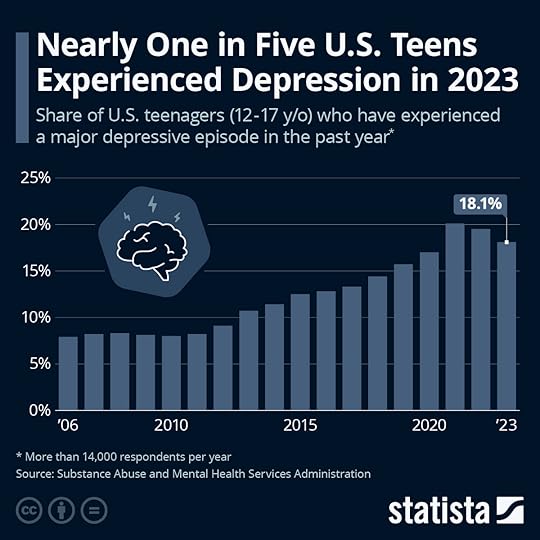
The basic premise is this: Sometime around the years 2010 to 2015, something drastic and worrisome started happening to children born in the late-1990s (a demographic of children often referred to as “Gen Z”). Rates of childhood depression, anxiety, and suicidal ideation began to skyrocket across the country. This was across racial, ethnic, and gender lines, although it seemed to effect girls more.
Haidt and his researchers believe that a combination of factors are the reason for these high rates of mental illness among children.
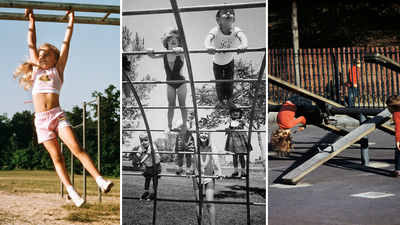
One factor is a type of parenting called “helicopter parenting” that became prevalent, which essentially involves an extreme overprotection of children, out of an irrational sense of safety, that does not allow—-or over-regulates—-certain childish activities that children of the ‘70s and ‘80s engaged in quite regularly: climbing trees, walking unsupervised to the park or school or store, playing on a playground, skateboarding, staying in a house by him or herself.
Another factor is the prevalence of devices that allowed children a preponderance of “screen time” that far exceeded previous norms in previous generations. Haidt directly links this rise of device usage to the introduction of smartphones (specifically, iPhones, which were brought to market in 2007) and popular social media platforms like Facebook (launched in 2004).
A third factor is an inexplicable “underprotection” of children from the Internet and, specifically, social media sites. So-called helicopter parents were fearful of their children playing on a jungle gym, but they seemed to have a complete lack of worry about their children being vulnerable to cyberbullying or on-line sexual predators. One explanation for this—-given by parents themselves in studies—-is the parents’ own distractedness and addiction to device usage.
Haidt’s solutions—-based on the advice of mental health professionals, educators, and social scientists—-is weirdly simple: Don’t give your kid a smartphone until they are about 16-18; Limit kids in both time and access to the Internet; allow kids to do more activities unsupervised; increase the amount of playtime for kids.
According to almost every scientific study, playtime has been shown to be vitally important to a child’s development. Despite this fact, many schools have limited or eliminated playtime and replaced it with more academics, such as testing, to detrimental results. Thankfully, there is a swing back towards more playtime during school hours, especially more unsupervised playtime.
Even Haidt acknowledges that it goes against every fiber in one’s being to let your kid walk to the grocery store in town by him or herself. On the same token, it’s hard to give up the “babysitter” benefits of the iPad or iPhone.
I’ll be honest: I get a shitload of laundry and house-cleaning done when my daughter is curled up on the couch playing God-knows-what on her iPad, and while I trust that my daughter is playing appropriate games and not browsing Youtube for porn, I realize that it’s not the healthiest thing for her.
Seriously, Haidt’s book is an important resource for parents, teachers, and health care providers. We need to be more aggressive advocates for the health of our children, but if healthier children means loosening the reins and letting our kids engage in more risky activities by themselves while simultaneously limiting—-or forbidding—-access to stupid shit like Snapchat, Instagram, or Facebook, then we need to do some serious soul-searching as parents.
As he’s apt to do, Haidt uses lots of research, but always to back up what he already believes. There are no other possibilities. From the start he throws out terms he hopes will become part of society’s vocabulary so conversations on these topics inherently flow towards his conclusion and thus his prescriptions. Not that there isn’t interesting data presented or a complete lack of critical thought, but there is a constant drumbeat under the text of an old man yelling at the world that he knows what’s best.
I’m not really sure how relevant the observations and advice in this book will be in a couple of generations. I think our current younger generations (mostly whom will be unaware of the practices outlined) will figure out how to get through life in different ways out of necessity. What we know about child development will change epigenetically. So I’d be interested in testing this book against the world in about 30 years. Until then, what’s provided seems infinitely beneficial. I can already see it play out in my life a little - my older nephew learned to read and write in Korean as a toddler on YouTube, but there’s a distinct and immediately noticeable difference between him and my niece who only knew Elmo through books and only started getting screen time probably at age four or five, and it was one episode of Daniel Tiger a week and a yoga program she did with her dad. My niece is a lot more excited about new experiences and meeting new people. There are many factors that distinguish them, but I’ve kind believed their access to screen times was a big contributor.
Uniquely bad — Haidt repeatedly notes that what you do is more important than what you say but then also admits he follows none of his advice in practice. Someone needs to tell him that acknowledging a counterargument with one sentence isn’t the same as refuting it (let’s not even get started with his transgender social contagion theory).
Also, this was such a privileged perspective (which he didn’t even acknowledge — not everyone’s 12 year old can just hail a cab when they’re out late without a phone). This was written like an OpEd, but was actually worse since Haidt has never experienced growing up with technology firsthand, so he’s merely speculating about what that feels like and using Wikipedia as a source to back up his claims.
He had some interesting points about tracking your kid that I agree with (i.e. don’t do that), but once again he himself doesn’t even follow this advice (he tracks his kids anyway. Go figure).
Nothing new here but it confirms what we already know with the science to back it up. A life lived online leads to anxiety & depression. Of course it’s more nuanced than that. It starts in young children and I urge all parents to read this book. There are actionable steps to take to protect our children and it’s imperative that we do so.
A must read for parents, grandparents, and school officials.
DNF. You've heard "this could've been an email" in reference to meetings. Now meet "this could've been a blog post" instead of a book. And it probably should've been.
Way too many anecdotes that shouldn't be generalized and far too little actual data to back up some pretty big claims. Which is a shame, because I do believe that social media algorithms and constant smartphone usage are having negative mental/emotional impacts on young people—but there's not enough here to firmly back up that hypothesis or to realistically hash out potential course corrections for that issue.
It feels like the author had a good idea he wanted to explore, but he wasn't patient enough to wait for the necessary research to support the premise to be conducted and published. So what we ended up with is a bunch of claims that aren't properly supported, along with some odd tangents that seem like filler. (The spirituality chapter, in particular, really threw me off. It felt so out of place after all the previous chapters with their graphs and charts and percentages.)
When I finally got through all the claims and reached the part of the book where the author was going to explain his proposed "solutions," I had too much doubt about the "evidence" for those claims to be interested in reading about those "solutions." So...I didn't.
I hate read this book, and it was a chore to finish. While I agree that parents overprotect their kids in the real world and underprotect in the virtual world, that’s pretty much where the agreements end. Social media CAUSES depression in Gen Z? Kids and young adults are “trying on gender dysphoria only to change their mind about it,” thanks to social media? To make matters worse, there is a “God-shaped hole” in Gen Z’s heart that they are filling with phones. Sure, Jan.
Gotta love a privileged and bias white man who waxes poetic about the good ol’ days.
I finished this a few days ago, but just never got around to writing a review.
I like Haidt a lot, and I believe a lot of his work aims to take on large problems in an earnest and benevolent way, using data when available and common sense where necessary. This book is similar in that vein, but left me somewhat underwhelmed.
To be clear, I do think Haidt is on to something with his larger argument. The declining trends in mental health are undeniable, and they do seem to coincide with the rise of cell phones/social media that Haidt alludes to in this book. I’m somewhat sympathetic to the critics of this book that a lot of what he cites in the book is merely correlational, but YOU go ahead and try to get a randomized study by an IRB in this vein and tell me how far you get. I also give kudos to Haidt for trying to collect a lot of his evidence in a really public way (see the Google docs), and feel like he’s tried to be transparent about conclusions we just can’t be certain about yet.
But my biggest gripe with this book is that the argument just needs a lot of tightening. Haidt cites a lot of other people’s work and his efforts at synthesizing it all fell sort of flat for me. Like is the cause of all this anxiety social media (specifically)? Cell phones (generally)? Parenting styles? All of the above? I feel like the book throws all of these explanations at me, and I feel like each one sounds reasonable enough, but none of them struck me as being individually convincing causal mechanisms for the downstream side effects. Collectively, I didn’t feel like they were woven together in a coherent enough way either.
As I said before, I think Haidt is certainly on to something here. The trends he identifies are certainly problematic and I’m glad somebody is sounding the alarm bells. The solutions (“new norms”) he proposes all seem like smart ideas, even if they are somewhat wishful thinking. I’m just not sure he’s really nailed down the cause yet. It’s like he’s a doctor who’s identified some troubling symptoms, prescribed some cures that seem promising, but still hasn’t diagnosed the root disease. Maybe I’m being an unfair critic and forcing Haidt into simplifying an inevitably complex topic. But that’s how this thing felt to me.
The play-based childhood has ended. The phone-based childhood has taken over—and smashed it entirely. That’s the core of this powerful book.
I didn’t impose enough limits. I work full-time, and life happened. For me, this was an incredibly interesting, well-researched, and unsettling read. Others may feel differently, but reading this made me realise just how much these ideas have shaped my own family life.
Steeped in research and sharp observation, social psychologist Jonathan Haidt explores the rise in depression, anxiety, and addiction—especially screen addiction. Honestly, it’s not rocket science to connect the dots.
Listening to this book was the right choice for me. I think reading the physical version might have felt too heavy.
One idea that really stuck: we’ve become overprotective in the physical world (not letting kids roam or play freely), but underprotective online. My 13-year-old recently had a bad bike accident. He’s okay now—helmeted, padded, and back on the bike. But not all kids are out there. One of his friends isn’t allowed to play outside, and that really saddens me. It’s not my business, but I notice.
Socially and cognitively, kids are being affected. Girls especially face intense pressure to gain likes and compare themselves—body image, acceptance, all of it.
These are just my reflections, my observations. Others may have very different experiences. But this book? It made me stop and think hard. I’m at a point in life where this is hitting home with my youngest. It’s more than food for thought—it’s alarming. I listened to this via the Libby app and my public library.
The Anxious Generation: How the Great Rewiring of Childhood Caused an Epidemic of Mental Illness is an eye-opening, must read especially for every parent raising (or bringing) a child in(to) this digital age. Jonathan Haidt breaks down in meticulous detail, underpinned by academic research (albeit mostly correlational rather than casual) the adverse effects that a smartphone-based upbringing has on children, especially teenage girls and boys (who are particularly vulnerable).
Haidt makes cogent arguments for raising the age at which children should have unrestricted access to (feature) smartphones from 13 years old to 16 years old. In addition, he proposes many solutions to combat and even reverse the effects of smartphone-based childhoods, including "playful, phone-free" schools and banning of smartphones during school time (for the entire day). This book is an urgent call to action which should be heeded.
My only minor critique of The Anxious Generation is that it is a bit alarmist. There is an aspect of scaremongering which might lead parents unnecessarily to panic and overreact. It is perhaps worth bearing this in mind when tackling this one.
Some people are out here saying that Haidt is fear mongering when it comes to the link between social media and poor mental health outcomes. And to those people I say...you've got to be joking. The link is clear. If you doubted it, you won't after reading this book.
This book is a mixture of science, research, tips for parents, and suggested policy changes. If you are just wanting some guidance on what limits to set with your kid's tech use, I think you'd find this cumbersome. You could get a lot of the main points by looking him up on YouTube and listening to some of his interviews. But if you are interested in psychology, sociology, etc., I think you'll appreciate how thorough he is.
I love liberty, but I am totally in support of Haidt's policy suggestions to limit minors' access to social media and place more accountability in the hands of Big Tech. As smart as we parents may be, we are no match for AI and sophisticated algorithms. Y'all, they could stop this nonsense if they wanted to. But they don't because they're making too much money off exploiting our kids. We as parents must protect our children using every tool available to us. (I am apalled at how many of my peers treat schools with derision when they try to set phone limits during school hours.)
This book is going to be my new go-to baby shower gift for new parents that I know and love well, wrapped up nicely with a Sophie Giraffe on top. I share Haidt's sense of urgency on the issue of smartphones and adolescents; parents need to figure out their take on screens before the kids are old enough to start asking. Neil Postman's Amusing Ourselves to Death helped me do that in the early 2000's, long before I was a parent myself. But Postman, writing in the mid-1980's and primarily concerned with television, could not have imagined what was coming.
I savored The Anxious Generation, and I'm so grateful to Haidt for writing it. In it, Haidt carefully unpacks with clear and engaging writing what he refers to as The Great Rewiring of Childhood: "...a profound transformation of human consciousness and relationships [that] occurred, for American teens, between 2010 and 2015. This is the birth of the phone-based childhood. It marks the definitive end of the play-based childhood" (34-35).
Haidt argues that as a society we've made two big mistakes that have contributed to an international mental health crisis among adolescents: "overprotecting children in the real world (where they need to learn from vast amounts of direct experience) and underprotecting them online (where they are particularly vulnerable during puberty)" (15). I believe down to my core that Haidt is right on this. Abigail Shrier's excellent book Bad Therapy argues the first point. But I think Haidt is right not to neglect the second point. They clearly go together.
Anyone who has read a few of my Goodreads reviews may have noticed that I have written about smartphones and children before. Out of conviction, my husband and I decided that we will not buy smartphones for our kids. This includes our teenager, who is not aware of even a single other student in her secondary school who, like her, does not own a smartphone. In our experience, many parents at our kids' schools started buying smartphones for their children in Year 5 (The UK equivalent of 4th grade in the USA). This comports with Haidt's findings, and feels absurd to us. Our sense is that, with the exception of a few fellow religious friends, both Christian and Muslim, we are largely standing alone on this issue. As Haidt points out, "an individual acting alone faces high costs, but if people can coordinate and act together, they can more easily choose actions that are better for all in the long run" (12). This book, which already seems to have won a large readership, encourages me that a good change may be on the horizon.
I have only one criticism of The Anxious Generation but it is more personal in nature, and so does not tip the scales much against this book. Unlike Haidt, an atheist, I believe as a Christian that human beings are more than just "highly sociable mammals" (70) who have evolved to thrive under certain social conditions. I want more for my children than to help them grow into "socially functional adults" (54) who will enjoy "success" in the culture I find myself in. I don't believe that videogame addiction and pornography use are harmful and wrong solely because they tamper with our "evolved desires" (196) and prevent us from having "real world exploration and adventure" (193). Unlike Haidt, I believe that the "God-shaped hole" is real, and not something that "natural selection might have carved" (215). At the end of the day, what can Haidt say to the Hikikomori who assures us that he is happy and fulfilled living his confined, nocturnal, socially withdrawn existence? It's not obvious to me that Haidt would have anything much to say to that Hikikomori. Haidt's argument is especially profound and urgent to me because I believe that we are made in God's image, to live in his world and enjoy communion with him and our fellow human beings. Anything that puts a barrier between the chief end for which we are made and my kids is something that I will take pains to avoid.
That said, The Anxious Generation is a book for everyone, not just parents. I sincerely hope that my kids' school administrators will read it. This is where I think this book could have the biggest impact.
While I mostly agree with Haidt’s opinions and observations on just how major of a negative effect social media/iPhone/gaming has had on the real-life social skills of younger generations, I feel largely that most of this book relies on just that - opinion. It’s certainly more conclusive with its qualitative data vs. quantitative data. Again, this makes it harder to accept everything he’s arguing as concrete.
Haidt mentions that - I believe starting in 2012? - there had been, for the first time since reporting, a marked increase in young adults and teenagers who reported feeling anxious, depressed, and lonely “most or at least half of the time”, for example, but then, for rhe most part, goes on to report that none of the participants had been diagnosed with major depressive disorder, generalized anxiety disorder, or panic attacks.
Interestingly, this would also fall directly in line with when the first and oldest members of Gen Z and younger (I believe the starting year is 1996, so they’d be 16 in 2012).
If it also stands to reason, if, as Haidt would later have us believe and come to argue: disorders such as DID, gender dysmorphia, and Tourette’s syndrome began to emerge on many TikTik accounts, where suddenly, millions of users not only claimed, but actively acted out symptoms of these illnesses to gain subscribers, what would stop younger people from exaggerating their anxiety and depression? After all, apparently serious disorders and victimhood are no longer to be sympathized with and sought to eventually overcome. Rather, they’re actively encouraged to give someone an “authentic struggle.”
For me, it’s more a cry for attention, that may, in fact, correspond with the fact that teenagers are indeed spending far less time with face-to-face social interactions, increasingly limiting that interaction to screens. Therefore to stand out in the infinite universe of the Internet, the more outrageous, the better.
I hope to come back to this review, but my main problem with the book was threefold. 1) It was repetitive to the point that I could essentially scan long paragraphs, confident I’d already ingested all the information; 2) The problems he focuses on and the solutions he suggests seem inherently common sense; 3) Implementing many of these policies may work in his small community/circle or friends. Yet, it can easily be assumed it’s far more likely parents will disagree amongst themselves concerning identical implementation of iPhone/social media rules for their child, along with the rest of the kids that age. I do think it would be great if kids didn’t use Insta, Snapchat, Twitter, etc., until they were older. But to truly enforce that on a grand scale is, to me, at least, wishful thinking.
(Not to mention some kids are impressively wise by age 12, while others struggle to show any sign of maturation at 17 - while some may show remarkable understanding regarding the difference between the Internet and real life, this isn’t necessarily going to happen at any magical age.)
I was pretty disappointed given how much I loved his last work with Greg Lukianoff, The Coddling of the American Mind. Obviously this isn’t something I’d recommend… but then again, looking at the majority of reviews and ratings - among friends too - perhaps you shouldn’t listen to me. Maybe people saw something in it that I overlooked. Who knows. I was just happy to finish it.
The most important book I’ll read this year. I wish I could put this into the hands of every parent, every teacher, every caregiver, and every teen. So much data and research, combined with TANGIBLE action steps I actually feel equipped to take.
All about kids and smart phones and the things we all know but don’t want to admit 🤓 I enjoyed the reminders of free range parenting and the value of molding future adults 👍
If you are here and indecisive about whether to read it or not, just read it.
This book is eye-opening. It presents something we’ve all sensed that is now backed by studies and statistics. It highlights this modern disease that we can now understand and take action to address. The practical advice the author offers is useful not just for parents but for anyone who wants to better understand the younger generation, as well as the addiction to endlessly scrolling.
One minor critique I have is that some findings rely on surveys with children, which can feel tricky. Asking a child about sadness, for instance, might inadvertently introduce the idea, rather than letting them process emotions naturally. Still, these perspectives contribute to a broader understanding of the problem and its scope.
This book is a must-read: important, practical, and timely. It forces us to confront realities we may have ignored and empowers us to make changes for the better.
المقصود بالجيل المضطرب هو الجيل زد، الجيل الذي تفتح وعيه وتشكّل في عالم التطبيقات والهواتف الذكية، والذي يعاني في المجمل من تدهورٍ في لياقته النفسية، ومن ارتفاع نسبة القلق والاكتئاب وتشتت الانتباه وإيذاء النَّفس. الجيل الذي دمّرته شركات التقنية الكبرى.
هذا الكتاب هو دعوة لإنقاذ ما يمكن إنقاذه، وإن كنا وصلنا متأخرين. لكن أصبح لدينا على الأقل أدلة علمية وإحصائية على طبيعة الدمار الذي تسببت به الهواتف الذكية وتطبيقات التواصل الاجتماعي وألعاب الفيديو على الإنترنت.
أدعو كل تربوي، وكل مشرّع، وكل أبٍ وأم إلى قراءة هذا الكتاب، والانفتاح على مراجعة نقدية غير مريحة، والاعتراف بأخطاء ارتبكت بالجملة طوال العقد المنصرم.
وكما صاغها كونديرا: الجهل خطيئة.
شكرًا للدار العربية للعلوم على هذه الإضافة المهمة للمكتبة العربية، عساها تكون بادرة تغيير حقيقي.