What do you think?
Rate this book


301 pages, Paperback
First published May 1, 2014
01 September 2017Tehran accommodates a diverse society characterized by opulence and debauchery, complete illiteracy and excellent universities; a terrifying regime, and underground resistance movements. At Theran's railway station, the diversity becomes even more apparent: Lors, Kurds, Azeris, Turkmens, Tajiks, Arabs, Baluchis, Bakhtiyaris, the Qashqa'is and Afghans mill around, waiting for the next transport opportunity into the city. The railway station is also the place where Vali Asr Street ends in the south.
Preface
Let’s get one thing straight: in order to live in Tehran you have to lie. Morals don’t come into it: lying in Tehran is about survival. This need to dissimulate is surprisingly egalitarian – there are no class boundaries and there is no religious discrimination when it comes to the world of deceit. Some of the most pious, righteous Tehranis are the most gifted and cunning in the art of deception. We Tehranis are masters at manipulating the truth. Tiny children are instructed to deny that daddy has any booze at home; teenagers passionately vow their virginity; shopkeepers allow customers to surreptitiously eat, drink and smoke in their back rooms during the fasting months and young men self-flagellate at the religious festival of Ashura, purporting that each lash is for Imam Hossein, when really it is a macho show to entice pretty girls, who in turn claim they are there only for God. All these lies breed new lies, mushrooming in every crack in society.
The truth has become a secret, a rare and dangerous commodity, highly prized and to be handled with great care...
...Let me be clear about one last thing. I am not saying that we Iranians are congenital liars. The lies are, above all, a consequence of surviving in an oppressive regime, of being ruled by a government that believes it should be able to interfere in even the most intimate affairs of its citizens.
While living (and lying) in Tehran I heard the stories of the Tehranis you are about to meet. Not all of them are ordinary Tehranis; some exist at the very margins of Iranian society. But I hope that even the most extreme stories in this book will help an outsider understand everyday life in this city of over twelve million people. In my experience, the defining trait of Tehranis is their kindness, for no matter how hard life gets, no matter how tight the regime turns the screw, there is an irrepressible warmth; I have felt it from diehard regime supporters to ardent dissidents and everyone in between.


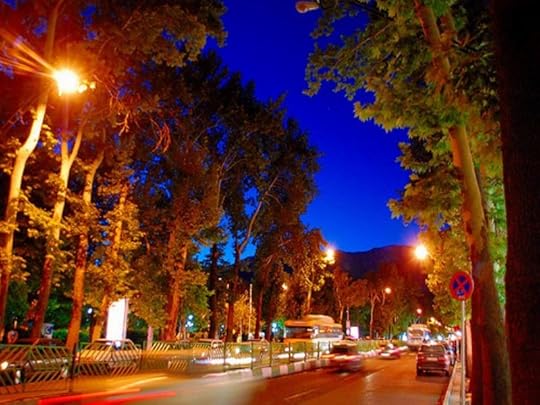
THE BLURBDespite the journalistic realism of the stories, I headed onto the internet to find a broader idea of the city in which these stories are embedded. All the characters in the book have a passion for Tehran. The city is their heimat, their soul. I was wondering why anyone suffering to this extent would want to remain here.
Far removed from the picture of Tehran we glimpse in news stories, there is another, hidden city, where survival depends on an intricate network of lies and falsehoods. It is a place where Mullahs visit prostitutes, gangs sell guns supplied by corrupt Revolutionary Guards, cosmetic surgeons restore girls' virginity and homemade porn is bought and sold in the bazaars. It is also the home of our eight protagonists, drawn from across the spectrum of Iranian society: the gun runner, the aging socialite, the porn star, the assassin and enemy of the state who ends up working for the Republic, the volunteer religious policeman who undergoes a sex change, and the dutiful housewife who files for divorce. These are ordinary people forced to live extraordinary lives. plotted around the city's pulsing central thoroughfare, Vail Asr Street, City of Lies is an energetic, intimate and unforgettable portrait of modern Tehran and of what it is to live, love and survive under one world's most brutally repressive regimes.


On a small patch of scrubland beside the motorway, a family had laid out a sofrehi, picnic blanket, and were eating abgoosht, a hearty peasant dish of meat, beans and potatoes; nothing could get in the way of an Iranian and a picnic, not even six lanes of roaring traffic.
DNF at 30%
From the beginning it felt like the author took a lot of liberties to interlard the thoughts and feelings of the people she wrote about. To me it read like she interviewed a bunch of people from the same background and merged their stories to give some sort of generalized account of whatever the theme of the chapter was about. That's why I turned to the Sources in the back of the book and I was right:
Chapter One: Dariush
Dariush's story is mostly based on my interviews with an ex-MEK member, who has spoken publicly of his MEK mission to Tehran to kill a former Tehran police chief. I have also used details provided by two other former MEK members living in Tehran and merged them with this man's story. Interviews with these former members also provided the details of the arrival in the country, family background, the MEK handler and the gun-runner. I have changed a few details of Dariush's assassination attempt. [...]
Chapter Two: Somayeh
Somayeh's story is based on that of a woman who wishes to remain anonymous; [...] Conversations between Somayeh and her friends are conversations heard between girls of the same age group and from the same conservative families as Somayeh, or they are conversations recounted by Somayeh. Political conversations between the men were conversations I listened to in her area [...]. I also interviewed several women in their fifties from conservative families for a full picture of Somayeh's mother and friends. [...]
◦ explicit: infidelity, misogyny, sexism
◦ moderate: fatphobiam sexual content
◦ minor: car accident, domestic abuse, drug abuse, gun violence, homophobia, incest, kidnapping, sexual violence, torture