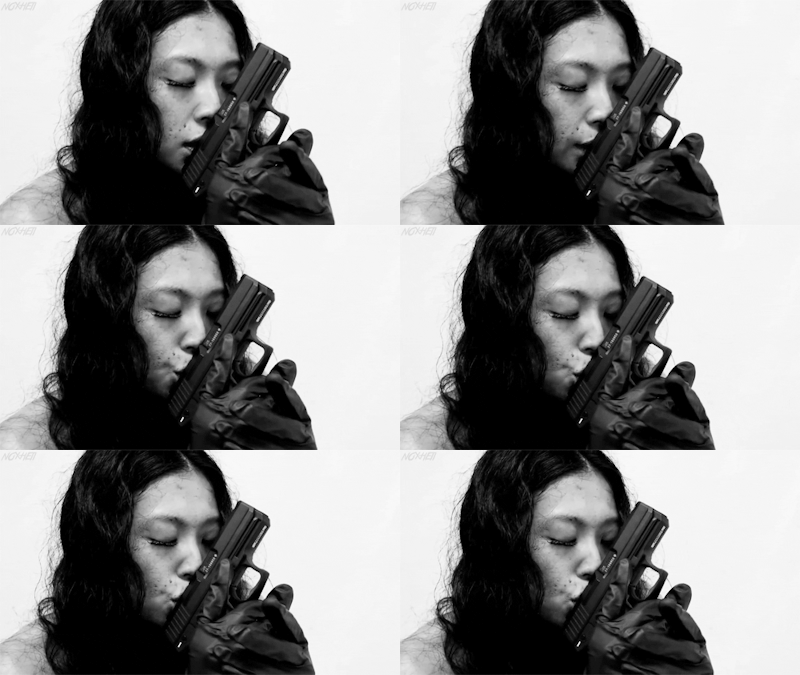
In a suburb on the outskirts of Tokyo, four teenage girls drift through a hot smoggy August and tedious summer school classes. There's dependable Toshi; brainy Terauchi; Yuzan, grief-stricken and confused; and Kirarin, whose late nights and reckless behaviour remain a secret from those around her.
Then Toshi's next-door neighbour is found brutally murdered and the girls suspect Worm, the neighbour's son and a high school misfit. But when he disappears (taking Toshi's bike and cell phone with him) the four girls become irresistibly drawn into a treacherous vortex of brutality and seduction which rises from within themselves as well as the world around them.
NATSUO KIRINO (桐野夏生), born in 1951 in Kanazawa (Ishikawa Prefecture) was an active and spirited child brought up between her two brothers, one being six years older and the other five years younger than her. Kirino's father, being an architect, took the family to many cities, and Kirino spent her youth in Sendai, Sapporo, and finally settled in Tokyo when she was fourteen, which is where she has been residing since. Kirino showed glimpses of her talent as a writer in her early stages—she was a child with great deal of curiosity, and also a child who could completely immerse herself in her own unique world of imagination.
After completing her law degree, Kirino worked in various fields before becoming a fictional writer; including scheduling and organizing films to be shown in a movie theater, and working as an editor and writer for a magazine publication. She got married to her present husband when she turned twenty-four, and began writing professionally, after giving birth to her daughter, at age thirty. However, it was not until Kirino was forty-one that she made her major debut. Since then, she has written thirteen full-length novels and three volumes of collective short stories, which are highly acclaimed for her intriguingly intelligent plot development and character portrayal, and her unique perspective of Japanese society after the collapse of the economic bubble.
Today, Kirino continues to enthusiastically write in a range of interesting genres. Her smash hit novel OUT (Kodansha, 1997) became the first work to be translated into English and other languages. OUT was also nominated for the 2004 MWA Edgar Allan Poe Award in the Best Novel Category, which made Kirino the first Japanese writer to be nominated for this major literary award. Her other works are now under way to be translated and published around the world.
A spell binding crime story about alienation and actions & consequences. Some critics care calling this 'feminist noir'. Natsuo Kirino’s uneasy, unsettling and challenging 'Real World' centres around Worm, a juvenile killer on the run, who as well as having accessories (young women) to his deeds looks to create a manifesto to give what he's doing some sort of rationale and legacy. Kirino captures her unique characters so well. With the addition of that 'special voice and tone' that so many Japanese translations seem to have for me, this tale feels like no other. 9 out of 12 Four Star read. 2013 and 2009 read
I really wanted to like this one (especially after reading and enjoying Grotesque) but unfortunately this one just didn’t work for me. The book centers around a teen nicknamed Worm- who we learn very early on, kills his mother. Four female friends decide to help Worm out while he’s on the run and the book details these interactions. The actions of these characters seemed ridiculous- they seemed so bored or sick of their lives, that they were just looking for something to do. I must say that while I enjoyed the ending, this isn’t a book I’d recommend-it was just too unrealistic for my liking.
When I said that this book is intense, I might have understated a bit. Imagine, if you will, that you have stepped into the heads of four very different teenage girls and one, probably insane, teenage boy.
Kirino's Real World gives you a closer look at reality than you might have wanted to get. The books explores issues of blatant materialism, consumerism, how contemporary society seems to be fervently buying, selling, consuming and asks what the effect of this is on children. Society has turned into a huge business transaction and everyone is competing. Worm, whose mother is constantly pushing him to be more and more successful, who feels that he is but a puppet being manipulated by his mother, kills this same mother and feels a fierce elation at having done so. There is no remorse whatsoever in any of the pages of this book. None at all.
And then there are the girls who are titillated by this boy who has rebelled against the rules of the society. They interact with him through the phone, in shabby hotels, seeing themselves reflected in his run from the law, see him as a saviour and as a manifestation of their own suppressed desires. Real World is, I reiterate, intense. It is both an introspective and extroverted endeavor. It delivers both in an intellectual capacity and a physical one (as in there is plentiful action). The conclusion is shocking and thought provoking.
I really liked this novel. I don't think there was any distance from the themes it discusses to what is true about Western society. I think that materialism and consumerism are issues found in all societies of first worlds. What is fascinating is how it shapes minds and thus society. I recommend this to you.
Born from the same obsession with violence and rebellion found in Mishima and Dazai, but with a more feminist and modern tone, the book still lacks something that would make it stand out from other similar Japanese works.
I gave up on this book. Real World follows the lives of one teen guy and 4-5 girl teens after the guy murders his mom. Perhaps it is the translation that is the problem. Maybe it is not the writing....I found the writing to be very unconvincing and awkward (I guess maybe that fits the teen POV). Kirino gives the reader too much. Each chapter is from a different teens perspective and it just goes on and on about how horrible their lives are (not saying I don't agree). I think Kirino does capture the angst pretty well but I just found myself caring less and less about these characters. This should really be a YA book even though it is really dark. I really enjoyed "Out" and am disappointed in this book.
Κάθε μια από τις πρωταγωνίστριες της ιστορίας, μας την αφηγείται από τη δίκη της σκοπιά, εμβαθύνοντας κυρίως στον εσωτερικό ψυχολογικό της κόσμο. Ανήκουν στην ίδια παρέα, αλλά πόσο καλά γνωρίζει η μία την άλλη;
Περίεργο πράγμα οι φίλοι. Φαίνεται σαν να ξέρουν τα πάντα για σένα, αλλά δεν ξέρουν καθόλου πως είσαι στ' αλήθεια.
3.5/5 - I enjoyed some of the characters' perspectives in this book more than others, but overall I'm very excited to check out more of Natsuo Kirinio's work in the future. I'll have a video review of this up next week!
A group of girls act out against their parents and society by aiding and abetting a boy in their neighborhood who murdered his mother. It doesn't always make sense as to why these girls do what they do, but then again I guess that's part of the point.
A dark little book about the dangers of disaffected youth.
I suspect, due to Kirino's popularity, that this book is better than the translation makes it appear. I found the translation to be heavy-handed and treated the reader as if he or she wouldn't know anything about Japanese culture by over-explaining things. For example, there's a ganguro character, which is a style many people are familiar with, but the translator calls her "barbie girl", which really gives entirely different connotations and confused me until I realized she was ganguro. Needless dumbing down of the text for a western audience really gave this book the distinctive feel of a young adult thriller, and while the main characters are indeed teenagers, this book was shelved in adult fiction.
And for a young adult novel, it would work. The multiple narrative voices are dripping with angst and really brought me back to what it was like to be an angry teenager, but the writing firmly mires it in that territory, and the plot, which is predictable and never goes anywhere, wrapping up in a letter that over-explains in a move that seems to emulate Agatha Christie but without the complex plot to back it up, never is able to elevate it.
The book is just fairly shallow. It has a glossy surface, but the writing consistently breaks the show-don't-tell rule; we hear about how smart and philosophical Terauchi is but get little in the way of actual philosophizing. She keeps going on about things that "can't be undone," proposing that death is not one of these things, only to abruptly go back on this following another death without even addressing it. Nietzsche and Dostoyevsky are name-dropped but it's to no purpose, there are no points being made that warrant this, so it ends up feeling false.
The inclusion of lgbt characters was a nice surprise, but aside from Yuzan, who I didn't think was characterized in a very psychologically astute way, they are token characters inconsequential to the story. The depiction of transsexuals is very unflattering, which is a problem only because it clashed with the tone of how other characters in the novel were treated. Kirino is trying to work with "unlikeable" characters but doesn't seem to trust herself enough to go all the way; the characters have negative qualities and wonder repeatedly if they are "evil" but it's all under a glamorous sheen, making it safe.
There were also several typos in my edition.
I was definitely let down after hearing how exciting and dark this writer was supposed to be, but there was certainly nothing here on the level of Ryu Murakami, the master of japanese psycho-sexual horror/thriller. I may try once again with Out or Grotesque; especially to see if another translator would make a difference.
Επέλεξα το συγκεκριμένο βιβλίο ως αστυνομικό μιας και με τράβηξε το εξώφυλλο και έπειτα η πλοκή. Όμως διάβασα κάτι άλλο, κάτι που μετα βίας πατάει στο αστυνομικό είδος όπως το γνωρίζουμε. Είναι μια αφορμή για σχολιασμό πάνω σε ποικίλλα θέματα και νομίζω οτι τα κατάφερε πολύ καλά. Kι ας μοιάζαν κάποια σημεία πιο βεβιασμένα, όταν η παρέα απηύθυνε το δριμύ κατηγορώ της στην κοινωνία. Ενώ μου άρεσε το πως μπλέκονται οι ζωές των κοριτσιών και μαθαίνουμε πράγματα για την ζωή τους, για το πως μαθαίνουν με τον σκληρό τρόπο να αναλαμβάνουν τις ευθύνες τους και το ποσο σκληρό μπορεί να αποδειχθεί κάτι ανεπανόρθωτο, το αγόρι που θα δολοφονήσει την μητέρα του, μου φάνηκε ανεπαρκώς ανεπτυγμένο, με σχεδόν αστεία κίνητρα.
Είναι ένα βιβλίο ενηλικίωσης περισσότερο που φέρνει στον νού την αβάσταχτη και γνήσια ειλικρίνεια του Φύλακα στην Σίκαλη αλλα και την τρομαχτική και μοιραία αποξένωση (και απο τον ίδιο τους τον εαυτό), ακόμη και την παράνοια του American Psycho του Ellis.
Μια σύντομη, διαφωτιστική και σκληρή ματιά στην ψυχοσύνθεση των εφήβων.
I really wanted to like this book more than I actually did.
Listen, I love Natsuo Kirino. She is a brilliant Japanese noir author who tends to write gritty thrillers with a strong feminist focus. She engages in social commentary on the grim expectations, pressures, and injustices surrounding the modern Japanese woman— while simultaneously delivering stories centered on crime and violence. Kirino is truly a pioneer of feminist Japanese noir, and typically, she weaves these elements together with such efficiency.
I want to blame the translator.
Real World was not it, for me.
The premise was promising. A high-school aged boy, nicknamed Worm by his neighbor, Toshiko— commits a brutal matricide in his family home on a random, sunny day during the summer break.
Toshiko hears the sound of shattering glass through the walls of her own house, and even sees the boy outside post-murder on her way to cram school.
Though internally she knows something bad has happened—she goes on about her day.
Until Worm quite literally worms his way into the life of Toshiko and her three friends while he is on the run.
Now, four girls find themselves deeply involved in Worm’s world.
This book is not so much about the crime as it is a shallow character study on the variety of internal and external battles these teenage girls face while aiding and abetting Worm.
Real World is a multi-narrative full of youthful angst that reads like a messed up, private diary. The reader is simply a voyeur— given the opportunity to piece together and understand why four distinct personalities would give in to Worm’s heartless agenda.
These girls droned on and on, do trust.
And I still didn’t understand.
Worm’s chapters give these standard, reclusive, ‘incel-like’ reasons on why he decided to kill his mother and why he hates women.
Very edgy, gloomy teenage boy stuff— I guess.
The book felt like I was being “talked at.” While I understood and acknowledge the challenges Toshi, Terauchi, Yuzan, and Kirarin faced in their daily lives— it was primarily just a set up to connect their individual reasons to Worm, and the different actions they each took to ‘help’ him.
[My mom died from illness, but I felt like I killed her— so I deeply understand why he killed his mom. I want to help.]
[I sleep with random boys on my wild nights in Shibuya, I want something more dangerous than that! I think I’ll give myself to the killer.]
[Worm took the easy way out on killing his mother. It was weak, he’s weak— and I hate him for it. Involving myself will help him get caught if I can just use my overly-philosophical and critical brain that I’ve developed from trauma to weaken him.]
Things like that.
Nothing connected, and nothing felt truly deep. I found much of the reasoning far-fetched and the whole plot was ”my life is terrible, so I need a ridiculous outlet,”— which wasn’t a plot at all.
I will say, the ending was the slightest bit of redemption. It was a somber moment that acknowledged the title of the book— Real World. Everyone’s world looks different, and how you live in that world is different. The story wraps up with various paths being taken as Worm’s crime-ridden tale comes to a close. Four girls were affected in contrasting, distinct ways under the umbrella of one teenage boy’s foul doings.
Deep, if you think about it.
Real World gets a ★ ★ ½ star rating from me. I just couldn’t get into it. If the first one-hundred ninety something pages were as insightful and thoughtful as the last ten— this would have been a much higher rating.
I still love Kirino though, and highly recommend reading Out as the first foray into her books if you’re new to them, it’s a great read.
Another mesmerizing masterpiece from Kirino. I thought going in that at just over 200 pages it might be somewhat unsatisfying but as it turned out, calling it "satisfying" would be an extreme understatement. Every page was wrapped in such intensity it was a thoroughly exhausting read (I mean that in the best possible way). I was under the impression that her books that have been translated into English (this one plus Out and Grotesque) were the totality of her novels, but reading the book jacket I learned that she has 18 novels to her credit. As she becomes more well known internationally I'm hoping English translations will continue to follow. This novel tells the story of four young women who help a young man, who has killed his mother, survive as the authorities and media search for him. What the girls (and the reader) must confront is how one carries his or her burdens through life. It requires some self-reflection. Another interesting aspect is the photo of Kirino on the back inside jacket. When shelving the book with Out and Grotesque I noticed the same photo is included on Out but I hadn't noticed it before. It's a very unique photo. In the same way the Afghan Girl photo holds one spellbound so does this photo, but it's a completely different type of spell.
I found this to be very interesting and thrilling to see how everything will come to an end for these four girls and their classmate Worm. While it was interesting and I was hooked, there is no connecting with the characters, especially since each character gets a chapter or two. Something that I do like about the characters is how the characters are written in a way to show that they are flawed and that is okay. If the book was longer we would have a better chance at connecting with them, and get a better understanding of the relationship that is formed. But the plot was gripping and it was interesting to see how everything ended up unfolding in the end for the four girls and one guy. And the ending was surprisingly emotional to me because of what happens and how the girls are left to deal with all the deaths that have happened to those close to them. Overall, this was an interesting story but I wanted to learn more about each character.
It's easy to read, but I just didn't love it. I wasn't convinced that the characters' actions made sense. I liked Out way better, but there just may be something to her writing that doesn't seem real to me. I didn't get their teenage angst and it didn't make me understand their ridiculous actions.
A deceptively game-like excitement about news of a male neighbor's matricide leads four female friends into a surprisingly harsh look at the masks they've put on to maintain appearances, at our fascination with and empathy for those who are driven to do an unthinkable act, and at the meaning of life's struggle to be honest with ourselves and our closest friends and to accept the consequences of our actions. The boy's young neighbor doesn't want to get involved in the police investigation and protects him for her own sake, while her lesbian friend is intent on helping him escape; a third friend is intrigued by this boy-on-the-run enough to meet him and a fourth follows everyone's actions and makes a decisive move of her own. All the time, I couldn't help wondering, who would I have been in this scenario?
At turns funny, melodramatic, hyper-aware, and realistic to the point where I was placing those I knew in these characters' situations, this was a disorienting read at times due to the need to change internal settings as the mood of the characters did, but Kirino pulls it off successfully because an underlying truth connects all these mood swings and second guessing.
(spoiler warning)
I was left crying at the end, wondering for the first time not about those who end their lives, but those who are left behind to remember and endure the meaning of lives cut short. For once, I thought not of the reasons for suicide (to spare others' humiliation, tpo end one's own suffering, to erase oneself from the world's chaos) but of those left behind to deal with what the suicide meant, and the body that is no longer fit to be seen in the coffin, and the questions that will always remain unanswered: about the crossed webs of guilt, and why we feel we must keep the secrets we do, and how well our closest friends truly know us and why we can't be open to them when we need them most. So yes, I cried, thinking improbably not of the deceased, but of those left to remember and wondering how things could have turned out differently.
I admit, I needed another antidepressant by the time we'd finished the book (we'd read through the night and it's morning now), but perhaps the thoughts that came to me about the no-win situation of life (damned if you kill yourself, damned if you live on to endure a life that will end in death) and the unfairness of who deems themselves worthy of passing on their genes to future generations and who is so overwhelmed at the thought of being an adequate parent so that they never do have children--well, all these thoughts may be brushed off as a sign it was time for me to take another antidepressant pill, but I can't help wondering, was it depressive realism that overwhelmed me when I finished this book and saw the utter bleakness of our situation with death so near and our goals so meaningless?
And I thought of those who had died recently, from those I never knew, like Tim Russert, to those I did, like my father-in-law, and the thought of the reality of their death was suffocating and felt too real, too close to life. So what does this prove? I am afraid of death. It's an escape, but to escape by means of seeking out the thing you fear makes no sense yet complete sense, and why is this?
Again, Capote came to mind with the image of the friend with a white cloth over her head, which was unfit to be seen. No, Kirino is not flawless, but her works are haunting and they do raise very real issues amid the chattiness and seeming lightness. They hit you when you're least prepared. Which is good, no?
My first impression? Better integrated than but including the eerie insight into Japanese schooling of Grotesque with the keen social commentary of Out, but with less compelling characters than the latter.
Like 6 years ago I read and really enjoyed Out by Natsuo Kirino. So I was excited to pick up Real World and experience another story from her. But this just didn’t work for me. I just found it hard to get sucked into the story, which is surprising since it’s about a group of teenage girls and their interactions with a boy who killed his mom. I do think that at times there was some interesting commentary about Japanese society in the early 2000s and the roles that girls are expected to play. Overall I just wanted more from this book.
Real World is a novel about the stresses of teenage life in Japan, told in a first-person narrative through five characters. Parricide and suicide are big topics Kirino addresses.
"I was in a self-induced depression. Welcome to my Real World."
"When you don't have the strength to fight against fate, you just have to accept what comes." —Natsuo Kirino
I picked this one up on a whim after seeing it on the $0.25 shelf at a thrift store. I had read Kirino's Out many years ago, and I was hoping for something similar here: somewhat mysterious and noir. The book is that ... sort of.
The title "real world" invites reflection on the events of the story as portraying both a "real" world and an "other" world(s). The boundary and definition of those worlds seems to shift across the different narrators and connection between those worlds is mediated almost exclusively by SMS and phone calls, which is primarily how the different narrators interact. Technology as a medium of border crossing between reality and unreality seems to be an undercurrent here.
Kirino seems to sketch out a couple of different worlds including 1) the world that Worm occupies while on the run from authorities after murdering his mother. Another world is 2) that of high-achieving or high-aspiring Japanese youth who are attending prestigious schools or cram schools hoping for high enough scores to get into universities that will, hopefully, leave them destined for "the good life." Another is 3) the monotonous and deflated work world that the parents occupy. Then there is 4) the liminal world occupied by the four teen girls in this novel who are not fully in any of the other worlds but can view them and enter them from their vantage point. Which one of those worlds is the "real" is open for interpretation but it is #3 that seems like the least appealing and most inevitable, which may be one of the main driving elements of the plot, as it is a reaction to that world that seems to lead the four teen girls into the spaces and conflicts where they find themselves.
The book was fine. I enjoyed Out quite a bit more as the characters seemed more accessible and motives more articulately reasoned. The characters in this novel are frustrating and opaque, perhaps in the way that some teenagers are. Or maybe the inaccessibility of these characters reflects the way that I am lodged in a world apart from the liminal world they occupy.
Been a fan of Natsuo Kirino ever since reading her masterpiece, and first ever work translated into English, 'OUT'. I won't forget the intensively written characters with their own motives, along with the dark, gripping plot. 'GROTESQUE' is more psychological, equally dark and thrilling but longer and more intensive.
'REAL WORLD' as expected, is an equivalent masterpiece. If ranked, it'll be somewhere between OUT and GROTESQUE. Once again, Natsuo Kirino showcased her writing prowess through this complex psychological thriller. The characters, being young, are complex and uncertain still; each with their own definition of what 'real world' is.
'REAL WORLD' is the story of four junior school girls: Toshi, Kiratin, Terauichi and Yunza, as they get theirselves entangled in a neighborhood matricide perpetuated by a young man, Worm. From that fateful day the murder was commited, each of the characters were exposed to their own internal dilemmas.
'REAL WORLD' introspects the world where living in the eyes of these teenagers. How it appears to be dark and scary and how one should toughen up in order to survive. How one can get cut off from one real world to another with just one irreparable action.
The novel was gloomy yet really beautiful on its own way. It provides understanding to human emotions and motivations. The ending is dark yet I somehow feel hopeful for a specific main character. Really loved it and I hope this is more intensively written so we can have more pages and chapters exploring the lives of the characters. Would definitely love a sequel (tho yea i know i do t think this will happen).
To sumamrize: Natsuo Kirino is a psychological thriller rockstar!
I bought Kirino’s Out months ago, after reading the rave reviews, but rather than start with that book, I picked up Real World to zero disappointment.
What happens when four teenage girls, who are allegedly great friends, get caught up in the murder that the teen boy who lives next door to one of the girls commits? Some of those girls choose to get close to the criminal and others fear that any/all evidence might point to them being involved in the crime — even if they had nothing to do with it at all.
The four teen girls in this story kept me going, not just because of how they were choosing to relate to “Worm” (the teen boy who kills his mother), but also because they’re struggling with their own teen girl issues alone and amongst themselves. Kirino did an excellent job rendered them as realistic teens; they are, at times, shallow and lacking in cognitive reasoning, but those are two reasons why the story works so well. This murder story is twisted into a bigger exploration of feminism, male entitlement, and so much more.
I rarely enjoy books filled with teenage angst, and theoretically I would have disliked this one - but the four teenage girls, the protagonists, are very richly written. Their angst and immaturity are balanced with in-depth descriptions of their individual psychological worlds. Very pleasantly chaotic.
For a book that packs in itself (or atleast touches) a myriad of subjects important to the intellectual audience such as commercialism, existentialism, parent-child relationships, crime and psychology, Real World does not deliver as well as it should. But it is still a good book. Let me explain.
The story revolves around 4 girl friends- Toshi the kind one, Terauchi the smart one, Kirarin the cutesy feminine one and Yuzan the hard to read one. All of their lives change forever when Toshi's neighbour Worm murders his mother and takes off with Toshi's bicycle and mobile and Toshi, despite guessing this, says nothing to the police for reasons unfathomable to herself.
All these girls and Worm get in touch at some point or the other in varying degrees- from Toshi's talk in the beginning with him to Kirarin's extreme and sexual involvement with him.
All of their actions separate them from The Real World and the world of their confusion, sadness and hatred becomes their own personal world, untouched by whatever is going on around them. And all of them have their own masks to hide what they really feel or think.
In their world, time just stretches on endlessly, today the same as yesterday, tomorrow the same as today, the future the same as tomorrow.
The premise is great, the tone not so much. Kirino keeps the tone teenager-like and this is really irritating. I guess that was her point of doing it but OHGOD. Maybe it lost its essence in translation but the translator is excellent, apparently. At the end of it all, it comes across as 5 teenagers who compare their lives to others and how others lack the sadness and misery that they possess.
Toshi's problem is that her life is too problem-less and boring.
...my own world was too simple, too smooth, too boring and worthless.
Terauchi is the extremely smart one who cannot but be affected by stuff like consumerism. Even as a child she saw that people do not care about anyone else. Plus her mother has an affair that she knows about.
But even a nice mom and dad like this can’t really sense how their child’s been assaulted by commercialism ever since she was little, how she’s lived in fear of being eaten alive by the morons around her. They just don’t get it.
Yuzan is a lesbian and this is basically the root of all of all her problems.
Kirarin is confused about what she really is. She has at different points in the book come across as a simple girl, an extremely adventurous girl, a girl who goes to get picked up by men regularly...you get the idea.
Worm is a guy who hates his parents and is a pervert and honestly probably has a few screws loose. He hates everyone to be precise. He's the most annoying out of all these characters.
Probably he just felt his mother was a pain. A real pain. If you told adults that was the reason you killed your mother, they wouldn’t believe you. But it’s the truth. The whole world’s a pain.
It is a multiple POV kind of book and every single person can be seen saying 'They don't understand what its like. They don't understand how difficult my life is because of ABCDEFGHIJK reason.'
This makes it come across as a teenage angst novel and not a very good one at that. Maybe if the writing was executed differently, it would have been a really good novel. Maybe.
(Terauchi)....was frightened by the optimism of adults, their stupid trust in science to treat a troubled heart. Afraid of their obsession with believing they have to treat troubled kids>
Despite all this, it does good in showing the reader that our lives are what we decide them to be and how every little decision affects what happens to us. It also portrays the gloomy lives that teens live today being exposed to all sorts of consumerism and whatnot even when we are little. Exposed to too much at too young an age makes people disillusioned and wanting to get out of that reality by whatever means possible. People today are more miserable than they ever were and this is an outcome of whatever the world throws their way. This book will remind you that as a teenager you had a problem with everything and honestly, if you sit down and think for a minute-you probably still do.
This book is so depressing. Not in a way that makes you cry, no. In a way that reminds you of stuff that you said 'Nevermind' to and decided to move on.
I think that the Real World touches some really deep life issues but the level of patience required to peel all the layers of gibberish teen-talk and really look at what she is trying to say is too damn high.
There are at least two distinct “real” worlds described in “Real World”, Natsuo Kirino’s most recent novel to be published in the United States. There is the world of parents, teachers, police officers and other adults and there is the world of high school students being driven insane by the pressure exerted on them from the other world. The two worlds are almost but not completely discrete—when they come together it is a disaster for all concerned.
On one level the central action is the murder of a mother by a son—a murder described as seen by the son as the killer and also from the point of view of the mother being murdered, as imagined by her son. An artistic tightrope act like this—effortlessly shifting points of view, startling, almost horrifying images (the description of the metal bat hitting the victim’s head and body, for example) done by a lesser novelist might be just the author showing off her verbal chops. For Kirino, though, every action by every character—whether carefully thought out, done at the spur of a moment or even random happenstance—serves her theme of the unbridgeable gap between high school students in Japan, who act as if they are insane but who aren’t yet and their parents, who have given in to the insanity. While the murder is brutal, the response of the four girls in the clique at the center of the book is the real story. They are jaw-droppingly casual about the killing itself, even as they become more involved with Worm, the teenage killer, a neighbor of Toshi one of the girls in a clique. Worm steals Toshi’s bike and cell phone. He begins calling the numbers in the phone, eventually reaching Terauchi, Kirarin and Yuzan, girls who are not so much friends as allies against the madness around them.
The central reality in all of the girls’ lives is the level of the high school they attend—if one is a poor student at an elite school is that better then being a superior student at a merely good school—the college entrance exams they face and dread. Their lives have been based on an 11-month school year with a couple of weeks off between each of the three semesters and the one month summer break taken up by cram school to prepare them for the exams. This has been how they have lived for years, barely seeing their parents, fearful of the future, hating the present with its incessant smog alerts. The novel opens with a metallic voice from a loudspeaker announcing dangerous air quality, which Toshi ignores, a perfect image of how little affect adults have on the teenage world. Under these circumstances killing one’s mother makes as much or as little sense as anything else. Toshi is more annoyed with the loss of her cell phone than the death of her neighbor and lies to the police almost naturally and certainly without compunction.
The book is structured as serial narratives from each of the girls. Toshi hears the killing take place next door—hears a struggle and glass breaking—but since she isn’t interested in Worm or his mother, thinks little of it once she decides she isn’t in danger. Her sections begin and end the book—her style is flat, unadorned and tough, describing both what she sees and what she feels with the same affectless tone. Kirarin is a beauty, one who has been subject to being groped and tormented on the subway by men beginning when she was nine years old. Unaccompanied in trips across the city to a “good” grammar school, wearing her school uniform sailor suit, she was a magnet for the men who molested her and now makes money by accompanying them to love hotels in the afternoon. Yuzan is a Lesbian who decides the real world is the gay subculture she found when she ditched her cram school to cruise gay bars. Both Kirarin and Yuzan are sexual misfits with no connection with their families.
“Real World” begins with murder and ends with suicide, accidental death and random violence. While not quite on the same level as “Out” and “Grotesque” it is a chilling and dismaying look at the world and an extraordinarily well done book.
Real World tells the story of 4 teenage girls who live in a small but crowded suburb in Tokyo. A murder happens and it all just goes downhill from there.
Most of the time, I wasn't sure what I was reading about (still not entirely sure). Sometimes, I didn't get decision-making the characters made or their humor but what I grasped in this book is that it tells about people who hide and pretend or who have a front to show to the public, suppressing their real selves. It showed a lot of different ways on how wrong things could go when one does this. Whether one does it because of intimidation, feeling of inferiority or use it as a "weapon", in the end, it ultimately destroys you and consumes you one way or another.
One of the things I liked the most in this novel is the way it's written. I like how it's told from 5 perspectives (a different narrator per chapter) but we are only seeing a singular story.
Truly different from the novels I've read. I thought the overall plot was kind of weak but maybe it was meant to be that way. It interested and intrigued me a lot though that I couldn't put it down. I'm surprised to have finished it this quick.
Đương những ngày lạnh ít ỏi của mùa đông năm nay. Hành lang nhỏ dùng để phơi phóng nhà tôi, gió miết vào giữa mấy cái móc áo trống kêu tang tang liên tục và inh ỏi. Như một lời nhắc nhở cũng lạnh te rằng dù đang đặt tầm mắt trong một thế giới không thực, tôi vẫn luôn và sẽ luôn phải tồn tại, đối mặt trong thế giới thực của mình. * Giun Đất, một nam sinh trung học tự kỷ, khi các phép tắc và khuôn khổ đã vượt ngưỡng chịu đựng, bèn gây ra một vụ sát hại rồi lững thững đi trốn. Nhờ pháp luật không công khai tên thật và diện mạo của tội phạm vị thành niên, Giun Đất có thể an toàn đến khi nó muốn. Nó đánh cắp xe đạp và điện thoại của cô bé hàng xóm, giở danh bạ gọi cho các số ưu tiên, từ đó làm quen với nhóm bạn thân của cô. Và nhóm này, gồm bốn nữ sinh trung học, bằng những cách khác nhau đã tương trợ cho cuộc đào tẩu của Giun Đất. "Thế giới thực" miêu tả hai thế giới: thế giới hiện thực nơi các nhân vật phải sống, và thế giới thực thụ nơi các nhân vật muốn sống. Những bộ đồng phục trung học hiền lành, phẳng phiu là phông nền cho cơn nổi loạn đó, một sự khủng hoảng mắc kẹt giữa hai thế giới. Đây là lời preview ở bìa 4 dành cho tiểu thuyết "Thế giới thực" của nhà văn Natsuo Kirino - cuốn sách được gắn tag trinh thám mà tôi nghĩ đáng ra phải đổi thành tag tâm lý mới phải. Nếu đã đọc "Xấu" và chấp nhận được nó, bạn có thể yên tâm vì so với "Xấu" cuốn này mỏng tanh và nhẹ hều về nhiều mặt. Nhưng nếu không thì tôi cũng không dám chắc. Với tôi, "Thế giới thực" là một món nếu không đến béo bở thì cũng là vừa miệng. Bạn trông chờ lời khuyên nào ở cái đứa đang dần chai mặt với các ngón nghệ thuật diễn tả tâm lí biến thái bây giờ? * Chợt nhớ dịch giả Vĩnh Lạc, trong bản dịch "Hoàng tử bé" của mình, có sử dụng cụm từ "tiểu tinh cầu". Giờ thì tôi thấy cụm từ đó như dành riêng để chỉ thế giới của các nhân vật có mặt trong Thế giới thực, nhưng nó đã không còn giữ được vẻ tinh khôi nguyên thủy nữa rồi. Những tinh cầu của họ không nhẵn tròn mà gồ lên các nếp vô tận như cái tổ chim nhỏ, bàng bạc thứ bụi lấp lánh, xoay tròn các vòng buồn tẻ trong vũ trụ tối đặc không hồi kết, và nối nhau bằng những sợi dây bụi mong manh đang co rút dần đến giới hạn cực tiểu. Chúng là các pháo đài được xây lên để người ta giấu giếm bản thân, quay cuồng trong những ý nghĩ cá nhân cả đẹp đẽ lẫn xấu xa mà ngay cả những người thân thuộc vô cùng cũng không thể xâm phạm. Ở đó, người ta co quắp đơn độc, mà chắc cũng đang nhỏ bé đi, tiêu biến dần. * Đột nhiên tôi thấy mình giống Toshi như tạc. Phải nói tôi là bản sao của nó hay nó là bản sao của tôi đây, tự mắc kẹt trong cái thế giới "đơn điệu, bằng phẳng, thấp kém và nhàm chán", lo sợ không ngừng về thế sự loạn cào cào vì mấy cái tít giật đùng đùng ngày qua ngày chường ra trên mặt báo. Dù là vế nào cũng thấy bốc lên cái mùi nực nội lại rẻ tiền. Điều đó khiến tôi tự hỏi giả dụ mình rơi vào tình huống như Toshi, liệu tôi có làm như nó, tiếp tay cho thằng ôn Giun Đất bỏ trốn sau khi giết mẹ nó không? E rằng câu trả lời sẽ là không. Nhưng nếu tôi thật sự là Toshi... ờ... tôi không còn dám chắc nữa. Điều đáng sợ khi quen dần với những thứ đáng sợ là dần dần chúng ta không còn cảm thấy chúng đáng sợ nữa, đến mức quên cả sự có mặt của chúng, đến mức sự tồn tại của chúng dần trở thành thông thường. Và rồi chúng quay lại nuốt chửng lấy ta. * Tôi bắt đầu thử nghĩ xem còn đứa nào có thể liên lạc được với cuộc đời thực của tôi không. Tỉ như một đứa thần kinh, máu lạnh, ngu ngốc, sẵn sàng giết mẹ mình mà không có mảy may một giây hối hận như thằng Giun Đất? Hay một đứa mãi chưa đủ can đảm sống thật với bản thân như Yuzan? Một con bé thích nổi loạn nhưng luôn làm ra vẻ ngoan ngoãn dễ thương để lấy lòng mọi người như Kirarin? Hay một đứa khôn ngoan nhưng toàn giả khùng giả điên để che giấu nội tâm như Terauchi? Ôi, ở ngoài kia kìa, chúng đang dần tràn vào thế giới thực này! Và ở đây, ngay trong tôi cũng có một ít mỗi người. Chỉ là có lẽ mỗi đứa đều đang co cụm trên một tiểu tinh cầu, cách nhau một sợi dây mong manh sắp đứt rồi. * "Thế giới thực" đã đi một vòng tròn. Bắt đầu từ Toshi với việc không khai báo bị Giun Đất lấy trộm đồ; tiếp diễn khi Yuzan trong một phút đồng cảm gần như bốc đồng đã đưa xe đạp và điện thoại của mình cho Giun Đất chạy trốn; tới khi Kirarin vì hiếu kì đã trở thành bạn đồng hành của Giun Đất; và trở về điểm xuất phát khi Terauchi - đứa tôi thích nhất - báo cảnh sát, kéo theo một loạt cái chết hợp lí đến nực cười. Mạng người bỗng trở nên rẻ rúng đến nỗi chỉ còn biết đơ ra mà cười nữa thôi. Đó là khi tôi thấy thế giới này THỰC hơn bao giờ hết. * Năm ngoái, trong một môn học chẳng mấy liên quan tới ngành học của tôi, một câu hỏi đặt ra là: Bạn có bao nhiêu phần trăm hài lòng với cuộc đời bạn đang sống? Hầu hết các câu trả lời nằm trong khoảng 70-90%. Câu hỏi tôi đặt ra cho lí trí của mình là: Mấy bạn có đang nói thật không đấy? Lí trí của tôi ngay lập tức trả về câu trả lời: Không. Vậy thì, đâu mới là 'thế giới thực' của bạn?
“Bye-bye. I'm off on a journey to the real world. “Cause within this meta-reality what's real is this - my death.”
Natsuo Kirino once again manages to astound me with her raw portrayal of the characters involved. I have previously read and loved two of her works: Out and Grotesque and it pains me to admit that Real World fails to meet my expectations by a considerable margin.
As always, there is a murder and we look into what goes on in the head of the people involved. In this case, that would be Worm: he killed his mother just because she was annoying, Toshi (Toshiko Yamanaka): she has created this persona of Ninna Hori for herself, kind of like a false identity but also not. She does everything she wished to do but cannot as Toshi under the alias of Ninna. The other three are Terauchi, Kirarin: who pretends to keep up the persona of a so-called Barbie girl, but is much more than that, and Yuzan: she is a lesbian but it is only now that she comes to term with it.
Terauchi is the only person in here that does not seem to lead a double life but actually does through the others.
There is a plot just for the sake of it, this book is all about the characters, and I wish I could like them or connect with them more than I did. Maybe that was the purpose. To display personalities that will not go well with each other but still manage to stick together.
This is a sad tale about the alienation of a group of youngsters. It is played out to the full; that is, their fantasies have become reality. They see the world from a distance. The lack of communication with their parents. The world around them has become a cancer. Page 59'Most of the kids I know read only manga, but I prefer novels. Novels are closer to real life than manga, it’s like they show you the real world with one layer peeled away, a reality you can’t see otherwise. They’re deep, is what I’m saying. Which makes me sort of a weirdo in my class. The guys in my class see only the outer surface. Same with their parents. Guess they find that makes living easier, like that’s the smart way to approach life. What a bunch of assholes.'