

What do you think?

The Innsmouth Legacy #0.5
The Litany of Earth
The state took Aphra away from Innsmouth. They took her history, her home, her family, her god. They tried to take the sea. Now, years later, when she is just beginning to rebuild a life, an agent of that government intrudes on her life again, with an offer she wishes she could refuse. "The Litany of Earth" is a dark fantasy story inspired by the Lovecraft mythos.
At the Publisher's request, this title is being sold without Digital Rights Management Software (DRM) applied.
32 pages, Kindle Edition
First published May 14, 2014
Ratings & Reviews
Friends & Following
Create a free account to discover what your friends think of this book!
Community Reviews
Displaying 1 - 30 of 203 reviews

August 5, 2017
“Some people think that ‘power’ is a good answer, and it isn’t. The power that can be found in magic is less than what you get from a gun, or a badge, or a bomb…. What magic is for is understanding. Knowledge. And it won’t work until you know how little that gets you.”
this was a surprisingly good story. my surprise has nothing to do with either the author, who is completely new to me, or the free tor shorts themselves, despite our on-again/off-again relationship. it has everything to do with my general dislike of lovecraft, which i may have mentioned on here once or twice or forty-seven times. me and lovecraft sit in no trees. however, miriam guided me towards this particular story with assurance:
I think you might like it despite the Lovecraft. It's just using his mythos, not written with his purple prose.
and she was correct, i DID like it. i’m not sure i appreciated it with the same fervor as someone who was really into lovecraft would, which only means that if you do like lovecraft, and you are more familiar with the references here, you’re probably going to dig this one like butter, so go prove me right!
because let’s get something straight - my dislike of lovecraft is well-documented, but it’s built on a pretty flimsy foundation. i read exactly one collection of his stories in my teens, and went - NOPE! which reaction was later reinforced by reading, and disliking, several books by authors described as “lovecraftian,” whose use of his tone and vocabulary and frustratingly obscure manner of storytelling strengthened my NOPE assessment.
this one doesn’t fall into that category - it’s just creating a spokesperson out of one of the brands of beasties in the cthulhu mythos and giving her the opportunity to speak for her people, which lovecraft never did. aphra is one of the deep ones, which i have learned from internet are described as being an ocean-dwelling race, as evidenced by their name, with an affinity for mating with humans and they look a little something like this:

this story gives them a little more…gravitas in both the physical and intellectual realms. not that i know what the intelligence of a deep one is in lovecraft’s hands, but that thing sure looks dumb. and sticky. whereas aphra is intelligent, proud, and totes passing for human, enough to infiltrate a group of dilettante-humans appropriating the faith of her people, hoping to become godlike and immortal themselves. silly humans.
it’s a well-written story, with actual social themes and not just eldrich ichor or whatever it is lovecraft is always going on about.
so thank you, miriam! with the two strikes of "lovecraftian" and "novelette" going against it, i never would have read this on my own!

read it for yourself here:
http://www.tor.com/2014/05/14/the-lit...
 come to my blog!
July 14, 2017
Rating: 4* of five
And so Ruthanna Emrys casts the first stone in the civil war we fight among our many ill-taught unlearned people. The tale continues in Winter Tide, which I am reading at present.
Read it here, free, on Tor.com's generously stocked omnium gatherum. You don't need to know a single thing about the Cthulhu mythos to get the gist, and you need only a general appreciation for good writing to enhance the experience of dipping your toes into the Mythos vastly.
Enjoy. It waits for you to find it.
“The state is not one entity. It is changing. And when it changes, it’s good for everyone. The people you could help us stop are truly hurting others. And the ones being hurt know nothing of what was done to your family. Will you hold the actions of a few against them? Should more families suffer because yours did?”
And so Ruthanna Emrys casts the first stone in the civil war we fight among our many ill-taught unlearned people. The tale continues in Winter Tide, which I am reading at present.
Read it here, free, on Tor.com's generously stocked omnium gatherum. You don't need to know a single thing about the Cthulhu mythos to get the gist, and you need only a general appreciation for good writing to enhance the experience of dipping your toes into the Mythos vastly.
Enjoy. It waits for you to find it.

January 9, 2017
An interesting story setting the stage for Winter Tide by Ruthanna Emrys.

October 3, 2018
Lovecraftian story with a twist and one of the best stories I read that are set in Lovecraft's world.

November 6, 2016
This is a good story that I didn't really like.
I appreciate the main message, about cultural appropriation and the tendency of humanity to demonize what it doesn't understand. In the world of "The Litany of Earth," the deep ones are not human, but they're not inhuman. They're people, with strange cultural practices and an odd appearance, but they're not really fundamentally different as they are depicted here.
And that's the problem, to my mind. "The Litany of Earth" is written as a deconstruction of The Shadow over Innsmouth, and in the latter story the deep ones are obviously monsters who sacrifice travelers and worship a pre-human god whose very existence is injurious to human mental stability. And the "Litany of Earth" deals with that by saying that's the interpretation that humans had of it, but that it's just the natural human tendency to fear the Other and project demonic cultural practices onto them. I get that. I'm Jewish, and for centuries the Christians around us told stories about how we ground the bones of Christian babies to make our Passover matzah, even sometimes going so far as to plant Christian corpses near communities to get rid of us. But despite what some people still think, Jews are human. "If you prick us, do we not bleed?" and all that.
Deep ones are not human. "The Litany of Earth" even makes that point, with Aphra's attempts to convince the cult that they can't go into the water and live in glory forever because it's a biological process, not some secret the deep ones are keeping from everyone else. But because they're not human, the calculation changes in a way that it doesn't with other human ethnic groups. It's not unreasonable to assume that a non-human intelligence would have behavior and cultural practices that are very different from humans, and that makes it a poor metaphor. One of the quotes on this subject I like is:
It's the same problem I have with most oppressed-group-as-supernatural-creature stories. Supernatural powers of any stripe muddy the waters so much that it makes drawing a clear connection almost impossible. When I think of the Mutant Registration Act, I don't think of the Nuremberg Laws and yellow stars, I think of the Marvel comic that a friend of mine showed me about a teenage mutant whose power was "Everyone within a few hundred yards of me dies" who killed several hundred, or maybe several thousand, people before he knew what was wrong.
The cultural appropriation aspect, with a cult of Cthulhu--called "Aeonism" here--being adopted by bored people looking for real true spiritual meaning is pretty familiar in modern America, with the explosion of interest in Buddhism in the 60s, the popularity of yoga now, people who say they're spiritual but not religious, and so on. But again, the metaphor falls apart because Aeonism has magic that works. It may not be able to make humans immortal like the deep ones, but it can keep them youthful and extend their lives. You know, if shaking the lulav and etrog at Sukkot cured cancer, I don't think I'd have a space to complain that non-Jews were appropriating our cultural practices even though it does have deep spiritual meaning for us, because it'd be a cure for cancer.
And that's why I said it was a good story that I didn't like. It's very well written and portrays another side of "The Shadow over Innsmouth" in a believable fashion, but the use of supernatural groups ruins the metaphor for me. I'm not able to read it without constantly thinking all the thoughts I've elaborated on above and that ruined it for me.
If you're curious yourself, you can read it here.
I appreciate the main message, about cultural appropriation and the tendency of humanity to demonize what it doesn't understand. In the world of "The Litany of Earth," the deep ones are not human, but they're not inhuman. They're people, with strange cultural practices and an odd appearance, but they're not really fundamentally different as they are depicted here.
And that's the problem, to my mind. "The Litany of Earth" is written as a deconstruction of The Shadow over Innsmouth, and in the latter story the deep ones are obviously monsters who sacrifice travelers and worship a pre-human god whose very existence is injurious to human mental stability. And the "Litany of Earth" deals with that by saying that's the interpretation that humans had of it, but that it's just the natural human tendency to fear the Other and project demonic cultural practices onto them. I get that. I'm Jewish, and for centuries the Christians around us told stories about how we ground the bones of Christian babies to make our Passover matzah, even sometimes going so far as to plant Christian corpses near communities to get rid of us. But despite what some people still think, Jews are human. "If you prick us, do we not bleed?" and all that.
Deep ones are not human. "The Litany of Earth" even makes that point, with Aphra's attempts to convince the cult that they can't go into the water and live in glory forever because it's a biological process, not some secret the deep ones are keeping from everyone else. But because they're not human, the calculation changes in a way that it doesn't with other human ethnic groups. It's not unreasonable to assume that a non-human intelligence would have behavior and cultural practices that are very different from humans, and that makes it a poor metaphor. One of the quotes on this subject I like is:
"There's a fundamental difference between a vampire and a regular human minority, Pete: normal people don't have super-strength, mind control powers, and a thirst for blood."Deep ones are an aquatic species that lives forever if not killed and has real, repeatable magic. The story isn't clear on whether Cthuhlu, Shub-Niggurath and all the rest are real, but that itself makes them different in a way that opens the question back up again and that really undermines the central message for me.
-Charles Stross, The Rhesus Chart
It's the same problem I have with most oppressed-group-as-supernatural-creature stories. Supernatural powers of any stripe muddy the waters so much that it makes drawing a clear connection almost impossible. When I think of the Mutant Registration Act, I don't think of the Nuremberg Laws and yellow stars, I think of the Marvel comic that a friend of mine showed me about a teenage mutant whose power was "Everyone within a few hundred yards of me dies" who killed several hundred, or maybe several thousand, people before he knew what was wrong.
The cultural appropriation aspect, with a cult of Cthulhu--called "Aeonism" here--being adopted by bored people looking for real true spiritual meaning is pretty familiar in modern America, with the explosion of interest in Buddhism in the 60s, the popularity of yoga now, people who say they're spiritual but not religious, and so on. But again, the metaphor falls apart because Aeonism has magic that works. It may not be able to make humans immortal like the deep ones, but it can keep them youthful and extend their lives. You know, if shaking the lulav and etrog at Sukkot cured cancer, I don't think I'd have a space to complain that non-Jews were appropriating our cultural practices even though it does have deep spiritual meaning for us, because it'd be a cure for cancer.
And that's why I said it was a good story that I didn't like. It's very well written and portrays another side of "The Shadow over Innsmouth" in a believable fashion, but the use of supernatural groups ruins the metaphor for me. I'm not able to read it without constantly thinking all the thoughts I've elaborated on above and that ruined it for me.
If you're curious yourself, you can read it here.

January 6, 2015

e, is for Emrys.
3.5 Stars
Foreword by a Vampire Ninja:
I am NOT well versed in Lovecraft's Cthulhu Mythos, in fact: I am not even versed in it AT ALL. I have never touched a book on the subject. The beginning and end of my knowledge has been garnered from snippets of conversation on the interwebz OR friend's brief discussions. In short: this is about the extent of my Cthulhu knowledge.....

That's right.... NOTHING!
So if, for some unknown reason, you come on my review to argue mythos or continuity.... well just don't okay. You do NOT need to meet and assess the parents of a child to determine if they are cute or not! If their nose is in the middle of their face with eyes above and mouth bellow; they are off to a good start in attractiveness, okay?!
Review Time:
The gods you can take or leave, but the history is real.
Litany of the Earth was a very interesting read for me. Although there were moments which drew on too long for my tastes, mainly in description and world building, I was drawn into this story beautifully. Emrys has a lovely way with words. I was immediately drawn into the plights of the main character, Aphra, and found - happily - that she was a woman I didn't mind sharing my headspace with. I don't want to go into the plot overmuch so I will merely say that there are some prejudice parallels at work in these twenty-five pages, as well as some dream-memory hazes. Overall a solid, enjoyable read.
The real test of this book's merit, for aficionados, is likely whether I will be picking up any of Lovecraft's books in the near future?! To that I give a side-eye-maybe.
All man's other religions place him at the center of creation. But man is nothing - a fraction of the life that will walk the Earth. Earth is nothing - a tiny world that will die with its sun. The sun is one of trillions where life flowers, and wants to live, and dies.

January 7, 2015

e is for Emrys
3.5 stars
BEWARE! CTHULHU!!!!
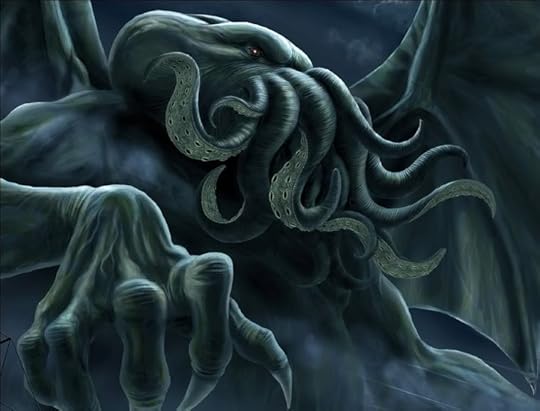
I have never read anything by H.P. Lovecraft before. And I know that a lot of people have. I know a teensy weensy little bit about his mythos involving his legendary Cthulhu monster but not a lot. And this story is set in the same world as that mythos. So, some of the story was unfortunately lost in translation for me which is why it didn't get more stars. Because there were some things that I absolutely loved about this short story. I loved the world building and the main character, Aphra. I loved Emrys's style of writing and description. I loved the mythology of the world, the hints of backstory that were uncovered slowly, and the supporting characters who really came to life in such a short period of time. However, I just kinda felt a little lost at times, I didn't always understand some of the backstory, and there were a few words, phrases, and concepts that just didn't click with me. And unfortunately, I think that all of this is due to my lack of Lovecraftian knowledge. Had I been more familiar with that world, this would have been an easy 4 stars if not more. It's also too bad that Emrys hasn't (to my knowledge) published anything longer, because her style of writing is very well crafted and beautiful. I loved reading every word, even if I got a little lost.
What this short story did was bump up Great Tales of Horror on my TBR list. Because after reading this I think that I would absolutely love his world-building and supremely awesome take on creature-horror. I am a big fan of kick-ass creatures anyway, and I do kinda wish there was more of a creature-presence in this story, but hey, you can't win 'em all.

January 12, 2015
An original take on Cthulhu mythos. Anyone who has read Lovecraft will recognize the names and places and hints of the past events (the Yith, the Shoggoth, Cthulhu, the Marshes, Innsmouth).
This story deals with the aftermath of the government's treatment of Innsmouth. While it is not necessary, I'd recommend reading The Shadow Over Innsmouth before this.
As the FBI agent says it is always easier to find those that don't hide, those who are just trying to get by. The dangerous ones are better at hiding. Today, the government found themselves 'shorthanded, ignorant, and having angered the people least likely to be a danger'. There seem to be a new Aeonists cult. The FBI agent, Ron Spector, sent to recruit Aphra Marsh, tries to convince her that the state is not one entity, it is changing. And they owe her an apology. And if she agrees to help them against this new enemy, to check if they are truly a danger, the agent might be able to find out what happened to her mother.
This is really interesting story of Innsmouth legacy told from the point of view of one of them. The thing is, it never occurred to me to see them as objects of pity - they belong to Cthulhu after all, but after reading this it made me sad. It almost made me forget that they had human sacrifice.
So much is packed into this story. Through Aphra you'll get a portion of old beliefs, the way they teach their young their history; you'll get their view on mankind (it is not cheerful).
You can read this great story here.
This story deals with the aftermath of the government's treatment of Innsmouth. While it is not necessary, I'd recommend reading The Shadow Over Innsmouth before this.
'The state stole nearly two decades of my life. The state killed my father, and locked the rest of my family away from anything they thought might give us strength. Salt water. Books. Knowledge. One by one, they destroyed us. My mother began her metamorphosis. Allowed the ocean, she might have lived until the sun burned to ashes. They took her away. We know they studied us at such times, to better know the process. To better know how to hurt us. You must imagine the details, as I have. They never returned the bodies. Nothing has been given back to us.'
As the FBI agent says it is always easier to find those that don't hide, those who are just trying to get by. The dangerous ones are better at hiding. Today, the government found themselves 'shorthanded, ignorant, and having angered the people least likely to be a danger'. There seem to be a new Aeonists cult. The FBI agent, Ron Spector, sent to recruit Aphra Marsh, tries to convince her that the state is not one entity, it is changing. And they owe her an apology. And if she agrees to help them against this new enemy, to check if they are truly a danger, the agent might be able to find out what happened to her mother.
This is really interesting story of Innsmouth legacy told from the point of view of one of them. The thing is, it never occurred to me to see them as objects of pity - they belong to Cthulhu after all, but after reading this it made me sad. It almost made me forget that they had human sacrifice.
So much is packed into this story. Through Aphra you'll get a portion of old beliefs, the way they teach their young their history; you'll get their view on mankind (it is not cheerful).
You can read this great story here.

July 10, 2017
Interesting story that uses Lovecraft's Innsmouth story for its inspiration, picking up several years after the raids of the town. Aphra Marsh, along with her Japanese American friends, is rebuilding a life after years in camps in the desert.
I appreciated Emrys' use of the actual imprisonment of Japanese Americans to highlight the unethical incarceration of individuals. There's a lot of fog and humidity references in this short, all things Aphra was denied while growing up in prison.
I appreciated Emrys' use of the actual imprisonment of Japanese Americans to highlight the unethical incarceration of individuals. There's a lot of fog and humidity references in this short, all things Aphra was denied while growing up in prison.

July 19, 2022
Lovecraftian?
Aphra is a member of the group of people who once lived in Innsmouth before it was destroyed by the FBI.
Because she was just a child when it happened, she really doesn’t have much memory of everything that occurred.
She roams through the book trying to relearn her teachings of Cthulhu, but her childhood was a long time ago.
She is hunted down by the FBI for a little favor.
Aphra is a member of the group of people who once lived in Innsmouth before it was destroyed by the FBI.
Because she was just a child when it happened, she really doesn’t have much memory of everything that occurred.
She roams through the book trying to relearn her teachings of Cthulhu, but her childhood was a long time ago.
She is hunted down by the FBI for a little favor.

June 27, 2017
The people of the water are born in shadow on the land, but what they make beneath the waves will live in glory till the dying sun burns away their last shelter.
Aphra Marsh is a survivor of interment camp. Her old town was Innsmouth.
For you, o not versed, Innsmouth is a fictional place of Lovecraftian horror. ( The Shadow Over Innsmouth )
More than a short story this is a sneek peak into the book of this author - Winter Tide . Takes place in the 1940s, after the war. Emrys (really??) narrate with Aphra, the other side of the people persecuted and stripped of family, legacy and religion. She is an Old Deep hybrid, with head down she lives following lost threads when able. Her tranquility is once more shattered when one man, Spector, ask her help with ... other people. Now, she is bitter, but then curious.
I'm not really sure how I feel about the comparation between the religion persecuted and culture persecuted and ... I don't know ...
The ending of this story -see here -is a bit weak. But I'm curious enough to look for the book.


Read
June 14, 2016Extra bias ahoy, since this is a story from our site...but with that caveat up front, wow. A Lovecraftian story told from the perspective of a Deep One hybrid Innsmouth survivor, this doesn't just subvert HP Lovecraft, it turns it on it's head & makes his Mythos about found families, outsiders & outcasts, & finding love in an uncaring world. We've got a follow-up, WINTER TIDE, coming early in 2017 & it's so good. Like I said, take this with a grain of salt...but it's amazing stuff. --MK
September 29, 2024
Loss and sorrow in a Lovecraftian world
I have resisted reading anything H.P. Lovecraft wrote. I nevertheless know something of the world his fiction built, because it shows up so often in work by authors I admire, for instance N.K. Jemisin and Charles Stross. (There are any number of others.) Without exception, these authors explain, sometimes at length, how *awful* Lovecraft was: unreadably tedious and racist. (To be fair, racism is a charge justly raised against a lot of early twentieth century authors.)
Yet Jemisin, Stross, and now Ruthanna Emrys seem unable to resist the call of Lovecraft's stories. And, judging by the results, they are right to give in. They have produced powerful stories by giving in.
The Litany of Earth is a story told from the point of view of one of the Deep Ones, a worshipper of Dread Cthulhu. Until they were taken from her and destroyed by the government, Aphra March lived in Innsmouth, Vermont, with her family. Aphra now lives in San Francisco with a Japanese family, the Kotos, who know what she is -- they call her Kappa-sama (???). They also had their lives taken from them when they were put into an internment camp, during the second World War.
Aphra is a gentle soul who is as kind to the human mortals around her as she can be. There is no Lovecraftian horror here. The Litany of Earth is a novelette, that is, a long short story (32 pages in kindle). It can be read for free at Tor.com.
Blog review.
I have resisted reading anything H.P. Lovecraft wrote. I nevertheless know something of the world his fiction built, because it shows up so often in work by authors I admire, for instance N.K. Jemisin and Charles Stross. (There are any number of others.) Without exception, these authors explain, sometimes at length, how *awful* Lovecraft was: unreadably tedious and racist. (To be fair, racism is a charge justly raised against a lot of early twentieth century authors.)
Yet Jemisin, Stross, and now Ruthanna Emrys seem unable to resist the call of Lovecraft's stories. And, judging by the results, they are right to give in. They have produced powerful stories by giving in.
The Litany of Earth is a story told from the point of view of one of the Deep Ones, a worshipper of Dread Cthulhu. Until they were taken from her and destroyed by the government, Aphra March lived in Innsmouth, Vermont, with her family. Aphra now lives in San Francisco with a Japanese family, the Kotos, who know what she is -- they call her Kappa-sama (???). They also had their lives taken from them when they were put into an internment camp, during the second World War.
Aphra is a gentle soul who is as kind to the human mortals around her as she can be. There is no Lovecraftian horror here. The Litany of Earth is a novelette, that is, a long short story (32 pages in kindle). It can be read for free at Tor.com.
Blog review.

September 13, 2016
A fascinating and brilliant take on Lovecraftian themes, Emrys pushes the boundaries in a tale that is both enthralling and new.

September 18, 2016
Review also published here
Disclaimer: After buying this story and procrastinating on getting started, the novel sequel to it appeared as an ARC in my mailbox. While I made the purchase independently, I read it with that knowledge in mind.
The Litany of Earth is the first story written by Ruthanna Emrys that I've read so far. The idea of a somewhat-sequel to H.P. Lovecraft's The Shadow Over Innsmouth caught my attention while browsing Amazon for Kindle short stories, and I picked it up.
However, this story was/is also available to read for free on Tor.com, in case you don't want to spend a buck on this story (though I'd say it is well worth that much, at least).
The Litany of Earth plays on Lovecraft's themes and the horrors of Innsmouth in way that feels familiar as far as the Mythos is concerned, yet is decidedly different from HPL's works. It puts us into the story of Aphra Marsh, a survivor of the raid of Innsmouth and the traumatic experiences resulting in it. She is a Deep One, has the "Innsmouth look" (long-limbed, ugly, bulging eyes etc) and suffered from the persecution of her kin.
Emrys aims to give the cults, described as Aeonism here, in a more sympathetic light, like a religion like any other with its nutters and good people searching for more. She succeeded in making the cultists here more than extremists willing to throw their lives away to doom the world, and give them more depth, which I liked a lot.
While not nearly as bleak or hopeless as a classic Lovecraft (nobody actually goes insane, or commits suicide out of desperation or paranoia, for example), it still expands on the Mythos in multiple directions, to the point of elaborating on the Yith and other Mythos beings, and the inevitable death of the Earth.
It is delivered in a way that doesn't feel out of place in the context of the story, or makes light of Lovecraft's ideas and concepts, like many stories by other authors I've read on the matter sadly did.
As a result I'd consider this a worthwhile extension to the Mythos, written by somebody with a noticeable degree of passion for the subject, even if it is a stylistic departure.
A bonus for me was the likeable cast of characters (which, with Lovecraft, I don't normally expect). Aphra herself is intriguing and gives the whole topic a more esoteric feeling, and tying her into the Innsmouth raids was a cool core concept. She lives with a japanese family who also suffered ethnical persecution, so there's a certain degree of understanding and trust there which makes Aphra's situation appear more grounded. Her employer, a bookstore owner and collector of occult books, gives the story the opening to delve into the matter of magic and talk about the Mythos's larger themes. The cultists, too, offer a look at the Aeonist movement, zealotry and desperation of the common human.
The one thing that I didn't enjoy as much was the abrupt ending. I was surprised to find that the story was over already. I didn't feel lost, or that plotlines weren't wrapped up sufficiently, but I'd have liked to see a little more happen before the curtain call. Still, I enjoyed the ambiguity in it, and figured that would be the logical conclusion, so I am satisfied with it.
Seeing how much I enjoyed The Litany of Earth, I am looking forward to reading more of Emrys's lovecraftian horror / Mythos stories in the future. I'll probably start with Winter Tide , since hey, it's already in my mailbox and continues the story of Aphra Marsh and co. If it is anything like this short story, it'll be a nice treat for Lovecraft fans like me.
Disclaimer: After buying this story and procrastinating on getting started, the novel sequel to it appeared as an ARC in my mailbox. While I made the purchase independently, I read it with that knowledge in mind.
The Litany of Earth is the first story written by Ruthanna Emrys that I've read so far. The idea of a somewhat-sequel to H.P. Lovecraft's The Shadow Over Innsmouth caught my attention while browsing Amazon for Kindle short stories, and I picked it up.
However, this story was/is also available to read for free on Tor.com, in case you don't want to spend a buck on this story (though I'd say it is well worth that much, at least).
The Litany of Earth plays on Lovecraft's themes and the horrors of Innsmouth in way that feels familiar as far as the Mythos is concerned, yet is decidedly different from HPL's works. It puts us into the story of Aphra Marsh, a survivor of the raid of Innsmouth and the traumatic experiences resulting in it. She is a Deep One, has the "Innsmouth look" (long-limbed, ugly, bulging eyes etc) and suffered from the persecution of her kin.
Emrys aims to give the cults, described as Aeonism here, in a more sympathetic light, like a religion like any other with its nutters and good people searching for more. She succeeded in making the cultists here more than extremists willing to throw their lives away to doom the world, and give them more depth, which I liked a lot.
While not nearly as bleak or hopeless as a classic Lovecraft (nobody actually goes insane, or commits suicide out of desperation or paranoia, for example), it still expands on the Mythos in multiple directions, to the point of elaborating on the Yith and other Mythos beings, and the inevitable death of the Earth.
It is delivered in a way that doesn't feel out of place in the context of the story, or makes light of Lovecraft's ideas and concepts, like many stories by other authors I've read on the matter sadly did.
As a result I'd consider this a worthwhile extension to the Mythos, written by somebody with a noticeable degree of passion for the subject, even if it is a stylistic departure.
A bonus for me was the likeable cast of characters (which, with Lovecraft, I don't normally expect). Aphra herself is intriguing and gives the whole topic a more esoteric feeling, and tying her into the Innsmouth raids was a cool core concept. She lives with a japanese family who also suffered ethnical persecution, so there's a certain degree of understanding and trust there which makes Aphra's situation appear more grounded. Her employer, a bookstore owner and collector of occult books, gives the story the opening to delve into the matter of magic and talk about the Mythos's larger themes. The cultists, too, offer a look at the Aeonist movement, zealotry and desperation of the common human.
The one thing that I didn't enjoy as much was the abrupt ending. I was surprised to find that the story was over already. I didn't feel lost, or that plotlines weren't wrapped up sufficiently, but I'd have liked to see a little more happen before the curtain call. Still, I enjoyed the ambiguity in it, and figured that would be the logical conclusion, so I am satisfied with it.
Seeing how much I enjoyed The Litany of Earth, I am looking forward to reading more of Emrys's lovecraftian horror / Mythos stories in the future. I'll probably start with Winter Tide , since hey, it's already in my mailbox and continues the story of Aphra Marsh and co. If it is anything like this short story, it'll be a nice treat for Lovecraft fans like me.

June 26, 2018
“The state took Aphra away from Innsmouth. They took her history, her home, her family, her god. They tried to take the sea. Now, years later, when she is just beginning to rebuild a life, an agent of that government intrudes on her life again, with an offer she wishes she could refuse.“
I read this short story, because I have Winter Tide on my shelf and thought this would be a good intro to the story. It was mostly confusing, I didn‘t have a clue what was going on at first. I finished it this morning and already can‘t recall the ending of it.
So, bottom line, not a great read for me. I hope Winter Tide has better world building and more straight forward story telling.
I read this short story, because I have Winter Tide on my shelf and thought this would be a good intro to the story. It was mostly confusing, I didn‘t have a clue what was going on at first. I finished it this morning and already can‘t recall the ending of it.
So, bottom line, not a great read for me. I hope Winter Tide has better world building and more straight forward story telling.

September 26, 2021
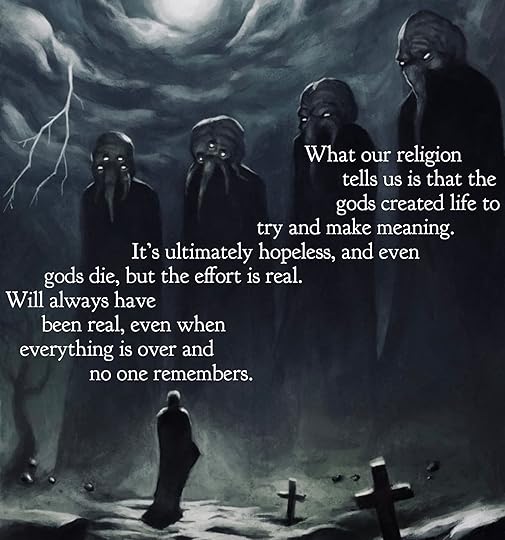
This is the best mythos story I have ever read. Ms. Emrys, you have made me a believer! I must now read everything the gods have bid you write.

Read
September 12, 2014The narrator is a woman taken as a child from Innsmouth, placed in care and kept far from the sea; her experience is explicitly compared to the innocent Japanese-Americans interred during the Second World War. And like them, her family just wanted a quiet life: “Most religions consist largely of good people trying to get by. No matter what names they worship, or what church they go to, or what language they pray in.” Other, more modern parallels are clearly intended here, of course. And the story is a perfect exemplar of the section of current culture which is scrupulous to a fault in considering the experience of the other. Ideologically, I am repulsed by the idea of moderate, C-of-E-style Cthulhu cultists; but then ideologically I'm repulsed by Catholicism, and I still enjoy GK Chesterton, because judging art by ideology is what the bad guys do (indeed, it's as good a way as any to identify a bad guy). That one of these gentle moderates could then be talked into helping deal with the dangerous behaviour of 'fundamentalist' converts seems absurd, though to be fair Emrys does a brilliant job of selling the idea. My real problem, though, is the lack of strangeness. It's entirely possible to have a sympathetic narrator who follows strange gods, and yet have them come across as powerfully uncanny - Arthur Machen's 'White People', a key proto-Cthulhu Mythos tale, is founded on that. Here, Aphra's family seem far too like us in their ways. This is perhaps the biggest problem with seeking to show that everyone is just people really - rather than teaching respect for the magnificent variety of life and mind, you instead end up forcing everyone into your own well-meaning but bloodless image.

November 29, 2017
The original Cthulhu mythos doesn't do much for me, but I'm very much enjoying the modern trend toward deconstructing it. And Emrys's writing is spare and lovely, perfect for evoking the viewpoint of an immortal species drawn to drift beneath the waves. This was all set to be four stars until the ending, which I found awkwardly abrupt, with the climactic character moment occurring off-screen.
(It's possible I would have found the ending less jarring more had my expectations been better-set by the ebook. Because the ebook includes sample material from Emrys's novel at the end, the actual story ends at 81%. So I was just reading along, expecting things to start slowly arcing toward a conclusion, and then, bam, it ended. Dear ebook publishers: please stop doing this. At least with paper books I can do a quick flip before I begin reading and see where the actual endpoint is.)
(It's possible I would have found the ending less jarring more had my expectations been better-set by the ebook. Because the ebook includes sample material from Emrys's novel at the end, the actual story ends at 81%. So I was just reading along, expecting things to start slowly arcing toward a conclusion, and then, bam, it ended. Dear ebook publishers: please stop doing this. At least with paper books I can do a quick flip before I begin reading and see where the actual endpoint is.)

November 14, 2017
This is a gem of a story, set in postwar 1940s San Francisco, which extends the examination of the legacy of the Japanese-American internment camps and the Holocaust into the realm of Lovecraftian fantasy. It's particularly interesting in light of the xenophobic themes of the original Lovecraft stories, which I should add I read only some of, and that a long time ago. The language is beautiful and transparent, the themes of identity, friendship, and othering strong but not preachy. I'm looking forward to reading the novel Winter Tide.

March 7, 2017
3.5ish stars.
A promising introduction to what will hopefully be a great series.
A promising introduction to what will hopefully be a great series.

October 14, 2020
Very interesting start to this series.

October 7, 2019
4.5
Unexpectedly haunting and compelling - unexpected because elements from the Lovecraftian mythos are used but it’s completely different from what I imagined. I’ll be catching up with the related novels soon.
Unexpectedly haunting and compelling - unexpected because elements from the Lovecraftian mythos are used but it’s completely different from what I imagined. I’ll be catching up with the related novels soon.

June 6, 2014
The Litany of Earth is a short novella, roughly 32 pages, depicting the life of Aphra Marsh. Aphra Marsh is an unusual protagonist as she is a Deep One hybrid and trying to make a normal life for herself amongst humans. While short, The Litany of the Earth serves as one of the best deconstructions of Lovecraftian horror in years.
I admit to firm bias as one of the things I was tackling when writing Cthulhu Apocalypse: Death May Die was how to deal with the Othering of other races. I could ignore it and treat monsters as monsters while ignoring the metaphor, I could embrace it fully (which was never going to happen), or I could subvert it. In the end, I chose to subvert it and my decision to make Cthulhu Apocalypse the first Post-Lovecraftian series of novels.
It seems Ruthanna Emrys has beaten me to the punch.
The Litany of the Earth invokes things like the United States attempts to eliminate Native American culture, Japanese internment, and other real-life atrocities to compare how the children of Innsmouth were affected by their imprisonment post-The Shadow over Innsmouth. She never attempts to compare the suffering of her fictional human-fishman hybrids to that of real-life victims but the applicability is there.
The conceit of the story is that Ruthanna believes the United States motivation for destroying Innsmouth was a mixture of racism as well as hatred for the non-Christian religious practices of the townsfolk. Which, given the time period, would have been a perfectly valid justification for the all-out assault we saw at the end of the short-story. Much as fantasy stories have depicted things from the perspective of the Orcs, so is this from the perspective of the Deep One hybrids.
Lovecraft purists may note there's no attempt at moral ambiguity here. The Innsmouth people are depicted as victims and the story ignores the Marsh family's reign of terror over regular humans. This isn't necessarily a retcon as Aphra Marsh spent the majority of her life in an internment camp, so there's no problem assuming she might be looking at things with rose-colored glasses. What does the Marsh family's reign of terror have to do with her and dozens of other people held prisoner for the rest of their lives, anyway?
Some anvils need to be dropped when dealing with America (and other nation's) racist as well as culturally dominionist past. The fact H.P. Lovecraft is virtually a symbol for authors who were really talented but really intolerant is what makes the story interesting.
We also get some great moments where Aphra is forced to deal with a guilty-feeling government agent, similar racism towards her from other Cthulhu Mythos races, and even a stab at cultural appropriation. How would you feel if your religion was adopted by a bunch of ignorant rich folk who think it's cool and get large numbers of details wrong? The idea even Great Cthulhu worship deserves respect and honor is something that I found quite intriguing.
I recommend all fans of Lovecraft pick this up and I hope the author expands it into a full-length novel.
10/10
I admit to firm bias as one of the things I was tackling when writing Cthulhu Apocalypse: Death May Die was how to deal with the Othering of other races. I could ignore it and treat monsters as monsters while ignoring the metaphor, I could embrace it fully (which was never going to happen), or I could subvert it. In the end, I chose to subvert it and my decision to make Cthulhu Apocalypse the first Post-Lovecraftian series of novels.
It seems Ruthanna Emrys has beaten me to the punch.
The Litany of the Earth invokes things like the United States attempts to eliminate Native American culture, Japanese internment, and other real-life atrocities to compare how the children of Innsmouth were affected by their imprisonment post-The Shadow over Innsmouth. She never attempts to compare the suffering of her fictional human-fishman hybrids to that of real-life victims but the applicability is there.
The conceit of the story is that Ruthanna believes the United States motivation for destroying Innsmouth was a mixture of racism as well as hatred for the non-Christian religious practices of the townsfolk. Which, given the time period, would have been a perfectly valid justification for the all-out assault we saw at the end of the short-story. Much as fantasy stories have depicted things from the perspective of the Orcs, so is this from the perspective of the Deep One hybrids.
Lovecraft purists may note there's no attempt at moral ambiguity here. The Innsmouth people are depicted as victims and the story ignores the Marsh family's reign of terror over regular humans. This isn't necessarily a retcon as Aphra Marsh spent the majority of her life in an internment camp, so there's no problem assuming she might be looking at things with rose-colored glasses. What does the Marsh family's reign of terror have to do with her and dozens of other people held prisoner for the rest of their lives, anyway?
Some anvils need to be dropped when dealing with America (and other nation's) racist as well as culturally dominionist past. The fact H.P. Lovecraft is virtually a symbol for authors who were really talented but really intolerant is what makes the story interesting.
We also get some great moments where Aphra is forced to deal with a guilty-feeling government agent, similar racism towards her from other Cthulhu Mythos races, and even a stab at cultural appropriation. How would you feel if your religion was adopted by a bunch of ignorant rich folk who think it's cool and get large numbers of details wrong? The idea even Great Cthulhu worship deserves respect and honor is something that I found quite intriguing.
I recommend all fans of Lovecraft pick this up and I hope the author expands it into a full-length novel.
10/10

November 25, 2022
A well written story from the point of view of an "Innsmouth" folk that is a fun quick read, better than some Lovecraftian type stories I've read but doesn't quite work for me on all levels-mostly dealing with the way she wove her lore together-but we'll get to that later in the review. Overall I liked the short story and have picked up the Novel length sequel and recommend it, even if not everything worked for me as we see.
Emrys doesn't try to ape the Early 20th Century/Late 19th Century Prose that Lovecraft wrote in, making for a story that is written clean, with good imagery that doesn't lose itself in the metaphor- which is a continual issue for me in stories that tend towards the fantastic. Aphra is an interesting narrator, sad, traumatized and while I wouldn't say broken as some in her situation would be-she definitely has some lingering PTSD that is well portrayed but doesn't become the entire focus of the story. Something I appreciated, as a sufferer of PTSD of my own I'm going to be heartless and say I'm sick to death of stories that become nothing more than exercises for people dealing with Trauma and less about telling a story. Well aware I might get flack for that but sometimes, I just want a story and not the cliff notes of a therapy session in a fantastic guise.
With that being said, onto the story and my feelings on it:
Aphra Marsh is an Innsmouth folk, is one of the ones from the New England Coastal town of Innsmouth that Captain Obed Marsh forever changed in the 1800's after the towns fortunes and his own started failing. Marsh sold his soul (basically) and the soul of his family and people for riches, gold, a healthy harvest of fish and quasi-immortality in exchange for mating with the deep ones-who later come to claim not only sacrifices, but also their long-ago descendants who will-after a time change into a deep one and go to live with them in their underwater cities.
Where we start this short story is with Aphra Marsh. A descendent of Obed in 1940's San Francisco. As the narrator-she is trying desperately to find her place in this new world when her old one was seriously uprooted and demolished when she and her folk were placed into Internment camps along with the Japanese Americans during the second World War.
WHAT DIDN'T WORK FOR ME
While Marsh was a child when this happened, her memories of the Innsmouth folk and their life are definitely colored by her youth and naivete and she paints her religion (worshipping Cthullu) and her people (simple fishing folk who will "outlive" humanity until this world ends when our Sun becomes a Red Giant and consumes the Earth.) as generally kindhearted and wise isolationists who want nothing more to get by. She also adds in, that her people take comfort in the cold, harsh reality of existence because in the future the "Yith" (the alien race featured in "The Shadow Out of Time" by Lovecraft) will collect (or have? they can project themselves across time into other bodies so it's hard to describe) the memories of our world and so some aspect of humanity will still be around. This is a way to take Lovecraft's nihilism and turn it on its heel by saying that even if life is meaningless, we will-somehow-still be remembered. We'll have made an impact somehow, even if it's just a figurative book of "Life on Earth" in some aliens' library. While I get the notion it's her interpretation of Lore that sorta doesn't work for me and knocks this down to three stars rather than four or five.
Weaving the Yithians (while that's the planets name not their name for lack of a better term we'll call them that.) into Cthullu lore (where the Deep Ones suddenly worship Cthullu rather than Dagon) is where it falls apart for me because it lost some of the original impact of the story and their major origins. Aphra at one point describes her childhood faith in Cthullu in rather positive terms and talks about his tentacle arms welcoming her and her people and the story lost me a bit with that because that is not at all what Cthullu is-both in the original stories and later interpretations of the character. Not sure quite why Cthullu is brought into this other than of course he's the favorite of Lovecraft's universe but there we go. While people can (and definitely are) delusional when it comes to their religion or their experiences especially when it relates to childhood as Aphra was, Emrys had to make some serious subversions to the original story and the race of Deep Ones and those subversions in my opinion go against what the original stories and their impact was and were supposed to be. If you change the original foundation stone for a story and its characters, why even both using those elements and not just make your own?
The Innsmouth folk were described as isolated and xenophobic (for obvious reasons in the original story), they performed sacrifices and killed off large swaths of the original inhabitants of Innsmouth that refused to bow to Marsh's wishes. There's a reason the Deep Ones were to be feared and Emrys has simply tried to make a connection between persecuted minorities and the Deep Ones which-again doesn't work because Japanese and Jewish people (who are those that she's trying to make a connection to with the camps) aren't quasi-immortal, magic using, super senses and recover and strengthed demon god worshipping fish people who routinely sacrifice anyone who comes into their path. The Deep Ones even implant "spies" within human society to bring more isolated fishing communities into the worship of Dagon. Even though her Deep Ones worship Cthullu now in this world and if he's portrayed as anything other than the Eldritch uncaring abomination he supposedly is, is he even really Cthullu?
This is where the story falls apart for me and maybe if in the novel sequel Emrys addresses some of these issues, perhaps because Aphra was a child she never saw these aspects of the cult in question or it was shown to her in a Deep Ones Sunday School class type session where she never questioned or was taught to really think about the implications of what her people do and did and are.
However as this is a short story it seems she ran out of time to do so-if she ever intended too at all.
WHAT WORKED FOR ME
Aphra herself was the saving grace of this story, as Aphra was a pretty realistic character whose head and actions and behaviors are engaging as is her inner voice. She's a relatable character without the lofty snobbery I'd suspected she might have been shown to have with any other writer. Emrys does a good job making characters with unique voices so I can easily remember who is who and not get confused by blended together voices. Emrys excellent at creating plot and scenes that aren't all devoted to showing off the lore and world she built. It feels like it's both about the world and the characters and I'm here for that. Since that is what the story is all about, I'll keep this section short and simply explain that it's so well done, which is why I'm saying this was good.
It's also why I've picked up the novel length sequel and why I still recommend the short story besides my lore issues. I'm not saying people can't change Lore if they need to, as a Person of Color I'm not married Lovecraft canon as some kind of pure horror staple that shouldn't be played with. Even Lovecraft himself was alright with others playing in this world, he created a kind of Shared/Open Source canon that anyone can play with and I'm fine with that. But when the changes seem to go against the very structure of the canon in question? That's when I'm not terribly or always fond of the results. If Cthullu is portrayed, as I said as anything other than an Eldtrich Ambomination (minus parodies obviously which this is not), is he even Cthullu?
Three out of Five stars, recommended but the lore doesn't always work.
Emrys doesn't try to ape the Early 20th Century/Late 19th Century Prose that Lovecraft wrote in, making for a story that is written clean, with good imagery that doesn't lose itself in the metaphor- which is a continual issue for me in stories that tend towards the fantastic. Aphra is an interesting narrator, sad, traumatized and while I wouldn't say broken as some in her situation would be-she definitely has some lingering PTSD that is well portrayed but doesn't become the entire focus of the story. Something I appreciated, as a sufferer of PTSD of my own I'm going to be heartless and say I'm sick to death of stories that become nothing more than exercises for people dealing with Trauma and less about telling a story. Well aware I might get flack for that but sometimes, I just want a story and not the cliff notes of a therapy session in a fantastic guise.
With that being said, onto the story and my feelings on it:
Aphra Marsh is an Innsmouth folk, is one of the ones from the New England Coastal town of Innsmouth that Captain Obed Marsh forever changed in the 1800's after the towns fortunes and his own started failing. Marsh sold his soul (basically) and the soul of his family and people for riches, gold, a healthy harvest of fish and quasi-immortality in exchange for mating with the deep ones-who later come to claim not only sacrifices, but also their long-ago descendants who will-after a time change into a deep one and go to live with them in their underwater cities.
Where we start this short story is with Aphra Marsh. A descendent of Obed in 1940's San Francisco. As the narrator-she is trying desperately to find her place in this new world when her old one was seriously uprooted and demolished when she and her folk were placed into Internment camps along with the Japanese Americans during the second World War.
WHAT DIDN'T WORK FOR ME
While Marsh was a child when this happened, her memories of the Innsmouth folk and their life are definitely colored by her youth and naivete and she paints her religion (worshipping Cthullu) and her people (simple fishing folk who will "outlive" humanity until this world ends when our Sun becomes a Red Giant and consumes the Earth.) as generally kindhearted and wise isolationists who want nothing more to get by. She also adds in, that her people take comfort in the cold, harsh reality of existence because in the future the "Yith" (the alien race featured in "The Shadow Out of Time" by Lovecraft) will collect (or have? they can project themselves across time into other bodies so it's hard to describe) the memories of our world and so some aspect of humanity will still be around. This is a way to take Lovecraft's nihilism and turn it on its heel by saying that even if life is meaningless, we will-somehow-still be remembered. We'll have made an impact somehow, even if it's just a figurative book of "Life on Earth" in some aliens' library. While I get the notion it's her interpretation of Lore that sorta doesn't work for me and knocks this down to three stars rather than four or five.
Weaving the Yithians (while that's the planets name not their name for lack of a better term we'll call them that.) into Cthullu lore (where the Deep Ones suddenly worship Cthullu rather than Dagon) is where it falls apart for me because it lost some of the original impact of the story and their major origins. Aphra at one point describes her childhood faith in Cthullu in rather positive terms and talks about his tentacle arms welcoming her and her people and the story lost me a bit with that because that is not at all what Cthullu is-both in the original stories and later interpretations of the character. Not sure quite why Cthullu is brought into this other than of course he's the favorite of Lovecraft's universe but there we go. While people can (and definitely are) delusional when it comes to their religion or their experiences especially when it relates to childhood as Aphra was, Emrys had to make some serious subversions to the original story and the race of Deep Ones and those subversions in my opinion go against what the original stories and their impact was and were supposed to be. If you change the original foundation stone for a story and its characters, why even both using those elements and not just make your own?
The Innsmouth folk were described as isolated and xenophobic (for obvious reasons in the original story), they performed sacrifices and killed off large swaths of the original inhabitants of Innsmouth that refused to bow to Marsh's wishes. There's a reason the Deep Ones were to be feared and Emrys has simply tried to make a connection between persecuted minorities and the Deep Ones which-again doesn't work because Japanese and Jewish people (who are those that she's trying to make a connection to with the camps) aren't quasi-immortal, magic using, super senses and recover and strengthed demon god worshipping fish people who routinely sacrifice anyone who comes into their path. The Deep Ones even implant "spies" within human society to bring more isolated fishing communities into the worship of Dagon. Even though her Deep Ones worship Cthullu now in this world and if he's portrayed as anything other than the Eldritch uncaring abomination he supposedly is, is he even really Cthullu?
This is where the story falls apart for me and maybe if in the novel sequel Emrys addresses some of these issues, perhaps because Aphra was a child she never saw these aspects of the cult in question or it was shown to her in a Deep Ones Sunday School class type session where she never questioned or was taught to really think about the implications of what her people do and did and are.
However as this is a short story it seems she ran out of time to do so-if she ever intended too at all.
WHAT WORKED FOR ME
Aphra herself was the saving grace of this story, as Aphra was a pretty realistic character whose head and actions and behaviors are engaging as is her inner voice. She's a relatable character without the lofty snobbery I'd suspected she might have been shown to have with any other writer. Emrys does a good job making characters with unique voices so I can easily remember who is who and not get confused by blended together voices. Emrys excellent at creating plot and scenes that aren't all devoted to showing off the lore and world she built. It feels like it's both about the world and the characters and I'm here for that. Since that is what the story is all about, I'll keep this section short and simply explain that it's so well done, which is why I'm saying this was good.
It's also why I've picked up the novel length sequel and why I still recommend the short story besides my lore issues. I'm not saying people can't change Lore if they need to, as a Person of Color I'm not married Lovecraft canon as some kind of pure horror staple that shouldn't be played with. Even Lovecraft himself was alright with others playing in this world, he created a kind of Shared/Open Source canon that anyone can play with and I'm fine with that. But when the changes seem to go against the very structure of the canon in question? That's when I'm not terribly or always fond of the results. If Cthullu is portrayed, as I said as anything other than an Eldtrich Ambomination (minus parodies obviously which this is not), is he even Cthullu?
Three out of Five stars, recommended but the lore doesn't always work.

June 7, 2014
I stumbled across a link to this story on I09 and I am so very happy that I did. Set some time after Lovecraft's "Shadow Over Innsmouth", it explores the repercussions of the American government's discovery of the Deep Ones and the various other cults (called Aeonists)devoted to the worship of eldritch abominations. Aphra Marsh and her family were taken from Innsmouth and held in camps for decades deep in the desert and far from the sea destined to be their eternal homes when the change came upon them. Now Aphra is making a life for herself in San Francisco with a family of Japanese-Americans who had been interred during World War II, also in the camp were the Aeonists were held. She finds a bookshop to work whose owner longs for magical knowledge and shelters a tiny library of forbidden tomes such as the Necronomicon. Then one day a man arrives in the shop seeking Aphra's help in investigating Aeonists who may be a danger to society.
Cosmic horror has fascinated me for a very long time now. I've tried my hand at writing it a few times, with little success, and delved deeply into modern twists on the genre such as the Slender Man Mythos. Still, I had never before found a story that takes on the viewpoint of the cultists and tries to imagine why they might worship the likes of Cthulhu. It makes for a fresh and interesting take on the genre, transforming the odious mutant townspeople of Innsmouth into sympathetic and believable characters. The language with which Ruthanna Emrys tells her story is rich and poetic, without taking on the purple tinge that cosmic horror, Lovecraft in particular, can often develop. The story itself is self-contained, but a continuation would be quite welcome.
Cosmic horror has fascinated me for a very long time now. I've tried my hand at writing it a few times, with little success, and delved deeply into modern twists on the genre such as the Slender Man Mythos. Still, I had never before found a story that takes on the viewpoint of the cultists and tries to imagine why they might worship the likes of Cthulhu. It makes for a fresh and interesting take on the genre, transforming the odious mutant townspeople of Innsmouth into sympathetic and believable characters. The language with which Ruthanna Emrys tells her story is rich and poetic, without taking on the purple tinge that cosmic horror, Lovecraft in particular, can often develop. The story itself is self-contained, but a continuation would be quite welcome.

June 19, 2017
I first encountered this unexpected gem of Mythos lit in Scott R. Jones' unique and masterfully edited Cthulhusattva: Tales of the Black Gnosis, and noted in my review that Emrys' tale was the real star of the anthology. I'm gonna go ahead and quote my own review, since I already said it:
*****
". . . the heart, and possibly also the point, of the collection is Ruthanna Emrys' "The Litany of Earth." Here we meet Aphra Marsh (of those Marshes), a mild, devout "Aeonist" in a world where they are a persecuted minority. Here, Emrys turns our expectations of the Mythos gods inside-out (and lays in some fair social commentary in the process):
"Most religions consist largely of good people trying to get by. No matter what names they worship, or what church they go to, or what language they pray in . . . [a]nd every religion has its fanatics, who are willing to do terrible things in the name of their god. No one is immune . . . [i]t's a failing of humanity, not of any particular sect.'"
*****
It proves no less melancholy and wonderful on a second read. I'm thrilled that Emrys is expanding Aphra's story into a series, starting with Winter Tide, and cannot wait to get my hands on a copy. Her empathetic revisioning of "the Innsmouth legacy" as persecution of "the other" rings all too relevant in the world's current political climate. Bravo for taking on the hard issues -- both today's and the past's -- by infusing HPL's problematic legacy with grace, lyricism and humanity.
Five stars.
*****
". . . the heart, and possibly also the point, of the collection is Ruthanna Emrys' "The Litany of Earth." Here we meet Aphra Marsh (of those Marshes), a mild, devout "Aeonist" in a world where they are a persecuted minority. Here, Emrys turns our expectations of the Mythos gods inside-out (and lays in some fair social commentary in the process):
"Most religions consist largely of good people trying to get by. No matter what names they worship, or what church they go to, or what language they pray in . . . [a]nd every religion has its fanatics, who are willing to do terrible things in the name of their god. No one is immune . . . [i]t's a failing of humanity, not of any particular sect.'"
*****
It proves no less melancholy and wonderful on a second read. I'm thrilled that Emrys is expanding Aphra's story into a series, starting with Winter Tide, and cannot wait to get my hands on a copy. Her empathetic revisioning of "the Innsmouth legacy" as persecution of "the other" rings all too relevant in the world's current political climate. Bravo for taking on the hard issues -- both today's and the past's -- by infusing HPL's problematic legacy with grace, lyricism and humanity.
Five stars.

August 15, 2018
Aphra Marsh is a suvivor of Innsmouth. Yes, that Innsmouth, the one that harbored a malevolent undersea civilization of the Deep Ones. The one that was destroyed by government agents in the 1930s. The one that Lovecraft wrote about.
As a child, Aphra is taken by the government - ripped away from her family, her home, her culture, her religion. She is forced to live in a desert, away from the sea, away from her god, away from whatever remains of her family. As an adult in the post-WWII US, she works at a bookstore and rooms with Japanese-Americans who likewise have been interned by the state for being 'other.' In making this comparison, of the hybrid cultists to Japanese-American citizens and the similarity of their treatment by the state, author Emrys points to the similarities that unify, rather than divide, us.
Most religions consist largely of good people trying to get by. No matter what names they worship, or what church they go to, or what language they pray in.
On an intellectual level, I buy that. But when it comes to Lovecraft's cosmic horror, it's hard to swallow that the majority of the Deep Ones just want to get along. Unless getting along includes human sacrifice and arcane knowledge that renders mere mortal minds into gibbering jelly.
However, I want to love Aphra Marsha, because as a character she is so sympathetic. So color me intrigued, and I'll be looking for more by this very unusual author. Kudos!
As a child, Aphra is taken by the government - ripped away from her family, her home, her culture, her religion. She is forced to live in a desert, away from the sea, away from her god, away from whatever remains of her family. As an adult in the post-WWII US, she works at a bookstore and rooms with Japanese-Americans who likewise have been interned by the state for being 'other.' In making this comparison, of the hybrid cultists to Japanese-American citizens and the similarity of their treatment by the state, author Emrys points to the similarities that unify, rather than divide, us.
Most religions consist largely of good people trying to get by. No matter what names they worship, or what church they go to, or what language they pray in.
On an intellectual level, I buy that. But when it comes to Lovecraft's cosmic horror, it's hard to swallow that the majority of the Deep Ones just want to get along. Unless getting along includes human sacrifice and arcane knowledge that renders mere mortal minds into gibbering jelly.
However, I want to love Aphra Marsha, because as a character she is so sympathetic. So color me intrigued, and I'll be looking for more by this very unusual author. Kudos!

December 27, 2016
You can read this novella online here, and it’s good background to have if you’re interested in reading Emrys’ novel, Winter Tide. It helps orientate you and figure out the characters, how they’re related, what they care about, where they’ve been. I paused in reading Winter Tide to read this, and it definitely clarified things. In fact, I liked it more than Winter Tide: it felt better paced, perhaps because it does have to have a beginning, middle and end in a fairly short stretch of words.
It’s beautifully written, as well; both this and Winter Tide are excellent reworkings of Lovecraft’s ideas concerning the Deep Ones, taking away a lot of the horror he held and expressed about anything Other. It stands alone well, even though it serves as a good introduction for Winter Tide. It’s definitely a good way to dip into Emrys’ work to see if you like her style and ideas.
Originally reviewed on my blog.
It’s beautifully written, as well; both this and Winter Tide are excellent reworkings of Lovecraft’s ideas concerning the Deep Ones, taking away a lot of the horror he held and expressed about anything Other. It stands alone well, even though it serves as a good introduction for Winter Tide. It’s definitely a good way to dip into Emrys’ work to see if you like her style and ideas.
Originally reviewed on my blog.

August 22, 2014
Found this novelette by accident, and started reading it on my way home from work yesterday. It's probably one of the best Lovecraft pastiches that I know of, similar in intent to Neil Gaiman's "The Problem of Susan"--taking the unpleasant subtext of an acknowledged classic and delivering a story that's both critique and tribute. HP Lovecraft was famously driven in part by a horror of race-mixing, and here Emrys is using his universe to tell a powerful story about bigotry and cultural appropriation. Definitely worth a read, and I for one will be reading as many stories by Ruthanna Emrys as I can get my hands on.
Displaying 1 - 30 of 203 reviews