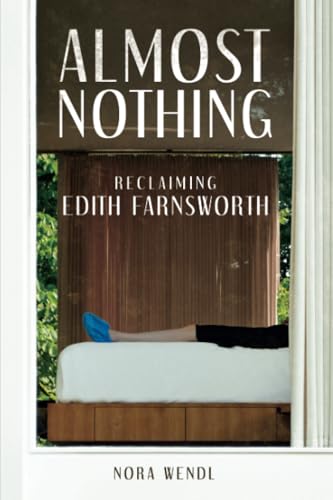
The iconic Edith Farnsworth House is a singular glass home designed by Mies van der Rohe. But the oft-told history of the house overwrites Farnsworth’s role as Mies’s collaborator and antagonist while falsely portraying her as the architect’s angry ex-lover. Nora Wendl’s audacious work of creative nonfiction explodes the sex-and-real-estate myth surrounding the Edith Farnsworth House and its two central figures. An eminent physician and woman of letters, Farnsworth left a rich trove of correspondence, memoirs, and photographs that Wendl uses to reconstruct her voice. Farnsworth’s memories and experiences alternate with Wendl’s thoughts on topics like misogyny and professional ambition to fashion a lyrical examination of love, loneliness, beauty, and the search for the divine.
Eloquent and confessional, Almost Nothing restores Edith Farnsworth to her place in architectural history and the masterpiece that bears her name.
Book Review: Almost Nothing: Reclaiming Edith Farnsworth by Nora Wendl
Rating: ★★★★☆ (4/5)
Overview Nora Wendl’s Almost Nothing: Reclaiming Edith Farnsworth is a groundbreaking work of creative nonfiction that challenges the patriarchal narratives surrounding the iconic Edith Farnsworth House. Designed by Ludwig Mies van der Rohe, the glass house is often celebrated as a modernist masterpiece, while its commissioner, Edith Farnsworth, is relegated to a footnote in architectural history. Wendl’s audacious reclamation project dismantles this erasure, blending rigorous research with speculative narrative to recenter Farnsworth’s agency, intellect, and legacy. The book transcends traditional architectural criticism, offering a feminist intervention that interrogates power, authorship, and the gendered politics of space.
Themes and Content
Wendl explores: -Architectural Mythology vs. Reality: Exposes how Farnsworth’s contributions and critiques were systematically minimized in favor of Mies’s genius narrative. -Feminist Reclamation: Uses speculative biography and archival fragments to reconstruct Farnsworth’s voice, resisting her portrayal as a passive client or scorned lover. -Spatial Politics: Analyzes how the house’s design—often lauded for its “transparency”—ironically obscured Farnsworth’s lived experience and privacy. -Creative Nonfiction as Activism: Innovates genre boundaries by merging scholarship with imaginative storytelling to challenge historical silences.
The book’s most compelling achievement is its refusal to accept the “almost nothing” left of Farnsworth’s perspective, instead weaving a rich counter-narrative.
Writing Style and Structure Wendl’s prose is both lyrical and incisive, balancing academic precision with narrative flair. The hybrid structure—alternating between archival analysis, speculative diary entries, and critical essays—mirrors the book’s thematic tension between absence and presence. While this approach risks disorienting readers expecting conventional biography, it ultimately serves the book’s radical purpose: to question who gets to write history and how. Some sections could benefit from tighter transitions, but the experimental form powerfully underscores its central argument.
Strengths and Weaknesses
Strengths: -Interdisciplinary Innovation: Bridges architecture, gender studies, and creative writing with originality. -Provocative Speculation: Imagined dialogues and diary entries humanize Farnsworth without overclaiming. -Cultural Urgency: A timely critique of how women’s legacies are commodified or erased in cultural landmarks.
Weaknesses: -Niche Appeal: The avant-garde style may alienate readers seeking linear biography. -Density: Some theoretical passages demand prior familiarity with architectural discourse.
-Section Scoring Breakdown (0–5) -Originality: 5/5 – A genre-defying work that redefines architectural historiography. -Research Depth: 4.5/5 – Meticulous archival engagement, though speculative elements dominate at times. -Narrative Cohesion: 3.5/5 – Experimental structure occasionally sacrifices clarity for ambition. -Thematic Resonance: 4.5/5 – A vital corrective to gendered erasure in design history. -Accessibility: 3/5 – Best suited for readers comfortable with academic-creative hybrids.
Final Verdict Almost Nothing is a dazzling, necessary rebellion against the silencing of women in architecture. Wendl’s refusal to let Farnsworth remain a “ghost in the glass house” sets a new standard for feminist scholarship. While its unconventional form may not suit all tastes, its intellectual rigor and emotional force make it indispensable for those invested in reclaiming marginalized histories.
★★★★☆ (4/5) – A luminous, unflinching reclamation of voice and space.
Thank you to NetGalley and the author, Nora Wendl, for providing a copy of this book in exchange for an honest review.
Lots of stars but for different reasons... One star for the work's success as an annotated bibliography. Wendl covers the waterfront when it comes to surveying the literature dealing with Edith Farnsworth. Two stars for seamlessly blending her story into Edith's. They have a lot in common when in comes to life experiences. Not all of it is pretty, but Wendl doesn't hide anything. One star for reminding historians, and historians in training just how hard research can be. The travel, the clashes with administrators/supervisors tight with funding and even more miserly when it comes to release time, reluctant and persnickety sources and the rules they impose just to take a look at materials. It enough to make you just want to Google everything and be done with it. And a final star not just for the clarity of the writing, but writing a story which doesn't often get told...that Edith Farnsworth, independently wealthy, and an independent thinker, was not the type of woman Post-World War 2 America wanted, expected, or was trying to mold. She charted her own course, which made her an outlier. She probably paid for that, most notably as she navigated her way through a medical career, and, of course, in her dealings with Mies van der Rohe.
One review describes her book as lyrical and propulsive, Nora Wendl's search for Edith Farnsworth and herself is all those things. It is a beautiful book, revelatory and yet asking many unanswerable questions about what it is to be an artist, a woman. I found myself equally drawn and immersed in the story of Edith and the author.
If you are looking for a precise, unbiased, and surface level history of the Plano house, look elsewhere. This is an entirely different kind of book. Almost Nothing is a complex web of both historical research and personal narrative, pulsing between Wendl's experience navigating her life as a female architectural academic, and her thorough research of Edith Farnsworth, who's history is documented via patchwork journal entries and letters, as well as legal battles with the celebrated architect Mies Van Der Rohe. The writing style of this weaving and blending of both subject's stories defies the typical regimented voice of historical writing, and creates meaningful transparencies that identify the nuanced pitfalls that continue to exist for women within the field of architecture. This of course makes the book read as biased, but I don't really care. I didn't read this to get to the bottom of the juicy dirt between Edith and Mies (although don't get me wrong, I do love some gossip), I read this to finally listen to a voice that talks about who Edith was outside of the inflated narrative that paints her as Mies's vengeful lover (ugh... so typical).
Wendl's writing is vulnerable and exposing, mirroring the visibility of the house itself. While reading the book I found myself moved by many moments, but a bit unimpressed by others. I enjoyed the overall pacing, I think the speed and timing of each steady flip flop between both narratives helped build the purpose of the book itself and make it more effective. I only knock one star off because I wish that the raw yet beautiful "a-ha!" moments that were scattered across the book at the end of several paragraphs were narrowed down to a handful of only the most impactful, which would leave space to expand on the dissecting of Edith's history. But honestly that's just me being picky, because this book was truly a breath of fresh air, especially in the atmosphere of obscenely priced hardcover architectural coffee table books that don't really say much other then "Architecture is space and silence" or some other b.s. variation of that obvious statement.
This book is so evocative. It defies categorization... which is kind of the point. The more we learn about Edith Farnsworth, the less we know. This book made me think about architecture, poetry, humanity, feminism... the way our attempts to control & understand often fail. Wendl is a wonderful guide into the unknown. Generous. Humble. Honest. In the end I feel like I went on a journey with her- and it took me to unexpected places, perhaps, like a trip down a river.
I’m becoming increasingly entranced either genre-bending memoirs. “Almost Nothing” blends the author’s present-day experience with Farnsworth’s from decades prior, all the while searching for meaning and answers in these parallel stories. It’s a rich territory for themes of women getting written out of history, architecture, the dehumanizing of academia, what it means to be an artist, and who gets to tell the “truth” of one’s life.
I loved this memoir/ history/ biography of both Edith Farnsworth and Nora Wendl. While Wendl sets out to research the story of Farnsworth and her relationship with Mies van der Rohe while building what would come to be known as the Farnsworth House, she also weaves in the story of her own professional life as a professor of architecture. Wendl’s research is impressive; her writing smart, elegant, and approachable. I highly recommend this book.
This is a fairly successful blend of memoir, biography and architectural history that explores the life of Edith Farnsworth, for whom Mies van der Rohe built his iconic glass house in Illinois. I was only marginally interested in the memoir part of the book, as I found the narrator self-absorbed, and her meditations on art and memory fairly banal, but I enjoyed learning about Edith herself, her house, her vexed relationship with Mies and their subsequent court case.
Not sure what I can say without being rude or unfortunately misogynistic. Certainly made me feel a bit misogynistic. Here’s a quote from the text:
“He hands you a large coffee. You improvise, with the energy that belongs only to a woman who has just urinated on herself, because this interview has moved int the realm of performance art”