

What do you think?

恋が僕等を許す範囲 #1
戀愛允許的範圍 1
異性の恋人(しかも極上品)と、同性のあいつ(しかも超ワガママ)。でも心とカラダのベクトルはあいつに傾きがちで…。互いに熱く恋し合う山咲と藤尾が、死ぬ気で模索する恋のルールとは…!?
Paperback
First published September 1, 1996
About the author
Modoru Motoni
33 books23 followersMOTONI Modoru: 本仁戻
Well known for her random-style of writing, not everything has to make sense with Modoru Motoni-sensei.
She started in 1988 in a circle with ISAWA Mauo called "Joe's KiraKira" and with a copy-book text doujinshi based on the series Saint Seya called "BALLAD".
Her circle now is MAQUNICALIS.
Well known for her random-style of writing, not everything has to make sense with Modoru Motoni-sensei.
She started in 1988 in a circle with ISAWA Mauo called "Joe's KiraKira" and with a copy-book text doujinshi based on the series Saint Seya called "BALLAD".
Her circle now is MAQUNICALIS.
Ratings & Reviews
Friends & Following
Create a free account to discover what your friends think of this book!
Community Reviews
Displaying 1 - 3 of 3 reviews

Read
May 12, 2019Motoni-sensei is a very interesting mangaka. She is known, as she admits in the afterword, for being a difficult read all around and has a knack for stretching what BL allows to the very limit and beyond. As a result, her manga is often extremely uncomfortable, disturbing and occasionally nothing short of brilliant. BL, as a genre, represents consent as not just optional but almost as a drawback to an actual relationship: Motoni-sensei works within this very warped context to produce stories that go beyond the pale and deliberately so. It follows an implicit- if not explicit- criticism of many of the issues I have with BL.
KoiBoku, as the mangaka shortens it, does not quite display all of Motoni’s dismaying genius for shock but remains subversive none the less. For starters, it puts into play as a central concept two notions of ‘love’, a kind that is socially recognized and as such is supposed to take precedence (‘ai’, often translated in the context of this manga as ‘love’) and another, lesser kind that is never meant to overflow its domain of the exclusively private (‘koi’, which is rendered as ‘desire’ by translators). The first applies to heterosexual relationships and can rightly be termed as heteronormative; the second is that between men and can be viewed as almost terra incognita.
This distinction is crucial and the entire manga is articulated around and through it. The linguistic complications, nuances, subtle sub-distinctions that follow add layers of involved social, sexual, emotional cultural speech in which every single character is trapped.
This all goes into creating a manga that is much closer to Japanese reality than the usual BL fare. KoiBoku is not presented as realistic, in fact, it is structured in such a manner that demands its characters, especially the female cast, to operate very much against the grain. With all this said, the strictly enforced hierarchy in which heteronormativity organizes, controls and even to some extent legislates homosexuality is very true to life. This notion of homosexuality as a purely private affair has done much harm to LGBTQ activism in Japan as even some queer individuals themselves are very wary of supporting legislation or even an actual recognition of themselves as a group with common interests. The fear of being outed and a deeply ingrained notion that the heteronomative rule will always relegate queers into the deepest of closest does much to keep said closets firmly intact.
KoiBoku does not use any of this vocabulary but it is very much working against this and in reaction to this background. Much of the craziness in the manga is justified by the system of values that represents more Japanese society than BL conventions.
A perfect example in which this manga goes absolutely against BL is the importance and increasing visibility that the women assume. Both of the men have girlfriends: Fujio, the patient salaryman who tends to be the voice of reason is dating a college student, Miku; Yamazaki, the temperamental artist who can be as snarky as it gets is dating Reiko who works in the publishing industry and has a sharp tongue herself.
Miku and Reiko are present almost from the very first panel as the manga begins with a conversation in which the men discuss them. As Yamazaki goes on to explain, Reiko told him that she was pregnant so he strongly urged her to have an abortion, which she did; things being less than stable between them Yamazaki and Fujio end up bunking together for the night. This opening scene is framed in such a way as to lead the reader into thinking that these two are a couple, which is further confirmed by their even sharing a bed.
At this point KoiBoku goes against yet another convention that is so dear to BL, namely, the nature of the initial tension between the mains is not rooted in the usual misunderstanding. Very often BL manga positions the would-be couple as in some sort of non-romantic relation simply because they both assume that the other one is not interested when, in fact, the feelings are mutual. The progress of such narratives naturally includes an aha moment that sets everything right after much conflict and mandatory drama.
But in KoiBoku Fujio’s inner dialogue almost immediately announces that he knows that Yamazaki is in love with him and that, in turn, Yamazaki knows that he is in love with him. The term used is ‘desire’ (the ‘koi’ from the title) but it remains an almost perfect inversion of what is expected. These men know that they are attracted to each other but have made it a ‘rule’ not to act on it.
Given that Fujio and Yamazaki have known each other since college, they are engaged in a long game of placing a façade of pure heterosexuality over their interactions. Interestingly, what urges them to break said façade and own up to it is, a bit against all odds, their respective girlfriends.
This plotting on the part of Reiko and Miku to get Fujio and Yamazaki to have sex is a strange decision indeed. Their reasoning is provided in several different points across the volume and, more widely, throughout the entire manga and changes with time. The level of awareness that Fujio and Yamazaki have of the actual status of their entanglement has overflowed to include their girlfriends. Reiko and Miku resort to this borderline matchmaking as a way of setting limits to what is allowed between Fujio and Yamazaki. As Reiko explains, left entirely to their own designs and without the women’s oversight and authorization, the brittle cover of mere heterosexuality that is already showing cracks- Yamazaki spirals into a depression as Fujio suggests that he just marry Reiko- will shatter altogether.
It is convoluted and perhaps not very likely but it sets the main thrust of the manga beautifully by both giving the boys an out to engage in whatever sex they want without encroaching into the women’s domain as the primary power dynamic.
Reiko and Miku are obstacles to ‘desire’ ever graduating into ‘love’ but they are also the instigators of active ‘desire’ in the first place. In this KoiBoku seems to nod toward breaking the fourth wall as readers of BL, overwhelmingly female, are very much the activators of desire between men. BL as a genre was born from heterosexual female aesthetics projected onto male bodies and it carried much of that baggage to this day.
If Reiko and Miku are almost as important as Yamazaki and Fujio, they only become characters by degrees. They are first introduced via a conversation between the men and for the first two chapters they are voices on the phone or faces cropped so as not to reveal the eyes. In some panels they are reduced to body parts- the back, a breast- even as the men are rendered in great detail. Long before we actually meet Reiko and Miku they are already established as more than just the girlfriends, in the sense that they are borderline oracular in power and pronouncements, and the progressive revelation of them as actual people is one of the most intriguing aspects to this manga.
Speaking of the visuals of KoiBoku , the very cover tosses away virtually every single typical trope in BL manga. Right away, Fujio and Yamazaki are drawn in such a way as to make it impossible to identify seme and uke roles. There is no marked height difference, they are both imbued with Motoni-sensei aesthetics that border on the androgynous, with solid line work, long eyelashes, narrower eyes and glossy lips.
The structural aspect that makes KoiBoku stand out from the genre is precisely the fact that the men are very much involved in heterosexual relationships. This is hardly the usual recurring nagging girl who obsesses over one of the men, or the arranged bride whose sole role is to serve as a hindrance nor the now long, long gone wife who at some time served her purpose in introducing some cute children into the plot. KoiBoku almost goes out of its way to let us know that these two men have sex with these two women, complete with female nudity which is almost never seen in BL. I even wonder if Motono-sensei did not lose a large slice of readers for this alone.
I reached the conclusion recently, after some reflection and minimal research, that BL tends to view infidelity as the one unforgivable sin. Rape is fine as long as it is kept within the couple but if the rapist were to engage in consensual sex with anyone else, he would immediately become an irredeemable villain that the reader is expected to abhor. Much of the drama in BL revolves around a character thinking that their partner is cheating only to realize at the very end that it was all a misunderstanding. In some cases some convoluted scheme will force one of the partners into letting the other think that there is cheating involved.
Apart from rare titles in which a highly promiscuous uke is very willing and eager to go on long sex romps with a plethora of semes, BL is extremely pro monogamy. Even games in which no pairing is canon to the exclusion of others, each route almost always will include one couple. Poly relationships are immensely consensual more often than not but the standard monogamy is overshadowed by rape: there are probably some considerations to take from this surprising disjunction.
KoiBoku has its own problematic take on rape. Trigger Warning in case you toggle the spoiler tag
I have read KoiBoku a few times but this was the first time I read it in Japanese along with the postscript. Motoni-sensei encourages the reader to go through the manga more than once as the passage of a few years brings to light all sorts of new interpretations. I found that she is entirely right, KoiBoku seemed much more unique this time around but the points of contention also stood out much more.
As an aside, the postscript also mentions how Motoni-sensei is revisiting this title after 14 years and how she frequently hears from readers and assistants how they’ve admired her for ages, ever since they were in middle or even elementary school. What elementary school students read Motoni-sensei, it makes me fear greatly. I can only hope it wasn’t, say, 飼育係・理伙 Shiiku Gakari Rika 1
KoiBoku, as the mangaka shortens it, does not quite display all of Motoni’s dismaying genius for shock but remains subversive none the less. For starters, it puts into play as a central concept two notions of ‘love’, a kind that is socially recognized and as such is supposed to take precedence (‘ai’, often translated in the context of this manga as ‘love’) and another, lesser kind that is never meant to overflow its domain of the exclusively private (‘koi’, which is rendered as ‘desire’ by translators). The first applies to heterosexual relationships and can rightly be termed as heteronormative; the second is that between men and can be viewed as almost terra incognita.
This distinction is crucial and the entire manga is articulated around and through it. The linguistic complications, nuances, subtle sub-distinctions that follow add layers of involved social, sexual, emotional cultural speech in which every single character is trapped.
This all goes into creating a manga that is much closer to Japanese reality than the usual BL fare. KoiBoku is not presented as realistic, in fact, it is structured in such a manner that demands its characters, especially the female cast, to operate very much against the grain. With all this said, the strictly enforced hierarchy in which heteronormativity organizes, controls and even to some extent legislates homosexuality is very true to life. This notion of homosexuality as a purely private affair has done much harm to LGBTQ activism in Japan as even some queer individuals themselves are very wary of supporting legislation or even an actual recognition of themselves as a group with common interests. The fear of being outed and a deeply ingrained notion that the heteronomative rule will always relegate queers into the deepest of closest does much to keep said closets firmly intact.
KoiBoku does not use any of this vocabulary but it is very much working against this and in reaction to this background. Much of the craziness in the manga is justified by the system of values that represents more Japanese society than BL conventions.
A perfect example in which this manga goes absolutely against BL is the importance and increasing visibility that the women assume. Both of the men have girlfriends: Fujio, the patient salaryman who tends to be the voice of reason is dating a college student, Miku; Yamazaki, the temperamental artist who can be as snarky as it gets is dating Reiko who works in the publishing industry and has a sharp tongue herself.
Miku and Reiko are present almost from the very first panel as the manga begins with a conversation in which the men discuss them. As Yamazaki goes on to explain, Reiko told him that she was pregnant so he strongly urged her to have an abortion, which she did; things being less than stable between them Yamazaki and Fujio end up bunking together for the night. This opening scene is framed in such a way as to lead the reader into thinking that these two are a couple, which is further confirmed by their even sharing a bed.
At this point KoiBoku goes against yet another convention that is so dear to BL, namely, the nature of the initial tension between the mains is not rooted in the usual misunderstanding. Very often BL manga positions the would-be couple as in some sort of non-romantic relation simply because they both assume that the other one is not interested when, in fact, the feelings are mutual. The progress of such narratives naturally includes an aha moment that sets everything right after much conflict and mandatory drama.
But in KoiBoku Fujio’s inner dialogue almost immediately announces that he knows that Yamazaki is in love with him and that, in turn, Yamazaki knows that he is in love with him. The term used is ‘desire’ (the ‘koi’ from the title) but it remains an almost perfect inversion of what is expected. These men know that they are attracted to each other but have made it a ‘rule’ not to act on it.
Given that Fujio and Yamazaki have known each other since college, they are engaged in a long game of placing a façade of pure heterosexuality over their interactions. Interestingly, what urges them to break said façade and own up to it is, a bit against all odds, their respective girlfriends.
This plotting on the part of Reiko and Miku to get Fujio and Yamazaki to have sex is a strange decision indeed. Their reasoning is provided in several different points across the volume and, more widely, throughout the entire manga and changes with time. The level of awareness that Fujio and Yamazaki have of the actual status of their entanglement has overflowed to include their girlfriends. Reiko and Miku resort to this borderline matchmaking as a way of setting limits to what is allowed between Fujio and Yamazaki. As Reiko explains, left entirely to their own designs and without the women’s oversight and authorization, the brittle cover of mere heterosexuality that is already showing cracks- Yamazaki spirals into a depression as Fujio suggests that he just marry Reiko- will shatter altogether.
It is convoluted and perhaps not very likely but it sets the main thrust of the manga beautifully by both giving the boys an out to engage in whatever sex they want without encroaching into the women’s domain as the primary power dynamic.
Reiko and Miku are obstacles to ‘desire’ ever graduating into ‘love’ but they are also the instigators of active ‘desire’ in the first place. In this KoiBoku seems to nod toward breaking the fourth wall as readers of BL, overwhelmingly female, are very much the activators of desire between men. BL as a genre was born from heterosexual female aesthetics projected onto male bodies and it carried much of that baggage to this day.
If Reiko and Miku are almost as important as Yamazaki and Fujio, they only become characters by degrees. They are first introduced via a conversation between the men and for the first two chapters they are voices on the phone or faces cropped so as not to reveal the eyes. In some panels they are reduced to body parts- the back, a breast- even as the men are rendered in great detail. Long before we actually meet Reiko and Miku they are already established as more than just the girlfriends, in the sense that they are borderline oracular in power and pronouncements, and the progressive revelation of them as actual people is one of the most intriguing aspects to this manga.
Speaking of the visuals of KoiBoku , the very cover tosses away virtually every single typical trope in BL manga. Right away, Fujio and Yamazaki are drawn in such a way as to make it impossible to identify seme and uke roles. There is no marked height difference, they are both imbued with Motoni-sensei aesthetics that border on the androgynous, with solid line work, long eyelashes, narrower eyes and glossy lips.
The structural aspect that makes KoiBoku stand out from the genre is precisely the fact that the men are very much involved in heterosexual relationships. This is hardly the usual recurring nagging girl who obsesses over one of the men, or the arranged bride whose sole role is to serve as a hindrance nor the now long, long gone wife who at some time served her purpose in introducing some cute children into the plot. KoiBoku almost goes out of its way to let us know that these two men have sex with these two women, complete with female nudity which is almost never seen in BL. I even wonder if Motono-sensei did not lose a large slice of readers for this alone.
I reached the conclusion recently, after some reflection and minimal research, that BL tends to view infidelity as the one unforgivable sin. Rape is fine as long as it is kept within the couple but if the rapist were to engage in consensual sex with anyone else, he would immediately become an irredeemable villain that the reader is expected to abhor. Much of the drama in BL revolves around a character thinking that their partner is cheating only to realize at the very end that it was all a misunderstanding. In some cases some convoluted scheme will force one of the partners into letting the other think that there is cheating involved.
Apart from rare titles in which a highly promiscuous uke is very willing and eager to go on long sex romps with a plethora of semes, BL is extremely pro monogamy. Even games in which no pairing is canon to the exclusion of others, each route almost always will include one couple. Poly relationships are immensely consensual more often than not but the standard monogamy is overshadowed by rape: there are probably some considerations to take from this surprising disjunction.
KoiBoku has its own problematic take on rape. Trigger Warning in case you toggle the spoiler tag
I have read KoiBoku a few times but this was the first time I read it in Japanese along with the postscript. Motoni-sensei encourages the reader to go through the manga more than once as the passage of a few years brings to light all sorts of new interpretations. I found that she is entirely right, KoiBoku seemed much more unique this time around but the points of contention also stood out much more.
As an aside, the postscript also mentions how Motoni-sensei is revisiting this title after 14 years and how she frequently hears from readers and assistants how they’ve admired her for ages, ever since they were in middle or even elementary school. What elementary school students read Motoni-sensei, it makes me fear greatly. I can only hope it wasn’t, say, 飼育係・理伙 Shiiku Gakari Rika 1

April 27, 2013
This is a review based on all three volumes in this series.
This manga is just on the 'Ok' level for my taste. Most of their romance is utterly frustrating. Throughout the story they kept taking turns shutting and putting each other off although they are clearly unable to live without one another. Their insistent self-denial is what got on my nerves most although there are many sweet and passionate moments between the two guys and the sex is very hot. As much as I tend to enjoy stories with dysfunctional relationships, this particular couple's wishy-washy way of expressing their love for each other drove me nuts. I do ship them both very very much though.

The theme of this story is all about the difference between desire and love and finding the balance to preserve the two. Which to me is just an overly idealistic pursuit and destructive in relationship. The protagonists, Yamazaki and Fujio has their own steady girlfriend. Somehow these two couples decided to make it a quadrangle relationship further complicating their already complex situation. The men 'desired' each other but they 'love' their respective girlfriend. Hence the start of their headache on finding the right balance between love and desire. What a merry-go-round, this is going no way. Trying to explain this concept makes me feel like I am talking in circle. Haha.
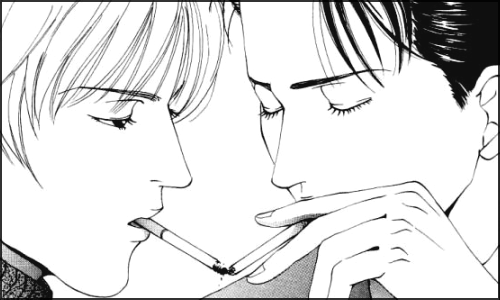
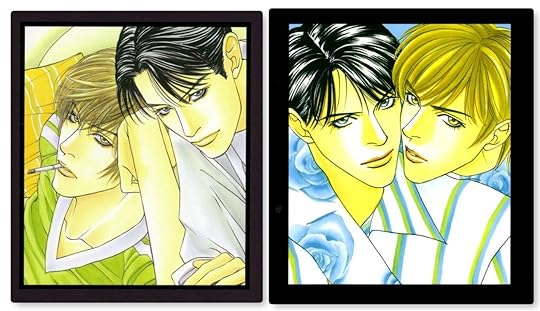
Overall I am giving this series a 4 stars in view of the pretty artwork (I love how the bishies look), the hot sex scenes and also in respect of the author's hardwork in producing the complex matured plot although the strangeness of their relationship and their annoying attitude towards romance didn't jibe well with me.
* Reviewed January 15th, 2017

June 2, 2012
Motoni sensei can easily be related to one of those authors that spin your mind on a spindle and leave you feeling in adequate. She is Brilliant, Beyond Brilliant. Her artwork sometimes is ecstatic and sometimes she blows YOU AWAY with a simple kiss to a man’s pulse!!! This Manga is one one of her EPICS after Shiiku Gakari Rika. Which is Brutal, Raw, and Naked in EVERY SENSE.
This is the story of two best friends one who are gay. The story is woven meticulously around how and when and IF he decides to bat for the other team and the rationalities he justifies to himself. The role both their girlfriends play is melting and I loved the way they both manipulated each other to make insanity compartmentalize in conventionality.
This is the story of two best friends one who are gay. The story is woven meticulously around how and when and IF he decides to bat for the other team and the rationalities he justifies to himself. The role both their girlfriends play is melting and I loved the way they both manipulated each other to make insanity compartmentalize in conventionality.
Displaying 1 - 3 of 3 reviews