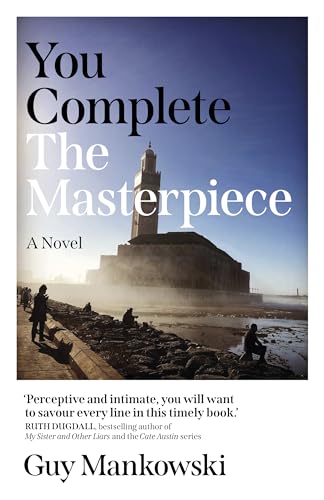
Millennial author Jude is lost in obscurity until he's saved by an award bequeathed by Alberto Valdez, the highly controversial surrealist Spanish author who first inspired him to write. But given Valdez's unsolved disappearance, the motives behind his giving Jude the award are a mystery. Jude soon learns that there is more to the award than he'd first realised, and it requires him to complete Valdez's final masterpiece. But why was he chosen? And can one person ever really know another - let alone complete their work? You Complete the Masterpiece is part jet-setting thriller, part literary puzzle, and part indictment of corruption in the #MeToo era.
The biography No Treble magazined described as 'long awaited'- which Substack certified as a 'bestseller' in February 2025 (a top 30 'Rising in Music Substack) follows volume one of two about Pfaff's life (taking the reader up to her joining Hole). Subscribers to the Substack are also hearing on there unheard songs by Pfaff, excerpts from her journal recordings, unseen photos from her time at the heart of the alt-rock music scene and other media. John Robb (the first journalist to interview Nirvana) said 'This book ultimately places Kristen back in the deserved centre of the narrative.’
Jane Savidge said of it, ‘Mankowski’s brilliant retelling of the extraordinary life of Kristen Pfaff- one of the most important players in the Seattle / Sub Pop scene- is a timely reminder that sometimes the heroes don’t always win and the truth is out there if you look hard enough.’
Mankowski is a Senior Lecturer at Lincoln University, and his agent is Matthew Hamilton at The Hamilton Agency.
Guy Mankowski’s latest novel ‘You Complete the Masterpiece’ pulls off a delicate balancing act. On one level it’s an intimate portrait of the main characters and their challenges yet the plot is dynamic with intrigue and crime stretched over a broad geographical canvas. A literary puzzle, satire and some important contemporary themes (#MeToo and inter-generational inequality) further elevate the novel.
This is accessible literary fiction at its finest. The author’s assured handling of prose works as an invitation, not a barrier, to the general reader. From the intriguing title onwards, everything is multi-layered. The book’s blurb refers to a ‘literary puzzle’ and this set me thinking. Was this an escape room style challenge or something else? In the end, I hit on the idea it was like a Matryoshka with each new plot point concealed inside the last like those intricate wooden dolls, harbouring secrets and reveals.
The story opens in Barcelona where aspiring millennial writer, Jude Green, has been catapulted from obscurity to centre stage after winning an award. His prize is connected to the estate of Spanish literary giant, Valdez, who has recently disappeared, believed dead. Jude has received 8,000 euros thinking he has only to spend a month as a writer in residence and deliver a lecture, with a similar amount payable on completion. Instead he’s handed a poisoned chalice linked to Valdez’s final collection of work.
Francine, Jude’s not-quite-girlfriend and co-author on a new project, has travelled with him to Spain but when Jude meets Valdez’s granddaughter, Maria, jealousies fracture their relationship before it briefly reignites.
The vice-chancellor of the university, Marco Velasco, is executor of Valdez’s estate and set to profit financially and professionally from the publication of his friend’s posthumous collection. While one strand of the narrative is a quest to discover whether Valdez is really dead, another focuses on rot and manipulation at the heart of this prestigious university. Privilege is embedded in the establishment. Institutions close ranks to protect their own. It’s staggering that in the post-#MeToo world, an entitled few believe they are bulletproof against allegations of sexual misconduct. On a quest to explain and expose the corruption, Jude’s journey takes him to Marrakesh and Casablanca where he collaborates with Rosalie, Velasco’s granddaughter to find the truth. It’s not a coincidence that granddaughters of two powerful literary and academic figures feature in this novel as they illustrate the theme of inter-generational inequality in different ways.
A scene in Casablanca takes place in Rick’s bar, famous from the Bogart/Bergman film. I’ve been to Casablanca but not to the bar. Despite the cliché of Play It Again Sam ‘oozing through the speakers’, Mankowski’s description and one character’s meditation on Casablanca being:
‘the place everyone gets stuck. The place everyone wants to escape from’
For me it had the opposite effect - I’m now super-keen to revisit!
The novel’s social commentary on the imbalance of life security between boomers and millennials is savage but handled with a light touch. There’s a literary puzzle, too, on the theme of ‘where is the author?’ Does an author exist in their work or in their possessions? Is Valdez dead or just missing? Does an author exist only when readers bring their own experience to ‘complete the masterpiece’. Mankowski empowers his characters, Jude and Rosalie, to come up with their best conclusion. In the case of Valdez they decide, ‘He didn’t find himself but he spent a lifetime looking.’
With Mankowski’s inside track on the culture of academia, students of English Lit and Creative Writing will devour this novel but I’m confident a general readership will enjoy it too. I loved it. Highly recommended.
Review by Helen Matthews, prize-winning author of 'Girl Out of Sight'
Rich in detail and wonderfully entertaining You Complete The Masterpiece draws attention to the ills of modern society, the greed seen in the charge towards wealth and the fickle nature of the #metoo generation as they plot and plan their way towards their obscure goals. Guy Mankowski captures the essence of a man, Jude, who is lost, wanting to be a writer, a man full of dreams and fears that he believes can make him a noted author, with a compassionate skill. Jude has always been inspired by Spanish author Alberto Valdez and when he wins an award for his recent manuscript, the money will get him out of debt and four weeks in Barcelona; the one caveat is that he ‘overlooks’ the last manuscript of Valdez before it is published. On his arrival in Barcelona, he is met by Valdez’s granddaughter Maria, a Spanish beauty, who informs him that he has to finish the manuscript or forfeit the prize; the manuscript, once complete, must not be read by anyone else until it is published. Valdez’s Will is very clear on the terms and conditions of the prize and Jude realises there is very little choice; with the help of Maria he sets out to make Valdez’s last manuscript one of which he would be proud. The narrative moves along at a brisk pace to reveal that all is not as it seems. There are people who are not to be trusted, people who will stop at nothing for what they believe is revenge and others who are blatant in their dishonesty. Add in the on again off again girlfriend, the girl next door who uses Jude’s apartment to shower as she has no hot water and the beautiful personable Maria, who just want to see her grandfather last wish complete! And there you have it, a manuscript in the making or life as it is lived! But then, it appears that maybe Alberto Valdez is not dead? Maybe this is just one big hoax for reasons unknown. What cost the price of fame and fortune is the question pondered as Jude reflects on his recent tumultuous few weeks. You Complete The Manuscript is a most enjoyable read with a conclusion that perhaps does not live up to the body of the book, but that is a personal reflection. Alternatively, as there are so many endings not quiet complete, maybe You Complete The Manuscript. Reviewed by Ian Banks for Bluewolf Reviews.
This is a powerful book about corruption, a theme the author has explored before. The language is lyrical, the message is sharp, and yet it never feels heavy. Instead, it flows in a way that kept me utterly hooked till the very last page. That balance is rare.
The story uses poetic language to show the truths about power, complicity, and the systems that allow corruption to continue. It also made me think.. where do we actually draw the line when deciding if something is corrupt, or immoral?
At the same time, it gives us characters and moments that feel real and human. And even with such a serious subject, there were touches of humour. I actually found myself wishing Mankowski would write a full comedy one day.