

What do you think?
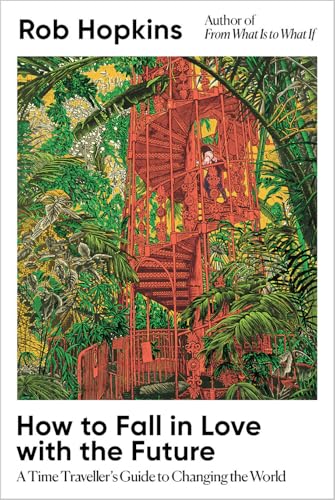
How to Fall in Love with the Future: A Time Traveller's Guide to Changing the World
Longlisted for the 2026 Wainwright Prize for Conservation Writing
2025 Foreword Reviews INDIES Award Honorable Mention for Ecology & Environment
There are an infinite number of possible futures that lie ahead of us—like threads stretching out into the distance. Rob Hopkins, cofounder of the international Transition Network movement, invites us to travel to future worlds we would actually want to live in.
"No one makes environmental optimism more credible or compelling than Rob Hopkins. Read this and don’t weep."
—Hugh Fearnley-Whittingstall, chef and campaigner
In 2020, when the COVID-19 pandemic disrupted every aspect of daily life, climate activist and Transition Network cofounder Rob Hopkins responded the way a lot of people by starting a podcast. But it wasn’t any ordinary podcast. In each episode, Hopkins and his guests would “time travel” together to the year 2030—walking down imagined future streets, talking with imagined future neighbors, visiting imagined future local businesses. While Hopkins’s guests came from all walks of life—economists, politicians, bakers, comedians, novelists and more—they all shared a willingness to suspend their worries about the future long enough to mentally inhabit and then describe a world they were thrilled to be a part of.
What Hopkins discovered was no less this simple exercise of visiting a positive future forced him to rethink the work he’d been doing as a climate activist for decades.
How to Fall in Love with the Future is the result of that radical disruption—and Hopkins’s deep dive into the people and movements throughout history who have used visions of the future to inspire positive change on a large and dramatic scale. From the life and writings of musician Sun Ra and the history of Black utopian movements to the latest neuroscience on what goes on in our minds—and hearts—when we “time travel,” Hopkins brings essential new thinking to anyone overwhelmed with dread and anxiety for the future. He asks us to what would the world look like if we all got to work imagining—and then building—a world we were deeply in love with?
"Rob Hopkins is one of the world’s great optimists. He really believes that things can get better, and, when he’s around, they usually do. This book will lift your spirits and give you hope."
—Brian Eno, musician, producer and artist
“Rob Hopkins puts imagination back at the heart of future-dreaming, offering us an irresistible invitation to dream bigger and then make those dreams a reality.”—Kate Raworth, author of Doughnut Economics
2025 Foreword Reviews INDIES Award Honorable Mention for Ecology & Environment
There are an infinite number of possible futures that lie ahead of us—like threads stretching out into the distance. Rob Hopkins, cofounder of the international Transition Network movement, invites us to travel to future worlds we would actually want to live in.
"No one makes environmental optimism more credible or compelling than Rob Hopkins. Read this and don’t weep."
—Hugh Fearnley-Whittingstall, chef and campaigner
In 2020, when the COVID-19 pandemic disrupted every aspect of daily life, climate activist and Transition Network cofounder Rob Hopkins responded the way a lot of people by starting a podcast. But it wasn’t any ordinary podcast. In each episode, Hopkins and his guests would “time travel” together to the year 2030—walking down imagined future streets, talking with imagined future neighbors, visiting imagined future local businesses. While Hopkins’s guests came from all walks of life—economists, politicians, bakers, comedians, novelists and more—they all shared a willingness to suspend their worries about the future long enough to mentally inhabit and then describe a world they were thrilled to be a part of.
What Hopkins discovered was no less this simple exercise of visiting a positive future forced him to rethink the work he’d been doing as a climate activist for decades.
How to Fall in Love with the Future is the result of that radical disruption—and Hopkins’s deep dive into the people and movements throughout history who have used visions of the future to inspire positive change on a large and dramatic scale. From the life and writings of musician Sun Ra and the history of Black utopian movements to the latest neuroscience on what goes on in our minds—and hearts—when we “time travel,” Hopkins brings essential new thinking to anyone overwhelmed with dread and anxiety for the future. He asks us to what would the world look like if we all got to work imagining—and then building—a world we were deeply in love with?
"Rob Hopkins is one of the world’s great optimists. He really believes that things can get better, and, when he’s around, they usually do. This book will lift your spirits and give you hope."
—Brian Eno, musician, producer and artist
“Rob Hopkins puts imagination back at the heart of future-dreaming, offering us an irresistible invitation to dream bigger and then make those dreams a reality.”—Kate Raworth, author of Doughnut Economics
192 pages, Hardcover
First published June 17, 2025
About the author
Rob Hopkins
27 books101 followersRob Hopkins did his permaculture design course in 1992, and around the same time saw Bill Mollison lecture in Stroud, and both of these things dramatically changed his life. He became involved in the Bristol Permaculture Group, and at the same time did a degree in Environmental Quality and Resource Management at UWE Bristol. His dissertation, ‘Permaculture - a new approach for rural planning’ is on his website. He moved with his family to Ireland, where he began teaching permaculture and laying the groundwork for the ecovillage development he wanted to undertake.
He set up Baile Dulra Teoranta, the first company granted charitable status for an eco-village development in Ireland. In September 2005 he moved to Totnes in Devon, to begin a PhD at Plymouth University looking at Energy Descent Action Plans, refining the model in such a way that they can be done anywhere.
He set up Baile Dulra Teoranta, the first company granted charitable status for an eco-village development in Ireland. In September 2005 he moved to Totnes in Devon, to begin a PhD at Plymouth University looking at Energy Descent Action Plans, refining the model in such a way that they can be done anywhere.
Ratings & Reviews
Friends & Following
Create a free account to discover what your friends think of this book!
Community Reviews
Displaying 1 - 30 of 91 reviews

November 6, 2025
I picked this book up on a whim at a bookstore — I just liked the title and cover. I didn’t realize it was about environmentalism, which is actually something I really care about. It’s all about imagining a positive future so we can actually act toward it instead of getting stuck in negativity. As someone who’s always been a bit of a futurist, I loved that message. It made me want to be braver and bolder about helping shape what comes next.

Read
February 3, 2026Questions we don't ask ourselves enough: what does the past smell like? Taste like? What about the future? There is something about smell that really grounds you in a specific time and place.
***
Initially, I almost put this book down. It reads like an instruction manual with a clear message and doesn't really provide me with any new information. More cynically, there is still (and there always will be) a part of me that finds this kind of narrative to be hopelessly naive... but I stuck with it, and I think what it does offer is a fresh perspective.
There is a lot of doomerism these days—and for good reason. Our hope has been weaponized against us as a kind of cruel optimism, and it can feel like the logical outcome is to treat our imaginations as a rich man's luxury, an outdated relic that can not survive the modern demands on our productivity. But I think it is human to still want to be brave enough to dream of something different, and that there is a power in collective longing and working together. So often we mistake pessimism and cynicism for realism, when sometimes this defeatism is really just a lack of imagination for something different than what we were sold.
To be clear, he is not just advocating for dreaming aimlessly, but for dreaming with an action plan. But what dreaming can do is provide a freedom to envision alternatives, of seeing the artificial barriers in our world as the man-made and fallible things that they are. What has been made can be unmade and remade. Dreaming of solutions is an act of creation, of a desire to live, instead of a suicidal acceptance of the status quo towards inevitable collapse. This book makes a great case for things that seemed "impossible" in the past (like less car-dependent cities) that are already working, and just need more of a push for mass adoption. I hope he is right... or, rather, I have a longing for a world in which we are right.
Like anything worth fighting for, there is always risk, especially the risk that the future will be colonized (again) by the dreams of a few powerful men. But as one of the best would say:
"We live in capitalism, its power seems inescapable — but then, so did the divine right of kings. Any human power can be resisted and changed by human beings. Resistance and change often begin in art. Very often in our art, the art of words."
- Ursula K. Le Guin
***
Initially, I almost put this book down. It reads like an instruction manual with a clear message and doesn't really provide me with any new information. More cynically, there is still (and there always will be) a part of me that finds this kind of narrative to be hopelessly naive... but I stuck with it, and I think what it does offer is a fresh perspective.
There is a lot of doomerism these days—and for good reason. Our hope has been weaponized against us as a kind of cruel optimism, and it can feel like the logical outcome is to treat our imaginations as a rich man's luxury, an outdated relic that can not survive the modern demands on our productivity. But I think it is human to still want to be brave enough to dream of something different, and that there is a power in collective longing and working together. So often we mistake pessimism and cynicism for realism, when sometimes this defeatism is really just a lack of imagination for something different than what we were sold.
To be clear, he is not just advocating for dreaming aimlessly, but for dreaming with an action plan. But what dreaming can do is provide a freedom to envision alternatives, of seeing the artificial barriers in our world as the man-made and fallible things that they are. What has been made can be unmade and remade. Dreaming of solutions is an act of creation, of a desire to live, instead of a suicidal acceptance of the status quo towards inevitable collapse. This book makes a great case for things that seemed "impossible" in the past (like less car-dependent cities) that are already working, and just need more of a push for mass adoption. I hope he is right... or, rather, I have a longing for a world in which we are right.
Like anything worth fighting for, there is always risk, especially the risk that the future will be colonized (again) by the dreams of a few powerful men. But as one of the best would say:
"We live in capitalism, its power seems inescapable — but then, so did the divine right of kings. Any human power can be resisted and changed by human beings. Resistance and change often begin in art. Very often in our art, the art of words."
- Ursula K. Le Guin

August 4, 2025
I was really excited to read this one, even more so after the first two chapters. But then things took a turn, becoming little more than piecemeal examples of people and organizations creating visionary shifts through various executions in different communities. While a lot of these examples were important and interesting to learn about, the book lost its guiding thread for me and no longer felt relevant or substantial. It was definitely optimistic and had a lot of useful and joyful moments, but I ended it feeling unsure of the takeaway. If it really was simply a how-to on designing a Time Machine workshop on climate-positive futures with scattered inspirational examples, well ok then, checkmark. I was hoping for a lot more from this book, and it never got there.

April 4, 2026
4.5* - an uplifting read and great reminder that a better future is possible :)

August 27, 2026
How To Fall in Love with the Future is a love letter to climate activism and a call to collective action.
The book starts off with the premise that, to build a better future, we have to want it. To want it, we have to be able to imagine it (or remember it). The author is a podcaster whose mission is to show people “the future” of the planet so that, when they think about it, they can remember what they saw and know what they're working toward. As he explains, he wants to give people something to run towards rather than something to run from. He does this by pretending he's a time traveler.
The book doesn't quite follow what he probably does on the podcast. Instead, it shows how his time-traveling approach and other people's ideas can help improve the future (depaving cities, restaurant forests, Afrofuturist grassroots communities, funding for sci-fi projects, utopian moments, and more).
I thought this was a very cool book that made me excited about what other people are doing. Nowadays, you can't check the news without seeing climate change affecting one place or another, and it was nice to see that, alongside all the bad news and the people making things worse, there are also people out there working toward something better. It even made me want to start listening to the podcast.
I also liked that it point to the “everyday” reasons why people can’t care or do enough for the planet, besides the usual defeat sentiment that comes from seeing you’re here drinking from dissolving paper straws while the US bombs oil refineries in Iran. The concept of time poverty (feeling you don’t have enough time in a day and sacrificing exercise, cooking, sleeping time) was enlightening to me, I never heard of it. I’m typing this at 5.20 AM while going to the gym with 4 hours of sleep so it hit me hard 👌
While I enjoyed it, I think the book moved too quickly, and I wish it had spent more time on everything because it felt a bit surface-level. I would have especially liked to know what positive impact is already being achieved (or is hoped for) with the initiatives presented in the book. It addresses them too broadly, and I would have loved more specific details (like the number of books published, people attending events, meals served, projects scaled up, or people inspired to grow their own food).
“Sci-fi is strategy.”
The book starts off with the premise that, to build a better future, we have to want it. To want it, we have to be able to imagine it (or remember it). The author is a podcaster whose mission is to show people “the future” of the planet so that, when they think about it, they can remember what they saw and know what they're working toward. As he explains, he wants to give people something to run towards rather than something to run from. He does this by pretending he's a time traveler.
The book doesn't quite follow what he probably does on the podcast. Instead, it shows how his time-traveling approach and other people's ideas can help improve the future (depaving cities, restaurant forests, Afrofuturist grassroots communities, funding for sci-fi projects, utopian moments, and more).
I thought this was a very cool book that made me excited about what other people are doing. Nowadays, you can't check the news without seeing climate change affecting one place or another, and it was nice to see that, alongside all the bad news and the people making things worse, there are also people out there working toward something better. It even made me want to start listening to the podcast.
I also liked that it point to the “everyday” reasons why people can’t care or do enough for the planet, besides the usual defeat sentiment that comes from seeing you’re here drinking from dissolving paper straws while the US bombs oil refineries in Iran. The concept of time poverty (feeling you don’t have enough time in a day and sacrificing exercise, cooking, sleeping time) was enlightening to me, I never heard of it. I’m typing this at 5.20 AM while going to the gym with 4 hours of sleep so it hit me hard 👌
While I enjoyed it, I think the book moved too quickly, and I wish it had spent more time on everything because it felt a bit surface-level. I would have especially liked to know what positive impact is already being achieved (or is hoped for) with the initiatives presented in the book. It addresses them too broadly, and I would have loved more specific details (like the number of books published, people attending events, meals served, projects scaled up, or people inspired to grow their own food).
“Sci-fi is strategy.”

June 12, 2026
Such a beautiful title and premise for a book about wishful thinking. I had high hopes.

April 6, 2026
I generally agree with and appreciate the message that we need to be able to envision a future that we want in order to combat climate change. I didn’t love the execution (as much as I wanted to) in this book though.
I wish the time spent elaborating on community examples was shortened (not erased!), and I wish he talked about psychology more. Sigh I guess that wasn’t the intent of this book- just my opinion
I wish the time spent elaborating on community examples was shortened (not erased!), and I wish he talked about psychology more. Sigh I guess that wasn’t the intent of this book- just my opinion
July 12, 2026
The general atmosphere of this book is amazing and I really enjoyed the first and the last chapter, where he speaks about his motivations and his time-travel workshops. Everything in between can be summarized as hopeful examples of where people are already living a „better future“. I agree that they give hope and I enjoyed learning about them, but from a story-telling point of view, the book quickly gets repetitive. Reading this book has definitively widened my horizon and deepened my hope, so I can recommend it!

August 12, 2026
Really loved this book! Given how much dread I feel about climate change, and the future in general, it was really uplifting to read a book and learn about so many people who are driven to make the future feel like a positive place. 💕 It was heartwarming and made me feel a bit more motivated to do something about it.

July 16, 2026
A fun take on how to build hope and belief in better futures. Maybe the only feel-good/encouraging activism book I’ve ever read?? I do wish it was a scooch more grounded. He had me at time machine, lost me at space travel.
June 1, 2026
WE SHOULD ALL BE DOING THIS EVERY DAY.

January 25, 2026
I should probably rate this 2 stars. But, it's a wonderful premise and a beautiful cover and I don't want to be too punitive.
The first chapter was nice in the way it planted you in a fictional 2030 world and the third chapter was also cool in the way it told real stories of places that are already living in the future in some dimension.
Beyond that though, blech. It repeats itself over and over and over again in 1% different ways each time. It spends 90% of its time telling you how to time travel (by imagining that you are in a beautiful future and then talking about what you see) and telling stories of groups and organizations doing this time travel exercise and how those people felt great doing it. The phrase time travel has to be in the book no less than 2000 times.
On pg 35 it outlines that we tend to think of utopias in two different ways: sci-fi utopias and green utopias. This reminded me of Kai-Fu Lee's book, AI 2041: Ten Visions for Our Future. That scif-fi book was super imaginative in presenting 10 different complex stories each detailing a different dimension of what the future might hold. In ways that sometimes made you excited, or hopeful, or sad, or fearful. I finished that book with a larger imagination for the future of tech than I started it with and I wish this book had the same effect on my imagination of the relationship between society and nature.
The first chapter was nice in the way it planted you in a fictional 2030 world and the third chapter was also cool in the way it told real stories of places that are already living in the future in some dimension.
Beyond that though, blech. It repeats itself over and over and over again in 1% different ways each time. It spends 90% of its time telling you how to time travel (by imagining that you are in a beautiful future and then talking about what you see) and telling stories of groups and organizations doing this time travel exercise and how those people felt great doing it. The phrase time travel has to be in the book no less than 2000 times.
On pg 35 it outlines that we tend to think of utopias in two different ways: sci-fi utopias and green utopias. This reminded me of Kai-Fu Lee's book, AI 2041: Ten Visions for Our Future. That scif-fi book was super imaginative in presenting 10 different complex stories each detailing a different dimension of what the future might hold. In ways that sometimes made you excited, or hopeful, or sad, or fearful. I finished that book with a larger imagination for the future of tech than I started it with and I wish this book had the same effect on my imagination of the relationship between society and nature.

April 7, 2026
Heartwarming! Hopkins asks us to leave cynicism in the present and join him on a journey to the future, a future in which we've done everything we can to avoid climate disaster. The book opens with a description of this future, which might make your eyes roll until it backs this up with examples of cities and organisations around the world which have already taken the first, radical steps to make this future a reality. The vast remainder of this book is more about 'futurism' in itself and how different artists and activists play with the concept of time travel to enable us to imagine alternative futures, I found this section a bit more dry but still interesting.
Would recommend!
Would recommend!

February 18, 2026
If you're demoralised by all the bad news in the world, then this is such a tonic as well as a compelling and inspiring call to action. What's more, I can honestly say that Rob Hopkins is the real deal having been fortunate enough to attend one of his 'How to Fall in love with the Future' trainings last week. Unlike many leaders who get a bit 'precious' about their intellectual property Rob's book - and workshops - focuses on equipping people to take these very practical ideas and interactive activities and run with them. Power to the imagination for a better world for us all!

February 21, 2026
This is a beautiful book. I listened to the audiobook, which is read by the author. He’s a great reader, but I need to buy a copy, reread it and mark it up.

October 10, 2026
How to Fall In Love with the Future: A Time Travellers Guide to Changing the World has inspired me to continue cultivating utopian moments in my day to day life. As well motivated me to connect with other people creating change in my local community to connect with my place and the wonderful work humans are doing here.
One of my favourite chapter was chapter 8 on Time, the current ways in which we live by time feels so wrong and limiting, living minute to minute and it was interesting to expand my concepts and hear about other cultures relationship to time.
Hope is infectious from Rob Hopkins enthusiasm and research on how many groups are enacting change towards a utopia now. If only we could get the capital fat cats to see the only way forward is to harness this way of dreaming and becoming.
I dream of more birds and bees and trees, cyclists and community spaces amongst the moss, herbs and solar panels.
Solarpunk is a way of life here and now!
One of my favourite chapter was chapter 8 on Time, the current ways in which we live by time feels so wrong and limiting, living minute to minute and it was interesting to expand my concepts and hear about other cultures relationship to time.
Hope is infectious from Rob Hopkins enthusiasm and research on how many groups are enacting change towards a utopia now. If only we could get the capital fat cats to see the only way forward is to harness this way of dreaming and becoming.
I dream of more birds and bees and trees, cyclists and community spaces amongst the moss, herbs and solar panels.
Solarpunk is a way of life here and now!

June 7, 2026
I loved the idea of this book. It was particularly good in the first few chapters at helping the reader imagine alternate futures that our current earth could aspire to. I also loved learning all of the ways that people are already doing that work. I particularly loved learning about the beavers in England who were re-introduced into the environment and then were able to solve loads of water problems humans had created because of the damns that they (the beavers) created naturally. This is a deeply hopeful read. I love that the imagined futures aren't for futures decades off from now, they are just about imagining new futures we could get to within 5 years if we could just make changes in our own communities and within the systems around us.

September 12, 2026
What a lovely book. I heard about this at an education conference and I immediately put it on hold because the quote that was shared by the plenary speaker was so hopeful. I appreciate the optimism of this book that is grounded (not naive). Cynicism about the future is an easy trap, but it will never be as powerful as hope for prompting actual change ❤️ I needed this book to revive that sense of why not and what if and not yet.
A bit repetitive at times. Focused on climate change issues, but easily applicable to whatever issues you care about where hope feels heavy
A bit repetitive at times. Focused on climate change issues, but easily applicable to whatever issues you care about where hope feels heavy

September 3, 2026
I enjoyed the beginning of this book and had high hopes for it, but it unfortunately ended up being disappointing. It had really interesting mindset of how to think about various topics in a positive way. The book didn’t really give me any new insight, information or ideas, and in the late at chapters when he talked about the space traveling it lost the whole imagination for me to think about a realistic green future.

March 21, 2026
Zo verrukkelijk om je de gedroomde toekomst van deze planeet en haar bewoners in te beelden.
Wat zie je, wat hoor je, hoe ziet de straat er uit, waar zijn de auto’s, hoe is al het groen, hoe zijn de mensen?
Wat zie je, wat hoor je, hoe ziet de straat er uit, waar zijn de auto’s, hoe is al het groen, hoe zijn de mensen?
September 3, 2026
Sådär alltså. Läste i skolan till kurs SU1212. Hade hoppats på att den skulle vara bra. Den lät och såg intressant ut. Men den kändes lite rörig och osammanhängande. Hittade ingen direkt röd tråd. Kändes mer som han beskrev olika scenarier och intervjuade några personer om deras tankar. Jag har inte med mig något direkt från boken. Kanske läser igenom igen innan tentan om det verkar relevant.

October 1, 2025
I actually have to meet this bloke. Recommend!

June 18, 2026
I wish I could give it 4.5. The book is definitely inspiring, and gives practical advice on how to run effective workshops (I might incorporate parts of in my own work). A huge plus is reading anything sustainability related that is actually positive and optimistic!

July 7, 2026
the future is (hopefully) bright

April 9, 2026
Very thoughtful & full of wonder, & gave me a much needed dose of hope & positivity for the future. Let’s long for that best version of the future of our dreams & use that as fuel to make the steps to get there! What if! Yes, and…

May 28, 2026
I enjoyed listening to this audiobook in bite-sized pieces so it felt like a podcast series. Imagining the exercises described in the book was helpful for cultivating hope and visualizing what a better future could look really look like.

June 12, 2026
laying in ashes, goggles broken, battery dead, / I will still smile at the sparkly, energetic Rob Hopkins and his fellow time travelers, / happy to know that they exist, / powerful, free and elevating humanity.

June 17, 2026
A much needed dose of hope for the planet. Bursting with ideas for our future.
August 14, 2026
A beautiful reminder to keep dreaming of a brighter future & not let cynicism interfere with your activism !!!
September 1, 2026
Perspective changer for sure
Displaying 1 - 30 of 91 reviews