Jump to ratings and reviews
Rate this book

What Art Does: An Unfinished Theory

Rate this book
Why do we need art?

What Art Does is an invitation to explore this vital question. It is a chance to understand how art is made by all of us. How it creates communities, opens our worlds, and can transform us.


Curious and playful, richly illustrated, full of ideas and life, it is an inspiring call to imagine a different future.

131 pages, Kindle Edition

Published January 15, 2025

120 people are currently reading
4663 people want to read

About the author

Bette Adriaanse

5 books15 followers
Bette A. - also known as Bette Adriaanse - is a writer and an artist from Amsterdam.
Her novels include ‘What’s Mine’ and ‘Rus Like Everyone Else’. With artist Brian Eno she wrote the non-fiction book ‘What Art Does’. Her short story collection ‘Slow Stories’ is forthcoming with Unnamed Press.
Bette writes in English and in Dutch.
Bette is also a visual artist, a teacher and the co-founder of the TRQSE Foundation, an international network for artists and scientists, who work together on projects with a social purpose.

Ratings & Reviews

What do you think?
Rate this book

Friends & Following

Create a free account to discover what your friends think of this book!

Community Reviews

5 stars
326 (42%)
4 stars
307 (39%)
3 stars
122 (15%)
2 stars
12 (1%)
1 star
2 (<1%)
Displaying 1 - 30 of 132 reviews
Profile Image for s.penkevich [hiatus-will return-miss you all].
1,573 reviews15.1k followers
June 13, 2025
Brian Eno? Say no more…
If you need a little dose of joy, this little book is for you. What Art Does: An Unfinished Theory is a whimsical collaboration between Brian Eno and Bette A. that reminds us how art can bring magic into our lives. ‘Art is where we share dreams (and nightmares),’ Eno writes and shares these dreams with all of us to help us be more mindful of how art can shape our minds, hearts, and do so to better affect change in ourselves and the world around us. ‘Art changes how we feel about feelings,’ he points out, ‘how we notice them, how we respond to them, how we compare them, how we make use of them,’ and through this little book we are taken on a lovely and riveting little ride into the soul of art, accompanied by some rather cute artwork. It is a quick read, but one that will shine into all the artistic caverns of your heart to brighten you from the inside out and bring an optimistic smile and hopefully a bit of inspiration.
Untitled

One of Eno’s primary concerns is to examine how ‘art is something that punctuates our lives with feelings.’ Art is the closest thing to pure magic left in the world, how a static image or collaboration of words and phrases on a page can evoke a stirring in our hearts or send us soaring into joy, sorrow, hope, or any other torrent of emotional resonance. We think about how color can shape our impressions, how brushstrokes can harness our feelings, how a beat can get us moving and how a melody can harmonize with our souls and feel like the cosmos have aligned across the sound waves. The spark of joy and fun is all part of the art and Eno examines how creating art is similar to how play is important to children. He has us think about ‘how we project our minds into possible futures where we create and test projects that do not presently exist’ not unlike how imaginative play works.
In art, we try out new possible worlds and other ways of being, by paying attention to our feelings about them. Art allows us to share complicated concepts and feelings with each other. This cultural conversation opens doors to shifts—in ourselves and in society. Art shepherds change.

When we consume fictional words or imagine possible worlds that we express through art, we absorb those worlds into our hearts and desires and carry them with us wherever we go. By imagining better worlds we give our hearts a target and can start constructing a map how to arrive at those better worlds from the one we are in now. ‘Meanings are fluid, not eternal: they shift in time and space’ Eno says and through the way we perform language and symbolism through art we can change the meanings or connotations behind words and ideas. It might seem like small changes but small changes amalgamate into big ones.

Making art seems to be a universal human activity

In a world of AI we often think about how creating art is part of what makes us human and every society across history has had it’s own artistic culture. ‘Two things significantly distinguish human beings from other animals: an interest in the past and the possibility of language,’ author Jeanette Winterson writes in the novel Art and Lies, ‘brought together they make a third: Art.’ Art is how we capture the human condition and the spirit of the times but it also helps us sort out what matters to us:
What an artist chooses to write or make drawings or songs about, can draw out attention to certain worlds. It tells us that somebody takes something seriously, perhaps finds it beautiful or threatening, and invites us to rethink how we feel about it. The things we care about are the things we make art about. We frame them with our attention. Art is proof of care.

I find this to be a really beautiful sentiment, how we frame ideas with our attention as if we are the gilded frames holding the artwork in the museum of history. ‘I paint flowers so they will not die,’ artist Frida Kahlo once said, and in this way art is a path to an immortality of sorts.

If we want a new world, we have to start making it right now.

Brian Eno and Bette A. have done a wonderful job and I really enjoyed this bite-sized book on art and why it matters. Also thank you to Stephanie and her review for recommending this one to me. Go out, create art, share art, collaborate, share imagination, share dreams, share inspiration, and share your humanity with all. Art is magic and we can all be magicians.

4/5
Profile Image for Beth.
635 reviews17 followers
April 1, 2025
This is one of the most delightful little books I've ever read.

Eno's approach to art is not only that it's something that brings people together, it's something we all do every single day. Has someone ever complimented you on your outfit, or vice versa? You, or they, made a creative and aesthetic decision in choosing that outfit. You expressed yourself with the clothes you picked out to put on your body. Having someone acknowledge that you made a good decision makes us feel good but it also makes them feel good to recognize your good taste.

Art is all around us and it is pervasive in our daily lives. Eno maintains that we can recognize that and celebrate it in ourselves and in others, and in the process, we can connect to others.

Bette A. is a Dutch artist and her illustrations are a nice accompaniment to Eno's words, but his words are what had the most impact on me.

I'm on the verge of saying that this was a life-changing book for me (as well as the "Eno" documentary, which I have watched several times now). As a hardcore science type, I have never thought of myself as particularly creative. A good friend pointed out a while back, when I wrote often in a blog, that that was certainly a creative endeavor. Perhaps it's time that we all recognize that we are creative in numerous, varied ways, and that this can be an important way to connect to others.

This would be an ideal book to share with a young person interested in art, but anyone of any age could benefit from its simple but mind-blowing concept. I can't recommend this book enough. (And see the documentary if you get the chance!)
Profile Image for Rhonda Hankins.
777 reviews2 followers
Read
December 27, 2024
Nifty book with playful graphic design to get across messages that might inspire you.

Takes a couple of hours to read but there is plenty in the book to prod you for quite a while.

& a bibliography is a very nice bonus, greatly appreciated.
Profile Image for Adele.
27 reviews6 followers
Read
April 26, 2025
A bit confused by the tone - is it for children or adults who don’t know much about art and need it explained in simple words? Not very convincing and slightly muddled points about haircuts and gender. The basic premise is good but what is it for?
Profile Image for John Burroughs.
Author 55 books385 followers
April 22, 2025
So grateful to Eno for this important collaboration with Bette A and for so much more.
Profile Image for GONZA.
7,449 reviews127 followers
May 11, 2025
Much like Neil Gaiman's book “Art Matters,” this short essay by Brian Eno, accompanied by Bette Adriaanse's illustrations, tells in a straightforward and simplistic way, what the reasons are for why art came into being and what it “serves,” or better said, what it does.
Between a coffee table book and a children's book.

Molto simile al libro di Neil Gaiman "Art Matters", questo breve saggio di Brian Eno, accompagnato dai disegni di Bette Adriaanse, racconta in modo immediato ed anche piuttosto semplice e semplicistico, quali siano le ragioni per cui l'arte é nata ed a cosa "serve", anzi, cosa fa.
Quasi un libro per bambini,
Profile Image for Lay.
51 reviews
September 15, 2025
“There’s a beautiful sculpture by Giuseppe Penone [Alberto porta]. He took a tree trunk and cut away most of the growth of the tree, leaving behind what had been there when the tree was ten years old.

Inside big tree is baby tree. Inside you is little you. It’s always there.”


Profile Image for Mads.
199 reviews
February 11, 2025
cute! very charming, easily digestible, but full of good ideas and thoughts
Profile Image for Adam.
366 reviews5 followers
October 9, 2025
I can’t believe I’m rating something written by Brian Eno anything less than 5 stars or whatever the maximum is on any grading system. Eno is one of my favorite public figures. I’m dazzled by his artistry and his intellect. And I don’t mean just his music (which is among my most favorite - both his singularly off-beat pop and his ambient). I feel fortunate every time I discover and read another interview or article by him.

I didn't expect a grand thesis (the title makes that clear), but I was left wanting for a little more. Even so, Eno expresses his ideas cogently:

“Art is how adults play. Art is the continuation of play into adulthood. We keep playing as adults because we need to keep learning. Play is research. In art we research our feelings. Artists are feelings merchants–a piece of art is something designed to trigger feelings. Our feelings guide us as we move into new futures, either by tempting us on, or frightening us away” (72).

“Paying attention to the things we love and that make us feel good and happy isn’t an indulgence, but a sensible use of our faculties. That’s why we evolved them. The problem is that those faculties are constantly overwhelmed by things that other people wished that we liked” (77).

“Central to the idea of a cultural conversation is the notion of surrender. Surrender is what we do when we stop trying to control things, when we let something happen to us.

All humans voluntarily engage in activities that involve surrender–sex, drugs, religion, art–and very often these are considered peak experiences. In each of those we deliberately put ourselves into a situation whose reward is to be carried along by something ‘bigger than us.’

Surrender becomes an active verb. It’s a way of stepping back from individualism, stop being ‘me’ for a little while and enjoying being ‘us.’ This voluntary suspension of control allows us to have experiences and feelings that are new to us, that didn’t originate in our conscious brains. Isn’t this what we also call learning?” (104).

“As a species, we’re so phenomenally good at control, that we tend to think it must be the right posture for every problem.

But genuinely novel situations don’t come with ready-made control strategies: we have to understand them by letting them happen to us. If that’s too dangerous, we can simulate them, and let the simulations happen to us.

That’s what we’re doing in art.

If we don’t learn to make a balance between control and surrender, if we only know how to control, we end up in a world shrunken to the bits that we can still control. The raw wild world develops and leaves us behind, playing Solitaire on our phones” (105).
Profile Image for Cady.
157 reviews
November 20, 2025
Art is feelings and feelings is art <3 really loved this! I feel like we take a lot of art, and what we consider art, for granted when really art is about self-expression and language that’s found in the every day. Really appreciate Eno’s focus on art as a way to connect people together, to imagine different worlds, to understand others and share lived experiences — it’s basic theory that gets forgotten about and under appreciated in this capitalist hellscape. We make art every day, whether we realize or not, just in the way we choose to present ourselves to the world.
Profile Image for David Glass.
9 reviews
January 12, 2026
Definitely art. The wisdom is wonderful and concise, yet poignant and silly too. The hand drawn illustrations added a lively and playful dimension to the feeling of reading this book. Brian Eno has such a hypnotic way of describing the human experience whether through spoken or written language.

Two quotes I loved:
"Art is a way of making feelings happen"
"to realize that what we need is already inside us, and that art - playing and feeling - is a way of discovering it."
Profile Image for Stephanie.
19 reviews2 followers
December 21, 2025
This book is a work of art all by itself. Eno and A masterfully break down high philosophy into a warm comfort and cadence similar to that of a children's book. They provide an approachable entry into art appreciation and sociology by inviting a relationship to a shared experience rather than requiring several 1,000 word essays on cubism. In a world that seems so utterly bleak at times right now, this book is a calming presence that reminds us of the importance of the things that make us human and that proffer connection.
Profile Image for Julie Meunier.
44 reviews2 followers
July 23, 2025
Incredibly simple, and thoughtful. This should be required reading for everyone, especially all creatives.

This feels like the kind of book I want to carry around with me just to remind myself why I do what I do.
Profile Image for Nik Maack.
765 reviews38 followers
January 17, 2026
A fairly light and simple philosophy that I appreciated reading. I picked up this book because I heard Brian Eno on the Ezra Klein podcast talking about art. It was great. And I would not call myself a fan of Brian Eno's music.

"Civilization is shared imagination."
Profile Image for Leah Weyandt.
118 reviews4 followers
March 11, 2025
“The art engagement begins where the functional engagement ends.”

“Art can have a tremendous effect on the world - that is why dictators have been so eager to lock artists away or employ them as propagandists. But art is effective because it is safe.”
Profile Image for Stuart Smith.
281 reviews1 follower
May 4, 2025
A fun, if very slight, examination of art and its place in society.
Profile Image for Katie.
27 reviews
October 30, 2025
“inside big tree is baby tree.
inside you is little you.
it’s always there.”
🥹🥹🥹🥹🥹🥹🥹

this was simple yet complex. i had a great time reading it!
Profile Image for Cesca.
21 reviews
August 6, 2025
Play is how children learn and art is how adults play :)
Profile Image for Jari Mäkelä.
35 reviews1 follower
October 10, 2025
A book full of quotable gold nuggets on every page.

I leave it at this:

"If we don’t learn to make a balance between control and surrender, if we only know how to control, we end up in a world shrunken to the bits that we can still control. The raw wild world develops and leaves us behind, playing Solitaire on our phones."
Profile Image for nini.
149 reviews
October 17, 2025
it was facilitation as a book not about facilitation + quite cute — 🩷
Profile Image for Ryan Harris.
104 reviews
April 24, 2025
A delightful reflection on the essential role of art in our lives. Eno argues that art—broadly conceived as any form of creativity that does not have a purely functional purpose—provides a safe space to explore and experience our feelings. We make and consume art to learn and convey how we feel, in a similar way to how children learn about the world through play.

*
“Art is a way of making feelings happen.

It may sound trivial, until you realise that what we call feelings comes before what we call cognition – thinking. Feelings come before thought and articulation. They are our antennae, they help us feel our way forward into the future.

Most of the really big choices in our lives – who to marry, who to vote for, which job to take, whether or not to try to have children – aren’t based on just the careful application of logic and deduction: we use our feelings.”

So I guess art speaks to, or speaks for, our feelings before we know our thoughts.

That is certainly true of the books I read. I look for what resonates with me and I write about it here to understand why.

This year I have read a lot about art, poetry, Rachel Cusk talking about family, musician memoirs, work essays, clothes, home. These are all feelings on my mind and I seek out conversations about them to translate how I feel into thoughts and words, and then actions.

I guess it brings me comfort that other people make art about these things. That these feelings are in some way shared and I can connect with them.

*
“Take haircuts, for instance - the practice of shortening your hair. The very first intentional haircuts in human history may have been simply functional: a way to keep the hair out of your eyes. And, since humans love experimenting, they would naturally have developed different ways of doing that - some easier, some more elaborate.

Perhaps, in some groups, women started doing it differently from men, or older people differently from younger ones. Those different ways of doing it would soon come to stand for 'male or female', 'older or younger'.”

I cut my hair short recently and I regretted it. I saw a photo of me having dinner with a friend and overreacted to the size of my forehead. It seems I had been watching too much football analysis with men and I wanted to look more masculine. I even grew a moustache.

But then it didn’t feel like me. I didn’t feel soft or wavy or fun. I didn’t feel a modicum of femininity to balance the masculinity of my body.

So I am growing it back. I think I’ll do highlights again too to feel beachy and light. To put my hands through something.

Every time I do this—change my hair—I always come back to ‘my’ style, and that’s OK. Conan O’Brien has had a definitive style his entire career and it is what makes him recognisable and unique.

I want to feel recognisable and unique.

I want to laugh at absurdity.

*
“Art doesn't have to be eternal. There could be something that works as art for a few people for a few weeks, for a lot of people for a hundred years, for one person for a lifetime, for a small number of people for a thousand years. There are all sorts of levels.

It is always a conversation, even if there is only one person involved in the conversation. You might make art as a conversation with yourself.”

Totally. Art is a conversation of feeling. I learn from books, from music, from gardens, from architecture, about how I feel.

It is why I ‘review’ books here. They are prompts through which I generate feeling-words.

In a way, I am just rearranging the words I have read to express how I feel. Like a feeling machine. Without them I would be mute.

*
“But what's wrong with escaping? What's wrong with wanting to experience another reality that is better than this one? What does that tell you about this one?

If you find out what 'better' means for you, you have a richer understanding of the world you're in and what it is missing. If you find, for example, that you're drawn to listening to types of music where not much happens, where there are big open spaces, it may make you realise that you want to live in a world where there's less stimulus ... That's important to know! Wanting less stimulus can be quite a radical message in a world where you are exposed to ten thousand adverts a day.”

I’m not sure I use art as escapism per se but let’s explore that idea for argument’s sake.

Let’s take my 10 most played songs of the year so far and ask, what am I missing?

1. Lonesome Tonight, New Order
Hm. OK, sure, romantic love is ‘missing’ from my life. But I am not lonely. I experience longing but it is a light longing. A fun longing? I think more so what I’m missing is band members to write bangers like New Order. A friend is coming over soon though to jam.

2. Reason Why, SOPHIE (Mixed by Björk)
Am I missing being high and dancing with a partner in my living room, arms up, ecstatically? I mean, yes? But I can do that by myself?

3. Age of Consent, New Order
The ability to write catchy songs? I’m trying?

4. Kusi Na Sibo, Ebo Taylor
Hosting friends at home? Purchases made, playlist made, dates scheduled.

5. Your Silent Face, New Order
I gave up trying to learn that drum machine. I had a friend who offered to play drums though, so why don’t I take him up on that offer?

6. Sweat (On The Walls), John Tejada
MDMA? Yes, missing. Summer was a bit drug-fuelled and I relearned what I like and don’t like. But it’s been over a decade since I felt that feeling. I know how dangerous it is, but I want to dance.

7. Dog Proposal, Dry Cleaning
A dog? Not now. Certainly not a toller. I bumped into one the other day and its beauty was nullified by its distracted lack of affection. Fair enough though.

8. Song of the Black Swan, Pink Martini
Family? Love? Freedom within love? Travel? I can’t figure this one out.

9. Nasty, Franco Smith & TimiR (Mixed by Amelie Lens)
Hahaha, yeah.

10. Aspettami (First Recording), Pink Martini
All of the above?

Conclusion, I am not missing anything at all. I just want to share how I feel.

*
“Art is that cloud; a reservoir of shared experiences that gives us ways of sharing complex feelings and ideas with each other. It's the lifeblood, the lubricant, the circulatory system of community. The maintenance of community.”

Exactly, art is community.

Strangers enjoying live music together.

Guests in your home.

Readers of words.

A communion of feeling.

*
“A wish for this book would be that it causes us to reassess the value of these two things: playing and feeling.

And to realise that what we need is already inside us, and that art - playing and feeling - is a way of discovering it.”

Yeah, I think that’s true. I use art to stir up strong emotions that already exist within me. I want to feel strongly in the same way that I want to lift heavy things at the gym or ingest mushrooms or see friends and family I love. It is validating, it is soothing, it is regulating, it is fun, it is beautiful.

I think the strong emotions we stir up in other people though, through relationships and communication, is… more complex? Certainly not as a safe as art. Certainly not as risk-free. Certainly not as certain.

Which leads us back to art. To feel and to play.

*

The original formatting and illustrations of this work is such a treat. So much content we consume is fitted to a standard frame, even books. The graphic design and illustrations of this work—even just text on contrasting colour backgrounds—is a visual relief. In that sense I felt like Eno and Adriaanse achieved equal authorship.
31 reviews1 follower
November 17, 2025
Powerful little book that made me think about art, why it exists and why it is important in our lives.
Some insights:
- everyone makes art, artists just made it their job
- haircuts and clothes are part art, part practical
Profile Image for firuza huseynova.
19 reviews3 followers
February 24, 2025
really good, short but sweet. i might be biased because i paid an exorbitant amount of money for a signed copy of this book so i need to get my ROI back in knowledge.

“The things we care about are the things we make art about. We frame them with our attention.”

“We could say that art is one of the key attributes of being human, like language. It’s easy to understand why language is so universal, but we don’t seem to have a very clear picture of why art should also be.”

“A meme that goes out on social media may reach a ton of people, and do all the things that another piece of art does - but perhaps not for very long. That doesn’t mean it wasn’t important. It just means it was a short-lived piece of art.”

“[Art includes] all kinds of things where somebody does more than is absolutely necessary for the sake of the feeling they get by doing it.”

“We all make art all the time but we don’t usually call it that.”

“Art is a way of making feelings happen.”

“Most art objects don’t describe a whole world in detail. Instead they come only as fragments of another world, and another way of being.”

“Art doesn’t have to be external. There could be something that works as art for a few people for a few weeks, for a lot of people for a hundred years, for one person for a lifetime, for a small number of people for a thousand years.”

“[Art] is always a conversation, even if there is only one person involved in the conversation. You might make art as a conversation with yourself.”

“Art suggests new places to direct our attention.”

“Art is one of the things that binds people together. It’s a way of saying: “I belong with this body of ideas and feelings, not that body of ideas and feelings.”

“Art [is] a reservoir of shared experiences which give us ways of sharing complex feelings and ideas with each other.”

“We are unfinished (and un-finishable) beings whose task is constantly to re-examine and remix our ideas and our identities.”
Profile Image for HalKid2.
726 reviews
July 10, 2025
WHAT ART DOES: AN UNFINISHED THEORY by British artist Brian Eno and Dutch artist Bette Adriaanse was a TOTAL surprise to me! First because I usually choose fiction to read. And secondly because this is NOT a topic I normally gravitate towards. Instead, every page turned out to be a complete delight! If you’re the kind of person who thinks art is most often found in museums and galleries, this book is for you!

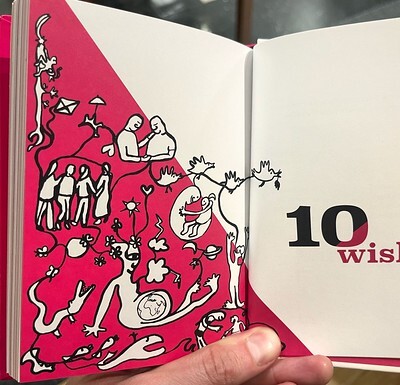
The book itself is a work of art. It’s small, measuring just 4.5″ by 6.5″. It’s also short and can be read in a couple of hours. But each two-page spread is unique – full of thought-provoking text, typographical artistry, colorful and wildly varied hand-drawn images, and occasional useful observations about art. (see sample pages below).

Ever wonder why art is part of every culture? Or why others may worship a famous painting that simply leaves you cold? Ever ponder the connection between art, play, and feelings? Maybe you’ve wondered why one type of art lasts for centuries while another is nothing more than a fad? The authors ask us to consider rich philosophical questions like these and offer fresh explanations which, I promise, will lead you to a better understanding of the definition of art, which I now understand as much broader than I ever thought. And I also see how art is much more integrated into our daily lives than I realized. (HINT: Think music, television, advertising, even haircuts, etc.)

WHAT ART DOES gives us all permission to experience art in any way we like. To enjoy it as each individual wishes. Or not to enjoy it at all. Because each of us gets to define art for ourselves, with the understanding that our own definition can change often throughout the course of our lives.

Seldom do I feel a book I read, even a great book, changes me. But WHAT ART DOES has. As much by its playful approach as its content. So, I highly recommend it to everyone. It could prompt some very interesting discussions among family and friends.
Displaying 1 - 30 of 132 reviews

Can't find what you're looking for?

Get help and learn more about the design.