

What do you think?
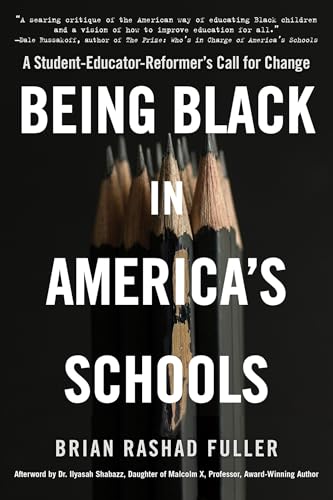
Being Black in America's Schools: A Student-Educator-Reformer's Call for Change
A leading educator, writer, and strategist sheds a timely and powerful light on American public schools, their miseducation of marginalized students of color and the action required to make tangible changes and reforms to a failing and racialized educational system.
In a polarizing and racially divided America, what do children of color learn about themselves before they even go to school? How do they see themselves and is that image only exacerbated by spending twelve years in a public education system that perpetrates negative stereotypes? Brian Rashad Fuller personally knows that the impact of low expectations can be devastating, as proved by the “school to prison” pipeline that so many students have experienced. He aims to make a difference in this humanizing and very personal portrayal of what it means to be Black in America’s schools.
As a Black man who has spent his life as a student and educator, Brian shares his own story of navigating the world, overcoming his family struggles, and eventually entering an educational system that he believes is inherently racist, damaging, and disserving. He exposes the challenges Black students face in elite and predominantly white universities and spaces, dissects “Black exceptionalism” in the schooling experience, and offers a firsthand account of the emotional and psychological impact made by teachers, administrators, policies, practices, lessons, and student interactions. Most Americans are looking for answers on how to improve our education system—as illustrated by the critical race theory debate—but have not fully understood the lived
Black experience, until now.
With powerful insight into a thoroughly American institution, Brian offers present-day solutions, and liberating hope, for a centuries-long issue, as well as a galvanizing and radical step forward. It is a book essential to our challenging times.
In a polarizing and racially divided America, what do children of color learn about themselves before they even go to school? How do they see themselves and is that image only exacerbated by spending twelve years in a public education system that perpetrates negative stereotypes? Brian Rashad Fuller personally knows that the impact of low expectations can be devastating, as proved by the “school to prison” pipeline that so many students have experienced. He aims to make a difference in this humanizing and very personal portrayal of what it means to be Black in America’s schools.
As a Black man who has spent his life as a student and educator, Brian shares his own story of navigating the world, overcoming his family struggles, and eventually entering an educational system that he believes is inherently racist, damaging, and disserving. He exposes the challenges Black students face in elite and predominantly white universities and spaces, dissects “Black exceptionalism” in the schooling experience, and offers a firsthand account of the emotional and psychological impact made by teachers, administrators, policies, practices, lessons, and student interactions. Most Americans are looking for answers on how to improve our education system—as illustrated by the critical race theory debate—but have not fully understood the lived
Black experience, until now.
With powerful insight into a thoroughly American institution, Brian offers present-day solutions, and liberating hope, for a centuries-long issue, as well as a galvanizing and radical step forward. It is a book essential to our challenging times.
- GenresEducationNonfiction
256 pages, Paperback
Published July 29, 2025
Ratings & Reviews
Friends & Following
Create a free account to discover what your friends think of this book!
Community Reviews
Displaying 1 - 4 of 4 reviews

August 6, 2025
Thank you to Kensington for the ARC in exchange for my honest review.
This book is not just a memoir, not just a call to action, and not just a commentary on education. It is all of those things, woven together with purpose, clarity, and lived truth. Being Black in America’s Schools is both deeply personal and universally resonant, especially for those who care about the future of education and equity.
Brian Rashad Fuller shares his story with vulnerability and strength. His experiences as a Black student, and later as an educator, reveal how racism is embedded not just in policy but in subtle daily interactions, expectations, and silences. The book doesn’t feel preachy, but instead offers a human voice that says, “Let me show you what I’ve lived.” And it’s powerful.
One of the most striking aspects of this book is how it balances hope with truth. Fuller doesn’t sugarcoat anything. He names the harm. He describes the trauma. He recounts the moments when simply existing as a Black boy in a classroom was politicized, policed, or erased. And still, he believes change is possible.
What I Loved:
• The narrative voice is authentic, raw, and filled with heart.
• Fuller’s personal stories ground the book in reality and emotion.
• The book covers the journey from student to educator with insight and nuance.
• Clear connections are drawn between structural racism and daily classroom experiences.
• Solutions are offered, not just criticism—there is direction and intention.
• The sections on “Black exceptionalism” and the psychological impact of miseducation hit hard.
What Didn’t Work for Me:
• Some ideas could have been expanded further—especially in the policy sections.
• Readers already familiar with CRT and systemic racism may find some repetition.
• A few transitions between topics felt abrupt.
• I wanted more perspectives from students beyond the author’s own experience.
• Some anecdotes, while moving, could have been given more context for unfamiliar readers.
“We do not need more Band-Aids. We need healing. Real, structural, human-centered healing.”
This book will stay with me. It invites educators to reflect, parents to listen, and students of all backgrounds to be seen. Brian Rashad Fuller writes with urgency, but also with deep care. Being Black in America’s Schools deserves space in every classroom, every policy room, and every heart willing to be changed.
⭐️⭐️⭐️⭐️½
📚🧠🗣️✊🏽
This book is not just a memoir, not just a call to action, and not just a commentary on education. It is all of those things, woven together with purpose, clarity, and lived truth. Being Black in America’s Schools is both deeply personal and universally resonant, especially for those who care about the future of education and equity.
Brian Rashad Fuller shares his story with vulnerability and strength. His experiences as a Black student, and later as an educator, reveal how racism is embedded not just in policy but in subtle daily interactions, expectations, and silences. The book doesn’t feel preachy, but instead offers a human voice that says, “Let me show you what I’ve lived.” And it’s powerful.
One of the most striking aspects of this book is how it balances hope with truth. Fuller doesn’t sugarcoat anything. He names the harm. He describes the trauma. He recounts the moments when simply existing as a Black boy in a classroom was politicized, policed, or erased. And still, he believes change is possible.
What I Loved:
• The narrative voice is authentic, raw, and filled with heart.
• Fuller’s personal stories ground the book in reality and emotion.
• The book covers the journey from student to educator with insight and nuance.
• Clear connections are drawn between structural racism and daily classroom experiences.
• Solutions are offered, not just criticism—there is direction and intention.
• The sections on “Black exceptionalism” and the psychological impact of miseducation hit hard.
What Didn’t Work for Me:
• Some ideas could have been expanded further—especially in the policy sections.
• Readers already familiar with CRT and systemic racism may find some repetition.
• A few transitions between topics felt abrupt.
• I wanted more perspectives from students beyond the author’s own experience.
• Some anecdotes, while moving, could have been given more context for unfamiliar readers.
“We do not need more Band-Aids. We need healing. Real, structural, human-centered healing.”
This book will stay with me. It invites educators to reflect, parents to listen, and students of all backgrounds to be seen. Brian Rashad Fuller writes with urgency, but also with deep care. Being Black in America’s Schools deserves space in every classroom, every policy room, and every heart willing to be changed.
⭐️⭐️⭐️⭐️½
📚🧠🗣️✊🏽

May 13, 2024
Thank you, Netgalley and Kensington Publishing for this advanced reader's copy. The author, Brian Fuller is an educator and equity strategist, and he draws on research and his own experience, both as a Black student in the classroom and a Black teacher in the classroom. Brian discusses how he was treated in the classroom as one of only a few Black students in his classes growing up, where he strived to quiet, and liked, and one of the best in his classes. When he saw obvious racist acts, he helped speak out, such as when there was a policy put in place that no boys in school could have their shirts untucked as they could be hiding weapons, but it was only enforced with the Black boys. Brian also saw numerous racist acts while in college and as a teacher himself, which just reinforced why the educational system needs to change to improve the educational experience for all students. This book is a must read for anyone with children and anyone in the educational system.

July 31, 2025
A tragic yet even more triumphant account of events that walks the reader through the author's life and his view of how racist, systemic white supremacy influences us on both personal and societal levels- from playgrounds to prison grounds and yes, school grounds. Many readers around the world will likely nod along, recognizing the shared struggles and mounting hardships they’ve faced.
If you’ve read books like The New Jim Crow, White Fragility, or Ruin Their Crops on the Ground, you’ll appreciate this one. Politically speaking, however, those on the right will likely remain unmoved.
If you’ve read books like The New Jim Crow, White Fragility, or Ruin Their Crops on the Ground, you’ll appreciate this one. Politically speaking, however, those on the right will likely remain unmoved.

August 6, 2025
Admire his determination make education better. I hope that someday it will happen.
Displaying 1 - 4 of 4 reviews