

What do you think?
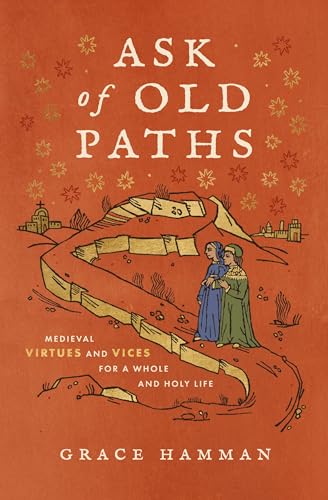
Ask of Old Paths: Medieval Virtues and Vices for a Whole and Holy Life
Traditional Christian virtue and vices like abstinence, gluttony, and sloth make many of us bored or uncomfortable. At their best, these words sound dead or confusing, like incomplete fossils that belong to a distant past awkwardly enshrined in a museum. At worst, they signify a prejudiced past, when these words were wielded like weapons.
Yet in medieval writing, the language of the virtues and vices was powerful, lively, and delightfully weird. Patience is described as a peppercorn. Unicorns preach chastity. Knightly virtues fend off devious vices by throwing roses at them. In medieval books, words like avarice and meekness meant different things and carried different weight than they do today. And great medieval preachers and poets taught the virtues as crucial to what it meant to live a life of holiness, right alongside the Lord's Prayer and the Creed.
Ask of Old Paths by Grace Hamman meditates upon those strange and wonderful word-pictures and explanations of virtues and vices found in medieval traditions of poetry, sermons, and treatises long confined to dusty corners of the library. It focuses on the ancient tradition of virtue language called the Seven Capital Virtue pride and humility, envy and love, wrath and meekness, avarice and mercy, sloth and perseverance, gluttony and abstinence, lust and chastity.
In accessible and thoughtful chapters, scholar and writer Grace Hamman shows how learning about these pairs of medieval virtues and vices can help us reevaluate our own washed out and insipid moral vocabulary in modernity. Our imaginations for the good life are expanded; our longing for sanctification sharpens. Old ideas can give us new fire in our practice of the virtue--and in that practice, we imitate Jesus and become more human.
Yet in medieval writing, the language of the virtues and vices was powerful, lively, and delightfully weird. Patience is described as a peppercorn. Unicorns preach chastity. Knightly virtues fend off devious vices by throwing roses at them. In medieval books, words like avarice and meekness meant different things and carried different weight than they do today. And great medieval preachers and poets taught the virtues as crucial to what it meant to live a life of holiness, right alongside the Lord's Prayer and the Creed.
Ask of Old Paths by Grace Hamman meditates upon those strange and wonderful word-pictures and explanations of virtues and vices found in medieval traditions of poetry, sermons, and treatises long confined to dusty corners of the library. It focuses on the ancient tradition of virtue language called the Seven Capital Virtue pride and humility, envy and love, wrath and meekness, avarice and mercy, sloth and perseverance, gluttony and abstinence, lust and chastity.
In accessible and thoughtful chapters, scholar and writer Grace Hamman shows how learning about these pairs of medieval virtues and vices can help us reevaluate our own washed out and insipid moral vocabulary in modernity. Our imaginations for the good life are expanded; our longing for sanctification sharpens. Old ideas can give us new fire in our practice of the virtue--and in that practice, we imitate Jesus and become more human.
224 pages, Hardcover
First published September 1, 2025
Ratings & Reviews
Friends & Following
Create a free account to discover what your friends think of this book!
Community Reviews
Displaying 1 - 30 of 98 reviews

Read
September 20, 2025The opening didn't really draw me, but about halfway through the book I fell into the rhythm, and now I want to quit my job and study medieval art.

December 28, 2025
"every virtue is just love in disguise"
breaking my no-star rule for my reviews in order to give this book ALL THE STARS. glad i saved them for the occasion
luckily for me while reading this i was mostly literally walking old paths, because the chapter on Sloth/Fortitude made me weep several times. i've been having A Year, and it very nearly broke me: this chapter patched me up and gave me the strength to keep going--or at least gave me the why of how i had scraped myself up and kept going
shout out to the chapter on Avarice/Mercy (right judgement) and to the one on Lust/Chastity, which were both huge reminders to see rightly/judge rightly every day and to every person, and to not be using people as things, but treating them as people, and told me to keep doing it
there was so much here that was good, but there are other reviews that will do the job of enumerating them far better than i can. i think this is a book that every Christian should read.
i already loved "Jesus Through Medieval Eyes" and thought it beautiful and needful; Ask of Old Paths outstripped that already excellent book in my estimation. i will re-read it often, and will also spring for the hardback
read on audio
breaking my no-star rule for my reviews in order to give this book ALL THE STARS. glad i saved them for the occasion
luckily for me while reading this i was mostly literally walking old paths, because the chapter on Sloth/Fortitude made me weep several times. i've been having A Year, and it very nearly broke me: this chapter patched me up and gave me the strength to keep going--or at least gave me the why of how i had scraped myself up and kept going
shout out to the chapter on Avarice/Mercy (right judgement) and to the one on Lust/Chastity, which were both huge reminders to see rightly/judge rightly every day and to every person, and to not be using people as things, but treating them as people, and told me to keep doing it
there was so much here that was good, but there are other reviews that will do the job of enumerating them far better than i can. i think this is a book that every Christian should read.
i already loved "Jesus Through Medieval Eyes" and thought it beautiful and needful; Ask of Old Paths outstripped that already excellent book in my estimation. i will re-read it often, and will also spring for the hardback
read on audio

November 29, 2025
Enriching, edifying, stirring! So much food for thought. I’ll definitely be keeping this handy to reread as my knowledge and practice of the virtues grows, by God’s grace.
December 17, 2025
Ask of Old Paths was one of my most anticipated reads of 2025. I even wheedled a copy off the author so I could get my hands on it before release, which was after I moved overseas! I read as much of it as I could at the cathedral ruins in St Andrews, to immerse myself not only in the natural world but also in the medieval mindset (though medieval folk, enviably, had this cathedral before it was ruined).
Hamman opens the door wide to let the wind of the Spirit into the dusty, cobwebby room of how we have spoken about virtues. She peels each one back to its delicious core, showing how desirable virtue is. I also appreciated, so much, how she refused to let vice be the same old thing, either. Gluttony and abstinence--applied to things other than food, including online consumption? Whew. Now that I live in Scotland, where the national animal is the unicorn, I am never not going to think of it in the christological terms Hamman presented in the final chapter. The last two chapters, in particular, are paradigm-shifters. Not a term I use often, especially for more than one instance!
Ask of Old Paths is beautifully produced, with a lovely title page for each chapter, wonderfully reproduced images of medieval manuscripts, and footnotes (my delight). I am so glad to see Hamman's work getting the publishing treatment it deserves. (If only it were in color, but maybe her third book will be?) I needed the messages in this book and encourage you to give it a try.
As I thought and prayed about this season of life, where I'm beginning my doctoral studies, I felt convicted that I needed to intentionally cultivate my spiritual life, particularly virtue, in these years. In grad school, working as a doctoral enrollment counselor, and supporting my husband through his PhD, I saw way too many people who genuinely became worse during their studies. They were prideful, angry, unpleasant to be around, self-centered, whiny. (Obviously not all of them--or even most! Definitely not my husband, who became an even more virtuous person despite having an advisor worthy of being in R. F. Kuang's Katabasis. But I saw this so much, still.) I decided that I wanted to push myself in a different direction, to chase after virtue rather than vice. So I've chosen Ask of Old Paths as a guardrail, to keep me thinking about vice and virtue. I printed "The Heart as House" (52) to hang at my desk (also St Martha, dragon slayer, because reasons). I'll be reading Ask of Old Paths again during my studies and marking passages to return to. I wrote "Wolt thou be maad hool?" on a sticky note and put it at my desk to remind me that every day I can choose to me made whole through my studies rather than made more fragmented.
Hamman opens the door wide to let the wind of the Spirit into the dusty, cobwebby room of how we have spoken about virtues. She peels each one back to its delicious core, showing how desirable virtue is. I also appreciated, so much, how she refused to let vice be the same old thing, either. Gluttony and abstinence--applied to things other than food, including online consumption? Whew. Now that I live in Scotland, where the national animal is the unicorn, I am never not going to think of it in the christological terms Hamman presented in the final chapter. The last two chapters, in particular, are paradigm-shifters. Not a term I use often, especially for more than one instance!
Ask of Old Paths is beautifully produced, with a lovely title page for each chapter, wonderfully reproduced images of medieval manuscripts, and footnotes (my delight). I am so glad to see Hamman's work getting the publishing treatment it deserves. (If only it were in color, but maybe her third book will be?) I needed the messages in this book and encourage you to give it a try.
As I thought and prayed about this season of life, where I'm beginning my doctoral studies, I felt convicted that I needed to intentionally cultivate my spiritual life, particularly virtue, in these years. In grad school, working as a doctoral enrollment counselor, and supporting my husband through his PhD, I saw way too many people who genuinely became worse during their studies. They were prideful, angry, unpleasant to be around, self-centered, whiny. (Obviously not all of them--or even most! Definitely not my husband, who became an even more virtuous person despite having an advisor worthy of being in R. F. Kuang's Katabasis. But I saw this so much, still.) I decided that I wanted to push myself in a different direction, to chase after virtue rather than vice. So I've chosen Ask of Old Paths as a guardrail, to keep me thinking about vice and virtue. I printed "The Heart as House" (52) to hang at my desk (also St Martha, dragon slayer, because reasons). I'll be reading Ask of Old Paths again during my studies and marking passages to return to. I wrote "Wolt thou be maad hool?" on a sticky note and put it at my desk to remind me that every day I can choose to me made whole through my studies rather than made more fragmented.

December 30, 2025
I started 2025 with Grace Hamman's wonderful devotional, JESUS THROUGH MEDIEVAL EYES. It feels fitting that I ended the year with ASK OF OLD PATHS, her exploration of the seven medieval vices and their corresponding virtues, which is even better.
If anything, I'm astonished this book wasn't written sooner. If there's something medieval people loved it was lists, categories and classifications. The Seven Wonders of the World. The Seven Planets. The Nine Worthies (and Nine Worthy Ladies). The Seven Sorrows of the Virgin. It's no wonder that the theologians and mystics of the Middle Ages also catalogued the vices and virtues, with painstaking attention to exactly what each vice entailed and how each was to be remedied, sometimes in surprising ways. On the other hand, it makes sense that we had to wait this long for this book: talk of virtues and vice has fallen out of fashion these days, and the true meaning of the words has been flattened and lost. Sloth, once known as that form of cowardice that holds us back from confession, repentance, and true love, is today reduced to mere laziness. Meekness, the virtue that fends off sinful wrath by counselling us to stop and think before reacting, is today ridiculed as unmanly and effeminate (if you are a man) or downtrodden and antifeminist (if you are a woman).
This flattening process, as Hamman shows, was in progress already by the late middle ages. Astoundingly rich, by turns convicting, and encouraging, ASK OF OLD PATHS retrieves these medieval categories for the 21st-century Christian in all their original richness. Simply put, I have never read such an excellent devotional. Each chapter expanded my thinking. Consider the fact that the sin of Avarice, for instance, is opposed to the virtue of Mercy - Avarice, which insists on getting something for everything it gives, opposed to Mercy, which by its very nature can never be earned, only freely given and received. Each chapter, too, made me weep. Sometimes this was merely because of the marvellous richness of the virtues or the terrifying dangers of the vices; often, it was because I saw, suddenly in myself, that actions I had agonised over were not vicious but virtuous. Take greatheartedness, for instance: that which sets out on some enterprise with confidence, wise plans, and reasonable hope for success. I had been in the habit of calling that pride, when I thought of it at all. Learning that it is, rather, a form of the virtue of Fortitude - who in the medieval iconography is a woman - hit me like a lightning-strike. It's virtuous for me to have ambitions, and to seek them?
I want to buy my own physical copy of this, and perhaps half a dozen spares to give away.
If anything, I'm astonished this book wasn't written sooner. If there's something medieval people loved it was lists, categories and classifications. The Seven Wonders of the World. The Seven Planets. The Nine Worthies (and Nine Worthy Ladies). The Seven Sorrows of the Virgin. It's no wonder that the theologians and mystics of the Middle Ages also catalogued the vices and virtues, with painstaking attention to exactly what each vice entailed and how each was to be remedied, sometimes in surprising ways. On the other hand, it makes sense that we had to wait this long for this book: talk of virtues and vice has fallen out of fashion these days, and the true meaning of the words has been flattened and lost. Sloth, once known as that form of cowardice that holds us back from confession, repentance, and true love, is today reduced to mere laziness. Meekness, the virtue that fends off sinful wrath by counselling us to stop and think before reacting, is today ridiculed as unmanly and effeminate (if you are a man) or downtrodden and antifeminist (if you are a woman).
This flattening process, as Hamman shows, was in progress already by the late middle ages. Astoundingly rich, by turns convicting, and encouraging, ASK OF OLD PATHS retrieves these medieval categories for the 21st-century Christian in all their original richness. Simply put, I have never read such an excellent devotional. Each chapter expanded my thinking. Consider the fact that the sin of Avarice, for instance, is opposed to the virtue of Mercy - Avarice, which insists on getting something for everything it gives, opposed to Mercy, which by its very nature can never be earned, only freely given and received. Each chapter, too, made me weep. Sometimes this was merely because of the marvellous richness of the virtues or the terrifying dangers of the vices; often, it was because I saw, suddenly in myself, that actions I had agonised over were not vicious but virtuous. Take greatheartedness, for instance: that which sets out on some enterprise with confidence, wise plans, and reasonable hope for success. I had been in the habit of calling that pride, when I thought of it at all. Learning that it is, rather, a form of the virtue of Fortitude - who in the medieval iconography is a woman - hit me like a lightning-strike. It's virtuous for me to have ambitions, and to seek them?
I want to buy my own physical copy of this, and perhaps half a dozen spares to give away.

September 11, 2025
A wonderfully written book reminding us that the Christian life is not about rules to follow but about the people we become by growing in sacred virtues each and every day.
Also a reminder that the Middle Ages was a wildly weird time.
Also a reminder that the Middle Ages was a wildly weird time.

July 28, 2026
I read this too fast, for sure. So much to chew on and so much to be invited into in this conversation about virtue in the medieval understanding. I loved how the author brought the historical culture to life, but also connected it to today and what pursuing virtue and fighting vice can look like. She does not speak from a high tower- she shares honestly and appropriately in my opinion, and doesn’t shy away from the challenge (or joys!) of this holy work. The book stirred my imagination, and was a great follow up to the book I just read on that topic! 😅 I always find it a great help to look back and learn from the saints of the past.

December 14, 2025
I loved this so much! What a profound little tome that shares the history of medieval virtue and so delightfully translates it into a modern day practice and reflection. I’ll be getting a physical copy asap.

March 23, 2026
Very interesting review of about the understanding of the 7 capital sins and their opposing virtues in medieval writings. The author brings to life forgotten symbols and associations, and suggests how to live these virtues for a XXI century middle-class American. This is precisely where I wish the references to current events and persons were not so specific (and hence, likely to be soon dated), because the suggestions in the book can be applied much more widely.

August 5, 2026
An absolute balm to the soul after 500 leadership books. Thrilled to be teaching this book this year!

October 31, 2025
Beautiful

Read
January 10, 2026I didn't have the same reaction to this as many other readers, which was disappointing. As a medieval historian, both of Hamman's titles have intrigued me and I was looking forward to seeing how she discusses medieval devotional and penitential literature here. The audiobook is a really pleasant experience -- Hamman is an excellent speaker and ASK OF OLD PATHS goes down smoothly; I particularly liked listening to her read the Middle English quotations. The genres she deals with are not especially familiar to me, so most of the images and word-pictures she engages with felt new and fresh. Each chapter highlights a different vice/virtue pairing, such as Sloth & Fortitude and Gluttony & Abstinence, and I deeply appreciated the way Hamman opens her readers' eyes to the original expansiveness of these concepts in medieval thought. Sloth, for instance, is not merely lying around on a couch; it has much to do with spiritual apathy and neglect of responsibility. Wrath is not just about losing one's temper, but can be found in a resentful spirit. Gluttony and Avarice are not just about eating until you're sick or hoarding money like Silas Marner, but about consuming beyond your allotted share and trusting in material goods rather than in the provision of God. These discussions frequently gave me a lot to think about (I think I benefited most from the earlier chapters, especially the one on Wrath & Meekness, whereas the later ones felt more diffuse than helpful).
Yet I also had strong reservations throughout. As one other reviewer mentioned, there isn't much here about the empowerment of the Spirit or His role in the believer's life, individually or corporately; this means that the several explicit comments about God inviting us to participate in our own sanctification very much sound like that sanctification is entirely our own work. I totally agree that we have responsibilities in the Christian life and that we aren't meant to kick back and twiddle our thumbs, but the theology here made me raise an eyebrow. Though I haven't been able to determine Hamman's confession, ASK OF OLD PATHS seems to be based on Catholic assumptions that foreground the interaction of divine grace and human effort. (My thought that the background to this is Catholic seemed reinforced by references to various saints, to Mary as our mother, and to traditions of the church like the liturgical calendar. Any of these could also stem from a different High Church denomination, though.)
In addition to having issues with the theological underpinning, I found myself disappointed by the lack of engagement with actual biblical teaching on the vices or virtues. Bible passages are mentioned, but more as additional supports to conclusions already reached by other means. I understand that this is primarily a book inspired by medieval writing, but it's (I think) aimed at believers and is trying to encourage action, so it seems to me imperative that the discussion be grounded in what the Bible actually says and teaches and models. I'm not saying I disagreed with everything Hamman said, but just that even when I did agree, I wondered how much of it was rooted in biblical teaching and how much was rooted in philosophical assumptions that I just happen to share. For example, is it really possible to have a chapter on Sloth and not engage with the teaching in Proverbs on "the sluggard"? Or is it really true that we find fasting in the Bible presented as a spiritual exercise that heightens our dependence on God and ability to say "no" to over-consumption? (I haven't made a study of fasting, but where it appears in the Bible, it seems to be a response to calamitous situations rather than a practice meant to enhance the person's virtue.) These instances are symptomatic of problems that kept popping up for me.
There was also the fact that I very much felt this was all coming from one specific perspective, and that's social action. Much is made of examples like Dietrich Bonhoeffer and Martin Luther King, Jr. (never mind the fact that the latter doesn't seem to have demonstrated private virtue, whatever his public virtue may have been!). What about virtue throughout the Scripture (beyond Mary and Jesus)? What about Paul's injunction for us to live quiet, productive lives? This links up with another question: who is the intended audience, and how and where, primarily, do we practice virtue? I think Hamman assumes her readers will be Christian, but since what makes us Christian is never defined and boundaries are not set, I felt like everything was too porous; very little distinction is made between the body of believers and the world-at-large. Can non-Christians live a virtuous life? If not, what makes Christians' virtue distinct? Is practicing virtue just about being whole in ourselves, or is there a bigger goal? If so, what is it? I suppose I felt that the discussions of the vices and virtues, interesting as they were on their own, lacked sufficient context. I wanted a more robust foundation, and I didn't find it.
Yet I also had strong reservations throughout. As one other reviewer mentioned, there isn't much here about the empowerment of the Spirit or His role in the believer's life, individually or corporately; this means that the several explicit comments about God inviting us to participate in our own sanctification very much sound like that sanctification is entirely our own work. I totally agree that we have responsibilities in the Christian life and that we aren't meant to kick back and twiddle our thumbs, but the theology here made me raise an eyebrow. Though I haven't been able to determine Hamman's confession, ASK OF OLD PATHS seems to be based on Catholic assumptions that foreground the interaction of divine grace and human effort. (My thought that the background to this is Catholic seemed reinforced by references to various saints, to Mary as our mother, and to traditions of the church like the liturgical calendar. Any of these could also stem from a different High Church denomination, though.)
In addition to having issues with the theological underpinning, I found myself disappointed by the lack of engagement with actual biblical teaching on the vices or virtues. Bible passages are mentioned, but more as additional supports to conclusions already reached by other means. I understand that this is primarily a book inspired by medieval writing, but it's (I think) aimed at believers and is trying to encourage action, so it seems to me imperative that the discussion be grounded in what the Bible actually says and teaches and models. I'm not saying I disagreed with everything Hamman said, but just that even when I did agree, I wondered how much of it was rooted in biblical teaching and how much was rooted in philosophical assumptions that I just happen to share. For example, is it really possible to have a chapter on Sloth and not engage with the teaching in Proverbs on "the sluggard"? Or is it really true that we find fasting in the Bible presented as a spiritual exercise that heightens our dependence on God and ability to say "no" to over-consumption? (I haven't made a study of fasting, but where it appears in the Bible, it seems to be a response to calamitous situations rather than a practice meant to enhance the person's virtue.) These instances are symptomatic of problems that kept popping up for me.
There was also the fact that I very much felt this was all coming from one specific perspective, and that's social action. Much is made of examples like Dietrich Bonhoeffer and Martin Luther King, Jr. (never mind the fact that the latter doesn't seem to have demonstrated private virtue, whatever his public virtue may have been!). What about virtue throughout the Scripture (beyond Mary and Jesus)? What about Paul's injunction for us to live quiet, productive lives? This links up with another question: who is the intended audience, and how and where, primarily, do we practice virtue? I think Hamman assumes her readers will be Christian, but since what makes us Christian is never defined and boundaries are not set, I felt like everything was too porous; very little distinction is made between the body of believers and the world-at-large. Can non-Christians live a virtuous life? If not, what makes Christians' virtue distinct? Is practicing virtue just about being whole in ourselves, or is there a bigger goal? If so, what is it? I suppose I felt that the discussions of the vices and virtues, interesting as they were on their own, lacked sufficient context. I wanted a more robust foundation, and I didn't find it.

March 24, 2026
As a medievalist — and more, someone with a degree from Chapel Hill who also worked on late Middle English (romance, though, not devotional literature, although the lines can be blurrier than one might expect) — I always approach popular medieval books (especially by Duke grads 😂) with trepidation. But this was such a lovely book! Hamman clearly knows and loves her source material and has the gift of helping us sift it for the gems of wisdom that the late medieval church can share with us today.
I think it’s especially important that Hamman is drawing from popular devotional material, largely in English (not Latin). We so often forget that medieval Christians, just like us, wanted to know how to live well: the intellectual theology of the universities is all well and good, but the penitential manuals and other devotional materials (including the images, that she includes so well!) brought that heady theology down into lived experience. Even though we 21st century Christians live in a very different context (even 21st century Catholic Christians), I love how Hamman mines these popular texts for insights on how we, too, can live as whole and healed followers of Jesus.
I think it’s especially important that Hamman is drawing from popular devotional material, largely in English (not Latin). We so often forget that medieval Christians, just like us, wanted to know how to live well: the intellectual theology of the universities is all well and good, but the penitential manuals and other devotional materials (including the images, that she includes so well!) brought that heady theology down into lived experience. Even though we 21st century Christians live in a very different context (even 21st century Catholic Christians), I love how Hamman mines these popular texts for insights on how we, too, can live as whole and healed followers of Jesus.
May 18, 2026
Honestly, I don't think this book quite achieved its lofty aim. It claims to make the virtues vibrant and alive. While the book certainly does help to clear up some misconceptions about virtues and vices (and occasionally suggest how these misconceptions came about), it doesn't really go much further than that. And I do still have some questions. The book makes the point that virtue isn't just resisting vice; virtue is positive action instead. That's a good point, but in some cases what the positive action associated with a virtue ought to be isn't clear at all.
I do think this is a frequently helpful and often convicting book, but some lingering questions and unmet expectations hold my rating back a bit. 3.5 stars but I'll round up.
I do think this is a frequently helpful and often convicting book, but some lingering questions and unmet expectations hold my rating back a bit. 3.5 stars but I'll round up.

July 23, 2026
I enjoyed this book way more than I thought I would. It blew fresh air through the old dusty ideas of vices and virtues. The medieval perspective was so interesting and the author did such a good job of modernizing it and applying it to today’s reality.
“The medieval language of the virtues was like a garden gone wild after a rainstorm in July, filled with fruits and weeds, and decaying, organic matter, so alive. It wasn’t always pleasant, not always intelligible, but pulsed with life, beauty, challenge.”
“The medieval language of the virtues was like a garden gone wild after a rainstorm in July, filled with fruits and weeds, and decaying, organic matter, so alive. It wasn’t always pleasant, not always intelligible, but pulsed with life, beauty, challenge.”

April 27, 2026
I will write a full review soon but let me just say I LOVED THIS BOOK. Really, truly a great read - I listened to the audiobook but it was so wonderful and full of great truths and in depths way of thinking that I ordered a print copy right away and can’t wait to reread.

November 14, 2025
Grace is one of my favorite contemporary medievalists and this latest book is absolutely beautiful. As always, her words are rich with history yet fresh and relevant for the modern age in which she writes. In a book that could easily swing toward moralistic truisms, Ask of Old Paths is instead a spiritual refresher that takes to task our modern (and not-so-modern) misconceptions of vices and virtues. Another luminous addition to my library!

June 22, 2026
Really enjoyed this on audio and will absolutely be picking up a physical copy when the paperback is available! I loved the author’s use of medieval writers and wisdom to talk about virtues and vices, and you can tell she’s writing from a place of both expertise and love for this period of Christian history. All our favorite medieval writers are quoted, especially Julian of Norwich <3 She also has a love for classic literature that I really appreciated. While this book does have some personal reflections in it, I found it to be much less autobiographical than a lot of the other contemporary Christian living books I’ve been reading recently.
I would love a physical copy of this to see the artwork discussed, note down her recommendations for further reading, and really dive into the reflection questions and prayer prompts. Honestly I’d love to reread this with other Christians to really enrich my understanding of these topics and I think this would be a great tool for discussion!
I would love a physical copy of this to see the artwork discussed, note down her recommendations for further reading, and really dive into the reflection questions and prayer prompts. Honestly I’d love to reread this with other Christians to really enrich my understanding of these topics and I think this would be a great tool for discussion!
June 1, 2026
Another really good but challenging book on the virtues and vices. I enjoyed how the author covered virtue and vice in tandem each chapter. If anyone wants to start on the subject, this would be a good book. She breathes life into the virtues and vices.
Personally, I think one of the reasons why I keep going back ro the subject is that it has allowed me better understand my own sin and what is really going on in my heart. I definitely want to continue my exploration.
Personally, I think one of the reasons why I keep going back ro the subject is that it has allowed me better understand my own sin and what is really going on in my heart. I definitely want to continue my exploration.

February 16, 2026
I first read Grace Hamman's book Jesus Through Medieval Eyes and loved it so much this book was an immediate "buy." I didn't know much about the "Virtues and Vices" beyond their names. Even then, it's not something often talked about with great depth. Pride vs Humility, Envy vs Love, Wrath vs Meekness etc. It looks like it should speak for itself right? I mean, we know what envy is or meekness or pride. Or do we? Take these words back to our medieval ancestors in the faith and they come out meaning so much more than we realized. I was reading this just before Lent began and it really encourage me to take that time a bit more seriously. To get away from the trappings and temptations of social media and how it attempts to conform my views, back to a more quite time with the virtues.
"In the virtues, we do not pound ourselves into the identical shape of something or someone else, like dough by cookie cutter, or brick and mortar and stucco into the same shape of houses on the suburban street. People are not sugar cookies nor, praise God, the split-levels that plague my Denver suburb. It is the vices that conform us into the same dreary old obsessions, insecurities, and self-absorption."
"In the virtues, we do not pound ourselves into the identical shape of something or someone else, like dough by cookie cutter, or brick and mortar and stucco into the same shape of houses on the suburban street. People are not sugar cookies nor, praise God, the split-levels that plague my Denver suburb. It is the vices that conform us into the same dreary old obsessions, insecurities, and self-absorption."

October 27, 2025
I absolutely ADORED this book, a spiritual look at vices and their remedies, virtues. I wish this book was longer, I was educated, informed and inspired by this read. What does it mean to live a whole and holy life as a Christian? I loved the vivid medieval imagery paired with the virtues. I left each chapter with things to ponder and appreciated how the author invited us to apply the virtues.

May 6, 2026
Words have a special kind of power. Unfortunately, when words come to mean many different things to different people, they lose much of this power. “Capitalism”, “Conservative”, and don’t even get me started with “Nonplussed”.
The virtues and vices have started to fall into this category. Should I take “pride” in my work? And what is “meekness” but a tool of the patriarchy to subdue women? “Chastity” and “abstinence” summon images of 2000s-era purity rings and surrounding youth-group culture.
For me, Grace Hamman has breathed new life into these words. Ask of Old Paths asks us to sit with them and contemplate them in the way they were understood in medieval times - for better or worse. This also turns to what they might mean for us today.
She draws from numerous quotes - and lots of medieval art! - to bring history to life. There’s enough scholarship to chew on, but the pace is easy and entertaining. Really beautifully written.
I may not be able to reclaim the deep and ancient meaning of the virtues in the collective consciousness, but I’ve certainly gained a new appreciation of them for myself. Hopefully that appreciation can help me live them better.
The virtues and vices have started to fall into this category. Should I take “pride” in my work? And what is “meekness” but a tool of the patriarchy to subdue women? “Chastity” and “abstinence” summon images of 2000s-era purity rings and surrounding youth-group culture.
For me, Grace Hamman has breathed new life into these words. Ask of Old Paths asks us to sit with them and contemplate them in the way they were understood in medieval times - for better or worse. This also turns to what they might mean for us today.
She draws from numerous quotes - and lots of medieval art! - to bring history to life. There’s enough scholarship to chew on, but the pace is easy and entertaining. Really beautifully written.
I may not be able to reclaim the deep and ancient meaning of the virtues in the collective consciousness, but I’ve certainly gained a new appreciation of them for myself. Hopefully that appreciation can help me live them better.

January 7, 2026
An ultimately delightful exploration of how medievals perceived the vices and virtues, peppered with examples not only from the writings of philosophers but from medieval art (the slightly strange kind that usually gets made fun of online.) The chapter on pride and humility was fairly straightforward but by the time envy and love (basilisk and blossom) came on the scene I was hooked. It's very easy to sit in judgement over the past, and the Middle Ages in particular are easily scoffed by those with modern sensibilities. This book is one of several that point to the good that we are missing out on when we dismiss it as merely an age of diseases, feudalism, and superstition. Ultimately, they had a more complex and nuanced understanding of the life of the soul than we seem to have today.

January 10, 2026
A fun and informative read full of Hamman’s characteristic wit and style. I laughed and I learned and I cannot wait to dive deeper into the concepts that she has presented in this book.
Hamman sets out to untangle much modern misunderstanding around the virtues and vices and breathe life into them again. She does an excellent job of introducing each vice and its remedy (the virtues) to a modern audience, setting the ground work for further study. She also does a great job at bringing the Middle Ages to beautiful life in its glories while also pumping the breaks on its flaws. A worthy read.
Hamman sets out to untangle much modern misunderstanding around the virtues and vices and breathe life into them again. She does an excellent job of introducing each vice and its remedy (the virtues) to a modern audience, setting the ground work for further study. She also does a great job at bringing the Middle Ages to beautiful life in its glories while also pumping the breaks on its flaws. A worthy read.

August 5, 2026
This is one of my top 5 books for 2026. It is part scholarly and part nutty gritty conviction of sin. It’s got practical and thoughtful ways to adopt the virtues into your life, not in legalism but in transformation with and understanding that the only reason vices and virtues were “created” was because of love. Love of Christ is what moves us in the journey of sanctification. Not pride or self- importance or self-improvement.
I plant to read this book again with a few friends so that we can marinate in these very relevant practices and raise our awareness of how we still mirror the 1000’s even in 2026. And that it is still only Jesus.
I plant to read this book again with a few friends so that we can marinate in these very relevant practices and raise our awareness of how we still mirror the 1000’s even in 2026. And that it is still only Jesus.

October 25, 2025
4.5 stars.
What does it look like, practically, to live a life that is whole? To answer this question, author Grace Hamman delves deep into medieval language of vice and virtue to offer an old perspective on the moral life, complemented by her own new insights. Her writing style is succinct and refined to a beautiful clarity, and the vivid medieval imagery will last with me for a long time. A short book, but each chapter has plenty to ponder, and I enjoyed taking my time with this one. Both convicting and encouraging in the best ways.
What does it look like, practically, to live a life that is whole? To answer this question, author Grace Hamman delves deep into medieval language of vice and virtue to offer an old perspective on the moral life, complemented by her own new insights. Her writing style is succinct and refined to a beautiful clarity, and the vivid medieval imagery will last with me for a long time. A short book, but each chapter has plenty to ponder, and I enjoyed taking my time with this one. Both convicting and encouraging in the best ways.

January 24, 2026
Obviously, highly recommended.
An exemplary performance of academic research on the virtues, made not just relevant for a general audience but, with a combination of winsome writing and the kind of penetrating personal wisdom that is hard-won, brought to life in the pages in a way that can come to life in the lives of readers. A devotional with footnotes! If that scares you, ignore the footnotes. The point is just: the water's fine. It's clear, calm . . . and deep. Come in.
An exemplary performance of academic research on the virtues, made not just relevant for a general audience but, with a combination of winsome writing and the kind of penetrating personal wisdom that is hard-won, brought to life in the pages in a way that can come to life in the lives of readers. A devotional with footnotes! If that scares you, ignore the footnotes. The point is just: the water's fine. It's clear, calm . . . and deep. Come in.

July 21, 2026
My favourite book this year. I have just finished both of Grace’s books in the last month and her voice has stayed in my head and heart.
I am confident that today’s Jesus followers would benefit from this study on vices and virtues- as they illuminate both the reality of our hearts, and the reality of Christ’s love that brings the fruit of the virtues lived out amongst us.
Bravo Grace - here’s to the medieval voice bringing richness and vocabulary to our Chritian walk.
I am confident that today’s Jesus followers would benefit from this study on vices and virtues- as they illuminate both the reality of our hearts, and the reality of Christ’s love that brings the fruit of the virtues lived out amongst us.
Bravo Grace - here’s to the medieval voice bringing richness and vocabulary to our Chritian walk.

June 20, 2026
This is a pleasantly-written, easy to read book about the medieval diagnosis and prescriptions for the seven deadly sins. She very helpfully summarize and explains the expansive categories employed by medieval Christians to think about these issues. She walks through these vices & virtues with real insight drawn from the medievals.
Strange to me, though, for one who loves the medieval world, she is dismissive and regards them with a surprising irreverence at times. Surprising for a book titled *ASK* of old paths, and specifically saying she wanted to resist chronological snobbery. There’s an almost waving of the hand at the obvious wrongness of some medieval thinkers, but that’s exactly where I am interested in hearing what they have to say. Why do they disagree with moderns on this? And what might we learn from them?
She is also obviously progressive and I have fundamental disagreements on ethical issues to which she conveniently apply principles from the medieval age.
An enjoyable, helpful book on the whole. But I’m not sure who I would recommend it to, however.
Strange to me, though, for one who loves the medieval world, she is dismissive and regards them with a surprising irreverence at times. Surprising for a book titled *ASK* of old paths, and specifically saying she wanted to resist chronological snobbery. There’s an almost waving of the hand at the obvious wrongness of some medieval thinkers, but that’s exactly where I am interested in hearing what they have to say. Why do they disagree with moderns on this? And what might we learn from them?
She is also obviously progressive and I have fundamental disagreements on ethical issues to which she conveniently apply principles from the medieval age.
An enjoyable, helpful book on the whole. But I’m not sure who I would recommend it to, however.

March 4, 2026
I absolutely loved this book! 🥹 I will come back to it again and again. My commonplace book is now full of wisdom from every single chapter. I loved how she wove medieval art and imagery into each virtue and vice. Fantastic read.
Displaying 1 - 30 of 98 reviews