

What do you think?

World Without Women
Beautiful, blonde Connie Renner and her husband had spent fourteen months alone together in the tropics -- completely isolated from all civilization.
Their return to Los Angeles had been bleak. The boat basin was deserted and cluttered with debris. Their neighbors in the swank bay community hadn't bothered to welcome them home.
Now Connie stood at the big living room window starting, shocked, at a machine-gun platoon of young soldiers digging foxholes in her front lawn.
She had no way of knowing that she was one of only 452 adult female survivors in the area or that her body was in danger of being violated by thousands of sex-starved men . .
Their return to Los Angeles had been bleak. The boat basin was deserted and cluttered with debris. Their neighbors in the swank bay community hadn't bothered to welcome them home.
Now Connie stood at the big living room window starting, shocked, at a machine-gun platoon of young soldiers digging foxholes in her front lawn.
She had no way of knowing that she was one of only 452 adult female survivors in the area or that her body was in danger of being violated by thousands of sex-starved men . .
- GenresScience FictionFiction
384 pages, Paperback
First published January 1, 1960
About the author
Day Keene
174 books36 followersDay Keene, whose real name was Gunnar Hjerstedt, was one of the leading paperback mystery writers of the 1950s. Along with writing over 50 novels, he also wrote for radio, television, movies, and pulp magazines. Often his stories were set in South Florida or swamp towns in Louisiana, and included a man wrongly accused and on the run, determined to clear his name.
Ratings & Reviews
Friends & Following
Create a free account to discover what your friends think of this book!
Community Reviews
Displaying 1 - 13 of 13 reviews

December 31, 2016
The future according to 1960.
Super entertaining to me because it screams a lot louder about 1960 than the future it’s supposed to be inventing: no one spends five minutes under a roof without a mixed drink in hand, no hands are devoid of cigarettes at any time, and the few surviving women of the plot are spectacularly devoid of original thoughts, opinions, or initiative, while still performing all the cooking seen in the book.
Plus my copy has a way better pulp cover.
Super entertaining to me because it screams a lot louder about 1960 than the future it’s supposed to be inventing: no one spends five minutes under a roof without a mixed drink in hand, no hands are devoid of cigarettes at any time, and the few surviving women of the plot are spectacularly devoid of original thoughts, opinions, or initiative, while still performing all the cooking seen in the book.
Plus my copy has a way better pulp cover.

July 26, 2012
The synopsis above is incorrect. Its not about the Titanic. Its about:
"A sixties style science fiction plot about a husband and wife (on the verge of divorce) who return to the mainland after six months in self-imposed seclusion (no phone, no TV, no radio, no newspaper) on their private island where they had been trying to salvage their failing marriage; when they get back to civilization, they discover that 99% of the world's women have mysteriously died due to some incurable disease and the remaining women of child bearing age have all been rendered barren. It looks like the end of humanity is sure to follow. And the wife that the protagonist was about to divorce? Well, she's a hot commodity now. Everybody wants her."
I bought the large print version as that was the only one available.
It was a good amusing read. It played out some time late 1950's early 1960's I presume.
So things had me laughing like that "babies cannot be made in test tubes", but now we can.
The only thing which I found somewhat irritating was that the "hero" took a long time to realise how lucky he was to have a wife and that things have changed and he should have been more worried about her safety. He was somewhat dim.
But in the end all was good.
Its a quick read and could have been so much more. If this were to be written now it could be a major story.
"A sixties style science fiction plot about a husband and wife (on the verge of divorce) who return to the mainland after six months in self-imposed seclusion (no phone, no TV, no radio, no newspaper) on their private island where they had been trying to salvage their failing marriage; when they get back to civilization, they discover that 99% of the world's women have mysteriously died due to some incurable disease and the remaining women of child bearing age have all been rendered barren. It looks like the end of humanity is sure to follow. And the wife that the protagonist was about to divorce? Well, she's a hot commodity now. Everybody wants her."
I bought the large print version as that was the only one available.
It was a good amusing read. It played out some time late 1950's early 1960's I presume.
So things had me laughing like that "babies cannot be made in test tubes", but now we can.
The only thing which I found somewhat irritating was that the "hero" took a long time to realise how lucky he was to have a wife and that things have changed and he should have been more worried about her safety. He was somewhat dim.
But in the end all was good.
Its a quick read and could have been so much more. If this were to be written now it could be a major story.

December 7, 2017
Pure amusing and outrageous rubbish pulp written in 1960
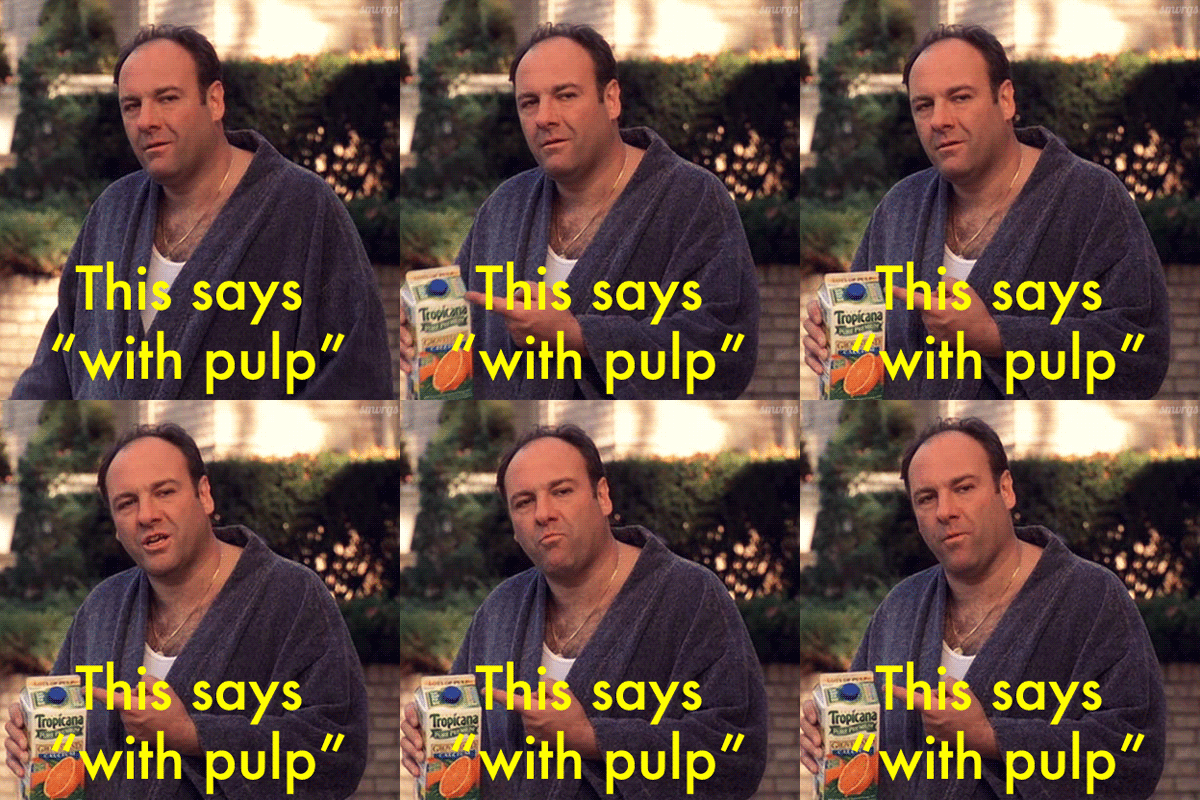
Here are some gems:
"The gap between man and beast wasn't as wide as they had believed. And in all of their minds was the haunting thought that some of them would never know where criminal rape ended and necrophilia began."

"At least now they couldn't blame women drivers. Women weren't allowed to drive. Women were sacred, fragile vessels to be kept under heavy guard and filled at as frequent intervals as possible, just in case their physiological block or gynecologic inadequacy should lift."

"She got to her feet patting a yawn. "If you guys don't mind, I think I'll call it a night. You're becoming too legal and complex for my little mind to follow your argument. "

Yup, no kidding - it's been a hoot - I'm out.
Here are some gems:
"The gap between man and beast wasn't as wide as they had believed. And in all of their minds was the haunting thought that some of them would never know where criminal rape ended and necrophilia began."
"At least now they couldn't blame women drivers. Women weren't allowed to drive. Women were sacred, fragile vessels to be kept under heavy guard and filled at as frequent intervals as possible, just in case their physiological block or gynecologic inadequacy should lift."
"She got to her feet patting a yawn. "If you guys don't mind, I think I'll call it a night. You're becoming too legal and complex for my little mind to follow your argument. "
Yup, no kidding - it's been a hoot - I'm out.

February 1, 2010
I'll be honest here. I see this under the Gold Medal science Fiction heading...I've seen several fairly positive reviews...Okay.
I read this back in the early 70s having found it in a used book store. The plot revolves around a couple who come back from a secluded vacation (where the wife had been very ill but recovered) to find that a plague had killed most of the worlds women and left the others unable to have children. Was it temporary? Would the human race die out?
The book sees humans in general and men in particular in a very poor light. ALL surviving women need to be protected from what amount to roving bands of men who would rape any woman they happened to know about to death. Military guards are placed around the remaining live women...
On the whole,in spite of the people who like this I'd say it's just sort of pretentious soft core porn. There are several graphic sex scenes, plus descriptions of sexual situations and other "almost" sexual situations (a fairly long description of a graphic strip tease on television, with anatomical description taking precedence).
Not a bad story, but it is largely (in my opinion) an excuse for a soft porn S/F book.
I read this back in the early 70s having found it in a used book store. The plot revolves around a couple who come back from a secluded vacation (where the wife had been very ill but recovered) to find that a plague had killed most of the worlds women and left the others unable to have children. Was it temporary? Would the human race die out?
The book sees humans in general and men in particular in a very poor light. ALL surviving women need to be protected from what amount to roving bands of men who would rape any woman they happened to know about to death. Military guards are placed around the remaining live women...
On the whole,in spite of the people who like this I'd say it's just sort of pretentious soft core porn. There are several graphic sex scenes, plus descriptions of sexual situations and other "almost" sexual situations (a fairly long description of a graphic strip tease on television, with anatomical description taking precedence).
Not a bad story, but it is largely (in my opinion) an excuse for a soft porn S/F book.

October 4, 2020
Dated.Very

December 19, 2013
Connie returns from a long sailing trip with husband that was meant to shore up their failing relationship. The world looks a little different and a bit crazy. While she was at sea, women have died by the masses and the human race is in danger. Government steps in as Connie now becomes a cog in the machine meant to keep the human race alive. How does a happy ending occur here? A must read for dystopian fans.

September 23, 2013
Both hilarious and outrageous.

June 16, 2025
all those mimetic writers moonlighting in sfnal space should take a page from keene's playbook. john macdonald's sf is strodgy; lessing's stuffy; and atwood's self-abnegating. keene's background was in the fawcett pulp mines, and he brings an air of menace and moral upheaval suitable to this vision of a world in which almost all women of childbearing years have died and the residual men resort to what you might assume. keene knows where his strengths are, and the story does much to underscore rather than sublimate them. a good metric for film criticism: "how well did this movie do what it WANTED to do?" and applied here, hard to find fault.

November 9, 2017
Actually pretty good. Would have preferred a little more post apocalyptic content. It's pretty much a straight up crime story for the last 3rd. Good fun if you want a pulp 60s thriller though, read it with a whisky in your hand. I especially liked the little touches of how society changes, tv immediately becomes full of sex and violence, the roads become much more dangerous to drive on etc.

October 13, 2021
Fun, very trashy, very much of its time. The ending, quite unexpectedly, is a smutty riff on the finale scene in The Grapes of Wrath - the novel, not the movie. Didn't see that coming.
This entire review has been hidden because of spoilers.
January 10, 2020
Inexcusable even for the early 1960s. Our protagonists are Reed and Connie, just back from a disastrous trip to the Galapagos Islands. Reed, a hotshot lawyer/war hero/he-man, is inadvertently portrayed as a dullard who doesn't figure out that most of the world's women are dead until his lawyer pal explains it to him. Connie, who has somewhat less personality than a Barbie doll, exists solely to be Reed's mommy/sextoy until the end of the book when, well, you really don't want to know.

May 18, 2013
Reed and Connie Renner, a young couple on the verge of divorce, return from fourteen months isolated in the Pacific Ocean to discover a world mired in desperation. Some event, speculated to be the test detonation of an extremely dirty nuclear bomb, has killed off nearly every woman on the planet of childbearing age. Those who survived are for some unknown reason unable to conceive, and are placed under heavy guard by their governments in an effort to preserve them from hordes of desperate, lonely men. A top lawyer, Reed soon finds himself working for a government desperately trying to hold off the collapse of a society without a future, where his actions soon draw the ire of a powerful mobster who is willing to stop at nothing to get to Reed – and his beautiful wife.
Day Keene (the pseudonym of Gunnard Hjerststedt) was a writer best known in the 1950s and 1960s for the crime fiction he wrote. This collaboration with Leonard Pruyn was his only foray into science fiction, which is unfortunate considering how well he writes. His novel is a fascinating look at the impact of gendercide upon a population, one with some interesting and well-thought-out details. His literary roots are evident in the efficient prose, tight plotting, and focus on the criminal underside, which finds its own way to profit in a changed world. Fifty years later, it still holds up well as a moving tale of a slowly unfolding apocalypse, one in which sane people struggle against the odds to hold onto hope.
Day Keene (the pseudonym of Gunnard Hjerststedt) was a writer best known in the 1950s and 1960s for the crime fiction he wrote. This collaboration with Leonard Pruyn was his only foray into science fiction, which is unfortunate considering how well he writes. His novel is a fascinating look at the impact of gendercide upon a population, one with some interesting and well-thought-out details. His literary roots are evident in the efficient prose, tight plotting, and focus on the criminal underside, which finds its own way to profit in a changed world. Fifty years later, it still holds up well as a moving tale of a slowly unfolding apocalypse, one in which sane people struggle against the odds to hold onto hope.
September 24, 2023
Als Connie und ihr Mann Renner von einem gescheiterten Ausstiegsversuch in der Südsee zurück in die USA kommen, merken sie, dass sie ein Großereignis verpasst haben: die meisten Frauen sind an einer mysteriösen Seuche verstorben, die Überlebenden können keine Kinder mehr kriegen.
Connie muss nun vom Zivilschutz bewacht werden, denn sonst würden die frauenlosen Männerscharen über sie herfallen.
Sicher kein Meisterwerk, aber das goodreads-Rating ist schon etwas brutal schlecht. Und wohl auch dem Zeitgeist geschuldet.
Ich fand das Büchlein nicht so übel, es hat mich zum Nachdenken angeregt, was ja schon mal etwas ist.
Connie muss nun vom Zivilschutz bewacht werden, denn sonst würden die frauenlosen Männerscharen über sie herfallen.
Sicher kein Meisterwerk, aber das goodreads-Rating ist schon etwas brutal schlecht. Und wohl auch dem Zeitgeist geschuldet.
Ich fand das Büchlein nicht so übel, es hat mich zum Nachdenken angeregt, was ja schon mal etwas ist.
Displaying 1 - 13 of 13 reviews