Jump to ratings and reviews
Rate this book

We Live Here Now

Rate this book
From a literary master of the form, Calvino meets Borges in a wickedly smart novel that explores the boundaries between art and life, vision and reality, and beauty and commerce . . .

When a famous conceptual artist’s installation project suddenly vanishes, the sinister aftershocks radiate outwards through twelve people who were involved in the project, changing all of their lives, and launching them on a crazy-quilt trajectory that will end with them all together at one final, apocalyptic bacchanal.

Mixing illusion and reality, simulucra and replicants, sound artists and death artists, performers and filmmakers and galleriests and journalists, We Live Here Now ranges across the world of weapons dealers and international shipping to the galleries and studios on the cutting edge of hyper-contemporary art. Rose’s characters are, as one of the puts it, in search of “a gateway to the Un, the Ex, the Outer, the Under, the Anti, the Non, the Other Place, the Not,” and it is those mysterious Other Places where C. D. Rose weaves his surreal magic. We Live Here Now spins a dazzling web that conveys, with eerie precision, the sheer strangeness of what it is like to be alive today.

320 pages, Paperback

Published August 5, 2025

16 people are currently reading
399 people want to read

About the author

C.D. Rose

16 books30 followers
C. D. ROSE is a writer of short fiction and novels. He has published three books, The Biographical Dictionary of Literary Failure, Who's Who When Everyone is Someone Else, and The Blind Accordionist. A new collection of stories is coming soon.

His major influences are Calvino, Borges, Georges Perec and Danilo Kis. He is at home anywhere there are dusty second-hand bookshops, quiet libraries, and dark bars.

He is currently the Royal Literary Fund Fellow in Residence at the University of Manchester, UK.

Ratings & Reviews

What do you think?
Rate this book

Friends & Following

Create a free account to discover what your friends think of this book!

Community Reviews

5 stars
14 (21%)
4 stars
30 (46%)
3 stars
14 (21%)
2 stars
5 (7%)
1 star
1 (1%)
Displaying 1 - 28 of 28 reviews
Profile Image for Paul Fulcher.
Author 2 books1,954 followers
November 8, 2025
Winner of the 2025 Goldsmiths Prize - judge Simon Okotie describing it as a “dizzying, encyclopaedic series of stories linked by texture, resonance and suggestion”.

“You want to turn this into a thriller?”
“There’s no tension, no conflict.”
“I’m not interested in tension and conflict. I want texture, atmosphere, suggestion. This is experiential.”


C.D. Rose's We Live Here Now focuses on modern art, and its interception with financial speculation and the wider business world.

At its centre, but a deliberately ambiguous and enigmatic centre, is the artist Sigismunda Conrad, at the height of her fame in the first half of the 2010s, but now a mysterious figure unique in being the only major contemporary artist with no Wikipedia page.

Her 2015 installation We Live Here Now, a massive piece designed to catapult her into the super-league, ended in some controversy after various people (staff, visitors, critics, the artist herself?) seemed to enter the exhibit and then were not heard from again:

Nothing was ever proved of course. There was nothing to prove. They were there; they weren't there. A correlation maybe (vague at best), no connectio. There was no inquest or anything.

The few shows Conrad had scheduled (Stedelijk, Jeu de Paume, Neue Nationalgalarie) were all cancelled. The piece rumoured to involve a large ship, or to be about the sea, or to be in the sea, or something like that, seems to have sunk. Others said she was working on something inspired by the work of the philosopher Lukas Lemnis, or was working with the scientist Thomas Vyre. Conrad herself no longer gives interviews. No one seems to know where she is: Fox thinks she's in Berlin, Herman on her Scottish island, and Lauro won't say for definite but concurs with Herman and thinks she's still at work on the sea project.


The novel then features 12 chapters, each focused on the life of someone associated with, or impacted by Conrad's work, and ends with Conrad's comeback, a mysterious artistic installation, which attempts the form of a Klein Bottle.

This is in literary terms a novel in the form of a collection of connected short stories - connected strongly in a thematic sense, and loosely in terms of plot with small intersections across both, as well as the characters coming together (and for no obvious reason) for a lecture to be given, reluctantly, by Lukas Lemnis.

But the book is perhaps best seen as one artwork, an exhibition, with the chapters each different pieces within it.

The author acknowledges the work of artists Jill Gibbon, Trevor Paglen and Thomas Demand as providing some of the work's starting points, and perhaps my favourite piece, Commission, draws on the work of the latter and former of these. It is told from the perspective of Ryan Gaunt, who, inspired (perhaps a little too much, some had noted) by Gerhard Richter, began with portraits based on painting over pictures of his subjects, often from the public domain. And now post-pandemic, (like Demand, but here the author rather than the fictional artist has taken inspiration), built tiny models of rooms, or sometimes entire buildings to scale, out of cardboard, then photographed the models, and then painted over the photographs he'd taken of the models, destroying the originals.

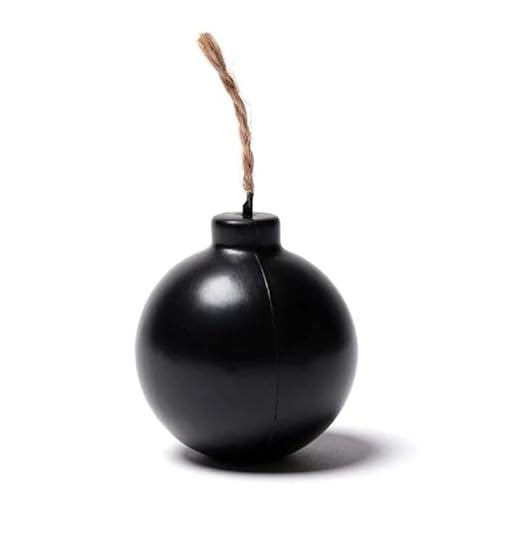
He's commissioned to paint a portrait of a secretive businessman - 'CEO of the biggest global corporation you've never heard of' - a Norwegian company originally that started with rigging for ships, and then expanded at the end of the 19th century into cables, which are still a key component of its business which includes copper mining, shipping and more recent rather more shadowy activities. The CEO's daughter reminds him repeatedly that he wasn't their first choice, particularly when his methods (wanting to take photos and paint later) aren't quite what they expect. And his final 'sitting' with his subject is at an arms fair, where he picks up merchandise including a stress ball, a rubber ball which Ryan realised was in the shape of a bomb, a good, old fashioned bomb. A Tom and Jerry, Bugs Bunny bomb, the kind of bomb that moustachioed anarchists would have thrown in late 19th century pulps, black and spherical with a long fuse protuding.

This, which he melts down and works into his final piece (they'd hate it he thought, but they'd probably accept it) is straight from the work of Jill Gibbon, who per her own website:
Visits arms fairs in Europe and the Middle East by dressing up as an arms trader with a suit, plastic pearls, and a fake company. Her pretence is a metaphor for the facade of respectability in the industry. Once inside she draws, and collects complementary gifts from the stalls - stress balls in the shape of bombs and grenades, toy tanks, sweets and condoms with marketing slogans.

description

Manifest is set on a large intermodal cargo ship, travelling international waters, and sailing under a flag of convenience and layers of murky ownership, full of ISO6346 containers (They have been described [as] 'the greatest art work of the 20th century', though others have been less flattering. There is a supernumerary passenger onboard, who even the Captain knows nothing about save for the fact they were an artist who had booked passage on the ship as part of an ongoing art project. This chapter is full of maritime disasters, particularly fires, and the crew of the ship feel haunted by a presence, and when the Captain checks the manifest there is additional container onboard, unaccounted for, which the crew decide to open:

Later Mani claimed that he had seen shadows escape; Vinod saw black mechanical shapes, some kind of machinery which he couldn't describe; Mary had seen darkness, a deep black nothing where there should have been at least something; Yannis had seen the same but saw there were some kind of boxes or containers in there; Janis remembered only how cold it had been in there, colder than it ever could have been; Callum saw nothing but empty space.

The supernumerary wasn't there. The captain thought he had seen his own face, staring back at him, but he never told anyone this. The crew, fearing for future employment, all signed a pact swearing each other to secrecy. Many of them respected it.

But all this happened on the ocean, so far from our eyes, as if it didn't really happen at all.


Overall, this is a fascinating and intelligent novel although not without its flaws - the stories are perhaps too disconnected for it to cohere; it isn't obvious if Rose is aiming at satire of artistic pretentions, or if displaying them; (a mix of both I think); and as for the mysteriously absent artist at the centre, well Ezra Maas would beg to differ that she is unique in being the only major contemporary artist with no Wikipedia page.

Amy Sackville, Chair of Judges on the novel:
“A book about what art is and what it does (or doesn’t do), C.D. Rose’s We Live Here Now in its turn asks profound questions of the contemporary world and the systems that power it, in the aether, deep under the surface, far out at sea. Motifs emerge and recur: containers, erasures, shady markets, sound and silence, ‘echo and drone’. This constellatory novel tests the bounds of the form while delivering all of its satisfactions: at once hilarious and deeply haunting, intellectually challenging and supremely entertaining.”

Simon Okotie, Judge on the novel after it won:

“The distinction between short- and long-form fiction is a convention the novel is well-placed to challenge. This year’s Goldsmiths Prize-winner uses a series of linked short stories to undermine both the traditional workings of novelistic plot and the ontological status of the fictional characters that are supposedly “developed” by it. In the process it traces the invisible circuits and networks – of art, capital and war – that shape our lives.”
Profile Image for endrju.
442 reviews54 followers
Read
October 16, 2025
I’m really a sucker for this kind of novel - it is about contemporary art but grounded in art and critical theory. I mean, a Hito Steyerl quote opens the novel, and that’s exactly what you get — but playful. It never gets bogged down in dry theory or, for that matter, in flowery literariness. When it does get a bit theoretical, it’s always with a touch of irony, even though I completely agree that we live in the world as described by Rose. I’m not happy with the ending, though — it felt like an add-on. But then again, how does one end anything in the absolute immanence of whatever-stage-it's-in capitalism?
Profile Image for TheConnieFox.
448 reviews
March 22, 2025
This fiction novel is one of a kind! This is the first book that I have read by the author and it won’t be the last! The book takes you on a magical journey on what it is like to be alive today. It gives mystery vibes, eerie vibes and fantasy vibes. It also has some dark humor in it, which I loved! It really explores art and reality. It makes you question what is real and what isn’t. When an artist’s installation goes missing, that included twelve people working on it, everything changes. Their lives turn upside down. As this story starts to unfold, unthinkable things start to happen. This is a fast paced, well written, easy to read book! It was definitely thought provoking! I give this book a 4 out of 5 stars! I highly recommend this book to anyone that loves reading a great humorous literary fiction book!

Thank you to NetGalley, author C. D. Rose, and Melville House Publishing for this digital advanced reader’s copy in exchange for my honest review of this book!

This book is set to be published on August 5, 2025!
Profile Image for Paul Dembina.
694 reviews163 followers
November 21, 2025
This ended up being much better than I expected. When I was part-way through I was thinking this would be yet another tale signifying not very much indeed. However with the final chapter (this isn't really a spoiler) mentioning the Klein Bottle - an object that can only really be represented in 4 dimensions and that has no discernible edge it all seemed to come together for me.

That's not say that the ending wraps things up neatly - not at all. Just that what went before does (sort of) make sense
Profile Image for Opal Edgar.
Author 3 books10 followers
May 3, 2025
"Silas spent hours trying to work out quite what an NFT was but ended up none the wiser and decided he wouldn't bother. It was the same as the crypto thing: the idea was brilliant, but the practice gave him the ick."

And maybe this quote best conveys all the unease and alienation and anguish you feel as you read this extremely smart and acerbic Kafka-like criticism of the modern art world. The detailed language of this book, so real and life-like, pinpoints the lack of humanity in this digitalised, modernised, never quite real experiences... and you wonder as you read, is this the life of the characters? Is this a simulation? Is this their neurodivergence at play? Is this an installation? An hallucination? Is it art? Is it a criticism or an elevation of the art form?

I love art... and I hate the world that it has always swam in: money and patronage, pretence and scams, intelligentsia and elitism, suffering and superiority... such an ugly world to hold what should be the most beautiful humanity has to offer, and such an odd contrast.

An amazing book, carefully crafted across multiple characters living seemingly different experiences, but who are all somehow linked, to make you think about today, tomorrow, and what art is and what it is becoming.
Profile Image for Garry Nixon.
350 reviews7 followers
November 3, 2025
A marvellous story which manages to be a page-turner and a satire on the contemporary art world. And to be genuinely "artistic" and moving. There are strong echoes of the Unauthorized Biography of Ezra Maas, and fainter ones of the character Ilan from The Loneliness of Sonia and Sunny.
2,300 reviews47 followers
June 10, 2025
This is definitely on the outer limits of weird for things I've read recently, but in an ultimately understanding sort of way. We have a conceptual artist whose artwork suddenly vanishes and affects the lives of twelve people, whose experiences form the bulk of the novel. It's meta in a way that lets you know it knows you're reading and judging it and it doesn't care in a punkish sort of way, and that ultimately what you think of it doesn't matter. This is one of the few times where I actually agree with marketing copy and think Borges and Calvino are legit comparisons. There's not a lot I can say about this other than to go and seek it out yourself and let it happen to you. Interested to see what the reception will be when it comes out.
108 reviews1 follower
August 5, 2025
This book made me feel simultaneously very smart and very stupid. The book is written essentially as a group of intersecting short stories, with each one focusing on a character whose life has overlapped somehow with a contemporary artist named Sigismunda Conrad who has since disappeared. These stories build and culminate in a final two chapters where all of the characters come together.

The Short Version (what I liked):

My favorite part of this book was definitely each of the individual stories. I loved almost all of them (sorry, the ship one was kind of a slog) and felt that each character was unique while also struggling from a similar estrangement from the world around them. Each of the stories is essentially about a lonely or perhaps simply isolated person and their eventual unraveling. In many cases this seems to be caused (or at least facilitated by) their isolation. Some characters have physically isolated themselves from the world on purpose while others have become disconnected from others due to broken relationships, mistrust, disinterest, or the unwillingness to be vulnerable.

Rose so compellingly creates this alternate version of reality where essentially everything is the same, except all of the artists, newspapers, organizations, even car models have different names. However, I regularly found myself reading these names expecting one to ring a bell before I would remember that they were all made up. He also apparently loves to hide little easter eggs in his work. I felt very cool when I recognized a unique turn of phrase as being from James Joyce’s The Dead. When he first teased his play on the German idiom “Ich verstehe nur Bahnhof”, I was kicking my feet. I’m sure there were many other references I missed, but at least Rose didn’t make me feel stupid by making it clear I was missing something (unlike Joyce).

The Long Version (what this book made me think about):

While it’s unclear to me what the central theme of this book is (if there is one), to me it conveyed the deep sense of isolation that is perhaps unique to the 21st century. The way we posture to curate our online identities, interact with others in half-truths for fear of ridicule, avoid eye contact with strangers on the subway. Commodification of everything ties strongly into this. The idea of art critics who survive off of their own opinions and artists who make work for commission—does the fact that we get paid to give our opinions or to make art make those opinions or art less authentic, less real? Artists who originally pursued their craft because of a deep love for it, an inability to not do it, may become removed from their original purpose by the necessary pursuit of money. And I think this can be true for many hobbies or professions.

I even found myself reflecting on my own bookstagram account and how this personality curation is somewhat unavoidable. Even if you don’t feel like the version of yourself you project online is fake, it inherently is not the true, full you. Most of us on bookstagram are here because we want to share our love of reading, and for that you need other people to pay attention to you. If you create for an audience and with an intention to grow that audience, does that reduce or alter your authenticity? At the end of the day I’m not sure this question really needs an answer, but I did find it to be a good reminder that I’m here, first and foremost, for myself.

In Summary:

These are the kinds of questions that this book poses. It is both a celebration and a critique of the contemporary art landscape. It questions how capitalism has driven the commodification of everything. It questions how we pose and project ourselves into the digital (and the real) world, but it does so with humor and levity. This book knows that it also, as a work of art, falls prey to all of these same issues. Rose has been compared to Calvino and Borges, and while I cannot comment on those comparisons (yet), I do think this book has similarities to Cloud Atlas by David Mitchell, but more character-forward and with a much more surreal bent. If you like weird, genre-bending, philosophical books that make you go “wtf”, then this book may be for you!

Many thanks to the author, publisher, and netgalley for the eARC! All opinions are my own.
Profile Image for Alana.
162 reviews5 followers
June 19, 2025
What an abstract read

I had no clue what I was getting into and I’m still trying to fathom most of what happened. The stories of each character were so fleshed out but at the same time just a snippet of their world.

I enjoyed how everything tied together eventually, but it was a bit of a slog at times. Some of the characters were very memorable and had more interesting stories. Some of them I’d like to read more about, like Oreste for example.

Overall, an interesting and strange read. If you enjoy art, absurdity, the unthinkable - this may be for you.

Thank you NetGalley for the ARC
Profile Image for Patrick Hewett.
33 reviews
December 2, 2025
its ok. problem is reviewers unfairly hyping this book up by saying it's like delilo meets borges for which it will only fail by comparison.

interesting themes; asking what is the arts role in an era of an ever commercial form, how to represent our ever complicating idea of reality.

prose falls short unfortunately for me.
Profile Image for Gumble's Yard - Golden Reviewer.
2,189 reviews1,796 followers
November 6, 2025
Winner of the 2025 Goldsmiths Prize.
 
But no, of course not. It was art. Of course it was. The guns weren't real. He tried to think how Kasha would spin this—there'd be some artspeak way of describing the work. It speaks to the nexus of power, violence and money through a representation of cliched imagery. Something like that. Ultimately questioning the possibility of human agency by interrogating the real. Not bad.

 
Ezra Maas meets Tom Mc Carthy by way of mid-career David Mitchell.
 
CD Rose is known both for his Borges/Kafka/Calvino inspired short stories (and has already met literary prize success this year with a shortlisting for the 2024 Edgehill Prize (awarded in 2025) for his collection “Walter Benjamin Stares at the Sea”) and for what he himself has labelled his “parafictional” novels, where he writers about seemingly fictitious books or authors – “a mode of literary enquiry which seeks to examine the truth status claimed by both fictional and non-fictional tropes, strategies and discourses. Unlike metafiction which lays bare its workings, and is ultimately interested in showing itself off, parafiction lies quietly alongside the established tradition, neither true nor false.”
 
And both of these, and much more, feature in this novel – effectively a thematically and character linked set of short stories, which might be described to some extent as applying some of the parafictional ideas to the art world and which (in a 2024 interview) Rose described as “a much bigger book about the art world, the arms trade, international shipping and the metaphysics of presence that has been exhausting me on and off for the last five years”.
 
The novel beings with two epigraphs which are key to the novel (more so I think than in most novels):
 
Most important things want to remain invisible. Love is invisible. War is invisible. Capital is invisible.-HITO STEYERL
Every something is an echo of nothing. -JOHN CAGE

 
As at its heart lies an examination of the increasingly invisible world of major corporations of arms manufacture, dealing and even arms use, of money flows and importantly of the art world also.  And the relationship between something and nothing – visual art which relies on blanking out features, sound engineering seeking to capture the absence of sound, liminal and void spaces, absences (Rose has written of his earlier writing how he has internalised a dictum of the brilliant Elif Batuman that “the short story can only accommodate a very specific content: basically absence”), empty rooms and containers, missing and vanishing people, art which is at its most renowned when it seems absent – is at the heart of the novel.
 
And crucially the very thing that holds the whole set of short stories together, and coalesces them into a novel, is a fictional artist Sigi(smunda) Conrad – who does not really ever for sure appear in the chapters, and who in the fictional world of the novel, is a famous artist who is best known for …. well no one who knows of her work can really quite remember or at least recollect to others what it is she did, and whose most famous work (which gives the novel its title), before her apparent disappearance for a number of years, was a fully immersive art installation into which people seemed not to reappear (all of this we learn from two essays which bookend the novel – essays which themselves were never actually published).
 
The 11 main chapters in between feature a disparate group of characters more or less connected to Conrad and her work, and with Mitchell-style small links between them (the twelfth features most of these characters assembling for a lecture on Conrad – the lecture itself given by an actor as its author decides – of course – to be absent).
 
“It Is What It Isn't, We Are Where We Aren't” – features Kasha an art-consultant who helps a mysterious private buyer invest in some art (a Conrad) which she then arranges, for tax purposes, to be shipped around the world, only to panic when the buyers want to see it, tracing it to a container in a shipping freeport.
 
“Every Echo Is a Leak” features sound engineer Rachel Noyes (noise, no/yes both deliberate) waiting in a Berlin flat for an interview for a residency.
 
“Manifest” was one of my favourite chapters – featuring a cargo ship carrying containers (and one fee paying but non-identified passenger) and one crew member from South Uist (where Conrad has a studio) with increasingly odd happenings.  As an aside it is telling perhaps of my biggest issue with this novel – my lack of knowledge and it has to be said any interest in modern art - that while I had to frequently Google artists names to see if they were real or fictional, that the one chapter where did not need Google was for the list of shipping incidents (and so insurance claims) in this novel – I recognised more ships in this chapter than artistic references in the whole book.
 
“Death #47” features Oreste – Conrad’s fixer from the first essay – who is fearing the latest in a series of deaths/near-death experiences.
 
“Commission” was an enjoyable chapter – a tale of Ryan (an artist who makes miniature models of buildings, photographs them and then paints over them) and who is commissioned to photograph the sion of Laerp - a Norwegian industrial conglomerate) and who ends up attending an arms fair. What perhaps confused me though about the novel was the realisation that Ryan’s practices were actually based on a couple of real artists which the author quotes in the acknowledgements – making me unsure if what I had assumed throughout was a satire of the perhaps easy but still deserving target of the pretension of modern art was actually partly a tribute.
 
“Six Versions of Thomas Vyre” – has Thomas, a scientist whose work (much of which is about echoes) has been uses for more nefarious purposes, dealing with a number of apparent identity-stealers as well as an apparent impending arrest.  This chapter is perhaps one of the weakest simply because Rose is much less convincing on science than art (or even commerce/capital) – Tom McCarthy is much stronger here.
 
“Ich Verstehe Nur Bahnhof” – another weak chapter (other than its pun on a German idiom) about a man Sweeney – once key to providing distressed pieces for Conrad – who know circulates on trains

“Crazy Russian Kids Climb Old Soviet Tower” – about a musician Ton and a video he becomes obsessed with.
 
“Available Light” – Gerry is an actor filming on South Uist (with Rachel as sound engineer and the cargo ship crew member’s brother as gopher) – the chapter ending with them watching a mysterious ship burning off shore (which becomes key in the penultimate chapter)
 
“Contract” – Jen the night desk manager at a private members club with a special room which seemingly does not exist


“Aleatoric Outcomes from an Interaction of Conflicting Forces” – a very strong chapter in which Silas (an acquaintance of Kasha) starts buying and selling art as a way to money-launder his drug proceeds before getting more and more involved in art dealing itself – ending up buying a Conrad
 
As an aside one of the novel’s side ideas is how even in a virtual world, where even physical art is moving into a world of non-fungible tokens and physical currency not just being replaced digitally but by crytpocurrencies (in both cases not just with no apparent physical presence but with no intrinsic value) physical assets (shipping containers and cables) are as essential as ever to the world economy (perhaps even more so) – I was reminded of Colum McCann’s latest “Twist” by some of the activities of the Laerp corporation.


Overall this for me a very enjoyable and thought provoking novel, worthy of its Goldsmith shortlisting.
 
Have we learned anything?' we ask. 'Is that even important?"
There is noise and its interpretation, we agree, that interpretation being a signal or sign upon which we confer form, and value, and Seary. The problem is, we may never recognise it.
Too abstract, we say. "Too difficult. Some of us are writing for the general reader. What can we tell them?'

Not much, we think. We try to draft something else, and come up with this: Everything that is broken can be fixed. Everything can happen again, but in a different form, one you may not recognise.
Everything will find its form, its home, its resting place.'
Profile Image for Juliet Bookliterati.
508 reviews23 followers
August 11, 2025
It’s always exciting to be invited to take part in a blog tour, and today I am grateful to Melville House for giving me the opportunity to read and review We Live Here Now by C.D Rose. I have previously read a book by C.D.Rose so knew this was going to be a fascinating and origional read, and it certainly was.

C.D Rose has taken a witty and humerous look at the world of modern art in We Live Here Now. The book starts with a critic writing about artist Sigi Conrad a reclusive and apparently difficult artist to work with. She creates the installation ‘We Live Here Now’ with the help of a team, until it suddenly vanishes with the artist. In a series of short stories C.D Rose tells the stories of those involved in the project and the trajectory their lives take until they all comeback to be part of another piece of art.

This is quite a hard book to review as it has a dreamlike and origional quality that made for such a intriguing reading experience. I did wonder at times just what was I reading, especially in respect of the stories of those who were part of the original project; including a scientist with four people pretending to be him, an art consultant, and a artist who uses sound as a medium. These stories, and the experiences of those who were the focus for them, had a surreal and dreamlike quality that had me thinking about what is art, can it been defined, and how art and life can blurr into one. C.D Rose also explores art as a commodity, as an investment put away for a future date and as currency , as an art lover this is something I see as the more unsavoury side of the art work; art should be enjoyed not hidden away. I did find some of these stories more of a chore to read than others, but I liked how the characters and their experiences all weaved together for the last chapters.

C.D Rose’s understanding of the art world really shines through in this book and is able to use that knowledge to make the reader think and form their own opinions. It was fascinating to see so many people, from varying professions and backgrounds work on the exerience of the installation, and how this then shows the move away from a singular artist to a more collective. There is a lot of humour and wit in this book, a few pieces of tongue in cheek moments that stop this feeling like an over serious read; you don’t need to be a connoisseur to read this book.

If you like a book that makes you stop and think then We Live Here Now is for you. It’s not a light easy read but it is a fascinating one that will take you on it’s own surreal and philosophical journey. I felt like I had really acccomplished something by the end of the book and that I had learned a lot more about conceptual art,how art is used as a currency and investment and surprisingly also about fires on cargo ships; who knew! Erudite and funny this is a read I won’t forget.
Profile Image for Haydn.
18 reviews6 followers
June 4, 2025
Whoa. What did I just read?

One thing I can say for certain: We Live Here Now is full of contradictions. This book claims that no idea is new, then praises the unique perspectives that artists bring to their work. It says art has no meaning, then shows how art holds unique significance for each individual. It denies art's value, but follows characters who literally make their living from it. Art is so many different things, and C.D. Rose—often tongue-in-cheek—has a lot of fun saying so!

We Live Here Now reads like a series of 14 short stories. Each follows a different character holding some position in the art world: artists, art dealers, a sound engineer, an actor, etc. Their thoughts, motivations, and perspectives—the ways they see the world—are all distinctly fascinating as they are explored in each chapter.

Throughout the book are many recurring symbols, ideas, people, and events. Some of these are quite subtly laid out, but you slowly start to wonder if the strange circumstances haunting each character are connected. Is someone pulling the strings behind the scenes? Rose lets the reader ask and answer these questions on their own. Nothing is a given, here. I had a lot of fun trying to figure out what was going on, piecing together a trail of surreal breadcrumbs one after the other (even if I now feel a little bit like a conspiracy theorist).

Along with this web of questionably intertwined fictions is a mixture of real people, places, and events. This playing with reality echoes the characters' own uncanny experiences. C.D. Rose blurs the lines between what is and isn't real—between art and life. My favorite was an ongoing bit where characters are driving aggressively named, fake car models from real car brands (e.g. the Lexus Persecutor). I laughed every time, even when I had to look them up to be sure it was just a joke.

For all this book celebrates art, it also spends a lot of time exploring the commodification of art by "the industry". To what extent is art valuable if it's made to be sold? To what extent is it meaningful if it's hidden in a shipping container floating between tax havens? Is it better or worse for a human or an AI to rip off an artist's work? What does it mean if we cannot distinguish between human and AI art? We Live Here Now doesn't strictly answer any of these questions, but it certainly gets the gears turning.

Strange, sharp, and sneakily profound—We Live Here Now is a work of art about art that makes you laugh and think at the same time. There's an absurdity here that I really appreciate. It serves to underscore the point that we shouldn't take this book, art, or anything in life too seriously.

I wouldn't read this expecting a straightforward plot-driven narrative. Comparisons to Calvino are probably apt. I'm not sure you can really pin this book down, but I suspect that's the point. I'd certainly recommend giving it a read if you're looking for something playful or perhaps a little bit unhinged!

Thanks NetGalley and Melville House for the ARC.
Profile Image for Katie Quirk.
77 reviews22 followers
June 5, 2025
Reading this book was like going through an “I Spy” book, just without any instructions on what you were trying to find.

In the best way possible, the first chapter both does and doesn’t set the scene for the rest of the book. While it clearly lays out what to expect from the artist Siggi Conrad, the tone of voice struck me as extremely formal. It felt as if I was reading an actual article about a real artist. The book then shifts from one POV character to another with clear changes in voice. With so many characters in this novel, I am shocked that Rose was able to make each of them and their story feel so unique.

Additionally, I loved that the chapters could be appreciated as short stories on their own. They weren’t just leading up to the final chapter. In a way this reminded me of the novels that I have read by Italo Calvino. It was also fun to pick out the motifs and similarities amongst all of the stories. I don’t want to spoil anything, so I won’t say more.

My only constructive comment would be about the presentation of the themes in this book. Perhaps one of the main messages of this book was to not look too deeply, or that all art (books included) is open to interpretation. However, I’m not 100% convinced that was the main purpose of this novel. There were other themes that were lightly explored (i.e. cyclic nature of humans, critique of art world and those in power), but I don’t feel that any of them necessarily left a strong enough impact on me for me to walk away from this novel with a clear takeaway. Like I said before though, that may have been the author’s intention!

Nevertheless, this was a truly enjoyable and one-of-a-kind novel. For all of my friends who have read “If on a Winter’s Night a Traveler,” I will tell them that they absolutely need to read this book when it comes out. I look forward to reading more novels by Rose!

** Disclaimer: I received this book as an ARC through NetGalley but all opinions are my own **
Profile Image for Sue.
1,337 reviews
September 4, 2025
Welcome to the world of art through the intriguing perspective of C.D. Rose, who explores a myriad of facets around the work, artists, and the sphere that surrounds them, via fourteen linked short stories to push your metaphysical boundaries.

Connecting them all is the enigmatic artist Sigismunda Conrad, her peculiar art installation We Live Here Now, and the twelve people who were involved in the project. From critics, to fellow artists, agents, fixers, and a selection of others on the fringes of the art world, Rose spins a tale about the almost mythical Conrad, rumours of strange disappearances, and the fact that the exhibition piece itself has subsequently vanished.

Between literary bookends from the perspective of an art critic, which brings everything full circle, each chapter explores the uncanny experiences of the characters. Through them Rose probes different artistic media, performance, perception, memory, illusion, corporate machines, murky investments, and even the fabric of space and time, in pursuit of answers to some pretty big questions... What is art, and what does it tell us about ourselves and the world around us?

For those of you that consider art to be a subject as dry as dust, then this the book to shatter your illusions. Rose pitches this somewhere between fever dream and philosophical investigation. He strikes out in a number of thought-provoking directions, blurring the line between speculative fiction and horror, to take you on an eerie existential journey.

It has been a good while since I read anything as wonderfully weird as this mind-bending odyssey, and I enjoyed every bizarre moment. Perfect for fans of Black Mirror.
Profile Image for Nerwen.
25 reviews6 followers
August 1, 2025
I have a bit of a hard time rating this book. It is a bit of a mixed bags. It is structured in a way that the chapters feel more of a short story collection. And with every collection they are hit and miss. Some chapters I was deeply invested in, other ones not so much.

The writing style is good and I liked the overall themes, but something was missing, that prevented me to be completely "into" the book. Maybe it is just one of the instances, where it just wasn't for me. I do recommend it still for readers who enjoy "different" books, the weird, the mindbending and philosophical. Something to think about. As i can see how one can enjoy it and be with the book for a long amount of time.

Thanks to Netgalley for providing a free ARC in exchange with an honest review.
Profile Image for Joseph Schreiber.
586 reviews182 followers
August 12, 2025
As a collection of loosely linked short stories that sometimes directly reference one another in unexpected and delightful ways, this book is brilliant. Rose is playing with all kinds of ideas about art, reality, and the banality of modern society, but whether it works as a whole is less certain. There are chapters and characters I would have loved to spend more time with, some less so, but that's the nature of a short story collection. The framing of the project, beginning and ending with articles about major exhibits by the elusive artist who connects all of the intervening stories, though necessary to a point, is the weakest aspect of the novel in my mind. Nonetheless, this is a remarkable, entertaining (if slightly over ambitious) work. In that respect, though, it's a lot like real life here, where we live now.
A longer review can be found here: https://roughghosts.com/2025/08/12/to...
4 reviews
August 4, 2025
Intrinsically linked, each character's lives overlap and imposter syndrome abounds. What constitutes art? What makes someone an artist? Concepts, ideas, sounds and space. Art as a chair seen from many aspects...

Calvinoesque, We Live Here Now explores boundaries between reality and dreams. When visitors to a famous conceptual artist's installation start mysteriously disappearing, twelve people ,who were involved in the project, start experiencing strange infinity loops within their lives.

An enjoyable and perplexing dream fuelled novel.

Thank you Melville House for my copy of this epic journey into the world of art.

What does art mean to you?
Profile Image for Lia Windsor.
130 reviews2 followers
July 14, 2025
This is like nothing I’ve read before - part short story, part novel, part dream. More of a vibe than anything else. Delving into the world of modern art, C.D. Rose takes you through a whirlwind of characters and impressions with a humorous cynicism that has you both reflecting on the nature of art and giggling about the silliness of it all. Entirely readable and utterly impenetrable. Highly recommend.
Profile Image for Liz Barnsley.
3,761 reviews1,077 followers
August 30, 2025
Somewhat of an existential novel about life, We Live Here Now is a collection of connecting chapters to a central theme.

It is an artistic story about art, some of the chapters have a fever dream feel to them some more straightforward literary insight into a character.

It is an oddity, a particularly compelling one, you get drawn into it almost despite yourself, beautifully written beautifully imagined and a novel that is uniquely styled.

I thought it was brilliant really.
83 reviews
November 20, 2025
Clever writing about uninteresting characters who all inhabited a world of almost zero relatability without a redeeming feature between them. I expired with under 60 pages to go - the writing appeared to give substance but there was nothing there. Perhaps this was the author’s intent - if so, it’s a success. Words full of unintelligibility.
I gave 2 stars because it nearly lulled me into thinking there was something there besides the skewering of pretention.
Profile Image for Randolph Perkins.
4 reviews
December 5, 2025
3.5. Not sure what to make of it. Definitely some excellent vignettes throughout, but not sure how they all fit together. Fun overall. It won the 2025 Goldsmiths prize, over Helm by Sarah Hall, and Nova Scotia House by Charles Porter, which surprised me.
25 reviews4 followers
November 19, 2025
Can I have some more please? Loved this very strange book. Eagerly awaiting the next book.
Profile Image for Ian Mond.
749 reviews119 followers
Read
December 14, 2025
You can read my review of one of the best books of 2025 in the December 20025 issue of Locus
Profile Image for Chiara Yaar.
270 reviews5 followers
November 30, 2025
It’s weird but special and well written but also was ther a plot was there not? I think the ending kinda didn’t connect, it could’ve ended with the chapter beforehand, but really nice speculation? Idk
Displaying 1 - 28 of 28 reviews

Can't find what you're looking for?

Get help and learn more about the design.