Eine bittersüße Geschichte von vier Teenagern, zarten Gefühlen und unerwiderter Liebe
Wenn man eine Freundschaft nicht verlieren will, sich aber heimlich nach mehr sehnt, bleibt oft nur, das abgewandte Gesicht des Liebsten zu betrachten…
Die Oberschülerin Hikari bezeichnet sich selbst oft als außergewöhnlich gewöhnlich. Neben ihren Klassenkameradinnen kommt sie sich so unscheinbar vor, dass sie selbst in ihren Tagträumen häufig in der Nebenrolle landet. Eines Tages beginnt Hikari sich auszumalen, wie eine Romanze zwischen ihrer hübschen besten Freundin Mari und dem süßen Otani aus ihrer Klasse aussehen könnte. Was als kleiner Spaß beginnt, verschwimmt schon bald in Hikaris Fantasie. Muss sie in dieser Geschichte wirklich nur die Nebenrolle spielen? Und an wen denkt eigentlich Otani, wenn sein Blick in die Ferne schweift…?
I really liked this. The artwork was gentle, the story and characters were likable and low drama, though you could see it was growing with the feelings being caught by one side and not the other. I definitely enjoyed this one, though I do hope that the center of everyone's desires gets to actually have her own needs heard, seen, understood and respected. She doesn't seem to have much agency according to the other characters. I would like to see her spread her winds and grow.
4, gentle sweet and interesting, stars.
My thanks to NetGalley and Kodansha Comics for an eARC of this to read and review.
This entire review has been hidden because of spoilers.
This contemporary slice-of-life high school romcom (?) was neither boring nor interesting. I will not continue it. The two male characters looked identical to me, which was confusing. The one female character is supposed to be some great beauty, but she was constantly drawn with comedically buggy eyes. The only plot was the daily life of high school kids, going to class and participating in extracurricular activities (band, sports), and developing unrequited crushes. And MAYBE the music teacher is a pedophile? Time will tell, but this just isn't for me.
Hmm, not sure what to say about this one. The ending left me intrigued enough to want to continue to see what happens, but at the same time, I don't feel drawn to pick it up either. 🙈
I like how Hikari does seem different compared to other shoujo manga heroines I've read recently though! I really love how she wants to be there for her friend, but I think I realized this story won't be for me with the approaching love triangle (square?).
Definitely not a bad story, but I unfortunately don't love the cast of characters enough to endure the angst this story is sure to give. 😅
Very glad I at least gave it a try though and the art sure is nice!
*(I received an e-copy from Kodansha via NetGalley. All thoughts expressed are my own.)*
Intrigue has been built. Unrequited love in a friend group. How can this go without someone being hurt…
However i think there are some issues with the translation and it should be edited over. I feel like the characters are a little dull, but there is four to focus on which can be difficult in such short pages so maybe with the upcoming volumes it will be better. Although i doubt I’ll read them
Ich fand's richtig schön, genau die Art von Highschool Romance, die ich mag. Und diese atmosphärischen Zeichnungen, hach lassen mein Herz schmelzen. Freue mich auf Band 2 :)
Hikari and the painfully shy Mari are best friends, so Hikari injects herself into Mari’s love life by helping her along with Ohtani, the boy in class who likes her. Too bad that feelings rarely stay in the lane they’re supposed to.
The art already made me think I’d read this mangaka before, but within mere pages we have had a cheeky name drop of My Sweet Girl, Rumi Ichinohe’s previous series, so that’s me done feeling clever.
Like that series, I think this one gets off to a strong start that I hope gets even better as it goes. There are some wonky snippets of dialogue and some jokes that don’t quite work for me, plus, while the art is better, there are some odd panels where clothing looks incredibly voluminous and off.
Hikari is utterly average (in her mind) and the way this is established over a few panels is very fun, especially with her height being bang on the national average. It’s all down to exactly how plain she sees herself. And, as with many of us, that’s a box she’s trapping herself in; we see she’s actually rather exceptional at playing French horn, but changing self-perception isn’t easy.
This also includes her monolid, which is one of those cultural things that they wisely discuss in the translation notes, but lands like a cultural difference I just can’t wrap my head around (your mileage may vary; it’s not like I don’t get the intent). It also starts the entire series off with one of the clunkiest opening lines I’ve ever seen.
Mari, however, is the typical high school beauty, except she is cripplingly shy. There’s no question that she’s fine when she opens up, but getting her to that point requires an incredible amount of nudging on basically everybody’s part.
The way Hikari inserts herself into Mari’s would-be dating life amusingly starts off with her mentally preparing Mari’s very own shojo series (complete with many volumes, a live action adaptation, and fancy theme song). But making shojo is a lot easier when you’re not standing next to everybody involved in it.
Ohtani is the boy (of a pair who look a little too alike for my liking) with designs on Mari and he’s aided the whole way by Hikari. And he notices, but not in the way that Hikari would like after it becomes clear that the two have a real chemistry that is blatantly not present between him and his crush.
This is all presented fairly well - there’s a wonderfully silly running gag about how much Hikari monopolizes the bath that’s pretty darn good and two very different subway trips that quietly illustrate the major differences between Hikari and Mari (for all that we learn about Mari this volume, which isn’t much).
As far as a vibe goes, there’s a nice melancholia about all this that gives it a welcome contrast to a lot of shojo stories. It’s not new, per se, but Hikari is quietly orchestrating her own demise, romantically speaking, and she slowly gets crushed over the course of the volume.
The dialogue is a little strange - sometimes it absolutely kills it (Hikari is wonderfully quick-witted at points), but other times things that are supposed to be jokes are either lacking in context or just kind of not terribly funny. The translation notes sort of help, but not really. Of course, the vibe of this is not a comedy, so that doesn’t sink it.
Still, it’s a good start and the orchestra subplot really shifts itself at the end of the volume, going in a whole other direction from what you might be thinking and that’s a development I appreciated too.
3.5 stars - stronger than the start of My Sweet Girl, yes, but something about this feels a bit choppier than I like and I cannot quite figure out why. It’s really good, there’s a ton of potential here, but I want to see it pull all these threads together for the second volume.
I have mixed feelings. The pacing is slow and the translation is awkward. In addition, the characters are shallow. I also have trouble telling the male characters apart. As a result, the story is slightly hard to follow. Still, I want to keep reading just to see where it'll go.
Thanks to NetGalley and Kodansha for a free review copy.
Ufff, no sabía si me iba a gustar Mirándote de perfil pero ha superado completamente mis expectativas. Me encanta! Las interacciones son maravillosas y la forma en que expresan sus sentimientos también.
A pretty quiet read. Only when I consider them a little bit older than little fifteen years old, I think it is a somewhat realistic romance story.
I hope that we’d see more of how they all had fallen in love with their crushes, and that the story would grow more intricate in upcoming volumes rather than falling into the painfully repetitive formula of Shojos, for I am excited to explore more about the characters and their relationships.
One thing though, I hope the sexualization jokes would calm down a bit later on. I can brush it off so many times. (+why is the music teacher young and handsome…😟 pls author do not do what I fear you’d do)
ehhhhhhh…. this wasn’t my favorite😕…. it definitely had some potential but a couple of things made it a difficult read for me…
1) it was really confusing and hard to understand a good chunk of the time… there were times where the main guy, ohtani, made some jokes which I couldn’t get AT ALL😖. unfortunately this is probably due to translation so I give grace for that fs
2) I COULD NOT TELL FOR THE LIFE OF ME WHO WAS OHTANI AND WHO WAS HIS BEST FRIEND LIKE DUDE THEY ARE TOO SIMILAR😫 so that was very confusing as well
3) some of the jokes and references at the end icked me out…🤢
but all that aside there was definitely some good parts!! like ALL OF THE STUDIO GHIBLI REFERENCES WERE AMAZING🤭🥰 and I really did like our main character hikari and mari!! I just wished we deep-dived into hikari more and even though there’ll probably be some in the next volume, I just don’t love it enough to continue…. it was nice to try out though and also the art style is beautiful so there’s definitely that🙌!!
I *flew* through this one so fast! It has a great pace and the characters have a lot of facets to them, especially the “main character” who is set up in the plot as a secondary character, Hikari. I love that she treasures her friendship over love which can potentially bring in drama, but she also loves herself to a degree that allows her to say “Yeah, I like him” despite the circumstances.
Her best friend Mari is the most mysterious, I think. I hardly know what she’s thinking most of the time. Only Hikari does. The MMC is Ohtani, which I truly love! He’s a golden retriever that has a very high emotional intelligence. What a green flag!
I hope I get to ARC the next volume. I can’t wait to see what happens next after that cliffhanger!!
Thank you Netgalley and Kodansha Comics for the ARC!
This manga is currently on hiatus, and I’m eagerly waiting for the next volume to be released. What initially seems like a simple school-life and friendship story gradually reveals deeper emotional layers as the lives of four students and their teacher become intricately connected. At first, the pacing feels slow, and it took me some time to get fully invested. However, as the story progresses, the relationships and character dynamics grow more compelling, making the emotional tension and subtle developments more impactful. The way their lives intertwine adds depth to what could have been a typical slice-of-life narrative. My only disappointment is that the story pauses right when things are becoming truly interesting. Just as the emotional stakes begin to rise, it stops midway due to the hiatus, which makes the wait even harder. Still, I’m genuinely looking forward to the continuation and seeing how their interconnected stories unfold.
This entire review has been hidden because of spoilers.
Thank you NetGalley for the digital ARC of this volume.
Hikari is a young musician trying to navigate high school as a freshman. Her best friend Mari is super shy and as a plan to get her to open up and meet people, she decides to hook her up with a popular boy at school. Luckily, he already has a crush on Mari.
I thought this was cute. The characters are pretty shallow for now and it seems like there may be the beginnings of a love triangle. There are similarities between this series and Komi Can't Communicate and I prefer Komi. I would have given this a 2⭐ rating if it wasn't for the art. Every panel is beautiful and I really enjoyed that part of the manga. I don't know that I will continue with the series, but if this every becomes a 12-16 episode anime, I would probably give it a go.
This could potentially be a really cute series. I liked the beginning, but there were some jokes through out that I didn’t understand and felt very niche. It’s about unrequited love so it’s either going to be a sad-ish ending or a cute romance.
2.5 It was a cute, generic love story. I liked the characters enough and was interested in how the story was going to progress. But the story did have some weird and gross lines that were meant for comedic effect that didn't land for me.
2.5 stars. Thank you to Netgalley and the publisher for allowing me to read an arc of this manga.
This was kinda interesting I guess. Probably won't read the next volume unless I get it from netgalley though.... It's not really my cup of tea personally.
Edit: Gonna use this manga to talk about another netgalley book I read called "Read proud: Sci Fi and Fantasy YA Sampler" because it's not on Goodreads. It's a book that has the first couple chapters of some books, presumably made to get readers interested in the story and potentially buy the books. This one was okay, gave it 2.5 stars. Skipped over one of the stories entirely because I didn't like the direction the author took with the story.
Special thanks to the author(s), publisher, Goodreads and/or NetGalley for the review copy. All views and opinions expressed are honest and my own.
Four students, who become friends, where feelings intertwine and yet, they are looking the other way.
Hikari is a self proclaimed ordinary person. She fantasizes her friend Mari, with a cute boy, Ohtani, in their class. Coincidentally, Ohtani has feelings for Mari and has been trying to get closer with the help of his friend, Asagiri. However, while playing matchmaker Hikari slowly starts realizing her feelings for Ohtani..
This story has so many emotions but it’s clear it’ll be focusing on the four friends alternatively. Volume one is primarily told from Hikari’s perspective and changes to Ohtani’s perspective near the end. The story is fast paced and although set up like a typical shoujo romance, it quickly evades the common troupes. There is only selflessness and innocence behind each character. However, this creates a lack of drama and intrigue because everyone is so understanding, which causes the story to feel like a gentle summer breeze passing by.
These four friends are all different. Each has their own personality and it’s clearly depicted in both the artwork and their dialogues. Personally, I could relate with Hikari the most, although I consider myself below average. However, I also play an instrument and I did at one time like pairing my friends together in my mind. I found the way Hikari reacted was similar to how I would, which was surprising and a bit unsettling.
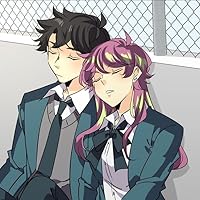
The artwork is beautiful. It’s soft and lyrical, similar to the words. Prioritizing the depiction of emotions and relationships, the manga makes it easy to understand what the characters are feeling. There are goofy facial expressions from time to time adding a little comedic relief and scenes of censored nudity. The character designs are pretty, although I sometimes couldn’t tell Asagi and Ohtani apart. The manga uses descriptive sceneries and iconography occasionally, placing an emphasis on the characters themself.
Overall I enjoyed the volume but I feel it lacks an overall intrigue to keep me interested. The cliffhanger at the end had me curious but also worried the story might go downhill for me. I think the story is somewhat beautiful but also a bit unrealistic. Nevertheless, I will continue this series as I think it’s only fair to hear the rest of Ohtani’s perspective as well as Mari and Asagi’s.
ARC Review While I liked the plot of this manga, there were instances where I struggled to juggle the side stories for the characters as the story progressed. This manga centers around Hikari who is merely in the shadow of her friend Mari who is admired by a guy in their class named Ohtani. This slice-of-life manga highlights how Hikari's perspective gradually shifts as she develops feelings for Ohtani, leaving her conflicted about her presence in social settings. I am curious about what will unfold in the next volume since Hikari's character development progressed toward the end of volume 1.
Thank you NetGalley and Kodansha Comics, for providing an eARC in exchange for an honest review! All thoughts are my own and left voluntarily.
One might call Hikari extraordinarily ordinary. One day, she takes up a new hobby--imagining what a romance would be like between her pretty friend Mari and the cute guy in their class, Ohtani. It's all in harmless fun, until the roles start to get tangled in Hikari's mind. Does she really have to be just the best friend in this love story? And just who is on Ohtani's mind when his eyes drift away...?
Now, blurb sounded interesting enough and I saw couple reviews that gave me an idea that I would probably enjoy it. But, alas, I was not one of those readers. For the life of me, I could not be interested in this story. Aside from the cute art and switching pov, this manga felt bit all over the place. Jokes didn't land with me, some scenes were unnecessary and some text was repeated? Either misprint or I really just didn't get the idea behind it. Vibe was there, potential was there but well.. I guess this was not for me.
If you like short story about seemingly ordinary life around high schoolers - this is for you!
There is no way I am emotionally strong enough to handle finishing this lmao. It’s a shame because it’s clearly great and impactful, with spectacular art and character designs. But my heart too fragile for this level of tragedy~