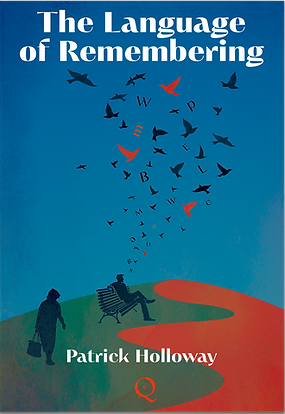
Returning from Brazil with his wife and daughter, Oisín is looking to rebuild a life in Ireland and reconnect with his mother, Brigid, who has early onset Alzheimer’s. As her condition deteriorates, she starts to speak Irish, the language of her youth, and reflects on her childhood dreams and aspirations. Mother and son embark on a journey of personal discovery and as past traumas are exposed, they begin to understand what has shaped them and who they really are. The Language of Remembering asks how we connect to the people we love and how we move on from the past to find meaning in the present.
The book moves between two timelines. In the present day, Oisín has returned to Ireland from Brazil along with his wife Nina and young daughter Ailish. The author deftly explores the conflict between Oisín’s sense of responsibility for the care of his mother and the disruption caused to the family by their move from Brazil, Nina’s native country. His struggles to find a job that will enable them to obtain a mortgage and move into a permanent home only add to his sense of guilt and frustration. His experiences are narrated in the second person which I found had the effect of giving immediacy to Oisín’s struggles, forcing me to place myself in his situation.
Brigid’s story starts in the 1970s, in rural Ireland. Whilst still a teenager, she discovers she is pregnant. Learning of her condition, her parents react with a mixture of anger and disappointment, well aware of the social stigma this will bring to Brigid and their family. Brigid and James, the father of her child, are pressurised into a hasty wedding by their respective families.
Brigid and James begin to realise their lives will have to take a very different trajectory, the responsibilities of parenthood putting paid to their personal ambitions. They also struggle to extricate themselves from the influence of James’s controlling family. But the birth of her son Oisín, albeit after a very difficult birth, brings Brigid unexpected joy.
With Brigid’s condition worsening, Oisín’s visits to his mother in her care home are often challenging. Sometimes she can recall events from her early life in detail, sharing things Oisín never knew, or remember vividly moments of their life when he was growing up. At other times, she seems in a world of her own, confused by her surroundings. There are heartbreaking moments that will be familiar to anyone who has cared for someone with Alzheimer’s such as when Brigid mistakes Oisín for her dead husband, James, or becomes distressed because of a misunderstanding.
As the title suggests, language and communication are key themes of the book. Along with Brigid’s declining memory is her increasing use of Gaelic, a language she spoke with her father but one Oisín does not understand, although he makes touching efforts to do so as the book progresses. The author includes the reader in this challenge by, from time to time, incorporating phrases in Gaelic without translation, placing us in the same position as Oisín in searching for clues as to their meaning.
Alongside the challenges of communication, I liked how the book explored the vibrancy of language. For example, Brigid’s mother, Kathleen, possesses an extensive vocabulary and interest in the etymology of words. Her speech is peppered with words such as ‘subjugated’, ‘euphemism’, ‘quandary’. And Oisín recalls time spent with his father learning the collective names for birds. However Oisín also knows the ability of words to wound.
The Language of Remembering is a moving and perceptive story about the role language plays in our interactions with others, and how it can be both a barrier and a pathway to understanding.
Stunning writing. Very emosh 😢 I loved the memory motif throughout and how it was the son who needed reminding just as much as his mother, how talking about memories brought them closer.
This book should come with a warning: do not read in public. It will make you cry. But in a good way. It is the story of Oisín, adult only child, and his mother, Brigid who is suffering from early onset Alzheimer’s. The narrative is split into two timelines: now, Oisín returned to Ireland with his Brazilian wife, Nina, and their daughter Ailish, to look after his mother, and then, the story of Brigid herself, when she falls pregnant while still in school and unmarried in the 1970s. The writing is felt, visceral, and the depiction of Oisín is haunting. Saudade is a word used in the book and it permeates the writing, a visceral kind of loneliness and longing. As his mother is losing her memory, Oisín is skating over his own lost memory and unresolved grief regarding the death of his father. The book is shot with many clever parallels, flashbacks of his mother’s pregnancy with him, interspersed with his wife’s pregnancies, the play with language from the title as Oisín tries all ways he can to communicate with his mother, the Gaeilge of her childhood beautifully juxtaposed with the elevated vocabulary of his grandmother. Although the subject matter is bleak, even dark at times, the quality of the writing is such that it never dips into maudlin, the whole narrative shot through with brilliantly observed moments and wrapped in many shades of love. Can’t wait to read more from this wonderful writer.
I was drawn to this book the moment I heard about it at the beginning of the year. I picked up a copy at the International Literature Festival in Dublin in May.
Published in February by Epoque Press, I wouldn’t be surprised to find this beautiful Irish debut novel on prize lists later this year. With echoes of Louise Kennedy and Elaine Feeney, the novel explores themes like belonging, connection, familial love and language through the story of one man and his mother, Oisín and Brigid.
In a dual timeline, simply called Then and Now, the relationship between Oisín, who has just moved home from Sao Paolo with his wife Nina and their daughter Ailish, and his mother Brigid, who gave birth to him at a very young age in 1970s Ireland is gently revealed. Brigid has been recently diagnosed with early onset dementia, and while Oisín grapples with the diagnosis and the move home to Ireland, past traumas are unearthed.
Through little breadcrumbs dropped, I figured the year in the Then is 1977, a time before Ireland underwent huge social change and pregnancy before marriage still carried with it huge stigma.
The writing is stunning, the narratives contrast nicely with each other - Oisín’s is in the second person, and Brigid’s is in the third person. I devoured the book in a day by the pool, and shed a tear reading the last chapter. Recommend. 4/5⭐️
gdyby nie to ze czytalam to do magisterki ktorej strasznie nie chce mi sie pisac to bym dala 5* pewnie xd ale na razie bez oceny bo gdzies wewnetrznie czuje niechec do tej ksiazki przez fuckass magisterke … postaram sie jej pozbyc i guess
Poignant literary fiction dealing with a son taking care of his mother who has moderate dementia. I heard about this book on book tube.Unfortunately, my local library system did not have this book and neither did Libby so I bought it on Kindle. It moves between two timelines, one being the present day when Bridget‘s son has come home from Brazil with his wife and child to take care of his mother in Ireland. The other timeline deals with Bridget as a teenage mother. In some ways, this book is a simple book, plot, wise, but the character development is stellar
Such a beautiful and heartbreaking voyage through loss both fast and unexpected and slow and torturous. The beautiful weaving of past and present allows you to sit in the characters feelings with the dramatic irony of knowing the outcome. This really gives you the time to actually embrace what’s happening on the page and it’s wonderfully raw and real.
⭐️⭐️⭐️⭐️ The Language of Remembering by Patrick Holloway
The story is told not only from Oisin’s perspective in the present day but also from his mum, Brigid’s in the 1970s, when she became pregnant with Oisin at a very young age.
Oisin has returned to Ireland with his wife Nina and daughter Ailish after years of living in Brazil to make a new life and to care for his mother Brigid, who was recently diagnosed with Alzheimer’s. Oisin is dealing with a lot of change, not only moving his family to a new continent, but also the huge change in his mother since he last saw her.
They start to reminisce, and this causes his mother to start conversing in Irish. Oisin struggles to understand her, and he begins to feel lost from his mother. He takes an Irish class to help him connect with her.
This was a beautifully written story of familial love between Brigid and Oisin and how language plays a major role in their connection and with others. Nina had a good grasp of English, but she felt she connected better with Oisin when they conversed in her language. He remembers how alone and disconnected he felt when he first moved to Brazil and was unable to join in on conversations because he hadn’t yet learned the language.
I loved how Holloway portrayed the wonderfully strong and charismatic women in this story, such as Brigid, her mother, Nina and my favourite no-nonsense character, Oisin’s Granny.
This was an exceptionally tender debut about a topic very close to my heart, which I found realistic and sensitively written. I will be surprised if this book doesn’t end up on some Booker Prize lists, and I am looking forward to what this author produces next.
This book is about Oisin and his mother Bridget, with Oisin's wife Nina and Bridget's mother Kathleen having good-sized secondary roles.
Oisin, Nina, and their young daughter have returned from Brazil (where Oisin met and married Nina) because Oisin's mother has early onset Alsheimer's disease. They are living in a rented house they do not like and Oisin is desperate to get a job that will permit him to get a mortgage so they can have their own house. Oisin is having great trouble dealing with his mother's disease. And he avoids his grandmother out of what seems to be his shame for how much he struggles with spending time with his mother. Oisin and Nina take jobs that neither particularly likes but Nina gets along better than Oisin. When Bridget has to go to a home, Kathleen works to have Oisin accept that he can move into Bridget's house -- the one he grew up in.
Bridget's story focuses on when she became pregnant and how that impacted various family relationships as well as her own life. Bridget and James do marry. James' parents are overbearing and controlling. Bridget's father is devastated. Kathleen is solid. Bridget was brilliant and eager for college. James was the son of wealthy parents and a soccer star who has an offer to play in England. Kathleen spoke Gaelic with her father. Kathleen had and has a tremendous volcabulary and required Bridget to look up the words she did not understand.
As Bridget memory deteriorates, she begins speaking more and more in Gaelic, which Oisin does not understand. He signs up for a night class to learn it but is not progressing very fast.
Through the two storylines we learn about James' death and a young age, Oisin's belief that he failed in getting help fast enough, the love between James and Bridgit, and what an anchor Kathleen is.
Key issues are language, memory, belonging, family connections.
‘You do not say anything but want to get up and run out of the house. The sitting room is the same as it was twenty years ago, you sit in the same armchair, your mother sits in the same place, the windows look out on the same houses, yet everything is different, and it makes you feel nauseous.’
The Language of Remembering by Patrick Holloway published in February 2025 with Epoque Press and is described as a novel that ‘asks how we connect to the people we love and how we move on from the past to find meaning in the present’.
Patrick Holloway lived and worked in Brazil for many years before coming back to Ireland with his young family a few years ago. Since his return he has openly spoken about his struggle to settle back into the rhythm of life here. Patrick moved home during the Pandemic and it was a culture shock for all. With a lingering sense of what he left behind and of the person he once was, he started to write, to try to make sense of these feelings he was experiencing.
In The Language of Remembering Oisín returns from Brazil with his wife and daughter to start the next chapter of their lives. Brigid, Oisín’s mother, has early onset Alzheimer’s and is starting to lose more and more of her memories as time slips by. Oisín’s father passed away many years previously, so the relationship between mother and son has always been close. Seeing her like this now is challenging for Oisín and he is beginning to question his decision to return to Cork.
As the reality of the daily grind hits home, Oisín is soon struck with his naivety when making the decision to come back to Cork. Living in rented accommodation, scraping together enough money to just exist, he starts to doubt his own self worth and his sense of being. Seeing Brigid slip away from him is tough. She persists in speaking to him in Irish and as Oisín does not have the same command of his native tongue, he finds it more and more difficult to understand her.
With chapters entitled Now and Then, we are given insights into Brigid’s early years and the personal struggles she faced growing up in a very upright Catholic society. Interweaving the different periods of time, a gorgeous story unravels, one of rediscovery, connection and memory. There is a raw quality to Patrick Holloway’s writing, depicting a vulnerability, almost like we are seeing his true self. This tale is fictional but I have no doubt that there are many factual elements filtered through the pages. Many readers will resonate, in particular, with the storyline about ageing, and the difficulties that presents, when we see a decline in our once vibrant parents. It’s a shocking reality and for those with dementia, it’s even more upsetting for all involved. The scenes with Oisín and Brigid are truly heart-breaking as he tries to find moments of lucidity, something to anchor him to her, something to remind him of the person she once was.
The Language of Remembering has been described by Elaine Feeney as ‘a beautiful meditation on family, love and the fragility of remembering’ with many more writers adding their praise for Patrick Holloway’s stunning prose. The characters feel real. The storyline feels real. The place is real. All this authenticity combines into a novel that has connected with so many.
Dignified, emotive and insightful, The Language of Remembering is a refined and polished debut, one I readily recommend to all.
A tender narrative documenting the fragility and tentative nature of ordinary humanity, love and relationships. A brilliantly delicate representation of witnessing a loved one change due to Alzheimer’s and the change in relationship this brings. A very touching read.
This is about a man who returns to Ireland after living in Brazil with his wife and child. His mother has dementia and needs his care. We follow his story as he navigates returning to his family and friends and his home. It also follows how his mother ended up with her husband. The story seems simple enough on the surface but is very complicated. There is so much heartache on some of these pages. At the same time, there is so much unadulterated love felt between these characters. Irish writers have a way of delivering so much heart in their work. This book is very good. I give this a 4.5/5.
I don't often write reviews, but this book absolutely knocked me sideways. I adored it, highlighted so many gorgeous passages, wished that I could spend more time with these characters. It's a profoundly beautiful meditation on the power of memory, the strength of family bonds, and how intense love and grief can often intersect in overwhelming, yet illuminating, ways. An emotional, riveting read.
3.5ish? rounding up... It was interesting and I flew through it but didn't hit the mark as much as I thought it would. needs more Irish and less irrelevant b plot
This a really well-written, touching story. It evokes the dual timelines masterfully. The characters are depicted in a true-to-life, unsentimental way, but with compassion.
I have just finished reading the beautifully written debut novel, The Language Of Remembering by the so very talented Patrick Holloway @hollowaywriter2 The Language Of Remembering is a moving and perceptive story about the role language plays in our interactions with others, and how it can be both a barrier and a pathway to understanding. Patrick is a true wordsmith who beautifully crafts sentences and uses language in ways that move and resonate so deeply with readers. The Language Of Remembering is published by @epoque_press
I had this book bought with the intention of having it finished for the Kinsale @wordsbywater festival back in early October at which Patrick Holloway was speaking. I didn’t manage to make the event with Patrick Holloway and only got round to reading the book now.
I loved this book! A novel, that reads almost like a memoir, it is about a man named Oisín returning to Ireland from Brazil, with his Brazilian wife Nina and their young daughter Ailish. He returns because his mother, Brigid, has developed early onset Alzheimer’s, and with the exception of her own aging mother Kathleen, has no close family to care for her. As Oisín tries to settle back, he takes his time visiting his mum and grandmother, afraid of what he will find, but also afraid of revisiting old memories and what they awaken in him. When he does see his mum, the love between them is evident, and as he sees her struggle to find words, he himself feels at a loss. She more comfortably reverts to Gaeilge, a language which Oisín has all but forgotten.
The book has a dual timeline, one simply called Now, is written in the present, with Oisín’s return home and attempt to reconnect with his mother and the other, Then, in which Brigid, a highly intelligent teenager with high hopes to pursue an academic career, becomes pregnant. Often with a dual timeline. I can find myself more invested in one time than the other, but in this book, I loved both. To become pregnant out of wedlock in Ireland at that time (late 70’s), was altogether different from now, and the shame and judgement it carried was so excellently conveyed here, not to mention the consequences it would have on one’s life. I was so interested to enter Brigid’s world then and I thought the author captured her voice beautifully. Seeing her as a young woman, also served the reader with a greater understanding of the woman she now is, trying to make sense of the world around her through the fog of her cruel illness.
Language is beautifully explored in this novel, the Irish Brigid now falls to when English fails her, is the language of her youth, the language she would speak with her father. Oisín has lost his Gaeilge but attempts to re-learn it to understand his mum. And his grandmother Kathleen, loves language, loves using big words and explaining their origins, something that she clearly shared with Brigid, but lost. And Oisín speaks a mix of English and Portuguese to his wife Nina, the Portuguese representing an intimacy and a reminder of their life before the move. It explores how language can act as a vessel for understanding, for exploring shared memories, for connection. But so too, how language can only go so far, how language can fail us, how silence can overtake us and how memories unfold at their own pace.
I thought this was a stunning novel. I loved the Cork setting and the overall atmosphere, voices and time felt familiar and relevant. It was such a beautiful read, so authentic, heart-felt and raw and I would highly recommend it.
I’m not going to give any spoilers but I am going to say, you really should read this book. I read it through the night in one sitting because the writing is so good. I couldn’t put it down. I loved everything about it…the second person narrative, the beautiful prose/quality of the writing, the depth of feeling, exploration of language etc. Utterly readable. Fantastic