

What do you think?

Just F**king Say It: The Ultimate Guide to Speaking with Confidence In Any Situation
*
Are you worried about what other people think of you?
Do you want to feel confident and in control the moment you speak?
Just F**king Say It is the ultimate guide to speaking with confidence in any situation.
___
With this empowering step-by-step guide from Britain's leading speech coach, you'll soon
* Requesting the pay-rise you deserve * Delivering a knockout pitch
* Networking like you enjoy it
* Acing that interview
* Giving an unforgettable speech
* Speaking with clarity in any situation
*Communicating and connecting with authenticity and impact when it really matters
___
'This is the straight-talking, practical confidence boost we've been waiting for.' Jennifer Cox
Are you worried about what other people think of you?
Do you want to feel confident and in control the moment you speak?
Just F**king Say It is the ultimate guide to speaking with confidence in any situation.
___
With this empowering step-by-step guide from Britain's leading speech coach, you'll soon
* Requesting the pay-rise you deserve * Delivering a knockout pitch
* Networking like you enjoy it
* Acing that interview
* Giving an unforgettable speech
* Speaking with clarity in any situation
*Communicating and connecting with authenticity and impact when it really matters
___
'This is the straight-talking, practical confidence boost we've been waiting for.' Jennifer Cox
- GenresNonfictionSelf Help
277 pages, Kindle Edition
Published May 22, 2025
Ratings & Reviews
Friends & Following
Create a free account to discover what your friends think of this book!
Community Reviews
Displaying 1 - 19 of 19 reviews

January 5, 2026
Based on the first line of the book description, I was expecting this to focus on public speaking. Which it did, at least for the first half or 2/3. The "how to give a speech at a wedding" section offered some great advice, too.
Then it shifts into more conflict resolution style conversations, based on the type of person you're dealing with. (a mosquito, a hookworm, or the third one that I can't remember offhand). It also talks about giving (and receiving) feedback effectively, which in my experience good lord people need to learn how to do better. I'd like some of my former professors to read that section lol.
Overall it's a practical guide.
Thanks to the publisher and Libfro.fm for the ALC to review.
Then it shifts into more conflict resolution style conversations, based on the type of person you're dealing with. (a mosquito, a hookworm, or the third one that I can't remember offhand). It also talks about giving (and receiving) feedback effectively, which in my experience good lord people need to learn how to do better. I'd like some of my former professors to read that section lol.
Overall it's a practical guide.
Thanks to the publisher and Libfro.fm for the ALC to review.

March 4, 2026
A Public-Speaking Coach Walks Into a Meeting: On Panic, Performance, and the Strange Violence of “Try to Be More Confident ;-)”
By Demetris Papadimitropoulos | March 3rd, 2026
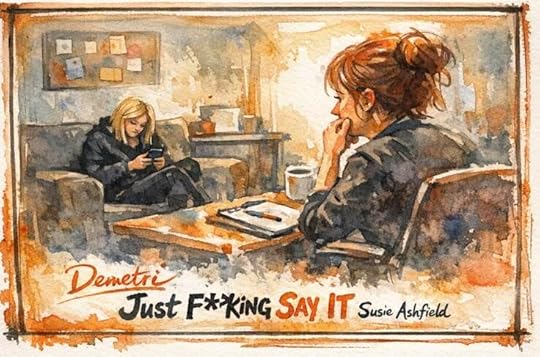
Watercolor Piece by Demetris Papadimitropoulos
The first thing “Just F**king Say It” understands is that “confidence” is rarely a feeling. It is a costume. Sometimes it’s a suit jacket swapped at the last minute for a cardigan, leaving a young coach looking, by her own verdict, like a librarian going on a first date. Sometimes it’s a cue card answer at “Miss Teen USA” that becomes a 75-million-view cautionary tale about what panic does to syntax. Sometimes it’s a corporate professional who can run a P&L in their sleep but goes faint at the phrase “So, are there any questions?” The book’s core move is to drag those costumes into the light and show you the stitching – then tell you, with affectionate brutality, to stop worshipping the outfit and start using your voice.
Susie Ashfield is a speech coach with an actor’s instincts and a gossip columnist’s ear for the line that reveals the whole mess. Her chapters are built like sets: you walk into a small dusty office in West London and watch a champion weightlifter stonewall a trainer by scrolling on her phone; you sit in a barrister’s chambers among leaning towers of folders and witness the “curse of knowledge” turn an interview answer into a medieval dissertation; you attend the nightmare meeting at “Pop & Cork Marketing” where the only outcome is – naturally – another meeting. Ashfield’s gift is her ability to make the familiar feel newly ridiculous, then newly fixable. She doesn’t so much “empower” you as hand you a mirror and a script and say, calmly, Now. Try again.
The title performs a kind of bait-and-switch. It promises bravado, the self-help equivalent of a pint slammed on a pub table. But what follows is less a manifesto for loudness than a primer on precision. Again and again, Ashfield argues that most communication failures are not moral failures. They are engineering problems: too many inputs, not enough structure, a speaker forgetting that the audience does not live inside their brain. “Confidence in a can” – the posture hacks, the shoulders back, the eye contact, the smile you plaster on like deodorant – is treated with both respect and suspicion. Yes, it works, because bodies are persuadable, and the mind often follows the performance. But the book’s more interesting claim is that the real formula for confidence is boring: knowledge, practice, experience. You don’t become compelling by wishing harder. You become compelling the way you become strong: by repetition, exposure, time.
It is a relief to read a communication book that doesn’t pretend it can cure you in an afternoon. Ashfield is frank about the fantasy of outsourcing self-esteem. “Just make me confident,” her clients beg, as if she has a syringe. She keeps insisting that confidence isn’t a pill; it’s a build. And yet she is not above giving you the pill anyway, if what you need is to get through Tuesday at 9 a.m. There is a sly compassion in her willingness to offer small tricks without pretending they are salvation: the “pint and a half” version of yourself you can borrow for the boardroom; the index cards that free you from your slides; the permission to say, “Let me think about that for a second,” instead of sprinting into nonsense.
Part of the book’s charm is its refusal to be sanctimonious. Ashfield is allergic to the corporate pieties that turn language into wallpaper. She has a wicked ear for the phrases that are meant to sound supportive and instead land like a slap: “Try to be more confident with clients! ;-)” – a sentence so empty it makes a man pound a desk. She understands that vagueness is often a form of cowardice, a way of avoiding the discomfort of specificity. If the book has a villain, it’s the person who hides behind soft words because they’re afraid of feelings – their own, or yours.
That fear, Ashfield suggests, is the real modern epidemic. And here the book begins to feel quietly timely. We live in an age of back-to-back screens, where a colleague can disappear into a camera-off silence and still be “present,” where corporate life is conducted through tools that make misinterpretation frictionless and outrage instantaneous. The book’s repeated instruction – talk to your audience, ask the question, clarify the meaning, name the objective – reads like a rebuttal to a culture that is increasingly mediated, increasingly abstract, increasingly tempted to replace conversation with performance management emojis. Ashfield’s examples are soaked in the air of now: the Zoom day that leaves you grey and aching; the meeting that could have been an email; the nervousness that spikes not because the stakes are life and death, but because you can imagine your “freeze” becoming a little workplace legend, a clip, a screenshot, a cautionary Slack thread. Even her detours into public shame – Bill Clinton and Monica Lewinsky, the “patient zero” of viral disgrace; the “tall poppy” backlash that comes for the woman who dares to step into the spotlight – land differently in a world where reputations can be memeified before lunch.
The architecture of the book is pleasantly unfussy. Part 1, “I Can’t Can Fking Do This,” begins with confidence, then goes straight for the throat: the inner voice that catastrophises, the “red dot” that grows until it eclipses all evidence. Ashfield’s “parrot on your shoulder” is a useful invention not because it’s cute but because it externalises the noise. The method she offers – a Socratic dismantling of worst-case fantasies – is standard cognitive restructuring dressed in the book’s vernacular: What am I really worried about? What evidence do I have? What would I say to a friend? The profanity works here as punctuation, a way of refusing to treat anxious thoughts as sacred. Tell the parrot to fk off. Then do the thing anyway.
Part 2, “How To Do…,” is the book’s toolbox, and it is where Ashfield’s performer’s brain becomes most visible. Her chapter on presentations is essentially a plea for purpose. If you can’t summarise your message in one sentence, she suggests, you don’t have a message, you have a pile. She offers structures the way a director offers blocking: a storytelling formula based on Freytag’s pyramid; an informative formula borrowed from “IKEA” instruction manuals; a Q&A formula that forces you to “interview yourself” into clarity. The book is at its best when it gives you a framework and then shows you, with a crisp example, how it changes the energy in a room. Her argument is simple and bracing: corporate material is not inherently dull. It becomes dull when you choose the safe, bland voice that signals you have no desire to be felt.
This is a book that frequently repeats its own philosophy in different outfits: “This is not about you.” It says it in the panel chapter, where the best host is the one who talks 10 to 20 percent and makes everyone else sound brilliant. It says it in self-promotion, where you escape nausea by making your marketing about the solutions you offer rather than the praise you crave. It says it in networking, where the goal is not to perform interest but to be interested. It says it in feedback, where the only useful critique is the kind that is anchored in evidence and delivered with an “I want you to win” mindset. And it says it, most poignantly, in the eulogy chapter: funerals are for the living. The words are a bridge thrown across a room full of grief.
Ashfield’s range surprises. Many books in this genre would happily live on conference stages forever, hunting laughs and “actionable takeaways.” But her best chapters are often the ones where the stakes are personal and messy, where “care less” becomes complicated. The wedding speech chapter, with its bent spoon souvenir from a best man’s grotesque stand-up routine, is funny in the way real horror stories are funny – because you’re powerless, because you can’t believe someone is continuing, because you are watching a slow-motion social car crash and thinking, Who raised you? Yet even here, Ashfield’s advice is not simply “be funny.” It is, again, “be kind, be brief, punch up, practise.” Her eulogy chapter is even more deft: she is unsentimental about the craft (150 words per minute, cut the Wikipedia, keep the quirks) and deeply tender about the task.
Where the book occasionally wobbles is in the same place many charismatic how-to books wobble: it risks turning its own voice into a kind of authority costume. The anecdotes are so vivid – and often so enjoyable – that you can feel the gravitational pull toward performance, toward the idea that the story itself is the lesson. Sometimes it is. Sometimes, though, you want the book to linger a little longer on the edge cases it gestures toward: the workplaces where “just speak up” is not merely frightening but materially risky; the cultures where bluntness reads as disrespect; the power dynamics where “be the adult in the room” is hard when the other person controls your mortgage. Ashfield nods toward these realities, but the book’s main temperament is optimistic: if you communicate clearly, the world will generally meet you halfway. That’s often true – and often not.
Still, the optimism feels earned because Ashfield is not selling purity. She is selling practice. The book is full of permission slips that are oddly specific and therefore believable: you can take notes; you can go under time; you can say “I don’t know”; you can ask for the question again; you can ditch the 100-slide deck; you can leave the meeting if you have nothing to contribute; you can say “no” without a novel-length justification. You can be average. “Aim for a six or seven,” she tells the anxious meeting attendee. It’s a surprisingly radical instruction in a culture of performative excellence.
Ashfield’s sensibility also places her in an interesting lineage of contemporary communication literature. She shares the structure-mindedness of “Talk Like TED” and “Made to Stick,” the negotiation-adjacent pragmatism of “Never Split the Difference,” the workplace psychology of “Crucial Conversations,” the “stop catastrophising and do the reps” ethos that made books like “Atomic Habits” cultural wallpaper. But her tone is more theatrical, more openly bodily, more British in its suspicion of self-seriousness. If “Presence” tried to dignify confidence by draping it in science, Ashfield is happy to drag it through the pub and show you how it behaves after a pint and a half. She is also, slyly, a critic of “thought leadership” as a genre – the people who claim they rise at 4 a.m. for protein smoothies and pretend this makes them morally superior. Her book is, in part, an argument against the polished hero narrative. When she helps the sailor craft an inspirational talk, the breakthrough comes not from the “moonshot” speech but from the divorce – the shame, the boredom, the wreckage, the need to feel like a person again. “Tell them the one thing you’d rather no one else in the world knew,” she advises. It is the book’s most dangerous and most compelling instruction. It is also, if we’re honest, the instruction that can turn sincerity into strategy if you’re not careful. Ashfield seems aware of that line, even as she walks it with a grin.
The current moment hovers around the book like airport tannoy noise. A culture of layoffs and restructures sits behind the chapter on “A F**K-Up,” where the difficulty is not delivering bad news in theory but telling a close colleague they’re being let go. The post-pandemic meeting economy sits behind Ashfield’s insistence on shorter, sharper online gatherings and her contempt for monologues disguised as collaboration. The endless discourse about “psychological safety” appears explicitly, but it also hums beneath her broader point: people speak when they believe they won’t be punished for having a human voice. Even the chapter on “communicating with difficult creatures” – hookworms, hippos, mosquitoes – feels like a comic taxonomy of workplace dysfunction in an era when many teams are exhausted, surveillance-saturated, and one misfire away from quitting.
And yet the book’s final moral is almost aggressively small. It ends not with a grand system but with an airport queue story in which an Australian backpacker asks to cut ahead, gets rejected, then makes a friend and suddenly the crowd parts. The difference between the person who makes the flight and the person who misses it is not talent. It’s the willingness to risk being mildly annoying for the sake of the outcome. “Try,” Ashfield insists. The instruction is both obvious and, for many readers, strangely hard.
What makes “Just F**king Say It” more than another bright object on the self-help shelf is its recognition that communication is not merely technique. It is identity. It is shame. It is the history of every time you spoke and were laughed at, ignored, punished, or – worse – met with silence. Ashfield’s answer to that history is not to pretend it didn’t happen. It’s to hand you structure, rehearse with you, and then shove you gently toward the room.
A reader looking for a saintly, perfectly sourced, academically disciplined treatise will find the book too cheeky, too anecdotal, too in love with its own stories. But a reader looking for something rarer – a guide that treats fear as normal, treats practice as holy, and treats the audience as human – will find a book that earns its profanity the way it asks you to earn your confidence: by doing the work, by saying the thing, by caring less about looking brilliant and more about being understood. My rating: 78/100.
By Demetris Papadimitropoulos | March 3rd, 2026
Watercolor Piece by Demetris Papadimitropoulos
The first thing “Just F**king Say It” understands is that “confidence” is rarely a feeling. It is a costume. Sometimes it’s a suit jacket swapped at the last minute for a cardigan, leaving a young coach looking, by her own verdict, like a librarian going on a first date. Sometimes it’s a cue card answer at “Miss Teen USA” that becomes a 75-million-view cautionary tale about what panic does to syntax. Sometimes it’s a corporate professional who can run a P&L in their sleep but goes faint at the phrase “So, are there any questions?” The book’s core move is to drag those costumes into the light and show you the stitching – then tell you, with affectionate brutality, to stop worshipping the outfit and start using your voice.
Susie Ashfield is a speech coach with an actor’s instincts and a gossip columnist’s ear for the line that reveals the whole mess. Her chapters are built like sets: you walk into a small dusty office in West London and watch a champion weightlifter stonewall a trainer by scrolling on her phone; you sit in a barrister’s chambers among leaning towers of folders and witness the “curse of knowledge” turn an interview answer into a medieval dissertation; you attend the nightmare meeting at “Pop & Cork Marketing” where the only outcome is – naturally – another meeting. Ashfield’s gift is her ability to make the familiar feel newly ridiculous, then newly fixable. She doesn’t so much “empower” you as hand you a mirror and a script and say, calmly, Now. Try again.
The title performs a kind of bait-and-switch. It promises bravado, the self-help equivalent of a pint slammed on a pub table. But what follows is less a manifesto for loudness than a primer on precision. Again and again, Ashfield argues that most communication failures are not moral failures. They are engineering problems: too many inputs, not enough structure, a speaker forgetting that the audience does not live inside their brain. “Confidence in a can” – the posture hacks, the shoulders back, the eye contact, the smile you plaster on like deodorant – is treated with both respect and suspicion. Yes, it works, because bodies are persuadable, and the mind often follows the performance. But the book’s more interesting claim is that the real formula for confidence is boring: knowledge, practice, experience. You don’t become compelling by wishing harder. You become compelling the way you become strong: by repetition, exposure, time.
It is a relief to read a communication book that doesn’t pretend it can cure you in an afternoon. Ashfield is frank about the fantasy of outsourcing self-esteem. “Just make me confident,” her clients beg, as if she has a syringe. She keeps insisting that confidence isn’t a pill; it’s a build. And yet she is not above giving you the pill anyway, if what you need is to get through Tuesday at 9 a.m. There is a sly compassion in her willingness to offer small tricks without pretending they are salvation: the “pint and a half” version of yourself you can borrow for the boardroom; the index cards that free you from your slides; the permission to say, “Let me think about that for a second,” instead of sprinting into nonsense.
Part of the book’s charm is its refusal to be sanctimonious. Ashfield is allergic to the corporate pieties that turn language into wallpaper. She has a wicked ear for the phrases that are meant to sound supportive and instead land like a slap: “Try to be more confident with clients! ;-)” – a sentence so empty it makes a man pound a desk. She understands that vagueness is often a form of cowardice, a way of avoiding the discomfort of specificity. If the book has a villain, it’s the person who hides behind soft words because they’re afraid of feelings – their own, or yours.
That fear, Ashfield suggests, is the real modern epidemic. And here the book begins to feel quietly timely. We live in an age of back-to-back screens, where a colleague can disappear into a camera-off silence and still be “present,” where corporate life is conducted through tools that make misinterpretation frictionless and outrage instantaneous. The book’s repeated instruction – talk to your audience, ask the question, clarify the meaning, name the objective – reads like a rebuttal to a culture that is increasingly mediated, increasingly abstract, increasingly tempted to replace conversation with performance management emojis. Ashfield’s examples are soaked in the air of now: the Zoom day that leaves you grey and aching; the meeting that could have been an email; the nervousness that spikes not because the stakes are life and death, but because you can imagine your “freeze” becoming a little workplace legend, a clip, a screenshot, a cautionary Slack thread. Even her detours into public shame – Bill Clinton and Monica Lewinsky, the “patient zero” of viral disgrace; the “tall poppy” backlash that comes for the woman who dares to step into the spotlight – land differently in a world where reputations can be memeified before lunch.
The architecture of the book is pleasantly unfussy. Part 1, “I Can’t Can Fking Do This,” begins with confidence, then goes straight for the throat: the inner voice that catastrophises, the “red dot” that grows until it eclipses all evidence. Ashfield’s “parrot on your shoulder” is a useful invention not because it’s cute but because it externalises the noise. The method she offers – a Socratic dismantling of worst-case fantasies – is standard cognitive restructuring dressed in the book’s vernacular: What am I really worried about? What evidence do I have? What would I say to a friend? The profanity works here as punctuation, a way of refusing to treat anxious thoughts as sacred. Tell the parrot to fk off. Then do the thing anyway.
Part 2, “How To Do…,” is the book’s toolbox, and it is where Ashfield’s performer’s brain becomes most visible. Her chapter on presentations is essentially a plea for purpose. If you can’t summarise your message in one sentence, she suggests, you don’t have a message, you have a pile. She offers structures the way a director offers blocking: a storytelling formula based on Freytag’s pyramid; an informative formula borrowed from “IKEA” instruction manuals; a Q&A formula that forces you to “interview yourself” into clarity. The book is at its best when it gives you a framework and then shows you, with a crisp example, how it changes the energy in a room. Her argument is simple and bracing: corporate material is not inherently dull. It becomes dull when you choose the safe, bland voice that signals you have no desire to be felt.
This is a book that frequently repeats its own philosophy in different outfits: “This is not about you.” It says it in the panel chapter, where the best host is the one who talks 10 to 20 percent and makes everyone else sound brilliant. It says it in self-promotion, where you escape nausea by making your marketing about the solutions you offer rather than the praise you crave. It says it in networking, where the goal is not to perform interest but to be interested. It says it in feedback, where the only useful critique is the kind that is anchored in evidence and delivered with an “I want you to win” mindset. And it says it, most poignantly, in the eulogy chapter: funerals are for the living. The words are a bridge thrown across a room full of grief.
Ashfield’s range surprises. Many books in this genre would happily live on conference stages forever, hunting laughs and “actionable takeaways.” But her best chapters are often the ones where the stakes are personal and messy, where “care less” becomes complicated. The wedding speech chapter, with its bent spoon souvenir from a best man’s grotesque stand-up routine, is funny in the way real horror stories are funny – because you’re powerless, because you can’t believe someone is continuing, because you are watching a slow-motion social car crash and thinking, Who raised you? Yet even here, Ashfield’s advice is not simply “be funny.” It is, again, “be kind, be brief, punch up, practise.” Her eulogy chapter is even more deft: she is unsentimental about the craft (150 words per minute, cut the Wikipedia, keep the quirks) and deeply tender about the task.
Where the book occasionally wobbles is in the same place many charismatic how-to books wobble: it risks turning its own voice into a kind of authority costume. The anecdotes are so vivid – and often so enjoyable – that you can feel the gravitational pull toward performance, toward the idea that the story itself is the lesson. Sometimes it is. Sometimes, though, you want the book to linger a little longer on the edge cases it gestures toward: the workplaces where “just speak up” is not merely frightening but materially risky; the cultures where bluntness reads as disrespect; the power dynamics where “be the adult in the room” is hard when the other person controls your mortgage. Ashfield nods toward these realities, but the book’s main temperament is optimistic: if you communicate clearly, the world will generally meet you halfway. That’s often true – and often not.
Still, the optimism feels earned because Ashfield is not selling purity. She is selling practice. The book is full of permission slips that are oddly specific and therefore believable: you can take notes; you can go under time; you can say “I don’t know”; you can ask for the question again; you can ditch the 100-slide deck; you can leave the meeting if you have nothing to contribute; you can say “no” without a novel-length justification. You can be average. “Aim for a six or seven,” she tells the anxious meeting attendee. It’s a surprisingly radical instruction in a culture of performative excellence.
Ashfield’s sensibility also places her in an interesting lineage of contemporary communication literature. She shares the structure-mindedness of “Talk Like TED” and “Made to Stick,” the negotiation-adjacent pragmatism of “Never Split the Difference,” the workplace psychology of “Crucial Conversations,” the “stop catastrophising and do the reps” ethos that made books like “Atomic Habits” cultural wallpaper. But her tone is more theatrical, more openly bodily, more British in its suspicion of self-seriousness. If “Presence” tried to dignify confidence by draping it in science, Ashfield is happy to drag it through the pub and show you how it behaves after a pint and a half. She is also, slyly, a critic of “thought leadership” as a genre – the people who claim they rise at 4 a.m. for protein smoothies and pretend this makes them morally superior. Her book is, in part, an argument against the polished hero narrative. When she helps the sailor craft an inspirational talk, the breakthrough comes not from the “moonshot” speech but from the divorce – the shame, the boredom, the wreckage, the need to feel like a person again. “Tell them the one thing you’d rather no one else in the world knew,” she advises. It is the book’s most dangerous and most compelling instruction. It is also, if we’re honest, the instruction that can turn sincerity into strategy if you’re not careful. Ashfield seems aware of that line, even as she walks it with a grin.
The current moment hovers around the book like airport tannoy noise. A culture of layoffs and restructures sits behind the chapter on “A F**K-Up,” where the difficulty is not delivering bad news in theory but telling a close colleague they’re being let go. The post-pandemic meeting economy sits behind Ashfield’s insistence on shorter, sharper online gatherings and her contempt for monologues disguised as collaboration. The endless discourse about “psychological safety” appears explicitly, but it also hums beneath her broader point: people speak when they believe they won’t be punished for having a human voice. Even the chapter on “communicating with difficult creatures” – hookworms, hippos, mosquitoes – feels like a comic taxonomy of workplace dysfunction in an era when many teams are exhausted, surveillance-saturated, and one misfire away from quitting.
And yet the book’s final moral is almost aggressively small. It ends not with a grand system but with an airport queue story in which an Australian backpacker asks to cut ahead, gets rejected, then makes a friend and suddenly the crowd parts. The difference between the person who makes the flight and the person who misses it is not talent. It’s the willingness to risk being mildly annoying for the sake of the outcome. “Try,” Ashfield insists. The instruction is both obvious and, for many readers, strangely hard.
What makes “Just F**king Say It” more than another bright object on the self-help shelf is its recognition that communication is not merely technique. It is identity. It is shame. It is the history of every time you spoke and were laughed at, ignored, punished, or – worse – met with silence. Ashfield’s answer to that history is not to pretend it didn’t happen. It’s to hand you structure, rehearse with you, and then shove you gently toward the room.
A reader looking for a saintly, perfectly sourced, academically disciplined treatise will find the book too cheeky, too anecdotal, too in love with its own stories. But a reader looking for something rarer – a guide that treats fear as normal, treats practice as holy, and treats the audience as human – will find a book that earns its profanity the way it asks you to earn your confidence: by doing the work, by saying the thing, by caring less about looking brilliant and more about being understood. My rating: 78/100.

August 14, 2026
Some good tips in this book

March 31, 2026
This is fine. Practical advice but nothing that isn’t in every other book to TikTok out there
March 28, 2026
This is a practical and comprehensive guide for anyone looking to navigate the complexities of modern professional communication. The book covers a wide range of scenarios, from high-stakes presentations and inspirational talks to the day-to-day nuances of meetings, Q&A sessions and networking events.
One of the most useful aspects of this book is its versatility; it functions as a handbook that you can "dip in and out of" depending on your immediate needs. Whether you are preparing for a difficult company discussion—such as negotiating a pay rise or promotion—or learning how to give and receive feedback effectively, the author provides step-by-step support and practical advice for each situation.
On a personal level, I found the book's approach quite helpful. As someone who can struggle to ask for what I want and tends to avoid the spotlight of networking or public speaking, the tips provided were easy to follow and implement. The most significant takeaway for me was the encouragement to "care less" and the reminder that the people across from us are often feeling just as apprehensive as we are.
This book is a solid resource for anyone wanting to engage more effectively and build genuine confidence in their daily interactions. It offers clear tools to help you communicate more directly and handle different professional characters with ease.
Thank you to NetGalley, Elliott & Thompson and Susie Ashfield for providing an advanced copy.
One of the most useful aspects of this book is its versatility; it functions as a handbook that you can "dip in and out of" depending on your immediate needs. Whether you are preparing for a difficult company discussion—such as negotiating a pay rise or promotion—or learning how to give and receive feedback effectively, the author provides step-by-step support and practical advice for each situation.
On a personal level, I found the book's approach quite helpful. As someone who can struggle to ask for what I want and tends to avoid the spotlight of networking or public speaking, the tips provided were easy to follow and implement. The most significant takeaway for me was the encouragement to "care less" and the reminder that the people across from us are often feeling just as apprehensive as we are.
This book is a solid resource for anyone wanting to engage more effectively and build genuine confidence in their daily interactions. It offers clear tools to help you communicate more directly and handle different professional characters with ease.
Thank you to NetGalley, Elliott & Thompson and Susie Ashfield for providing an advanced copy.

September 15, 2026
This was a surprisingly helpful book that I wish I had read much sooner. I am someone who really dislikes public speaking and has had to present information to people in the past. The author is witty and exactly the kind of friend one would need to be pushed outside one's comfort zone.
In the book, Ms Ashfield gives helpful information on how to structure a presentation, the "do's" and the "don'ts" and how to cater to a live audience vs. an online audience. She takes into account very real things such as limited attention spans and audiences that might not be as familiar with the subject matter the presenter is talking about.
I am going to take to heart the small but mighty things the author said about storytelling and being relatable to the audience by being a bit self-deprecating (I'm good at that).
There is also a part in the book that deals with how to talk to difficult people, so "Just F***ing Say it" doesn't just tell you about the perfect length of a speech, what (not) to say at a wedding or the fact that most Ted talks are quite short. It dives quite a bit into how human communication works, in a way that's clearly understandable. I'm not sure if the author has a podcast but she really ought to start one.
I have now found a book I can whole-heartedly endorse for people to read (and perhaps for myself to re-read at a later point) and I'm not exactly known for dishing out compliments.
In the book, Ms Ashfield gives helpful information on how to structure a presentation, the "do's" and the "don'ts" and how to cater to a live audience vs. an online audience. She takes into account very real things such as limited attention spans and audiences that might not be as familiar with the subject matter the presenter is talking about.
I am going to take to heart the small but mighty things the author said about storytelling and being relatable to the audience by being a bit self-deprecating (I'm good at that).
There is also a part in the book that deals with how to talk to difficult people, so "Just F***ing Say it" doesn't just tell you about the perfect length of a speech, what (not) to say at a wedding or the fact that most Ted talks are quite short. It dives quite a bit into how human communication works, in a way that's clearly understandable. I'm not sure if the author has a podcast but she really ought to start one.
I have now found a book I can whole-heartedly endorse for people to read (and perhaps for myself to re-read at a later point) and I'm not exactly known for dishing out compliments.
June 8, 2025
This book surprised me—in a good way. I picked it up thinking it was just for public speaking, but it’s actually super useful for everyday conversations. It gives straight-talking advice that helps you speak more clearly and confidently, whether you’re asking for a raise, setting a boundary, or just trying to get your point across without overthinking.
What I liked most is how practical it is. It’s not about sounding perfect—it’s about being honest, direct, and not watering yourself down. The tips are easy to apply in real life, and the tone is no-nonsense but encouraging.
If you’ve ever struggled to say what you really mean, this book gives you the push (and tools) to just f**king say it.
What I liked most is how practical it is. It’s not about sounding perfect—it’s about being honest, direct, and not watering yourself down. The tips are easy to apply in real life, and the tone is no-nonsense but encouraging.
If you’ve ever struggled to say what you really mean, this book gives you the push (and tools) to just f**king say it.

May 8, 2025
Well this book certainly lives up to it's title bold in cover and title and bold in promoting you to act in steps building up your confidence and tackling anxiety that maybe trying to control you in a situation you need to be bold and fearless in speaking or presenting in.
With many examples of situations of aiding others snd steps breaking down how to act to reach peak confidence and ability in yourself with great detail I feel like I've learnt from the book to simply stand tall, believe in myself more when I speak and confidence can come through.
With many examples of situations of aiding others snd steps breaking down how to act to reach peak confidence and ability in yourself with great detail I feel like I've learnt from the book to simply stand tall, believe in myself more when I speak and confidence can come through.
June 8, 2025
This book was a real confidence booster. It’s one of those ones I’m going to keep going back to, because it covers so many different situations where you need to get a message across. The chapter on wedding speeches was especially good, and the advice was refreshing and practical. Despite the fact that it’s a practical handbook, it doesn’t get dry at any point and the stories are funny and interesting. Motivational, witty and clear. It has massively improved how I feel about communication and made me comfortable in speaking up.

July 31, 2025
Written in an engaging style with good information, Ashfield's books covers any number of situations where it might be hard to speak. For each of the situations, she gives examples of what you should say, and sometimes what you shouldn't.
The book starts with how to have general confidence. Then examples of when she used each of these in her job as a speech coach are added for things like self-promotion, presentations, interviews, and even personal instances like giving a wedding speech or a eulogy.
The book starts with how to have general confidence. Then examples of when she used each of these in her job as a speech coach are added for things like self-promotion, presentations, interviews, and even personal instances like giving a wedding speech or a eulogy.
January 4, 2026
Sometimes you just need to put down the fiction and pick up a book that can help you become a better you. Although I liked this book I loath public speaking and all this "yea you can do it" makes me anxious. LOL
I am an emotional person and don't often say what I'm feeling for fear of confrontation so I like to read books that can help me figure out why I'm this way. Can't say I've figured out beyond the fact I'm a people pleaser and who in their right minds want's to get in a fight? LOL
I liked this book but it wasn't really what I was looking for.
I am an emotional person and don't often say what I'm feeling for fear of confrontation so I like to read books that can help me figure out why I'm this way. Can't say I've figured out beyond the fact I'm a people pleaser and who in their right minds want's to get in a fight? LOL
I liked this book but it wasn't really what I was looking for.
June 8, 2025
As someone from a technical background now in a leadership role, Just F**king Say It was a game-changer. It’s not about public speaking in the traditional sense—it’s about being clear, direct, and confident in everyday conversations.
Susie Ashfield’s advice helped me cut the waffle, give feedback more effectively, and speak up without second-guessing myself. Super practical, no fluff. If you’re a techie stepping into management, this book is well worth your time.
Susie Ashfield’s advice helped me cut the waffle, give feedback more effectively, and speak up without second-guessing myself. Super practical, no fluff. If you’re a techie stepping into management, this book is well worth your time.

January 31, 2026
Some of what is in here feels obvious, but there are some good practical tips for certain types of speaking (solid outline for wedding speeches and project updates) that can make doing them (or listening to those who do them using these tips) far better. As she notes at the end, it's not possible to go and do all of the things in the book immediately, but that starting small and concretely is worth it to build confidence in being able to speak in front of audiences, big and small.
June 10, 2025
I really enjoyed this book because it is engaging, relatable and it provides useful instruction about how to navigate various scenarios. As someone who is scared of public speaking, even within meetings at work, this book offers excellent advice and clear steps about how to remedy this. The book is also very funny, I highly recommend!
October 6, 2025
I expected a book about public speaking, a got a handbook to handle most if not all the times my voice may fail me. From negotiating pay, handling criticism and writing an eulogy, it offers a comedic and approachable toolkit. Highly recommended.
thanks to the publishers for the copy.
thanks to the publishers for the copy.

November 11, 2025
Very practical, a few later chapters are even too specific on the situation, but again, practical. I would recommend the audiobook because her British accent makes the book feel even more no-nonsense, like a sassy lady giving you tough love.

September 24, 2026
Very detailed and addresses how to deal with many social situations.

October 7, 2026
Read it because of the title obviously! Refreshing, no shit and useful read.

May 3, 2025
As someone with crippling stage fright of any kind - a school presentation in front of few people gives me nightmares, I had high hopes for the book. The ideas are quite good, explained step by step, so you can follow them quite well. A great tool for someone who has a mild fear, but if it's anything deeper, I don't see this all that helpful, at least it wasn't for me.
Displaying 1 - 19 of 19 reviews