Stella Benson’s subtle, beautiful and poignant second novel built upon the phenomenal success of her first, I Pose, which sported crazy wit and bright conceits.
In the spring of 1916, we meet orphaned sister and brother Jay and Kew Martin in London. Jay (real name Jane Elizabeth) has run away from her strange, claustrophobic, interfering, well-heeled family to the simplicities of the ‘Brown Borough’ (otherwise Hackney), to live amongst its working-class people, to a job as a bus conductor, and to discover her own wild self.
Kew is on recuperative leave from the War, and manages to find Jay in her humble new abode. She begs him to preserve her newfound freedom and not reveal her whereabouts to their family. But nothing can stop their former guardians, the eccentric writer Anonyma Martin and her husband, their dry cousin Gustus, from setting out to try to find her, using clues from Jay’s letters. The problem is, Jay’s letters have been fabricated from her extraordinary dream-filled imagination; she’s set them on a wild goose-chase!
Benson subtly reveals a lot more of her personal philosophy in This is the End. She speaks in an enigmatic, haunting and deeply felt way about the power of dreams and fantasies. She also adds two other new ingredients – poignantly sad observation of life, love, and the world, and revelatory cries of pain about the savagery and horror of the War, at the very centre of whose appalling cost she was writing, right at the crucial juncture between Victorianism and Modernity.
First published in 1917, This is the End has the magnificent wit and brightness of mind which established Benson’s reputation for originality, and combines them with a fresh strength of emotion and poetic expression which make for one of the most unusual and moving novels set in the home front of the First World War.
Stella Benson (1892-1933) was an English feminist, travel writer and novelist. Stella was often ill during her childhood. By her sixth birthday, she and her family, based in London, had moved frequently. She spent some of her childhood in Germany and Switzerland getting an education. She began writing a diary at the age of ten and kept it up for all of her life. By the time she was writing poetry, around the age of fourteen, her mother left her father; consequently, she saw her father infrequently. When she did see him, he encouraged her to quit writing poetry for the time being, until she was older and more experienced. Instead, Stella increased her writing output, adding novel-writing to her repertoire.
Stella was noted for being compassionate and interested in social issues. Like her older female relatives, she supported women's suffrage. During World War I, she supported the troops by gardening and by helping poor women in London's East End at the Charity Organisation Society. These efforts inspired Benson to write the novels I Pose (1915), This Is the End (1917) and Living Alone (1919). She also published her first volume of poetry, Twenty, in 1918.
Benson's writings kept coming, but none of her works is well known today. Pipers and a Dancer (1924) and Goodbye, Stranger (1926) were followed by another book of travel essays, Worlds Within Worlds, and the story The Man Who Missed the 'Bus in 1928. Her most famous work, the novel The Far-Away Bride, was published in the United States first in 1930 and as Tobit Transplanted in Britain in 1931. It won the Femina Vie Heureuse Prize. This was followed by two limited edition collections of short stories, Hope Against Hope (1931) and Christmas Formula (1932).
She died of pneumonia just before her forty-first birthday in December 1933, in the Vietnamese province of Tonkin. Her last unfinished novel Mundos and her personal selection of her best poetry, Poems, were published posthumously in 1935. Her Collected Stories were published in 1936. Anderson's sons from his second marriage were Benedict Anderson and Perry Anderson.
However I would recommend getting the newly re-printed version, not least to support the independent publisher trying to get these books back into print.
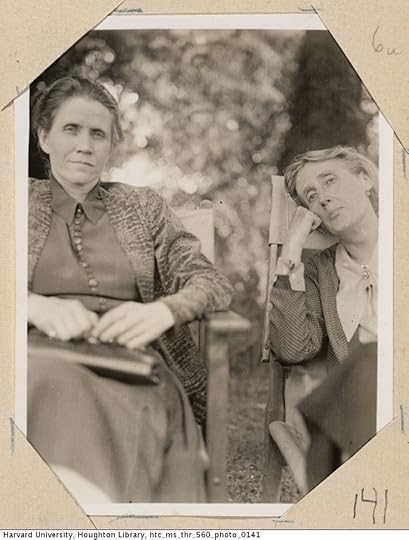
Here is a picture of Stella Benson with Virginia Woolf in 1931, less than two years before Stella died of pneumonia in Vietnam.
And why should you read this novel?
It is very funny and very sad, for a start. It is playful in that style we most associate with the Postmodernists who came fifty years after her - it has metafictional elements, it has letters and poems and all the rest. But also it is written in the midst of the Great War. It is set in the midst of the Great War. Its title is not as much of a joke as you may be led to believe.
Virginia Woolf loved her work. When Stella died she wrote in her diary: " 'A curious feeling: when a writer like Stella Benson dies, that one’s response is diminished; Here and Now won’t be lit up by her: it’s life lessened."
She is forgotten and neglected which is, quite frankly, bloody stupid.
This is how it begins, which was enough for me (and remember this was written in 1916/17):
"This is the end, for the moment, of all my thinking, this is my unfinal conclusion. There is no reason in tangible things, and no system in the ordinary ways of the world. Hands were made to grope, and feet to stumble, and the only things you may count on are the unaccountable things. System is a fairy and a dream, you never find system where or when you expect it. There are no reasons except reasons you and I don't know.
I should not be really surprised if the policeman across the way grew wings, or if the deep sea rose and washed out the chaos of the land. I should not raise my eyebrows if the daily press became the Little Sunbeam of the Home, or if Cabinet Ministers struck for a decrease of wages. I feel no security in facts, precedent seems no protection to me. The wisdom you can find in an Encyclopedia, or in Selfridge's Information Bureau, seems to me just a transitory adaptation to quicksand circumstances.
But if the things which I know in spite of my education were false, if the eyes of the sea forgot their secret, or if the accent of the steep woods became vulgar, if the fairy adventures that happen in my heart fell flat, if the good friends my eyes have never seen failed me,—then indeed should I know emptiness, and an astonishment that would kill.
I want to introduce you to Jay, a 'bus-conductor and an idealist. She is not the heroine, but the most constantly apparent woman in this book. I cannot introduce you to a heroine because I have never met one.
She was a person who took nothing in the world for granted, but as she had only a slight connection with the world, that is not saying very much. Her answer to everything was "Why?" The fundamental facts that you and I accept from our youth upwards, like Be Good and You Will Be Happy, or Change Your Boots When You Come In Out Of The Wet, or Respect Your Elders, or Love Your Neighbour, or Never Cross Your Legs Above The Knee, did not impress Jay.
I never knew her as a baby, but I am sure she must have been born a propounder of questions, and a smiler at the answers she received. I daresay she used to ask questions—without result—long before she could talk, but I am quite sure she was not embittered by the lack of result. Nothing ever embittered Jay, not even her own pessimism. There is a finality about bitterness, and Jay was never final. Her last word was always on a questioning note. Her mind was always open, waiting for more. "Oh no," she would tell her pillow at night, "there must be a better answer than that …"
Perhaps it is hardly necessary to add that she had quarrelled with her Family, and run away from home. Her Family knew neither what she was doing nor where she was doing it. Families are incurably conceited, and this one supposed that, having broken away from it, Jay was going to the bad. On the contrary, she was a 'bus-conductor, but I only tell you this in confidence. I repeat the Family did not know it, and does not know it yet.
The Family sometimes said that Jay was an idealist, but it did not really think so. The Family sometimes said that she was rather mad, but it did not know how mad she was, or it would have sent her away to live in a doctor's establishment at Margate. It never realised that it had only come in contact with about one-fifth of its young relation, and that the other four-fifths were shut away from it. Shut away in a shining bubble world with only room in it for one—for One, and a shining bubble Story.
I do not know how universal an experience a Secret Story and a Secret Friend may be. Perhaps this wonder is a commonplace to you, only you are more reticent about it than Jay or I. But to me, even after twenty years' intimacy with what I can only describe as a supplementary life that I cannot describe, it still seems so very wonderful that I cannot believe I share it with every man and woman in the street.
The great advantage of a Secret Story over other stories is that you cannot put it into print. So I can only show you the initial letter, and you may if you choose look upon it as an imaginary hieroglyphic. Or you may not."
I first discovered Stella Benson when I read her play Kwan-yin at Gutenberg. Then I moved on to a volume of poetry, Twenty. I was impressed but muddled a the same time when I read those poems. In my review https://www.goodreads.com/review/show... I said how I could not really grasp what she was trying to say, although she said it all so beautifully.
In a note at the beginning of that collection, Benson says that most of the poems had been previously published in two of her novels, I Pose and This Is The End. I thought nothing of that comment at the time, but while reading this book, I finally understood. On their own, the poems are lovely. But within the framework of the novel, used as untitled interludes at certain points of the story, they seamlessly reveal an extra depth to the work that was almost overwhelming for me, especially when I came to the events preceding the poem I quoted in my review of Twenty. I cannot now imagine these poems or this novel as separate beings: they need to be read together the way Benson intended.
As for the story itself, basically it is about becoming an adult, facing loss, learning to deal with the reality of life. The realities at that time (1917) were war, the changing society, women's new roles in the world, just to name a few.
I am finding it difficult to explain exactly what happens in the story, but only because every time I try to write even a basic plot outline, my words feel completely inadequate. I am just going to resort to adding a few lines from various places in the story, and leave the rest up to you. I know I am going to re-read this many times, and I have planned the final Benson title available at Gutenberg for January. I am completely enchanted with her and am very glad I did not give up after my first troubles with her poems. I feel that maybe if I spend a little more time in her Secret World I might be closer to finding my own again.
"If Jay's Family did not know she was a 'bus-conductor, and did not know she was a story-possessor, what did it know about her? It knew she disliked the smell of bananas, and that she had not taken advantage of an expensive education, and that she was Stock Size (Small Ladies'), and that she was christened Jane Elizabeth, and that she took after her father to an excessive extent, and that she was rather too apt to swallow this Socialist nonsense. As Families go, it was fairly well informed about her."
"When, by some accident, the whole Family was simultaneously silent, you could not help noticing what an oppressively still place London was. The sound of Russell's Hound sneezing in the hall was like a bomb."
" I never see a boat on an utterly lonely sea without thinking of the secret stories that it carries, of the sun moving round that private world, of the shadows upon the deck that I cannot see, of the song of passing seas that I cannot hear, of the night coming across a great horizon to devour it when I shall have forgotten it. Further off and more suggestive than a star, it seems to me."
This is Kew (Jay's brother) speaking to her on the day before he must return to France: "I am not half so brave as I used to be. I remember at the age of ten doing a thing that I have never dared to do since. I sat in the bath with my back to the taps. Do you suppose the innocent designer of baths meant everybody to sit like that, with a tap looking over each shoulder? Taps are known to be savage brutes, and it is everybody's instinct to sit the other way round, and keep an eye on the danger. If I were as brave now as I was at ten, I could probably win the War."
"Oh, friend of childlike mind, what is it that these two years have taken from us, what is it that we have lost, oh friend, besides contentment?"
Years ahead of her time, Stella Benson writes her metafaction with a light and airy touch, bringing an almost playful style to her work. She brings the reader into her story, almost as a second primary character, a clever (and successful) device making the worlds and the characters she creates more real. She combines being a technically gifted writer with emotionally-charged and raw writing, a rare gift indeed. Playful it may be, but in juxtaposing dreams and fantasies with the horrors of world war one, she sets side-by-side what-could-be with what-is. The result is fantasy that is surreal and beautiful, horror that is undiluted and sadness that is not dimished by any lasting comfort. This is one of the most (if not THE most) beautiful and poignant books I've ever read. She should be a household name, but seems forgotten or pretty much ignored these days. I don't understand why. Should be required reading for everybody.
"This is the end, for the moment, of all my thinking, this is my unfinal conclusion. There is no reason in tangible things, and no system in the ordinary ways of the world. Hands were made to grope, and feet to stumble, and the only things you may count on are the unaccountable things."
"Conversations, like the public, generally follow the loudest voice."
"There is always an end beyond the end, always something to love and look forward to. Life is a luxury, isn't it? there's no use in it—but how delightful!"
"I can cheer, but not laugh over such news as that... Doesn't even a German find the sea bitter to drown in? An English woman or a German butcher, isn't it all the same when it comes to a Me, with a throat full of water? Hasn't a German got a Me?"
"There are no essentials in life but bread and water and love. Everything else is a sort of skin-disease which has appeared on the surface of Nature, a disease which we call civilization."
"The Law likes to be argued with. Take away words and where is the Law? Silence always annoys it."
"Call no man foe, but never love a stranger. Build up no plan, nor any star pursue. Go forth with crowds; in loneliness is danger."
"One does not need to see with one's outward eyes."
"- Doesn't it seem as if all the happiest things happened yesterday? - To me it seems that they will happen to-morrow."
"She found to her surprise that one may love life and yet also think lovingly of death. To live is most interesting in an uneasy way, but to die is to forget at once all these trivial turbulences, to forget equally the people you have loved and the people you have hated, to forget everything you ever knew, to be alone, and to be no longer disturbed by unceasing voices."
"Jay was laboriously thinking small thoughts because she was tired of thinking of Love and Life and other things with capital letters."
"War is, even here, where Time is not. War is like air, in every house, in every land, on every sea. For ever... Time and Life and the sea go up and down. Eternity has no logic. There are no reasons, there is no explanation. But there is always War."
Currently for ZERO US=AMERICAN DOLLARS @amazon for kindle. http://www.amazon.com/This-End-Stella... ifn you do that kind of thing ; although the page count is iffy.
Also, it's in the public domain, so beware of half-assed ocr editions.
See Jonathan and his review. I believe he is recommending the recent edition from Michael Walmer (publisher) from 2014, as linked with this review. Isbn :: 0992422086
I didn't like this as much as the other Benson I've read; the rambling about Destiny and Secret Worlds and whatnot became a bit tiresome. Anonyma/Mrs. Gustus was the best part. But the ending was splendidly depressing, I'll give it that.
Can a book as short as this be described as rambling? There is much to enjoy, but there is also a lot that left me bemused and befuddled. Shades of early Aldous Huxley for me.
An ambitious work at every level, with many appealing elements. Benson's modern prose combines with her wit to skewer the moments that deserve it, while her imagery pairs with a melancholy tone at other times to reflect the fractured world she is depicting. Taking place in the spring of 1916, the story is of Jay (Jane Elizabeth Martin) who is effectively slumming it as a bus conductor, while her well to do relatives wonder where she has gotten to. Her brother, Kew, knows but he is part of a "Secret World" that holds Jay together as the storm rages outside. The book obviously is much influenced by Alain-Fournier. At times, it seems almost as powerful. But somewhere along the way, it doesn't work as intended. I appreciate the shifting perspectives, time, and moods. Above all it is a novel about moods (human as well as natural) slyly moving in and out of focus or comprehension. It's all very clever. And I don't know quite what is missing. But something is. Still, how unfortunate that Stella Benson is largely unremembered these days.
Il y a une forme de violence plus dur dans ce texte au contraire de ma première lecture de l'autrice. Il y a de la magie mais moins et moins de joie et d'entrain. On cherche toujours à survivre et s'éloigner de la guerre mais dans celui ci elle nous rattrape et on cherche en vain les moyens de vivre avec.