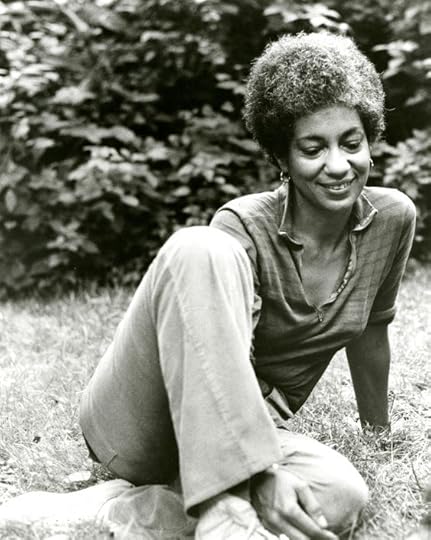
The first novel of poet and essayist June Jordan, His Own Where (1971) made the New York Times List of the Most Outstanding Books of 1971 for young adults and the American Library Association List of Best Books; it was also nominated for the National Book Award.
His Own Where is the love story of sixteen-year-old Buddy Rivers and fourteen-year-old Angela Figeroa, two African American adolescents struggling with parental abandonment and violence, an intimidating urban environment, and social institutions indifferent to human need. The young characters define their own world and establish their own values, which are often at variance with society's and their parents’ demands. Their story's unsparing depiction of society's slow extinction of youthful hopes and dreams warns about the effects of prejudice and sexism, and champions freedom over constriction, sensuality over puritanism, living for others over living for success. Narrated from Buddy's perspective, it is told in flashbacks and dream sequences in an African American spoken English whose rhythms poeticize Buddy's often heroic conflicts with his environment to change situations he finds physically or emotionally confining. At school he agitates for free sex, contraceptives, coeducational classes in anatomy, and dancing and music in the lunchroom; he helps Angela escape her abusive parents as well as an oppressive girls’ home. Refusing to be trapped by the hopelessness of indifferent and cruel environmental elements, Buddy takes Angela to a deserted cemetery toolshed, determined to make a new life for them, which includes the prospect of a baby; he seeks “His own where, own place for loving made for making love.”
His Own Where makes central June Jordan's interests in architecture and urban design and her commitment to African American English. The novel shows that space and language, vital means by which environment is shaped, bear directly on personal development and community health. Buddy's work on the house he and his father have renovated and on the toolshed he and Angela inhabit suggest that urban redesign should be enlisted to create environmental conditions that can foster African American life. The novel's poetic stream of consciousness style closes the gap between words and experience, with the result of a striking verbal immediacy that realizes the integrity of African American English as well as its energy and creativity. This reflects Jordan's educational and artistic goals to defend and preserve the language while luxuriating in its lyricism, rhythm, and poetic idiom.
His Own Where is an exemplary work from the “second renaissance” of African American culture of the 1960s and 1970s. Blending elements of fantasy and realism, the novel suggests a reconceptualization of realism from the perspective of poetic vision; its dreamlike quality and impressionistic style evoke the grittiness of urban life and the energy of being young and African American. In its emphasis on activist urban redesign and its pride in African American English, His Own Where is a novel of political protest that fits in a tradition of works by Alice Walker, Toni Morrison, and other socially conscious African American novelists of the 1970s. (*book description taken from: The Concise Oxford Companion to African American Literature)
June Millicent Jordan (July 9, 1936 – June 14, 2002) was a Caribbean-American poet and activist.
Jordan received numerous honors and awards, including a 1969-70 Rockefeller grant for creative writing, a Yaddo Fellowship in 1979, a National Endowment for the Arts fellowship in 1982, and the Achievement Award for International Reporting from the National Association of Black Journalists in 1984. Jordan also won the Lila Wallace Reader's Digest Writers Award from 1995 to 1998 as well as the Ground Breakers-Dream Makers Award from The Woman's Foundation in 1994.
She was included in Who's Who in America from 1984 until her death. She received the Chancellor's Distinguished Lectureship from UC Berkeley and the PEN Center USA West Freedom to Write Award (1991).
Every once in a while a book impacts me so deeply, I wonder how I will review it.
This is one of them.
I've actually been sitting here biting the skin on the inside of my thumb for a while now, procrastinating, wondering how I want to start, wondering what exactly I want to write.
You see. . . you see. . . Langston Hughes, who was born in 1901, is a top-5 poet for me. He and Carl Sandburg sort of rock my interior world.
And Gwendolyn Brooks, who was born in 1917, is a top-10 poet for me. I can't even look at a photo of her without getting the shivers.
And June Jordan, who was born later, in 1936, is, like, a combination of these two beloved poets, only I didn't know her work before now, and I was waiting for my 70s project for my introduction.
I just bit off my right thumbnail.
So. . . this is a novella, but it's more like an epic poem. I mean. . . slow down. . . don't freak out. . . it's a novella, not a poem, but Ms. Jordan was a poet first and everything else second, and she insisted on writing this in a poetic “Black English,” style, so it scared readers away. Yet it still managed to be a finalist for the National Book Award in 1971. Doesn't that tell you how good it must be??
This short novel has all the rhythm of Hughes's The Weary Blues, and the subtlety and tone of Brooks's Maud Martha, yet somehow it manages to create syncopation, too.
Can you believe that in this book I can also feel the influences of Edith Wharton, Zora Neale Hurston, Shirley Jackson and Truman Capote?
By the end of this story, I could suddenly play a saxophone.
Hey, Ms. Jordan. . . it's a pleasure to meet you. (See my jazz hands, dear?).
This is the first piece I've read from the great June Jordan. Known for her poetry, June Jordan's novella His Own Where still displays a strong poetic vibe. Buddy the main character is alone and in love with Angela. Jordan shows us life through the eyes and voice of a young black boy. The novella is written in Black English so it will take a few pages to get into the way it's written. His Own Where was published and highly praised in 1971. Happy to have started reading June Jordan on a high note. Another highlight to this edition is the introduction by Sapphire, author of Push adapted to a film called Precious, where she explains the poetic devices in the story and pinpointing Jordan's eclectic background. I highly recommend His Own Where.
Wow, wow, wow. This little book, clocking in at under 100 pages, packs a punch. Told in poetic street language, it's the story of Buddy finding his own "where" in the world. He's surrounded by death and the place he finds his life and his light is a cemetery.
Moving, powerful, and just damn gorgeous to read. I'd love to hear this on audio because the language is incredible.
This was Jordan's only novel and now I am going to take a deep dive into her poetry.
Readers who want an urban-set story, this is a total winner. It's a coming of age romance.
a beautifully constructed piece of literature, but i think reading it as quickly as i did (class deadlines) had a negative impact on my understanding/appreciation of it. i'll hopefully come back to this one in a little while
this book is quite cute! even though it is also quite sad. I rlly liked how the narrative style captured the naivety of young love---the simplicity of togetherness against the backdrop of a complex reality
His Own Where by June Jordan was such a splendid lyrical book. The cadence and voice in which the narrative was presented exposed an authentic gift. Through adversity and strife, the two ( Buddy and Angela) uncover purpose and love amongst each other in an ostensibly desperate and loveless situation. There was so much beauty in this 94pg novel.
YA really needs to step up to its own plate based on this foray into AAVE as a literary mode. Poetic turns of disjointed phrase abound with a surreal amount of content packed into ninety-two pages.
I am on a June Jordan kick lately. She was one special writer, and this is one special book. Her only novel--published in 1971--Jordan writes all 93 pages in Black English. While it takes a little while to fall into the rhythm of it (and there is a stunning, poetic, startling rhythm), there is a vibrant energy here the entire way through.
June Jordan is known for her wildly resistant and loving poetry, and this short novel is one similarly about resistance and love. A sort of modern update of Romeo & Juliet, the book tells the story of teenage lovers Buddy and Angela and their budding social consciousnesses. While they search for an authentic, safe space all their own, they learn about adulthood, emotional trial and themselves without ever losing hope.
In a time when young adult fiction is currently awash with teen characters in crisis, I wish there were more characters like these--characters with true agency who fight the hegemonic order with a resilience that inspires readers to do the same. The style of the book likewise affirms young people and their perspective on the world. But then, I totally credit June Jordan with that, for she was a poet and teacher who loved youth, despised oppression, and knew the power of spoken and written word.
This book is a true revelation! And losing June Jordan was a tremendous loss.
The book from 1971 feels a bit like something that would be assigned in college and many students would struggle through. It’s written in Black English and frequently veers into a rapping, slamming poetry style; you can sense that it’s a precursor to later books by writers such as Ntozake Shange, Sandra Cisneros and Sapphire, who writes the introduction and narrates the audio version. I almost gave up early on but decided to push through because I’ve heard so many great things about June Jordan, and then suddenly I was lost in the story about two Brooklyn teenagers in love, with one dealing with a dying father and the other kicked out of her home. I ended up really liking it but it’s not for everyone. Bechdel test: Pass. Grade: A-
Can I just tell you about the rhythm of the story? It ebbs and flows and rolls through your mind. The sincere and genuine love between Angela and Buddy is the naive yet unyielding love that I know I have experienced back when I was the kid who was going up against the world.
I read this in a sitting because the story soothed me. Although Angela and Buddy were living in the brokenhearted brooklyn they had love. There was always a struggle something going wrong but they were there for one another and they accepted the consequences of thier love... because the love was there; Buddy had his Angela and she had him.
I did not enjoy this book at all. Angela and Buddy are best friends who find love and comfort in each other’s arms. While they escape their dysfunctional lives, they find refuge with each other. They explore sex and intimacy and live as if the world is only for them. The writing was confusing as it is written in their voice (broken phrases and sentences that don’t flow). Just not my favorite book.
I understand the idea behind writing the story in Black English, but I feel it took away from the story. At times it was difficult to understand because of disjointed and half sentences. The story itself has a lot of heart, but thinking ahead the protagonists are heading for a a world of struggle and hurt. Their's is not a good solution for their dire situation, but what the solution is, I have no idea. So, it is indeed a sad story.
I read this in high school at a time when I had ZERO appreciation for Black English in its written form. Strange from a girl who went on to write half her novel in Ebonics right??? I do remember it was a good novel though; one with an intriguing love story; I just couldn't get past the way it was written. I'd like to read it again one day. Maybe soon.
I found this book to be just beautiful. It relates the classic theme of tragic, impossible love to an urban environment. It is simplistic yet heartfelt and mature. The prose is breathtaking (which, of course, one would expect from a poet) and although it is a small book that can easily be read in one setting, it is powerful and lovely to read.
"The dining room, where she cry that day, on other days unusual with celery and olives."
"Buddy leaning on the wall be thinking that the whole city of his people like a all-night emergency room. People mostly suffering, uncomfortable, and waiting."
June Jordan is one of the poetry world's most sorely missed masters. Her poetic leanings seep into this narrative, "young adult" yet unforgettable for all readers.
Although this book was published in 1971, it feels modern. Buddy is a budding 15-year-old community organizer whose father is in the hospital and possibly dying. He has big dreams, a heart to match, and the tools to make things happen. Angela is visiting another patient in Buddy's father's room and catches his eye. This is a story of young love, and so much more.
Written entirely in a poetic style mixing Black Vernacular English with 1970s slang, the language might be challenging at first (especially to teen readers), but it completely rewards the reader who persists.
As a non native English speaker I struggled a little at first with the sentence structure and the way this was written, but quickly eased into it. Then I realised how this story just ebbs and flows, masterfully crafted to have a rhythm. It's poetry in prose. Buddy has very insightful and poignant ovservations on the world around him, and his and Angela's love is something special.
Lovely fast-paced read that packs more emotional impact in 100 pages than entire book series.
I finished the book and immediately listened to the audiobook afterward. Wow, so powerful! Written in Black English, this novel touches on many sociopolitical realities, from urban teenage love to parental abuse, educational oppression, and, of course, the centrality of race and space. The poetic language embedded is radical on its own. It felt like every word was “right” and I looved the re-imagining of physical space as a way of/for liberation. I will definitely read more of Jordan’s works!
I love this book, I love June Jordan and her beautiful beautiful writing. I love how unique this book feels and how special and how awesome it is to be published in 1970s as the first book written entirely in AAVE. I love that it’s a love story but it’s good and cute. And the way Jordan talks about young love 💓 they’re like 14 and she doesn’t make it cringey and that alone impresses me
Caveat that this was required reading but I loved this book! The prose it’s written in is so rich and melodic in a way, the little vignettes of the lives of these characters are vivid and touching, their connection to each other and the world around them is profound, really great read