«En kirke er en slags skog. En skog er en slags kirke. De er egentlig akkurat det samme.»
Nitten år gamle Merowdis Scot er en uvanlig jente. Hun kan snakke med dyr og trær – og hun er bare lykkelig når hun vandrer i skogen.
En snøhvit ettermiddag er Merowdis ute med hundene sine og grisen Apple da hun møter en svarttrost og en rev. Da mørket senker seg, dukker en underlig skikkelse opp iblant dem – og livsveien hennes endres for bestandig.
Midtvinterskogen er hentet fra samme univers som Jonathan Strange & herr Norrell, og er en fortryllende og uforglemmelig julefortelling fra en forfatter med en fantasi som få andre.
Susanna Clarke was born in Nottingham in 1959. A nomadic childhood was spent in towns in Northern England and Scotland. She was educated at St Hilda's College, Oxford, and has worked in various areas of non-fiction publishing, including Gordon Fraser and Quarto. In 1990, she left London and went to Turin to teach English to stressed-out executives of the Fiat motor company. The following year she taught English in Bilbao.
She returned to England in 1992 and spent the rest of that year in County Durham, in a house that looked out over the North Sea. There she began working on her first novel, Jonathan Strange & Mr Norrell.
From 1993 to 2003, Susanna Clarke was an editor at Simon and Schuster's Cambridge office, where she worked on their cookery list. She has published seven short stories and novellas in US anthologies. One, "The Duke of Wellington Misplaces His Horse," first appeared in a limited-edition, illustrated chapbook from Green Man Press. Another, "Mr Simonelli or The Fairy Widower," was shortlisted for a World Fantasy Award in 2001.
She lives in Cambridge with her partner, the novelist and reviewer Colin Greenland.
The deep woods are often a doorway into the magic of the world. Long has the forest been the playground of fairy tales that bewitch the mind and guide the spirit and the wooded wilderness has often been a source of inspiration for the art of poets and painters. So too, we find the forest a place of wonderment in Susanna Clarke’s The Wood at Midwinter, a crisp and charming tale of patience, hope and dreams that brew in the depths of winter, hushed beneath the snowy branches. A bit of a fairy tale crossed with a christmas parable, Clarke delicately delivers the story of Merowdis, a young woman with aspirations for a child to call her own and share in her life that seems only at ease amongst the trees. As gorgeously illustrated by Victoria Sawdon as it is told in Clarke’s lovely prose, The Wood at Midwinter is like a picture book for adults and a tale to warm the heart on cold nights.
Having read Piranesi, I was very eager to check out The Wood at Midwinter and Clarke returns with another rather mystical story told with such a peaceful calm like snow settling on a pond at sunset. Merowdis is a fascinating figure, a young woman who has been told she is not obedient enough to be a nun, who rejects the offer of marriage to George, who finds herself most alive in the forest, and whom the animals flock around finding her a figure of sainthood. ‘'A church is a sort of wood. A wood is a sort of church,’ she tells them, ‘they're the same thing really,’ and in the woods she makes her own special ministry. I greatly enjoyed the voice given to the animals and the way they commune with her, discussing life, the wilderness, Christmas and—from there—the story of a child born midwinter.
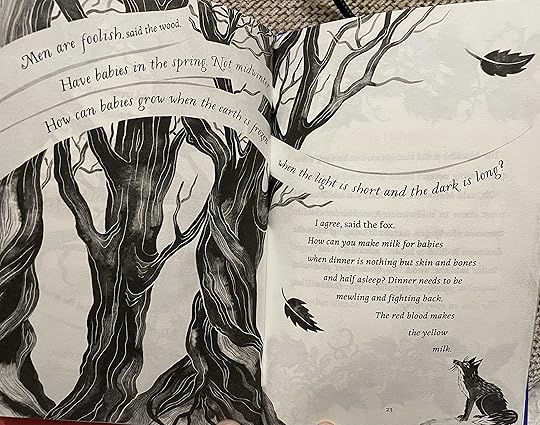
I love the way the nods towards christianity fold away into a look into the mysticism of nature. The story of a son born on Christmas day is understood by the forest to be ‘the Sun. The hidden Sun. The Sun in everything.’ It is a really tasteful blend of folklore, the yule, christianity and a deep love of nature. I also really love the artwork that adorns nearly every page, often framing the words or even interacting with them. Clarke provides a lovely afterword with insight into her stories, such as discussing how Piranesi was inspired by Jorge Luis Borges’s stories The Library of Babel and The House of Asterion. ‘Sometimes,’ she writes, ‘new stories are just old stories badly remembered.’ I also loved her discussion on her love for Kate Bush and how her music inspired the novel Jonathan Strange & Mr Norrell and how this story, which is set in the same universe as Jonathan Strange, was inspired by Bush’s album 50 Words for Snow. It is a delightful detail that already has me listening to it.
‘Some stories sink down into your bones.’
Speaking of listening, you can listen to this story HERE for BBC Radio 4. A quick little story, but a crisp and beautiful one that is as delicate as the snow itself.
3.5/5
‘All woods join up with all other woods. All are one wood. And in that wood all times join up with all other times. All is one moment.’
To be honest, this did very little for me. It was beautiful and atmospheric, but not particularly enchanting. It was over almost as soon as it began, and while some short stories can pack a hard punch, this didn’t deliver. It was a lovely idea, but it is only because the author expounds upon the concept in her note afterwards that I can really appreciate its foundation. I firmly believe a story should stand strong on its own, rather than rely on an author‘s follow up to enhance its depth.
Susanna Clarke is an enchanting storyteller! Her settings, characters, and narratives are richly described. It is a joy to get swept away by her words!
First read:
The tone and atmosphere of this story was utterly enchanting!
After reading Susanna Clarke’s epic novel Jonathan Strange and Mr. Norrell, I was curious to read this story, as it is much *much* shorter. I wondered how the two would compare, especially because The Wood at Midwinter is set in the universe of J. S. & Mr. N.
Though I really enjoyed the writing and certain aspects of J. S. & Mr. N. I felt like something, even now I’m not sure what exactly, was missing.
Finally, I’m thrilled to say that I thought The Wood at Midwinter was wonderful! The pacing of this novella was just right, and I was entranced the entire time, curious to see how it would end!
EVERYTHING that Susanna Clarke writes is endlessly so magical, eloquent and has me sinking into an entirely new world. The Wood at Midwinter is no different... my only fault is that I wish that this was a full novel!!! I adored reading every word of this; in all of its atmosphere, whimsy and hopefulness, it was beautiful. Absolutely will be rereading this closer to christmas!
"A church is a sort of wood. A wood is a sort of church. They're the same thing really."
First of all, I'm SERIOUSLY disappointed this isn't a new novel. Second, it's barely even a short story--almost no plot or story at all, a very slight impression of a story. Nearly half of the book was the afterword where she talks about her influences, and while I love how in to Kate Bush she is, it wasn't particularly satisfying as a piece of fiction.
I would, however, love to read a whole novel based on the main character and what actually happens to her in the wood!
The illustrations are beautiful and the cover is worth the price of admission for any book collector's library. This can be read in 30 minutes or less and feels like Christmas folklore/Grimm's fairytale. Susanna Clarke expands on her inspiration for this tale which includes a lot of Kate Bush songs and the universe from her novel, Jonathan Strange & Mr Norrell. This didn't really feel long enough--I think this needed a bit more character development to lure the reader into an emotional development. I felt enveloped by the rich, wintertime, Yule atmosphere and read it right here by the fire and Christmas tree lights. My honest opinion is this would have been better in an anthology rather than a standalone, but the illustrations and cover are very pretty :) I don't regret buying/reading
It may take a couple of hours to warm up after delving into this enthralling, chilling tale. Merowdis is an unusual young woman, caught at the gates of indecision. A life devoted to the church? To George, who proposed? To the woods, where her soul resides? It's a fascinating tale that ties Christian elements with ancient natural folklore. I recommend this to my friends who are mood readers to read on one of the cold, dark, short days of winter.
A lovely, fantastical short story that's beautifully illustrated! The Wood at Midwinter is about a young woman with a menagerie of animals who loves to walk alone in the woods. It's beautiful and a bit eerie.
First, just for those unaware, this is a very short novella--it's more like a short story. It would probably be even shorter, but the font used is huge. That's all well and good--it's still a beautiful little book--if you are fine with the cost. But it's awfully expensive for such a short book, so I recommend using the library or waiting for the cost to come down. I probably would've if I had known how short it really was in actuality with such large font.
This said, it is a darling tale, and it's just exactly the thing if you want an engaging, entertaining escape that is written by a brilliant author. This is literature--the prose is exquisite, unquestionably. So if I had been rating this merely as a short story, I'd have given it 5 stars. But it's sold as a novella at a costly price. So I do want to warn others. I'm not sure it's fair to downgrade a rating due to marketing, so I'm being upfront about that. But nothing I read warned me that the font size was akin to those little Beatrix Potter children's books. I wish this had been part of a longer collection. Many skilled, award winning writers put stories like this up on Tor for free. (Charles de Lint, Alix Harrow and Seanan McGuire to name a few).
The thing to know about this one is that despite being bound as a book, it is not a novel or even a novella, but a short story: I read it in under 15 minutes, so estimate it at around 10 pages of text with normal formatting. It’s stretched out to just over 40 with huge font, lots of illustrations, and rarely placing more than a few sentences on a page. Then there’s some blank pages and an author’s note describing her process. Basically, it’s Christmas gift bait (it’s even set at Christmastime)—and with that lovely cover, it could make a fine gift for someone who loves books as physical objects. But do know what you’re getting into.
The story itself is fine, with potential to make a great longer work, and interesting thematically: it’s about a young woman with an intense attachment to the natural world, to the point of being unable to live a normal life, drawing connections to both madness and sainthood. The illustrations are also fine; they’re in black-and-white, focused on depictions of plants and animals, and generally fit the mood of the story. Nothing here is remarkable to me but also nothing badly wrong. For the right reader, it could be an excellent choice for Christmas reading or gifting.
A woderful short story from the author of Jonathan Strange & Mr. Norrell.
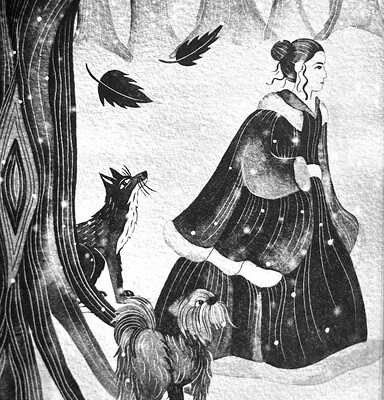
Merowdis is a nineteen-ear-old girl who likes animals and the woods more than other humans. One winter, shortly before Christmas, she goes into the woods to talk about her dearest wish whilst being accompanied by two dogs and a pig.
I can definitely identify with Merowdis. *lol* Her wish might be a bit unusual and I don't agree with her being declared a saint but it is better than the alternative (being declared a witch and burnt alive or drowned).
The little book was wonderfully bound (with shiny gold-foil details) and lovingly illustrated:
Most interestingly, the author has gone on record saying that this story takes place in the same universe as Jonathan Strange & Mr. Norrell. The afterword in this book provides even more context, also referring to part of what we can expect from the 2nd novel. Yep, you heard that right: there will be a 2nd volume! *cheers*
Really atmospheric setting and gorgeous writing combined with very pretty art, all of which makes for a wonderful reading experience.
Call me a grinch, but I will call this a cash grab. The illustrations are beautiful, but the story itself felt very superficial and very Christian-y in tone, which felt very annoying to me. It's too short to comment on the content outside of the spoiler tag, so here:
The author's note was a bit baffling because it felt like it was longer than the actual story and the sources of inspiration were intriguing, but the tale itself felt like a big ole nothing. I did not feel that the themes mentioned by Clarke were actually explored to any effect in the actual text.
75% of it is setup, basically, and it does feel cozy and whimsical and nice, but the elements don't amount to very much to my eyes.
Still, final buddy read of the year, with my bestie James and we were both equally what the fuck? that's it?!.
In this story set in midwinter, Merowdis Scot sets forth into the woods with her animals to walk and think for she is dissatisfied with her life. She does not wish to marry George who has offered and had been told that becoming a nun is not for her. What is her life to be? Surrounded by her dogs, her pig and the trees she loves, a fox and blackbird approach and all talk with her. Ultimately she has a vision of what might…will…happen in her life!
The Wood at Midwinter is a gentle, quiet tale that grows out of the world of Jonathan Strange & Mr Norrell, that “other” England beside the one we may see on a map. The magical other where creatures chat with humans and the course of life may run differently. This is a midwinter tale combining fable, religion and all that comes with the solstice. The illustrations complement the peaceful and gentle nature of the story. Clarke’s end notes also outline the influences on this story from her novels Piranesi and Jonathan Strange & Mr Norrell as well as the music of Kate Bush. I believe I must have a listening session very soon! I recommend this as a midwinter gift to yourself.
Thanks to Bloomsbury Publishing and NetGalley for the opportunity to read an eARC of this book.
I saw this in a list of upcoming books and it has a very short page count, I wonder if it is a written edition of this short story read at the BBC The Wood at Midwinter by Susanna Clarke which I have heard and it is lovely but felt like an introduction to some other longer story or universe... But not sure if that story would make even with large print and an introduction and illustrations 64 pages in hardcover, just posting this in case somebody knows if it is rewritten and longer or not...
If it is the same story, still it was lovely, wintry, Christmas-y, 19th century like (but weirder), northern England. The BBC audio production was really good also! But it left me wanting more, a longer book of hers. She is IMO (based on the anthology of hers I read, really good at short fiction, and the story I heard was a good example.
susanna clarke's the wood at midwinter is a lovely and quiet short story about merowdis scot, a girl who is keenly aware that her interests are singular, strange, and unlikely to be shared by anyone around her. she pursues them anyway. the wood at midwinter is a simple tale of an uncommon journey, alive with whispering trees, lively animals, beautiful illustrations, and a pervasive sense of odd comfort. it's a cup of hot tea just as the chill hits the wind, to be savored all at once.
after the end, susanna has penned a gorgeous afterward about the origin of this story, her love for kate bush, and how the fairies are still at work when it comes to jonathan strange and mr. norrell, even after all these years. i'll follow susanna clarke wherever she goes, and this short story was a perfect bridge to wherever she intends to lead us next. i can't wait to see where we end up.
Малесеньке оповіданько, але дуже гарне оформлене. Втім, мені не дуже сподобалося, що в заключному есе Сюзанна нам пояснює, що хотіла сказати оповіданням. Дуже дякую, канеш
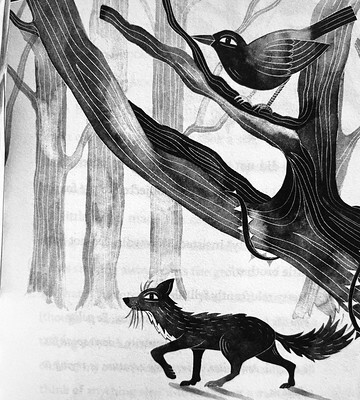
“Sometimes new stories are just old stories badly remembered.” I picked this up because I liked Jonathon Strange and Mr Norrell and because it was advertised as being part of that world. This is about nineteen year old girl, Merowdis, who is only happy when she is in the woods and can talk to animals. One snowy winter afternoon she is in the woods with two dogs (Amandier and Pretty) and a pig (Apple), they meet and converse with a fox and a blackbird too. The wood also speaks in its own way. The whole is beautifully illustrated. The point of it is that Merowdis realises and is told she is to have a baby. She is, of course a virgin (no messy sexual encounters here) and the baby will be a bear. So we have a Madonna and child trope and the whole has a strong religious streak running through it. “A church is a sort of wood. A wood is a sort of church. They’re the same thing really.” There is also the cute factor: “The names of the dogs were Pretty and Amandier. Pretty was a little dog with silky, ivory-coloured fur. He was what people call a lap dog, though this was not at all how he thought of himself. Amandier was a pale hunting dog, fine-boned, rough-coated and sensitive in nature. I do hope there’s no bears or wolves in this part of the wood today, she said. Can you smell wolves? She was rather an anxious person. I love wolfies, said Apple happily. They’re so-oo darling! Pretty looked at her. You have odd ideas for a pig, he said.” It has a certain charm, but I didn’t find it particularly inspiring. In the afterword Clarke also links the tale to her love for the music of Kate Bush. It’s a fable, and I am sure some will love this. I didn’t though I wanted to.
Having loved piranesi I expected more of this. This did not feel like a short story so much as it felt like a children’s picture book where the illustrations did a lot of the heavy lifting. This story could be told in one sentence. It felt very much like it was trying to be symbolic or meaningful and failed immensely.
A short story of fantasy for Christmas about a young woman, considered a saint by her family, who becomes a bridge 'between different worlds, between different states of being' and in doing so, 'attempts to heal the great estrangement between the natural world and Man.' I'm still not sure I understand this story and I read it twice.





![Profile Image for s.penkevich [hiatus-will return-miss you all].](/_next/image?url=https%3A%2F%2Fi.gr-assets.com%2Fimages%2FS%2Fcompressed.photo.goodreads.com%2Fusers%2F1735525095i%2F6431467._UX200_CR0%2C11%2C200%2C200_.jpg&w=128&q=75)


