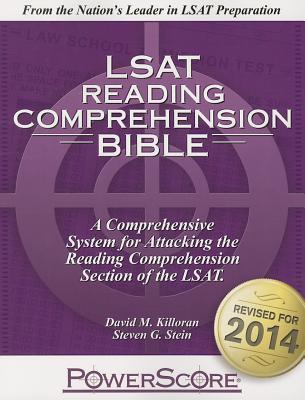
The PowerScore LSAT Reading Comprehension BibleTM will provide you with a powerful and comprehensive system for attacking any Reading Comprehension question that you may encounter on the LSAT. The concepts presented in this publication are representative of the techniques and approaches that have been tested in PowerScore's live LSAT preparation courses and have consistently been proven effective for countless students.
In an effort to clearly explain the fundamental principles of the Reading Comprehension section, this book Official LSAT passages and questions with complete explanationsSubstantial discussions of how to deconstruct the passagesStrategies to help you identify and attack the questionsStrategies for how to successfully avoid traps set by the test makers Detailed explanations for 12 official Reading Comprehension PassagesDiscussion of aspects of the Digital LSAT interface as well as diagramming strategiesA complete quick-reference answer key to all of the problems, including chapter-by-chapter answer keys and a unique reverse lookup feature that lists all of the included passages, sorted by the LSAT administration date and PrepTest numberIn addition, The PowerScore LSAT Reading Comprehension Bible contains a variety of drills and exercises that supplement the discussion of techniques and question analysis. The drills help strengthen specific skills that are critical for LSAT excellence, and for this reason they are as important as the LSAT questions.
We believe the use of official Reading Comprehension passages is essential to your success on the LSAT, and no LSAT passage in this book has been modified from its original form. By carefully studying and correctly applying the techniques employed in The PowerScore LSAT Reading Comprehension Bible, we are certain that you can increase your Reading Comprehension score.
It sure is a good thing that for the Reading Comprehension section of the LSAT, you are not required to memorize every detail like you are with Logical Reasoning! Instead, focus your efforts on understanding the following in each passage:
The main point The author's main point The author's purpose The author's attitude The author's opinion The author's feelings The author's beliefs The author's assumptions The author's biases The author's perspective The author's tone The author's reasoning The author's argument The author's conclusion The author's premises The author's evidence The author's support The author's objections The author's counterarguments The author's responses to counterarguments The author's qualifications The author's concessions The author's distinctions The author's comparisons The author's contrasts The author's examples The author's hypothetical examples The author's use of evidence The author's use of experts The author's use of statistics The author's use of historical events The author's use of scientific findings The author's use of quotations The author's use of terminology The structure of the passage The structure of each paragraph The function of each paragraph The function of each sentence The relationship between paragraphs The relationship between ideas The chronology of events The cause-and-effect relationships The similarities between competing theories The differences between competing theories The weaknesses of competing theories The strengths of competing theories The evidence supporting each theory The evidence contradicting each theory Which scholars agree Which scholars disagree Why they disagree What each scholar believes What each scholar would probably say about a new situation Every person's position Every group's position Every theory mentioned Every study mentioned Every historical event mentioned Every scientific finding mentioned Every qualification Every exception Every definition Every change in terminology Every subtle distinction Every relationship between concepts Every implication Every inference And, of course, the 47 completely irrelevant details that you were specifically told you don't need to memorize that you actually do
for someone who reads for fun i actually wanted to die while reading this book. they make the questions so complicated AND FOR WHAT? anyway i don’t recommend.
I started doing worse on the reading comprehension section after reading this book. Whereas the other two Bibles had good tips for understanding the mindset of test makers and providing unintuitive LSAT definitions (such as the LSAT definition of "some" and "most"), this one clogs up natural reading ability with its "tips." No "method" is going to make you a better reader.
If you read at least 15 nonfiction books a year, skip this one.
Worthwhile resource that provides a number of practical tips, but it is not sufficient by itself.
LSATlab + LSATdemon RC YouTube videos are great to watch in tandem w/ this book. Similar overarching principles, but different practical approach strategies.
This is mostly useful for covering your bases on the principles of the RC section + a handful of extremely valuable tips explaining common incorrect/correct answer patterns (things that help you immediately cross out otherwise tempting answers). The detailed approach strategies are impractical/overdone for my taste, but the book was still useful for filling in a few gaps.
In retrospect, even the “label the question type”, “write out the main idea” “write out each viewpoint” drill sections are useful for internalizing necessary habits into your brain - tho it does feel absurd while doing them. You won’t be physically writing down most, if any, of that stuff on test day. There’s no time.
About 1/3 of my current approach comes from this book Another 1/3 from online videos The remaining 1/3, I imagine, is going to come from patterns I pick up while doing a ridiculous # of practice test sets
— Side note:
The editors of these LSAT RC passages, by their insidious methods, are enough to make an atheist start believing in demons. You have to realize that perfectly good source material is collected by the test makers and then intentionally made worse/convoluted - to the point where the passages are almost unbearable but still comprehensible.
You have to approach the passages with an active & aggressive agenda of cutting through bullshit/traps in order to find the author’s main point & any viewpoints described. How you do that in a timely manner is what you have to figure out.
Honestly not too bad. The most useful part of the book was near the beginning because it shows you what to look for, what to highlight, and what to take notes of when you are engaging with a practice test. It gives a good rundown on how to approach different question types, what good and bad answers typically look like, and pretty decent strategies on how to approach certain topics. However, they recommend "The Fact Test" as a method to answer the most likely to be true questions. This is ridiculous because all it says for this "Fact Test" is that the answer choice must be found in the text itself...and that's it. I didn't need to be informed that the correct answer is in the text already, that's already obvious. Also, a lot of this information could've been conveyed more succinctly, instead I had to read large amounts of text to get a little bit of information. My practice scores have been improving so this book is effective, just inefficient.
The RC bible is a good way to become familiar with reading comprehension, but as most of the strategies and drills focused on note taking I did not find it to be as useful as the other two.
I’m being generous with 2 stars.. chatgpt taught me everything i know about RC, this book sucked. Don’t waste your time, either teach yourself or hire a tutor