One of four extraordinary graphic novels celebrating the Big Apple, from the master of American comics art.
Before the Lower East Side was cool, there was the grit and grime of Avenue C, a world filled with street musicians, overflowing sewers, and peeping toms, all recalled in Eisner’s unforgettable style.
William Erwin Eisner was an American cartoonist, writer, and entrepreneur. He was one of the earliest cartoonists to work in the American comic book industry, and his series The Spirit (1940–1952) was noted for its experiments in content and form. In 1978, he popularized the term "graphic novel" with the publication of his book A Contract with God. He was an early contributor to formal comics studies with his book Comics and Sequential Art (1985). The Eisner Award was named in his honor and is given to recognize achievements each year in the comics medium; he was one of the three inaugural inductees to the Will Eisner Comic Book Hall of Fame.
ويل آيزنر فيلسوف ومؤرخ بصري حقيقي هنا قصص قصيرة لها علاقة بمدينة نيويورك ملامح المدينة المميزة من اعلانات أو البالوعات أو البيوت والانحاء الخاصة بالفقراء كم القصص بمختلف المواضيع مثيرة لأهتمام بشدة من اصالة الأفكار وقوتها ما بين قصص صامتة أو حوار دسم ساحر عظيم
J'ai lu ce livre en anglais il y a longtemps (au moins 15 ans). Cette fois c'était moins impressionnant peut être c'est parce que je vis à côté de Paris donc le désespoir est plus concret pour moi
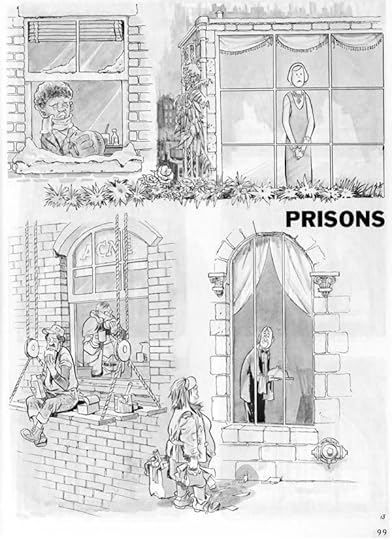
This is where the old magic was written. Eisner is working in miniature, short bits that were the staple of Mad Magazine for years, heavy on irony. Or it might be a single.page as one might see in ant number of magazines, selling a joke or a poignant moment in a 3x3 grid or a single image. Don't let the language--or the frequent density of it--distract you from the amazing line work in the drawings which capture so much detail of decay and collapse and ruin where we set these scenes.
A beautiful set of vignettes by a master. Not on the same level as his greatest masterworks, but that's because it isn't trying to be. These aren't even short stories, they're a kind of visual haiku. Elemental, gestural, poetic, and charming.
As I've said before: no one draws pants like Eisner. Just the best pants ever committed to the page.
En serie vignetter/striper som får frem ulike sider av livet i New York, rundt midten/andre halvdel av 1900-tallet. Samtlige striper er sjarmerende, og de fleste er morsomme og/eller tankevekkende. Jeg vil aldri få oppleve byen han beskriver, og det er utvilsomt et idyllisk blikk på en by som opplevde mange problemer, men det er likevel noe med utførelsen som gjør byen veldig gjenkjennelig. Jeg liker særlig hvordan denne følelsen ikke stammer fra enkeltstripene, men heller hele boka samla sett.
I had the pleasure of seeing Will Eisner’s artwork live once in a comic convention. I was awestruck. Star struck. Such fluidity in its lines and great expression. By God, what a master. This book deals with his perspective on big city living in America (New York); I love seeing these perspectives of how it was to live in such a place, before the year 2000 things had much more personality and danger to them. Some of it still exists, but not all. This was a different world
Pieniä kohtauksia suuressa kaupungissa, enimmäkseen köyhemmän väen parissa. Useimmat jutut ovat vain sivun mittaisia tuokiokuvia, jopa runollista fiilistelyä. Harmillisen suuri osa tarinoista jää turhankin pahasti kesken ja siten eivät herätä juurikaan ajatuksia saati tunteita. Ei siis nouse Eisnerin tuotannon kärkisijoille minun rankingissani tämä albumi.
Mestre. Em apenas um quadro ele descreve toda uma realidade ou situação, com todas as emoções que essa situação carrega. Não são 5 estrelas porque não tinha um enredo só, mas varias pequenas vinhetas mostrando a vida numa grande cidade. Uma das melhores é sobre os dois jovens que se veem no trem, sentem-se atraídos um pelo outro, fantasiam sobre a outra pessoa, mas não saem disso. Muito real.
C'est très beau et parfois très dur - un enchainements de scènes, de bruits et d'ambiances, de personnes, d'attitudes, de murs et de poubelles, tout ce qui constitue New-York, qui le fait vivre ... à lire !
I can see why the most prestigious award in sequential art has been named after Eisner. The man creates magic in just a few panels, often without using any words or text. A most satisfying read to close out 2019 with.
3.5 Stars. This was a really solid idea and it’s great to see the work of one of the biggest pioneers in the comics/graphic novels industry. But many of the stories were hit or miss for me. Glad I read it though.
Will Eisner is hailed as the pioneer of graphic novels. This book offers readers a glimpse into slices of New York life. While it may have been highly original during its time, I, having been raised on Mad magazine, found it to be good but not quite reaching the level of greatness.
Descrive l'america facendo parlare le cose e gli oggetti ed è tutto così sporco e crudo, è impossibile non sentirsi in qualche modo umano leggendo quest'opera.
Un vrai chef d'œuvre! J'ai adoré et je suis très impressionnée par la façon dont l'auteur nous fait vivre New York, je ne m'y attendais pas, et j'ai été très positivement surprise.
New York City and all kinds of its inhabitants are thoroughly captured by Eisner in this book. Scenes of apartments and public housing, busy streets and their elements - mail boxes, sewers, garbage bins and all - become the back- and foregrounds of the stories. My first impression is that it's actually a compilation of real-life fragments: sketches of daily struggle. I was far from considering it as most comic books that are full of fantasies. Although most of the stories are ironic, there are plenty of affectionate tales as well.
All visuals are done without vulgarity, yet honest. What really amazed me is that an arrangement of comical figures, random sceneries and a few words (or none at all) could actually bring up the sensitivity in me. A couple of stories could make my eyes warm or my heart skip a beat.
Like Eisner said earlier, making comic/strips is about "having something to say" - and that's what he really did. He intrigued us into pondering about humanity in a unique, not unpleasant, form. He clearly showed us how everybody is trying to get to a higher part of the pyramid built by society.
One of the most touching stories is about two hispanic women, one has a small baby, who are working as seamstress in a high-rise apartment building. The hardship of their (most probably illegal) jobs can be felt from their conversation. Their work environment clearly doesn't accommodate the safety regulation, and the story ends up tragically. So goes with the story about a rape that is witnessed by an old couple, who prefer not to testify for fear of their own future safety. A more pleasant happening is about how a couple who are used to live in social apartment buildings really prefer that crowded place to an 'upgraded' neighborhood.
I especially like the 'splash page' or one-page drawings that starts each chapter. These drawings have architectural quality, the lines are 'alive' and the shadings are perfect. For me, who have never been in New York, it's like reading a 'guide' to the city life, various domestic environment and its surroundings - but at the same time I could find similar stories in big cities anywhere in the world.
Scott McCloud revered Will Eisner. I revere Scott McCloud. Neil Gaiman admired Will Eisner. I admire Neil Gaiman. Art Spiegelman looked up to Will Eisner. I look up to Art Spiegelman.
And yet I waited so long to pick up this book. I am glad I didn't wait forever.
In a lot of ways, an sculptor creates his sculpture. In a lot of other ways, the sculpture dictates the creation itself, stating the ways it's going to mould. Will Eisner chose sequential art form to tell this story. Then the art form itself had a lot of inputs about the story being told. I imagine it'll be very hard to tell this story, using a different art form.
This is a story of any city, but then it's very much about the yesterday's New York.
Will Eisner was simply a genius, behind his drawings you can feel the love he always felt for New York and the people that live in the Big Apple. From the slums of the lower east side way before it became fashionable, Eisner introduces both the best and the worst of the big city world, including its buildings and misery. Loved the section about New York������s ������sentinels������.
Побутописний мальопис про життя Нью-Йорка (не Донецької області, але мені чомусь нескладно уявити як легка рука Вілла Айснера намалювала б і побут нашого), його урбану - графіті, вікон, метро, і звісно ж жителів. Естетична насолода, і трішки суму - що ніколи не побачу це місто таким, як колись його бачив Айснер.
Lebih tepat kalau buku ini disebut sebagai komik grafis. Mengisahkan keadaan kota New York dalam warna hitam putih secara lengkap dan detail. Buku yang sangat menakjubkan, soalnya saya membaca buku ini waktu Indonesia masih jauh sekali dari dunia komik grafis.