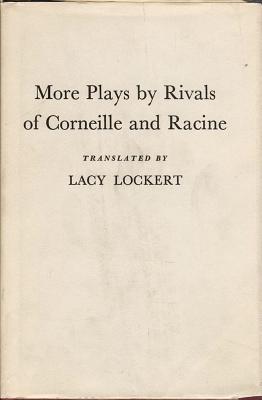
A follow-up to Lacy Lockert’s classic The Chief Rivals of Corneille and Racine (Vanderbilt University Press 1956), More Plays by Rivals of Corneille and Racine consists of more French tragedies of the period—eleven plays from the great age of French drama in the seventeenth century, one play from the prolific pen of Alexandre Hardy, who preceded the great age, and one from the eighteenth century, the aftermath of that age. The volume contains plays Lockert typified as “excellent,” such as Tiridate and Mariamne, Géta, and Ariane, “smash hits” of the time like Timocrate and Astrate, and several other plays Lockert called “minor” but that he felt would be of interest to scholars.
This is a fairly extraordinary collection, especially in terms of the really deep cuts in French tragedy that Lockert has translated into English. Not all are great, of course, and indeed a few are quite bad, but this collection really offers a rich portrait of French tragedy by many authors, and this is extraordinarily valuable since the only French tragedians anyone ever studies in English are the eponymous Corneille and Racine. Even better, Lockert's selection spans a full century, giving us a play from the very early 17th century and ending with one all the way in 1719. I'll describe each of the thirteen plays:
Mariamne (c. 1615) by Alexandre Hardy A rather fun time, although it's quite static in its sort of typically French Renaissance tragic way. But the language is evocative and filled with passions. Mariamne herself is an incredible diva, and Herod is an excellent character.
Esther (c. 1642) by Pierre Du Ryer What a strange play! It stages most of the biblical book of Esther, but its dramaturgy is quite bad. For one thing, the play is very repetitive, telling us things we already know, and for another thing, at a pivotal moment in the play, we begin following the villain Haman and his feelings when we should be following Esther or Mordecai, or even the king in his indecision. It's kind of a mess.
La Mort de Sénèque (c. 1643) by Tristan l'Hermite I'm actually stunned by how good this is. It moves quickly; it's filled with interesting cliffhangers and dynamic dramaturgy; it has a superior pair of characters in Nero and Epicharis; and it has the Roman Empire! This is surprisingly excellent. It's not interesting from a literary point of view, which is perhaps why it has received no accolades, but as drama, this is great.
Osman (1646) by Tristan l'Hermite How interesting that the themes in Osman are so similar to the themes in La Mort de Sénèque, i.e. the overthrow of an all-powerful emperor and the emperor's response to the complaints of his people. I am fascinated by thinking of both of these plays as responses to the absolute monarchy in France. Osman is not well plotted (as Lockert points out in his introduction), but it has some really great sequences, especially 4.2, with the Janissaries on the deck and the emperor on (maybe?) a balcony. One also can't help comparing this (at least a little bit) to Racine's Bajazet, since the source material is the same. Osman does have the structure of a Racinean play—where the person with the power is also the person who loves someone who does not love him/her in return—but it lacks almost everything else that is central to Racinean tragedy. This is a surprising play in that it lacks the claustrophobia of Racine's dramas and it lacks the tension that Racine creates so finely. It also never manages to convince us to care about the Mufti's daughter (the female protagonist), though the tragedy seems invested in her death in act five as an emotional event. Still Osman has its virtues: it's invested in politics in a way that Racine's tragedies never are, and it has at least one sparkling cliffhanger (as does La Mort de Sénèque).
Saint Genest (1646) by Jean Rotrou This is structured very badly. It is an apologia for Christian martyrdom and Christianity more generally – this takes up the three central acts of the play and the first scene of the last act – but the play ends with everyone discussing the stupidity of the central martyr and his death instead of the play ending with the martyr himself and his faith. Even more baffling, the central drama itself simply makes no sense: why on earth would an emperor of Rome wish to watch a Christian martyr defy his wishes and speak against his own religious beliefs? And yet that is the conceit of Jean Rotrou's play. Finally, and perhaps worst of all, Saint Genest is desperately repetitive. One hears again and again the same sentiments, the same arguments, and the same nonsensical celebrations of the death drive.
Timocrate (1656) by Thomas Corneille This is rather a fun drama, one that Lockert calls "romanesque", by which he means that it is completely artificial and has no links to history or mythology. Instead, the play has plenty of twists and turns. There are also quite a lot of switching loyalties, and this makes for good drama. The stakes here are artificially high, though—the Queen of Argos has vowed to kill the King of Crete and refuses to give up that vow even when she knows things would be much better for her. So the plot of Timocrate is to figure out a path for the Queen to give up her foolish vow for the good of her own city-state.
Maximian (1662) by Thomas Corneille This is fairly good. Maximian is a great, villainous character. But no one in the play acts in his own interest except for Maximian. It would be to nearly everyone's advantage for Maximian's nefarious plot to succeed, and yet almost no one in the play, even the people who feel a duty to Maximian, is willing to go along with it. It is only in the context of the absolute monarchy that this play can really make any sense whatsoever.
Ariane (1672) by Thomas Corneille I quite loved this Thomas Corneille play. It is thoroughly Racinean in its structure and its depiction of love, and I like that aspect a lot. It feels like a rich character study—each is finely drawn and intriguing—and Ariane herself has some outrageously, fabulously pathetic speeches. This is a great vehicle for an actress. My only gripe is the end, really. It ends far more abruptly than it ought to, and one is left wondering what on earth will happen. The ending lines don't feel final in any real way.
Oropaste, ou le Faux Tonaxare (1662) by Claude Boyer This play is great. It's gripping from start to finish, and filled with shifting loyalties and power games that never feel doomed or fates but instead feel as if they're unfolding in front of us—as if anything might happen and as if the tragedy that is promised might turn out to be unexpected. Lockert says in his introduction that the French poetry of Oropaste, ou le Faux Tonaxare is not very good, and this is one reason why no one likes this play. But if the poetry isn't good, the plotting works very, very well.
Astrate (1664) by Philippe Quinault More romanesque than even Timocrate (and to my mind, not nearly as fun), Astrate takes place in a no man's land with a made-up kingdom, a made-up crown, a made-up lineage, and made-up blood ties. The whole thing is extraordinarily artificial, and yet... the feelings of love described by the characters are sensitive and delivered beautifully, and the play does have a few fun twists in acts two and three. Once love becomes the overwhelming engine of the play, then both its obstacles and the love itself come to feel very, very silly, and the play is hard to take seriously.
Géta (1687) by Péchantré This is not really remarkable in any way, as far as I can tell. It can only really be compared to Racine's Brittanicus, and Géta suffers by such a comparison.
Tiridate (1691) by Jean Galbert de Campistron This is surprisingly good. Its topic is fraternal incest, which Renaissance tragedy only occasionally treated—I'm thinking of Canace and 'Tis Pity She's a Whore. But this treatment of the topic is really quite sublime, and the play's mercy and affection for the offending brother, Tiridate, comes through in every line. It's quite a moving play, and if Campistron's characters occasionally overdo it, the play's approach to Tiridate makes it well worth the read.
Ino et Mélicerte (1719) by La Grange-Chancel Lockert refers to this play as a melodrama, and he includes it because of its late date as a kind of bridge between tragedy and something else, but I think his evaluation misses something. Ino et Mélicerte isn't a melodrama, although perhaps it is what is often meant by the term. What it is is a kind of tragédie larmoyante, although I am not aware that there is actually such a thing. It's a tearful, sentimental drama, and indeed one that seems very typical of the early 18th century, certainly quite similar to what was happening in England at the time.