

What do you think?

Girl, 20
Life in London means glamour, fashion, finance and art. Consider then an aging conductor, husband in an unsatisfactory marriage, father to an unhappy brood. When a young woman responds to his overtures, he breaks the marriage and bursts the family...alas, everyone loses in this drama, for nothing puts people together again. Kingsley Amis is one of England's finest men of letters.
208 pages, Paperback
First published January 1, 1971
About the author
Kingsley Amis
221 books580 followersBest known novels of British writer Sir Kingsley William Amis include
Lucky Jim
(1954) and
The Old Devils
(1986).
This English poet, critic, and teacher composed more than twenty-three collections, short stories, radio and television scripts, and books of social and literary criticism. He fathered Martin Amis.
William Robert Amis, a clerk of a mustard manufacturer, fathered him. He began his education at the city of London school, and went up to college of Saint John, Oxford, in April 1941 to read English; he met Philip Larkin and formed the most important friendship of his life. After only a year, the Army called him for service in July 1942. After serving as a lieutenant in the royal corps of signals in the Second World War, Amis returned to Oxford in October 1945 to complete his degree. He worked hard and got a first in English in 1947, and then decided to devote much of his time.
Pen names: [authorRobert Markham|553548] and William Bill Tanner
This English poet, critic, and teacher composed more than twenty-three collections, short stories, radio and television scripts, and books of social and literary criticism. He fathered Martin Amis.
William Robert Amis, a clerk of a mustard manufacturer, fathered him. He began his education at the city of London school, and went up to college of Saint John, Oxford, in April 1941 to read English; he met Philip Larkin and formed the most important friendship of his life. After only a year, the Army called him for service in July 1942. After serving as a lieutenant in the royal corps of signals in the Second World War, Amis returned to Oxford in October 1945 to complete his degree. He worked hard and got a first in English in 1947, and then decided to devote much of his time.
Pen names: [authorRobert Markham|553548] and William Bill Tanner
Ratings & Reviews
Friends & Following
Create a free account to discover what your friends think of this book!
Community Reviews
Displaying 1 - 30 of 102 reviews

November 19, 2015

Flower power packs a powerful topsy-turvy punch on nearly everybody in the late 1960s, even a renowned 54-year old symphony orchestra conductor in London.
This is one Kingsley Amis novel I found to be highly engaging, entertaining and, such a pleasant surprise, actually funny – and for a clear-cut reason: the novel is first-person, the narrator, Douglas Yandell, a wishy-washy 34-year old aesthetically attuned classical musician and music critic continually speaks words and makes observations scathing, ironic, biting and occasionally heartfelt. And this in a time when the influence of 60s-style hippie culture was at its peak, when youth and newness were valued for their own sake, buttoned-down Douglas has much cultural material to be scornful and cutting about.
By way of example, Douglas listens to his friend, conductor/violinist Sir Roy Vandervane (many readers, including myself, can’t help picturing Leonard Bernstein) prattle in front of Sylvia, his new 20-year hippie-lover: “I suppose the real division comes between those who want to have and those who want to be. What the have ones want to have can be a lot of different things, not all of them bad in themselves, like political power or personal power. . . it can be possessions, cars and washing-machines and furniture and collections of china and things. The people who want to be can be a lot of different things too, like artists and mystics and philosophers and revolutionaries, some sorts anyway, and just people who live and feel and see. You’ve got to make up your mind whether you’re a have person or a be person.”
Sir Roy is the central character and much of the novel revolves around his musical life and personal life, especially his personal life and influence on his wife and children. Kingsley Amis is an excellent writer and all of the characters are sharply drawn and fully realized. One aspect of character (or lack of character) particularly struck me: on one level all these men and women are living a rather slovenly existence, not only continually, and I mean continually, plying themselves with liquor but also – many scenes take place during meals - mindlessly shoveling food into their mouths. I wouldn’t want to be too harsh here, but these Brits come off as a gaggle of slubberdegullions.
Performing and appreciating music is pivotal, most particularly for Sir Roy and the narrator. At one point, Douglas finds Sir Roy’s trendy, new age composition for violin, sitar, bass guitar and bongos entitled Elevations 9 positively appalling, entirely disrespectful and degrading to the great tradition of classical music. By way of an interior monologue, Kingsley Amis lets us know the narrator’s damning judgment also applies to the likes of John Cage. Turns out, when Sir Roy performs Elevations 9 on violin with a rock group called Pigs Out, the music is, in fact, awful.
Although Elevations 9, a mixing of instruments right out of the 60s, receives a well-deserved lampooning in this novel, I must disagree with Douglas (and indirectly with the author – sorry, Kingsley) - 20th century composers such as John Cage, Philip Glass and Morton Feldman with their innovative approaches are a tremendous development in the tradition of classical music. Also, the movement that began in the 1960s combining Western classical instruments with other traditions such as classical Indian, alternative and jazz is a development both spectacular and musically profound.
On this last point I offer three amazing examples: Yehudi Menuhin with Ravi Shankar - https://www.youtube.com/watch?v=IZRqu... Zakir Hussein with Charles Lloyd - https://www.youtube.com/watch?v=0-OSq... Ravi Shankar with Jean-Pierre Rampal - https://www.youtube.com/watch?v=XN4vx...
Back on the novel. Each and every page is filled with many pinpoint zingers, social and cultural commentary you will not want to miss. Highly recommended.

Zakir Hussain playing tabla with the Kronos String Quartet

January 14, 2020
After a couple of Martin Amis novels recently (one I liked, one not so much) I thought I'd give Amis Sr. a shot, and what a wise decision it turned out to be!
Girl, 20 is one the finest comic novels I've read in years. Featuring some brilliantly sharp, at times laugh out loud dialogue, richly humorous set pieces, and an anti-hero who really stuck in my mind after the closing pages. Oh, and then there is Sylvia, who, though she didn't appear that often, still managed to dig her nails into me. What an ignorant, rude and obnoxious cow!
Set in a swanky London, Amis' novel is narrated by Douglas Yandell, early thirties, and friend of conductor Sir Roy Vandervane, who is in his fifties, married with children, and has a thing for younger women, bordering now on the lines of them being barely out of girlhood.
Douglas, being the good old chap that he is, is carrying sympathy to all of the conflicting needs of those around him: Roy's mid life crisis-esque philandering, Roy's wife Kitty, who desires nothing more than a stable home life, and daughter Penny’s disgust for her father. Each of these people use Douglas for their own ends: he gets nothing out of it, meanwhile 'Duggers' as he is often referred to, has problems of his own. One being that he shares his girlfriend Vivienne with another man, another being that he may even fancy Penny, who in turn is involved with a man herself.
Within a few pages there is line where Kitty remarks on Roy's past flings by saying "they’ve been running at about twenty to twenty-six years of age over the last three years or so. Tending to go down. Getting younger at something like half the rate he gets older. When he’s seventy-three they’ll be ten.” In the case of Sylvia, Girl, 20 becomes Girl, 17. She is without doubt one of the most abhorrent female characters I've ever come across, and yet, at times she almost had me in stitches! There is one scene where Kitty, accompanied by Duggers, goes to have a word with her, which eventually results in a bit of catfight. By this time Sylvia is stark naked, having already stripped off to flaunt her young body, when asked by Kitty what it is specifically that Roy sees in her.
Sylvia's behavior is all shock and awe, and no one, especially Douglas, wants to be around her.
He just wants what's best for his friend. And it clearly isn't this kind of family destroying conduct.
All the time, I had the feeling Roy really just wanted to around the youthful generation, to again feel young himself. Never did I think he really had true affection for Sylvia, and he enthusiastically adopted some the most inane ideals through foolish desire just to feel fashionable and more appealing to others. It is through the character of Sir Roy that Girl, 20 becomes not only a comic satire of the ‘60s, but also a cautionary tale of irresponsibility and pretension.
Although Douglas was an admirable character, it was Roy's daughter Penny who was truly likeable, thus the one I felt for the most, which was brought on heavily after we get a sobering ending when she announcing her desire to develop a heroin addiction and just fade away. What went before it though, was great fun. There are the occasional racist remark, and it being a little too stereotypical of the era, but you have to remember the times it was written, when racist remarks weren't pulled to pieces and made such a fuss of as they are now.
Had Nabokov been English, he could well have written this novel. Yes, high praise indeed.

Read
April 9, 2018There is the English Language, and then there is the English Language as played with by Kingsley Amis, never on fuller display than here.
There was the usual British slang: knackered, buggering, sodding. But some of it was new to me. There was the Frenchman who couldn't read "Girl, 20" in a small-ad column without getting the horn or men who suddenly started flashing their hamptons. There are a social diluent, an odium-sharer, and a degenerate descendant of Charles II. There's also a psephologist (a man who knows about elections, we are told), but that's just another kind of showing off.
I can not begin to tell you for how many years I did not know that arse-creep was a verb.
Sunglasses are blinkers. I didn't know that either. Nor did I know that when you see a pedestrian wearing blinkers on an overcast day, stopped at a crosswalk, you should grab him by the arm and steward him across the street. What could go wrong?
As you can see from some of the above, there is a bit of discussion about sexual tangents:
'And a prick is a splendid thing, and a splendid idea as well. It strikes you. The trouble is that in every case it's got a man on the end of it. Which I'm afraid puts paid to it as far as I'm concerned. Then there's flagellation. I never even seriously considered that. It strikes you, sure, but what's it got to do with anything? You might as well play tennis or knit a pair of socks as a way of working up to a screw. And the same goes for capers like necrophily and bestiality. No point in even discussing any of them. It would just be flogging a dead horse.'
But, Amis needn't go all slangy. Here:
At this opportune time, the couple on the couch, probably feeling that enough time had elapsed for them not to be thought to be leaving because they had been asked to leave, left.
There are words there, but there is also meter. Which is appropriate because this is a story about a world-famous composer and the narrator, a music critic who can play Mozart without blushing. I loved that Amis did not talk down to the reader, using, for example, Bruckner's 8th Symphony as a metaphor without explaining himself, or referencing John Cage when he wanted you to know there was quiet. Our narrator, stalling for time, shaves his face at adagio sostenuto instead of his usual allegro con brio. Only Weber's bassoon concerto sent me scurrying to YouTube.
I hadn't thought of this, but things which are described as deafening, almost always aren't.
It's time for me to put on some Haydn and listen to about eight hours of perfunctory periwiggery. But first I wanted to tell you that this was a real joy, in a Kingsley Amis kind of way.
There was the usual British slang: knackered, buggering, sodding. But some of it was new to me. There was the Frenchman who couldn't read "Girl, 20" in a small-ad column without getting the horn or men who suddenly started flashing their hamptons. There are a social diluent, an odium-sharer, and a degenerate descendant of Charles II. There's also a psephologist (a man who knows about elections, we are told), but that's just another kind of showing off.
I can not begin to tell you for how many years I did not know that arse-creep was a verb.
Sunglasses are blinkers. I didn't know that either. Nor did I know that when you see a pedestrian wearing blinkers on an overcast day, stopped at a crosswalk, you should grab him by the arm and steward him across the street. What could go wrong?
As you can see from some of the above, there is a bit of discussion about sexual tangents:
'And a prick is a splendid thing, and a splendid idea as well. It strikes you. The trouble is that in every case it's got a man on the end of it. Which I'm afraid puts paid to it as far as I'm concerned. Then there's flagellation. I never even seriously considered that. It strikes you, sure, but what's it got to do with anything? You might as well play tennis or knit a pair of socks as a way of working up to a screw. And the same goes for capers like necrophily and bestiality. No point in even discussing any of them. It would just be flogging a dead horse.'
But, Amis needn't go all slangy. Here:
At this opportune time, the couple on the couch, probably feeling that enough time had elapsed for them not to be thought to be leaving because they had been asked to leave, left.
There are words there, but there is also meter. Which is appropriate because this is a story about a world-famous composer and the narrator, a music critic who can play Mozart without blushing. I loved that Amis did not talk down to the reader, using, for example, Bruckner's 8th Symphony as a metaphor without explaining himself, or referencing John Cage when he wanted you to know there was quiet. Our narrator, stalling for time, shaves his face at adagio sostenuto instead of his usual allegro con brio. Only Weber's bassoon concerto sent me scurrying to YouTube.
I hadn't thought of this, but things which are described as deafening, almost always aren't.
It's time for me to put on some Haydn and listen to about eight hours of perfunctory periwiggery. But first I wanted to tell you that this was a real joy, in a Kingsley Amis kind of way.

April 20, 2017
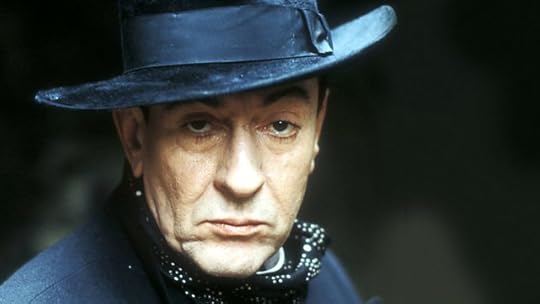
 http://www.bbc.co.uk/programmes/b08n1vxy
Description: "As you get older, you'll find that absolutely straight-down-the-middle sex doesn't strike you in quite the way it did."
Sir Roy's pursuit of something more stimulating wreaks havoc in his own and everyone else's life in this comic observation of the late 1960s. Written by Tony Bilbow based on Kingsley Amis's novel 'Girl 20'.
Starring Robert Stephens as Sir Roy Vandervane, Christopher Timothy as Douglas Yandell, Eva Stuart as Lady Kitty, Geoffrey Whitehead as Meers, Kim Thomson as Penny, Anna Mazzotti as Sylvia and Okon Jones as Gilbert.

 Pants it is... pants, and Lolita complexes are somewhat passé.
August 27, 2025
Girl, 20 by the astounding Kingsley Amis
Sir Kingsley Amis was a genius, named the funniest author of the second half of the twentieth century, nominated for the Man Booker Prize three times, winning it once and he is also included on the All-TIME 100 Best Novels with Lucky Jim (reviewed here: http://realini.blogspot.com/2018/05/l...)
Having read the aforementioned chef d’oeuvre and followed it with another glorious, cosmic, medicine, adjectival work – Ending Up (notes on it are here: http://realini.blogspot.com/2018/07/e...) the terrific, formidable bliss felt when reading Girl, 20 comes as no surprise.
Girl, 20 reveals the period of the Flower Power generation, the liberation, redemption, social activism, confusion, absurdity feels as a mix after the 1960s, from the perspective of a few intriguing, challenging characters.
The narrator is Douglas Yandell, a young music critic that readers can identify with, in spite of his rigid, somewhat passé and fundamentalist views on modern compositions- he dismisses pop and almost everything that is not “classical” as just mere sounds, if not aggravated noise as in the case of some of the bands performing in the book or whose music is just heard in some of the bars and restaurants the protagonists pass through.
In a manner similar to Lucky Jim, one would probably wish the hero-narrator to get emotionally involved and become the other half of Penny, a girl he likes, but who seems unlikely to form a couple with Douglas aka Doug for most of the narrative.
The other, perhaps second most important character would be Roy Vandervane, a personage that we can find was based in large part on Leonard Bernstein (who seems to have a cinematic biopic coming up on big screens in the next few years) and who is at the same time overbearing, absurd, vain, self-absorbed to the Trumpian point and endearing, creative and a music genius.
Nevertheless, his intention to perform Elevation 9, a composition in which he tries to move into the realm of “modern music” outrages so much his best friend and critic that he tries some desperate measures, such as attempting to boycott, ambush by a ruse a concert where the once quintessential musical genius would compromise himself and the idea of serious, sacred creations, descending into the abject realm of loud disco noises.
Roy Vandervane is married for the second time to Kitty, a pretentious, sometimes obnoxious woman and he lives with children from his previous marriage, Penny and Cristopher and the monstrous six year old Ashley, who is spoiled by his father and mother, because one does not want to take the trouble to educate him, to the point where he maims the poor old dog of the family- the Furry Barrel.
The composer has a habit of forming relationships that are mostly sexual – he is interested in varied sex, including the “going down” that involves escaping the confinement of matrimony – up to the point where he becomes infatuated –perhaps even in love – with Sylvia, who is not even eighteen…indeed, one of the hilarious –if worrying- moments is when Kitty says that at the rate her husband has of going for ever younger female partners, he would start dating teenagers in a few years.
Sylvia has a violent language and manner, she is rude, forward to and beyond the insulting point- when Lady Vandervane visits for an explanation and supplication, the mistress decides to opt for a ferocious attitude, which is her style anyway, takes her clothes off and then nearly kills the much older woman.
Present on the scene, Douglas looks at the naked young woman and thinks he cannot see if the body is handsome, healthy, because it has the head of the Hydra, the abhorrent demon and he even considers homosexuality for some time, because he is so overwhelmed, enraged by the woman who has indeed managed at that point to create chaos, overturn the lives of Kitty, Penny, Gilbert and others involved.
Gilbert is the Penny’s boyfriend and one of the fascinating characters, who encourages Penny to ask help from Douglas, after having…sex with him, for the situation is so desperate that the best friend of Roy Vandervane seems to be the last chance that anybody could prevent him from abandoning his family in favor of the monster who is not even eighteen yet.
The conductor – composer is also involved in political and social challenges of the time, taking extreme stands on various issues- he tries to speak against apartheid in a very outré manner – he places a banner for the racists, in the windows of his expensive car, driving like a mad man, proffering insults at pedestrians and other passengers in cars, to make the point that those who are in favor of the cause are despicable.
It seems nonetheless that the privileged Lord Vandervane does not have his heart in the statements he makes – that the opinion of his son at least – for he keeps drinking champagne, enjoying an easy, more than comfortable, maybe even luxurious life and not running to fight on the frontline or abandoning the clubs and benefits of a wealthy man.
Roy Vandervane manipulates his friend Douglas a few times, including when he asks for a favor, as he needs an alibi for going out with his (too) young mistress and if the critic comes along, with Penny, the evening out would not look suspicious – although, the young man wonders if the father did not want his daughter to get close to him as the main objective of the special soiree.
Penny and Sylvia hate each other, indeed, the mistress has no hesitation in antagonizing anyone, she seems to care little for the world – when challenged by Lady Vandervane, she admits that love does not come easy for her, she might not love the married man, but this is beside the point, since she wants him to abandon his wife and marry her and this is what he would do.
Kitty tries to supplicate the much younger woman, speaking about the people she would hurt terribly – herself, Ashley, Penny, Chris – but the mistress-soon-to-be-wife says she does not care, even when asked to think about it, maybe she would not marry Lord Vandervane after all and she agrees to consider it, she states:
“Ok, I will think about it…and after a few seconds:
I did. The answer is no!”
Sir Kingsley Amis was a genius, named the funniest author of the second half of the twentieth century, nominated for the Man Booker Prize three times, winning it once and he is also included on the All-TIME 100 Best Novels with Lucky Jim (reviewed here: http://realini.blogspot.com/2018/05/l...)
Having read the aforementioned chef d’oeuvre and followed it with another glorious, cosmic, medicine, adjectival work – Ending Up (notes on it are here: http://realini.blogspot.com/2018/07/e...) the terrific, formidable bliss felt when reading Girl, 20 comes as no surprise.
Girl, 20 reveals the period of the Flower Power generation, the liberation, redemption, social activism, confusion, absurdity feels as a mix after the 1960s, from the perspective of a few intriguing, challenging characters.
The narrator is Douglas Yandell, a young music critic that readers can identify with, in spite of his rigid, somewhat passé and fundamentalist views on modern compositions- he dismisses pop and almost everything that is not “classical” as just mere sounds, if not aggravated noise as in the case of some of the bands performing in the book or whose music is just heard in some of the bars and restaurants the protagonists pass through.
In a manner similar to Lucky Jim, one would probably wish the hero-narrator to get emotionally involved and become the other half of Penny, a girl he likes, but who seems unlikely to form a couple with Douglas aka Doug for most of the narrative.
The other, perhaps second most important character would be Roy Vandervane, a personage that we can find was based in large part on Leonard Bernstein (who seems to have a cinematic biopic coming up on big screens in the next few years) and who is at the same time overbearing, absurd, vain, self-absorbed to the Trumpian point and endearing, creative and a music genius.
Nevertheless, his intention to perform Elevation 9, a composition in which he tries to move into the realm of “modern music” outrages so much his best friend and critic that he tries some desperate measures, such as attempting to boycott, ambush by a ruse a concert where the once quintessential musical genius would compromise himself and the idea of serious, sacred creations, descending into the abject realm of loud disco noises.
Roy Vandervane is married for the second time to Kitty, a pretentious, sometimes obnoxious woman and he lives with children from his previous marriage, Penny and Cristopher and the monstrous six year old Ashley, who is spoiled by his father and mother, because one does not want to take the trouble to educate him, to the point where he maims the poor old dog of the family- the Furry Barrel.
The composer has a habit of forming relationships that are mostly sexual – he is interested in varied sex, including the “going down” that involves escaping the confinement of matrimony – up to the point where he becomes infatuated –perhaps even in love – with Sylvia, who is not even eighteen…indeed, one of the hilarious –if worrying- moments is when Kitty says that at the rate her husband has of going for ever younger female partners, he would start dating teenagers in a few years.
Sylvia has a violent language and manner, she is rude, forward to and beyond the insulting point- when Lady Vandervane visits for an explanation and supplication, the mistress decides to opt for a ferocious attitude, which is her style anyway, takes her clothes off and then nearly kills the much older woman.
Present on the scene, Douglas looks at the naked young woman and thinks he cannot see if the body is handsome, healthy, because it has the head of the Hydra, the abhorrent demon and he even considers homosexuality for some time, because he is so overwhelmed, enraged by the woman who has indeed managed at that point to create chaos, overturn the lives of Kitty, Penny, Gilbert and others involved.
Gilbert is the Penny’s boyfriend and one of the fascinating characters, who encourages Penny to ask help from Douglas, after having…sex with him, for the situation is so desperate that the best friend of Roy Vandervane seems to be the last chance that anybody could prevent him from abandoning his family in favor of the monster who is not even eighteen yet.
The conductor – composer is also involved in political and social challenges of the time, taking extreme stands on various issues- he tries to speak against apartheid in a very outré manner – he places a banner for the racists, in the windows of his expensive car, driving like a mad man, proffering insults at pedestrians and other passengers in cars, to make the point that those who are in favor of the cause are despicable.
It seems nonetheless that the privileged Lord Vandervane does not have his heart in the statements he makes – that the opinion of his son at least – for he keeps drinking champagne, enjoying an easy, more than comfortable, maybe even luxurious life and not running to fight on the frontline or abandoning the clubs and benefits of a wealthy man.
Roy Vandervane manipulates his friend Douglas a few times, including when he asks for a favor, as he needs an alibi for going out with his (too) young mistress and if the critic comes along, with Penny, the evening out would not look suspicious – although, the young man wonders if the father did not want his daughter to get close to him as the main objective of the special soiree.
Penny and Sylvia hate each other, indeed, the mistress has no hesitation in antagonizing anyone, she seems to care little for the world – when challenged by Lady Vandervane, she admits that love does not come easy for her, she might not love the married man, but this is beside the point, since she wants him to abandon his wife and marry her and this is what he would do.
Kitty tries to supplicate the much younger woman, speaking about the people she would hurt terribly – herself, Ashley, Penny, Chris – but the mistress-soon-to-be-wife says she does not care, even when asked to think about it, maybe she would not marry Lord Vandervane after all and she agrees to consider it, she states:
“Ok, I will think about it…and after a few seconds:
I did. The answer is no!”

March 31, 2020
A surprisingly good read. After reading the authors Old Devils winner of a Man Booker prize I decided to try another book written by him. Douglas Yandall is a critic writing about classical music for a newspaper. He is also friends with Sir Roy Vandervane a famous composer-conductor who is trying to be progressive in the liberal 60s. He is going through a mid life crisis and has a 17 year old mistress who is a truly horrible human being with as much sensitivity and compassion as Pol Pot.
Douglas his friend is a self observed person who will not commit to anything except his music. His girlfriend Vivienne wants commitment and for him to take an interest in her. Coupled with Douglas’s lust for Sir Roy’s daughter Penny who lives with Roy and his wife Kitty and their small son Ashley the child from hell.
The book is amusing with some funny lines. ‘You might as well play tennis or knit a pair of socks as a way of working up to a screw. And the same goes for those other capers like necrophily and bestiality. No point in even discussing any of them. It would just be flogging a dead horse’.
A fun read if a bit of a grim and unsatisfying end.
I reread this book. I randomly picked a book from my bookcase and 40 pages in realized I had read it. Second time round more amusing. Ashley the child from hell with no parental boundaries. Roy, well there’s no fool like an old fool. Shame about his Stradivarius violin. Sylvia is just a horrible human being and they deserve each other. Vivienne, Douglas’s girlfriend deserves better and thankfully gets it. Poor Penny deciding heroin is better than life. An entertaining book.
Douglas his friend is a self observed person who will not commit to anything except his music. His girlfriend Vivienne wants commitment and for him to take an interest in her. Coupled with Douglas’s lust for Sir Roy’s daughter Penny who lives with Roy and his wife Kitty and their small son Ashley the child from hell.
The book is amusing with some funny lines. ‘You might as well play tennis or knit a pair of socks as a way of working up to a screw. And the same goes for those other capers like necrophily and bestiality. No point in even discussing any of them. It would just be flogging a dead horse’.
A fun read if a bit of a grim and unsatisfying end.
I reread this book. I randomly picked a book from my bookcase and 40 pages in realized I had read it. Second time round more amusing. Ashley the child from hell with no parental boundaries. Roy, well there’s no fool like an old fool. Shame about his Stradivarius violin. Sylvia is just a horrible human being and they deserve each other. Vivienne, Douglas’s girlfriend deserves better and thankfully gets it. Poor Penny deciding heroin is better than life. An entertaining book.
This entire review has been hidden because of spoilers.

May 3, 2020
69th book of 2020.
A decent read, though only my second Kingsley Amis novel after Lucky Jim. The wit remains, but this time we have affairs, polyamory, a girl fight, a regular fight and classical music.
Duggers
Our protagonist is Douglas, and there's not a great deal to say about him. He's a thirty-three year old music critic and he's employed by Kitty Vandervane to watch over her husband (composer Sir Roy Vandervane) as he falls into a new affair with a hippie girl far younger than he is. Roy wants to use Douglas as his alibi as he gets more and more involved with his said hippie, Sylvia. And worst of all, old Duggers has troubles of his own. A web of love scandals.
Oh, Christ On a Bloody Big Bicycle
There are some good one liners and classic Amis humour running throughout which makes for an enjoyable read. Below are just several lines from a fight that ensues -
who swung her umbrella; a mistake, for any umbrella, though a potentially dangerous lance is an ineffective club.
She brought her knee up into my crotch, upon which I retired from the conflict for perhaps half a minute.
Possibly not as enjoyable as Lucky Jim, or maybe it is, I can't decide.
A decent read, though only my second Kingsley Amis novel after Lucky Jim. The wit remains, but this time we have affairs, polyamory, a girl fight, a regular fight and classical music.
Duggers
Our protagonist is Douglas, and there's not a great deal to say about him. He's a thirty-three year old music critic and he's employed by Kitty Vandervane to watch over her husband (composer Sir Roy Vandervane) as he falls into a new affair with a hippie girl far younger than he is. Roy wants to use Douglas as his alibi as he gets more and more involved with his said hippie, Sylvia. And worst of all, old Duggers has troubles of his own. A web of love scandals.
Oh, Christ On a Bloody Big Bicycle
There are some good one liners and classic Amis humour running throughout which makes for an enjoyable read. Below are just several lines from a fight that ensues -
who swung her umbrella; a mistake, for any umbrella, though a potentially dangerous lance is an ineffective club.
She brought her knee up into my crotch, upon which I retired from the conflict for perhaps half a minute.
Possibly not as enjoyable as Lucky Jim, or maybe it is, I can't decide.

July 19, 2015
One of the great moral novels of our parents' time: Amis proves himself here a successor to Jane Austen and Sophocles in his dramatization of the moral rules that are older than the gods and how they play out in contemporary, historically rooted life. Nothing so dated as the Goodreads reviews here that criticize the datedness of the setting: sooner rather than later, the BBC will be making a 3-hour costume drama adaptation, and later rather than sooner, some Peter Sellars of the future will be recasting it as an opera set in the Restoration age.
Read it before you too are ploughed under the soil.
Read it before you too are ploughed under the soil.

January 23, 2014
I read it because Hitchens (in his memoir Hitch-22) wrote that this was the Kingsley Amis' best work. I concur.

September 6, 2020
The first book by him I have read. Very entertaining and quirky.

June 30, 2026
Kingsley Amis tunes his comic instrument to a key both savage and side-splitting in Girl, 20, a novel built on the oldest joke in the orchestra pit, an aging maestro chasing a younger tempo. Sir Roy Vandervane, conductor of considerable reputation and questionable judgment, trades his baton for a guitar and his marriage for a seventeen-year-old muse named Sylvia, all while persuading his own ego the music of the times demands a brand new score. Douglas Yandell, a long-suffering music critic, watches from the string section of this farce, recruited again and again to play accompanist to Roy's midlife cadenza.
Amis pitches every scene with perfect comic timing, modulating between drawing-room satire and full orchestral chaos. Roy's late-career swerve toward youth politics, free love, and rock guitar reads as both pathetic and oddly heroic. A man determined to stay on beat with a generation playing in an entirely different time signature.
His daughter Penny provides her own discordant subplot, a teenager drowning in the same cultural waters her father insists on diving into headfirst. Between them, Yandell plays mediator, confidant, and occasional fool, a decent fellow surrounded by company he barely deserves and questions he can hardly stop asking.
Sylvia becomes a kind of breathing metronome, setting an impossible pace that Roy strains every ligament to match. Conversations crackle with wit honed to a fine edge, every exchange a duel fought in perfect pitch. This goes far beyond a basic skewering of swinging London, carrying genuine affection buried under the satire.
Roy emerges as foolish, vain, occasionally cruel, yet undeniably alive, composing his own decline with the gusto of a virtuoso determined to finish on a high note even as the orchestra quietly packs up around him. Kitty, his abandoned wife, carries a quieter ache through the proceedings. Someone always pays the price for somebody else's improvisation.
This is a comedy played fortissimo, every scene a movement building toward a glorious collapse. Amis calibrates precisely where the laugh ought to drop and measures how much it costs the people standing closest to it. Girl, 20 (Really a sus Girl,17) plays its closing bars with a wink and a wince in equal measure. The funniest music often comes from instruments badly, beautifully out of tune.
❤️ 🇮🇱
Amis pitches every scene with perfect comic timing, modulating between drawing-room satire and full orchestral chaos. Roy's late-career swerve toward youth politics, free love, and rock guitar reads as both pathetic and oddly heroic. A man determined to stay on beat with a generation playing in an entirely different time signature.
His daughter Penny provides her own discordant subplot, a teenager drowning in the same cultural waters her father insists on diving into headfirst. Between them, Yandell plays mediator, confidant, and occasional fool, a decent fellow surrounded by company he barely deserves and questions he can hardly stop asking.
Sylvia becomes a kind of breathing metronome, setting an impossible pace that Roy strains every ligament to match. Conversations crackle with wit honed to a fine edge, every exchange a duel fought in perfect pitch. This goes far beyond a basic skewering of swinging London, carrying genuine affection buried under the satire.
Roy emerges as foolish, vain, occasionally cruel, yet undeniably alive, composing his own decline with the gusto of a virtuoso determined to finish on a high note even as the orchestra quietly packs up around him. Kitty, his abandoned wife, carries a quieter ache through the proceedings. Someone always pays the price for somebody else's improvisation.
This is a comedy played fortissimo, every scene a movement building toward a glorious collapse. Amis calibrates precisely where the laugh ought to drop and measures how much it costs the people standing closest to it. Girl, 20 (Really a sus Girl,17) plays its closing bars with a wink and a wince in equal measure. The funniest music often comes from instruments badly, beautifully out of tune.
❤️ 🇮🇱

August 3, 2018
3.5 stars rounded up
I have only read one book by Kingsley Amis before, the well-known 'Lucky Jim'. This book is similar in style, a comedy set in London of the late '60's. In part a social commentary on the youth of the '60's, we follow 2 main characters: the narrator, a music critic in his mid-30's who detests anything modern, especially music (but not the sexual revolution which allows him to have an active sex life in his London bachelor pad), and his friend, a well-known orchestra conductor and musician who is going through a mid-life crisis and has run off with a teenager. It is funny, although sensitive readers will likely be put off by its casual racism and misogyny. More than just a comedy though, as the events of the book do turn the narrator's life upside down, causing him to question his whole outlook (but without any neat resolution at the end). Certainly part of Amis' talent is to create well-drawn and memorable characters, and although his books probably haven't aged well, I will still be reading more of them!
I have only read one book by Kingsley Amis before, the well-known 'Lucky Jim'. This book is similar in style, a comedy set in London of the late '60's. In part a social commentary on the youth of the '60's, we follow 2 main characters: the narrator, a music critic in his mid-30's who detests anything modern, especially music (but not the sexual revolution which allows him to have an active sex life in his London bachelor pad), and his friend, a well-known orchestra conductor and musician who is going through a mid-life crisis and has run off with a teenager. It is funny, although sensitive readers will likely be put off by its casual racism and misogyny. More than just a comedy though, as the events of the book do turn the narrator's life upside down, causing him to question his whole outlook (but without any neat resolution at the end). Certainly part of Amis' talent is to create well-drawn and memorable characters, and although his books probably haven't aged well, I will still be reading more of them!

March 25, 2011
Probably best placed in the category alongside excavated neolithic flint tools - useful only for its historic insights but about as anachronistic as kipper ties, muttonchop whiskers, and getting turned over in police cells. We should thank our lucky stars that the attitudes herein are largely confined to the past.
August 20, 2014
This books invites accusations that it is dated. The barbs at hippies/the 70s right-thinking left, etc., are certainly era-specific. And there is some casual racism and misogyny that rings off key today. But while the details may have changed, the types remain accurate. Where the trend followers in the early 70s may have been motivated by apartheid, anti-establishment fomenters, pop music, youth culture, etc., today's analogues are energized by Gaza, life style businesses, pop music and youth culture. The critique remains valid even if the decorations have changed.
But this is more than an attack on easy targets. It is the story of two men, one, yes, a trend-chasing composer/conductor in thrall with youth movements. But the second is an aesthete critic, unwilling to champion any ideals except art. This comedy is black: both men are left exposed as somewhat empty, unable to defend their biases. It's a heart breaking look at what is all too real for many of us.
And Amis is accurate. There is something disturbing about a society that treats idiotic pop music, made by 21 year-olds, as "serious" art. Why must it be both popular and elevated? Can't popularity be an end in itself, not some proof of greater significance? Can't we admit that the things we liked when we were 21 are moronic?
And there is also something disturbing about those of us who have elevated serious art above life.
But this is more than an attack on easy targets. It is the story of two men, one, yes, a trend-chasing composer/conductor in thrall with youth movements. But the second is an aesthete critic, unwilling to champion any ideals except art. This comedy is black: both men are left exposed as somewhat empty, unable to defend their biases. It's a heart breaking look at what is all too real for many of us.
And Amis is accurate. There is something disturbing about a society that treats idiotic pop music, made by 21 year-olds, as "serious" art. Why must it be both popular and elevated? Can't popularity be an end in itself, not some proof of greater significance? Can't we admit that the things we liked when we were 21 are moronic?
And there is also something disturbing about those of us who have elevated serious art above life.

April 23, 2008
'Lucky Jim' was far more knock-you-out enthralling, but 'Girl, 20' is far more nuanced. I stumbled over the first two chapters, though. Every once in a while you pick up a book and the first few pages seem unintelligible for no good reason.
As comic as this book is, there are many sobering moments that are frighteningly insightful. What seems like a romp ultimate turns out to a be a pretty profound novel about age and responsibility, free will and the affects of our choices on ourselves and loved ones, action and cowardice...
Really, really, really very good. Kingsley Amis seems incessantly talented enough to not only keep the plot volleyed, but maintain an air of serious inquiry and intellectualism to prick at my better senses no matter how much guilty fun I feel I'm having while reading him.
As comic as this book is, there are many sobering moments that are frighteningly insightful. What seems like a romp ultimate turns out to a be a pretty profound novel about age and responsibility, free will and the affects of our choices on ourselves and loved ones, action and cowardice...
Really, really, really very good. Kingsley Amis seems incessantly talented enough to not only keep the plot volleyed, but maintain an air of serious inquiry and intellectualism to prick at my better senses no matter how much guilty fun I feel I'm having while reading him.

October 14, 2019
Unfortunately I didn't find this very funny which made for quite painful reading.
Amis père can produce some stylish sentences (I approached mildly-amused with the Elevations 9 parts) but at 250 pages it seriously outwore its welcome with me.
What was that ending?
"At least they didn't have pop in the Black Hole of Calcutta" 148
Amis père can produce some stylish sentences (I approached mildly-amused with the Elevations 9 parts) but at 250 pages it seriously outwore its welcome with me.
What was that ending?
"At least they didn't have pop in the Black Hole of Calcutta" 148

July 14, 2016
Thirty-three-year-old Londoner Douglas Yandell, pianist, music critic, and crank, is clever, though some of his word play is hard for an American reader in 21st-century to comprehend quickly enough for his jokes to work, and some of his jokes seem context-specific. (I couldn’t figure out a running gag, as to why a man having an affair, which seems to involve normal coitus, would forever need to stock up on extra underwear. I’ll assume that this is because the joke aged poorly and not because of prudishness or denseness on my part.) Douglas also tells us, early on, that his curiosity is a problem for him because it leads him to get embroiled in other people’s problems, particularly those of his rakish mentor, Sir Roy Vandervane. Douglas loves and disapproves of Roy, and he’s troubled by Roy’s facile hippie rants, Roy’s hedonistic pursuit of an obnoxious teenager, and Roy’s squandering of his gifts, musical and personal (Roy is a twice-married father of three, states that do not seem to affect him very much at all.)
But for all Douglas’s staunch defense of normalcy, his self seems poorly defined. His problem isn’t so much curiosity or crankiness as it is a failure to be earnest about anything. There is a character, Mr. Copes, who appears only briefly near the end, apparently to be the novel’s primary moral voice, who diagnoses Douglas’s problem quite well:
“'With respect, Doug, what an extraordinary number of things you don’t think about and haven’t got time for. Science fiction. Religion. Whether the country’s heading for moral anarchy. Marrying [name omitted to prevent spoilers] or evidently anybody else either. I expect you must find a great deal to occupy you in other ways. Your music and all that. Some men have made music the only really important thing in their lives, I suppose. Bach, Mozart, Mendelssohn. But then they were all…’”
And he trails off. (This ellipses, by way of a little joke at Douglas’s expense--he is clearly not fit to be counted among geniuses—is the kind of cruel and enjoyable wit that makes the book run, I should add.) For all of Douglas’s trenchant criticism of contemporary culture, this character suggests, he has very little to say for himself. Douglas sets up to tell a story in which Roy, like the society he lives in, is degenerating, and winds up revealing his own vacuousness.
This is book is, by turns, sad and funny and dated, and it wasn’t always easy for me to tell what was going on because Douglas is such an arch narrator, but I looked forward to it between readings. Minor characters here, like Kitty, Roy’s wife, reveal glimpses of their inner lives that are very poignant. Perhaps if Douglas had been slightly less clever, or if I had a little more knowledge of British accents and class signifiers in the 1970s (or ever), I could have really, really liked this book instead of just feeling entertained and slightly bemused.
But for all Douglas’s staunch defense of normalcy, his self seems poorly defined. His problem isn’t so much curiosity or crankiness as it is a failure to be earnest about anything. There is a character, Mr. Copes, who appears only briefly near the end, apparently to be the novel’s primary moral voice, who diagnoses Douglas’s problem quite well:
“'With respect, Doug, what an extraordinary number of things you don’t think about and haven’t got time for. Science fiction. Religion. Whether the country’s heading for moral anarchy. Marrying [name omitted to prevent spoilers] or evidently anybody else either. I expect you must find a great deal to occupy you in other ways. Your music and all that. Some men have made music the only really important thing in their lives, I suppose. Bach, Mozart, Mendelssohn. But then they were all…’”
And he trails off. (This ellipses, by way of a little joke at Douglas’s expense--he is clearly not fit to be counted among geniuses—is the kind of cruel and enjoyable wit that makes the book run, I should add.) For all of Douglas’s trenchant criticism of contemporary culture, this character suggests, he has very little to say for himself. Douglas sets up to tell a story in which Roy, like the society he lives in, is degenerating, and winds up revealing his own vacuousness.
This is book is, by turns, sad and funny and dated, and it wasn’t always easy for me to tell what was going on because Douglas is such an arch narrator, but I looked forward to it between readings. Minor characters here, like Kitty, Roy’s wife, reveal glimpses of their inner lives that are very poignant. Perhaps if Douglas had been slightly less clever, or if I had a little more knowledge of British accents and class signifiers in the 1970s (or ever), I could have really, really liked this book instead of just feeling entertained and slightly bemused.

October 20, 2017
Kingsley Amis faz rir no meio de um parágrafo - é um pouco constrangedor, quando você está no metrô, mas todo mundo está olhando o celular e pouca gente repara quão bobão você é. Se alguém reparasse e perguntasse, de boa-fé, qual é a graça, seria difícil explicar. E você ficaria com aquele sorrisão derretido e se sentindo mais bobo que antes.
Esse talento incomum - acho que só o Wodehouse o manifesta, e com mais vigor - não esconde a visão desalentada da vida pós-moderna: o narrador é um cara cheio de ótimas intenções, que não chega a lugar nenhum porque é, ele mesmo, cheio de acídia. O personagem central da narrativa é um músico cinqüentão (maestro, violinista) cheio de maneirismos esquerdistas, semi-alcoólatra, priápico, egocêntrico, detestavelmente rico e naturalmente adorável. Destrói todos em seu redor, sem uma piscada de arrependimento.
O final, claro que não vou dizer o que acontece, é daqueles que põe uma carga extra nos seus ombrinhos já derrubados e faz você se perguntar, ainda mais bobão: "afinal, eu estava rindo do quê?"
Esse talento incomum - acho que só o Wodehouse o manifesta, e com mais vigor - não esconde a visão desalentada da vida pós-moderna: o narrador é um cara cheio de ótimas intenções, que não chega a lugar nenhum porque é, ele mesmo, cheio de acídia. O personagem central da narrativa é um músico cinqüentão (maestro, violinista) cheio de maneirismos esquerdistas, semi-alcoólatra, priápico, egocêntrico, detestavelmente rico e naturalmente adorável. Destrói todos em seu redor, sem uma piscada de arrependimento.
O final, claro que não vou dizer o que acontece, é daqueles que põe uma carga extra nos seus ombrinhos já derrubados e faz você se perguntar, ainda mais bobão: "afinal, eu estava rindo do quê?"

September 15, 2018
Rounded up from 2.5 stars.
Is it possible to enjoy and not enjoy a book at the same time? That’s how I feel walking away from Girl, 20.
I was largely entertained by this, the first novel by Kingsley Amis I’ve read, but couldn’t help feeling that I was missing something overall. The characters are interesting but are all despicable to differing degrees. The story is great in the beginning and feels like it’s building toward something, but nothing really happens. The language is beautiful and meticulously constructed, but ultimately is full of sound and fury, signifying nothing.
As a music professor, I truly appreciated the realism of the classical musicians in this novel. Believe it or not, we all really do talk like that. And as everyone says, it’s impossible to not see Leonard Bernstein in Sir Roy Vandervane. All in all, however, I was left with a big fat ambivalent “meh” as I finished the last page. Too bad.
Is it possible to enjoy and not enjoy a book at the same time? That’s how I feel walking away from Girl, 20.
I was largely entertained by this, the first novel by Kingsley Amis I’ve read, but couldn’t help feeling that I was missing something overall. The characters are interesting but are all despicable to differing degrees. The story is great in the beginning and feels like it’s building toward something, but nothing really happens. The language is beautiful and meticulously constructed, but ultimately is full of sound and fury, signifying nothing.
As a music professor, I truly appreciated the realism of the classical musicians in this novel. Believe it or not, we all really do talk like that. And as everyone says, it’s impossible to not see Leonard Bernstein in Sir Roy Vandervane. All in all, however, I was left with a big fat ambivalent “meh” as I finished the last page. Too bad.

February 26, 2014
Occasionally very funny, this book is a necessary read if you've ever questioned the product the Baby Boomer Nostalgia Factory pumps out about the sixties and seventies. Still, don't expect something fizzy, as I did. The ending is pretty bleak for what largely seemed like a sex farce.

November 6, 2012
An enjoyable comic novel that consists mostly of dialogue between the mediocre conductor/failed composer Roy Vandervane and his friend Doug Yandell, a snobbish classical music critic for a lowly London newspaper. There's drinking, sex on the side, traffic jams, music theory, early 1970's traditional vs. counterculture values battles, and a six-year old horrorshow spoiled child. Kingsley, like his son Martin, can condense a humorous situation into a single stylish line, or compound unfortunate occurrences into a single paragraph, either of which can evoke from the reader a chuckle or unchecked laughter. It's dated, however, fairly politically conservative and, at just 253 pages, too long. I won't rush to read another of his novels, but this one was fun for a few nights.
* * * * *
Some crossing pedestrians stopped and stared and stayed stopped.
Time went by as if an unlimited fund of it had suddenly been made available.
'So music's more important than sex. For Christ's sake, Duggers ...'
'I think it may well be. I think I'd rather be a monk in a world with music than a full-time stallion in a world without it.'
Oh God, I thought, how could he not know that this lot positively disliked the idea of the difficult being made to seem easy, seem anything at all, exist in any form - that what they liked was the easy seeming easy?
* * * * *
Some crossing pedestrians stopped and stared and stayed stopped.
Time went by as if an unlimited fund of it had suddenly been made available.
'So music's more important than sex. For Christ's sake, Duggers ...'
'I think it may well be. I think I'd rather be a monk in a world with music than a full-time stallion in a world without it.'
Oh God, I thought, how could he not know that this lot positively disliked the idea of the difficult being made to seem easy, seem anything at all, exist in any form - that what they liked was the easy seeming easy?

May 30, 2015
Part of getting older is doing more and more of those things which we do not want to do, and leaving undone more and more of those things which we want to do. Because there are fewer and fewer people round the place to do them with.
I thought this was hilarious, but it’s very British: I imagine it’ll verge on foreign-language novel or period piece for most U.S. readers. But if you speak (sorry, “have”) conversational public-school English, you’ll recognize enduring, comic, and—actually—universal truths.

May 23, 2010
If you want know what it's like to be inside a man's head during a middle-aged crisis, here's your book.

July 23, 2017
Girl, 20 is my 5th book by Kingsley Amis, but two of these are tied to James Bond and perhaps do not count. I get that he can write entire paragraphs worth reading. What I do not get is his reputation as a funny man. The common thread in the 3 of his ’real’ novels that I have read is the problem of a central character who is repellent and how to keep the reader interested.
In this outing we have 54 year old Sir Roy Vandervane. A very successful orchestra conductor also vain, spoiled, self-centered; reckless with friends, family and pretty much everything. His Girl, 20 is almost 18 and he is indifferent towards the possibility that this relationship teeters on criminal. His 2nd marriage, and his household is a mess from his drama queen wife, to his over fed dog. Together his nearest and dearest hardly combine to much except a collective bunch of enablers serving his whims, moods and politics while carping about and doing nothing about his whims, moods and womanizing.
Among his rationales for being always on the prowl for new and younger mistresses is a need for new inspiration. In this he may be right. Amis gives us enough for an interesting discussion of how much we should tolerate in bad behavior if the bad person happens to be an artist. Otherwise we have another Amis novel asking us to decide how much we want to know about someone we cannot legitimately like.
The narrator is a long time friend, 20 years Roy’s Junior. Douglas Yandell, by name is another musician and music critic. He is not bad to the degree that his friend, and drinking buddy Sir Roy is, but this character is too bland and ultimately weak to have control of his own life never mind the constant calls on him to act as a friend.
Along the way we have some amusing shots at the swinging 1960s, liberal politics and hard rock music.
I keep thinking I have not yet read the ‘right’ Kingsley Amis novel. But I also think there are many other writers I like and even more I have not yet read.
In this outing we have 54 year old Sir Roy Vandervane. A very successful orchestra conductor also vain, spoiled, self-centered; reckless with friends, family and pretty much everything. His Girl, 20 is almost 18 and he is indifferent towards the possibility that this relationship teeters on criminal. His 2nd marriage, and his household is a mess from his drama queen wife, to his over fed dog. Together his nearest and dearest hardly combine to much except a collective bunch of enablers serving his whims, moods and politics while carping about and doing nothing about his whims, moods and womanizing.
Among his rationales for being always on the prowl for new and younger mistresses is a need for new inspiration. In this he may be right. Amis gives us enough for an interesting discussion of how much we should tolerate in bad behavior if the bad person happens to be an artist. Otherwise we have another Amis novel asking us to decide how much we want to know about someone we cannot legitimately like.
The narrator is a long time friend, 20 years Roy’s Junior. Douglas Yandell, by name is another musician and music critic. He is not bad to the degree that his friend, and drinking buddy Sir Roy is, but this character is too bland and ultimately weak to have control of his own life never mind the constant calls on him to act as a friend.
Along the way we have some amusing shots at the swinging 1960s, liberal politics and hard rock music.
I keep thinking I have not yet read the ‘right’ Kingsley Amis novel. But I also think there are many other writers I like and even more I have not yet read.

September 20, 2015
Not quite the tour-de-force Lucky Jim or The Green Man were, this is quite the political statement on the changing times of the late sixties and seventies. Pleasure in this book is just out of reach, and the characters say and do just enough to infuriate the reader. One character might have an emotional outburst or two in the wrong moment, but have none in the right one, and Kingsley is - as one of my good friends puts it - excels in "poignant disappointment".
This is not to say the book is disappointing. The utility of the music genre, or political questions of the day (Rhodesia, South Africa, race relations, etc) all play a thoroughly archetypical role in figuring out what the hell it is people believe and why. What makes something good? What is love? What is youth? What is ... anything in our lives? I'll admit it falls short of my expectations, but it certainly is quite entertaining and lots of fun.
And there is some pretty good ironic commentary on music too, which certainly tickled me.
This is not to say the book is disappointing. The utility of the music genre, or political questions of the day (Rhodesia, South Africa, race relations, etc) all play a thoroughly archetypical role in figuring out what the hell it is people believe and why. What makes something good? What is love? What is youth? What is ... anything in our lives? I'll admit it falls short of my expectations, but it certainly is quite entertaining and lots of fun.
And there is some pretty good ironic commentary on music too, which certainly tickled me.
November 16, 2014
3 1/2 stars. Set in swinging late 60s London, Kinsley Amis's classical music-infused infidelity farce is a bit like urban P.G. Wodehouse with crappier behavior. Our half-assed hero is a classical music critic for a second-tier London paper; he's friends with a famous conductor whose extra-marital affair is the plot's centerpiece. The book is fast and fun, and Mahler haters will savor every snarky word of one particular rehearsal scene. But it's a bit slapdash: the expository purpose of some conversations is obvious, and Amis doesn't always know what's going on in our first-person narrator's mind: the interior world of the novel is unevenly executed. Also, I found the last scene a gratuitous disappointment. (I was perfectly justified in wanting our critic to walk off with the bad girl!) But I recommend "Girl, 20" and look forward to reading more Amis.

September 30, 2011
A clear-eyed send-up of hippies, peace, love and the swinging sixties. Youth culture is pole-axed, both the classical music and the rock'n'roll communities are skewered, and Amis takes deadly aim at Free-Loveniks, traditional marriage supporters and everyone in-between. This book might be depressing in its cynicism about human love if it weren't so deadly accurate and so funny so much of the time. The ending, which caught me by surprise, is harrowing and turns the comedy that precedes it quite a few shades blacker. My only complaints were occasional lulls in the plot and a lack of needed detail in a few scenes, both of which seem like minor problems in final editing. Highly recommended.

November 26, 2011
This book, described as a comic novel, is not actually all that funny. A lot of the humor is in the form of satirical descriptions of the state of popular culture in the late 60s and 70s, as well as the portrait of Roy Vandervane, an aging leftist who chases that culture (and a 17 year old girl who epitomizes it). Unfortunately, satirical stuff has a whining tone, and perhaps I just don't share some British cultural understanding that would make Vandervane a believable character, but it ended up falling quite short of my expectations (which were high, considering that I think Amis is quite funny and like other books of his a lot). Also, the ending is a downer.

March 28, 2015
HATED IT. This book has aged horrendously (thank god) but I'm sure Amis is more racist, sexist, smug, vulgar and unfunny than his contemporaries. No idea why someone decided this deserves a space in Liverpool library's paltry eBook collection, it would be kinder just to let it die quietly. OK, and painfully.

October 25, 2009
OK, this is a classic. But you have to appreciate Amis' sense of humor to enjoy it. Some of it I found a little depressing, but I don't think the author was aiming for that. I think he just wants you to laugh at the pathetic characters.
Displaying 1 - 30 of 102 reviews