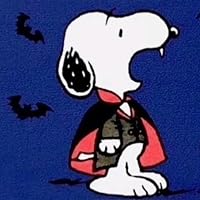
Charles Monroe Schulz was an American cartoonist, whose comic strip Peanuts proved one of the most popular and influential in the history of the medium, and is still widely reprinted on a daily basis. Schulz's first regular cartoons, Li'l Folks, were published from 1947 to 1950 by the St. Paul Pioneer Press; he first used the name Charlie Brown for a character there, although he applied the name in four gags to three different boys and one buried in sand. The series also had a dog that looked much like Snoopy. In 1948, Schulz sold a cartoon to The Saturday Evening Post; the first of 17 single-panel cartoons by Schulz that would be published there. In 1948, Schulz tried to have Li'l Folks syndicated through the Newspaper Enterprise Association. Schulz would have been an independent contractor for the syndicate, unheard of in the 1940s, but the deal fell through. Li'l Folks was dropped from the Pioneer Press in January, 1950. Later that year, Schulz approached the United Feature Syndicate with his best strips from Li'l Folks, and Peanuts made its first appearance on October 2, 1950. The strip became one of the most popular comic strips of all time. He also had a short-lived sports-oriented comic strip called It's Only a Game (1957–1959), but he abandoned it due to the demands of the successful Peanuts. From 1956 to 1965 he contributed a single-panel strip ("Young Pillars") featuring teenagers to Youth, a publication associated with the Church of God. Peanuts ran for nearly 50 years, almost without interruption; during the life of the strip, Schulz took only one vacation, a five-week break in late 1997. At its peak, Peanuts appeared in more than 2,600 newspapers in 75 countries. Schulz stated that his routine every morning consisted of eating a jelly donut and sitting down to write the day's strip. After coming up with an idea (which he said could take anywhere from a few minutes to a few hours), he began drawing it, which took about an hour for dailies and three hours for Sunday strips. He stubbornly refused to hire an inker or letterer, saying that "it would be equivalent to a golfer hiring a man to make his putts for him." In November 1999 Schulz suffered a stroke, and later it was discovered that he had colon cancer that had metastasized. Because of the chemotherapy and the fact he could not read or see clearly, he announced his retirement on December 14, 1999. Schulz often touched on religious themes in his work, including the classic television cartoon, A Charlie Brown Christmas (1965), which features the character Linus van Pelt quoting the King James Version of the Bible Luke 2:8-14 to explain "what Christmas is all about." In personal interviews Schulz mentioned that Linus represented his spiritual side. Schulz, reared in the Lutheran faith, had been active in the Church of God as a young adult and then later taught Sunday school at a United Methodist Church. In the 1960s, Robert L. Short interpreted certain themes and conversations in Peanuts as being consistent with parts of Christian theology, and used them as illustrations during his lectures about the gospel, as he explained in his bestselling paperback book, The Gospel According to Peanuts, the first of several books he wrote on religion and Peanuts, and other popular culture items. From the late 1980s, however, Schulz described himself in interviews as a "secular humanist": “I do not go to church anymore... I guess you might say I've come around to secular humanism, an obligation I believe all humans have to others and the world we live in.”
I'm trying to decide whether to let go of my old Peanuts books and buy a couple of the fancy collected editions instead...but I'm not sure if I'd regret it. I loved this book when I was growing up, and it's still just as funny and charming.
Peanuts is one of those comics that went on for far too long and wound up with a bunch of stale, recycled jokes and characters who turned into cash-friendly consumer-driven versions of themselves. But early comics like these were genuinely great, and were the reason why Charles Schulz was so popular for so long.
A bonus point for me as a dog-loving kid was that this collection was entirely about Snoopy - my favorite character, of course, especially in the early decades of the comic, when he was still very much a dog. A weird, neurotic, clever dog, but nothing like the essentially humanoid version he became later on. (I hate Joe Cool and all his iterations.)
I'm reading these books a little bit out of order, but I don't think that matters too much. The strips themselves are out of order anyway - Snoopy's character design shifts back and forth as I turn the pages, so I'm not entirely sure what the logic was in how to assemble these. (The advantage of the special editions is that everything would be in chronological order and labeled by year, which is information I like knowing...but it's hard to tell how I could get my hands on the collections that contain all these strips from these old books, because I don't know what time periods they were from. A minor frustration, I suppose. And maybe more reason to just keep these, since I know they have what I like.)
There are a few repeating gags throughout this book. One, which was always my favorite when I was a kid, involves Snoopy trying to expand past his dogness by trying on other types of animals for size. He pretends to be a snake, a penguin, and a polar bear, thinking that if he's any of those things, he might be more respected than he is as just an ol' fuzzy-faced dog.
I'd always loved how these visual jokes were illustrated, and I appreciated the humor, even if I didn't fully grasp the melancholy behind trying (and constantly failing) to grow beyond what society and nature expect of you. It's kinda funny, really, to have those types of comics mixed in with the running gag of Lucy getting mad about Snoopy dancing around, a dog with no worries and no weight of the world on his shoulders.
Schulz didn't really anchor Snoopy into a single personality type, letting him be a dog-of-all-trades (and moods). But maybe if you think about it harder, that's just part of who Snoopy is, too, and Lucy simply has no idea of all the worries that flood into that fuzzy little doggie head.
This is a really good collection - funny and cute and thought-provoking.
I love Snoopy - it's always hilarious and just so adorable. I found this old edition during my Amsterdam trip while browsing through used books. A true treasure!
I think 'We Love You Snoopy' was a bit better, but i still like this one. He's very cute, and some of the story lines are a bit more connected. Its cute that he likes classical music, and some of the comics just seem to be about having a dog in general, instead of one like snoopy. I think i could show some comics to my mum and she'd quite enjoy them. however the book felt a but repetitive at times, snoopy often just went 'i wonder what it'd be like to be x animal'. i also find it very cute that he likes classicsl music
I remember reading this when I was young, so it was fun it read again. I have always loved Snoopy, which is probably why I adore my pet beagle, Hunter, especially when he does the same characteristics. When I'm happy I love doing the "snoopy dance".
Any Charles M Shultz book is a good book. With this one, we follow snoopy around, seeing what fun he gets into with Woodstock and other members of the Peanuts gang. Because only the reader can understand Snoopy, it leaves for very comical moments.
What I love about this story is the feelings everyone tries to deal with! Being upset or bothered by how people treat you is really important. sometimes the other one dosen't know that upset you, so they keep doing the thing withouth knowing, but if you tell them then maybe they'll stop if they really love you.
How can you say no to Snoopy?! It would be like turning down cake (or something stronger) on your birthday! I don't know how Charles did it, but he was able to mix children with adult thoughts in a stretch of 4 panels. Daily. And he nailed what we were all thinking, every time. Each character is a part of everyone of us in a bigger way. We have all been a psychologist to someone (Lucy). We have all felt like we weren't good enough (Charlie Brown). We have all wanted to have comfort around us 24/7 (Linus). But most importantly, we have all wanted to be a World War Two pilot, writer and desert explorer (Snoopy) - even if we have never admitted that to ourselves ;) A snoopy comic a day, keeps the doctor away!
I was performing my traditional decennia library clean and came across a couple of long hidden but never quite forgotten gems. In upholding my 2014 resolution to skim off some of my literary fat and make room for more recent publications, I made the painful decision to part with this book. This isn’t out of malice but necessity. Before parting I had to read it one more time. Snoopy and the gang have been with me almost all my life. Thank God they aren’t family but more like distant neighbors and the sight of them screams HOME! I often wonder what Charlie Brown, Lucy and Linus would have become if they had been allowed to grow up. This is a book for everyone regardless of gender or age. Snoopy, I’ll miss you but will never forget you!
Who doesn't love snoopy? This book was comical and cute. I really enjoyed reading the many adventures of Snoopy and his friends. As a child I watched Snoopy and Charlie Brown every holiday on their holiday specials. This book brought back a lot of enjoyable memories for me. This book is a graphic novel because it is a collection of short stories. It is like a comic book because it uses sequential art to tell stories. The word balloons have a good impact on the story, without them we would not be able to know for sure what is going on. The gutters between the panels are empty so there is not a lot going on. The panels are kind of scattered but you can still tell the correct order. I think this is unique and gives the book a fun and light feeling.