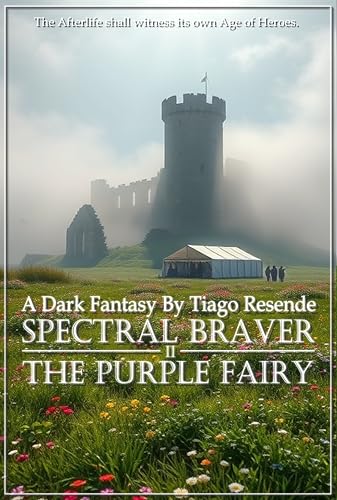
A wider World awaits Ben, Felicity and the children. In the Afterlife, few roam away from their hauntings like this. With wishes of extending their good fortunes to others in need, they meet a D'jinn, a millennia-old travelling spirit doing errands for ghosts looking to see their unfinished matters resolved.
Meanwhile, the Abyss holds a grudge, since the events in Craig None who oppose the Council of Devourers, should linger unpunished. As this loving couple strengthens bonds with other ghosts, rumors of a powerful curse in the Japanese Prefecture of Kanagawa lead them on a collision course against their demonic pursuers.
From this fateful clash, the Legend of the Purple Fairy shall Amidst the raging fires of spectral battle... Towards the perennial glow of Hope.
Spectral Braver II: The Purple Fairy by author Tiago R. Resende, represents the very natural progression from the events culminating in the last pages of book I. As Ben, Felicity, her son Gunnar and daughter Lydia have now become a real family—albeit of the ghostly type—they now depart Sleepy Hollow to help other ‘lost souls’ scattered all over the world. Once again, deeply introspective author Tiago R. Resende delivers an impressively original work of fiction with all the winning elements found in book I and then some.
THE PURPLE FAIRY As the subtitle suggests—if book I was more centered around Ben and his coming into contact with the Craigs at the old Manor of Sleepy Hollow—book II will see “the rise of Felicity Craig as the legendary Mother spirit who will change everything about the Greater Realm (Afterlife),” Resende explains. “In this arc, she becomes the symbol of Hope for lost souls, consecrated as a leader and a savior. She’s their Optimus Prime - valiant, kind, sensitive, mighty and idealistic.” Reading through the chapters of SB2, I can confirm that Felicity truly becomes a beacon for all mothers out there, and the inherent power mothers have. The skillful writing of the author lets us witness a Felicity who is as sweet as she is resilient, and ALL mothers will find great inspiration from this.
NOVEL CINEMATIC AND GHOSTS IN A NON-LINEAR TIMELINE Just as we witnessed in book I, Resende makes use of the narrative style he calls novel cinematic (read my review of book I for more on it.) This style, along with the frequent switch from past to present tense within the same paragraphs sometimes (due to the nature of ghosts within time) could create some confusion among readers, and I even saw some reviewers lower their overall rating of the book due to it. But this ought not to be so, and as Resende explains: “Pay attention to the dashes. If a piece of dialogue isn’t tethered to inner monologue, or a regular speech tag, that's another POV in the scene. SB is supposed to be a cinematic, high octane action romp with each paragraph detailing a shot which may contain several characters. I crafted their voices to be distinct, it’s up to the reader to pay attention. I know it’s a big ask, but I write for smart people, not the Tiktok brainrotted.” I don't consider myself to be very smart, but with a little practice and by following the instructions provided above, I quickly found my footing. In fact, I even got to enjoy the full cinematic effect that this narrative style offers.
ANIME Another crucial element is the increase in influence of anime, with the introduction of characters such as shinobi Kogetsu and yōkai Jorōgumo, in addition to the charming Kanagawa kids. The narrative really embraces the anime style here in both sense of humor and fighting choreography fans of the genre will be able to enjoy in a way that's never been done before.
CONCLUSIONS When asked what he would wish readers to get out of book II, Resende’s answer was this: “Stick together. If you look at the world today and think you’ll make it atomized and cynical, you’d best drop that notion because you won’t. The Greater Realm has been a terrifying, lonely place for millennia. Turns out that building a family and a solid group of friends who look at one’s heart first, is paramount to one’s safety in a hostile environment. I made it a power fantasy just to drive the point home, but if you’re smart, you can see the message therein. It’s applicable to anyone’s situation. I made regular people into Avengers-tier super heroes over that very simplistic but nonetheless true premise.” What I personally grew fond of in book I, and now in book II, is the iconic nature that this story and these characters truly possess. These books can truly be a platform for new pop culture IPs to bloom and expand into other media like movies, TV series, and games. But most importantly, these books force readers to face perhaps the biggest fear all humans share: the fear of Death. And how to defeat it. 💜
Novelized anime is the phrase that keeps popping into my head as I read this series. Spectral Braver: The Purple Fairy, is no different than the first for this type of writing style.
It has a cinematic framing that jumps between a script and a novel. It doesn’t have standard prose, and that might be a leap for readers expecting more traditional narration. But once you start picturing it as a season of anime playing in your head, the style clicks and feels exactly right for the story.
I’ll be honest, the sheer amount of names, titles, and lore was a hurdle for me. Terms fly by fast, sometimes in italics, and I don’t have a running mental photo library for every anime, or Japanese inspired name the book drops. More than once I just breezed past a term I didn’t fully grasp. But that did not hinder me in following the story because the heart of the story is in the characters and how they move through the world.
Ben and Felicity are the anchors. Their banter and chemistry keep the action grounded even when the stakes tilt into um, the fantastical. The Abyss hangs over everything and they can’t escape. Same with Aoyin’s presence. It all shapes the atmosphere of that dark under presence of the book.
Overall the book was enjoyable. And yes, the pace and terminology can feel overwhelming at times, but that’s part of its anime DNA. It’s colorful, chaotic, and fully committed to its own voice. If you read it thinking it’s a show, the style stops feeling unusual and starts feeling like the only way this story could be told.