Jump to ratings and reviews
Rate this book

Katabasis

Rate this book
Dante’s Inferno meets Susanna Clarke’s Piranesi in this all-new dark academia fantasy from R. F. Kuang, the #1 New York Times bestselling author of Babel and Yellowface, in which two graduate students must put aside their rivalry and journey to Hell to save their professor’s soul—perhaps at the cost of their own.

Katabasis, noun, Ancient Greek:

The story of a hero’s descent to the underworld

Alice Law has only ever had one goal: to become one of the brightest minds in the field of Magick. She has sacrificed everything to make that a reality: her pride, her health, her love life, and most definitely her sanity. All to work with Professor Jacob Grimes at Cambridge, the greatest magician in the world.

That is, until he dies in a magical accident that could possibly be her fault.

Grimes is now in Hell, and she’s going in after him. Because his recommendation could hold her very future in his now incorporeal hands and even death is not going to stop the pursuit of her dreams….

Nor will the fact that her rival, Peter Murdoch, has come to the very same conclusion.

With nothing but the tales of Orpheus and Dante to guide them, enough chalk to draw the Pentagrams necessary for their spells, and the burning desire to make all the academic trauma mean anything, they set off across Hell to save a man they don’t even like.

But Hell is not like the storybooks say, Magick isn’t always the answer, and there’s something in Alice and Peter’s past that could forge them into the perfect allies…or lead to their doom.

560 pages, Hardcover

First published August 26, 2025

26855 people are currently reading
418313 people want to read

About the author

R.F. Kuang

28 books87.7k followers
Rebecca F. Kuang is a Marshall Scholar, translator, and award-winning, #1 New York Times bestselling author of the Poppy War trilogy and Babel: An Arcane History, among others. She has an MPhil in Chinese Studies from Cambridge and an MSc in Contemporary Chinese Studies from Oxford; she is now pursuing a PhD in East Asian Languages and Literatures at Yale.

Ratings & Reviews

What do you think?
Rate this book

Friends & Following

Create a free account to discover what your friends think of this book!

Community Reviews

5 stars
24,329 (25%)
4 stars
37,424 (39%)
3 stars
24,015 (25%)
2 stars
6,878 (7%)
1 star
1,575 (1%)
Displaying 1 - 30 of 23,870 reviews
Profile Image for Clace .
870 reviews2,966 followers
October 18, 2025
5 stars!

“Now all that was gone. This was the unbelievable fact of death. This was a paradox her mind could not accept, that someone could be in the world one moment and simply be gone the next.”


I never doubt Rebecca Kuang when it comes to books. Like she can switch to any genre, write literally any storyline, but she's just so insanely talented that it never fails to capture my attention, it literally casts a spell on me, and I feel breathless when I read her books. I have read all of her books with the exception of "The Burning God' because lets be real 🧍I am not ready for the devastating blow it'll deliver but from what I have read by her, I've noticed how well researched her books are, and how they're so neatly finished like you cannot find any cracks and Katabasis like her other books followed this path. It was a different genre (Dark academia), but it was so well-researched, and I realized many times as I read this, I was simply in awe. The book felt like it was written by someone who had graduated from Oxford, Yale, and Cambridge. This book had Calculus, my worst nightmare, but the way R.F. Kuang wrote it to support the paradoxes and the logic around her world was so well done that I was secretly invested. I wanted to read more about it 😭 I felt so foreign harboring feelings like that towards Calculus, but if Miss Kuang decides to teach calculus...I'LL ENROLL. You don't understand how hard you have to try for me to like or even read something related to calculus, but I was so invested in the way she bent it to her own narrative and her own world-building. She's quite literally a mastermind.

“Christ,” said Peter. “Hell is a campus.”

There were a lot of criticisms that this book got when it was published, and the only one I found myself agreeing with was that it was a love story because it wasn't; it had a love story in it, but it was NOT a love story; it was so much more. Also, people criticized it for being too academic 😭 it's DARK ACADEMIA?? What do y'all expect, but even if we scratch that, it was still digestible, it was. It also wasn't like the academic part felt like a slog or dragged because the way she blended it in with the story just made the whole concept so much better, you had an idea of how everything was working because proofs were being provided and the explanation was so beautifully written within the novels constraint that it didn't feel like a "textbook" also I felt like this was way more easier to read than 'Babel' if we're talking about it being too academic. The logical demonstrations that Kuang did in the interludes were so exciting to read, and I was so bummed that they weren't filled throughout the book because I was having SOO MUCH fun reading them.

“This was the key to flourishing in graduate school. You could do anything if you were delusional.”
I have so much to say about this book 😭 one thing being how Rebecca writing this book made many of the readers feel like she was flaunting her three degrees because her characters are graduates in Cambridge but it quite literally the opposite of that, she highlight the criticisms of these institutions with her pen, the exploitation of students, the cruelty that was depicted and hell quite literally being Cambridge 😭😭 took me out but it was a really good way to convey that message. So, I feel like sometimes people should just actually try and see what the book is trying to convey rather than bashing it.

“She gazed at Peter and thought, 'I wish I were the night, so that I might watch your sleep with a thousand eyes.”

I honestly think that in the following years to come, this book will be perceived as a classic because it is a timeless classic, it has all the aspects that would give it that recognition and I know that the way she targeted institutional corruption, her take on hell so far is the best one I have seen, it's so unique and it stands so well on it's own despite drawing inspirations from others, I also loved the blend of Chinese mythology in it.

“And if falling in love was discovery, was letting yourself be discovered the equivalent to being loved?”

Rebecca's narrative in Katabasis refused to sit still because it transitioned from academic satire to academic seriousness. She weaved her way through the narrative, adding philosophical touches to it, and it worked in her favour. The journey that she took us on was presented to us through the present timeline and past flashbacks, and usually, I'm not that big of a fan when there's a past and present switch, but it sort of elevated the story here. The narrative that this book follows, coupled with its themes/tones and the setting itself, can be very heavy; the back and forth gave it a much-needed balance. Although the chapters were long, each of them ended up with a mini cliffhanger, which kept the pace moving; however, I would still classify this as a slow-paced book, and it's more beautiful like that, you absorb so much when you read it at the pace that it sets, the sharp twists and turns just hit you one after another. When I reached the end, I did sit and think, 'What was even the point of this book?' because there's not much that happens, but also simultaneously, there's so much that's happening. The main thing that really hit me was the factors that Alice faced. How she questioned her loyalty, how she processed her own emotions, her inner turmoil was so vividly displayed that it just made everything so much better.

“Her memory did that sometimes; she confused memories and reality, her imagination was too vivid, she couldn’t help it.”

Moving on to the characters,

Alice Law, I have never met a character whom I have been this conflicted about because Alice Law was a very hypocritical person. I did not like her at times, but I also resonated with her at times. Reading her journey through hell was the best part of this book. The reasons why she went to hell at first didn't convince me, but as I saw more of the flashbacks and got to know more of her, the reasoning became clearer, and I was more understanding towards her. Rebecca displayed Alice's mind in this unfiltered manner, where we saw everything that happened, ALL her thoughts- the bad and the good. Her determination is a quality about her that I really liked because 😭 she literally went to hell and had no idea what to do 🧍 but I liked the way she mapped hell out and her journey, which dealt with bitterness, guilt, and confusion. I really enjoyed reading about her character. The way I wanted to kill Grimes was because of the immense torture that he put everyone through and especially her, and the reason behind it made me even more enraged. Everything that she did. All the hate and the envy that was etched into her was a consequence of Grimes' words and actions, and I will forever hate him for that, and that is perhaps why the ending was very satisfying for me. Also, she was portrayed so well 😭😭 because she was literally bartering with the king of the underworld.

“I feel sometimes it is so difficult to be conscious.”

Peter Murdoch. We see Peter through Alice's perspective, and through that, Peter feels very distant and unpredictable. I had no idea what to think of them because Alice was so uncertain about him and reading the book through her thoughts made me uncertain about him as well, he did come off across as a bit reckless - joining Alice on her journey to hell, the whole notebook fiasco but Peter was the exact opposite of what we made him to be and it was al because of the subtle differences that Grimes had caused between them by favoring one over the other and this was so deep rooted. Ugh, I hate Grimes. Peter's story through his own perspective (flashbacks) was very refreshing because that way we saw Peter for who he was, what he was struggling with, and his encounter with Grimes was the same as Alice's. I felt so sad for Peter tbh :(( He deserved better.

“Surely no one else lived like this - burdened by the tiniest details they assumed had enormous consequences. Surely no one else was so anchored by anxiety. Other people could stumble and shake their heads and move on. How she envied their lightness.”

Elspeth and Archimedes, Archimedes was the cutest, and Elspeth was just another victim of Grimes. I liked how she helped Alice see him for who he really was, but also I hate how much she was underestimated because 🙏 she was strong asf.

“Meteorologically, Hell didn’t seem much worse than an English spring.”

The romance, initially, when this book was announced, I thought it was going to be a romance, but to my surprise, when I got to know more about it, I knew that was not the case, and thank god for that because it helped me manage my expectations so much better!! Alice and Peter's love story was so well written, it was a subplot, but the way it bloomed was what I loved, and the fact that all of this happened in hell, LMAOO. I feel like there was so much hate-filled b/w them because of Grimes, but I liked that they worked their way through that. But honestly, them working it through that and trying to trust each other was the best art, and the humor/ banter between them was absolute gold!!

“Fortunately graduate school had prepared her for this, the constant managing of despair.”

The plot I'm so tired of writing this review 😭😭 and the fact that I still have so much to talk about 🤸 So, Katabasis is the descent into the underworld and is a Greek term. Katabasis literally feels like reading a half descent in myth and a half dissertation, in the best way possible, btw. The way she interwove the linguistic and philosophical aspects of this book with the plot was truly phenomenal. I have never felt this immersed. This review might have a repetitive nature because I've been writing it for the past week 😭 The plot was not just complex, it had a logical emotional reasoning. It was literally like taking a rollercoaster ride on an intellectual escapade; the paradoxes, the interludes, and the intricate magic system just elevate the entirety of the reader's experience. For me, Katabasis had a rather stagnant plot. Not much was happening, and side by side, a lot was happening. I honestly do not know how to explain that, but that literally is what it felt like reading it. You might think nothing of substance is happening, but you would also be conflicted because you would feel a lot is happening 🧍🤸 the stakes were not always high.

“But of course it was worth it. It was the only thing that was worth it. She had been fortunate to find a vocation that made irrelevant everything else, and anything that made you forget to eat, drink, sleep, or maintain basic relationships—anything that made you so inhumanly excited—had to be pursued with single-minded devotion.”

I think it doesn't always matter if the journey doesn't have epic action sequences or climactic situations, and Katabasis proved that. The main focus, or the main beauty of reading Katabasis, is noticing Kuang's deliberate action of making Katabasis a slow-paced book. I was truly able to appreciate this book way more this way. I was able to see that the plot was the journey itself, because at its core, it's about Alice's descent through knowledge and self-destruction. Katabasis itself is so nuanced that this kind of pacing is necessary for you to catch up on these subtle hints and understand what the plot actually revolves around. One of the main plot points was Alice and Peter discovering that hell was a campus. Highlighting how academic drive or academic ambition can be hell itself, another thing that was done very subtly was showing us how Alice was a character who had her perceptions about knowledge, academics, progress, success, and the way it was slowly peeled away for her to be met with the cold, hard truth was so brilliant to see tbh. This shows how the plot was never moving around things like entering or escaping hell; it was about what Alice felt and discovered, and how her priorities shifted; it was her experiencing something of which she had no control.

“What you must realize, Alice, is that you cannot just take refuge in feminism when it suits you.”

All of this doesn't negate that there were scenes of action sequences and climax, but they were not to the degree you would expect them to be. It was more about the main character unveiling the reality of the world of academia, while tackling her own personal critiques. If you want action, you will get that. Do you want plot twists? You will get that too. It's sort of filled with everything, but the amount of it in the book differs. The plot twists tbh really got me, and the chapters after the reveal were my favorite because we got so many answers!! I absolutely loved that.

“Hell’s lonely,” said Peter. “You’ll want company.” “Hell is other people, I’ve heard.”

I'm blabbering so much in this review 😭 but I don't want to stop because I loved it so much!!! And one thing that I loved the most about this book was its world-building and magic system, I fear I may never shut up about this part. The world that Rebecca created literally has me in awe because it's so vast, it's so well crafted, and like you could go on hours and hours dissecting it, and AHHHH you would love it because everything about it is so damn interesting and all-consuming. Rebecca Kuang's take on Hell is so different from the other interpretations despite her inspirations. So, in Kuang's version of Hell, Cambridge itself is hell. The entirety of the system fits categories that would define hell; it's served as a vivid parallel for Alice as the eight circles mirror academic corruption, and it's done so well!! Every inch of this world is a critique of the system. Kripke's symbolizes the consequences of when the intellect overpowers humanity; the Lethe, according to my interpretation, was a relief of academic stress or academic burnout. In this version of Hell, it served as a form of mercy where you could forget everything, and all the courts of hell represent the academic corruption, like the arrogance of intellect, the need for validation, exploitation, rivalry and resentment, self-destruction, autocratic control, and knowledge being weaponized. All of the parallels are so well reflected!! You can quite literally see them in the institution that Peter and Alice attend, and how vividly it mirrors hell.

“Perhaps human intelligence was a mistake, and everyone who celebrated the escape from the Garden of Eden was wrong. Perhaps the gift of rationality did not outweigh the debilitating agony that came with it.”

The magic system's backbone is logic, reasoning, and paradoxes. There's so much theory involved in just the magic system alone that I believe someone can write a separate book on that, and honestly, I would devour that as well, like every epic magic system, it's not perfect. It has its flaws too, which makes it so much better. The way she gives us extensive knowledge on the system she created in the form of interludes just shows how passionate Rebecca was about this world; it honestly felt like the output of a collision between Theory and logic, and it honestly was explosive. The main source of magic is done throughout the use of chalk which felt very academicy and intriguing to me 😭 so chalk is used in the real world, Alice and Peter bring it along in hell thinking it would work but upon using it on the sands of hell it would remove the work done, this formed the way the hell functions and the use of blood on chalk to perform magic for it to exist felt so fun to read!! I might be wrong on this, but I think the magic was also heavily reliant on maths, with functions and equations being used to perform. The spells worked really well that way. I love it when there's some depth, and there was extensive depth in this world's magic systems so far as to using the principle of paradox, and the very idea of that was so mind-boggling, I LOVED IT!!

“The life of the mind, unfettered from commerce, was the only kind worth living.”

The ending was satisfying to read, it gave me what I wanted in the most satisfying manner, and I loved that as well!!! Overall, Kuang aced this! It was my favorite read of the month, if not the year.

p.s.: special thanks to areeba who proofread this entire review and corrected my mistakes for free out of the goodness of her heart.
___
The review is never-ending 🧍🏻 I've been writing for the past 3 days.
___
I don't get the hate😭 this was breathtaking.
___
I am feral over this already, and I'm at page 1 🧍🏻
___
AVON AND HARPER IM ON MY KNEES BEGGING FOR AN ARC 🙏🏻
___
Can we just stop what we're doing to admire this beautiful cover 🙏🏻 it's gonna look so good on my shelf!!
___
"Alice Law, you naughty girl. You're trying to go to hell."

Just give it to me, please 😭 🙏🏻
Profile Image for Ana.
960 reviews787 followers
September 28, 2025
If nothing else, Kuang is always capable of surprising me. I did not expect to love Babel’s hefty prose as much as I did, nor did I expect to find Yellowface as unfunny as it was. Katabasis is unique in that it is bereft of anything particularly good or bad. It is nothing.

Here, Kuang asks the question, what if every account of Hell was based on real experiences? What if Dante really traveled to the nine circles? What if Aeneas actually crossed the river styx? What if you read an entire book solely dedicated to the author showing off how much they read?

A full half of this book (more, to be honest) is nothing more than Kuang desperately trying to remind the reader that she is smart. She knows T.S. Elliot and Michael Huemer. She understands Blaise Pascal and August Ferdinand Möbius’ theories. Nietzsche and John Bancroft? Child’s play. When characters aren’t busy info dumping about a dead philosopher (or mathematician, or logician, or theorist, or just some random guy), the narrator does it for them. I cannot emphasize this enough. This is not a case like Babel, where she included quite a bit of context and explanations for languages, histories, and general events. Here, the entire narrative comes to a screeching halt every five seconds so she can explain Schrödinger‘s cat to us. It quite literally reads like a textbook where the actual storyline is only added in to stop you from putting it down. It is so boring.

I must clarify (because some people have clearly misconstrued my words) that I do not have a problem with a dark academia book doing what dark academia books do. Again, and I cannot stress this enough, I really enjoyed Babel. I thought the weaving in of history and her personal knowledge was creative and fun. I have a problem with how goddamn boring this book was. Every single new reference made me groan out loud because all it did was take away from the actual plot.

This is exactly the type of book that will have people online claiming they were “too dumb” to understand it (this is, somehow, used as a compliment!). I am here to tell you that you are not in any way lacking in intelligence if you cannot understand the insane amount of slop in here. It is not a positive attribute that the author threw together a bunch of random academia bullshit in the same way that millennials insert Harry Potter references into their books. Frankly, once you look past all of the philosophy, the writing is quite juvenile.

It actually shocked me quite a bit. My main praise for Babel was the writing. I thought, even if Kuang isn’t the most elaborate with her prose (she’s usually a very straightforward writer, which I like), it was still a beautiful love letter to languages. Katabasis reads like a Tumblr post.

Consider: “You know very well what a heap is. You know it when you see it. It is like porn.” (Apparently a reference, but so random in context that it sounds silly)

“You couldn’t just decide you didn’t like being punished and nope back out into Limbo.” (Nope as a verb???)

Not a quote, but worth noting that the Hell described in this book is not only unimaginative but actively irrelevant to the course of events.

The characters, whom I haven’t brought up at all until now, are insufferable. This certainly tracks with Kuang’s record, as she is really quite good at writing frustrating protagonists (this is a compliment). I liked Alice! Peter, not so much.

Feels a bit ironic that I said there wasn’t anything either good or bad when I’ve gone on for so long about the writing, but I do want to make it clear that I do not actually feel any way about this book. It is strangely written with an alright story that is interesting at times and, more often than not, uninspired. It is merely fine. Not great, like The Poppy War. Not awful, like The Burning God. I will forget I read it in a week.

Review in exchange for an advanced reader’s copy.

Edited Sept. 2025 for clarification.
Profile Image for ଘRory .
108 reviews429 followers
October 16, 2025
★★★

"𝗟𝗶𝗻𝗲𝘀 𝘁𝗵𝗮𝘁 𝗮𝗿𝗲 𝗽𝗮𝗿𝗮𝗹𝗹𝗲𝗹 𝗺𝗲𝗲𝘁 𝗮𝘁 𝗜𝗻𝗳𝗶𝗻𝗶𝘁𝘆!’ 𝗘𝘂𝗰𝗹𝗶𝗱 𝗿𝗲𝗽𝗲𝗮𝘁𝗲𝗱𝗹𝘆, 𝗵𝗲𝗮𝘁𝗲𝗱𝗹𝘆, 𝘂𝗿𝗴𝗲𝗱. 𝗨𝗻𝘁𝗶𝗹 𝗵𝗲 𝗱𝗶𝗲𝗱. 𝗮𝗻𝗱 𝘀𝗼 𝗿𝗲𝗮𝗰𝗵𝗲𝗱 𝘁𝗵𝗮𝘁 𝘃𝗶𝗰𝗶𝗻𝗶𝘁𝘆: 𝗶𝗻 𝗶𝘁 𝗵𝗲 𝗳𝗼𝘂𝗻𝗱 𝘁𝗵𝗮𝘁 𝘁𝗵𝗲 𝗱𝗮𝗺𝗻𝗲𝗱 𝘁𝗵𝗶𝗻𝗴𝘀 𝗱𝗶𝘃𝗲𝗿𝗴𝗲𝗱. —𝗣𝗜𝗘𝗧 𝗛𝗘𝗜𝗡, “𝗣𝗔𝗥𝗔𝗟𝗟𝗘𝗟𝗜𝗦𝗠”

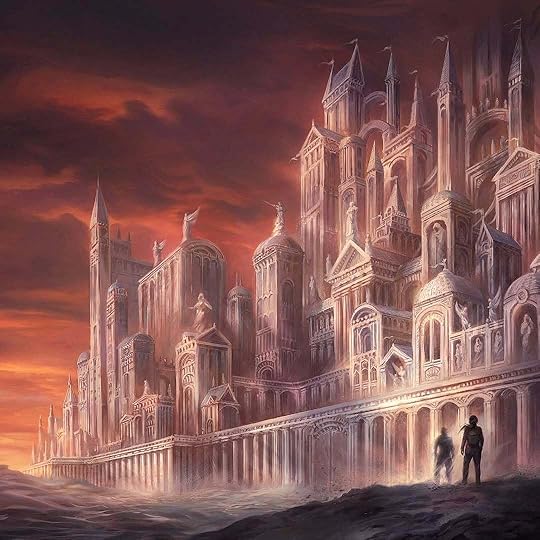
While I entered Katabasis with high expectations, anticipating a thrilling descent into a magical underworld, I found myself navigating a narrative that, while undeniably ambitious, occasionally lost its footing. R.F. Kuang's premise, a postgraduate in analytic magick, Alice Law, and her fellow Peter Murdoch embarking on a perilous journey through the eight courts of Hell to retrieve Professor Jacob Grims, held immense promise. The initial setup, the chalk-drawn pentagram, and the evocative descriptions of the oppressive weather and the chilling architecture of Hell, painting a vivid and compelling tableau.
However, the immersive atmosphere was frequently obscured by an overabundance of descriptive detail. Kuang's prose, while often beautiful, became a dense fog, making it difficult to maintain focus and follow the narrative's thread. The emphasis on Peter Murdoch's backstory, while intriguing, often overshadowed Alice Law's journey in the first helf of the book , leaving her character somewhat underdeveloped. Peter, the aloof yet seemingly empathetic magician, held the reader at arm's length, creating an emotional disconnect that I found frustrating. Alice's attempts to bridge this gap, to truly understand him, were compelling, but often felt thwarted by the narrative's focus on Peter's internal landscape ,It is worth noting that Alice does take a pivotal role in the final chapters, demonstrating her agency and importance within the story.
The enemies-to-lovers trope, a point of significant interest, delivered moments of both captivating tension and jarring incongruity. Certain twists were genuinely unpredictable, eliciting a visceral shock that propelled me forward. However, the initial motivation for the descent into Hell remained shrouded in a perplexing ambiguity, leaving me feeling disoriented rather than intrigued.
Kuang's integration of philosophical and mathematical concepts, while intellectually stimulating, often felt like a display of academic prowess rather than a seamless narrative element. The author's rapid-fire exposition, jumping between complex ideas without sufficient contextualization, left me feeling intellectually inadequate. While a good book should challenge the reader, Katabasis occasionally veered into didacticism, creating a sense of distance rather than engagement.
In conclusion, Katabasis is a work of undeniable ambition and intellectual depth. Kuang's ability to craft a dark and atmospheric world, including the detailed building and oppressive weather, is evident, and the narrative's unexpected twists are genuinely compelling. However, the overreliance on dense description, the uneven pacing, and the occasional feeling of being talked down to ultimately prevented me from fully immersing myself in the story. While I commend Kuang's willingness to tackle complex themes and push the boundaries of genre, I ultimately felt that the narrative's potential was not fully realized. I would recommend this book to readers who appreciate intellectually challenging fantasy and are willing to navigate a dense and sometimes perplexing narrative, but with the caveat that it demands patience and a willingness to grapple with its complexities.


𝙋.𝙎: some quotes I loved :
* I wish I were the night, so that I might watch your sleep with a thousand eyes.
* You thought the world was one way and then it wasn’t. One could become zero. One could become two.
* Everyone else lived in such an ossified world. They simply took the rules given to them.
* An unexamined life is not worth living, as Socrates tells us.
* Goodbyes were worth the effort only when you meant to see someone again.

-Guess who got the arc 🤭
Profile Image for Marianna Moore.
467 reviews64.1k followers
October 23, 2025
4.5⭐️ “Hell is a classroom”

Wow wow wow. I absolutely adored this book!! And this is why I will always say go into books with an open mind, especially popular new releases with A LOT of differing opinions. I know a lot of people didn’t like this book and found it to be too info dumpy and reads like a textbook with all of its literary references and philosophical underpinnings, and honestly that take is entirely valid. I totally understand by people either love or hate this book and I just so happened to be in the camp that LOVE IT!!!

I think one of the main reasons why I loved this so much is that it resonated with me so so deeply. As someone who spend 6 years in higher education, who thrived off academic validation and for praise and approval from my professors, being in Alice’s head made me feel so seen and heard. RF. Luang really said, hey, all of you who have ever lost yourself to the need for perfection and approval in the world academia, who sacrificed your mental and physical well being to the point where you don’t even recognizing yourself anymore… I see you and I hear you. And GOD did I feel seen. Reading this made me feel like a student again and brought back so many memories both good and bad, it was quite healing.

I adored this plot, it sucked me right in! The parallels and prose and depth to this world and these characters made it so easy for me to so deeply invested in the story right away. Peter and Alice have my whole heart, their romance (though subtle) was perfect, this is everything I want from rivals to lovers. This is also EVERYTHING I WANT from dark academia. This is also exactly how I prefer to read a soft magic system. The magic is there and it’s intriguing and easy to understand and fit into the world, yet it is not used to solve problems and accelerate the plot. Some people might not like this aspect but it’s perfect for me.

The depression representation too!!! Don’t even start with me, it was so perfect it actually made me emotional because of how much I related to Alice’s struggles. This is the type of mental health rep I want from books.

“She was not one of the depressives who lay stinking in bed; she could not just lie there, the stillness hurt worse. Moving staved the agony.“

Two lost, damaged souls, unknowing victims of the same trauma, with minds so big it can be overwhelming, wander to hell together to bring back their professor…. What could go wrong?

“I wish I were the night, so that I might watch your sleep with a thousand eyes.”
Profile Image for Nilufer Ozmekik.
3,115 reviews60.6k followers
November 29, 2025
Some books are too magnificent to simply be described—they must be devoured and savored slowly to fully appreciate their brilliance. This is one of them—a spellbinding blend of enemies-to-lovers romance and dark academia fantasy, featuring a mind-blowing journey through hell, where every level embodies sins like pride, desire, greed, wrath, and tyranny, alongside the infamous City of Dis. The story weaves together elements of mathematics, philosophy, and religion, enriched with fascinating anecdotes from Ancient Greek mythology.

Alice Law, an ambitious and brilliant mind in Cambridge’s Magick field, accidentally kills her mentor by misdrawing a pentagram. Determined to bring him back, she embarks on a dangerous quest to hell—only to be joined by her arch-nemesis (and former crush), Peter Murdoch. Their mentor, Grimes, could be anywhere in the underworld, and as they navigate its treacherous levels, they encounter terrifying entities, battle monstrous creatures, and undergo hell’s grueling trials.

Trapped in a relentless race against time, Alice and Peter must confront their tangled past, wavering between love and hate, while guarding dark secrets that could destroy them. The deeper they descend, the greater the danger—not just of losing their lives but of succumbing to the underworld itself. If their secrets come to light, will they escape hell unscathed, or will they be doomed to wander its eternal abyss, their memories erased forever?

Overall: Words cannot capture how much I adored this book—it’s not just my favorite fantasy of the year but possibly the best book I’ve read all year! With its sharp academic wit, themes of abuse, existential questioning, self-respect, and the infinite choices that shape our lives, this novel masterfully blends intellectual depth with an addictive rivals-to-lovers romance. I can’t recommend it enough—add it to your reading list immediately, and prepare to be enthralled by its intricate, mysterious, and utterly unputdownable adventure.

A huge thank you to NetGalley, Avon, and Harper Voyager for providing a digital review copy of this masterpiece in exchange for my honest thoughts!

medium.com
instagram
facebook
twitter
Profile Image for chloé ✿.
242 reviews4,568 followers
September 18, 2025
boring as Hell, pun intended

after deeming Babel a masterpiece, i had such high hopes for Katabasis.

i don’t feel like putting you through an overly long review of my thoughts. let’s make this easy. (i’ve read enough over-explaining in this book to last a lifetime, so i won’t do the same to you.)

┏━━━━━❂ the issues ❂━━━━━┓

tedious + exhausting to read
✦ the mathematics, logic, and geography were all wayyyy over-explained. we know you’re smart but i don't want to read a textbook. nor do i know who any of these people you're referencing are. i’m not going to go do a significant amount of research to enjoy a fantasy book.
Alice was EXTREMELY unlikable
✦ long-winded and unnecessarily wordy. extremely textbook-like for long stretches at a time
boring (!) the first two courts were creative and then it went downhill from there
✦ the most dull, underdeveloped characters. we don’t even know what they look like besides their hair colors. and we only learn Alice’s hair color around PAGE 300. they lack personality, as well.
✦ the entire book gave off a ”holier than thou” vibe. like if you didn’t understand something or earn a PhD, you weren’t *worthy* of reading this book.
✦ the time jumps were very disjointed
✦ our storyline was so non-linear i had to remind myself which court of hell we were in and i just ended up not caring
✦ Peter was just… dull
none of this shit was worth losing half a lifetime. none of this shit was worth wasting however many hours i did dragging myself through this.

if you disagree with me — good for you! i completely understand people who have read this book and believe it is brilliant.

… but be nice. do i really need to remind adults on the internet that reading is subjective? i hope not.
Profile Image for ♡ waniya ♡.
94 reviews84 followers
September 5, 2025
Edit: Just prefacing this review with something I believe should be obvious, but apparently is not to the vast majority: I DO NOT condone senselessly hating on any author. If your criticism comes from a place of personal malice toward the author, best keep that rubbish to yourself. This one-star review reflects Kuang as a writer, not as a person. Thank you.


Dear Rebecca,

What went so wrong in my love for you, hm? Did I not find you an untested, unpolished author and pass you with flying colours? Did I not defend you against the rightful arguments that your debut novel—The Poppy War—was simply a fantastic, banal caricature of the Sino-Japanese War? Did I not disregard the fact that, if you stripped the entirety of The Poppy War trilogy off of its fantastic elements, it would assume the face of a history book—because you, like an insentient mimeograph, copied word for word actual historical events and shoved them into your novel, believing in your hubris that the average reader wasn’t capable of pointing out these acts of plagiarism?

You were good, Rebecca. Not great, but good. You had potential. You could create. And I loved you. I really did.

Then came Babel. What a marvel it was; in didacticism, repetition, and blatant slights to the reader’s intelligence. You badgered me, prodded at my patience, fed me your opinions as facts, and I could have forgiven it all in the name of love if you hadn’t broken the one, very, very sacred promise a writer makes to their reader: I will not think for you, dear reader.

But you did.

Colonialism. What a concept. You wanted to speak to us of the bane of society, of the plague my ancestors endured, of the bloodied trains that carried my family from Kashmir to Punjab after the British were done ravaging our lands—leaving us bitter with a perennial animosity when once we were an amiable lot. But despite my familiarity with this sickness, you didn’t trust me with it. You thought me deaf and dumb and blind. You believed that, unless you repeated the same idea a million times, I would not admit it into my thick brain. You thought of me as the British once did: a lesser race.

For a few long moments, I became disillusioned with you. In a childish tantrum I unfollowed you on Instagram, only to follow you right back the next day. I took a deep breath. Babel was your mistake. You were human, and I found it my duty to forgive you. And forgive I did.

But now you’ve made the same mistake with Katabasis. You wrote sentences like, “You know very well what a heap is. You know it when you see it. It is like porn.” You called magic magick. You introduced me to two insufferable characters who my friends and I would gladly bludgeon to death with hammers. Alice Law is a self-insert. I know. Peter Murdoch is your fiancé-insert. I know that too. You’d actually be surprised at how much I know, if you actually cared about your reader.

I didn’t want Socrates, Rebecca. I didn’t want Plato, Archimedes, Pythagoras, Dante, or Virgil. I wanted you. But you’re so incredibly busy trying to make sure I remember you went to Oxford, Cambridge, and Yale. You’re shaking me violently by the shoulders and screaming, “I’M SMART! I’M SMART! I’M SMART!” And your book suffers for it. I can believe you are a smart student, Rebecca, but never that you are a smart writer.

Katabasis is regressive, doctrinal, and autocratic. It is a fool’s guide to hell. It has no flair, no true emotion, nothing to say that the reader doesn’t already know. It looks busy while doing nothing. Alice is Robin from Babel. Robin is Rin from The Poppy War. Rin is Alice from Katabasis. Nothing separates one character from another. My brevity and sense of literary propriety are failing me the longer I try to pen my thoughts about Katabasis.

Rebecca, you made hell boring. Hell. BORING. What is wrong with you? Why must you torture me like this? Should I fall to my knees, press my cheek against your feet, and beg for mercy because I didn’t get a master’s degree from Oxford or Cambridge, nor pursued a doctorate at Yale? Is that my crime? Is the real crime not the fact that you are conceited in your belief that the average reader is stupid, while you are so incredibly smart, and that’s why you must hammer the nails of exposition into our skulls instead of doing what the better writer does—showing instead of telling?

Rebecca. Oh, Rebecca. We will never be friends again. We won’t even be acquaintances. The only natural relationship I can see us forming is that of foes. What a shame. I don’t think you’ll ever change, and I know that I can’t love you like this.

So this is goodbye. I leave you to the BookTok masses, to the timorous, vociferating few who’ll claim, “Katabasis wasn’t for you because you’re ignorant/stupid/sterile/unimaginative/hateful,” and to those who’ll never know how I loved you once.

I’m sorry—and please know—it wasn’t me. It was you.

Yours, (although not anymore, I suppose)
Waniya.
Profile Image for Maddy ✨   ~The Verse Vixen {AFK brb}.
150 reviews1,221 followers
September 15, 2025
Dark Academia meets 🤝🏻Dante’s Inferno!

— A storm of shadows, a blaze of sorrow. It’s a labyrinth of fire and mind games Hell of a ride indeed, got tea for days.. Review incoming… my mind is still untangling this..🕯️📖

-----
ೃ ⁀➷pre-view:🎯

"One journey to Hell, two minds in a race—will they save a soul or just lose their place?"
"Rivals turned allies, with magic to bend—play the game or watch everything end."
"Alice Law’s got ambition, Peter’s got pride? And I’m about to witness them both collide."
-OH YESS! 🎭


"Just unboxed the physical ARC of THE most anticipated book of the year— Can you hear me screaming!? -Massive love and thanks to KF Kuang for making my entire month!" The cover, the promises the magic I crave,
A journey to Hell, to save or to slave. "I’m in. I’m ALL in. Watch me dive headfirst into the flames... this ride’s gonna be WILD!" 🤸‍♀️
Profile Image for Uzma Ali.
182 reviews2,479 followers
August 26, 2025
This must be annoying. If a non-fan got an ARC by one of my favorite authors just to shit all over it, I would be annoyed. I would think, they just don't get it. So there! I've done my due diligence, I've walked a solid mile or so in those shoes, and maybe... maybe I just don't get it.

Entertained yet underwhelmed by the depth of Yellowface, I itched to read more Kuang. I was sure deeper intellectual criticism was bound to find me in her other works. So how divinely guided must I have been to watch an ARC of the shiny, glittering Katabasis fall right into my lap! (Thank you Harper Voyager and all those at Shelves & the City... all press is good press right?). I didn't move a muscle. Here it was, BookTok's most anticipated read in the year of our Lord 2025. Touching my hands! Oh! All of its glory! Long minutes passed, and I broke free of my paralytic spell. Yes, my loves, with shaking fingers, I cracked open those fresh pages... and read.

My eyes gloss over “naughty girl." Hm. No matter, this is fine. Kuang's first foray into romance will have its bumps, so I'll be forgiving of rookie replications. I continue—oh, woah! Would you believe it, within the first chapter, spells are cast, and straight into hell we go. All right! Although unexpected, I'm geared for a fast paced ride! What do you have in store for me, Ms. Kuang?

The short story? Disappointment. The long story?

Read on, man.

I'll spare you the dramatics for the rest, but as some of you may know... from a TikTok video I made at the halfway reading point... three main gripes arose. While I stand by these, I plan on exploring them further in the context of the finished book. Girlsss, introduce yourselves now:
1. prose
2. fact over fun
3. character development

Beginning with #1: prose, I often find myself unimpressed with the typical BookTok favorites populating that table in Barnes & Noble, so this is run of the mill. But knowing Kuang, watching her interviews, and learning her authorial inspirations, I think her style attempts to replicate some literary darlings. Yet it falls flat on its face. Here: although not a constant, many paragraphs hold entire sentences following the formula of "subject verb object." I present an example:

"He tumbled the last meter but landed all in one piece. Alice jumped down beside him and landed sprightly on her feet. This hurt her heels, but she had a silly urge to impress Peter," and on it goes.

Since I'm a freak, I know Didion inspires Kuang. Since Kuang's a freak, I know she'll read this review, but that's besides the point. Didion has a similar approach, as she commonly follows the "subject verb object" formula, but what differentiates the two is where the rest of the sentence flows from its primordial beginning. While Kuang adheres to parallelism (and maybe that's intentional, hey props to you, girl!), Didion lets each sentence flow a different direction. That's the variation that makes the reading experience more enjoyable to me, at least. Each sentence may start the same, but they end up somewhere else. See, Kuang lacks this diverse flow, and for that, I find it difficult to savor.

Oh, my reader friends, but to say it's the worst would be to lie! It’s not the worst. It is fine. Again, I've been reading too many impressive books that I now assume something tame must disappoint. So if this is no problem for you,

read on, man.

(This is a reference to Sophie Kemp's Paradise Logic btw. Idk if you can tell I'm obsessed. Sorry to bring up another book in the middle of this review... she's the other woman...)

Numero Dos! or #2, as the English would say. Fact. Over. Fun. While my initial criticisms under this number were typical, I have a bit more to share. See, a lot of Kuang's critics share their aversion to her exposition dumps, but seeing as I have nothing to compare this to but Yellowface, I'm not sure if Katabasis is better or worse than, say, Babel. I think the latter two are closer sisters than the former.

Since all I know is Katabasis, I’ll look at it as an isolated case study. We dive in. Her integration of exposition (all the research she did on hell) is lazy. It is not tightly bound to the plot, it is loose. Unfortunately, Kuang herself is aware of this: "She wasn't sure her ramblings made any sense—it was all a jumble of associated concepts flung together from days of frenzied research" (326). Yeah I just cited that. Kuang rationalizes her poorly constructed research integration by projecting her own writing struggles onto her characters. Ooh that was a claim. Okay sorry, I'll level the playing field, so we can get one thing straight: everyone is impressed with Kuang's research talents. Everyone is impressed that she takes research to fiction! But it's like the RuPaul's Drag Race talent shows: you can have a talent, but if you can't integrate it into your drag, it will flop. Research should likewise be integrated into fiction. But alas! This is a misuse of medium.

While I'm not a fan of the major expo dump in the first hundred pages, like any other fantasy, it improves as the chapters progress. Yet, the dip in exposition is not met with a rise in... well... FUN! I'm majorly upset with the fact that hell was simply not fun!

This is not by design. Little background: Kuang writes hell as a mirror of Cambridge, insinuating that any living visitor will see hell reflected in their own life, or vice versa, however you wanna put it. Sweeping past the plot holes this introduces, that's an interesting set-up! Imagine what Alice and Peter could get into! Lol. Are you imagining? Yeah. It's cool right? Now erase all of that because none of it happens.

The biggest challenges Alice and Peter face are almost instantly resolved by a convenient third party. It keeps happening! Matter of fact, I counted each time Alice said, "could it be this easy?" and for those who own the copy, they're on pages 145, 257, and 398. I don't know, Kuang, it could be easy if you want to write it easy. But at some point, the reader (me) becomes frustrated with the little struggle in these obstacles. They become frustrated that so many advances are earned quite... uh, how do you say... EASILY! Like your ending! Oh, no. Nope. I can't think about the ending or else I'm gonna start twitching in this here library where I write this review.

All right now, all this talk of fun in plot, what about fun in MIND? Is the book intellectually stimulating? I'd admit it depends on how you define the term. At risk of sounding pretentious (I've already sped way past that point), it seems I have a threshold higher than the average Kuang fan. Undeniably, my biggest dissatisfaction with Kuang is the immediate interpretations of her own story. This sharp delivery lent itself well to Yellowface, because it was a satire! Her guided direction worked itself into the comedy of the piece. Yet in the context of a fantasy, in the context of Katabasis, this overbearing Kuangian voice infiltrates all! I find that any interesting questions Kuang introduces (and there are many!) are answered within pages. Please girl, let me think for myself.

This is not exploration, this is rhetoric. Bombastic rhetoric, even. Harken back to the beginning of this review, I was so insanely, graciously lucky to attend Shelves & the City, where fate led me to hear Kuang speak on a panel. Thank heavens! She is such a great speaker! But she said one thing there, and it's been racking my brain ever since I finished Katabasis. It is (paraphrased), "I don't want to tell anyone how to think. I just want to explore the questions that keep me up at night." Oh. Well.

Holy f*cking airball, as they say.

I recall the most common defense Kuang fans tout, which argues that her sharp delivery effectively communicates her message. Then I compare that to her claim above, and there's an obvious disconnect. The one thing on which Kuang lovers and haters agree is that she's direct. And there she was saying that she is not. So is she missing something? Am I missing something?

Maybe she knows her bombastic rhetoric is... bombastic? Her commentary on women in academia is repetitive, tiresome. I wonder who she writes for. If it's meant to be a Cambridge circle jerk, then they already know this. But if it's meant to be for us plebeians, then she must think lowly of our interpretative skills.

At the end of the day, it's not a crime to be direct. But it is a minor offense to lie... and the punishment? How about bombast for bombast? I decree to Kuang the sentence of......... BOMBASTIC side eye!!!! Lmfao sorry to bring that one up ewwww that's kinda cringe sorry. But it was right there.

If you're not totally disgusted by that display, then,

read on, man.

#3 and at this point I'm getting tired I kinda just wanna finish this. I’m not getting paid. Okay so 3 was character development. What I originally said in my TikTok was that we didn't know anything about the characters in the first half, making it painful to trudge through. And well yes! We do get more character info, but only in flashbacks to Alice and Peter at Cambridge. We never quite see it in play. You know the whole "show, don't tell" thing? Kuang forgot about it writing Katabasis. The one time she showed (didn’t tell) was that stellar chapter on Alice and Peter’s strikingly intimate relationship. I yearn for more. Because most often, the reader can not make their own judgement before she steps in. I guess that's par for the course! Praise be the day Kuang realizes that too. That's really all I have to say on that.

When it comes to good things, I wonder if I've spent so much time being negative that I've completely lost the light. Ummmm lemme rummage around in here for a bit. Um. Ooh. No not that. Hmmm. Nope. Ooh. Nuh uh. Ahh! Okay. Parallels between Peter and Alice were lovely! They both have characteristics that make them susceptible to exploitation. How satisfying was that. I do think it would have meant more if we weren’t given crumbs up until some of Peter’s lore dropped. But that’s debatable. And I do love a parallel. I do love it.

And another. All the pieces tied up together at the end, ending with a final reflection on how precious life is! That was quite sweet! Yes yes, I liked how it all came together. The story seemed to be heading that way the entire time, though, lol, like it was quite obvious even when Alice was thinking otherwise. Alice was not very convincing in her stance, but maybe that's why it was so easily changed over the course of this book. Now I know that's just how it goes.

I always want to give an author two chances to see if they vibe with me, and now that I've done that, I know I'll be sitting the rest of Kuang's stuff... out. (I also posted a TikTok on the plot holes of the magic system, but that's gratuitous. For those who are curious, I push you there)

Hope that was elucidating. Hope I wasn't too hateful. Hope Kuang won't subtweet me in her next book. Thank you for reading :)

***

Post-script: it’s release day so I’m thinking of Kuang. What frustrates me most between Katabasis and Yellowface are her “nuanced” characters. Although Alice may fall prey to the system, although June may hold racist beliefs, neither of them are convicted. There is only surface-level stereotyping of alternate thought, rather than true investigation. A powerful writer would challenge their own and their reader’s beliefs, consider how the opponent is right, and return to beginning, with better tools for combat. To fight, you must know your enemy. Yet Kuang dismisses them. Writes them as caricatures. I do not believe this is effective fiction. It is rhetoric masquerading as fiction.

I almost always agree with Kuang’s beliefs, but what I wish her to ask me, through written word, is… why?

Why do I agree?

I wonder if the value of a book lies in its storytelling or its message. Maybe some readers only prioritize the message. I want a story.

Maybe I’m only upset because my fellow readers endlessly sing her praises, and I can’t see it. I have to pick apart the pieces. Say, let’s take the piece where she writes caricatures of enemies. I ask myself, why does this not work? Kurt Vonnegut does the same, and I accept it. Why do I find it funny when he does it? Well, I guess I found it funny in Yellowface. Maybe it’s because these two lean satirical? But outside of the satire medium, Kuang continues to do this! Does it still work in a fantasy? Or is something else required of the genre?

I’ve been spending a lot of time thinking about what makes fiction good. Or maybe it’s a subjective experience and I’m wasting all this time.

Well! Whatever. Kuang announced her next book, and she’s coming for my preferred genre of litfic… we will see how her style lends itself out there.
Profile Image for Salomé.
548 reviews56 followers
August 29, 2025
Why Katabasis Doesn’t Work

R.F. Kuang has built her reputation on sharp, ambitious novels that interrogate power, colonialism, and language in a way that felt both urgent and original. Even when polarizing, her books usually succeeded in provoking meaningful conversation. Katabasis, however, represents a startling departure, not because it risks too much, but because it risks so little. It takes a premise as rich as a descent into hell and reduces it to a derivative, unimaginative, and often offensive narrative.

The significance of this failure lies not only in the book itself, but in what it suggests about Kuang’s trajectory as a writer.

1. Trigger Warnings and the Ethics of Shock Value

One of the first and most glaring issues is the book’s reliance on disturbing content for impact. Katabasis introduces a long catalogue of triggers: animal cruelty, eating disorders (“She was very proud of the days that she forgot to eat…”), child murder, bestiality, gore, sexism, suicidal ideation, lesbophobia, gaslighting, sexual harassment, and more. Yet none of these are thematically developed or given narrative weight. They are presented, often graphically, then abandoned.

This reliance on shock value reveals a fundamental problem: the book confuses provocation with depth. Literature can and should engage with disturbing realities, but it carries an ethical responsibility to do so with purpose and care. In Katabasis, these moments function as spectacle, not critique. Instead of illuminating power, suffering, or ideology, they leave the reader with revulsion and little else.

2. Alice and the Repetition of Misogyny

Alice, the protagonist, epitomizes another failure. Her voice is abrasive not in a complex, thought-provoking way, but in a manner that forecloses engagement. She sneers at activists, despises other women, and reduces feminism to caricature. The most telling lines

“She couldn’t stand those screeching activists who believed the only politically just thing was to become a lesbian.”
“The best way to prove women were not inferior was just to not be inferior.”


read less like the construction of a flawed but challenging character than as unexamined ventriloquism of misogynistic discourse.

This is particularly troubling because it repeats a pattern across Kuang’s oeuvre. Her women often emerge as hostile to solidarity, dismissive of activism, or antagonistic toward their own sex. In Babel, such a stance was contextually coherent and ultimately challenged. In Katabasis, it is neither contextualized nor interrogated. The misogyny stands largely unopposed, raising the question: why is this the third time in four books that Kuang has turned to this trope? When repetition becomes pattern, it begins to reflect less on the characters and more on the limits of the authorial imagination.

3. The Failure of Setting and World-Building

A descent into hell carries immense literary and cultural weight. From Dante to Milton, from Bosch’s paintings to modern fantasy, hell is a space where theology, morality, and imagination converge. In Katabasis, however, hell is disappointingly superficial. What should be a site of philosophical, religious, and mythological resonance is reduced to aesthetic borrowing: Dantean gestures, Mad Max wastelands, The Atlas Six-style magic.

The absence of religious or cultural depth suggests not only a lack of research, but also a missed opportunity. Hell, by definition, is never neutral; it is always entangled with systems of belief, punishment, and morality. To strip it of this context is to render it generic. Compared with works like The Saint of Heartbreak, which explores hell with nuance and empathy even when it is not the central subject, Kuang’s hell appears unimaginative, less a site of meaning than a backdrop for spectacle.

4. Romance and Character Flatness

The marketing of Katabasis as a romance further compounds its failure. Peter is inert, his twist neither surprising nor transformative. The relationship between him and Alice lacks chemistry, intimacy, or narrative function. What emerges is not romance but proximity dressed up as intimacy. More than that, it exposes a weakness in Kuang’s writing: she has never attempted romance seriously before, and here it becomes clear why. The novel confuses proximity with connection and marketability with emotional investment.

More broadly, the novel suffers from a collapse of subtle characterization. We are told Alice seeks validation. We are told she believes herself superior. We are told how to read her. What is lost is ambiguity, space for interpretation, or the beauty of implication. Where Babel married lush prose with complexity, Katabasis settles for blunt exposition.

5. The Problem of Audience

The most revealing flaw in Katabasis is its lack of a clear target audience. The novel gestures toward many readerships but satisfies none:
- Too academic for a general audience, yet too shallow for readers steeped in classical or theological traditions.
- Marketed as a romance, yet offering none of the emotional or narrative beats of the genre.
- Potentially aimed at fans of hell-as-setting, yet doing nothing new.

This tension reveals something about Kuang herself. She has often drawn heavily from her academic training, with Babel showcasing the brilliance and the pitfalls of this approach. In Katabasis, however, the academic bubble becomes a cage. The novel reads as though designed more to demonstrate cleverness than to engage readers. The result is a work that is alienating without being profound, academic without being rigorous.

6. Resolution Without Consequence

If the novel spends much of its time mired in provocation, its ending swings abruptly in the opposite direction. The resolution is oddly simplistic, almost Disney-like in its moral clarity: the “good” prevail, the “bad” are punished, and the toxicity of academia is neutralized. This undercuts whatever complexity the novel might have gestured toward. For a writer known for her refusal to offer easy answers, this tidy resolution feels especially hollow.

7. The Larger Question: Why Does This Book Exist?

All of this leads to the central problem: Katabasis lacks purpose. It does not advance mythology in new directions, it does not interrogate misogyny with depth, it does not develop its disturbing content into critique. It offers spectacle, but not meaning.

For an author who has positioned herself as a serious voice in contemporary literature, interrogating empire in The Poppy War and language in Babel, this regression is striking. Katabasis is not ambitious, but hollow; not daring, but careless. What once distinguished Kuang was her ability to weave influences into something distinctively her own. If earlier works invited readers to wrestle with questions of power and morality, this one invites little more than frustration and disgust.


What does it mean for an author like Kuang to fail in this way?
Katabasis is not a failure of excess, but of imagination. It does not stumble because it reaches too far, but because it settles for the shallow, the derivative, the shock-for-shock’s-sake.

As part of Kuang’s trajectory, this matters. She has established herself as a writer who interrogates systems of power, empire, language, colonialism, academia. But with Katabasis, the critique collapses. Misogyny is repeated but not interrogated. Disturbing content is invoked but not explored. Hell is evoked but not imagined. Even academia, the one theme Kuang does know intimately, is reduced at the end to a simplistic moral victory.

The result is not simply a disappointing novel. It is a work that calls into question whether Kuang, at this stage in her career, has become trapped within her own academic frame of reference, mistaking spectacle for substance and provocation for profundity. If The Poppy War was her confrontation with empire, and Babel her meditation on language, then Katabasis should have been her descent into the underworld of meaning itself. Instead, it is an empty masquerade, a regression that leaves wondering whether the author who once dared to unsettle us has been replaced by someone content to imitate herself.
Profile Image for Serenity.
1,609 reviews127 followers
Want to read
December 19, 2023
I can barely find anything on this book, but there's a tiktok that shows the author talking about the book, and she says, "It's called Katabasis, which is the Greek term for the descent into the underworld narrative. It's about two Ph. D. students who are magicians who travel to hell to rescue the soul of their dead adviser, who died in a freak magic accident, so that he can come back to life and write their recommendation letters and become not just magicians, but tenure track magicians. And it's also a love story. They start off as rivals and end up realizing that they're in love with each other."

Sounds amazing, and I need it!!!

Tiktok and Instagram
Profile Image for Mia.
2,862 reviews1,049 followers
March 3, 2025
Journey to hell shouldn't be this boring.
Profile Image for Alexia.
424 reviews
May 9, 2025
2.5 stars.


I can’t recall the last time I felt such disappointment toward a book, especially one I had eagerly anticipated all year. Unfortunately, this book failed to meet my expectations in ways I hadn’t foreseen.

The premise was intriguing, and the author’s depiction of hell was creative, offering a captivating exploration of various courts, each with its own unique characteristics. I found the interpretations of the seven deadly sins particularly fascinating, as they deviated from traditional representations in refreshing ways. The initial chapters hooked me with the promise of a compelling storyline, but as I delved deeper, the narrative lost its initial allure.

One of my major grievances was the overwhelming amount of exposition. Instead of immersing the reader in the narrative, it often felt like I was trudging through a lecture. The book was packed with information about philosophers, mathematicians, and historical figures, frequently devolving into lengthy info dumps that left the plot stagnant and tedious. Eventually, it felt as if we were endlessly circling the same points, losing the momentum I had hoped to maintain.

Whenever a captivating moment arose, I would eagerly turn the page, only to be met with yet another dense exposition, breaking any exciting rhythm that had developed. Equally frustrating were the poorly executed flashbacks. Instead of enhancing the narrative, they often felt like unnecessary distractions, with thrilling events in the present immediately followed by drawn-out tangents into the past. This disruptive structure gradually sapped my interest and investment in the story.

The characters themselves were another significant letdown. In a story where unlikable characters can add depth and realism, their flaws and the relentless info dumps overshadow the narrative.

Alice, the protagonist, was particularly troublesome for me. From the very beginning, her character felt stagnant; she exhibited minimal growth throughout the story. By the end, there were faint hints of development, but it felt far too late for me to care. Her constant angst over Peter, a character from whom she obsessively sought validation, made it incredibly difficult for me to sympathize with her. Instead of relatable struggles, I found a portrayal of desperation that became exhausting to read.

Peter, on the other hand, was equally unremarkable. He was the perfect character, seemingly having everything he desired handed to him on a silver platter since birth. By the end, I found myself quite disliking him. The romantic arc between him and Alice felt forced and one-sided. I spent so much time waiting to learn Peter’s backstory, only to feel, in the end, that I didn’t know him at all. Alice was often reduced to merely a side note in his tale.

Ultimately, I had high hopes for this book, looking for a unique and engaging experience, but instead, I was left feeling deflated and frustrated. As this was my first experience with an Advanced Reader Copy, I sincerely hope my review is acceptable.
Profile Image for el.
418 reviews2,385 followers
December 2, 2025
so, like colleen hoover for people who are in grad school.

before anyone comes banging down my door to say "YOU'RE HATING JUST TO HATE!" yes, this is my first r.f. kuang book, yes i've heard she's prone to autofiction + didacticism, yes i know she wrote her first book at 19 (something i've famously criticized chloe gong for), HOWEVER—i read the recent new yorker profile and was immediately sold.

i found a lot to admire in kuang's humility + work ethic, and felt i'd waited for the right moment to finally pick up one of her books. i think we revere male authors for much less (see also: haruki murakami's 5am writing sprints, followed by real sprints in service of the next pair of manic pixie dream breasts). i also found the narrative thread about kuang's husband, his precarious health, and her caretaker role very (bitter)sweet (i'm trying to be more open-minded about autofiction trends). i was only slightly skeptical after learning she'd never written anything creatively until college when she gave up debate club, sat down to pump out the poppy war, and the rest—as they say—was history.

this context is important because i went into katabasis ready to love it. and i did! for about 5 seconds. what i will say about kuang that i can't about gong is there's at least line-level skill being exhibited here. no, kuang isn't the talentless hack that colleen hoover is (despite my earlier joke) and no, she's not writing soapy airport slop that'll go on to inflame future celebrity lawsuits (knock on wood). i can see kuang is enthralled by her own projects and that she cares a lot about her research. this is, for the record, a great skill to have as a writer, and one we should encourage.

i can see also that for the average non-readerly reader who subsists on an (imbalanced) diet of automatic nyt bestsellers (ana huang, rebecca yarros, SJM), katabasis will feel literary by contrast, maybe even too smart to warrant its popularity. the near-constant references will confuse, confound, and (less often) impress. the non-readerly will either be uninterested or dazzled. they'll feel too dumb for kuang or they'll feel like they picked up a philosophical textbook, that having slogged through 500 pages of intertextual monologues, they've proven their mettle and can finally call themselves suitably intellectual. this is, for them, the Peak.

(i'm defining 'non-readerly reader' as: anyone who gets their recommendations from influencers; anyone whose eyes glaze over during narrative description + who longs to skip ahead to dialogue; anyone who stares into space when asked to name an independent press or a poet who doesn't post their drafts on instagram; people who live for trends, for concepts, for tiktok authors, people for whom books are mere vehicles on the way to movie/tv adaptations, yes this is derogatory)

having finally finished a kuang book, i can safely say katabasis is largely middling, absolutely average in concept and execution, the result of a lifetime spent chasing external validation through rhetorical feints + flourishes (that debate club track record is all over this project), an unexceptional, boilerplate genre submission that will have tried & true SFF fans raising their eyebrows until it's no longer being pushed by bookstore displays.

katabasis is neither too stupid nor too smart. it hits almost every beat needed to appeal to the widest possible net of readers. it's commercial genre fiction masquerading as literary (remember we're living through a literacy crisis rn....back in my day, we were spending the near-decade between every donna tartt release pioneering the dark academia niche with our own tumblr drafts). i can maybe see a world where we categorize kuang as aspirationally 'upmarket' (her work is more intellectually robust than taylor jenkins reid's, less so than suzanne collins'. what does it say that collins' YA genre fiction is more clever than katabasis?).

in other words, i'm NOT here to fault the book for its jargon or references. i'm well aware kuang is pretentious and so is she (she apparently self-identifies as such). i love work that's unapologetically stuck-up—if and only if writers go all out, with no care for commercial viability or mass audience appeal. this isn't that. this is a 'living out my latent harry potter fantasies at cambridge!' starter pack—except kuang couldn't decide how or when to deliver her jargon.

occasionally, we get italicized "interlude" chapters ("On Reincarnation," "On Chalk") from some yet-unexplained, all-knowing world-building source. i could get behind this concept if kuang had funneled all her heaviest world-building into these little chapters, and if they cropped up regularly, resolutely, & in a way that tied into subsequent plot elements. but the interludes drop off, then vanish for no rhyme or reason.

in all the worst ways, katabasis is reflective of an outdated, institutionally-backed vanity. because it's an oxford- and cambridge-endowed vanity (literally, fictionally, meta-referentially), the social fabric of her world is overwhelmingly male.

i don't just mean alice is defending her misogynistic, sexually abusive mentor (even blushing over him!) until the very last pages of the book (that plotline is its own can of worms). i mean every bit of scholarship, every philosopher & poet used to build out the world of the novel, comes from a canon of majority white men. katabasis is tasked with walking the unfortunate line between "this is social commentary on the abusive, white, misogynistic nature of academia!" AND, "this book is replicative of every awful system of power in academia!"

the result is a confused, uninventive, flatly padded jail cell—really, kuang's world is nothing short of a glorified, self-obsessed seclusion room—passed off as Hell, capital H. the biodiversity? nonexistent. the ensemble cast? largely harmless, immaterial NPCs. we get sand, bones, sand, some white college buildings, sand, cobblestone, sand, some more sand, bones except now they bite but not too much because they need to be easily defeated lest they threaten the hero status of our main characters, more sand, more bone creatures but kuang already expended too many brain cells on her last dante monologue so the only name we get for them is Bone Things (great to see that cambridge degree at work!).

the little bit of color we're given arrives during the book's final act, when we're refreshingly free of peter 'Gary Stu's second cousin' murdoch. finally, we get a large bazaar with monsters beyond the (frankly, boring) Shades & Bone Things, new business ventures, new plant life (kuang seems to have taken a brief page from mxtx's Ghost City drafts). otherwise, there's sand. and some cats, because they can for some reason cross metaphysical boundaries + see the dead (basically The Cat from coraline, down to the impeccable narrative timing).

even king yama, the fabled, fearsome gate-keeper we've spent 500+ pages waiting for is a let-down—a giant who perches silently on his mega-awesome throne and nods along while professor grimes (at long last!) launches into his 20-minute, mustache-twirling villain diatribe. then yama snaps his fingers and we get the insta happy ending absolutely no one fought or risked anything substantial for (except, i guess, peter, who only becomes interesting posthumously).

i'll be the first to say it. i wish he stayed dead. would've been a more compelling novel!

now: if kuang was going to throw us into an unending, reddit-level logic puzzle, she should've gone all in. i wish Hell-with-a-capital-H was made up of physical & mental logic puzzles that peter/alice were forced to trek through, so they had a chance to put those so-called 'world-class' degrees to the test. i wish there were mazes, games, kooky game masters, survivalist schemes with direct consequence/reward systems to force proximity + build out the threadbare ship we're meant to root for (except, y'know, alice/peter hate each other for most of katabasis, and their 'chemistry' isn't established in anything but time-lapse-style flashback summaries sans dialogue shoehorned into the 2nd half of the book...do these two ever share interactions that don't involve exchanging theory? the answer is NO!).

i wish ANY part of Hell delivered real stakes. there were none. we open the novel already having accepted that peter/alice gave up half of their lifespans to make the journey (and, to the surprise of no one, this consequence is quickly resolved by king yama's scowly finger-snapping...at this point, i wish he would've just broken into song, that's how Movie Magic® the finale rollout was. commit! make it a wicked marathon while we're at it!)

professor grimes comprises most of the emotional/physical stakes in katabasis: peter/alice's advisor, the guy who holds the key to the ivory tower, the guy who, from minute 1 until the last pages of the novel, is an unbearable, uncharismatic, black-&-white TWAT.

you had one job, kuang. make us care about the book's DRIVING FORCE. FLESH HIM OUT, GIVE HIM NUANCE, PERSONALITY. we don't get that though. as soon as i met this bitch, i knew there was some level of sexual abuse waiting right around the corner. sure, the execution was worse than i could've imagined, but my point stands. kuang practically beamed 'SEX PEST' to us from across the pond. it's like grimes ripped off his mask to reveal an identically ugly face right beneath the first. he was a parody of a scooby doo baddie.

but let's back up.

from the book's first paragraph, we're launched into an internal monologue. we have no idea where we are in time & space (beyond cambridge, michaelmas term, fall). i mean, literally speaking, what building and room are we in? what's around us? desks, bookcases, chalkboards? i know alice is gripping chalk, but where is she standing? in...the void? we have time for a roman propaganda interlude, a bit of dante, but no physical description, no scene-setting, no gesture work. yes, it's safe to assume we're in a classroom. but if this is the OPENING SCENE of your literal tome and your fmc is DRAWING A PENTAGRAM ON THE GROUND as an inciting event, i don't think an establishing shot is too much to ask for. i can't believe the golden girl of HarperCollins wasn't given an editor competent enough to catch this glaring visual oversight.

the first bit of setting description we EVER get arrives well into chapter 1:

She knew before she turned around whom she would find at the door.


GIRL WHAT DOOR?!?@?# WHERE THE HELL ARE WE???

(addendum: kuang finally establishes that we're in a lab 16 pgs into my ebook, after plenty more monologuing!)

i hate to break it to kuang, but if you don't balance your soliloquies with basic scene work, you are in fact selling readers your term papers.

perhaps my most flagrant issue with the premise of katabasis: the circumstances surrounding grimes' death. he is, in kuang's words, "the most brazen thinker of his time" & "the most influential analytic magician in England," an uncontested authority, THE foremost cambridge professor, highly sought after, lauded by magicians everywhere, well-known for making his advisees carry out the inconvenient parts of his research, with the power to open ANY door + assure tenure through a mere rec letter. and NO ONE suspects foul play when he dies suddenly and for no reason in a gruesome accident? even though "[Grimes] had yelled at [Alice] once or twice and she had yelled back and the rest of the department had probably noticed"? you've got to be fucking with me. like. girl.

not only does it make no sense that alice would walk away scot-free (that no one saw her leave covered in blood while staving off a panic attack), but the ALTERNATIVE WOULD'VE BEEN SO MUCH MORE INTERESTING? if alice was dedicating every last waking moment of her life to making it to Hell BECAUSE magical detectives were poking around campus, interviewing students, and getting closer to exposing her part in the murder...this would've made the journey more urgent & high-stakes! it would've given alice multiple motives (some VERY conflicting, all of them more interesting than 'needs a rec letter' or 'still kinda fantasizes about being sexually harassed by her dead advisor' or 'simultaneously wants to torture him forever?'). it would've imposed REAL temporal restrictions on the otherwise lax, free-wheeling, week-long sojourn in Hell (yes, the book takes place over 1 single week).

as is, alice/peter aren't working against any kind of clock except hypothetically, grimes could be reincarnated by now, but we don't know for sure, we're just guessing hehe!

again: no stakes. obfuscating alice's true part in grimes' death did NOTHING for the book's pacing or suspense.

i'm running out of room, so some quick bullet points:

• idk why kuang hid peter/alice's true feelings for each other in present-time when they were CANONICALLY IN LOVE all along. wdym alice doesn't know why there's a weird stir in her gut when he's around? the logic isn't logicking!
• i wish we would've moved between past + present peter/alice from the outset to establish friction between their early intimacy & their current awkwardness. this way, we would've gotten some (much-needed) fluctuation and a reference point for chemistry (a chemistry the book would then work to re-establish!).
• WHO WERE ALICE'S PARENTS? what's her backstory? to our knowledge, she had THE MOST NORMAL UPBRINGING, YET SHE'S NOW A WALKING, TALKING, TANTRUM-PRONE, SELF-SERVING YET SELF-FLAGELLATING(?), WOE-IS-ME, I'M-THE-WORST, I-DESERVE-TO-DIE, SEXUALLY REPRESSED LOSER FIENDING FOR A CRUMB OF GRIMES' ATTENTION? what the HELL happened in the interim? & why does she not care more about losing contact with anyone but Male Crush #1 (peter) & Male Crush #2 (grimes)? oh, wait: "...her mind wandered vaguely to her parents in Colorado[...]but she could not imagine anyone would miss her that much." okay, that resolves that i guess!
• i just think it's funny that every square inch of Hell is populated with ppl from cambridge—is in fact modeled after the campus. the rest of the world? anyone outside of the (british) collegiate social class? we don't know them nor do we give a fuck about them.
• kuang couldn't make up her mind about the regional or temporal inflections of her world. sometimes "Anyhow" is our only transition phrase + we get modern anachronisms ("You couldn't just [...] nope back out into Limbo."), and other times, alice/peter are unable to have convos that don't sound like this:

alice, an american: Say, Peet-uh! ["Peter" but British™]
peter, a brit: why, yes?
alice: would you fancy a pinch of wah-tuh? ["water" but British™]

so alice is a koreaboo but for english culture (cobblestones & tea & halal carts)!
• i also think it's funny that she's spiritually Victorian, a quality peter later interprets as "bird-like": "She liked the light, absent feeling she got when her stomach was completely empty and she was running only on air. When she felt a pale and ethereal shade, a mind that existed without a body." okay, edward cullen with an eating disorder, let's get you some fluids and maybe then you'll calm down and stop equating paleness to perfection
• the other incredibly (& unintentionally) comical part of katabasis is how terrible kuang is at eroticism. when we make it to the court of Desire, we get some remarkable world-building: "She felt she was being tested, monitored to see if any of these enticements aroused similar interests in herself. Do you like feet? Do you like dolls? Do you like hard wooden objects? [...] They saw Shades fellating dogs, licking chalkboards, writhing upon beds of panties..." (me when i'm in a competition with an asexual species of plankton to see who's better at misinterpreting what sex is)
• later: "...Marilyn Monroe's splayed fingers, Jessica Rabbit, breasts bouncing. Jezebel dressed to the nines[...]Fucking bunnies, fucking like bunnies, a jackhammer, a sledgehammer, iron into flesh..." do NOT let kuang anywhere near ao3. she'll have a stroke.
• it gets worse when we dive into the 'SEX PEST ADVISOR' subplot, but there's no time to unpack that here so all i'll say is: god-awful + riddled with clichés!
• incredible that peter's singular flaw was revealed to be chronic illness all along (& therefore not a flaw...back to Gary Stu we go!).
• some of the world-class description we get: "...dipped the chalk in her not-blood..." & "...barge-type thing composed of scrap and bones..."
• "Alice didn't know whether to laugh or scream." okay, xie lian.
• "'I hate that man,' she said. 'When [Grimes] died, I felt like I could breathe.'" everything in this book says otherwise (literally everything, including your own thoughts!). nice try tho.
• because this takes place over 1 week, because grimes = the only stakes, & because kuang kept him from us until the very end of the book, alice's character development is fully contingent on his 'villain reveal' and is delivered in a last-minute, slipshod lightbulb moment. incredible!
• i love the magical deus ex machina flower that a side character who has every reason to hate alice discovers by chance, then selflessly (& conveniently) gifts her as the key out of hell.
• alice's character is like...

alice's inner monologue: this is all my fault I SHOULD JUST GO DIE i can't do anything right I'M RESPONSIBLE FOR THE SUFFERING OF EVERYONE AROUND ME
alice out loud: i was just trying my best ☹️😣😖😓🥺🥺🥺🥺

boring, badly plotted, with an unbearably obnoxious, man-obsessed fmc & her government-assigned emotional support cardboard cutout, 0 stakes, an ensemble cast who hands her instruction manuals at every turn—in essence a colossal waste of time + my cue to never pick up another kuang book! she'll continue to be widely read & will therefore never have to engage in serious editorial overhaul.

i'll leave you with 2 quotes that flawlessly capture the spirit of katabasis:

"Murdoch." [Alice] followed behind him, pathetic—but she didn't know where else to go. "Please don't hate me."


&

What had she done since they'd come to Hell? Lied, betrayed Peter, betrayed Elspeth, landed them all in this sorry mess.
Profile Image for Khalilah D..
78 reviews9,684 followers
May 29, 2025
4.5 ⭐️ I was fortunate enough to get an ARC of this book and it was incredible. There were so many complex concepts seamlessly blended together to make this masterpiece. There was magical realism, an epic adventure through hell, a critical analysis on academia and a study on our mortality just to name a few of the topics Kuang tackles in this book. It was truly such a unique story with surprising takeaways and I can’t recommend it enough.
Profile Image for Maddie Fisher.
335 reviews10.4k followers
September 10, 2025
RATING BREAKDOWN
Characters: 3⭐️
Setting: 4⭐️
Plot: 3.5⭐️
Themes: 4⭐️
Emotional Impact: 2⭐️
Personal Enjoyment: 3⭐️
Total Rounded Average: 3.25⭐️

My favorite aspect of this book was the symbolism. Having never read Dante's Inferno or any of the other source materials referenced in the book, I'm sure it's much richer than I was even able to notice or interpret while reading. That said, the things that stuck out to me, the lay reader, are first, that Hell is laid out as a college campus. It's so on the nose, but I adored it. And I loved that the main characters' names were Alice and Peter. I immediately thought of Alice in Wonderland and Peter Pan. And since we are in a Neverland/Wonderland of sorts, if it wasn't intentional, it was still brilliant. One thing about R.F. Kuang, the woman is BEYOND clever, well-read, obscure, and witty. If you want something smart to ponder and take time with, you'll find it in her books. I'm not always looking for this, but I can certainly appreciate it.

Structurally, the book being a quest through the levels of Hell worked well. It made for slower pacing, but it was consistent, and it always felt like we were making progress, either into the characters' traumas and back stories, or towards their goals. The writing style felt a little like the interior of Alice's mind, at times frenzied and over-detailed, but laser-focused on the objective. It worked for me. Possibly, the academic detail will be a deterrent for some readers, but it made sense to me stylistically. I know nothing of calculus, and I could still hang with the story.

Compared with Babel, this felt softer, more whimsical, and ultimately sweet. The tone of the book feels more like a healing journey, a quest of the soul, than I was anticipating. And that has left me with warm feelings for the book's messages in general.

As for my own taste, some things just don't resonate with me, which is why this isn't a five-star, and it will be tough for me to recommend over other things. A few of these personal preferences have to do with the characters feeling similar to others I've read. Their struggles and behaviors felt obvious, and I lost interest. The setting is brilliant, but also awful. So mission accomplished, since it's Hell. But it didn't make me eager to pick up the book. It took a long time for me to feel invested in the characters or plot, so my emotional experience with the book was just mid. Curiosity and symbolism kept me hooked enough, and ultimately, the payoff was worth it.

As for themes, I love the overall message of this story. It's optimistic and simple. The characters grow and change, and ultimately, if this is how Kuang delivers an aspirational story, instead of a cautionary social criticism, I'm here for it! If I could ask for anything, I'd just wish for more subtlety. But this is a recurring mismatch for me with this author.

Technically, this is solid. Characters, setting, and plot are all clinically successful. Thematically, it has substance. For me, it's missing an emotional grip, to make me look further, linger, rage, wonder. At the end, it feels complete, but I'm not satiated.

Should you read it? Well, Kuang fans will enjoy this. Readers who are hit-and-miss with Kuang's work may like this, as it has a different feel to her other work. Those who find the author's previous writing to be dry, overly academic, or obvious should probably skip this one.
Profile Image for fatma.
1,020 reviews1,179 followers
August 31, 2025
Katabasis is Info Dump: The Novel. It's a novel that seems to mistake information for narrative, so caught up in its ideas and "clever" logic that it loses sight of basically everything else. How could a novel this long have been so allergic to storytelling? I swear, it felt like all the information in this book was delivered through massive chunks of exposition. Explaining how Hell works? Massive chunk of exposition. Exploring the characters' lives and experiences? Massive chunk of exposition. Critical moment where the characters finally talk to each other? Massive chunk of exposition.

And it's not even that it's a lazy novel, but rather that its energy is entirely misdirected: rather than spend time fleshing out its characters' dynamics or storylines (which, let me tell you, are frustratingly threadbare and massively underwhelming), it funnels almost all its energy into explaining scholarly theories and paradoxes and logic and math etc etc etc. And the fact of the matter is, I can't invest in ~Ideas~ and ~Theory~ when they're not grounded in solid storytelling with solid character dynamics. The result being that Katabasis read like a textbook with the thin veneer of a novel imposed onto it. This whole novel just felt like an inside joke I didn't get--and by the end, I really had no desire to "get" it, anyway.

(thank you to hrc for the eARC!)
Profile Image for Taufiq Yves.
509 reviews320 followers
October 9, 2025
Potential Spoilers Ahead!!!

Beneath the ancient stone walls of Cambridge University, Alice Law is pursuing a master’s degree in Analytical Magic. She’s smart and hardworking, but no matter how much effort she puts in, she just can’t seem to win the favor of her advisor, Professor Grimes - a powerful academic gatekeeper who basically controls the entire field. His biases and manipulations are like invisible spells, shaping the fate of his students. Those who don’t earn his approval, no matter how brilliant, often find themselves sidelined and forgotten.

Then, during a magical experiment gone wrong, Grimes dies - and his soul ends up in hell. Alice originally just wanted to advance her academic career, but after his death, she makes a shocking decision: she offers up half of her remaining lifespan in exchange for a one - time trip to the underworld, hoping to bring Grimes back. Joining her is Peter Murdoch, another of Grimes’s students. He’s nothing like Alice - different personality, different beliefs - but in this journey, they become each other’s only lifeline.

Their descent into the underworld - called Katabasis - takes them from one infernal hall to another, facing philosophical riddles, logical paradoxes, and trials of the soul. Along the way, they meet the Shades - spirits who were once victims of Grimes’s cruelty and deception. These souls are waiting for rebirth, and for justice. The more Alice sees, the more she starts to question her mission: why save someone who’s hurt so many?

As the journey deepens, Alice’s goal quietly shifts. She no longer wants to rescue Grimes - she wants to bring Peter back with her. She realizes that the man she once idolized, the person she aspired to become, isn’t worth sacrificing her life for. Grimes belongs in hell. What she truly needs is to reclaim the part of herself she gave up chasing a false ideal.

So this is a novel packed with intellectual weight. Reading it feels like you need a cheat code - math, logic, Greek mythology, philosophy… all these layers are woven into the story’s fabric. The title itself comes from Greek, meaning ”a journey into the underworld,” often referring to a hero or deity who ventures into the realm of the dead and returns with a loved one or deeper wisdom. So yeah, the title kind of spoils the plot - but in a poetic way.

The book reminded me of the Kuang’s other works. In Yellowface, she takes aim at the publishing industry’s hypocrisy and gatekeeping. In Babel she goes full force against the colonial undertones of Oxford. And here in Katabasis, she turns her critique toward academia itself - specifically the toxic power dynamics between professors and students. Cambridge’s ivory tower isn’t sacred anymore; it’s a breeding ground for control and oppression.

Kuang’s writing is wildly creative and ambitious. She blends Eastern and Western mythologies seamlessly: there’s Hell, but also Lord Yama; the River Lethe from Greek myth, and Meng Po from Chinese lore; Dante’s inferno meets traps set by the betrayed Weaver Girl. There’s Orpheus descending into the underworld for love, and now, students diving into hell for their professor. This cultural mashup is totally my thing - it’s rich, layered, and challenges how we perceive myth and meaning.

So why does Alice insist on saving Grimes? By the end, I realized she wasn’t trying to save a person - she was chasing an ideal, a version of the future she thought she wanted. She was willing to give up everything for that imagined future, which is something a lot of us do. We sacrifice the present for a dream that might not even be real.

When Alice finally sees Grimes for who he truly is - a morally bankrupt, mediocre academic who bullied and harassed students - she also sees through her own illusions. Her rescue mission becomes a personal reckoning. She’s no longer trying to save him; she’s trying to save herself. This journey through hell was never about him - it was always about her.

Of course, with 2 young protagonists, romance is bound to show up. I get that. But Alice’s emotional shift felt a bit jarring - she goes from being laser - focused on academia to suddenly prioritizing being with Peter. It didn’t quite sit right with me. They’re brave enough to face death, yet too scared to admit their feelings? That trope felt a little tired, and didn’t fully match Alice’s character.

That said, Kuang mentioned in an interview that this book was written for her husband - a brilliant, gentle man who even added her surname, Kuang, to his own. Knowing that, the romance feels more personal, more heartfelt. It’s a love letter between intellectuals, wrapped in myth and metaphor.

As expected, Katabasis isn’t an easy read. It doesn’t cater to the casual reader or chase market trends. It demands knowledge, cultural awareness, and philosophical patience. But that’s exactly what makes it special. In a time when love is dismissed, literature is commodified, and knowledge is oversimplified, this book stands as a quiet rebellion.

It’s not a book that’s easy to understand as well, but it’s one that deserves to be understood. It’s a literary descent, a spiritual journey, a conversation between self and world. And as I read it, I felt like I was going through my own Katabasis too.

4.6 / 5 stars
Profile Image for Allison E.
296 reviews
June 23, 2025
Welcome to my review for Katabasis. This is officially my favorite R.F. Kuang book, an undoubtable 5 star (6 ??), and a shoe in for making my top books of the year list.

It’s not really my style to hold back in a review, seems like people tend to put a pin in sharing their full thoughts until closer to publication date (August) but I shan’t do that (unless it’s literally illegal lmk I’ll take this down).

Katabasis follows two Cambridge graduate students as they journey through hell to rescue their recently departed advisor. Professor Grimes is the shining key to opening the doors of Alice and Peter’s academic dreams, but can they put aside their rivalry and complicated feelings towards each other to bring him back from the dead and survive the underworld themselves?

Such a fun premise and with a delectable and harrowing !! execution. I loved every single detail, let’s get into it.

Characters

The character work in this is genuinely fabulous. At the most surface level you’ve got a black cat golden retriever dynamic at play but my god is it so much more. Alice mf Law. Gurlllllll.

She is an academic weapon, an underdog, a genius. She’s scrappy though and is not afraid of sacrificing her morals to get ahead. The internalized misogyny that pervades her internal monologue my goddd. Alice is the type who rolls her eyes at the cliche of the disadvantaged / mistreated woman in academia. “Feminism” is embarrassing to Alice, the notion of fighting for her own space in the world so exhausting, so impossible, that she belittles and ignores the concept instead.

“That the academy was sexist was such a boring truism that Alice was no longer disturbed by the fact.”

Rebecca also just knows how to write a protagonist who is totally losing it. Have you ever been able to feel a character’s hunger? Their obsession? Their rising instability? Have you ever felt so deeply intertwined with a character’s psyche that you can recognize their toxic thinking but you can’t help but spiral with them, gaslight yourself, and gloriously hit rock bottom. For me the answer became a decided Y.E.S. with Alice’s portrayal. Her character development and arc was as a result, incredibly satisfying.

I won’t say as much about Peter, half the charm of this story is viewing and learning him through the eyes of Alice. Trust that you will adore (& also want to violently shake) this pathetic brilliant lil bean pole of a man. The romance between Peter and Alice is a SUBPLOT guys. But goodness was every detail scrumptious. Chapter TWENTY TWOOOOO. What an insane pair they make. Obsessed.

“And if falling in love was discovery, was letting yourself be discovered the equivalent to being loved? For it tickled Alice to hear Peter make observations about her; to announce facts she’d never noticed about herself.”

World Building / Magic system

Dante would be sat if he read this. Listennn you do not need to read Dante’s Inferno before diving into Katabasis. But it is a delight to smile knowingly at all the references if you do!! I was enraptured by Kuang’s take on each circle of hell. Such an amazing display of research infused creativity and it felt like she truly had a blast coming up with things. The chalk based magic system rooted in logic? Plsssss. The “intellectual humor” is so good in this too and the pretentious person in me ate up every reference as if I too could make passing jokes like a Cambridge scholar:

“I'm not sure the Furies have read Foucault," said the chairman. "You must consider your audience."

Pacing

In classic R.F. Kuang fashion, Rebecca isn’t afraid to show you she’s an extremely well educated genius of a writer. Katabasis has that same research packed density that Babel did except I found myself eating up every single detail (Babel occasionally felt bogged down / dragged for me… as smart as it was). There are many references to complex logic puzzles, academic theories, mythological texts, authors etc. Despite the weight of all the information Rebecca crammed into this story, I found the pacing excellent. It could be that I was just naturally interested in the subjects touched on… but I truly found this compulsively readable. In short I was eating out of the palm of Rebecca’s hand!!

Themes - some might consider theme sharing spoilery? Proceed accordingly <3

The term “dark academia” has kinda lost the plot but if this isn’t dark academia I don’t know what is. Katabasis is bursting with cynical wit but uses that wit to deliver a blistering critique of academia. I did genuinely felt sick to my stomach at certain parts.

Now it’s time to get cheesy. Aren’t the simplest truths always a bit cheesy though? Like the mind rejects the fact that a universal insight could possibly hold deep value just because it’s widespread.

To me this is a story about what really matters in life when you get down to it. And when you’re scraping the fiery pits of hell what “matters” becomes abundantly clear. What matters is not the prestige, the accolades, or the impossible achievement of “success”. It’s not beating out all your competition. It’s not being the smartest. It’s not climbing the ladder or playing the game or securing the job by whatever means. What matters is human connection. What matters is the big-small things. A shared cup of tea, a conversation between two likeminded people, a cinnamon bun, with raisins.

“Therefore to seek reincarnation is to gamble with overwhelmingly bad odds on a life not worth living.”

But what is a life worth living? Katabasis pokes and stabs at this question in a way I quite enjoyed.

Now for a singular, tiny, honestly pathetic, critique if I may….

This is where we get into what some might consider SPOILER TERRITORY HELLO SPOILER SPOILER SPOILER HELLO BYEE READ THIS LATER WHEN YOUVE FINISHED THE BOOK. I do admittedly read a lot of romance… so there’s a few romance genre conventions that are engrained into my expectations. Because of this, the climax of the romantic subplot I found just a pinch wanting. Like I get Rebecca is not a spice writer and in no way was I expecting that kind of content from her, but I would have loved a drop more of physicality between Alice and Peter? Like they’re literally “forced proximity” stuck together in Hell and working through so much anger and frustration and so what do you mean you’re not going to have an explosive heated intellectual argument that devolves into a juvenile personal attacks that inevitably ends with them making out? The potential for that was so ripe but maybe that would have been too formulaic for miss Kuang. I’ll have to content myself with that adorable hug.

Regardless, 10/10 book, the people are going to love this and thank you to HarperVoyager for the free arc!
Profile Image for Rebecca Roanhorse.
Author 63 books10.3k followers
Read
December 12, 2024
Hell is The Academy. I had an inkling of this truth from my stint in grad school... and my quick departure post MA. After experiencing the politics, infighting, and the whole "competition in academia is so vicious because the stakes are so small" thing for myself, I knew it wasn't for me. But Kuang has lived the majority of her life in academia, and she has something to say about that. Starting with Babel (and arguable rearing its nascent head in Poppy War), she has staked her ground in dark academia. And similar in tone to those other works, this isn't soft prep school kids listening to yacht rock and committing privilege on drunken hijinks weekends, this is gritty, brutal, cutthroat semi-feral grad students at elite universities doing what must be done to survive. Frat boys named Topher could never.

The plot is straightforward: Two competing academics (or are they lovers? Enemies? Both? Neither?) travel to Hell to retrieve their advisor who dies in a botched magic ritual. Not that their advisor doesn't belong in Hell, as we quickly learn, but then, they're not retrieving him out of any beneficence, but for their own dark reasons. And in a nod to Dante and Eliot and probably lots of other artists and thinkers who have taken us on a journey through the netherworld (and whose references I just don't recognize), our anti-heroes use their learning and wits and eventually their hearts to discover that maybe there is more to life than post-grad.

There are moments of high action, but many more moments of philosophy and theoretical math
(which are not my fave, but see: quit grad school after my MA). Overall, though, it works. This book is a balance of more literary deep thinking, pop commercial fun, and outrageous audacity - which I entirely applaud - because Kuang uniquely and authentically writes the Academy with the right mix of love and rage. This won't be the book for everyone, but for those to whom it does speak, it will be a catharsis.


I received an ARC which in no way impacted my review.
Profile Image for Jaime Fok.
245 reviews3,245 followers
August 27, 2025
Babel meets Ninth House meets Inception meets Alice in Wonderland 🤓

Reading vlog coming!
Profile Image for anh.
114 reviews1,231 followers
October 10, 2025
3.5 stars

A trip to hell to rescue a soul should not be this boring.

This book left me with a mix of conflicting feelings. I know R.F. Kuang is brilliant—her passion for her subject matter just radiates from every page, and she's undeniably an intellectual. The way she addresses women's experiences in academia through the main character Alice is razor-sharp, and I genuinely appreciated how unflinching the book is about tackling hypocrisy, misogyny (including the internalised kind), problematic feminism, classism, and all those badly behaving men who populate academic spaces. Like, she doesn't pull punches on any of that, and I respect it.

The worldbuilding- I found it very fascinating. I loved how the book imagines this alternate history where every recorded story or account of hell and journeys into it are treated as genuine explorer reports of a real place. In this world, all the different depictions of hell throughout history, each written from a different time, culture, and perspective, are fragments of a collective attempt to describe something that actually exists. That idea alone is incredibly compelling. It reframes literature, religion, and folklore as part of this long, shared process of discovery, like scholars or travellers trying to document an unfamiliar realm that no one can fully comprehend.

I especially admired how R.F. Kuang weaves all these accounts—many of which exist both in her world and ours as "fictional" works into a single, unified version of hell. She takes the common threads and recurring images from across these sources and fuses them into her own vision of what hell could look like and how its nine circles might actually function if they were real.

Especially at the start, the imagery and the depiction of the world feels newly alive, like we're reading the culmination of every prior attempt to describe hell. The pieces of mythology and lore that appear throughout the book deepen that sense of reality through a lot of academic flavour.

And here's where I think the true genius lies, where hell becomes this twisted reflection of academia itself. Pride manifests as a library, Desire as a student centre, and scholars are condemned to write dissertations on their sins forever. The eternal torture of peer review and endless citations and grind of academic validation that is both ironic and devastatingly fitting. The implication that hell is the destination for people like Peter and Alice, who's obsession over the pursuit of knowledge and validation mirrors their damnation.

Yet hell in this book isn't only an academic construct or a literary exercise—it's also a philosophical one. The more you think about how it works, the more questions it raises about personalisation and multiplicity. Like if hell is meant to mirror each individual's flaws or sins, then why do people end up sharing the same version of it? Is it tied to a person's moral failures, etc.? It makes this version of hell feel unsettling yet thought-provoking, and leads to even bigger questions about how many versions of hell might exist. The book doesn't answer these questions outright, but they hang in the background, shaping how we interpret the story. Even though they're not central to the plot, these philosophical undercurrents give the world a richness and ambiguity that invite reflection when we finish the book.

Understanding Alice's character is essential to this book. She's introduced as a linguist and classicist with a photographic memory, someone whose intellect is inseparable from her trauma. Her character arc is meant to be the novel's heart—this reckoning with abuse, self-delusion, and guilt unfolding against the 80s academia setting. Alice is written as a compelling character. Her internalised misogyny and belief in meritocracy blind her to the systemic cruelty around her. She is isolated, self-deceiving, and desperate for approval; hence, she becomes easy prey for Dr Grimes, her brilliant yet monstrous mentor. She idolises him because she needs him to justify her suffering. We watch her obsession turn into despair and self-destruction, like even her attempt to resurrect him speaks to her broken need for control and vengeance. She simultaneously hates and defends him because admitting he wasn't worth it means admitting that everything she sacrificed was for nothing.

So ultimately this book is good in the sense that the premise, the themes, the messages, the ambitious drive—it's all good. But the narrative structure, pacing, and storytelling, in turn, made the book an extremely tiresome and boring read.

After that strong opening, there's no sense of urgency. Not once was I invested in Alice and Peter's journey through hell. They're never cautious; there's no momentum in the plot. They are in hell—yet it doesn't feel dangerous or suspenseful. We have countless myths, legends, and works about hell featuring trials, danger, and vicious deities, and Alice and Peter are simply strolling through it.

The Kripkes as villains had brilliant potential, but their motivations are so cartoonish and their threat so defanged that I was never worried for the main characters. Babel had more nuanced character development than this. Yes, Alice and Peter face consequences, but then we just move on. Everything feels resolved too easily, leaving me with more questions—what happened after they did that? Why did it work? There's no sustained anxiety about what hell might throw at them next, no sense that the stakes are mounting. The obstacles appear and dissolve with equal ease, draining any tension from the narrative. The entire journey feels like "and then this happens, and then this happens, and then something occurs, but what did it mean? Moving on, and then this happens."

Peter is an especially weak character—not because he lacks potential, but because his characterisation is handled so poorly. We don't know much about him for most of the book, and when we finally get some insight into why he acts the way he does, something massive happens that recontextualises everything. The revelation itself was so jarring because we'd been given so little foundation to understand him before that point. It's as though his character suddenly comes into focus only to immediately transform into something else entirely.

As for the romance, I wasn't invested at all. There's no chemistry between the two characters. Maybe that's intentional since this book isn't really a romance, but there's absolutely no emotional honesty. They barely ever talk about their feelings, and I need depth, vulnerability, or at least something to make it convincing. Perhaps the lack of emotional honesty is meant to undermine or comment on Alice's arc of self-deception, but if so, it doesn't land—all it just feels unconvincing, and what happens to Peter later makes the relationship even less satisfying in retrospect.

My main issue, and I know this is a very common critique by many others I know that, and I understand why she is that type of writer because her messages are not subtle—I just want to say in my opinion it's exhausting. Kuang doesn't trust her readers. In Babel, there's a tendency toward heavy-handed thematic clarity—yes, it was literally paint-by-numbers colonialism, but at least the footnotes gave you a choice. You could skip them if you already understood the context. The educational material didn't interrupt the narrative itself; it was adjacent to it. That structural decision, while still didactic, at least kept the story moving. Here, that restraint is gone entirely. The copious textual references and explanations are embedded directly into the prose, breaking the narrative flow. Don't get me wrong: I do need things explained. I learned so much through this book, and I appreciated the education. But the difference is that Babel's heavy-handedness didn't stop the plot dead in its tracks every few pages. This book does. Yes, the characters understand all these theorems and logic paradoxes, but how much depth did we really need in the moment? The constant interruption for explanation slowed the plot to a crawl. It also kills some of the mystery. Hell should feel unknowable, frightening in its inscrutability, but instead it's exhaustively annotated. I wouldn't mind googling references or doing a bit of work to understand allusions on my own time, but being force-fed explanations mid-text pulls you out of the story entirely.

Despite my extensive criticisms, this isn't a failed book. It's an ambitious, intelligent work and an important testament on knowledge, guilt, and what it takes to reclaim one's humanity from the ashes of obsession. The satirical conceit works: the whole plot and character setup is deliberately over-the-top, a grand metaphor using a fantastical journey to hell to represent the oppressive, soul-crushing aspects of academic ambition.

The problem is that intellectual success doesn't translate to experiential satisfaction. The ideas work; the reading experience doesn't. From an author like R.F. Kuang, I expect greatness, not just competence. This wasn't great—it was competent in concept but tedious in execution, which is perhaps the most fitting critique one can give a book about hell. This is my least favourite work of hers that I've read. It's still very much a great book, but I was just expecting better from her.
Profile Image for Nataliya.
985 reviews16.1k followers
October 13, 2025
My second attempt at a book by R.F. Kuang, and this time its marginally better. At least I learned what “katabasis” is, so now I’m intellectually improved.
————

In a fight between Kuang and the grind of academia no punches are pulled.
“Christ,” said Peter. “Hell is a campus.”

The premise is delightfully absurdist — a pair of graduate students travel to Hell to retrieve a prematurely deceased (well, exploded in a lab accident) thesis advisor, since apparently proper letters of recommendation can open doors to the extent that even Hell is worth it. The catch is — the version of Hell for academics is a university campus full of monotonous drudgery. And Kuang does her damnedest to skewer academia failings with utmost gleeful satisfaction.
“But she didn’t want to transfer elsewhere, she wanted a Cambridge degree. And she didn’t want any advisor, she wanted Professor Jacob Grimes, department chair, Nobel Prize laureate, and twice-elected president of the Royal Academy of Magick. She wanted the golden recommendation letter that opened every door. She wanted to be at the top of every pile. This meant Alice had to go to Hell, and she had to go today.”


Kuang writes about academia with the dark passion of someone who clawed their way through it in survival mode. Her version of the drudgery of graduate education makes me feel quite lucky that my postgraduate education was of a very different kind. What we take on here is the view of obscure academic disciplines through the blinders that make achieving success in them the only thing that matters, and with that comes the almost willing self-sacrifice in the name of the allure of recognition and success within a very unfriendly bubble. Grunt work for little compensation, supervisors taking sole credit for your work, worship of prestige and validation, keeping single-minded focus on coveted tenure track positions and hoping to someday climb to the top, possibly over the bodies of those who didn’t make it. Exhaustion and overworking and masochistic approach to work coexist side by side with sexism and favoritism, on the background of intradepartmental politics and squabbles.

“Good jobs were vanishingly rare in academia. Alice very much wanted one. She wouldn't know what to do with herself otherwise. She had trained her entire life to do this one thing, and if she could not do it, then she had no reason to live.”

It’s a boot camp of masochism, where the more they bring you down, the more you convince yourself it’s worth it. And Kuang sets out to show the system that perpetuates itself on exploitation and dehumanization, condemning the survival technique of internalizing abuse and idolization of abusers, of craving to earn their respect and approval and to deludedly prove yourself worthy. “Favoritism was all right so long as it benefited her,” thinks her heroine way before she realizes that she’s a deluded victim of academia Stockholm syndrome.
“She relished the thought that her adviser might be harsh, impatient, even cruel to others — for that made his attentions to her worth all the more.”

But here’s the thing — as laser-focused as Kuang is on eviscerating things she does not like about the bubble of academia, she seems to lose her way when it comes to developing an actually interesting story that goes beyond exposition and exposing.

Just like in “Babel”, this still stands — Kuang just cannot do subtle. She still sledgehammers her messages as though she’s afraid the readers would not get her points otherwise, and still is a bit too earnest in her exposition, as though it’s an introductory course and she’s lecturing to the undergrads. And in addition to unsubtlety, she spends too much time on wordily explaining herself and her set-ups, with constant name-dropping and pointedly self-aware emphasis on cleverness — until it makes the storytelling and the pace stumble. (I admit there probably are quite a few allusions that I missed, not being well-versed in the same subjects that are Kuang’s forte, but still I don’t need constant explanations and digressions that are equivalent to “show your work” in school assignments).

It becomes tedious, really.
“You’ve barely lived,” said Peter. “There’s so much more to life—wouldn’t you like to try again?”
The undergraduates quivered.
“But magick—”
“But Cambridge—”
“The throne of the intellectual world,” said the more intact girl. “Privileged beyond belief.”
“It is the only rational choice,” declared the boy with glasses. He spoke with such authority, the other undergraduates seemed momentarily to shrink behind him, as if giving him permission to speak for the group. His voice deepened. He gestured as he spoke, in imitation of a professor. “You see, given the population on Earth it is overwhelmingly likely we will be reincarnated into lives under the poverty level. Most of the world population never go to school, let alone come to Cambridge. An unexamined life is not worth living, as Socrates tells us. Therefore to seek reincarnation is to gamble with overwhelmingly bad odds on a life not worth living. For instance, once reincarnated, we could end up doing something like—I don’t know, working rice paddies in China.”
“Milking cows in Arkansas,” agreed the more intact girl.
“Mining diamonds in Africa.”
“Now, look here,” said Alice. “That’s rather prejudiced—”
“Being an idiot.”
“Being an idiot!” All four Shades shuddered; a quivering mass of jelly. “Oh, the horror! Oh, to not be clever!” And one of them wailed, “What if you never learn to read!”


The idea of logical paradox-based magic (or excuse me, “magick” since that wretched “k” in the spelling must be special) is interesting, but here it’s really a stuffy niche discipline that seems to not affect the world around it much, and it seems quite inconsequential — other than creation of quite useful permanently full water bottles, moderately useful trick of having people caught in slow traps of linguistic persuasion and very much less useful travel to Hell. And the world of Hell itself is superficially blurry, with initial absurdist campus-like eight Courts of Hell seeming promising, but quickly petering out to vague sameness as the characters easily stroll through it, being distracted by underdeveloped clumsy villains and the middle of the book dragging like it’s stuck in Zeno’s paradox itself.

This worldbuilding just feels off and a bit too flimsily thin. Alice is an insufferable character who irritated and bored me in equal parts, and the romance tropes were just so predictably tropey so that everyone but the protagonists saw them coming. Not to mention the suffocatingly narrow focus on the Cambridge prestige and tiny bubble of niche academic life that left me perplexed.

And my strongest emotion in the end, after all that, ended up boredom.

Still, there was some quite funny parts that I appreciated, some biting satire, and the initial absurdism was entertaining, and Kuang’s calling out the ridiculousness of academia bubble carried true emotional weight in it, and that made it less of a chore to finish than her other book I disliked.

2.5 stars (with 0.5 for teaching me the word “katabasis”).

——————
Also posted on my blog.
Profile Image for deniz.
163 reviews894 followers
November 4, 2025
⭐ 4,50 stars

katabasis wasn’t what i expected and that turned out to be a good thing. i went in thinking it would have action,fast-paced fantasy, something in the vein of the poppy war.
instead, i found deeper,academic,more introspective story. it doesn’t unravel through plot, but through people.their grief, their guilt, their detachment from being alive.

reminded me of babel in the storytelling,and the academic style at some parts. the pacing is slow,but it mirrors the characters emotional paralysis. you’re not reading to find out what happens next,you’re reading to understand why these people are the way they are.

“she was so tired of the contents of her mind. her thoughts were so loud; they pounded her skull, it never stopped, it was all too much.”

peter and alice broke me.
but i wish we had seen more of them. their relationship was full of history and tension.but the book only offered glimpses: shared glances, quiet breathing, unspoken memories. maybe that’s intentional. maybe some connections aren’t meant to be revived,just remembered.

grimes’s storyline caught me off guard. it was raw and deeply unsettling, but also one of the book’s strongest emotional threads. it forces you to sit with the discomfort. there are no clean resolutions.just a quiet honesty.

“all the ghost stories were wrong; hauntings were so rarely malicious. the dead only wanted to feel included.”

katabasis doesn’t shout but its presence stays with you.
the concept was so good but had a few missed emotional moments.if i hadn’t read her previous books i would rated it 5 stars.

still, this book left a mark on me and so glad to get an arc from one of my favorite authors.

thank you to harpercollins for the arc, it was a dream come true

.
.
.
.
.

this will be the BEST thing of 2025.
Profile Image for Ashleigh (a frolic through fiction).
562 reviews8,844 followers
September 18, 2025
Where oh where to begin this review.

I can usually rattle off my thoughts within minutes of finishing a book. This is the first time in a long, long time I've taken over a week to even try to gather my thoughts.

To say it plainly - Katabasis is the sort of book to recalibrate something within me. A book that spoke to my very soul.

I've always had such an intense love for the dark academia subculture, its themes often pulling on so many tangled, complicated emotions towards academia as both institution and romantic image in one. The indulgence of knowledge, paired with the stark contrast between an appreciation for the aesthetic vs the feverish, cult-like darkness that can often lurk behind closed doors, is a very specific feat to accomplish well - and Kuang proved she could manage it with Babel.

With Katabasis, those same themes were achieved but with a shift in aim for its scathing criticism of academia, and with a stronger romance element too. After loving Babel, I hardly dared hope Katabasis would reach the same level of enjoyment. But it somehow, unbelievably, managed just that.

Katabasis proved to be one of those rare books that felt personal somehow. For better or for worse, I saw parts of myself in Alice and Peter. I saw their flaws and hated them for it because I understood some of them all too closely, wanted to shake them knowing it'll get them nowhere. And I adore reading about insufferable characters if done right. Another balance Kuang manages effortlessly.

Hand in hand with those characters are their backstories. While I don't wish to go into any amount of detail (admittedly, it's a large contributing factor to why I struggle to review or even talk about this book), one thing I didn't expect to find was a touch on chronic illness that was so succinct, yet so accurate to my own experience in academia, that I shut the book and stared at the wall for a long while. Not once have I heard or seen that particular experience from someone else. To use my own staircase analogy, it felt like I missed one step from the bottom - startling, yet comforted once the shock fades. While the moment in the story itself passed quickly, everything in me felt laid bare, and continued to be so throughout. It was humbling and overwhelming all at once.

There's a lot of discourse around this book, grand expectations built up and readers daunted by the apparent homework it requires. Even if it'll ease one person to know - I don't think it's necessary. Of course, R.F. Kuang has a brilliant mind and there's no escaping that knowledge throughout. But just as she is a successful academic, she is a successful writer. She knows how to remind you of what's relevant, to break down the bones of her point to ensure readers understand enough to keep reading. I truly don't believe all the talk of philosophy and mythology and whatever other types of -ologies need to be all that daunting. It's Kuang's job to guide us through. She doesn't lock you in a philosophy lecture.

It's a strange one, to have so many emotions tied to a book. I could prattle on for days (clearly). Equally, you could ask me my thoughts and I'd simply stop in my tracks.

I know this book won't be for everyone. But it sure as hell* felt written for me.

*Let's not get into how 'sure' hell is after reading this, eh?
Profile Image for fadheela ♡ (mid-terms ia).
135 reviews533 followers
August 25, 2025
ˏˋ°•*⁀➷・❥・𝓹𝓻𝓮𝓿𝓲𝓮𝔀・❥・ˏˋ°•*⁀➷

⤿🏛️ 25/08/25
with happy tears rolling down my cheeks, I declare this is one of the best endings Mother Kuang could've ever written!😭✋🏻 she took my heart out and shattered it, but then at the end gave everything back intact and I couldn't ask for more. full rtc to come later this week, until then I'm going to hell to find my academic rival, named peter 😌👉🏻👈🏻
P.S. ADVANCE HAPPY RELEASE DAY!! Y'ALL AREN'T READY FOR THIS BOOK 🤭 *in a good sense*

⤿🏛️ 21/08/25
*big drum rolls please* 🥁🥁🥁 It's time-*mic drops🎤* to get my soul destroyed, my heart pierced, my brain's chemistry altered (and also beat that longest slump) by none other than the myth, the legend Mother Kuang 😌✋🏻 Are we ready?! Once upon a time, there lived two girls named fadhee and vee, who crawled on their knees and begged for this magical arc for countless sleepless nights from their mother 🧎🏻‍♀️, and then scrumpt a scream when they got it, because this meant everything for them 😭🫶🏻 Their dreams came true, and now they are set out on the journey to find out what's the magic this time. But we all know what happened last time when they were together, so one way or another, they are going to get their souls destroyed yet another time I fear 💔
Here goes nothing....
Displaying 1 - 30 of 23,870 reviews

Can't find what you're looking for?

Get help and learn more about the design.