

What do you think?

In Winter I Get Up at Night
From one of the greatest writers of our time comes a profound and moving novel of an unforgettable life.
In the early morning dark, Emer McConnell rises for a day of teaching music in the schools of rural Saskatchewan. While she travels the snowy roads in the gathering light, she begins another journey, one of recollection and introspection, and one that, through the course of Jane Urquhart’s brilliant new novel, will leave the reader forever changed.
Moving as effortlessly through time as the drift of memory itself, In Winter I Get Up at Night brings Emer and her singular story to life. At the age of 11, she is terribly injured in an enormous prairie storm—the “great wind” that shifts her trajectory forever. As she recovers, separated from her family in a children’s ward, Emer gets to know her fellow patients, a memorable group including a child performer who stars in a travelling theatre company, the daughter of a Dukhobor community, and the son of a leftist Jewish farm collective. The children are tended to by three nursing sisters and two doctors, whom the ever-imaginative Emer comes to call Doctor Angel and Doctor Carpenter.
Emer’s tale grows outwards from that ward, reaching through time and space in a dreamlike fashion, recounting the stories of her mother’s entanglement with a powerful yet mysterious teacher; her brother’s dawning spirituality, which eventually leads him to the priesthood; the remarkable lives of the nuns who care for her; and the passionate yet distant love affair of Emer and an enigmatic man she calls Harp—a brilliant scientist whose great discovery has forever altered millions of lives around the world.
In luminous prose, and with exhilarating nuance and depth, Jane Urquhart charts an unforgettable life, while also exploring some of the grandest themes of the twentieth century—colonial expansion, scientific progress, and the sinister forces that seek to divide societies along racial and cultural lines. In Winter I Get Up at Night is a major work of imagination and self-exploration from one of the greatest writers of our time.
In the early morning dark, Emer McConnell rises for a day of teaching music in the schools of rural Saskatchewan. While she travels the snowy roads in the gathering light, she begins another journey, one of recollection and introspection, and one that, through the course of Jane Urquhart’s brilliant new novel, will leave the reader forever changed.
Moving as effortlessly through time as the drift of memory itself, In Winter I Get Up at Night brings Emer and her singular story to life. At the age of 11, she is terribly injured in an enormous prairie storm—the “great wind” that shifts her trajectory forever. As she recovers, separated from her family in a children’s ward, Emer gets to know her fellow patients, a memorable group including a child performer who stars in a travelling theatre company, the daughter of a Dukhobor community, and the son of a leftist Jewish farm collective. The children are tended to by three nursing sisters and two doctors, whom the ever-imaginative Emer comes to call Doctor Angel and Doctor Carpenter.
Emer’s tale grows outwards from that ward, reaching through time and space in a dreamlike fashion, recounting the stories of her mother’s entanglement with a powerful yet mysterious teacher; her brother’s dawning spirituality, which eventually leads him to the priesthood; the remarkable lives of the nuns who care for her; and the passionate yet distant love affair of Emer and an enigmatic man she calls Harp—a brilliant scientist whose great discovery has forever altered millions of lives around the world.
In luminous prose, and with exhilarating nuance and depth, Jane Urquhart charts an unforgettable life, while also exploring some of the grandest themes of the twentieth century—colonial expansion, scientific progress, and the sinister forces that seek to divide societies along racial and cultural lines. In Winter I Get Up at Night is a major work of imagination and self-exploration from one of the greatest writers of our time.
11 pages, Audiobook
First published August 27, 2024
About the author
Jane Urquhart
39 books394 followersJane Urquhart (June 21, 1949 - ) is a Canadian novelist and poet.
She is the author of seven internationally acclaimed novels entitled, The Whirlpool, Changing Heaven, Away, The Underpainter, The Stone Carvers, A Map of Glass, and Sanctuary Line.
The Whirlpool received the French Prix du Meilleur Livre Étranger (Best Foreign Book Award). Away was winner of the Trillium Book Award and a finalist for the prestigious International IMPAC Dublin Literary Award. The Underpainter won the Governor General's Award for English-language fiction and was a finalist for the Rogers Writers' Trust Fiction Prize.
The Stone Carvers was a finalist for the Giller Prize and the Governor General's Award, and was longlisted for the Booker Prize. A Map of Glass was a finalist for a regional Commonwealth Writers' Prize for Best Book.
She is also the author of a collection of short fiction, Storm Glass, and four books of poetry, I Am Walking in the Garden of His Imaginary Palace, False Shuffles, The Little Flowers of Madame de Montespan, and Some Other Garden. Her work has been translated into numerous foreign languages.
Urquhart has received the Marian Engel Award, Calgary's Bob Edwards Award and the Harbourfront Festival Prize, and is a Chevalier dans l’Ordre des Arts et des Lettres in France. In 2005 she was named an Officer of the Order of Canada.
Recently, she was named the 2007 Banff Distinguished Writer.
Urquhart has received numerous honorary doctorates from Canadian universities and has been writer-in-residence at the University of Ottawa and at Memorial University of Newfoundland, the University of Toronto, and the University of Guelph.
She has also given readings and lectures in Canada, Britain, Europe, the U.S.A., and Australia.
In 2007 she edited and published The Penguin Book of Canadian Short Stories, and in 2009 she published a biography of
Lucy Maud Montgomery as part of Penguin’s “Extraordinary Canadians” series.
Urquhart lives in Northumberland County, Ontario, Canada, and occasionally in Ireland.
http://en.wikipedia.org/wiki/Jane_Urq...
She is the author of seven internationally acclaimed novels entitled, The Whirlpool, Changing Heaven, Away, The Underpainter, The Stone Carvers, A Map of Glass, and Sanctuary Line.
The Whirlpool received the French Prix du Meilleur Livre Étranger (Best Foreign Book Award). Away was winner of the Trillium Book Award and a finalist for the prestigious International IMPAC Dublin Literary Award. The Underpainter won the Governor General's Award for English-language fiction and was a finalist for the Rogers Writers' Trust Fiction Prize.
The Stone Carvers was a finalist for the Giller Prize and the Governor General's Award, and was longlisted for the Booker Prize. A Map of Glass was a finalist for a regional Commonwealth Writers' Prize for Best Book.
She is also the author of a collection of short fiction, Storm Glass, and four books of poetry, I Am Walking in the Garden of His Imaginary Palace, False Shuffles, The Little Flowers of Madame de Montespan, and Some Other Garden. Her work has been translated into numerous foreign languages.
Urquhart has received the Marian Engel Award, Calgary's Bob Edwards Award and the Harbourfront Festival Prize, and is a Chevalier dans l’Ordre des Arts et des Lettres in France. In 2005 she was named an Officer of the Order of Canada.
Recently, she was named the 2007 Banff Distinguished Writer.
Urquhart has received numerous honorary doctorates from Canadian universities and has been writer-in-residence at the University of Ottawa and at Memorial University of Newfoundland, the University of Toronto, and the University of Guelph.
She has also given readings and lectures in Canada, Britain, Europe, the U.S.A., and Australia.
In 2007 she edited and published The Penguin Book of Canadian Short Stories, and in 2009 she published a biography of
Lucy Maud Montgomery as part of Penguin’s “Extraordinary Canadians” series.
Urquhart lives in Northumberland County, Ontario, Canada, and occasionally in Ireland.
http://en.wikipedia.org/wiki/Jane_Urq...
Ratings & Reviews
Friends & Following
Create a free account to discover what your friends think of this book!
Community Reviews
Displaying 1 - 30 of 330 reviews

June 18, 2025
5 "erudite, elegant, revelatory, integrative" stars !!!
Tie - The Gold Award Read of 2025 (mostest favorite read)
How does one make sense? (A poem of thanks inspired by Jane Urquhart's In Winter...)
The glaring Northern Saskatchewan sunlight blinds us three
In rocking chairs sit Jane, Emer and Jaidee
We say little but are empathic as we drink our tea
How does one make sense of a life?
Jane researches, writes, creates and weaves strands of beauty through poetic prose
Emer teaches music, honors the good men, forgives her mother and reminisces
Jaidee makes jams, prays and meditates and joy cultivates
How does one make sense of darkness ? (In Winter we all get up at Night)
Jane faces it head on through the the projections of stories semi-concsious
Emer turns her gaze to her former fever dreams and reading forbidden letters
Jaidee quietly processes, dismisses the toxic and moves towards a soft lavender hue
How does one make sense of love ?
Jane quietly smiles and keeps it down low but experiences fully
Emer is furtive and sweet with a fierce longing drinking thirstily
Jaidee reflects it back to his beloved in an ever ending cycle of diamantine brilliance
How does one make sense of the sacred ?
Jane and Emer and Jaidee join hands in a quietly defiant act of synchronicity.
-Jaidee
-With deepest thanks to Ms. Urquhart and her wonderful creation of Emer- a peak reading and life experience

Tie - The Gold Award Read of 2025 (mostest favorite read)
How does one make sense? (A poem of thanks inspired by Jane Urquhart's In Winter...)
The glaring Northern Saskatchewan sunlight blinds us three
In rocking chairs sit Jane, Emer and Jaidee
We say little but are empathic as we drink our tea
How does one make sense of a life?
Jane researches, writes, creates and weaves strands of beauty through poetic prose
Emer teaches music, honors the good men, forgives her mother and reminisces
Jaidee makes jams, prays and meditates and joy cultivates
How does one make sense of darkness ? (In Winter we all get up at Night)
Jane faces it head on through the the projections of stories semi-concsious
Emer turns her gaze to her former fever dreams and reading forbidden letters
Jaidee quietly processes, dismisses the toxic and moves towards a soft lavender hue
How does one make sense of love ?
Jane quietly smiles and keeps it down low but experiences fully
Emer is furtive and sweet with a fierce longing drinking thirstily
Jaidee reflects it back to his beloved in an ever ending cycle of diamantine brilliance
How does one make sense of the sacred ?
Jane and Emer and Jaidee join hands in a quietly defiant act of synchronicity.
-Jaidee
-With deepest thanks to Ms. Urquhart and her wonderful creation of Emer- a peak reading and life experience

March 27, 2025
This is an excellent piece of Canadian historical fiction that takes the reader to Saskatchewan, the Northern Plains in the 1920’s. It’s introspective with a sense of sadness that permeates the story moving back and forth in time with flashbacks and memories from eleven year old Emer and her later in life self. I knew from the first beautiful sentences that I would love this book.
“Late last night I woke when the prairie moon slid into the upper million of my window, then reached inside and touched my face. I rose, flung off the eiderdown, and stood shivering by the sill for a few moments, looking at the blue-tinted snow with fury and sorrow inside me from a dream I couldn’t recall.”
After migrating from Ireland to Ontario, Canada , Emer’s family moves to Saskatchewan where she is horribly injured after “a big wind”. A long time spent in the hospital connects her to some equally amazing characters, among them other suffering children, amazing nursing nuns, a doctor who recites poetry. A long affair as an adult and her deep connection to literature, love of teaching, her desire to know more about her mother are part of the story that Emer tells. The novel is filled with pain and grief and perseverance, and hope that allowed her to see love that ultimately heals. There are also broader themes of the immigrant experience which was a part of the Canadian history that was new to me.
Thanks to my Goodreads friend , Jodi for bringing this book to my attention . This was my first book by Jane Urquart, but won’t be my last .
“Late last night I woke when the prairie moon slid into the upper million of my window, then reached inside and touched my face. I rose, flung off the eiderdown, and stood shivering by the sill for a few moments, looking at the blue-tinted snow with fury and sorrow inside me from a dream I couldn’t recall.”
After migrating from Ireland to Ontario, Canada , Emer’s family moves to Saskatchewan where she is horribly injured after “a big wind”. A long time spent in the hospital connects her to some equally amazing characters, among them other suffering children, amazing nursing nuns, a doctor who recites poetry. A long affair as an adult and her deep connection to literature, love of teaching, her desire to know more about her mother are part of the story that Emer tells. The novel is filled with pain and grief and perseverance, and hope that allowed her to see love that ultimately heals. There are also broader themes of the immigrant experience which was a part of the Canadian history that was new to me.
Thanks to my Goodreads friend , Jodi for bringing this book to my attention . This was my first book by Jane Urquart, but won’t be my last .

September 15, 2024
🍁🇨🇦—One of the finest books I've ever read, by one of the very best storytellers ever to have emerged from this country. So full of surprising storylines and threads that may shock you. What an incredible ride! Jane Urquhart, this was absolutely worth the ten years it took you to produce this amazing masterpiece!!! Exemplary!
4.5 stars, rounded up. Longlisted for the 2024 Giller Prize
4.5 stars, rounded up. Longlisted for the 2024 Giller Prize

May 5, 2025
A young Saskatchewan girl, at the liminal age of eleven, has been severely injured in a cyclone at her family farm. Emer ends up in the children’s ward of a hospital, uncertain what has happened to her family. This is decades ago, not exactly an enlightened era of the twentieth century, but the girl is quick, smart, sensitive, intuitive. Most of the novel takes place either in the ward, or later during her affair with a married and taciturn scientist, whose life became static after one great discovery. We know that Emer is now a music teacher who travels to different schools in the district. Her narrative of childhood up to the present shimmers with her ease of passing a hand through time. Urquhart can conjure a crack in space, describe yellow to an individual born blind, sculpt sand into stone.
Disabling physical injury accelerated Emer’s keen insight. It matured her intense compassion for others but stunted her self-esteem. She was unable to be the hero of her own story. Instead, she concentrates on the other kids in the ward, and when she thinks about herself, there’s either pain or absence, and they are tied together because she’s on heavy pain meds.
Nothing prepared me for this rip in the fabric of the universe thing. We dream. We think. Sleep is just thinking while asleep, but writers mostly get it wrong. They pen dreams as if they are plot, or at least something you can personify and reproduce. A dream doesn’t share the same time-space continuum as lives lived. Urquhart is one of the rare writers who can transcribe dreams. You know because you can put your finger through its air, formed from layers with no solid turf, but expanding in big streams. Volume and vision proceed with no partition, the dream spreads at your volition, without restraint.
Even Emer’s life is hypnagogic, the needle in her hip at regular intervals, given by the two doctors she has renamed, and taken care of by the stern but compassionate nuns. Her brother Danny also survived the storm of their childhood, and is now a priest and, to Emer, nearly a saint.
Emer meets other children in the ward who also are limited by injury or disease. The cracks on the wall Emer faces resemble the railroad stops she knows in Saskatchewan, the smaller hubs within the expansive prairie that goes on from west to east, Alberta to Manitoba. A stain in these cracks simulates her mother’s special black dress, a steady object that weaves in and out of the story and cycles through, like her hospital bed dreams. There’s no way to describe Urquhart’s talent, you just have to experience it for yourself, its gentle brutality and poetry.
Disabling physical injury accelerated Emer’s keen insight. It matured her intense compassion for others but stunted her self-esteem. She was unable to be the hero of her own story. Instead, she concentrates on the other kids in the ward, and when she thinks about herself, there’s either pain or absence, and they are tied together because she’s on heavy pain meds.
Nothing prepared me for this rip in the fabric of the universe thing. We dream. We think. Sleep is just thinking while asleep, but writers mostly get it wrong. They pen dreams as if they are plot, or at least something you can personify and reproduce. A dream doesn’t share the same time-space continuum as lives lived. Urquhart is one of the rare writers who can transcribe dreams. You know because you can put your finger through its air, formed from layers with no solid turf, but expanding in big streams. Volume and vision proceed with no partition, the dream spreads at your volition, without restraint.
Even Emer’s life is hypnagogic, the needle in her hip at regular intervals, given by the two doctors she has renamed, and taken care of by the stern but compassionate nuns. Her brother Danny also survived the storm of their childhood, and is now a priest and, to Emer, nearly a saint.
Emer meets other children in the ward who also are limited by injury or disease. The cracks on the wall Emer faces resemble the railroad stops she knows in Saskatchewan, the smaller hubs within the expansive prairie that goes on from west to east, Alberta to Manitoba. A stain in these cracks simulates her mother’s special black dress, a steady object that weaves in and out of the story and cycles through, like her hospital bed dreams. There’s no way to describe Urquhart’s talent, you just have to experience it for yourself, its gentle brutality and poetry.

March 27, 2024
As a child it would put me in mind of a line of that poem that had been read aloud to us by our poetry-loving Master back in Ontario: “‘In winter I get up at night ,’” he had begun, “‘and dress by yellow candle-light.’” Then came the musical rhythm of poetics, with a onesyllabled final verse that began with the line “‘And does it not seem hard to you?’”
In Winter I Get Up at Night is a beautifully considered and composed history of Canada’s expansion west into the “northern Great Plains”. Jane Urquhart’s writing is fluid and reads effortlessly as her main character, Emer McConnell — a middle-aged itinerant teacher of music, and less frequently, art — goes about her business, driving long stretches from rural classroom to rural classroom, and remembers her own time as a student in one-room schoolhouses (and the imperious Inspector of Schools, and sometimes instructor, who followed her family from Ontario to Saskatchewan), the time she was severely injured in a tornado (and the year she spend recovering on a children’s ward with a colourful group of other patients, doctors, and nursing sisters), and the great love of her life: a famous scientist who would meet the permanently disabled Emer at remote hotels along the railway’s spur lines for years, but who would not agree to be seen with her in public. Exploring imperialism, racism, what women will do for love, and the true history of a people who are not as blameless as we may like to think we are, Urquhart forces us to reevaluate the Canada of the twentieth century through the eyes of a good person mulling over terrible events. It takes the entire novel to tie a bunch of threads together, and while I wasn’t exactly surprised by any of the ultimate revelations, everything does conclude on a satisfying note. I’ve been a longtime fan of Urquhart’s work, and this is a tour de force; rounding up to five stars. (Note: I read an ARC through NetGalley and passages quoted may not be in their final forms.)
My family, whose ancestors had endured the outlawing of their language and religion, the imperial takeover of their land, and the peril of famine, could never free themselves from property hunger. They gobbled up land in Ontario, field by field. Then they sent my father out to feast on the prairies in a similar fashion. All this without giving more than a passing thought to those who had for millennia inhabited the geography my family coveted. One tribe, forced out of its homeland by imperial dominance, war, and scarcity, migrates across the sea and forces another tribe out of its homeland.
My husband had a great uncle who, injured at Vimy Ridge, was granted a large section of land in Saskatchewan and moved out there to ranch after WWI, but I had never before heard, as is written here, that just as in Ireland a family would expect one of their sons to become a priest, an Irish immigrant family in rural Ontario would instruct one of their sons “to go west for the land that was being made available there” at the beginning of the twentieth century (or that relatives with Irish backgrounds would hold an “immigration wake” for family members leaving the province, knowing that they would never see them again). Urquhart mentions the displaced First Nations a few times, but this is really more about the irony (and ugliness) of people who — immigrants to the land themselves — were capable of racism (and even violence) against fellow immigrants who didn’t quite talk, act, or believe in the same God as themselves. As Emer scrolls through her memories, she reveals a lot of the systemic ugliness she grew up with (unremarkable to her at the time), and when she got older, the even uglier ideas she was exposed to from the powerful world in which her famous lover lived.
When I think of the scene now, my legs braided with Harp’s, my head on his arm, speaking about my brother, it seems to come from a country so far away and visited so long ago, no memory can recover its shorelines. Harp’s long body. And that woman who was me, not young, but so much younger than I am now. What of her? How did she manage it all? The man, his body. No one before or after. I was helpless and adrift. He was unknowable. And that meant there wasn’t any part of me that I didn’t want him to understand, to know.
“Harp” is a nickname that Emer gave to her secret lover (an inside joke based on Harpocrates, the Hellenistic god of silence and secrecy), but it eventually becomes clear who this real life man is supposed to be — and that kind of bothered me. Urquhart lists a biography of the man among the “dozens of books and articles related to my subject” that she read in preparation for this novel, but even if he was actually a cad and a playboy (and a racist sympathiser with a fetish for scarred bodies?), something feels off about him being an officially unnamed secondary character in this novel — I’m looking forward to seeing what other readers think about this.
How strange we all are! Most of us come from Irish and Scottish tribes cast out by the mother country. But we are still reading her poems and singing her songs. How odd that we define foreignness as those whose speech hold the trace of another language, and then we ignore altogether our own foreignness on land that was never our own.
I first learned of the Doukhobors (a fascinating people, beloved of Tolstoy, and integral to the storyline) when my own family moved out west in the 1980s; and although their protests and nudity and fire-setting were all very shocking to my young sensibilities, my mother (of pure Irish immigrant background) urged me to open my mind to their beliefs and perspective, so maybe that’s progress? Even so: Urquhart weaves a fascinating story of our little-acknowledged history — with consistently beautiful writing about ugly events — and I am grateful and delighted that this exists.

September 19, 2025
I wasn’t familiar with Janet Urguhart until a fellow Constant Reader member mentioned In Winter I Get Up At Night and then it was nominated for this month’s reading. I decided to read it based on that member’s words about the novel and what I had read about it. It wasn’t an easy book to find but, happily, it’s available for kindle. What a joy to discover a new author that I truly admire.
In Winter I Get Up At Night is the story of Emer McConnell and her family, with roots in Ontario, but moving to the unknown west of the northern prairie in Saskatchewan for land and hoped for opportunity during the time of the depression. We meet the adult Emer initially as she is reminiscing on chapters of her life as she travels in the dark early morning to her first classroom of the day. To bring music and song to children. In prose that at times is almost poetic, Emer takes us back to major events in her life: her family’s rough travel west to create a new farm in Saskatchewan; her life with her family; her school experiences and questions about the Master, who visited schools and assessed the teachers and children routinely; her love for an apparently famous man who she calls Harp; and perhaps most impactful of all, the “great wind” that picked her up and threw her, leaving her body badly broken when she was 11. She was then taken to a hospital hundreds of miles away from her home to be treated in a children’s ward of special children.
The narrative threads these stories together beautifully in ways that are easily followed, with the hospital thread perhaps the most powerful for me. But there is power throughout, in the prose, in the gradual unfolding of truths and thoughts, in the poetic descriptions of the land and nature. I liked this more and more as I read and will seek out more from this author. Highly recommended.
In Winter I Get Up At Night is the story of Emer McConnell and her family, with roots in Ontario, but moving to the unknown west of the northern prairie in Saskatchewan for land and hoped for opportunity during the time of the depression. We meet the adult Emer initially as she is reminiscing on chapters of her life as she travels in the dark early morning to her first classroom of the day. To bring music and song to children. In prose that at times is almost poetic, Emer takes us back to major events in her life: her family’s rough travel west to create a new farm in Saskatchewan; her life with her family; her school experiences and questions about the Master, who visited schools and assessed the teachers and children routinely; her love for an apparently famous man who she calls Harp; and perhaps most impactful of all, the “great wind” that picked her up and threw her, leaving her body badly broken when she was 11. She was then taken to a hospital hundreds of miles away from her home to be treated in a children’s ward of special children.
The narrative threads these stories together beautifully in ways that are easily followed, with the hospital thread perhaps the most powerful for me. But there is power throughout, in the prose, in the gradual unfolding of truths and thoughts, in the poetic descriptions of the land and nature. I liked this more and more as I read and will seek out more from this author. Highly recommended.
June 23, 2025
July 22, 2025 Addendum Added some notes and trivia at the bottom based on hearing Jane Urquhart discuss the book this past weekend at the Lakefield Literary Festival.
A Prairie Life 🍁
A review of the McClelland & Stewart hardcover (October 27, 2024).
In Winter... is presented as if it were a memoir by middle-aged itinerant art & music teacher Emer McConnell looking back on her life from the early 1950's. The heart of it is the time she spent in a children's hospital ward in the 1920s after suffering many bodily fractures through injuries suffered when a tornado devastated her family farm in Saskatchewan.
We know that Emer survives to tell the tale, but we are kept in suspense for the longest time as to whether endearing characters such as the diabetic young travelling theatre boy-singer Friedrich, the burned daughter of a stringent Douhkhobor sect family Tatiana, and others will do so. Along the way we meet the caring nurses and doctors of their children's ward. Various visitors to the ward include members of the theatrical troupe and also the railroad porter Abel (Don't call me George) who assisted in bringing Emer to the hospital.
Emer's later life also involves a liaison with a famous medical man, a fictionalized version of someone who made perhaps the greatest Canadian medical discovery ever (no spoiler, but I think many can guess the inspiration here). This is paralleled with her own mother's liaison with a much darker character, who starts off as the Grand Cyclops of the Saskatchewan branch of the Klu Klux Klan, but who later in life turns to Provincial politics. I don't think this is based on a real person, but the Klan in Saskatchewan, Canada was real.
All of this is tied together in a masterful way by Urquhart, making for a compelling read which touches on much of Canadian immigrant history, its darker paths but also the miracles of children's hospital care and of medical discoveries. The twists and revelations keep coming until the very last pages.
Trivia and Links
Jane Urquhart will be attending the 2025 Lakefield Literary Festival to discuss In Winter I Get Up at Night. Further information here.
Bonus Link
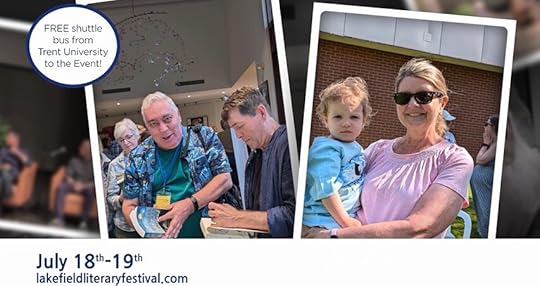
I made it into the promos for the 2025 Lakefield Literary Festival when I was photographed bringing a bunch of books for Michael Crummey to sign at the 2024 Festival. 😊
Bonus Trivia and Links
In answer to the question why she did not use Frederick Banting's real name as the discoverer of insulin in the book, Jane Urquhart answered that using such a prominent figure would have dominated the book and removed the focus from her main character Emer.
In answer to a question which of her own books is her favourite, Jane Urquhart said that her first novel The Whirlpool (1986) still holds a special place for her as it seemed such a miracle that it was accepted by McClelland and Stewart (after having lost a Seal Books competition for 1st novel) and shepherded through by editor Ellen Seligman (1944-2016) (who had been on the Seal Books Jury) who was her editor for every book afterwards except for this latest one.
There was actually a historical precedent for the main antagonist in the book and that was James Thomas Milton Anderson who wrote The Education of the New Canadian: A Treatise on Canada's Greatest Educational Problem (1918) [the book is about how to destroy other cultures and ethnic heritages] and was the Minister of Education for Saskatchewan and was suspected of association with the Ku Klux Klan.
Speaking about how Canadian literature evolved, Urquhart used a quote from Margaret Atwood: “There had been nothing there until there was something” which is an excerpt from The Blind Assassin (the original quote is not about literature): “There had been nothing there until there was something—something small and frightened, and it belonged to me.”
It was mentioned in passing that there was no such thing as a Canadian citizen until 1947 when the Canadian Citizenship Act was passed.
Urquhart talked about her early reading and love of the works of L.M. Montgomery and how when she was approached to write a non-fiction book for the Extraordinary Canadians series, she answered that Montgomery was the only person she could write about. Extraordinary Canadians: L.M. Montgomery (2009) was the result.
Talking about Robert Louis Stevenson and A Child's Garden of Verses, Urquhart mentioned that an early teacher of hers was Elizabeth Waterston who wrote and edited her final book at the age of 102 although she did not live to see it published: Open the Gate: Transactions in A Child's Garden of Verses [not listed on Goodreads].
A Prairie Life 🍁
A review of the McClelland & Stewart hardcover (October 27, 2024).
In winter I get up at night
And dress by yellow candle-light.
In summer, quite the other way,
I have to go to bed by day. - "Bed in Summer" from A Child's Garden of Verses (1885) by Robert Louis Stevenson (1850-1894).
In Winter... is presented as if it were a memoir by middle-aged itinerant art & music teacher Emer McConnell looking back on her life from the early 1950's. The heart of it is the time she spent in a children's hospital ward in the 1920s after suffering many bodily fractures through injuries suffered when a tornado devastated her family farm in Saskatchewan.
We know that Emer survives to tell the tale, but we are kept in suspense for the longest time as to whether endearing characters such as the diabetic young travelling theatre boy-singer Friedrich, the burned daughter of a stringent Douhkhobor sect family Tatiana, and others will do so. Along the way we meet the caring nurses and doctors of their children's ward. Various visitors to the ward include members of the theatrical troupe and also the railroad porter Abel (Don't call me George) who assisted in bringing Emer to the hospital.
Emer's later life also involves a liaison with a famous medical man, a fictionalized version of someone who made perhaps the greatest Canadian medical discovery ever (no spoiler, but I think many can guess the inspiration here). This is paralleled with her own mother's liaison with a much darker character, who starts off as the Grand Cyclops of the Saskatchewan branch of the Klu Klux Klan, but who later in life turns to Provincial politics. I don't think this is based on a real person, but the Klan in Saskatchewan, Canada was real.
All of this is tied together in a masterful way by Urquhart, making for a compelling read which touches on much of Canadian immigrant history, its darker paths but also the miracles of children's hospital care and of medical discoveries. The twists and revelations keep coming until the very last pages.
Trivia and Links
Jane Urquhart will be attending the 2025 Lakefield Literary Festival to discuss In Winter I Get Up at Night. Further information here.
Bonus Link
I made it into the promos for the 2025 Lakefield Literary Festival when I was photographed bringing a bunch of books for Michael Crummey to sign at the 2024 Festival. 😊
Bonus Trivia and Links
In answer to the question why she did not use Frederick Banting's real name as the discoverer of insulin in the book, Jane Urquhart answered that using such a prominent figure would have dominated the book and removed the focus from her main character Emer.
In answer to a question which of her own books is her favourite, Jane Urquhart said that her first novel The Whirlpool (1986) still holds a special place for her as it seemed such a miracle that it was accepted by McClelland and Stewart (after having lost a Seal Books competition for 1st novel) and shepherded through by editor Ellen Seligman (1944-2016) (who had been on the Seal Books Jury) who was her editor for every book afterwards except for this latest one.
There was actually a historical precedent for the main antagonist in the book and that was James Thomas Milton Anderson who wrote The Education of the New Canadian: A Treatise on Canada's Greatest Educational Problem (1918) [the book is about how to destroy other cultures and ethnic heritages] and was the Minister of Education for Saskatchewan and was suspected of association with the Ku Klux Klan.
Speaking about how Canadian literature evolved, Urquhart used a quote from Margaret Atwood: “There had been nothing there until there was something” which is an excerpt from The Blind Assassin (the original quote is not about literature): “There had been nothing there until there was something—something small and frightened, and it belonged to me.”
It was mentioned in passing that there was no such thing as a Canadian citizen until 1947 when the Canadian Citizenship Act was passed.
Urquhart talked about her early reading and love of the works of L.M. Montgomery and how when she was approached to write a non-fiction book for the Extraordinary Canadians series, she answered that Montgomery was the only person she could write about. Extraordinary Canadians: L.M. Montgomery (2009) was the result.
Talking about Robert Louis Stevenson and A Child's Garden of Verses, Urquhart mentioned that an early teacher of hers was Elizabeth Waterston who wrote and edited her final book at the age of 102 although she did not live to see it published: Open the Gate: Transactions in A Child's Garden of Verses [not listed on Goodreads].

March 16, 2025
Beautifully written in a language and rhythm from another time and place, from dreams. Earth, wind, rain, snow, hush. A sudden cyclone so fierce that some lives are carried off and taken, others forever altered. Several children were severely injured, one of them, years on, now telling her story; this is Emer McConnell, a teacher who rises early, into the chill blue air of not quite dawn, and remembers.
I read this stunning novel knowing nothing of the 1912 Regina Cyclone, which devastated Saskatchewan at the end of that June. This event is at the core of Emer's life. She has become a mid aged teacher of music and English; once a secret lover of a famous Canadian, once, long before, a frightened child in a pediatric hospital ward; and before that, the daughter of a troubled family who moved by railway to the great Northern Great Plains of Canada around the turn of the century. Emer recalls looking out of the window during that journey -
The train that took our family Westward in the "better" car was propelled by the most extreme velocity that I had ever experienced, with farm houses and herds and flocks hurdling by in an alarming manner, followed by the smudge of a vanishing great barn. It was as if everything we had ever known was being blown away from us by a noisy industrial wind.
The family is entering into a life ruled by skies. Emer's memories of early childhood are vivid, frequently difficult. We get to know her devoted father and equally distracted mother, a woman essentially uninterested in her children. These memories appear like shards of a broken mirror, now splayed out on the ground; one could say Emer's story is told as if trying to catch her reflection in those pieces of glass, once whole, now in many pieces but still gleaming. We travel with her back and forth between adulthood, childhood, the Time Before, and What Came After, after the storm.
The telling of what she lived through as a severely injured 11 year old, separated entirely from her family, looked after by nuns, sharing a hospital ward with other children in critical condition, contains some of the most beautiful story telling I can remember. Emer's floating in and out of consciousness or understanding, slowly learning what has happened and whom it is she shares the room with: children also unable to leave their beds, medicated out of pain and into sleep, all the days and nights rolling into and past one another. The connections built amongst them; the kindness of some attending doctors and the cruelty of others; the strange cast of visitors who troop in and out of the ward, often so theatrical that they might as well be spun out of the same hallucinations that whirl around Emer's bed. One thing this novel does extraordinarily well is to capture a child's logic, how one imagined understanding leads to another. The child's frame of reference is limited by their years, but they are always reaching for understanding. And language - Emer confusing the doctors discussing "a box of vials" with a lot of "vile people" until she figures out what medical vials are.
I will confess that on later reflection, the group of invalid children felt slightly forced, made up of a brilliant young musician with the peacock vanity of Amadeus, an anxious boy from a leftist Jewish family farm, a beautiful granddaughter of slaves - and a silent burn victim who had been part of the Canadian Doukhobor community. Still, they rang completely true, their backgrounds submerged beneath their struggle to heal.
That time out of time continues to mold Emer's current existence. So much silence. When her memories aren't coursing through her -
I am left alone, and willing to bargain for the comfort of strangers, for a life that matters, for human companionship, wishing there were another breath in the house.
How much of her solitude was choice became the one returning thread that I struggled with. For years, she was the passionately, devoted lover of a scientist named Harp (a renamed character also taken from Canadian history). Her attachment is so all encompassing that it's unmoved by his refusal to acknowledge her in any real way beyond the bedroom. Despite no longer being married, he insists - for years! - on entering her house by the back door. At times I grew weary of Harp being referred to as "the man I love". For that matter, I became weary of his overly romantic first name, which I began to think of as appropriate in a backward sort of way, because he was playing her.
I looked for clues. Emer's memories of her mother tell us something about what might have been instilled in childhood about the nature of attachment; be wary, nothing is as it seems. Couple that with all the loss endured, the physical self consciousness she's left with. It's not until quite far in that I finally sensed her need to keep Harp as a special occasion, fully enveloping, secreted component of her life. An occasional glimmer of the man was less likely to show off any imperfection that daily morning light might have revealed.
Hardly anyone I loved has remained alive.
Emer in the present day still has some family, one true, solid connection. She has her teaching position, the happiness of bringing music into a classroom of children. Yet it's the person she became as a child herself, reaching to break the silence of her hospital bed, that streams through her. An extraordinary passage from her convalescence during which she begins to recall looking at her mother's family Bible and reading the names of children who had died. A change overcomes her -
Dead children. In the family bible. Living in me. Playing in me.
This entry of mine is far too long, even after deleting multiple paragraphs. I'm realizing now it's because I want to remain inside the pages of In Winter I Get Up at Night - or perhaps because I haven't entirely left them yet. I'll be doing something and think - oh! I need to look in on the hospital ward! Ridiculous, I know, but this invincible dream of a novel is that tangible.
(Now I must remember to seek out Jane Urquhart's poetry.)
I read this stunning novel knowing nothing of the 1912 Regina Cyclone, which devastated Saskatchewan at the end of that June. This event is at the core of Emer's life. She has become a mid aged teacher of music and English; once a secret lover of a famous Canadian, once, long before, a frightened child in a pediatric hospital ward; and before that, the daughter of a troubled family who moved by railway to the great Northern Great Plains of Canada around the turn of the century. Emer recalls looking out of the window during that journey -
The train that took our family Westward in the "better" car was propelled by the most extreme velocity that I had ever experienced, with farm houses and herds and flocks hurdling by in an alarming manner, followed by the smudge of a vanishing great barn. It was as if everything we had ever known was being blown away from us by a noisy industrial wind.
The family is entering into a life ruled by skies. Emer's memories of early childhood are vivid, frequently difficult. We get to know her devoted father and equally distracted mother, a woman essentially uninterested in her children. These memories appear like shards of a broken mirror, now splayed out on the ground; one could say Emer's story is told as if trying to catch her reflection in those pieces of glass, once whole, now in many pieces but still gleaming. We travel with her back and forth between adulthood, childhood, the Time Before, and What Came After, after the storm.
The telling of what she lived through as a severely injured 11 year old, separated entirely from her family, looked after by nuns, sharing a hospital ward with other children in critical condition, contains some of the most beautiful story telling I can remember. Emer's floating in and out of consciousness or understanding, slowly learning what has happened and whom it is she shares the room with: children also unable to leave their beds, medicated out of pain and into sleep, all the days and nights rolling into and past one another. The connections built amongst them; the kindness of some attending doctors and the cruelty of others; the strange cast of visitors who troop in and out of the ward, often so theatrical that they might as well be spun out of the same hallucinations that whirl around Emer's bed. One thing this novel does extraordinarily well is to capture a child's logic, how one imagined understanding leads to another. The child's frame of reference is limited by their years, but they are always reaching for understanding. And language - Emer confusing the doctors discussing "a box of vials" with a lot of "vile people" until she figures out what medical vials are.
I will confess that on later reflection, the group of invalid children felt slightly forced, made up of a brilliant young musician with the peacock vanity of Amadeus, an anxious boy from a leftist Jewish family farm, a beautiful granddaughter of slaves - and a silent burn victim who had been part of the Canadian Doukhobor community. Still, they rang completely true, their backgrounds submerged beneath their struggle to heal.
That time out of time continues to mold Emer's current existence. So much silence. When her memories aren't coursing through her -
I am left alone, and willing to bargain for the comfort of strangers, for a life that matters, for human companionship, wishing there were another breath in the house.
How much of her solitude was choice became the one returning thread that I struggled with. For years, she was the passionately, devoted lover of a scientist named Harp (a renamed character also taken from Canadian history). Her attachment is so all encompassing that it's unmoved by his refusal to acknowledge her in any real way beyond the bedroom. Despite no longer being married, he insists - for years! - on entering her house by the back door. At times I grew weary of Harp being referred to as "the man I love". For that matter, I became weary of his overly romantic first name, which I began to think of as appropriate in a backward sort of way, because he was playing her.
I looked for clues. Emer's memories of her mother tell us something about what might have been instilled in childhood about the nature of attachment; be wary, nothing is as it seems. Couple that with all the loss endured, the physical self consciousness she's left with. It's not until quite far in that I finally sensed her need to keep Harp as a special occasion, fully enveloping, secreted component of her life. An occasional glimmer of the man was less likely to show off any imperfection that daily morning light might have revealed.
Hardly anyone I loved has remained alive.
Emer in the present day still has some family, one true, solid connection. She has her teaching position, the happiness of bringing music into a classroom of children. Yet it's the person she became as a child herself, reaching to break the silence of her hospital bed, that streams through her. An extraordinary passage from her convalescence during which she begins to recall looking at her mother's family Bible and reading the names of children who had died. A change overcomes her -
Dead children. In the family bible. Living in me. Playing in me.
This entry of mine is far too long, even after deleting multiple paragraphs. I'm realizing now it's because I want to remain inside the pages of In Winter I Get Up at Night - or perhaps because I haven't entirely left them yet. I'll be doing something and think - oh! I need to look in on the hospital ward! Ridiculous, I know, but this invincible dream of a novel is that tangible.
(Now I must remember to seek out Jane Urquhart's poetry.)

September 29, 2024
I am so glad that I did not miss this beautiful, moving novel by Jane Urquhart, whose work I had not previously read. The setting is Saskatchewan (the Northern Great Plains), beginning in the 1920’s. The narrator is Emer, now an older woman, who recounts her life, through lovely, thoughtful language. Emer is seriously injured as a child, and one part of the story line revolves around life in a child’s ward in a hospital. The reader comes to know well the other children, the doctors and the nursing nuns. However, it is through the experiences of a sick child, some of which are grounded in a child’s imagination, that the power of the story and the writing are fully expressed. The other significant part of the story relates to Emer’s relationship with Harp, who is more frequently referred to as “the man I loved”. Although never married, the relationship between the two endured for many years, and Emer’s thoughts on love in its many facets (and in light of their seeing each other only sporadically) were extremely well written. The novel covers big subjects – childhood illness (and the lifelong effects thereof), romantic love and family issues – but it is a “quiet” novel. If you want a lot of action, this is not for you; but if you want lovely writing and a character whose reminiscing will stay with you, I think you would enjoy this one.

July 15, 2025
“In Winter I Get Up At Night“, by Jane Urquhart
3 stars ⭐️⭐️⭐️
This was my first book by this author. I do own copies of “The Stone Carver” and “The Underpainter”, which I purchased a long time ago but remains unopened to date. One of these days I will give them a try.
I must praise the beautiful writing, but I had high expectations for this book. I wanted to love it, but I didn’t. I did not connect with the character and I didn’t find the story that engaging. Therefore I must conclude that this book was not for me.
Although it is a small book, the story was so slow that it felt too long.
This work had everything to become an epic experience, as the concept is excellent, but too many social issues, although touched, were left out for the reader to ponder and find out what really happened during the colonization of the Canadian prairies.
There are mentions of racism and xenophobia, and there are no indigenous or Chinese characters present in this book. There are two Black characters, one being a Porter.
The story is told by one single POV, but different timelines.
There were some good moments and scenes, but the plot lacks some clarity. I did find it a bit convoluted and there was nothing memorable.
I read the ebook while simultaneously listening to the audiobook.
The narration of the audiobook at normal speed was extremely boring. I could not enjoyed it unless played at 1.25x, at least. There are no calls for the chapters, so if you are not looking at the progress you would not know where in the book you were. It was also difficult to identify the timelines, as the narration seemed to have the same tone.
E-book (Kobo): 312 pages (default), 92k words
Audiobook narrated by Christine Horne: 10.2 hours (normal speed), unabridged
3 stars ⭐️⭐️⭐️
This was my first book by this author. I do own copies of “The Stone Carver” and “The Underpainter”, which I purchased a long time ago but remains unopened to date. One of these days I will give them a try.
I must praise the beautiful writing, but I had high expectations for this book. I wanted to love it, but I didn’t. I did not connect with the character and I didn’t find the story that engaging. Therefore I must conclude that this book was not for me.
Although it is a small book, the story was so slow that it felt too long.
This work had everything to become an epic experience, as the concept is excellent, but too many social issues, although touched, were left out for the reader to ponder and find out what really happened during the colonization of the Canadian prairies.
There are mentions of racism and xenophobia, and there are no indigenous or Chinese characters present in this book. There are two Black characters, one being a Porter.
The story is told by one single POV, but different timelines.
There were some good moments and scenes, but the plot lacks some clarity. I did find it a bit convoluted and there was nothing memorable.
I read the ebook while simultaneously listening to the audiobook.
The narration of the audiobook at normal speed was extremely boring. I could not enjoyed it unless played at 1.25x, at least. There are no calls for the chapters, so if you are not looking at the progress you would not know where in the book you were. It was also difficult to identify the timelines, as the narration seemed to have the same tone.
E-book (Kobo): 312 pages (default), 92k words
Audiobook narrated by Christine Horne: 10.2 hours (normal speed), unabridged

January 4, 2025
Set in Saskatchewan, this is a beautifully written historical fiction that explores colonialism, scientific advancements, and prejudices. Protagonist Emer McConnell is gravely injured in a freak tornado, resulting in a long hospitalization in a children’s center, run by three nursing sisters and two doctors. She gets to know her fellow child patients and is visited by the train porter who helped rescue her. The storyline shifts forward and backward in time. In her adult life, she is in a one-sided relationship with a renowned scientist. She professes to love him, but he is emotionally distant, and it is a sad, doomed relationship. It seems she does not feel that she deserves to be fully loved. We learn about her family, and some of the hate groups that were active in the region at the time. Emer was too young to understand what was going on, but the reader will get it. It is a quiet and melancholy book that presents life in early twentieth century Canada as seen through one woman’s viewpoint. I love the writing style and will be seeking out more books by Jane Urquhart.

February 25, 2025
This beautiful lyrical mosaic of events or eras in the life of a teacher who grew up in Ontario and Saskatchewan erupts like a sleeping, hidden monster on page 230.
That's all I will say. Enjoy the lyricism, a childhood perfectly enshrouded with a child's misunderstanding and an adulthood conveyed with an old person's triggered memories of other times; trust this phenomenal artist, Jane Urquhart, to know exactly what she is doing. Assume nothing about the stillness that pervades the first 200 pages.
What a work of art this is!
***
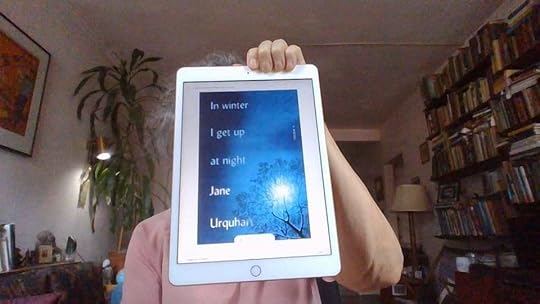
Thank you, Goodreaders, Canadian Jodi and American Mary Lins. Without your reviews, I probably never would have heard of this book. My massive New York Public Library system didn't even list it, so I bought an e-book from Bookshop.org, which is now selling e-books you can read using their app on your iPad or phone—same price as the amazonians' books, but the sale benefits local bookshops.
****
I have a lot more opinionated stuff to say about this book--stuff that doesn't belong in a review. You can read it here: Betsy's Blog
That's all I will say. Enjoy the lyricism, a childhood perfectly enshrouded with a child's misunderstanding and an adulthood conveyed with an old person's triggered memories of other times; trust this phenomenal artist, Jane Urquhart, to know exactly what she is doing. Assume nothing about the stillness that pervades the first 200 pages.
What a work of art this is!
***
Thank you, Goodreaders, Canadian Jodi and American Mary Lins. Without your reviews, I probably never would have heard of this book. My massive New York Public Library system didn't even list it, so I bought an e-book from Bookshop.org, which is now selling e-books you can read using their app on your iPad or phone—same price as the amazonians' books, but the sale benefits local bookshops.
****
I have a lot more opinionated stuff to say about this book--stuff that doesn't belong in a review. You can read it here: Betsy's Blog

May 7, 2025
In 1912 a young Canadian girl is picked up by a tornado known as the Regina Cyclone and launched several hundred feet where she breaks virtually every bone in her body. In “In Winter I Get Up at Night” Emer McConnell spends the next year miles away from home in a hospital ward with other sick children. Her injuries are so severe that she must undergo multiple operations. Hence, with all her medication and pain killers she spends most of her time floating between reality and confusion.
Emer tells her story years later when she is alone as a music and art teacher in a small school. Her hospital stay is the main story. But she tells two other stories about her life. One story takes place before the cyclone. Emer and her brother Danny, and twins live with their father and an increasingly distracted mother. Although Emer knows her mother loves them she confesses that she can’t even remember her mother ever kissing her. Emer and Danny attend a school run by a charismatic and brilliant teacher. Since Emer and Danny are the top students in the class the teacher often leaves them in charge while he has business elsewhere. So why does Emer sometimes see him leaving her house when she’s getting home from school?
The other story is about “the man I loved”, a phrase that got more tedious as the book went on. Harp was a famous Canadian who discovered a cure for some malady that netted him a small fortune and great notoriety. He meets Emer years after she’s released from the hospital. Her class would invite famous Canadians to visit their classroom on the off-chance one of them would accept. Harp does and a romance blossoms. Emer loves Harp but it seems Harp is only looking to escape the limelight with a traveling partner and plays Emer as on a stringed instrument.
Like her body after the Regina Cyclone Emer’s life is in pieces. Oddly, you could argue that the best phase of her life was when she was hospitalized. Her hospital mates were all children with illnesses and other problems arguably worse than hers. She was looked after by a group of nuns who love her and all the children and have dedicated their lives to looking after such broken children. And every two weeks she is visited by the train porter who carried her on a front door into the hospital when her family flagged down a train near the accident. Porter Abel is my favorite character in the book who makes you feel good about humanity when so many other characters fall short.
But Emer is the best character. Her body was broken by the Regina Cyclone and her heart by love and domestic affairs. Which one does the most damage to the spirit? “In Winter I Get Up at Night” was a surprisingly Good Read. I wouldn’t be surprised if I got up some night to read it again.
Emer tells her story years later when she is alone as a music and art teacher in a small school. Her hospital stay is the main story. But she tells two other stories about her life. One story takes place before the cyclone. Emer and her brother Danny, and twins live with their father and an increasingly distracted mother. Although Emer knows her mother loves them she confesses that she can’t even remember her mother ever kissing her. Emer and Danny attend a school run by a charismatic and brilliant teacher. Since Emer and Danny are the top students in the class the teacher often leaves them in charge while he has business elsewhere. So why does Emer sometimes see him leaving her house when she’s getting home from school?
The other story is about “the man I loved”, a phrase that got more tedious as the book went on. Harp was a famous Canadian who discovered a cure for some malady that netted him a small fortune and great notoriety. He meets Emer years after she’s released from the hospital. Her class would invite famous Canadians to visit their classroom on the off-chance one of them would accept. Harp does and a romance blossoms. Emer loves Harp but it seems Harp is only looking to escape the limelight with a traveling partner and plays Emer as on a stringed instrument.
Like her body after the Regina Cyclone Emer’s life is in pieces. Oddly, you could argue that the best phase of her life was when she was hospitalized. Her hospital mates were all children with illnesses and other problems arguably worse than hers. She was looked after by a group of nuns who love her and all the children and have dedicated their lives to looking after such broken children. And every two weeks she is visited by the train porter who carried her on a front door into the hospital when her family flagged down a train near the accident. Porter Abel is my favorite character in the book who makes you feel good about humanity when so many other characters fall short.
But Emer is the best character. Her body was broken by the Regina Cyclone and her heart by love and domestic affairs. Which one does the most damage to the spirit? “In Winter I Get Up at Night” was a surprisingly Good Read. I wouldn’t be surprised if I got up some night to read it again.

April 30, 2025
This is my first Urquhart and I´m enchanted. Reading her is like being enveloped in a warm quilt (prickly at times too). Lyrical prose, interwoven stories,a dreamlike narration. On to read more by her.

April 6, 2025
In Winter I Get Up at Night is a beautifully written novel, with lovely, flowing, poetic prose, stunning imagery, and much less substance than one might have first assumed. It follows Emer, an Irish-Canadian, from her childhood to her adulthood, flitting back and forth between various times in her ages: the present time, where she is a middle-aged English teacher in the 50s, her 20's-30s, set more than a decade before the present time, the time she spent in the children's hospital after she had been taken up by a tornado at the age of 9 (or 11? One of the two, though I can't remember which now), and the time before the tornado that changed her life.
It was certainly a choice that Urquhart decided to speak at length about the colonization of Canada and the Indigenous people who were removed from the lands, and then didn't include a single Indigenous character in her story.
It was certainly another choice that she made a point to discuss how British people were just as foreign to Canada and Saskatchewan as any of the "foreigners" that were discriminated against when they came to settle in Saskatchewan, and then chose to only show Europeans being discriminated against (especially when the first half of this novel goes on and on and on about Canada's railway, especially Saskatchewan's railway, and makes not a single mention of the Chinese people who died building it).
This novel, which talks quite a lot about the racism on the prairies, has racism and discrimination as a central theme, and then includes exactly two characters of colour, both of them black, and one of them a train porter (!!!). And look, maybe it's just me, but the fact that both the POC characters are black in this story set in Saskatchewan (a province that has historically had a very small black population, but has historically had large Chinese and Indigenous populations) really just kind of hammered home to me that the author has lived in Ontario her whole life.
Was also baffled by the fact that the author made it a point to give the "present" timeline a solid date (by referencing Queen Elizabeth's recent coronation, which happened in 1956), and then said that her lover, a historical figure who died in 1941, died "less than a decade" previous.
And also, this isn't necessarily Urquhart's fault, but I am so, so tired of High Literature Fiction that has a female protagonist revolving around the protagonists illicit and secret love affair with a married (or recently married) man. This isn't a fault of this novel in particular. It's just something I'm extremely tired of reading about.
Anyway, this novel is very Canadian lit, and it is especially very Saskatchewan lit. Like I said, the prose is absolutely beautiful, and I very much enjoyed the poetic language throughout it. I just wish that the poetic language didn't mask the fact that this novel gave lip service to a number of issues and never actually addressed any of them.
It was certainly a choice that Urquhart decided to speak at length about the colonization of Canada and the Indigenous people who were removed from the lands, and then didn't include a single Indigenous character in her story.
It was certainly another choice that she made a point to discuss how British people were just as foreign to Canada and Saskatchewan as any of the "foreigners" that were discriminated against when they came to settle in Saskatchewan, and then chose to only show Europeans being discriminated against (especially when the first half of this novel goes on and on and on about Canada's railway, especially Saskatchewan's railway, and makes not a single mention of the Chinese people who died building it).
This novel, which talks quite a lot about the racism on the prairies, has racism and discrimination as a central theme, and then includes exactly two characters of colour, both of them black, and one of them a train porter (!!!). And look, maybe it's just me, but the fact that both the POC characters are black in this story set in Saskatchewan (a province that has historically had a very small black population, but has historically had large Chinese and Indigenous populations) really just kind of hammered home to me that the author has lived in Ontario her whole life.
Was also baffled by the fact that the author made it a point to give the "present" timeline a solid date (by referencing Queen Elizabeth's recent coronation, which happened in 1956), and then said that her lover, a historical figure who died in 1941, died "less than a decade" previous.
And also, this isn't necessarily Urquhart's fault, but I am so, so tired of High Literature Fiction that has a female protagonist revolving around the protagonists illicit and secret love affair with a married (or recently married) man. This isn't a fault of this novel in particular. It's just something I'm extremely tired of reading about.
Anyway, this novel is very Canadian lit, and it is especially very Saskatchewan lit. Like I said, the prose is absolutely beautiful, and I very much enjoyed the poetic language throughout it. I just wish that the poetic language didn't mask the fact that this novel gave lip service to a number of issues and never actually addressed any of them.

October 7, 2024
I have loved the Jane Urquhart novels I’ve read to date, so I was primed to enjoy her latest, “In Winter I Get Up at Night”. I was immediately captivated by this poignant portrayal of Emer, and her unforgettable life story.
The title comes from a well-loved poem written for children by Robert Louis Stevenson. It’s fitting because our narrator Emer, is an itinerant teacher of art and music to young children.
Set in the 1950s, we follow Emer one snowy morning, as she makes her rounds to the small rural schools where she teaches. Emer has been lame since childhood after being injured in a horrific windstorm on the northern Great Plains of Saskatchewan. As she makes her halting way, she reminisces about her life; growing up, her siblings (especially her older brother Danny), and of course the injury the shaped her life. Through these memories we get also glimpses into her one love story with a man named Harp. Bits and pieces of their relationship tease the reader with curiosity until all is revealed.
Urquhart’s prose is absolutely beautiful, her characters are fully fleshed out and fascinating, and the plot is stunning. Her fans will not be disappointed.
The title comes from a well-loved poem written for children by Robert Louis Stevenson. It’s fitting because our narrator Emer, is an itinerant teacher of art and music to young children.
Set in the 1950s, we follow Emer one snowy morning, as she makes her rounds to the small rural schools where she teaches. Emer has been lame since childhood after being injured in a horrific windstorm on the northern Great Plains of Saskatchewan. As she makes her halting way, she reminisces about her life; growing up, her siblings (especially her older brother Danny), and of course the injury the shaped her life. Through these memories we get also glimpses into her one love story with a man named Harp. Bits and pieces of their relationship tease the reader with curiosity until all is revealed.
Urquhart’s prose is absolutely beautiful, her characters are fully fleshed out and fascinating, and the plot is stunning. Her fans will not be disappointed.
September 10, 2024
I really enjoyed this book. At first I thought it was one of those books with delightful prose that wandered a bit, but then it all began to make sense halfway through. Heartwarming.

October 6, 2024
2.5 ⭐️
I was so bored reading this. I did not connect with the writing, or the characters. Painful.
I was so bored reading this. I did not connect with the writing, or the characters. Painful.

June 2, 2025
In its early pages, this novel is deceptively sunny; it’s easy to be lulled by Jane Urquhart’s lyrical prose. The aged Emer seems to be at peace with her lot in life as a somewhat disabled itinerant music teacher. And recalling her childhood experiences, despite the physical suffering endured in a children’s ward, this is a place of kindness, love, shared small victories; deep bonds are formed among the children and with their caregivers. Eleven-year-old Emer is visited by her personal guardian angel in the form of Mister Porter Abel; although he cannot remove Emer’s physical pain, he assuages her emotional trauma and isolation from everything she had known.
But the true nature of this story gradually emerges: a tale of seduction, betrayal, and racism in its ugliest forms. It’s also the story of two women who, despite knowing that the men they love are unworthy and will ultimately fail them, are unable to break free.
Urquhart’s The Stone Carvers created for me what are probably unrealistic expectations each time I open another of her novels. Here, she has selected a smaller canvas, and this is very much an internal story of the life experiences of her protagonist; and yet, as always, Urquhart anchors her characters and their stories securely within a historical context. Here we experience homesteading in the northern Great Prairies; the impact of the discovery of a treatment for diabetes; the tragic story of the Doukhobors in Saskatchewan; the Canadian governmental obsession, early in the 20th century, with constructing institutions into which to confine sectors of the population seen as being problematic.
Urquhart’s portrayal of the inner life of a child, her sense of wonder, even her growing disillusionment with the character and behavior of adults, is truly masterful—especially as Emer’s personality is set in stark contrast against the shallowness and emotional abusiveness of two men. She observes that ”Love is uninterested in a crack in the character of the beloved. And even at its most conventional, it is the enemy of rational decisions.”
Emer’s constant referral to Harp as ”the man I loved” reveals a great deal about her story.
But the true nature of this story gradually emerges: a tale of seduction, betrayal, and racism in its ugliest forms. It’s also the story of two women who, despite knowing that the men they love are unworthy and will ultimately fail them, are unable to break free.
Urquhart’s The Stone Carvers created for me what are probably unrealistic expectations each time I open another of her novels. Here, she has selected a smaller canvas, and this is very much an internal story of the life experiences of her protagonist; and yet, as always, Urquhart anchors her characters and their stories securely within a historical context. Here we experience homesteading in the northern Great Prairies; the impact of the discovery of a treatment for diabetes; the tragic story of the Doukhobors in Saskatchewan; the Canadian governmental obsession, early in the 20th century, with constructing institutions into which to confine sectors of the population seen as being problematic.
Urquhart’s portrayal of the inner life of a child, her sense of wonder, even her growing disillusionment with the character and behavior of adults, is truly masterful—especially as Emer’s personality is set in stark contrast against the shallowness and emotional abusiveness of two men. She observes that ”Love is uninterested in a crack in the character of the beloved. And even at its most conventional, it is the enemy of rational decisions.”
Emer’s constant referral to Harp as ”the man I loved” reveals a great deal about her story.

July 1, 2025
I believe that Urquhart and I are simply not compatible.

December 24, 2024
This is for you if you like: modern medical history; Canadian lit; stories by Alice Munro and Jocelyne Saucier; forgotten minorities; stories involving natural carastrophes or generational trauma; train travel; Thomas Mann's Magic Mountain or Solzhenitsyn's Cancer Ward; coming of age novels; the uncanny; soul searching; hope.
One of the best novels I've read in a long time, masterfully narrated by Christine Horne. Book 78 of 2024.
One of the best novels I've read in a long time, masterfully narrated by Christine Horne. Book 78 of 2024.

July 5, 2025
Read this because I love Jane Urquhart as an author, but can't say I loved it. Multiple storylines interwoven but a lot left out and left to the reader to figure out.
Main character is Emer, a young girl at age 11-12 in a hospital children's ward in the early 1920s, and also later as a schoolteacher on the Great Plains of Saskatchewan. The narrator voice kept switching between the two ages and at times I found this jarring.
I didn't like older Emer's boyfriend or rather "the man that she loved" - Harp - at all. I also didn't like how obsessed she was with him. But I can see where this sit into the storyline - how it paralleled Emer's mother, Laura, and her extra-marital liaison. And I can see how it framed how removed from power and agency women were then. But I really didn't like reading about these men.
The children's ward at the hospital was the centre of most of the action and that was interesting, with the two doctors and the three nuns running the place and upwards of 6 kids as patients. But with the children there was a lot of mystery about their illnesses/conditions with hints from time to time that kept the reader guessing for too long.
Diabetes was never mentioned. The cure for diabetes never mentioned. But the discovery of the cure and who discovered it and who was afflicted with it and the impact on the life of the discoverer was pretty much kept out of the story - and yet it was the story in part. Lots of guessing by the reader. Only mention of the discoverer dying at middle age but nothing more - I had to look that up online. Why so much mystery even beyond the end of the book?
Emer as a child was delightful. Her relationship with her brother, Danny, interesting. Danny's eventual relationship with Friedrich was interesting. Emer as a teacher was interesting and the title of the book and how it relates to her experience as a teacher as well as to a poem from which the line came, was wonderful. I love the choice of title of this book!
I think the exploration of PTSD in children was interesting, especially in Emer with her blue misted Conductor presence.
The Company antics in the hospital room and the presence of Porter Abel who is always so positive and affirming were uplifting within a story of much pain and suffering, physical and psychological for the children and heart-breaking for the women.
For me however, this novel just didn't come together enough in the reading of it to love it. It felt really long to me for a book at 293 pages. And too much unsaid for the ending.
Main character is Emer, a young girl at age 11-12 in a hospital children's ward in the early 1920s, and also later as a schoolteacher on the Great Plains of Saskatchewan. The narrator voice kept switching between the two ages and at times I found this jarring.
I didn't like older Emer's boyfriend or rather "the man that she loved" - Harp - at all. I also didn't like how obsessed she was with him. But I can see where this sit into the storyline - how it paralleled Emer's mother, Laura, and her extra-marital liaison. And I can see how it framed how removed from power and agency women were then. But I really didn't like reading about these men.
The children's ward at the hospital was the centre of most of the action and that was interesting, with the two doctors and the three nuns running the place and upwards of 6 kids as patients. But with the children there was a lot of mystery about their illnesses/conditions with hints from time to time that kept the reader guessing for too long.
Diabetes was never mentioned. The cure for diabetes never mentioned. But the discovery of the cure and who discovered it and who was afflicted with it and the impact on the life of the discoverer was pretty much kept out of the story - and yet it was the story in part. Lots of guessing by the reader. Only mention of the discoverer dying at middle age but nothing more - I had to look that up online. Why so much mystery even beyond the end of the book?
Emer as a child was delightful. Her relationship with her brother, Danny, interesting. Danny's eventual relationship with Friedrich was interesting. Emer as a teacher was interesting and the title of the book and how it relates to her experience as a teacher as well as to a poem from which the line came, was wonderful. I love the choice of title of this book!
I think the exploration of PTSD in children was interesting, especially in Emer with her blue misted Conductor presence.
The Company antics in the hospital room and the presence of Porter Abel who is always so positive and affirming were uplifting within a story of much pain and suffering, physical and psychological for the children and heart-breaking for the women.
For me however, this novel just didn't come together enough in the reading of it to love it. It felt really long to me for a book at 293 pages. And too much unsaid for the ending.
November 23, 2024
A wonderful, lovely book. Quiet but intense. I loved how it moved easily back and forth between her childhood and adulthood. Some of the characters are unforgettable and will stay with me a long time.
February 13, 2026
I managed to get 75% through and then called it quits - I just have never been so bored reading a book before. I’m sure from a literary perspective this was great but there are just too many books I want to read to spend any more time absolutely bored to death by this one.

January 10, 2026
I feel like I have to write two different reviews for this book because there is an absolutely wild twist that gets revealed on like page 220/290 of this book that totally changed my reading experience!!!!
This is for the most part a slow and meditative novel where Emer recounts her life living on the plains in Saskatchewan and gives major "terrifying Canadian landscape" vibes. It plays with memory and narrative, weaving in and out of different events in Emer's life without any real structure. There are two main plots: Emer's injury in a great storm that forces her to live in a hospital ward for a year and her relationship later in life with this jerk named Harp. My favourite parts were Emer's experiences in the hospital where she befriended the other children. Mister Porter Abel was my favourite character and like the only normal adult in the whole story. The relationship with Harp reminded me a lot of The Glass Essay by Anne Carson but this book was not nearly as good as Carson's poem (imo).
**Spoilers below***
Maybe I am just a dumb Ontarian who didn't know enough about Saskatchewan...but the most of the book I was slogging through because it was interesting and well-written but it didn't pull you in. Then BAM all of a sudden in the last quarter of the book it is revealed that her mother was part of the KKK????? One of the wildest reveals I've read!!!! I have no words!!!!!
This is for the most part a slow and meditative novel where Emer recounts her life living on the plains in Saskatchewan and gives major "terrifying Canadian landscape" vibes. It plays with memory and narrative, weaving in and out of different events in Emer's life without any real structure. There are two main plots: Emer's injury in a great storm that forces her to live in a hospital ward for a year and her relationship later in life with this jerk named Harp. My favourite parts were Emer's experiences in the hospital where she befriended the other children. Mister Porter Abel was my favourite character and like the only normal adult in the whole story. The relationship with Harp reminded me a lot of The Glass Essay by Anne Carson but this book was not nearly as good as Carson's poem (imo).
**Spoilers below***
Maybe I am just a dumb Ontarian who didn't know enough about Saskatchewan...but the most of the book I was slogging through because it was interesting and well-written but it didn't pull you in. Then BAM all of a sudden in the last quarter of the book it is revealed that her mother was part of the KKK????? One of the wildest reveals I've read!!!! I have no words!!!!!

try-again-sometime
January 22, 2026This is a lovely book that is not jelling with my mood (-iness). It would be a disservice to the book and to my mental health to try to continue.

December 10, 2024
3.5 stars really. Another lovely and perfectly enjoyable story. While I have many of Urquhart's books on my shelves, this is the first I've read. I liked the style of it, and I did enjoy the story. It's just that it wasn't a knock my socks off and I'm starting to get desperate for one of those to end my reading year with. :-)

January 17, 2025
Fabulous. Such a fascinating blend of history and deep
personal stories and emotions.
personal stories and emotions.
May 30, 2025
CBC "In the early morning dark, Emer McConnell rises for a day of teaching music in the schools of rural Saskatchewan. While she travels the snowy roads in the gathering light, she begins another journey, one of recollection and introspection, and one that, through the course of Jane Urquhart's brilliant new novel, will leave the reader forever changed.
Moving as effortlessly through time as the drift of memory itself, In Winter I Get Up at Night brings Emer and her singular story to life. At the age of 11, she is terribly injured in an enormous prairie storm—the "great wind" that shifts her trajectory forever. As she recovers, separated from her family in a children's ward, Emer gets to know her fellow patients, a memorable group including a child performer who stars in a travelling theatre company, the daughter of a Dukhobor community, and the son of a leftist Jewish farm collective. The children are tended to by three nursing sisters and two doctors, whom the ever-imaginative Emer comes to call Doctor Angel and Doctor Carpenter.
Emer's tale grows outwards from that ward, reaching through time and space in a dreamlike fashion, recounting the stories of her mother's entanglement with a powerful yet mysterious teacher; her brother's dawning spirituality, which eventually leads him to the priesthood; the remarkable lives of the nuns who care for her; and the passionate yet distant love affair of Emer and an enigmatic man she calls Harp—a brilliant scientist whose great discovery has forever altered millions of lives around the world.
In luminous prose, and with exhilarating nuance and depth, Jane Urquhart charts an unforgettable life, while also exploring some of the grandest themes of the twentieth century—colonial expansion, scientific progress, and the sinister forces that seek to divide societies along racial and cultural lines. In Winter I Get Up at Night is a major work of imagination and self-exploration from one of the greatest writers of our time. (From McClelland & Stewart)"
I’m going to hear Jane Urquhart speak in July so I really want to read her latest book. I was very disappointed. The prose was beautiful…..that is true, but the storyline was so convoluted and slow. It just didn’t speak to me at all. I know people are giving it some great reviews, but I’m an avid reader and this wasn’t a book that grabbed me.
Moving as effortlessly through time as the drift of memory itself, In Winter I Get Up at Night brings Emer and her singular story to life. At the age of 11, she is terribly injured in an enormous prairie storm—the "great wind" that shifts her trajectory forever. As she recovers, separated from her family in a children's ward, Emer gets to know her fellow patients, a memorable group including a child performer who stars in a travelling theatre company, the daughter of a Dukhobor community, and the son of a leftist Jewish farm collective. The children are tended to by three nursing sisters and two doctors, whom the ever-imaginative Emer comes to call Doctor Angel and Doctor Carpenter.
Emer's tale grows outwards from that ward, reaching through time and space in a dreamlike fashion, recounting the stories of her mother's entanglement with a powerful yet mysterious teacher; her brother's dawning spirituality, which eventually leads him to the priesthood; the remarkable lives of the nuns who care for her; and the passionate yet distant love affair of Emer and an enigmatic man she calls Harp—a brilliant scientist whose great discovery has forever altered millions of lives around the world.
In luminous prose, and with exhilarating nuance and depth, Jane Urquhart charts an unforgettable life, while also exploring some of the grandest themes of the twentieth century—colonial expansion, scientific progress, and the sinister forces that seek to divide societies along racial and cultural lines. In Winter I Get Up at Night is a major work of imagination and self-exploration from one of the greatest writers of our time. (From McClelland & Stewart)"
I’m going to hear Jane Urquhart speak in July so I really want to read her latest book. I was very disappointed. The prose was beautiful…..that is true, but the storyline was so convoluted and slow. It just didn’t speak to me at all. I know people are giving it some great reviews, but I’m an avid reader and this wasn’t a book that grabbed me.
This entire review has been hidden because of spoilers.
September 15, 2024
Richly intense. Though only 300 pages, it took me several days to read and ponder this exquisitely painful novel. Jane Urquhart has scored again.
Displaying 1 - 30 of 330 reviews