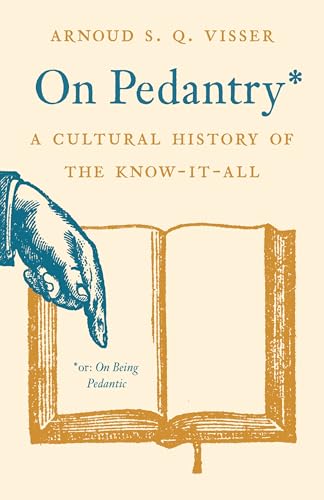
I knew I was going to read this the second I heard of it. And: I very much liked it, but I wanted to unreservedly love it. It traced the history of pedants all the way back to ancient Greece and Rome, then through the early and high middle ages with the fussy scholastics, through the renaissance and enlightenment and industrial revolution, and finally into the modern world. This was really impressive in its depth and covered in a unique to me manner (and, FWIW, I consume a fair amount of nerd stuff like this), since the author traced both the hard philosophy as well as fiction such as plays and movies, since the latter is where the pedants get mocked for being insufferable.
My complaint is that I wanted more: I think there was a section on the internet sitting right there waiting to be written at the end. In fairness to the author, this book was already quite dense, and such a chapter would have presumably been a quite different researching and writing experience than the historical approach he took. The book is titled On Pedantry, and his pedantic meta-joke secondary title is *Or, On Being Pedantic. I elected to not dock a star because I met his pedantry and read onto the subtitle, A Cultural History of the Know-It-All, and so I grudgingly acknowledge that he scoped himself to history. But, still! When I think of pedants, I think of people online – full disclosure, sometimes myself – getting annoyed at minor usage errors (they’re their there, your you’re, its it’s), being mortified by typos in their own writing, scolding people for being narrowly wrong in their area of special interest, throwing dictionary definitions around during arguments, etc. Writing a big ol’ citation-filled book on pedants and leaving out those (us?) persnickety folks feels like leaving a ton of meat on the bone. Hopefully someone picks up this baton and writes a sequel to fill this [citation needed] gap. I hope to read Pedantry 2: Electric Boogaloo someday!