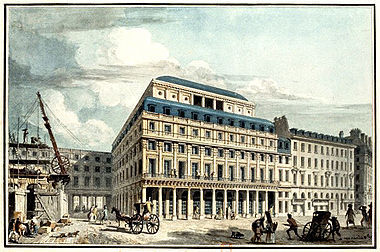
In 1662, many critics, and some bishops, attacked this play for: 1) Moliere's realism in certain scenes and even in certain words; 2) the character M played, Arnolphe who parodies the Ten Commandments (here, of marriage); and 3) the impiety of Arnolphe's sermon to his pupil, whom he's trying to raise as a chaste woman, not a runaround. Performed 31 times between Boxing Day 1662 and Mar 9,1663, when the playwright had been married a year, its success resulted in the Sun King Louis XIV granting Poquelin/ Moliere a pension of £1000 not as comédien, but as excellent poète (Maynial intro to Hachette Molière Théâtre, tome II, p.40). Maynial argues that this, Moliere's most "modern" play, where a debate has social implications.
In the first scene, Arnolphe's friend tries to talk him out of marriage, not to be made a "sot," a cuckold. But Arnolphe has a plan to avoid the social sophisticate and her gallants, or the chaste wife who spends all their money or the one buying expensive hats, or who expects them as gifts. Arnolphe plans to marry a simpleton, who only knows one poem, a riddle, "Même ne sache pas ce que c'est qu'une rime"(43). One who knows only what is necessary, "De savoir prier Dieu, m'aimer, coudre et filer," To pray to God, to love me, to spin and sew.
Moliere delights in every scene, descending from discussion of women and society to the proud Arnolphe's arrival home, where his untrained peasant-servants don't know how to serve. When he knocks, the married couple fight over who will go downstais to open the door; when their master threatens to starve whoever does not open it, they battle to prevent the other. Meanwhile the handsome young son of his friend has visited his house daily while he was away, and fallen for Arnolphe's protected, childlike student Agnes.
The male servant explains jealousy, wouldn't his wife be jealous if someone dipped a finger to taste her soup? Well, "La femme est en effet le potage de l'homme," almost a proverb. When a man sees another dip his finger, "tremper les doigts dans sa soupe," he flies into a rage. (57)
Moliere's genius at character then brings on stage the beloved simpleton Agnes, whom Arnolphe asks, "Did a young man visit while I was away?" Honestly, she recounts minutely how each greeted the other, bowed, she from her balcony sewing, he out front, and each time each bowed, she enumerates. Same thing with her Petrarchan instruction by the servant woman Georgette, how her eyes have "blessé", wounded someone to die in two days...but she can also cure him with her eyes. Agnes is astonished, wants to heal the wound she caused. (60) Again, her simplicity causes her a detailed recitation of exactly what she was told, and did. The simple person's inability to summarize and analyze thus prolongs the torture of her recounting details. (II.v.)
To Arnolphe's questioning what the young Horace did: give her a box with a jewel, give the servants money, and tickle her backside. The "teacher" wants to ask if the lad touched or took anything, she says, Well, he did, but you'll get mad if I tell you. Repeating both sides for two pages, Agnes finally relents and says, "Il m'a pris le ruban que vous m'avis donné," He took the ribbon you gave me. Naive, she thinks he'll be so mad about the ribbon, though he really fears her being "felt up" [350 years before our Harasser in Chief].
In Act III.ii, Arnolphe cites his ten commandments, Maxims of Marriage. He introduces with admonitions of male superiority--she should only think of "ma bonté" in raising her status. "The bearded are the bosses," women should submit as to a governor, or a soldier to his superior, or a valet to his master, a child to his father. The Ten Maxims forbid women all they love: to dress only as the husband allows, little to no make-up, no expensive hats (or expecting such from husband), no cards or gambling, no visitors but those invited by hubby, no women's groups. Most surprising to me, no writing desk, nor paper, pen and ink (70).
Arnolphe has changed his last name to Stump, De la Souche. When young Horace confides in Arnolphe, not knowing the older man has forbidden him, the delicious irony of the youth and Agnes's confidences, including a letter where Agnes says she wants to be with him, Arnolphe warns how love changes men, even to their complete opposite: a hoarder into a benefactor, "Un vaillant d'un poltron, un civil d'un brutal"(74).
In Act IV.ii the Notary arrives to do the marriage ordered for the evening, before Agnes's letter raises doubts. Arnolphe doesn't see the Notaire enter, but does comment on the letter. The Notary thinks he's criticizing him to "guarantee no surprises," or "this news won't be spread in society." Arnolphe, unaware the Notary's heard it all, asks, "Who said anything against you?" "Vous, qui me prétendez faire passer pour un sot"(80).
In the final Act we learn a preposterous fact, reminding us that marriage in the West 350 years ago was closer to ancient norms, family arrangements: Horace's father Oronte arrives in haste, an overnight coach, though he'd not even written his son a letter to inform his altered life: "C'est qu'il m'a marié sans m'en récrire rien"(99). Horace implores Arnolphe, best friends with Oronte, to intercede on his behalf. Of course, Arnolfe does exactly the opposite, reflecting the patriarchal norms, "Quoi? se laissera-t-il gouverner par son fils?"
The plot/"intrigue" concludes by the fruits of a secret marriage and a twist I shall not spoil, but Agnes turns out to be Angélique, the daughter of a military hero who's been abroad. The play ends, "Et rendre grâce au Ciel qui fait tout pour le mieux." I say, "Non! Non! Grâce au Moliére, qui fait la intrigue," made the plot (104).
See Moliere's sequel and defense, La Critique de L'Ecole des Femmes, which I am reading now, will post review in a day or two.
[Bought mine outdoors on the banks of the Seine in 1968]